I don’t typically do music videos. I’m not even an Ed Sheeran fan. But his new video for “Bloodstream” features some great acting by a 60-year-old Ray Liotta. The performance is absolutely heartwrenching. Check it out below.
College Safe Spaces: Therapeutic or Intellectually Stifling?
 The New York Times has a brand new article on “safe spaces” in college. Judith Shulevitz defines these spaces as “an expression of the conviction, increasingly prevalent among college students, that their schools should keep them from being “bombarded” by discomfiting or distressing viewpoints. Think of the safe space as the live-action version of the better-known trigger warning, a notice put on top of a syllabus or an assigned reading to alert students to the presence of potentially disturbing material…In most cases, safe spaces are innocuous gatherings of like-minded people who agree to refrain from ridicule, criticism or what they term microaggressions — subtle displays of racial or sexual bias — so that everyone can relax enough to explore the nuances of, say, a fluid gender identity.” While there is nothing inherently wrong with this, “the notion that ticklish conversations must be scrubbed clean of controversy has a way of leaking out and spreading. Once you designate some spaces as safe, you imply that the rest are unsafe. It follows that they should be made safer.” And this brings us to the heart of the matter:
…while keeping college-level discussions “safe” may feel good to the hypersensitive, it’s bad for them and for everyone else. People ought to go to college to sharpen their wits and broaden their field of vision. Shield them from unfamiliar ideas, and they’ll never learn the discipline of seeing the world as other people see it. They’ll be unprepared for the social and intellectual headwinds that will hit them as soon as they step off the campuses whose climates they have so carefully controlled. What will they do when they hear opinions they’ve learned to shrink from? If they want to change the world, how will they learn to persuade people to join them?
Is this “safe” mentality on college campuses a good idea? Should students, say, be banned from participation due to controversial views? Check out the article and give it some thought.
Who’s Better At Science?
No one. Stop it. No seriously, stop.
The story of this thought starts here. Dan Kahan over at the Cultural Cognition blog found in his studies that, counter to his expectations, “identifying with the Tea Party correlates positively (r = 0.05,p = 0.05) with scores on the science comprehension measure.” Aha, take that Democrats! Except Kahan very clearly states “the relationship is trivially small, and can’t possibly be contributing in any way to the ferocious conflicts over decision-relevant science that we are experiencing.” So what does the Tea Party do? Runs with it anyways like the Democrats have done before.
This is dumb and has to stop. Using statistics with zero understanding of both the particular study and statistics in general is going to show exactly one thing: your preexisting biases. But more importantly, this arguing back and forth about whose group is “better” at science or whose group “accepts” more science is often nothing more than an attempt to be “good” at science by osmosis. If my group is better at science, that must mean that I personally am better at science, right? Or if I accept more scientific conclusions, that must mean I am better at science? No, and no. For example:
…there is zero correlation between saying one “believes” in evolution & understanding the rudiments of modern evolutionary science.
Those who say they do “believe” are no more likely to be able to be able to give a high-school-exam passing account of natural selection, genetic variance, and random mutation — the basic elements of the modern synthesis — than than those who say they “don’t” believe.
In fact, neither is very likely to be able to, which means that those who “believe” in evolution are professing their assent to something they don’t understand.
That’s really nothing to be embarrassed about: if one wants to live a decent life — or just live, really –one has to accept much more as known by science than one can comprehend to any meaningful degree.
What is embarrassing, though, is for those who don’t understand something to claim that their “belief” in it demonstrates that they have a greater comprehension of science than someone who says he or she “doesn’t” believe it.
I agree with Kahan. Accepting at least some of the conclusions of science–and authorities in general–beyond our personal ability to verify is essentially prerequisite to functioning in this world. But let’s not pretend that means we understand science merely because we accept it. And let’s definitely not make science into another piece in the age old war of “who is the better, smarter, and more handsome group.” If you’re worried about the state of science, I can promise you that even a large number of yahoos believing silly things won’t destroy science, but politicizing science most certainly will.
Understanding the Cosmological Argument
I try to avoid Difficult Run posts that essentially regurgitate someone else’s blog post, but Edward Feser’s So you think you understand the cosmological argument? constitutes the best post I have read on both the cosmological argument itself and the general state of philosophy in the modern Western world. I’ll highlight my favorite parts (it’s decently long for a blog post) and comment.
1. The argument does NOT rest on the premise that “Everything has a cause.”
Lots of people – probably most people who have an opinion on the matter – think that the cosmological argument goes like this: Everything has a cause; so the universe has a cause; so God exists. They then have no trouble at all poking holes in it. If everything has a cause, then what caused God? Why assume in the first place that everything has to have a cause? Why assume the cause is God? Etc.
Here’s the funny thing, though. People who attack this argument never tell you where they got it from. They never quote anyone defending it. There’s a reason for that. The reason is that none of the best-known proponents of the cosmological argument in the history of philosophy and theology ever gave this stupid argument. Not Plato, not Aristotle, not al-Ghazali, not Maimonides, not Aquinas, not Duns Scotus, not Leibniz, not Samuel Clarke, not Reginald Garrigou-Lagrange, not Mortimer Adler, not William Lane Craig, not Richard Swinburne. And not anyone else either, as far as I know. (Your Pastor Bob doesn’t count. I mean no one among prominent philosophers.) And yet it is constantly presented, not only by popular writers but even by some professional philosophers, as if it were “the” “basic” version of the cosmological argument, and as if every other version were essentially just a variation on it.
…
What defenders of the cosmological argument do say is that what comes into existence has a cause, or that what is contingent has a cause. These claims are as different from “Everything has a cause” as “Whatever has color is extended” is different from “Everything is extended.” Defenders of the cosmological argument also providearguments for these claims about causation. You may disagree with the claims – though if you think they are falsified by modern physics, you are sorely mistaken – but you cannot justly accuse the defender of the cosmological argument either of saying something manifestly silly or of contradicting himself when he goes on to say that God is uncaused.
The counterargument ‘so what caused God?’ is probably the single most common and the single most silly answer to the cosmological argument. And yet it’s so prominent that just a few months ago I heard Michael Shermer use it as a rebuttal in a debate at Oregon State University on the existence of God. I like to joke that asking ‘so what caused God?’ is equivalent to saying ‘I was asleep while my opponent gave the premises of the cosmological argument.’ Edward Feser goes on:
What [the cosmological argument] seeks to show is that if there is to be an ultimate explanation of things, then there must be a cause of everything else which not only happens to exist, but which could not even in principle have failed to exist. And that is why it is said to be uncaused – not because it is an arbitrary exception to a general rule, not because it merely happens to be uncaused, but rather because it is not the sort of thing that can even in principle be said to have had a cause, precisely because it could not even in principle have failed to exist in the first place. And the argument doesn’t merely assume or stipulate that the first cause is like this; on the contrary, the whole point of the argument is to try to show that there must be something like this.
The above, to me, has always been the power of the cosmological argument. The argument is not one of probability or likelihood. Rather, the cosmological argument posits an uncaused cause that must exist, and that no other possibility is logically coherent with existence. Onward and forward…
3. “Why assume that the universe had a beginning?” is not a serious objection to the argument.The reason this is not a serious objection is that no version of the cosmological argument assumes this at all. Of course, the kalām cosmological argument does claim that the universe had a beginning, but it doesn’t merely assume it. Rather, the whole point of that version of the cosmological argument is to establish through detailed argument that the universe must have had a beginning. You can try to rebut those arguments, but to pretend that one can dismiss the argument merely by raising the possibility of an infinite series of universes (say) is to miss the whole point.
The main reason this is a bad objection, though, is that most versions of the cosmological argument do not even claim that the universe had a beginning. Aristotelian, Neo-Platonic, Thomistic, and Leibnizian cosmological arguments are all concerned to show that there must be an uncaused cause even if the universe has always existed. Of course, Aquinas did believe that the world had a beginning, but (as all Aquinas scholars know) that is not a claim that plays any role in his versions of the cosmological argument. When he argues there that there must be a First Cause, he doesn’t mean “first” in the order of events extending backwards into the past. What he means is that there must be a most fundamental cause of things which keeps them in existence at every moment, whether or not the series of moments extends backwards into the past without a beginning.
I’ll be honest. I didn’t even know the above. I thought the universe having a beginning played an important role in the cosmological argument. Turns out, the universe need not have a beginning for the most important forms of the cosmological argument to be just fine.
Later on Feser switches gears to challenging materialism in general. I appreciate the critiques down there as well, but they’re too long to re-quote here. I’d summarize them as the following:
1) Non-religious people are just as potentially motivated by desire for religion not to be true as religious people are motivated by desire for religion to be true. You’d think this point is obvious, since we’re all human beings with preconceptions and biases, but on a regular basis religious philosophers are suspected of bias while the same standard somehow doesn’t apply to non-religious philosophers.
2) Metaphysical naturalism cannot be taken for granted as the ‘correct’ or ‘neutral’ view of reality, yet many philosophers do so, particularly philosophers who do not specialize in the philosophy of religion.
3) Science in no way proves metaphysical naturalism or disproves supernaturalism. Rather, the very common starting assumption of metaphysical naturalism causes people to circle science back around as ‘proof’ of metaphysical naturalism. I’ve also written on this topic before.
So there you have it. If you have time, give the full post a read.
Wealth’s Impact on Child Outcomes: Evidence from Sweden
 Drawing on a large sample from Sweden, a new working paper suggests that wealth may not have much impact on child outcomes. From the abstract:
In adults, we find no evidence that wealth impacts mortality or health care utilization, with the possible exception of a small reduction in the consumption of mental health drugs…In our intergenerational analyses, we find that wealth increases children’s health care utilization in the years following the lottery and may also reduce obesity risk. The effects on most other child outcomes, which include drug consumption, scholastic performance, and skills, can usually be bounded to a tight interval around zero. Overall, our findings suggest that correlations observed in affluent, developed countries between (i) wealth and health or (ii) parental income and children’s outcomes do not reflect a causal effect of wealth.
These findings should give us pause. Perhaps we as citizens and policy makers should be looking at other factors that truly impact the long-term well-being of children.
Yglesias: American Democracy is Doomed

Matthew Yglesias says American democracy is doomed. I am tempted to follow the lead of the good folks at Jr. Ganymede and conclude the opposite but–also like those good folks–I think Yglesias has a point. It’s a long article and it’s worth your time, but here’s the TL;DR:
The idea that America’s constitutional system might be fundamentally flawed cuts deeply against the grain of our political culture. But the reality is that despite its durability, it has rarely functioned well by the standards of a modern democracy. The party system of the Gilded Age operated through systematic corruption. The less polarized era that followed was built on the systematic disenfranchisement of African-Americans. The newer system of more ideological politics has solved those problems and seems in many ways more attractive. But over the past 25 years, it’s set America on a course of paralysis and crisis — government shutdowns, impeachment, debt ceiling crises, and constitutional hardball. Voters, understandably, are increasingly dissatisfied with the results and confidence in American institutions has been generally low and falling. But rather than leading to change, the dissatisfaction has tended to yield wild electoral swings that exacerbate the sense of permanent crisis.
Yglesias goes on to say that, despite all these handicaps, the American political system has been incredibly lucky. And that it’s luck is potentially about to run out.
Me? I’ve got one thing to add. As quaint as it may seem, I think that we spend a little too much time focusing on the formal infrastructure of government: on the bureaucracies and the laws, the offices and the branches. The most important ingredients, I think, are the social ones. This is why I have so little interest in politics these days. It’s not just the cynicism. It’s the belief that politics is just the surface, and that the problems–and the solutions–lay in the depths below.
And now, as the preaching of the word had a great tendency to lead the people to do that which was just—yea, it had had more powerful effect upon the minds of the people than the sword, or anything else, which had happened unto them—therefore Alma thought it was expedient that they should try the virtue of the word of God. (Alma 31:5)
Progressivism, Rogue AI, and the Heat Death of Humanity
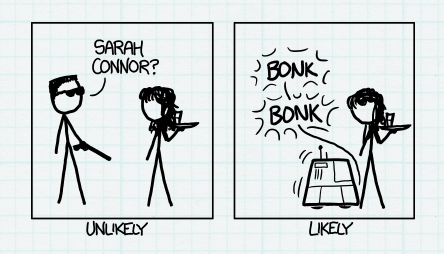
This is one of those blog posts that, once you’ve read it, makes you wonder how there was ever a possible universe in which you didn’t know the concepts that you just learned: The Heat Death of Humanity: Progressivism as the Second Law of Thermodynamics. The first major new concept has a humble name: paperclipper. According to the Less Wrong Wiki[ref]I have no idea[/ref], the paperclipper is “the canonical thought experiment showing how an artificial general intelligence, even one designed competently and without malice, could ultimately destroy humanity.” Imagine, as the original 2003 paper did, an AI given the task of maximizing the number of paperclips it has in its collection. Seems harmless enough at first glance. However:
If it has been constructed with a roughly human level of general intelligence, the AGI [artificial general intelligence] might collect paperclips, earn money to buy paperclips, or begin to manufacture paperclips. Most importantly, however, it would undergo an intelligence explosion: It would work to improve its own intelligence, where “intelligence” is understood in the sense of optimization power, the ability to maximize a reward/utility function—in this case, the number of paperclips. The AGI would improve its intelligence, not because it values more intelligence in its own right, but because more intelligence would help it achieve its goal of accumulating paperclips. Having increased its intelligence, it would produce more paperclips, and also use its enhanced abilities to further self-improve. Continuing this process, it would undergo an intelligence explosion and reach far-above-human levels. It would innovate better and better techniques to maximize the number of paperclips. At some point, it might convert most of the matter in the solar system into paperclips.
Or, in the words of Eliezer Yudkowsky, “The AI does not hate you, nor does it love you, but you are made out of atoms which it can use for something else.” In this case: paperclips.
Keep that example in mind for a moment, and think about recent critiques of the social justice movement: Chait’s, Ronson’s, or (what the heck), mine. The common thread is that there is no limiting principle to halt the downward spiral of ever increasing levels of outrage over ever smaller indignities. This doesn’t mean that the individual progressive causes are wrong. The problem is that–just as with the paperclipper–a benign (or even good!) goal has been mistaken for the only goal. Justice is the paperclip.
Well, obviously justice is a lot more intrinsically valuable than a paperclip (or any number of paperclips), but the fact remains that it isn’t the only goal. And justice at the expense of truth, or at the expense of mercy and forgiveness, or at the expense of any number of other possible virtues can become just as dangerous as the paperclipper.
There’s more to the story, however. The primary source of energy for the social justice movement is outrage, and the outrage is derived from examples of injustice. The more injustice the movement sees, the more energy it has available. To use a biological metaphor: here you have a bunch of leaf-eating herbivores and along comes an herbivore that can eat entire trees (bark, branches, and even trunks). The new organism is going to out-compete and eventually replace all others. But, in our case, the same feature that makes social justice ideology so perfectly adapted to our memetic ecosystem is also fueling a kind of second law of thermodynamics for social systems.
It seems that perhaps progressivism is the embodiment in human systems of the second law of thermodynamics, which can be roughly stated as “the tendency of natural processes to lead towards spatial homogeneity of matter and energy, and especially of temperature.”
The individual differences that social justice seeks to ameliorate may be, case-by-case, well worth the effort of amelioration. Or even eradication. But without a limiting principle, the risk is that all differences will be eradicated. And that’s bad because”
…If you even care about life existing – let alone the infinite diversity possible therein – then (contra Caplan), boundaries (such as national borders) are an absolute necessity. No differences, no energy flow, no (thermodynamic) work, no life. As in the stars, so on the earth: romance flows from polarity; trade from comparative advantage; thermodynamic work from heat differences;evolution from variation; economic competition from competing alternatives. All progress is driven by differences; so to erase differences is (counter-eponymously) to end progress.
A lot of this is argument-from-metaphor, of course, which is always perilous. But I certainly think there is some validity to this approach.
Hobbits, Kings, and Legitimate Government

I came across an interesting post not long ago on the topic of legitimate government using hobbits as the primary example. I found the post intriguing and especially these two ideas:
Where to the old Christian view, rights followed from duties in the same man, to our post-Christian view the arbitrary rights of one man translate to duties for unaccounted others. (My right to a free lunch translates to your duty to pay for it, &c.) In this sense, all modern political thinking is in its nature totalitarian.
The connection between rights and responsibility is a deep and important one, so I have to confess my first impression was simply, “I like it when people say things that I agree with,” but the kicker at the end about totalitarianism is, at least theoretically, genuinely interesting. When we move from a view of government as primarily guarantor of negative to provider of positive rights, it’s all downhill from there.[ref]Negative and positive rights. (Wikipedia)[/ref] Then came something a little different:
Similarly, a mediaeval king has the task of defending custom. It isn’t his “right” to change anything, but instead his duty to pass on the kingdom to his successor, unmolested. He is the symbol of unity, of social solidarity, of moral order, of motherhood and apple pie and everything that is “above politics.” When he exceeds his authority, he must be deposed. That is precisely why so much mediaeval political thinking was devoted to explicating the duty of rebellion. It can never be taken lightly, never be required except in the gravest circumstances. It is never a right; it can only be a duty. It is a duty not to overturn, but instead to restore a legitimate order, pleasing to God, that has itself been overturned.
What’s this, a red-blooded conservative American talking seriously about the duties and obligations of kings, as though monarchy wasn’t intrinsically and categorically inferior to democracy? Well, maybe democracy is a little overhyped at times, but there’s something more. As we’ve covered at DR fairly recently, meritocracies can be hereditary. In fact, the more egalitarian a meritocracy society becomes, the more it will tend to generate an entrenched aristocracy. The reason for this is that there are basically two components for human IQ (and other traits related to success in a meritocracy): genes and environment. A truly egalitarian society would give all kids the same (or at least very similar) environments. Thus, the remaining variation would be primarily genetic. Add in a little assortative mating (smart people marrying smart people) and presto: you’re perfect egalitarian meritocracy has an entrenched aristocracy.
This an oversimplification that makes a valid point: maybe some of the lessons of past political philosophies, institutions, and traditions might be more relevant to our modern society than we would like to admit. Instead of denying the undercurrent of hereditary privilege, we may want to acknowledge it and borrow from our past to find creative new approaches to mitigate its dark side.
2015 Faith & Knowledge Conference: “Labour…Is Their Religion”
I recently presented at the 2015 Faith & Knowledge Conference at the University of Virginia. As the website explains, “The Faith and Knowledge Conference was established in 2007 to bring together LDS graduate students in religious studies and related disciplines in order to explore the interactions between religious faith and scholarship. During the past four conferences, students have shared their experiences in the church and the academy and the new ideas that have emerged as a result. Papers and conversations provided thought-provoking historical, exegetical, and theoretical insights and compelling models of how to reconcile one’s discipleship with scholarly discipline.” The conference is typically for those in religious studies and “related disciplines (e.g., women’s studies, philosophy, anthropology, sociology, history, literature, etc.),” so I was grateful to be a part of it as the lone MBA student. My presentation was titled “‘Labour…Is Their Religion’: Toward a Mormon Theology of Work.” The abstract is below:
Despite the Platonic ideal, ordinary people do not spend the majority of their time in the act of deep contemplation. Instead, they are performing the seemingly menial tasks of daily life. This largely consists of one’s form of employment. Finding meaning in the lone and dreary world of day-to-day work has been a point of increasing interest among management experts and organizational theorists. Their findings yield fruitful insights, especially given that one of Mormonism’s earliest forms of consecration was a business organization known as the United Firm. The “inspired fictionalization” of the United Firm revelations is an early example of Joseph Smith’s cosmological monism, transforming a business entity into the ancient “order of Enoch.” This sacralization of the mundane was further elaborated by Brigham Young and recognized by non-Mormons as an oddity of the Utahns. The metaphysical overlap of the temporal and spiritual realms can influence the way modern Mormons conduct their business, inspire “Zion-building” within organizations, and pave the way for a Mormon theology of work and eternal progression.
Check it out.
NYT: Writing Your Way to Happiness

There was a fascinating article in The New York Times in January that I just came across that discusses the personal power of writing:
The scientific research on the benefits of so-called expressive writing is surprisingly vast. Studies have shown that writing about oneself and personal experiences can improve mood disorders, help reduce symptoms among cancer patients, improve a person’s health after a heart attack, reduce doctor visits and even boost memory.
Now researchers are studying whether the power of writing — and then rewriting — your personal story can lead to behavioral changes and improve happiness.
The concept is based on the idea that we all have a personal narrative that shapes our view of the world and ourselves. But sometimes our inner voice doesn’t get it completely right. Some researchers believe that by writing and then editing our own stories, we can change our perceptions of ourselves and identify obstacles that stand in the way of better health.
It may sound like self-help nonsense, but research suggests the effects are real.
This reminds me of the research on fiction reading. There are a few examples of this kind of writing here at Difficult Run. Perhaps I should engage in this style of writing more for the sake of my health.