The Age of Political Polarization

I chuckled.

A new NBER paper provides further evidence for increasing political polarization. The abstract reads:

We study trends in the partisanship of Congressional speech from 1873 to 2009. We define partisanship to be the ease with which an observer could infer a congressperson’s party from a fixed amount of speech, and we estimate it using a structural choice model and methods from machine learning. The estimates reveal that partisanship is far greater today than at any point in the past. Partisanship was low and roughly constant from 1873 to the early 1990s, then increased dramatically in subsequent years. Evidence suggests innovation in political persuasion beginning with the Contract with America, possibly reinforced by changes in the media environment, as a likely cause. Naive estimates of partisanship are subject to a severe finite-sample bias and imply substantially different conclusions.

Well, that’s disheartening.

“I know who you are now, and I name you my enemy.”

For those who haven’t read The Screwtape Letters by C.S. Lewis, Wormwood is the demon the letters are addressed to. It’s Wormwood’s job to weaken faith and encourage sin in the human he’s assigned to, and the letters are from his uncle, a demon named Screwtape, who gives Wormwood advice on how to do this.

Yesterday while meandering through Spotify, I came across the song “Dear Wormwood” by the Oh Hellos.  From what I can tell, the song is about a demon who weakened the singer’s faith since childhood and how the (now adult) singer is recognizing and trying to overcome the demon’s influence.

I’m a secularist, and by that I mean I don’t practice a religion and don’t have faith in anything supernatural. But I’m a reluctant secularist, and by that I mean I had good experiences with the religion of my childhood, I miss it and wish it were true, but I don’t actually believe it is. From that context, the song kind of hits a nerve.

You can listen to it here:

Here are the lyrics, though I recommend listening to it first or concurrently rather than reading them on their own:

When I was a child, I didn’t hear a single word you said
The things I was afraid of, they were all confined beneath my bed
But the years have been long, and you have taught me well to hide away
The things that I believed in, you’ve taught me to call them all escapes

I know who you are now

There before the threshold, I saw a brighter world beyond myself
And in my hour of weakness, you were there to see my courage fail
For the years have been long, and you have taught me well to sit and wait
Planning without acting, steadily becoming what I hate

I know who you are now

I have always known you, you have always been there in my mind
But now I understand you, and I will not be part of your designs

I know who I am now
And all that you’ve made of me
I know who you are now
And I name you my enemy

I know who I am now
I know who I want to be
I want to be more than this devil inside of me

We Are Children of God

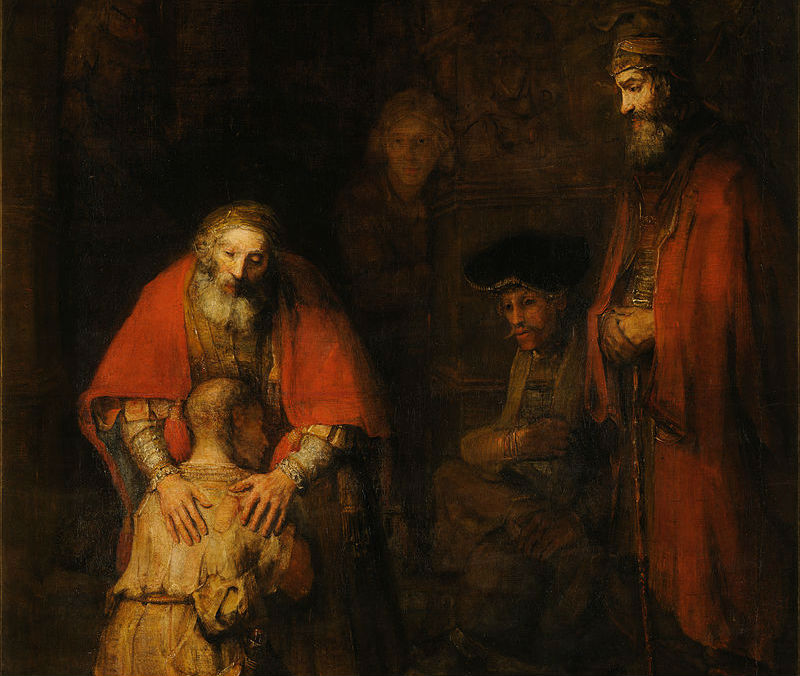
Rembrandt - Return of the Prodigal Son CROPPED
Rembrandt, The Return of the Prodigal Son

This post is part of the General Conference Odyssey.

Elder Marion G. Romney’s talk, Man—A Child of God, dove straight into some very Mormon teachings: “The truth I desire to emphasize today is that we mortals are in very deed the literal offspring of God.”

Members of The Church of Jesus Christ of Latter-day Saints accept this concept as a basic doctrine of their theology. The lives of those who have given it thought enough to realize its implications are controlled by it; it gives meaning and direction to all their thoughts and deeds. This is so because they know that it is the universal law of nature in the plant, animal, and human worlds for reproducing offspring to reach in final maturity the likeness of their parents.

They reason that the same law is in force with respect to the offspring of God. Their objective is, therefore, to someday be like their heavenly parents.

The emphasis on becoming like our Heavenly Parents is one of Mormonism’s most distinctive and controversial beliefs. Because it is so easy to misinterpret, we are often rather sensitive about it, and we take pains to point out that the belief has solid basis in scripture.

“The Spirit itself beareth witness with our spirit,” wrote Paul, “that we are the children of God.”[ref]Romans 8:16[/ref] Referring to Psalm 82, which states “ye are gods, and all of you are children of the most High,”[ref]Psalms 82:6[/ref] Jesus asked, “Is it not written in your law, I said, Ye are gods?”[ref]John 10:34[/ref]

We also often emphasize that early Christians held similar beliefs. I have a few quotes from an old PowerPoint presentation that my father put together years ago:

  • “Let the interpretation of the Psalm [82] be just as you wish, yet thereby it is demonstrated that all men are deemed worthy of becoming gods.” – Justin Martyr
  • “Yea, I say, the Word of God became a man so that you might learn from a man how to become a god.” – Clement of Alexandria
  • “The Word was made flesh in order that we might be enabled to be made gods.” – Athansius
  • “But he himself that justifies also deifies, for by justifying he makes sons of God. ―For he has given them power to become the sons of God‖ [John 1:12]. If then we have been made sons of God, we have also been made gods.” – Augustine

This is a good approach, but as I read Elder Romney’s talk, I had a different thought, which is this: How can we know our own theology if we don’t read these talks? What I mean by that is simply that I’ve seen fairly frequent debates about which beliefs are really doctrinal, which beliefs are core and essential, and frequently those debates refer to the Standard Works. And that is right and proper, but it is not enough.

If we believe in an open canon; if we believe in continuing revelation; if we believe that we are led by prophets, seers, and revelators (i.e. if we believe what we say we do), then the question of marking out the contours and landmarks of our faith is not an intellectual exercise for academics and scholars. It is a question of divine authority.

I’ll give you one specific example: there are those Mormons who take a very dim view of The Family: A Proclamation to the World. They will tell you that it is not canon (which, in fairness, is true), that it was written by lawyers, and so forth to argue that it’s not really Mormon. All well and good as intellectual debates go, but this is what I say in reply: go and start reading the General Conference talks and see how consistently, how prominently, how steadfastly the family is preached. You can’t go one session, it often seems, without at least a couple of paragraphs about the family as it relates to God’s plan for us. Any unbiased reader of the General Conference talks who was asked to list the most important topics would, without any ambiguity, list Jesus Christ and the Atonement first, and then families second. In that context, the critiques of The Family ring hollow.

As a Church that professes to be led by continuous, dynamic revelation it is impossible to understand our own faith without paying close attention to the ongoing stream of teachings. The Standard Works are the roots and foundation of our doctrine, but the branches and leaves are the General Conference talks.

And so, to return to Elder Romney’s talk, the idea “that man is a child of God is the most important knowledge available to mortals.” He concluded by bearing his own witness that “I know that I am a son of God, and that you, my beloved listeners, are individually a son or a daughter of God, and that this knowledge implemented in our lives will lift us back into his presence through the atoning sacrifice of our Savior, Jesus Christ.”

Check out the other posts from the General Conference Odyssey this week and join our Facebook group to follow along!

There’s a lot more to Trump support than racism.

hillbilly elegy

I’m a conservative. Over the last 9 months or so the Trump campaign has sent me from incredulous to enraged to dejectedly resigned, and I admit I’m still trying to figure out what just happened.

To hear some of my leftist friends talk, the Trump phenomenon is the inevitable climax of an increasingly out-of-touch, racist, backwards party, a predictable extension of the “extremism” of Bush.[ref]In general I think it’s a bad idea to let people who aren’t part of Group X–especially people who are hostile to Group X–explain what Group X thinks, feels, and wants. The explanation is usually pretty off-base.[/ref]

Those theories makes no sense to me. The conservatives I know who supported Bush hate Trump. In fact, Pew Research recently published a study showing the most religious and “very conservative” Republicans have been most resistant to Trump. This study echoes a Gallup poll last year that found the highly religious ranked Trump 12th out of 17 GOP candidates. But if the most religious and conservative Republicans dislike him, who has been supporting Trump from the outset?[ref]The WSJ had a great graphic explaining how Trump’s coalition differs from the traditional factions of the right-wing (what the WSJ dubbed the social conservative faction and the establishment faction).[/ref]

In his article “Trump: Tribune of Poor White People,” Rod Dreher interviews J.D. Vance, author of Hillbilly Elegy: A Memoir of a Family and Culture in Crisis, on the interplay between our current political parties and hillbilly culture.

The interview is a fascinating read. Vance discusses a variety of sometimes opposing ideas in an empathetic but honest way. For example, he talks about how the anti-elitist streak in hillbilly culture helps those who achieve financial success stay grounded, but it also pressures people not to become successful in the first place. Vance talks about  the problems with how, when it comes to the poor, there are opposing narratives suggesting either (a) the poor are helpless, with no power to affect their own lives or (b) the poor must simply bootstrap their way out of poverty. Both of these views fail to address important factors.

Vance uses his understanding of hillbilly culture to explain Trump’s popularity:

The two political parties have offered essentially nothing to these people for a few decades.  From the Left, they get some smug condescension, an exasperation that the white working class votes against their economic interests because of social issues, a la Thomas Frank (more on that below).  Maybe they get a few handouts, but many don’t want handouts to begin with.  

From the Right, they’ve gotten the basic Republican policy platform of tax cuts, free trade, deregulation, and paeans to the noble businessman and economic growth.  Whatever the merits of better tax policy and growth (and I believe there are many), the simple fact is that these policies have done little to address a very real social crisis.  More importantly, these policies are culturally tone deaf: nobody from southern Ohio wants to hear about the nobility of the factory owner who just fired their brother.

Trump’s candidacy is music to their ears.  He criticizes the factories shipping jobs overseas.  His apocalyptic tone matches their lived experiences on the ground.  He seems to love to annoy the elites, which is something a lot of people wish they could do but can’t because they lack a platform.  

This part especially resonated with me:

The other big problem I have with Trump is that he has dragged down our entire political conversation.  It’s not just that he inflames the tribalism of the Right; it’s that he encourages the worst impulses of the Left.  In the past few weeks, I’ve heard from so many of my elite friends some version of, “Trump is the racist leader all of these racist white people deserve.” These comments almost always come from white progressives who know literally zero culturally working class Americans.  And I’m always left thinking: if this is the quality of thought of a Harvard Law graduate, then our society is truly doomed.

Read the full interview here.


Causes of Anti-Immigration Sentiments: Evidence from Brexit

The graph above from researchers Chris Lawton and Robert Ackrill at The Conversation “shows the proportion of Leave votes for all local authorities in England and Wales (on the vertical axis) against the proportion of residents who stated that they had been born outside the UK in the 2011 census (on the horizontal axis). It shows that high proportions of Leave voters were overwhelmingly more likely to live in areas with very low levels of migration” (italics mine). “Of the 270 districts that had a lower proportion than average of people born outside the UK in 2011,” they continue, “in 229 (85%) the majority vote was for Leave. Of the 78 districts with a higher than average population born outside the UK, only 44% voted Leave.”

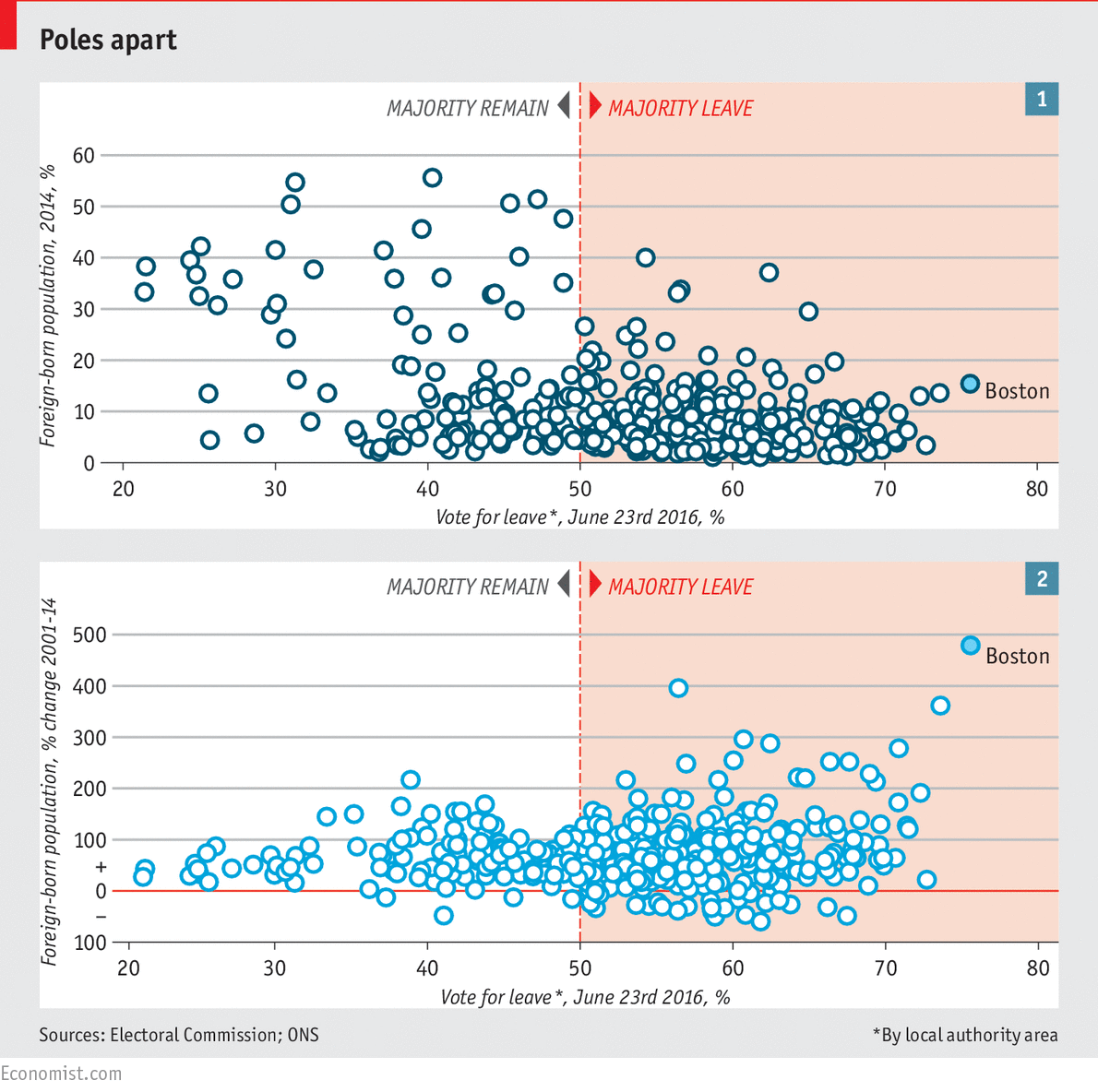
This seems to indicate that those with little exposure to immigrants have greater anti-immigration sentiments. However, this isn’t the whole story. Consider the graph below:

As The Economist explains,

Consider the percentage-change in migrant numbers, rather than the total headcount, and the opposite pattern emerges (chart 2). Where foreign-born populations increased by more than 200% between 2001 and 2014, a Leave vote followed in 94% of cases. The proportion of migrants may be relatively low in Leave strongholds such as Boston, in Lincolnshire (where 15.4% of the population are foreign-born). But it has grown precipitously in a short period of time (by 479%, in Boston’s case). High levels of immigration don’t seem to bother Britons; high rates of change do. 

Innovation and Its Enemies

Calestous Juma, Professor of the Practice of International Development at Harvard’s Kennedy School of Government, has a recent article based on his new Oxford-published book Innovation and Its Enemies: Why People Resist New Technologies. He explains,

[T]he answer is not simply that people are afraid of the unknown. Rather, resistance to technological progress is usually rooted in the fear that disruption of the status quo might bring losses in employment, income, power, and identity. Governments often end up deciding that it would be easier to prohibit the new technology than to adapt to it.

He uses the example of the Ottoman Empire forbidding the printing of the Koran for nearly 400 years. “By banning the printing of the Koran,” he writes, “Ottoman leaders delayed employment losses for scribes and calligraphers (many of whom were women who were glorified for their mastery of the art). But protecting employment was not their main motivation…[Religious knowledge] was both the glue that held society together and a pillar of political power, so maintaining a monopoly over the dissemination of that knowledge was critical to maintaining the authority of Ottoman leaders. They feared going the way of the Catholic pope, who lost considerable authority during the Protestant Reformation, when the printing press played a key role in spreading new ideas to the faithful.”

The list goes on, from English women petitioning against coffee in 1674 to American dairy farmers spreading misinformation about margarine in the 1800s to the resistance to tractors in the early 1900s. “People almost never reject technological progress out of sheer ignorance,” Juma concludes. “Rather, they fight to protect their own interests and livelihoods, whether that be operating a dairy farm or running a government. As we continually attempt to apply new technologies to improve human and environmental wellbeing, this distinction is vital.” The key in Juma’s mind is “inclusive innovation,” which seeks to help “those who are likely to lose from the displacement of old technologies are given ample opportunity to benefit from new ones. Only then can we make the most of human creativity.”

Sapiens: A Brief History of Humankind by Yuval Noah Harari

This is part of the DR Book Collection.

According to Amazon, Sapiens: A Brief History of Humankind is a best-seller. It’s not hard to see why. This deeply interesting book is also a deeply flawed book, and all of the flaws are calculated to make the book more sensationalist and provocative than the underlying research truly allows.

First of all, Harari is all-in for the hypothesis that the Agricultural Revolution was a colossal mistake. This is not a new idea. I’ve come across it several times, and when I did a quick Google search just now I found a 1987 article by Jared Diamond with the subtle title: The Worst Mistake in the History of the Human Race. Diamond’s argument then is as silly as Harari’s argument is now, and it boils down to this: life as a hunter-gatherer is easy. Farming is hard. Ergo, the Agricultural Revolution was a bad deal. If we’d all stuck around being hunter-gatherers we’d be happier.[ref]Sometimes they go farther and argue that disease had a hard time spreading when population densities were low, so hunter-gatherer societies were also healthier.[/ref]

The primary problem with this argument, philosophically, is its naked hedonism. I’m pretty sure I’d be happier if I just stayed in a perpetual, drug-induced high. And yet I don’t see Harari or Diamond (or any ostensibly sane person) standing outside of drug rehab facilities wearing a sandwich board warning heroin addicts that they’d be better off just staying high. Could it be conceivable that there’s more to life than minimizing the amount of time we spend procuring a bare minimum of resources to sustain life? The most frustrating thing about replying to this line of argument is that it’s absurd to even have to spell these things out. Isn’t the human penchant for dissatisfaction one of our noblest attributes? We’re not satisfied, and so we go out and we invent. Discover. Explore. Build. And, while we’re at it, plant and harvest.

Of course, it’s possible to take that to an extreme. Ideally, we find some way to balance the capacity to enjoy what we have–to live in the moment and to be accepting of the past–without giving up on our noble ambitions and desires to better ourselves, those around us, and the world we inhabit. The fact that this just might involve working more hours per week doesn’t automatically make it a bad idea, and the fact that I have to explain any of this to folks like Diamond or Harari is just plain silly. Their arguments are not insightful or provocative. They’re just childish.

Sadly, since this is one of the first arguments that Harari makes, he starts out by digging a deep credibility hole that he never really climbs back out of. He compounds it with other silly fad-arguments like the idea that we didn’t domesticate wheat, wheat domesticate us! Thus:

The Agricultural Revolution was history’s biggest fraud. Who was responsible? Neither kings, nor priests, nor merchants. The culprits were a handful of plant species, including wheat, rice, and potatoes. These plants domesticated homo sapiens rather than vice versa. Think for a moment about the Agricultural Revolution from the standpoint of wheat. Ten thousand years ago wheat was just a wild grass, one of many, confined to a small range in the Middle East. Suddenly, within just a few short millennia, it was growing all over the world. According to the basic evolutionary criteria of survival and reproduction, wheat has become one of the most successful plants in the history of the Earth. In areas such as the Great Plains of North America, where not a single wheat stalk grew 10,000 years ago, you can today walk for hundreds upon hundreds of miles without encountering any other plant. Worldwide, wheat covers about 870,000 square miles of the globe’s surface, almost 10 times the size of Britain. How did this grass turn from insignificant to ubiquitous?

The biggest problem here is that the very first thing that Harari argues for in his book is the distinction between “humans” (a term that covers many species) and “homo sapiens” (a term that refers to just one particular species). He puts all kinds of emphasis on this distinction, including making it the title of his book! And yet, in the passage above, he treats “wheat” as just a plant. Yet, according to Wikipedia, wheat is a term (like human) that refers to nearly 2-dozen distinct species. Again, it’s a hit for his credibility to be so sanctimonious about a technicality in one case, and then so cavalier about it in another. More than that, however, it substantively undermines his argument. Because the reality is that in domesticating various plants and animals, humans were engaged in slow-motion genetic engineering. The result, from the various species of wheat to animals like dogs and chickens, is a species that is genetically distinct from their ancestors. This matters a lot. Because if Harari wants to define a species genetically (which he does) then the domesticated wheat species is not the same thing as the wild wheat species from which it was derived over tens of thousands of years of selective breeding.

To clarify this mistake, imagine that he tried to argue that humans were domestictaed by wolves instead of vice versa. And so now wolves live in the houses of their domesticated humans, right? Well, no. Dogs have domesticated humans, but dogs (Canis familiaris) are not the same things as wolves (Canis lupus, Canis rufus, Canis lycaon, etc). And so you can’t say “wolves domesticated humans” because man’s best friend is no longer a wolf. Similarly, the wheat that we grow for food everywhere isn’t the same creature as its wild ancestor. Once again, this isn’t just wrong, it’s silly. When you see memes on the Internet about how cats own humans, that’s funny. When you see someone trying to turn the exact same Internet joke into a serious scientific point in an ostensibly non-fiction book, it’s just sad and a little pathetic.

Harari’s book suffers a lot from this kind of sloppy sensationalism. In addition to these examples, he also spends a lot of time ironically stating that there are no objective values on the one hand and then–often within mere sentences–making sweeping claims about how modern society is better than ancient society in this or that particular respect. Better, according to which values? It’s just another example of the utter failure of ostensible relativists to actually enact the relativism they claim to believe in. If there are no objective values, then there’s no basis for making statements like that.

So, enough of the criticism. What’s good?

Well, for starters, his separation of ontological concepts into three categories: objective, subjective, and inter-subjective is actually quite useful. He is sloppy about conflating “subjective”, “myth” and “false” (these terms are not synonyms, but he think they are), but the definition of inter-subjective as distinct from mere subjectivity is really quite good:

An objective phenomenon exists independently of human consciousness and human beliefs. Radioactivity, for example, is not a myth. Radioactive emissions occurred long before people discovered them, and they are dangerous even when people do not believe in them. Marie Curie, one of the discoverers of radioactivity, did not know during her long years of studying radioactive materials, that they could harm her body. While she did not believe that radioactivity could kill her, she nevertheless died of aplastic anemia, a disease caused by overexposure to radioactive materials. The subjective is something that exists depending on the consciousness and beliefs of a single individual. It disappears or changes if that particular individual changes his or her beliefs. Many a child believes in the existence of an imaginary friend who is invisible and inaudible to the rest of the world. The imaginary friend exists solely in the child’s subjective consciousness, and when the child grows up and ceases to believe in it, the imaginary friend fades away. The intersubjective is something that exists within the communication network linking the subjective consciousness of many individuals. If a single individual changes his or her beliefs or even dies, it is of little importance. However, if most individuals in the network die or change their beliefs, the intersubjective phenomenon will mutate or disappear. Intersubjective phenomena are neither malevolent frauds nor insignificant charades. They exist in a different way from physical phenomena such as radioactivity but their impact on the world may still be enormous. Many of histories most important drivers are intersubjective: law, money, gods, nations.

I also liked a lot of his later theories. As much as he made a hash of the Agricultural Revolution, his argument about the interrelationship between imperialism and science, for example, was really quite fascinating.

Scientists have provided the imperial project with practical knowledge, ideological justification, and technological gadgets. Without this contribution, it is highly questionable whether Europeans could have conquered the world. The conquerers returned the favor by providing scientists with information and protection, supporting all kinds of strange and fascinating projects, and spreading the scientific way of thinking to the far corners of the Earth. Without imperial support, it is doubtful whether modern science would have progressed very far. There are very few scientific disciplines that did not begin their lives as servants to imperial growth and that do not owe a large proportion of their discoveries, collections, buildings, and scholarships to the generous help of army officers, navy captains, and imperial governors.

This is a genuinely insightful argument, and it’s one I’d never heard before. It’s not hard to see why. Our culture–especially our intellectual culture–continues to treat science with a great deal of deference and respect. The mere existence of the term “social science”–combined with the embrace of statistical and other formal mathematical techniques in economics, psychology, etc.–all show how deeply ingrained this deference is. But imperialism? That’s practically a bad word in academic settings. Imperialism is pretty close to the Original Sin, as far as anyone residing in the Ivory Tower would believe. And so obviously it’s incredibly uncomfortable to suggest that imperialism and science are linked or even, not going quite that far, that historically science got a significant boost from imperialism. This is an embarrassment to modern Western sensibilities, and so the only kind of person who will bring it up is someone like Harari who seems intent on offending every conceivable member of his audience. The only time when mockery is really called for is in response to power, and so it is deployed appropriately in this case, and that is where the same penchant for kind of immature provocation turns from an annoyance (as with his silly theories about the Agricultural Revolution or wheat domesticating humans) into something important and serious.

Along these lines, I was also really struck with his argument about the consumerist-capitalist ethic. Here goes:

How can we square the consumerist ethic with the capitalist ethic of the business person according to which profits should not be wasted and should instead by reinvested in production. It’s simple. As in previous eras, there is today a division of labor between the elite and the masses. In medieval Europe, aristocrats spent their money carelessly on extravagant luxuries, whereas peasants lived frugally minding every penny. Today the tables have turned. The rich take great care managing their assets and investments while the less well-heeled go into debt buying cars and televisions they don’t really need. The capitalist and consumerist epics are two sides of the same coin, a merger of two commandments. The supreme commandment of the rich is “invest”. The supreme commandment of the rest of us is “buy.” The capitalist-consumerist ethic is revolutionary in another respect. Most previous ethical systems presented people with a pretty tough deal: they were promised paradise, but only if they cultivate compassion and tolerance, overcame craving and anger, and restrained their selfish interests. This was too tough for most. The history of ethics is a sad tale of wonderful ideas that nobody can live up to. Most Christians did not imitate Christ. Most Buddhists failed to follow Buddha. And most Confucians would have caused Confucius a temper tantrum. In contrast, most people today successfully live up to the capitalist-consumerist ideal. The new ethic promises paradise on condition that the rich remain greedy and spend their time making more money, and that the masses give free reign to their cravings and passions and buy more and more. this is the first religion in history whose followers actually do what they are asked to do. How, though, do we know that we’ll really get paradise in return? We’ve seen it on television.

Given his frequent borrowing of ideas I recognize from other sources, I suspect this is not original to Harari[ref]I had the audiobook, so I have no idea if he’s got footnotes.[/ref], but it is fascinating to me.

There are several more examples of these kinds of points Harari makes that are contrarian and interesting. Some I was already familiar with (such as the nonsensical notion that primitive humans lived in harmony with their environment, something that approaches farce once you actually look at the global swathes of mass extinctions that actually followed the spread of homo sapiens around the globe) and others were either new or particularly well-reasoned (such as his explanation of corporate personhood and intersubjective reality via Peugot). For those reasons: I do recommend reading this book. Just take everything in it with a grain of salt.

Free Trade Africa

The Washington Post reported on a new African free-trade deal that would include all 54 countries. Here’s what you need to know about the Continental Free Trade Area (CFTA):

  1. The CFTA would constitute the largest free-trade area in the world.
  2. It’s part of a larger global trend of mega-regional trade agreements.
  3. The CFTA would help African countries develop.
  4. The CFTA would boost African trade by more than 50 percent.
  5. The CFTA will build off the ECOWAS and TFTA agreements.
  6. The CFTA has widespread political and economic support.
  7. 2017 is the target deadline.

This is exciting news, so long as it is more successful than previous trade deals.

The Unchanging, Changing Church

Photo of General Sherman by Jim Bahn
Photo of General Sherman, the largest living organism, by Jim Bahn.

This post is part of the General Conference Odyssey.

The first talk in the priesthood session of the April 1973 General Conference was The Aaronic Priesthood MIA by Elder Victor L. Brown. Even after reading the talk, I really have no idea what the program was, and I couldn’t even tell you if it’s still in force. (Some parts of it seemed familiar, others less so.) It’s a very odd feeling, to read a talk given nearly a decade before I was born about a bold, new program that I’ve never heard of.

It made me think of Mosiah 26, when

there were many of the rising generation that could not understand the words of king Benjamin, being little children at the time he spake unto his people; and they did not believe the tradition of their fathers.[ref]Mosiah 26:1[/ref]

Even though Alma and Mosiah’s lifetimes were only separated by a couple of decades from their children, the separation of a single generation was enough to create a wide chasm in their worldview. Alma and Mosiah’s children had to rediscover their own faith.

And it’s the same for us: every generation has to rediscover many of the truths and relearn the lessons that their parents’ generation already discovered and learned. It’s so easy to think that—because we’re members of the same Church our parents were members of—we understand the things that they did. Perversely, the complacent assumption that we get it is one of the biggest stumbling blocks that holds us back from actually going out and discovering and learning what we don’t yet know.

There’s a sense in which the Church is always the same. It’s right there in our Articles of Faith: “We believe in the same organization that existed in the Primitive Church.” [ref]Articles of Faith 1:6[/ref] But there’s also a sense in which every generation—and every single individual and family—has to recreate or rediscover the Church for themselves not just once, but again and again throughout their lives.

The Church—when you think of it as the actual members—changes when those members change. It also changes in reaction to the surrounding culture. That’s what prophets are for, after all, to warn the people of present problems. If society didn’t change—and if the Church didn’t need to change its programs and policies and emphases in reaction—then we wouldn’t need continuing revelation and an open canon.

The mission and the doctrines do not change, but the policies and the members do. The twin imperative of stasis and change may seem contradictory, but here’s how I think about it: It’s our job to sink our roots deep so that we can grow.

Check out the other posts from the General Conference Odyssey this week and join our Facebook group to follow along!

Desire, Ponder, Pray

This is part of the General Conference Odyssey.

I’ve missed the last couple weeks and this one will be short, but I thought Marion G. Romney’s talk in the April 1973 Priesthood session had some sound advice on magnifying our calling (and ultimately our discipleship). The three necessities he lists are:

  1. “a motivating desire to do so.”
  2. “search and ponder the words of eternal life.”
  3. “pray.”

Romney stresses the need for proper desires: “The desire these men were to have was not a desire to be called to an office. It was a desire to take upon themselves the name of Christ “with full purpose of heart.”” He expounds, “No one should seek to be appointed to any particular office in the Church. Such an aspiration is not a righteous desire; it is a self-serving ambition. We should have a motivating desire to magnify our callings in the priesthood, whatever they may be. We should demonstrate that desire by living the gospel and diligently performing whatever service we are called upon to render. Holding a particular office in the Church will never save a person. One’s salvation depends upon how well he discharges the duties of the service to which he is called.” But desire is not “a mere wish. It is not impassive; it is a motivating conviction which moves one to action.” This in turn leads one “to search and ponder the words of eternal life.” Sensibly enough, Romney finds, “Since we cannot “live by [the words which] proceedeth forth from the mouth of God” unless we know what they are, it is imperative that we study them. This the Lord has directed us to do.” He notes the difficulty of teaching the principles of the gospel (see D&C 42:12) without knowing what they actually are. This study leads to pondering, which Romney views as “a form of prayer. It has, at least, been an approach to the Spirit of the Lord on many occasions.” Finally, Romney concludes the list: “Desiring, searching, and pondering over “the words of eternal life,” all three of them together, as important as they are, would be inadequate without prayer. Prayer is the catalyst with which we open the door to the Savior.”

I find the habit of scripture reading without serious study or reflection to be odd. While habits and rituals are important, to approach the scriptures as an item on a list of things to do to reach the celestial kingdom seems to me to miss the point. The scriptures contain wisdom about the human condition, human nature, and God’s interaction with these two elements. The scriptures are both incredibly human and divinely inspired. We should wrestle with them, immerse ourselves in them, question them, challenge them, be changed by them. They are not magic incantations that will suddenly make you more spiritual. They are full of hard truths, cosmic myths, and glorious hope that must be chewed and digested if they are to be nourishing.

This trilogy seems to be a reinforcing cycle: as one’s desire increases, so will the searching, pondering, and praying, which will in turn increase desire. The last part–pray–is something I need to work on though. If one spends time reading and pondering, but fails to open up the channels of communication, one could miss out on even greater spiritual knowledge and inspiration.

Maybe that’s why I haven’t been translated yet…[ref]I also want to call attention to James E. Faust’s talk “Reaching the One” in which he offers compassion and empathy for those singles in a family-oriented church.[/ref]

Check out the other posts from the General Conference Odyssey this week and join our Facebook group to follow along!