“If heaven exists, what would you like to hear God say when you arrive at the pearly gates?”
I’m sure you’ve brought plenty of laughter there already.
You will be missed.
I had another dream, I had another life
“If heaven exists, what would you like to hear God say when you arrive at the pearly gates?”
I’m sure you’ve brought plenty of laughter there already.
You will be missed.

Charles Kenney of the Center for Global Development has an excellent article in the Summer 2014 issue of the Breakthrough Journal (published by the Breakthrough Institute) on how international trade and innovation actually benefit everyone involved. He begins with a little history on the 19th-century Guano Islands Act, by which Americans were authorized to seize unoccupied islands filled with dry bat or bird poop. This was
at a time when guano was the world’s best fertilizer and source of saltpeter, a vital ingredient of gunpowder. Around 100 islands were claimed by the United States under the law, including Midway. And it wasn’t just the United States that scrambled for control of guano deposits: Peru, Spain, Bolivia, and Chile fought wars over them. That might have seemed reasonable at the time: everyone was desperate for the same source of nitrogen fertilizer. But in 1909, Fritz Haber developed a method of producing ammonia from nitrogen in the air, enabling chemists to manufacture fertilizer on an industrial scale. This new technology, the Haber process, provided the world with a less smelly and more widely replicable way to meet our nitrogen needs, slashing the strategic value of poop-covered real estate. Nonetheless, the Guano Islands Act remains on the books, representing a way of thinking about international relations that is as anachronistic as it is enduring: the idea that countries must compete for a set amount of resources, land, or wealth.
This fear-based approach to international relations fuels much of the isolationism and protectionism we see today. But Kenney argues that “the increasing success of emerging markets, in part the result of their adopting ideas and institutions pioneered by industrial economies, is binding the world’s countries together into ever closer relationships of mutual benefit.”
After reviewing the evidence, he concludes,
All of this suggests that we need to develop a new view of the international economy as a positive-sum game (to borrow from Financial Times columnist Martin Wolf), one that acknowledges that advances in wealth, technology, or wellbeing in one part of the world are likely to enhance rather than hurt prospects for progress elsewhere. Seeing the planet today through the decayed eyes of Malthus and Machiavelli — and framing engagement with developing countries as zero-sum — simply does not make sense in a non-rival, globally integrated world.
In our positive-sum world, cosmopolitanism and compassion increasingly align with self-interest. This is a far nicer situation than one in which the two conflict, and it is surely a leading reason to hope that the world will keep on becoming a better place to live. It’s time to shift our thinking about Asia, Africa, and Latin America, emphasizing cooperation and mutual gain rather than competition and fear. Thinking of the developing world’s growth in the 21st century as primarily a threat makes about as much sense as trying to run a modern empire on bird poop.
Check it out.
 A new study from the International Monetary Fund looks at multiple episodes of government spending “booms” across 21 different countries. It does not address whether or not “in theory public investment drives could accelerate growth, but rather whether in practice, with real governments deciding how to spend the funds and implementing investments, they have in fact accelerated growth” (pg. 62) The answer?: “probably very little”.
This conclusion pertains to the drives – the big increases in public capital spending – not necessarily to routine levels of public investment. And furthermore the evidence here is not about whether public capital can promote growth by averting the emergence of bottlenecks. Major public investment campaigns continue to be advocated in several countries as a major trigger for economic growth, and on this issue, whether they have in fact triggered growth, the evidence for a positive effect of public capital on GDP or GDP growth is weak (pg. 62).
It further states that “it is difficult to find a clear-cut example that fits the oft-repeated narrative of a public investment boom followed by acceleration in GDP growth. If anything the cases of clear-cut booms illustrate the opposite – major drives in the past have been followed by slumps rather than booms” (pg. 4).
Matthew Klein has a really good overview in the Financial Times. Check it out.[ref]This goes along quite well with previous research on government spending and economic growth.[/ref]
Marriage historian Stephanie Coontz has an interesting piece in The New York Times on rising family instability. Commenting on male and female wages, she states, 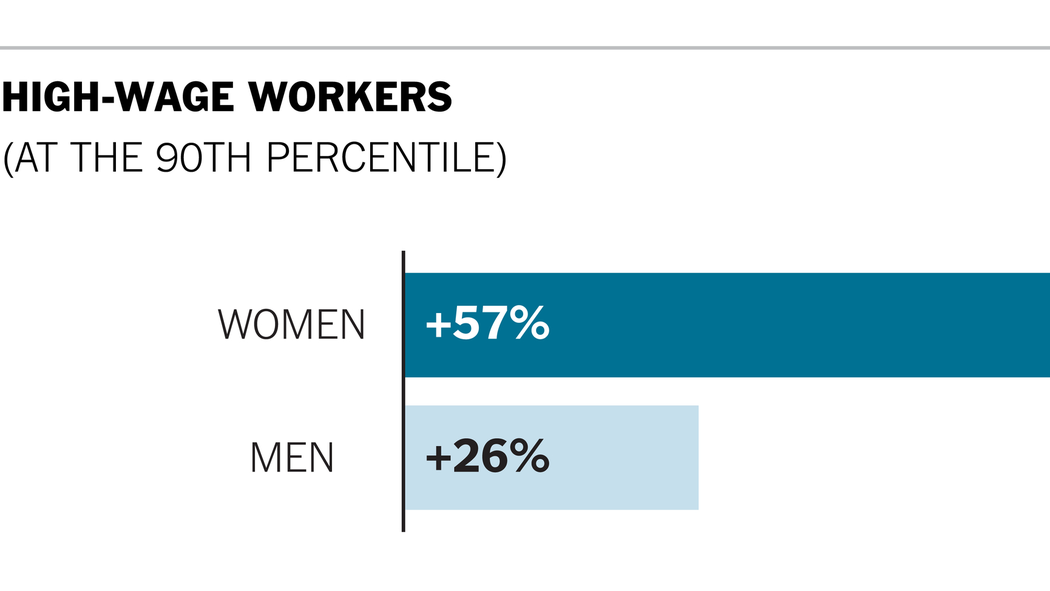
Today, job prospects for young men are far less favorable. Real wages for men under age 35 have fallen almost continuously since the late 1970s, and those with only a high school diploma have experienced the sharpest losses. Between 1979 and 2007, young male high school graduates saw a 29 percent decline in real annual earnings — an even steeper decline than the 18 percent drop for men with no high school diploma…Women’s wages, by contrast, have risen significantly since the 1970s, except for those on the very bottom…Meanwhile, women’s expectation of fairness and reciprocity in marriage has been rising even as men’s ability to compensate for deficits in their behavior by being “good providers” has been falling. Low-income women consistently tell researchers that the main reason they hesitate to marry — even if they are in love, even if they have moved in with a man to share expenses, and even if they have a child — is that they see a bad marriage or divorce as a greater threat to their well-being than being single.
She concludes,
If women lowered their expectations to match men’s lower economic prospects, perhaps marriage would be more common in low-income communities. But it would most likely be even less stable, and certainly less fair. Turning back the inequality revolution may be difficult. But that would certainly help more families — at almost all income levels — than turning back the gender revolution.
This piece goes nicely with a recent review in The Wall Street Journal by sociologist and National Marriage Project director W. Bradford Wilcox, in which he points out,
Although the authors put too much stress on economic explanations-their approach cannot explain, for instance, why the economic dislocation of the Depression did not result in high levels of family breakdown in the 1930s-the story told by “Marriage Markets” is worth heeding, whatever one’s political affiliations. Conservatives need to take note of the growing family divide in part because fragile families require more public aid, from Medicaid to food stamps: As marriage goes, so goes the tradition of limited government. Progressives, for their part, might well worry that the family divide begets not only economic disparity but also gender inequality. After all, communities where fathers are largely absent from their children’s day-to-day lives do not come close to approximating the egalitarian ideal championed by today’s left-of-center thinkers and activists.
…What, then, is to be done? Ms. Carbone and Ms. Cahn offer a number of good suggestions, such as job-relocation grants for laid-off workers (to help them move away from high-unemployment regions to those with jobs) and portable health plans that allow workers to seek out the best job opportunities instead of clinging to bad, low-paying jobs for the sake of their benefits.
But the authors also think that the way forward requires strategies designed to “enhanc[e] women’s power”-such as “improved access to contraception.” …Perhaps. But a stronger case could be made that the bigger challenge facing working-class and poor families is not a lack of female empowerment but rather that contemporary masculinity has been decoupled from work, fatherhood and marriage-and for reasons that are not entirely economic.
Good stuff. Check them out.
First, let me say that I promise not to make a habit out of cherry picking MotherJones articles to use as a punching bag.[ref]I’m referring to this post I wrote last week, btw.[/ref] I realize it’s unhealthy to spend too much time recapitulating the perceived failures of one’s ideological opponents, but I’m violating my own rule for two reasons. First, I am more inclined to use any article as a rhetorical punching bag when I feel it is, itself, perpetuating partisanship in a particularly noxious way. Second, I think some of the issues raised in this post will be genuinely interesting and important.
So this is what I saw on MotherJones last week:

I took a screen grab because it’s not just the article that I found so captivating. It’s the juxtaposition of an article about “how the superrich spoil it for the rest of us” with an advertisement for Patek Philippe watches. I’m no watch connoisseur, but that looks pretty expensive to me. Google would seem to agree:

The cheapest watch on that list costs about what both of my family’s cars cost put together. And the most expensive literally costs more than our house did, back before the housing bubble burst when we owned our own home. So I have to wonder: what kind of person is concerned about “the superrich” and in the market for a watch that costs tens or even hundreds of thousands of dollars? Well, apparently some of the folks who read MotherJones fit that particular bill.[ref]Of course it’s possible that the ad was served to me by some process that has nothing to do with MotherJones as a magazine. If so: (1) they need to fix their algorithm (2) the rest of this article will still be interesting.[/ref]
So what makes the post more than a mere gotcha? Well, I have two serious thoughts to add that I hope elevate us beyond mere rabblerousery[ref]I, for one, think “rabblerousery” should be a word.[/ref]
The first is a quick note on inflation-adjusted dollars. One of the charts claims that if median US wages had kept pace with the economy since 1970, then they would currently be at $92,000 instead of $50,000. Mathematically, I am sure that is probably correct. But can you really compare 1970s dollars to 2010s dollars so easily? Let me ask you this: would you rather have $92,000 in 1970 or $50,000 in 2014? How about $92,000 in 1714 vs. $50,000 in 2114?
Money, it turns out, isn’t everything even when you’re talking about economics.Think about some of the things you would lose by going back to the 1970’s: the Internet, cell phones, and Game of Thrones all come to mind. But it’s not just fun and games, would you trade 1970s medicine for 2014 medicine? Would you, if you had cancer? If your child did?
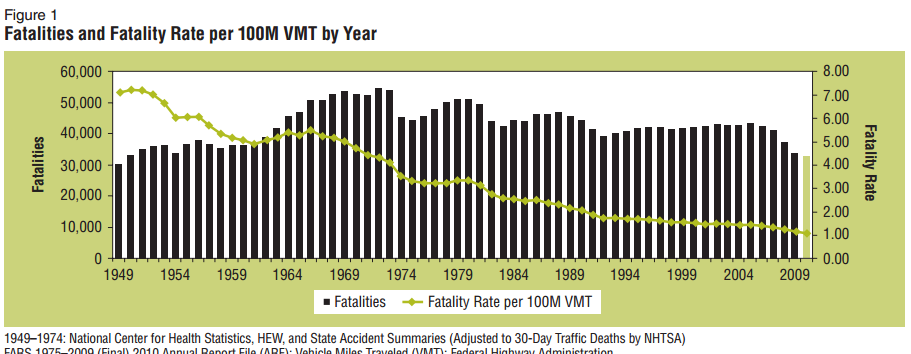
So that’s a chart that[ref]From the National Highway Traffic Safety Administration[/ref] shows your likelihood of dying in a car crash per 100,000,000 vehicle miles traveled (VMT). You can see in the 1970s it was about 3 to 4. By 2009 it was about 1. So your chances of dying in a car crash (per mile traveled) were roughly triple or quadruple in the 1970s what they are today. This is just one off-the-top-of-my-head example of the kind of comparison that inflation-adjusted wages don’t capture.[ref]It doesn’t escape my notice that a large part of the reason for increasing safety is government regulation, which is (broadly considered) a left-leaning policy. If that admission softens the tone of this piece: good.[/ref]
My point is just that there actually isn’t a way to compare our lives in the 1970s with the 2000s in a way that allows any kind of meaningful analysis. Inflation is calculated by economists who first create a bundle of goods (gasoline, food, clothes, etc.) that is supposed to be more or less representative of what a person or household buys, and then track the change in price of that bundle of goods over time. That’s the best they can reasonably do, and for a fairly consistent commodity (like wheat) it does OK. But it fails to address increases in product quality (e.g. a laptop in 2014 is not the same animal as a laptop in 2004), not to mention new products (e.g. a laptop in 2014 vs… ? in 1974), not to mention increases in public goods (like better air quality, perhaps) that are not captured by any bundle of goods that a person purchases. In short: saying that median income has stagnated doesn’t actually tell you if people are better or worse off, or at least, not nearly as clearly as MotherJones might want you to think.
The second thing to consider, and this one will not be very popular, is the question of why the median wages haven’t risen much over the last 40 years. MotherJones specifies that it’s “the superrich,” but that’s not a theory it’s a slogan. It’s designed to make people feel better, not to explain things. Here, on the other hand, is a theory that might actually offer some plausible explanation: the increasing numbers of women in the workplace suppress wages.[ref]Hey, I told you it wasn’t going to be popular. That doesn’t mean it’s not true.[/ref] This is econ 101: when supply (the number of workers, in this case) goes up then prices (the wages a worker earns, in this case) go down. The HuffPo conveniently has some numbers pegged to 1970 for comparison:
In terms of sheer numbers, women’s presence in the labor force has increased dramatically, from 30.3 million in 1970 to 72.7 million during 2006-2010. Convert that to percentages and we find that women made up 37.97 percent of the labor force in 1970 compared to 47.21 percent between 2006 and 2010.
At least some [ref]How much? I won’t try to guess or research that question for this piece.[/ref] of the wage stagnation therefore comes from women entering the work place. That’s not the only effect, by the way. At least one economic paper (based on dramatic changes in female participation in the workplace around World War II) found that not only did wages go down when women entered the workplace, but that wage inequality increased between high and low incomes and even that the gender pay gap increased. This might sound like ultra-right-wing propagandizing, but none less than Elizabeth Warren has contributed significantly to the understanding that women entering the work force has had negative impacts on our economy. In The Two Income Trap, Warren basically argued that (1) dual-income families are less financially secure than single-income families because if there is no insurance policy[ref]Meaning: that if worker loses his or her job in a single-income family, the other spouse can go to work to make up at least some of the difference, but in a 2-income family there is no Plan B.[/ref] and (2) dual-income families have bid up the cost of living (especially homes) to a point where single-income families can’t really compete anymore, which creates a vicious cycle. MotherJones covered this back in 2004, by the way, and they asked the book’s coauthor Amelia Tyagi about the apparently right-wing narrative she seemed to endorse:
MJ.com: Some conservative commentators might see this as evidence that the mother should return home.
AT: [Laughs] Right. Of course, the notion that mothers are all going to run pell-mell back to the hearth and turn back the clock to 1950 is absurd. But that aside, a big part of the two-income trap is that families have basically bid up the cost of living. Housing is a big example. A generation ago, an average family could buy an average home on one income. Today you can’t do that in three-quarters of American cities. We all know that housing prices are going up, but what most people don’t realize is that this has become a family problem. Housing prices are rising twice as fast for families with kids.
It’s telling that Tyagi replies to MotherJones’ comment with laughter and then sets the question aside. That’s because the evidence is actually pretty clear: two-income families have significant costs for our society. And let me be equally clear: my point is not that we should send all women back home. As far as the evidence presented so far is concerned, an equally prudent strategy (from a socio-economic standpoint) would have been to stick with single-income family structure, but to have men become the primary caregiver in 1/2 of the families, just as one possible example.
My point isn’t that the left-wing view is wrong and the right-wing view is right. My point is that reality doesn’t care about your politics. Or mine. If we really want to do our level best to fix problems, that means we’ve got to be more willing to entertain explanations and solutions that depart from everybody’s narrative and agenda. Who benefits politically from the fact that two-income families are bad for the country? I’m not sure anybody does, but if it’s true (and it seems to be true) then it’s important to know so. Maybe it will help us invent some new policy that will make things better, but at least it will help us avoid snake oil policies that will do no good.
Something else I like about this line of argument–and this does appeal to the conservative within me–is that it underscores the tragic vision conservatives have for our world. Want to improve society by making the work place more egalitarian on gender grounds? OK, but there are going to be costs. And some of those costs will be: stagnant wages, an increased gender pay gap, and increased income inequality.
Or, you know, you could ignore research that is politically uncomfortable and just blame the superrich. While you try to sell them luxury watches.
Look, my big problem with MotherJones has nothing to do with the fact that it is liberal. I will admit that doesn’t endear them to me, but there are lots of liberals I admire and respect (some of whom comment here.) If you want to see what really gets to me about MotherJones, just glance back at the very first line of the article. Or, to save you time, I’ll quote it here:
Want more rage?
No, MJ. I don’t think that’s what America needs right now. But thanks for being open and honest about what–even more than luxury watches–it is that you’ve got on offer.

The Brooking Institution’s Richard Reeves has an incredible article in the most recent volume of National Affairs entitled “The New Politics of Character,” which basically summarizes much of the research associated with Brooking’s Character and Opportunity Project (which I’ve mentioned before). As Reeves explains,
Character, as we will see, is not synonymous with morality. Character combines qualities like drive and prudence that could — but might not — serve moral ends. It’s much more prosaic, but it may be more important.
The development of character is perhaps the central task of any civilized society and every individual within it. Its absence is felt not only when communities collapse into a brief, riotous war of all against all, but in many long-standing areas that are vital for human flourishing and constitute many of the abiding concerns of policymakers and the everyday issues of American politics. This is perhaps most true of the current debates about inequality and social mobility. Gaps in character development closely correlate to gaps in income, family functioning, education, and employment. The character gap fuels the opportunity gap, and vice versa.
If we want a better, freer, fairer society, we will have to complement the 20th-century focus on strong institutions with a new (if also ancient) concern for strong individuals. The quality of our policies is a vital concern. But so is the quality of our people.
After exploring a vast amount of research, he concludes,
Any new emphasis on character will need bipartisan support. This will require liberals to get past their squeamishness about words like “character” and conservatives to get over their hostility to public policy. Liberals who are genuinely concerned about rising inequality cannot turn a blind eye to the deep character inequalities that track with class lines. They are understandably afraid of seeming to blame the poor for their plight. But as we work to provide opportunities, we need to ensure people are able to seize them.
Conservatives who are genuinely concerned about opportunity need to look beyond tropes about moral character to the more practicable cause of performance character. As James Q. Wilson urged in The Public Interest’s 20th-anniversary issue: “For most social problems that deeply trouble us, the need is to explore, carefully and experimentally, ways of strengthening the formation of character among the very young.” Step one is to harness education and put character development firmly on the school agenda; step two is to invest in parenting, especially in the very early years. More broadly, the design of policies aimed at alleviating poverty or promoting opportunity ought to be sensitive to their impact on character development.
What is needed is a bipartisan policy push to help cultivate character in the name of opportunity. Given deepening concerns on both sides over barriers to upward mobility, there is an opportunity for a new coalition on character. Let us hope it is seized.
Well worth the read.
I’ve been saving this adorable BuzzFeed Politics article since I saw it a couple of weeks ago: Mitt Romney Has The Same Problems We All Have Flying Coach. It made me miss Mitt–by which I mean, miss what might have been–almost as much as the documentary Mitt.

Then today I saw this article in The Week: Americans really wish they had elected Mitt Romney instead of Obama.
Americans are so down on President Obama at the moment that, if they could do the 2012 election all over again, they’d overwhelmingly back the former Massachusetts governor’s bid. That’s just one finding in a brutal CNN poll, released Sunday, which shows Romney topping Obama in a re-election rematch by a whopping nine-point margin, 53 percent to 44 percent. That’s an even larger spread than CNN found in November, when a survey had Romney winning a redo 49 percent to 45 percent.
Yes, as the article says, you should take the polls “with a grain of salt,” but at the same time the list of things Romney was right about is both extensive and depressing.[ref]BuzzFeed again, humorously.[/ref]
Well, we’ll never know what could have been. But hey, maybe in 2016 we’ll get a chance at the next best thing. It’s not likely–and I’m not sure it’s politically wise–but I’m still hoping.

William Deresiewicz’s article for The New Republic Don’t Send Your Kid to the Ivy League definitely rubbed me the wrong way, and it didn’t take long to put my finger on it. From Deresiewicz’s Wikipedia page:
Deresiewicz attended Columbia University, where he majored in biology-psychology and graduated in 1985. He received a Masters in journalism from the same school in 1987 and a Ph.D. in English in 1998.
Not that Deresiewicz was hiding his Ivy League creds in the article itself. He wrote:
It was only after 24 years in the Ivy League—college and a Ph.D. at Columbia, ten years on the faculty at Yale—that I started to think about what this system does to kids and how they can escape from it, what it does to our society and how we can dismantle it.
See, it’s not so much that his Wikipedia entry gives away some big secret that he went to an Ivy League school. Nope, the point is that he has a Wikipedia page. So right off the bat, we’re not talking about some Joe on the street. We’re talking a notable person. For someone to spend a quarter century in the Ivy League and then (after they have become a notable person) to decide that it’s a terrible, terrible stifling place after all is a little bit rich. Consider also the fact that Deresiewicz’s primary complaints about the Ivy League are the kind of complaints that only a person without real, pressing, economic concerns can have.
“Return on investment”: that’s the phrase you often hear today when people talk about college. What no one seems to ask is what the “return” is supposed to be. Is it just about earning more money? Is the only purpose of an education to enable you to get a job? What, in short, is college for?
Deresiewicz answers: “The first thing that college is for is to teach you to think.” It’s all well and good for successful academics to talk about the supreme importance of the life of the mind. After all, that’s what they are paid to do, right? But not everyone is so lucky.
I love the life of the mind. If I won the lottery I would spend the rest of my life in college, earning degrees in one field after another. Math, physics, history, languages, linguistics, architecture, medicine, computer science: there’s almost nothing I wouldn’t love to spend a lifetime studying. But the fact is I haven’t won the lottery, and a great deal of my life therefore revolves around the struggle to keep from having to move my wife and children back into my parents house for a second time.
Those of us who aren’t looking backwards from the comfort of a secure and prosperous career, but are rather looking forward at the daunting prospect of navigating these troubled economic times with solvent households are very concerned with “return on investment.” But it’s not because we’re unenlightened barbarians with no appreciation for the life of the mind. It’s because bills don’t pay themselves. Has Deresiewicz forgotten that? Or did he simply never know?
I will give him credit for this, however: his excoriation of elite schools as propagators of social injustice is an argument that does ring true to me. I have never seriously considered that Yale or Harvard could give me or my kids a better education than a good state school. The point of elite education is not to learn more. It’s get access to a better network and a better brand. My concern about sending my kids to the Ivies (should that be a possibility) has always queasiness at the trade off between encouraging them to participate in morally noxious elitism vs. wanting them to have an easier time of it than I have.[ref]I wouldn’t feel bad if it was meritocratic, but it’s not.[/ref]
I also have to give him credit for having an appropriately expansive definition of “elite education”:
When I speak of elite education, I mean prestigious institutions like Harvard or Stanford or Williams as well as the larger universe of second-tier selective schools, but I also mean everything that leads up to and away from them—the private and affluent public high schools; the ever-growing industry of tutors and consultants and test-prep courses; the admissions process itself, squatting like a dragon at the entrance to adulthood; the brand-name graduate schools and employment opportunities that come after the B.A.; and the parents and communities, largely upper-middle class, who push their children into the maw of this machine. In short, our entire system of elite education.
It’s not attendance at an Ivy that will turn your kid into a zombie. It’s the way parents must structure every aspect of their kids’ childhood (so called) in order to gain admittance into said school that does the damage. By the time the kids arrive, I’d argue they are about as zombified as can be.
But, it turns out, there is hope! Deresiewicz presumes–and so had I–that elite education has a significant monetary advantage. In researching this post, however, I learned that that assumption is not true at all. Alan Krueger at Princeton University and Stacy Dale at Mathematica Policy Research conducted a very clever study where they compared the earnings of kids who went to Ivy Leagues with kids who were accepted to the Ivy Leagues but opted to go to less-prestigious universities. Since both groups got in, arguably both groups are roughly commensurate in terms of ability. So if the Ivy Leagues really have a return on investment (whether its from better education, better networking, or any other factor at all) the cohort that attended should have gotten higher earnings. But they didn’t. The two groups–those who attended Ivy League schools and those who were accepted did not–earned the same over the next decades (the original cohort started school in 1976, but the findings hold for a new cohort that entered in 1989).
That, for me, is a real reason not to send your kids to the Ivies. It’s not that some intellectual who has reaped the rewards of elite education for decades patronizingly tells you to “do as I say, not as I did.” It’s because they probably aren’t worth it in most cases. There are probably exceptions, like going to Yale Law if you want to teach law, that might apply at the very top of certain fields, and data also suggests that poor kids have the most to benefit from elite education, but in general (and especially for undergrad) it looks like your kids will be better off, all things considered, going to a good state school. And hey, they might get a real childhood that way, too.

I came across an Atlantice article (from back in January) called The Dark Side of Emotional Intelligence. The article itself is rather boring. It is full of non-insights such as the fact that people who are highly emotionally intelligent (e.g. good at regulating their own emotions and intuiting the emotions of others) can be exceptional manipulators.[ref]In other ground-breaking research, social scientists discover that people who are very big and physical strong can beat up people who are smaller and weaker. And sometimes do.[/ref] It’s totally obvious that emotional intelligence would be a benefit in sectors like sales and customer service, and perhaps just mildly interesting that it would actually be a hindrance for mechanics and accountants. All of this leads to a completely banal concluding paragraph:
Thanks to more rigorous research methods, there is growing recognition that emotional intelligence—like any skill—can be used for good or evil. So if we’re going to teach emotional intelligence in schools and develop it at work, we need to consider the values that go along with it and where it’s actually useful. As Professor Kilduff and colleagues put it, it is high time that emotional intelligence is “pried away from its association with desirable moral qualities.”
The one thing that did strike my interest–and the reason I’m blogging about this–is the incredibly peculiar notion that The Atlantic thought there was anything at all to report here. Do we really live in a society where people associate emotional intelligence (which is basically just one particular form of power) with virtue? And, if so, where on earth did the notion come from?
I’m not quite willing to go so far as to say that the opposite is more intuitive–that emotionally (or otherwise) intelligent folks ought to be less moral–but it would at least certainly fit the age-old wisdom that power is fundamentally corrosive.

Immigration is in the news again with the influx of Central American children across U.S. borders. Some of the responses to these child immigrants have shown the ugly side of American nationalism. This skepticism toward immigration can be traced back to several of the Founding Fathers, including Benjamin Franklin, Thomas Jefferson, Alexander Hamilton, George Washington, and John Jay.[ref]Historian Thomas E. Woods, Jr. discusses their various concerns in his 33 Questions About American History You’re Not Supposed to Ask (New York: Three Rivers Press, 2007). However, some anti-immigration Americans assume immigrants are predominantly criminals, which the evidence doesn’t bear out. Furthermore, we often ignore how our own policies (such as the War on Drugs) helps create undesirable environments from which these immigrants want to escape.[/ref] However, even the skeptics among the Founders expressed the benefits of immigration. But I’m not particularly interested in cherry-picking Founders statements. What I am interested in is alleviating global poverty. Here are a few links that cover a variety of studies demonstrating increased immigration does just that:
Be sure to read and research the actual studies.