Unlivable Philosophy

In the course of reading philosophy, I sometimes find myself objecting to philosophical ideas not on the grounds that the ideas are demonstrably false (although they very well may be) but rather that, even if they were true, we simply couldn’t live as if they were true. I have been thinking about this principle, and for a while it has struck me as somewhat ad hoc and itself illogical. Whether or not someone can live a principle is irrelevant to whether or not the principle is actually true. For example, I think Christianity is true, but sooner or later, we reach a point where we simply cannot live exactly as Christ did during his earthly life and commanded us also to live.

I think I finally hit on why this principle would reasonably apply to, say, determinism or radical skepticism and not, for example, religious principles or the categorical imperative. The difference is not only that the principles are, eventually, unlivable but that no one even wants to live them. We praise Jesus’ teachings and the categorical imperative even if we know we can’t follow them completely, but nobody wants to live like rape or murder are the unavoidable consequences of either divine predestination or mechanical interactions. Nobody even wants to try and live their daily life in a radically skeptical way, doubting that any knowledge is attainable. Christians want to be like Christ, and Buddhists want to be like the Buddha, but even Hume doesn’t want to be Hume:

Where am I, or what? From what causes do I derive my existence, and to what condition shall I return? … I am confounded with all these questions, and begin to fancy myself in the most deplorable condition imaginable, environed with the deepest darkness, and utterly deprived of the use of every member and faculty.

Most fortunately it happens, that since Reason is incapable of dispelling these clouds, Nature herself suffices to that purpose, and cures me of this philosophical melancholy and delirium, either by relaxing this bent of mind, or by some avocation, and lively impression of my senses, which obliterate all these chimeras. I dine, I play a game of backgammon, I converse, and am merry with my friends. And when, after three or four hours’ amusement, I would return to these speculations, they appear so cold, and strained, and ridiculous, that I cannot find in my heart to enter into them any farther.

Pretty women and fun games make good diversion

I tie this observation into reason by noting that, if human reason can discover truths that no human can possibly live let alone want to live, reason must be either useless or suspect. Since reason leads us to truths that are antithetical to our continued existence, we must either profess truths that would destroy human existence if lived truly, or we must hide these truths and profess statements that are not true but convenient for continued existence. The former would ensure there are no humans, let alone philosophers, after a few generations, and the latter should be anathema to anyone who considers himself or herself a philosopher.

I by no means present these thoughts as air tight. They came to my mind while driving down the interstate and listening to a CD lecture on ethics. But I think we should walk through why we reject some claims out of hand but not others. Why am I ok, at least upon cursory inspection, with Christian ethics or the categorical imperative, but I instinctively reject determinism and radical skepticism? Is it simple prejudice, or is reason at play? Or both? Are we prejudiced against certain ideas because we subconsciously know the dangers to reason these ideas present?
On Being Pacifist

I’ve never identified as a pacifist. However, I think this is due to my view of pacifism being tainted by the American expression of it. As economist Bryan Caplan explains,

I’m a pacifist, but I’ve never been intellectually impressed with the U.S. peace movement.  The sound argument against war, in my view, combines (a) the common-sense moral view that, “You shouldn’t kill innocent people unless you know with high certainty that the long-run benefits heavily outweigh the short-run costs” with (b) the empirical fact that predictions about war’s long-run benefits are extremely inaccurate.  U.S. peace activists’ typical arguments against war are both too weak and too strong: Too weak because they focus on the badness of particular leaders and regimes rather than the murderous essence of modern war, too strong because they make overconfident, overblown predictions about the long-run effects of wars they oppose.  Worse still, U.S. peace activists have a ghastly tendency to side with despicable totalitarians and bloodthirsty nationalists.

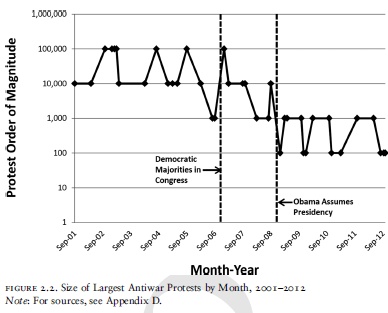
Even more frustrating is the fact that “Democrats’ war policies were very similar so those of their Republican predecessors, but the antiwar movement…durably dissolved once the Democrats gained power.” All one has to look at is the data (drawn from a recent book by political scientist Michael Heaney and sociologist Fabio Rojas) on antiwar protest size, media coverage, and partisan breakdown:

The sad fact is “Democrats energized the antiwar movement, then dropped it as soon as their side regained power.  “We observe demobilization not in response to a policy victory, but in response to a party victory.”  Why?  Because Democrats’ real target was not war, but Republicans…Though they’re too polite to come out and say it, Heaney and Rojas’ book shows that the good cause of peace was not merely ineptly defended, but insincerely defended.  While the peace movement no doubt includes some honest-to-goodness pacifists, they’re honorable outliers.  The peace movement was not about peace.”

Middle-Class Income: Still Not Stagnating

Last month, I posted a few links on why today’s middle-class salary may actually be better than we often think. Harvard professor and president emeritus of the National Bureau of Economic Research Martin Feldstein adds more food-for-thought on the subject:
…[I]t is frequently said that the average household income has risen only slightly, or not at all, for the past few decades. Some US Census figures seem to support that conclusion. But more accurate government statistics imply that the real incomes of those at the middle of the income distribution have increased about 50% since 1980. And a more appropriate adjustment for changes in the cost of living implies a substantially greater gain.

The US Census Bureau estimates the money income that households receive from all sources and identifies the income level that divides the top and bottom halves of the distribution. This is the median household income. To compare median household incomes over time, the authorities divide these annual dollar values by the consumer price index to create annual real median household incomes. The resulting numbers imply that the cumulative increase from 1984 through 2013 was less than 10%, equivalent to less than 0.3% per year.

Any adult who was alive in the US during these three decades realizes that this number grossly understates the gains of the typical household. One indication that something is wrong with this figure is that the government also estimates that real hourly compensation of employees in the non-farm business sector rose 39% from 1985 to 2015.

The official Census estimate suffers from three important problems. For starters, it fails to recognize the changing composition of the population; the household of today is quite different from the household of 30 years ago. Moreover, the Census Bureau’s estimate of income is too narrow, given that middle-income families have received increasing government transfers while benefiting from lower income-tax rates. Finally, the price index used by the Census Bureau fails to capture the important contributions of new products and product improvements to Americans’ standard of living.

Worth a read.

Economic Lessons From Ancient Greece

Stanford’s Josiah Ober has a recent article in Foreign Affairs based on his new Princeton-published book The Rise and Fall of Classical Greece that should interest those concerned about economic matters:

Greek states competed fiercely with one another, and with their imperial neighbors, notably Persia. Wars were frequent and bloody. But in the midst of conflict came new forms of social cooperation and a sustained era of rapid economic growth.

The total population of Greek speakers rose from some 330,000 persons in 1000 BCE to 8-10 million by the fourth century BCE. In the same period, average per capita consumption appears to have roughly doubled across the Greek world, and it probably tripled in Athens, the most advanced and among the most democratic of the city-states. The aggregate growth rate was low compared to high-performing modern states, but the rate was blistering compared to other pre-modern civilizations…Trade in commodities (including slaves), manufactured goods, and luxury goods boomed within the Greek world and between the Greeks and their neighbors. Among the remarkable features of the ancient economy of democratic Athens was the relatively low level of income inequality. Athens was home to many foreign “guest workers” and Athenians employed large numbers of slaves. But even taking slaves and foreigners into account, the distribution of Athenian income was much less unequal than in most premodern societies. Athenian wages for non-skilled laborers were high—comparable to the wages being paid in the most advanced economy of early modern Europe, Holland during its seventeenth century Golden Age…As…economists have long pointed out, there is a strong correlation between relatively low inequality and robust and sustained economic growth. 

The mounting evidence for the remarkably strong performance of the ancient Greek economy helps to explain what is sometimes called the “Greek Miracle”—the cultural explosion of Greek literature, visual and performing arts, and science that laid the foundations for Rome, the Renaissance, and the Enlightenment.

…So what made the impressive growth of the ancient Greek economy possible? The basic answer is good institutions.[ref]This notion of open institutions in ancient Greece reminds me of the work of economists Daron Acemoglu and James Robinson.[/ref] Greek city-states were governed by a range of regimes, but, by the fourth century BCE, the typical Greek city-state was, by world historical standards, very democratic. In Athens, and hundreds of other Greek states, most native adult males were participatory citizens, who set policy in citizen councils and assemblies, judged legal cases as jurors on people’s courts, and were elected or chosen by lot to serve as public officials.

See the full article for a good read.

The Family: Bridging Individuals and Communities

I’m a fan of the Cato Institute’s ongoing essay series Cato Unbound. Their most recent edition is on a topic of major interest to me: family and politics. The essays are based on political scientist Lauren K. Hall’s book Family and the Politics of Moderation: Private Life, Public Goods, and the Rebirth of Social Individualism. Hall writes,

…[T]he family challenges our most fundamental values and makes the creation of a consistent political theory essentially impossible. Those who emphasize the unlimited freedom of the individual come quickly up against the iron wall of genetics, early childhood development, and family experiences. We are not free to choose our families and our early familial experiences play a foundational role in the kind of person we eventually become. Individualists like Ayn Rand emphasize rationality and free choice only to be stymied by emotional and accidental bonds. The family is also one of the only places in the world where the creed “to each according to his need” not only works, but is indispensable. The family also challenges individualist arguments for personal responsibility and self-sufficiency since it relies in large part on the reality of human need and dependence. It is no accident that John Galt is an orphan.

On the other side of the spectrum, families are the root of inequality. This comes about both through the family’s role in education, habituation, and socialization, and through its intimate connection with property rights. The family’s multigenerational bonds challenge the demands of immediate collective decision-making and bind us to rules, habits, and ways of life that reject rationalist and egalitarian reforms. The family is the originator of unequal opportunity. The family also challenges egalitarianism due to its generally hierarchical form, which relies on the natural authority of parents over children for familial action. The reality of pregnancy, birth, and nursing places further stress on a strict egalitarian division of labor. Finally, families represent a divisive internal pull against collective identities. Families represent the private sphere in all its complexity of private and intimate bonds. The collective egalitarian cry that the private is really political is inevitably complicated by intimate groups that profoundly affect social structures but that also stubbornly refuse collectivization. The recognition that the family prevents radical egalitarian goals has led to (so far unsuccessful) calls to collectivize and control the family, from Marx and Engels to contemporary liberal feminists like Judith Moller Okin.

Economist Steve Horwitz provides additional insights from the works and theories of F.A. Hayek, based on his own forthcoming book Hayek’s Modern Family: Classical Liberalism and the Evolution of Social Institutions. Two more responses to Hall’s essay are in the process (one of which should appear later today).

Take a few minutes to read on this important topic.

19th Century Russia is Current America?

Portrait of an Unknown Woman - Ivan Nikolaevich Kramskoi
Portrait of an Unknown Woman – Ivan Nikolaevich Kramskoi

“The liberal party said that in Russia everything is wrong, and certainly Stepan Arkadyevitch had many debts and was decidedly short of money. The liberal party said that marriage is an institution quite out of date, and that it needs reconstruction; and family life certainly afforded Stepan Arkadyevitch little gratification, and forced him into lying and hypocrisy, which was so repulsive to his nature. The liberal party said, or rather allowed it to be understood, that religion is only a curb to keep in check the barbarous classes of the people; and Stepan Arkadyevitch could not get through even a short service without his legs aching from standing up, and could never make out what was the object of all the terrible and high-flown language about another world when life might be so very amusing in this world… He read the leading article, in which it was maintained that it was quite senseless in our day to raise an outcry that radicalism was threatening to swallow up all conservative elements, and that the government ought to take measures to crush the revolutionary hydra; that, on the contrary, ‘in our opinion the danger lies not in that fantastic revolutionary hydra, but in the obstinacy of traditionalism clogging progress,’ etc. etc.”

-Leo Tolstoy, Anna Karenina

Soviet Ray Bradbury Animations

Zdes Mogut Voditsya Tigry

I’m a fan of Soviet-era films and cartoons. The number of ham-handed, ideologically-driven films is not as great as one might think. There are plenty of faithful adaptations of western literature with high production values even on low budgets, and sensitivity to the philosophical and spiritual aspects of the stories. There also many comedies, and things like crudity and nudity are fairly rare. Plus, my wife grew up on many of these, so it has been a great way to bond. Yesterday I came across two animated shorts that I hadn’t seen before. Both are 1980s adaptations of Ray Bradbury stories (there are English subtitles). The plots are altered somewhat. Here There Be Tygers explores the beauty in life, and how our responses to that beauty reveal who we really are. Innocence and self-sacrifice are contrasted with destructive greed. There Will Come Soft Rains changes why the automated house is destroyed, introducing a darker, and more disturbing apocalyptic theme with a religious subtext. This is a good reminder that both animation and science fiction can be very serious art forms indeed, and definitely worth watching.

The Historical Context of the Family Proclamation

Over at Worlds Without End, I’ve written a piece on the political and social context in which The Family: A Proclamation to the World was developed. Laura Compton at Rational Faiths has demonstrated that the LDS Church’s entanglements with same-sex marriage date back to the early 1990s and spawned the creation of the Family Proclamation. I agree that this is the origin of the Proclamation. However, I think there is more going on in the Proclamation itself and within the political climate that produced it than is typically realized. Discussions over welfare and family breakdown had increased in frequency and popularity throughout the mid-1980s and into the 1990s, leading up to welfare reform under President Clinton. For our readers who have an interest in our posts on marriage and family here at Difficult Run, Mormonism, or both, you might find my post interesting.

Check it out.

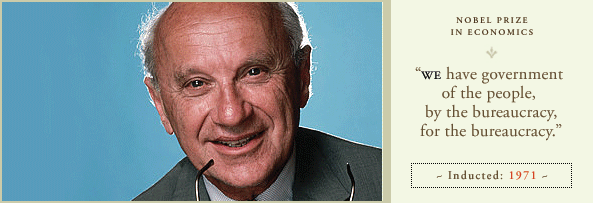
Wisdom from Milton Friedman

848 - Friedman

Greg Mankiw shares this sentiment from Friedman:

I do not believe that the solution to our problem is simply to elect the right people. The important thing is to establish a political climate of opinion which will make it politically profitable for the wrong people to do the right thing. Unless it is politically profitable for the wrong people to do the right thing, the right people will not do the right thing either, or if they try, they will shortly be out of office.

This is exactly the kind of doggedly pragmatic idealism that causes my spirit to resonate in sympathy. The stubborn refusal to give up on striving for a better world while keeping a pretty cynical view of human nature is–for me at least–one of the really deep, definitional aspects of the right wing of American politics. We’re not Utopians, but that’s not because we don’t care.

Government Barriers to Upward Mobility

A new study out of George Mason University looks at government barriers to upward economic mobility. Economist Steve Horwitz investigates three main factors:

  • Occupational licensing
  • Zoning laws and other small business regulations
  • Regressive taxation
Steve Horwitz
Steve Horwitz

As he explains in the opening of the study,

A common assumption in public policy is that government regulation of the market generally works to protect the poor and disenfranchised. However, such regulations more often have the opposite effect: that is, they benefit the wealthy and powerful at the expense of the poor. The key to understanding this point is recognizing that the regulatory process is not, in general, a pristine attempt to instantiate the public interest. Instead, economic actors see in the political process a means of enhancing their profits at the expense of their competitors, but without meeting the wants of consumers in the process. Support for regulations that create barriers to entry in an industry or occupation may well be couched in terms of the need to protect public interest, but such regulations are often demanded by (a) incumbent producers who wish to acquire monopoly profits by making it harder for new producers to enter the marketplace and (b) consumers whose income enables them to afford higher prices, while the burden is shouldered by lower-income producers and consumers. Such regulations effectively become a regressive transfer of income from the poor to the relatively well-off.

When considering new regulations or eliminating existing ones, policymakers should pay more attention to the regressive effects of government, from the way in which it prevents upward mobility to the way in which some policies and programs burden the poor more than other groups.[ref]Pgs. 3-4.[/ref]

Important observations. Give it a read.