Good, Evil, and Confusion Between the Two

Last week I wrote about some philosophers who were concerned with the unfair advantage enjoyed by children in loving families. What I didn’t mention at the time was that once, when I was on a messageboard back in the late 1990s, I was subject to an insult that has stuck with me for the rest of my life because of it’s incredible oddness. I was accused of being “emotionally spoiled.” As far as I can tell, this is an innovative way to call someone well-adjusted when you’re angry at them.

In any case, it reminded me of this amusing post from Jr. Ganymede:

I have this friend who is always exercising and carefully watching what she eats.  She won’t even go into a McDonald’s, because she says its just not the right environment for what she’s trying to do.  So restrictive!

Yeah, she’s fit, superficially.  But it’s not true fitness.  It’s naive fitness.  It’s sheltered fitness.  True fitness is when you stop living in some “exercise and nutrition” bubble and you go pork out on your couch in the real world.

Or, if you prefer the classics, there’s C. S. Lewis:

A silly idea is current that good people do not know what temptation means. This is an obvious lie. Only those who try to resist temptation know how strong it is. … You find out the strength of a wind by trying to walk against it, not by lying down.

Of course these two ideas–growing up in a good family and thus being “emotionally spoiled” on the one hand and avoiding temptation on the other–are very different. I get no credit for the circumstances of my home life and I’m not claiming to be a good person. But there is an important similarity: and that is that the world has ways of sneering at things that are beautiful and trying to make you feel ashamed for liking them. You grew up in a good family? Then you’re the beneficiary or privilege and unfair advantage. You’re basically cheating at life. You’re trying hard to avoid temptation and follow rules? Then you’re shallow and superficial.

Don’t let the world confuse you.

Don’t let them get you to trade your heroes for ghosts. Don’t give up trees for hot ashes. Don’t exchange your walk on part in a war for the lead role in a cage.

Don’t let anyone tell you that darkness is light and that light is darkness. Don’t forget the difference between the bitter and the sweet.[ref]Isiah 5:20[/ref]

Never forget, there are four lights.

But sometimes we do forget. Sometimes we make the trade.

When that happens, try to remember one more thing about bad deals: “Ye have sold yourselves for naught, and ye shall be redeemed without money.”[ref]3 Nephi 20:38[/ref]


Georgetown University Panel: Obama, Putnam, and Brooks on Poverty

The President joined Harvard’s Robert Putnam and AEI’s Arthur Brooks on a panel at Georgetown University on the problem of poverty. It’s an interesting discussion that displays not only how liberals and conservatives view and approach the problem of poverty, but how they believe each other approaches it. It’s an enlightening and somewhat irritating thing to behold, but worth the watch.

Check it out below.

The New Atheism As Religion

901 - New Atheism as Religion

Yes, yes. I’m well aware that seeking to sound clever with oxymoronic titles is tiresome, but–as John Gray argues in What Scares the New Atheists–religion and atheism are not actually contradictory. Not necessarily, in any case. The argument, which is worth reading in full, begins with the simple observation that atheism has historically reflected the morality of the times, just as religion often does, and Gray begins with a particularly embarrassing list of examples of atheists who provided the “scientific” basis of racism prior to World War II.

Now, this isn’t a case of someone just blaming the Nazi’s on atheism, which would be silly, and now is as good a time as any to point out that Gray is himself an atheist. His point isn’t that morality is impossible for an atheist or that atheism tends irreversibly towards moral oblivion and solipsism. Instead, his first point was simply that “none of the divergent values that atheists have from time to time promoted has any essential connection with atheism, or with science.” Got it? No necessary connection between liberal morality[ref]He means he classic definition of individual rights, not the left wing of American politics.[/ref] and atheism.

What’s more, Gray argues that liberal morality is itself a kind of derivative of traditional Jewish and Christian religious beliefs:

The trouble is that it’s hard to make any sense of the idea of a universal morality without invoking an understanding of what it is to be human that has been borrowed from theism. The belief that the human species is a moral agent struggling to realise its inherent possibilities – the narrative of redemption that sustains secular humanists everywhere – is a hollowed-out version of a theistic myth.

He also points out that while it’s not very difficult to come up with universal values (e.g. based on self-interest, reciprocity, and so forth), “Universal values don’t add up to a universal morality.” This is one of the most astute observations in the piece. As Gray points out, once you have a bunch of universal values, you still have to deal with the fact that “such values are very often conflicting, and different societies resolve these conflicts in divergent ways.”

Gray also dispatches with the idea that religion is some kind of unique source of evil in the human experience. While conceding that various religions are flawed in various ways, he writes that

The fault is not with religion, any more than science is to blame for the proliferation of weapons of mass destruction or medicine and psychology for the refinement of techniques of torture. The fault is in the intractable human animal. Like religion at its worst, contemporary atheism feeds the fantasy that human life can be remade by a conversion experience – in this case, conversion to unbelief.

So, what’s the point? Gray’s central thesis is that the New Atheism is basically a fearful reaction to the awareness that the secularization hypothesis isn’t going to fly. The world is not abandoning religion and, in fact, there’s no good reason to believe that it ever will. Gray cites Stuart Hampshire:

It is not only possible, but, on present evidence, probable that most conceptions of the good, and most ways of life, which are typical of commercial, liberal, industrialised societies will often seem altogether hateful to substantial minorities within these societies and even more hateful to most of the populations within traditional societies … As a liberal by philosophical conviction, I think I ought to expect to be hated, and to be found superficial and contemptible, by a large part of mankind.

Well, the New Atheists don’t want to face that. They don’t like the idea that their cherished liberal views (which, mind you, are not actually in any way logically linked to atheism) are not going to be universally accepted. And so they embrace a radical, doctrinaire form of atheism that involves an awful lot of pseudo-religious mechanisms: from evangelizing to witnessing to conversion narratives. In the end, Gray writes that “What today’s freethinkers want is freedom from doubt, and the prevailing version of atheism is well suited to give it to them.”

The final irony is that fear is driving the New Atheists to become in every way the mirror image of the doctrinaire, blind-faith religions they claim to despise.

In Which Guns Save Lives

902 - Garland TX

I haven’t written about guns and gun control in a long time. In part, this is a sad indictment of American politics: we talk about gun control pretty much exclusively in the wake of some horrific massacre (here or abroad) and, other than that, pretty much not at all. It’s not just gun policy that is addressed in this haphazard, sensationalist way, of course. It’s basically everything in American politics–short of a few issues that have movements behind them to give them perennial visibility–that basically ping-pong between utter obscurity and nauseating sensationalism.

But two events from earlier this month brought the issue to mind, and I at least wanted to note them. The first is the massacre that did not take place in Texas on May 3, 2015. ISIS later claimed credit for this attack, making it the first ISIS-backed terrorist attack on US soil. I’m not really sure why they claimed credit, however, because the attack was shortlived and no one died except the would-be mass murderers. A contest was being held, attended by a sparse crowd of about 75, to see who could come up with the best cartoon depiction of the Prophet Mohammad, and two men drove up, got out of their car, and opened fire with semi-automatic rifles at a security guard in an attempt to gain entrance. Instead, the security guard drew his handgun and shot  both attackers to death. No one else was killed, although another unarmed security guard was lightly wounded by the attackers.

Breitbart drew a straight line between the failed attack in Texas and the Charlie Hebdo attack in January of this year, noting that “When armed terrorists attacked Charlie Hebdo headquarters over Muhammad cartoons on January 7, unarmed police officers were forced to flee for their lives.” I’m not really thrilled at the glee with which some conservatives embraced this story. It’s hard to reconcile fear of a militarized police force with sneering condescension at our European neighbors for having unarmed police. Still, the story does underscore one sad reality: the only short-run response to a violent attack is with more, better violence.

The second example is even more interesting. As Business Insider reports, “An Uber driver with a concealed handgun prevented a mass shooting in Chicago.” The city of Chicago is, of course, known for both its horrific gun violence and also its draconian anti-gun laws. These laws made it the focus of the SCOTUS case McDonald v. Chicago which held that the 2nd Amendment (like other Constitutional rights) applies at the state level.

Gun control advocates openly scoffed at the idea that a concealed carry permit holder would ever be able to stop a crime in progress, suggesting that the only thing that would happen would be more fatalities. And yet the Uber driver in Chicago fired 6 shots, hit the target multiple times, and nobody else was injured. The list of mass shootings stopped by a civilian just got a little longer.[ref]Of course it’s hard to say that a “mass” shooting was stopped, because no one actually knows how many people would have died otherwise. [/ref]

In some ways it’s fitting that Charlie Hebdo come up in this conversation. Like a lot of people, I preferred to say “We are Ahmed” rather than “We are Charlie” in the days following the attack. I support the right of free speech, but some of the cartoons published by Charlie Hebdo made me support that right with a grimace rather than a smile. The same goes for guns. There is nothing happy or beautiful in the act of killing, even when the motives are noble and the violence is necessary. The fundamental right to self-defense is one I support in both theory and in practice, but it’s never been something I can be unreservedly excited about.

Divorce and Declining Christianity

A recent blog post at Patheos made an important point regarding recent declines in Christianity throughout the United States:

Some will attempt to spin this as a victory for atheists, implying that people are “seeing the light” and the light is exposing the lie that religion really is.  That view, however, is not really supported by other research on what accounts for the flight from religion.  In particular,  research by Elizabeth Marquardt and other research by Ken Pargament shows that divorce and the resulting inability to idealize caregivers is behind a great deal of the move to unbeliefIn order to feel at home in a religious community, two things need to happen.  First, kids need to feel like they have a spiritual home, but children of divorce struggle to do this.  As Marquardt explains it, children of divorce rarely end up going to church consistently, or going to the same church from  week to week.  This means, that rather than being able to use religion as a resource for constructing a coherent story for the meaning and purpose of their lives as many children from intact church-going families do, children of divorce have to go it alone.  They can’t trust their parents or their infrequently visited and divergent church communities to help them make sense of their lives…People raised in this environment struggle to let anyone else offer feedback or guidance.  They learn that they can’t trust the sources they are supposed to be able to trust for guidance and formation.  For these individuals church becomes just one more bunch of hypocritical grown-ups who can’t get their own crap together trying to tell other people how to live their lives.

With new research arguing that the divorce rate has actually increased, perhaps we shouldn’t be surprised that religiosity has decreased.

An Interview with a Product of Surrogacy

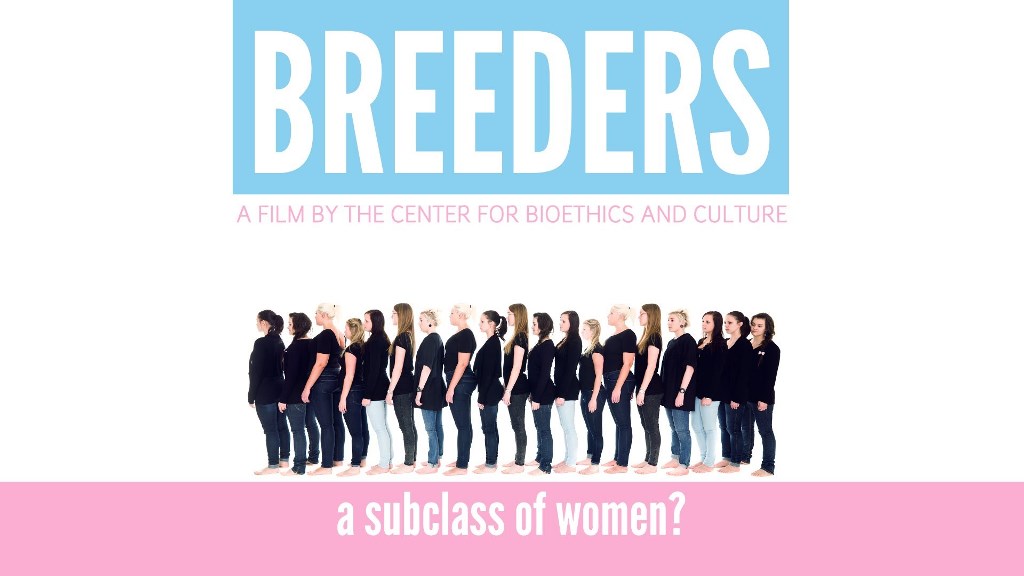
903 - Breeders

I found this interview at Chelsea Zimmerman’s Reflection of a Paralytic blog, and I’m re-using her post title. I’m fairly certain that she’s intentionally riffing on one of the most notorious euphemisms from the abortion debate: “products of conception.” The point of that euphemism was to elide the humanity of the unborn human being by (1) picking such an opaque term and (2) conflating the developing human being with the other “uterine contents” like the placenta. The term “product of surrogacy” is an ironic twist on that, referring to the way in which surrogacy tends to commoditize and thus dehumanize the children who are purchased this way.

This all sounds like fairly strong language, of course, but I think it’s important to let the children who have grown up in this system speak for themselves. And that’s what this interview is about.

The video features Center for Bioethics and Culture President and Founder Jennifer Lahl interviewing Jessica Kern. It’s an important interview, I think, and full of insights that I had never considered. Jennifer and Jessica have also worked together on the film Breeders which I haven’t seen yet, but hope to see soon. You can watch the entire video here.

Who Are Minimum Wage Workers?

Economist Mark Perry has an interesting blog post summing up the Bureau of Labor Statistics report “Characteristics of Minimum Wage Workers, 2014.” The following provides the percentages of different groups earning the minimum wage or less:

Age: 16-19 (15.3%), 25+ (2.5%).

Education: Less than high school (7.3%), High school graduates (3.5%), Associate’s degree (2.2%), Bachelor’s degree (less than 2%).

Marital Status: Never married (6.7%), Married (1.9%).

Hours Worked: Part-time (9.5%), Full-time (1.8%).

Perry summarizes,

Four important factors that will help workers earn a wage above the federal minimum wage are: 1) age (experience), 2) education, 3) marital status and 4) hours worked. Only 1-in-40 workers age 25 and above make the minimum wage, only 1-in-45 workers with an associate’s degree or higher makes the minimum wage, only 1-in-53 married workers earns the minimum wage, and only 1-in-56 workers working full-time earns the minimum wage. The evidence seems clear that the minimum wage applies only to a very small group of young, inexperienced, single, part-time workers, with a lack of education.

Check out the full report. In debates over the minimum wage, we should consider these demographics and take into consideration how much life experience–including work, education, marriage–plays into economic mobility.

Malcolm Gladwell and the Engineers’ Grievance

908 - Hug an Engineer
Hugging engineers is not the actual grievance.

Malcolm Gladwell has a long article in The New Yorker. Superficially, it’s about the man who ran Ford’s recall office during the 1960s and 1970s (at the time of the Pinto debacle). But what it’s really about is something altogether different: how engineers see the world differently.

There is an old joke about an engineer, a priest, and a doctor enjoying a round of golf. Ahead of them is a group playing so slowly and inexpertly that in frustration the three ask the greenkeeper for an explanation. “That’s a group of blind firefighters,” they are told. “They lost their sight saving our clubhouse last year, so we let them play for free.”

The priest says, “I will say a prayer for them tonight.”

The doctor says, “Let me ask my ophthalmologist colleagues if anything can be done for them.”

And the engineer says, “Why can’t they play at night?”

The greenkeeper explains the behavior of the firefighters. The priest empathizes; the doctor offers care. All three address the social context of the situation: the fact that the firefighters’ disability has inadvertently created conflict on the golf course. Only the engineer tries to solve the problem.

Almost all engineering jokes—and there are many—are versions of this belief: that the habits of mind formed by the profession enable engineers to see things differently from the rest of us. “A pessimist sees the glass as half empty. An optimist sees the glass as half full. The engineer sees the glass as twice the size it needs to be.” To the others, the glass is a metaphor. Nonsense, the engineer says. The specifications are off. He doesn’t give free rein to temperament; he assesses the object. These jokes, like many of the jokes people tell about themselves, are grievances. The engineer doesn’t understand why the rest of us can’t make sense of the world the way he does.

Later on, Gladwell talks about the head of the NHTSA (National Highway Transportation Safety Administration) who had just been dragged before Congress (again) to respond to questions about a Honda air-bag crisis (that had essentially zero impact on the safety of drivers on the road) instead of being allowed to continue to focus on the real safety concerns:

We have six hundred [staff at the NHTSA]. To deal with ten thousand people who are dying from drunk driving or ten thousand dying because they didn’t wear a seat belt, or the three thousand dying from distracted driving, or the four thousand dying because they are pedestrians or bicyclists and they are hit by a car.

And so Gladwell repeats his earlier observation: “Engineers have a grievance. They think we should think more like them.” And he adds: “They are not wrong.”

This resonates with me.[ref]Disclosure: one of my degrees is in engineering, but my full-time job is not in engineering.[/ref] My inclination is to be deeply cynical of anyone who wants to make the world a better place but has only studied in the kinds of disciplines where you never have to take a derivative. As one of my uncles said about his own kids, “They can major in whatever they want at college and math.”

898 - One Does Not Simply Hug An EngineerQuantitative disciplines like math, physics, or computer science are important for a lot of reasons. First, the objective failure you face in quantitative discipline tends more strongly towards teaching humility than the more subjective failure you face in non-quantitative disciplines. Computer scientists know this: their code either compiles or it does not.[ref]Not the only definition of success, obviously, but one necessary condition.[/ref] Mathematicians know this: they either proved the theorem or they did not. Physicists and chemists and engineers know this: their equations work out or they do not. Philosophers do not. They may think they do, but errors in philosophy usually have rounded edges thanks to the vagueness of language and sifting criteria of competing paradigms for evaluating arguments. There are, off the top of my head, at least three major conceptions of truth in philosophy, and that kind of ambiguity makes failure fuzzy.

Second, these disciplines are harder. There’s some wiggle room for individual variation, but overall there’s no question that math or physics or computer science are going to ask more out of you than education or English literature. This doesn’t just apply to academic disciplines, by the way. People whose livelihood depends on being able to do difficult things that have objectively observable results well face a lot of the same pressures as academics in objectively-grounded fields.

What does it all add up to? Be skeptical of anyone who says they  know the solution if that person doesn’t first understand what it’s like to not have the solution and be aware that wishing can’t change it. And be skeptical of someone who came by that solution too easily.

Don’t take this too far, folks. But keep it in mind when you’re thinking about controversial political questions and the sources you read to be better informed about them. Don’t automatically ignore everyone who didn’t major in math, but maybe keep an eye out for the folks who have quantitative backgrounds, who cite data, and who don’t claim to have easy or simplistic solutions to major, long-standing social problems.

Constructing ‘Cool’ and the Myths of Consumerism

Last year, The Atlantic reported on a study that offered a plausible definition of “cool.” “Cool,” The Atlantic said,

means departing from norms that we consider unnecessary, illegitimate, or repressive—but also doing so in ways that are bounded. The 1984 Apple ad that said, essentially, “you have a choice; don’t buy IBM!” was considered one of the coolest commercials of all time, because it was, in the researchers words, “autonomous in an appropriate way.” But a 1984 Apple ad saying “you have a choice; don’t pay federal income taxes!” wouldn’t be cool, because taxes are legitimate; and a 1984 Apple ad saying “burn IBM’s headquarters to the ground!” wouldn’t be cool, because that’s just overdoing it. Cool requires a bit of GoldilocksIt also requires something worth rebelling against.

The magazine recently interviewed a pair of neuroscientists on the same topic. “Cool,” according to these researchers, emerged in the 1950s. “Why were people getting so rebellious during one of the greatest periods of economic expansion in our history?” they ask. They conclude that it was because “the competition for the limited status of a traditional social hierarchy was getting too intense. It was the right conditions for the rebel instinct to ignite, and it started to drive consumption through rejecting the traditional routes to status and creating cool new lifestyles.” Cool, as the article name makes explicit, was created by capitalism and growing consumerism.

However, one of the most interesting parts of the interview was the list of four “damaging” myths about consumerism:

1. “It doesn’t make us happy.”

In 1974, Richard Easterlin reported that although richer people were happier than poorer people in the same country, people in wealthier countries were no happier than those in poorer ones. The implication was that happiness depended on relative income—how we stack up against the proverbial Joneses. But new studies question whether there ever was an Easterlin Paradox: The people of sub-Saharan Africa are not as satisfied with their lives as people in India, who are not as satisfied with their lives as the people of France or Denmark. There’s a global relationship between income and life satisfaction that shows no sign of a satiation point.

2. “It relies on instilling false needs in us because it’s contrary to our real nature.”

Our research show why the second myth is false. By examining how the brain responds to “cool” products, we discovered that they help fulfill a basic human need: to be recognized and respected by others. Our brains contain what’s basically a “social calculator” that keeps track of how we think other people are thinking about us—we feel its results as social emotions like pride and shame. Today, it’s typically called “social status,” but that has lingering negative connotations. We found that products are basically extensions of ourselves that reflect who we are—we use them to bond with others who share the same values. Doing this successfully was key to survival throughout human evolutionary history—you really needed allies, friends, and partners to survive.

3. “It erodes public life.”

There are lots of ways to gain status—it’s what even drives some Westerners to join ISIS—but integrating our need for status into the economy was, in our opinion, an enormously important feat. It allows the ways to gain status to expand over time, and it shows why the third myth is false—we use products to create lifestyles and community.

4. “It’s primarily about “stuff.””

Consumerism isn’t just about materialism. We use products socially—music is a great example. Look at all the lifestyles arranged around various musical tastes.

Check out the whole interview.

Thoughts on the Speed with Which America Changes Her Mind

905 - Americans Change Their Minds

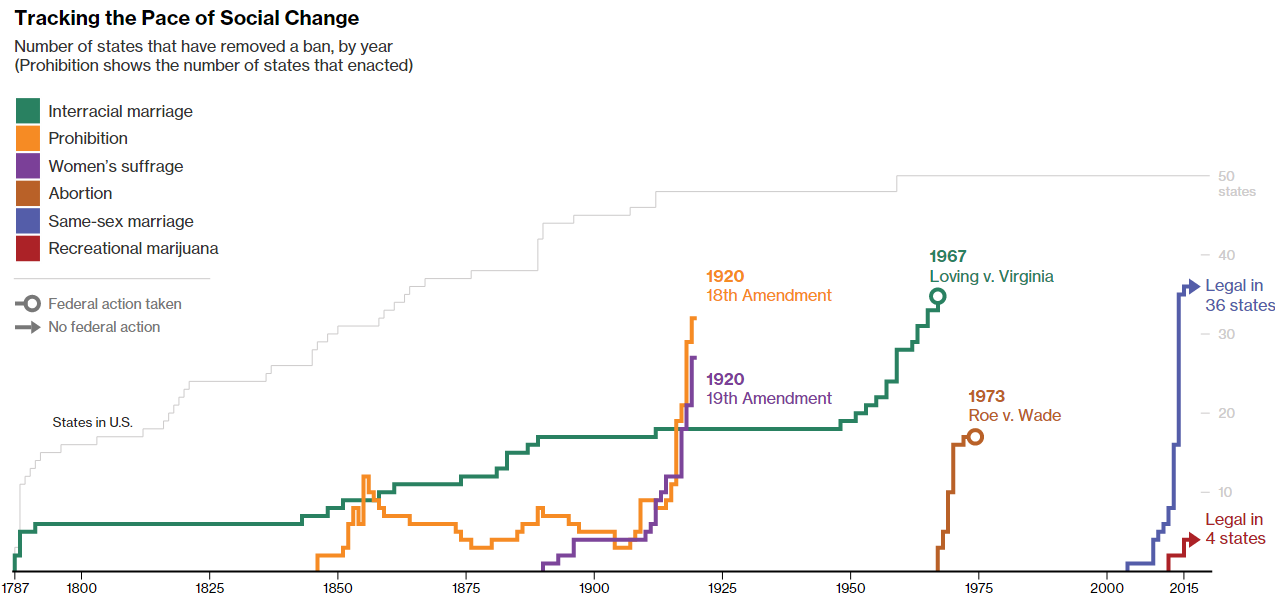
Bloomberg Business has an interesting post about the speed with which Americans change their minds on major social issues, complete with misleading graph above. I say misleading primarily because the graph stops at major milestones (Constitutional amendments or SCOTUS cases), and this gives an unjustified sense of finality to the change of mind, as though–having gone one direction–the transition is ultimately a complete switch.

Calling it misleading might be a little harsh. It does show exactly what it purports to show, and the authors even note that “the movement to legalize abortion is something of an outlier here. It ultimately may have followed the same pattern as other issues—but we’ll never know, because in 1973 the Supreme Court’s decision in Roe v. Wade cleared the way for legal abortions.” That’s a reasonable characterization, but it s somewhat contradicted in the following paragraph: “By acting before a critical mass of states was in support, the Supreme Court pre-empted what had been a steady popular movement in the states toward abortion rights.”

Just how steady and popular has that movement been in the decades since? I considered that question over a year ago when I contrasted the fate of interracial marriage and abortion (two controversial-at-the-time social issues) up to the present date.

As you can see, support for interracial marriage rose on a more or less steady trajectory from only 4% in 1959 to 87% in 2013. Abortion, on the other hand, has been flatlined (more or less) for the past 40 years. So if the Bloomberg Business chart were really “tracking the pace of social change” they should have picked not state-level support (which is kind of meaningless) but rather polling data, and then they should have carried it forward as far as possible instead of just stopping at the point of legalization. If they had done so, the graph would show two different kinds of rapid social changes. One, like interracial marriage, would show a genuine change in America’s views over time. Others, like abortion, would show that this change has stalled and would instead show lasting controversy.

It seems increasingly likely that same-sex marriage will soon become the law of the land. It is much less clear which of these two categories it will fit into: eventual universal acceptance or long-lasting controversy.