A Ragged Chorus of Faith

A couple of weeks ago J. Max Wilson[ref]He blogs at Sixteen Small Stones[/ref] put out a request for popular music with Biblical references for a playlist he was building. Finding religious themes in popular music is a passion of mine, so I went a little nuts with some off-the-cuff recommendations on his Facebook wall. But I didn’t stop there. I went and dug up my old MS Word doc where I’d been collecting music for a variety of related playlists that–taken together–I like to call the Ragged Chorus of Faith. Since not all the songs qualify for Wilson’s criteria[ref]He’s looking for explicitly Biblical references, and some of mine are more indirect religious themes.[/ref] and since I thought it might be of general interest, I decided to turn it into a post.

Let me explain the title really quick, however. I love me some conventional religious music. I have been a huge, huge fan of The Tallis Scholars ever since my parents took me one of their performances when I was a kid, and  their rendition of Miserere mei, Deus is (just as an example) breathtaking.[ref]Listen here.[/ref] But, in some ways, I almost feel unworthy of the harmony and the beauty of their music. It doesn’t feel broken. And, most of the time, I do. An additional consideration is that I worry listening to an exquisite piece like this rendition of Come Thou Fount of Every Blessing on a daily basis might desensitize me to the beauty. I needed music that turned my thoughts to God, but that was more workmanlike. More durable. Closer to my lived experience today and not a hope for transcendence tomorrow.

That’s what first attracted me to screamo. Screaming is what human beings do when we’ve lost control, when we’re overwhelmed, and when we’re on the point of exhaustion. And all of that is also a part of the religious life. I would never say it’s a great part, but for me over the last decade or so it has certainly felt like the most relevant part. I feel weak and small and with my head barely above the waves. And so I take great comfort in music that expresses the raw, jagged edge of a broken and injured soul desperately aware of their need to be saved. Thus: ragged.

It’s ragged in another sense as well. You might notice as you go through the list that a lot of the songs embrace philosophies or theologies that contradict each other and contradict what I believe in. I know. And several of them are not religious at all and are (for all I know) written by people who would be irritated to find out their music was being included on a faithful playlist. I know that, too. I just happen to think that life isn’t a theology exam. I’m sure I don’t have it all right myself, and I’m not looking for that kind of perfection in anyone else either. This isn’t a harmonious playlist in terms of style, genre, ideology, religion, philosophy, or anything. That’s OK. I’m looking for beauty and encouragement and truth wherever I can find it, and–in that sense–I’m just not picky.

As for chorus? Well, I started out with a realization that in addition to the majestic control and talent of The Tallis Scholars, the raw pathos of Dusin Kensrue‘s screaming was another way of approaching spirituality. And, once I recognized two ways, I started to see more. I’ve got everything from bluegress to hip-hop and from obscure to world-famous bands in this line-up. More and more I like the idea of a symphonic approach to the Kingdom of God. We have different strengths and weaknesses, insights and perspectives. The best way to contribute to the Kingdom of God is to find out where we fit. An orchestra is powerful not just because of how many players it has, but because of the diversity. Strings and brass, percussion and woodwinds. It takes a chorus. And this is what mine sounds like. So far.

Give a listen to the ones that look interesting to you, and let me know in the comments of any suggestions you have to add. (I may make some edits myself from time to time when I remember old songs I love or find new ones to add.)

Faith and Belief

These songs are about faith in terms of belief and knowledge, which makes it different from the fidelity aspect of faith that I emphasize on my Discipleship playlist (a little further down).

“I Believe” by Dustin Kensrue on Please Come Home

And all the answers that I find,
only take me so far down the line.
The tracks always give out
yeah it’s a leap from the lions mouth.

“King Without a Crown” by Matisyahu on Youth

With these, demons surround all around to bring me down to negativity
But I believe, yes I believe, I said I believe
I’ll stand on my own two feet
Won’t be brought down on one knee
Fight with all of my might and get these demons to flee
Hashem’s rays fire blaze burn bright and I believe

“Bling (Confessions Of A King)” by The Killers on Sam’s Town

The lyrics to this song are not entirely clear[ref]Not to me, at least.[/ref], but from interviews you can learn that this is the story of Brandon Flower’s father’s conversion to Mormonism.[ref]”‘Bling (Confession of a King)’ is the victorious story of Flowers’ dad forswearing – overnight – alcoholism and Catholicism to become a Mormon when Brandon was five.” – from The Guardian.[/ref]

It ain’t hard to hold,
When it shines like gold,
You’ll remember me.

“Stare at the Sun” by Thrice on The Artist in the Ambulance

I’ll stare straight into the sun
And I won’t close my eyes
Till I understand or go blind

Love (as in Charity)

“For Miles” by Thrice on Vheissu

The opening lyrics of this song definitely make it a good contender for the Hope playlist, but once I realized that the title “For Miles” was a reference to Matthew 5:41 this song became my favorite song about love.

41 And whosoever shall compel thee to go a mile, go with him twain.

As the song says, “one day, all our scars will disappear, like the stars at dawn,” but until then:

as long as we live, every scar is a bridge to someone’s broken heart
We must see that every scar is a bridge, and as long as we live
We must open up these wounds

There is a way to find meaning in our own suffering, and that way is love.

“Sigh No More” by Mumford and Sons on Sigh No More

Love that will not betray you,
dismay or enslave you.
It will set you free.
Be more like the man
you were made to be.

Tell the World by Lecrae featuring Mali Music on Gravity

I ain’t love you first, but you first loved me
In my heart I cursed you, but you set me free
I gave you no reason to give me new seasons, to give new life, new breathing
But you hung there bleedin’, and ya’ died for my lies and my cheatin’, my lust and my greed, (and Lord!)
What is a man that you mindful of him?

“Loyal to No One” by Dropkick Murphys on The Meanest of Times

This one, on the other hand, is the story of what happens in a life without love.

You said we die alone.
In this case you were right.

“I Will Follow You Into the Dark” by Death Cab for Cutie on Plans

A lot of the bands that I choose are overtly religious. Others, like the very Irish Dropkick Murphys, at least have that as part of their culture. Death Cab for Cutie? Not so much, as far as I can tell, but I still like this song. It lacks hope, but it’s got a great sense of love; a love that is greater than self.

If there’s no one beside you
When your soul embarks
Then I’ll follow you into the dark

“Forgiveness” by Collective Soul on Disciplined Breakdown

I believe that the album title, “Disciplined Breakdown” is about the process of having our heart broken in the sense of Psalm 51:

17 The sacrifices of God are a broken spirit: a broken and a contrite heart, O God, thou wilt not despise.

If I’m right[ref]And I vaguely recall reading an interview back in the day that suggested they had been reading the Bible a lot as they were writing these tracks.[/ref], then this is a great and very Biblical concept album.

So I wash away stains of yesterday
Then tempt myself with love’s display

“Believe” by Yellowcard on Ocean Avenue

This was Yellowcard’s tribute song for the 9/11 attack. I was serving my mission in Hungary in September 2001, and so I missed out on the spirit of national grief and unity that everyone at home felt. For me, listening to this song after I got home was one of the first times I understood some of the significance of what had happened. It’s a terrific tribute to the first responders who died that day, and a testament to the love they had and the love we have for them.

Let it all go, the life that you know,
just to bring it down alive
And you still came back for me

“Life of a Salesman” by Yellowcard on Ocean Avenue

The title of this track is not subtle but, just in case anyone misses it, it’s a rejection / riff on the famous Arthur Miller play about a clueless and inept father: Death of a Salesman. I don’t mean to knock the play, but a main plot point in the play is that the father cheats on his wife and thereby completely obliterates his son’s faith in him. “Life of a Salesman” goes the other way, and it’s a great song about the love between father and son. That’s a love I feel towards my dad and towards my kids, and one I hope that they can always feel towards me.

Father I will always be (always be)
That same boy that stood by the sea
And watched you tower over me (over me)
Now I’m older I want to be the same as you

“Just Like You” by Lecrae on Rehab

This is a really, really powerful follow up to Yellowcard’s “Life of a Salesman.” It’s that autobiographical story of Lecrae’s life without a father and, in his absence, the longing for an ultimate father figure. It takes the idea of love between fathers and sons and makes it about love between us and God.

I wanna be like you in every way,
So if I gotta die every day
Unworthy sacrifice
But the least I can do is give the most of me
‘Cause being just like you is what I’m supposed to be

“Snow” by Ryan Shupe & The Rubberband on Simplify

I can’t find a video for this song, unfortunately.[ref]Sadly, they also declined to play it when they opened up for audience suggestions at their show in Williamsburg a couple of weeks back. Blamed it on the new bassist for not learning it.[/ref] It’s a great song about God sending a blanket of snow on the day that one of his prophets died. It’s a poignant song about God’s love for His servants. You can find it on Spotify, however, on their 2011 album Simplify. (I originally heard it, and found out about the band for the first time, on the God’s Army soundtrack.)

No, it wasn’t a lightning storm
ripping leaves and limbs off of trees.
And it wasn’t a massive earthquake,
the earth buckling from beneath.
Because he wasn’t quite that sad,
and he wasn’t quite that mad,
but his messenger died yesterday
and he wanted us to know.

“Beggars” by Thrice on Beggars

This song makes me think irresistibly of King Benjamin’s sermon in Mosiah 2:

25 And now I ask, can ye say aught of yourselves? I answer you, Nay. Ye cannot say that ye are even as much as the dust of the earth; yet ye were created of the dust of the earth; but behold, it belongeth to him who created you. 26 And I, even I, whom ye call your king, am no better than ye yourselves are; for I am also of the dust. And ye behold that I am old, and am about to yield up this mortal frame to its mother earth.

King Benjamin’s point is that we depend utterly on the grace of God and therefore ought to show the same grace to our brothers and sisters. As He loves us, we should them.

Can you see now that everything’s grace after all?
If there’s one thing I know in this life: we are beggars all.

Hope

It is easy for me to believe in ideals like kindness, forgiveness, and sacrifice for others. That is obviously not to say it is easy for me to live according to those ideals, but their goodness and the beauty seems self-evident even when I fall short. What it much less obvious and easy to believe, however, is that somehow God will actually one day reconcile this world and its pain and injustice and hatred with those ideals. I do not see how it can be done. And so there’s always a temptation to reduce the Gospel to symbolism. To nice stories that embellish good principles but that, in the end, are just wishful thinking or gestures towards a promise we will never see fulfilled. This is why hope matters to me so much. Because hope is what gets me from a tragic view of a world eternally and miserably short of the beauty and peace to the idea that one day we’ll actually see beauty and peace realized on Earth. What I hope for is that it’s all real, and so the songs here are just the songs that speak most unabashedly of God’s existence and the message of Jesus. That makes it a bluegrass-heavy portion of the playlist.

“Shouting on the Hills of Glory” by Ralph Stanley on Clinch Mountain Country Music

Oh what a blessed reunion
When we’re together over yonder
There’ll be shouting on the hills of God

“When I Wake To Sleep No More” by Ralph Stanley on Clinch Mountain Country Music

Leaving behind all troubles and trials
Bound for the city up on high
When I wake up (when I wake up)
To sleep no more (to sleep no more)

“Weary Saints” by Dustin Kensrue on Please Come Home

Time will cease to stalk us
Death will be undone
We’ll shine with the light of
A thousand blazing suns.

“Do You Want To Live In Glory” by The Lonesome River Band on Talkin’ To Myself

From this world of pain and sorrow
To that golden promised land
There are goals for tomorrow
I know God can hold my hand

Discipleship

This playlist includes songs about faith in the sense of fidelity. It’s about trying to follow God instead of the world, about being on the outside, and about sacrifice. It’s very heavy on Thrice, but if that’s not your thing there’s some Pink Floyd and Mumford and Sons as well. These are the songs that I actually listen to the most, by the way, because it’s what I usually feel the most need for: encouragement to keep pushing as hard as I can every day to try harder than the day before to do and to be the things that I want to be as a follower of Christ.

“Divine Intervention” by Lecrae (featuring J.R.) on Rehab

The inversion of the meaning of the phrase “this is my moment”  is profound. Instead of meaning “this is about me,” in this song the phrase means “this is my sacrifice to you.” It’s incredible. No one can preach it like Lecrae and his crew preach it.

Here is my moment, here is my lifetime
All that I have I will give to You
In this moment, ’cause nothing really matters at all
Everything that this heart longs for other than You I will let die
Take all that I am ’cause nothing really matters right now
This is my moment

“Image of the Invisible” by Thrice on Vheissu

Though all the world may hate us, we are named
Though shadow overtake us, we are known

“Children of the Light” by Lecrae (featuring Sonny Sandoval and Dillavou) on Rehab

We are children of the light
Royal rulers of the day
Saints, no prisoners of the night
Trust and love will lead the way
We are free

“The Artist in the Ambulance” by Thrice on The Artist in the Ambulance

…I know that there’s
a difference between sleight of hand, and giving everything you have.
There’s a line drawn in the sand, I’m working up the will to cross it.

I still wonder, at the end of this song, if the artist in the ambulance is a reference to the singer or the one who saved the singer.

Fuego by Lecrae featuring KB and Suzy Rock on Gravity

I’m on and this little light I got
Imma let it shine til the day I drop
Heart quit pumping only way I stop
Til then I’m a light post on your block

“Identity Crisis” by Thrice on Identity Crisis

I’ll walk into the flame
A calculated risk to further bless your name
So strike me deep and true
And in your strength I will live and die, both unto you

“Like Moths to Flame” by Thrice on Vheissu

This video is based on footage from Passion of the Christ. It may not be easy to watch.

and then I met your eyes, and I remember everything
and something in me dies, the night that I betrayed my king

“Paul” by Haun’s Mill on Haun’s Mill

This song was written and is performed by my mission buddy Nord Anderson and his band Haun’s Mill. Yes, that Haun’s Mill. They are rocking a Decemberists vibe, and it is clearly working for them. They are running a Kickstarter at the moment. You should check it out and listen to more of their songs (with better recording quality!).

Today I was awakened, was lost but now am found

“Wish You Were Here” by Pink Floyd on Wish You Were Here

And did you exchange
A walk on part in the war
For a lead role in a cage?

If that doesn’t resonate immediately, consider Isaiah 5:20-25, and especially just verse 20:

Woe unto them that call evil good, and good evil; that put darkness for light, and light for darkness; that put bitter for sweet, and sweet for bitter!

I use this song every time I teach that chapter of Isaiah in Sunday School.

“The Cave” by Mumford and Sons on Sigh No More

The video here is a bit silly, but I still love the lyrics.

And I’ll find strength in pain
And I will change my ways
I’ll know my name as it’s called again

Yearning for Home

For as long as I can remember, I’ve always had a sense that this world is not my home. That I came from somewhere else, and that I’m headed somewhere else. It turns out that’s not an uncommon feeling: the yearning for a home we cannot remember. The songs on this playlist all share that yearning: a painful flipside to the Hope playlist from earlier on. After Discipleship, these are the songs that I listen to the most.

“In Exile” by Thrice on Beggars

I am a pilgrim – a voyager; I won’t rest until my lips touch the shore –
Of the land that I’ve been longing for as long as I’ve lived,
Where there’ll be no pain or tears anymore.

“Come All You Weary” by Thrice on The Alchemy Index: Volume 4 (Earth)

This one, because it depicts the ministry of Jesus, could fit in the Hope playlist, but the emphasis is clearly on the weariness and longing of His followers both in the lyrics and in the music.

Come all you weary
Come gather round near me
Find rest for your souls

“The Melting Point of Wax” by Thrice on The Artist in the Ambulance

Since there’es a lot of Thrice on these playlists, I went with an acoustic version this time.

“There’s no promise of safety with these secondhand wings.”

“Some Will Seek Forgiveness, Others Escape” by Underoath on They’re Only Chasing Safety

Although most of the screamo on this playlist come from Thrice, the best single example of the genre as it relates to Christianity actually comes from the band Underoath. It won’t sound like screamo at first. It starts very soft and gentle, but the sense of pain and loss and disappointment builds and builds quietly until the screaming crescendo of yearning. If there’s any one song where a scream makes sense, it is this song. It’s one of the most powerful songs on the entire playlist. I know not everyone will enjoy the song, but I don’t think there’s a single one of us alive on this planet who haven’t felt this way at some point.

Hey unloving, I will love you.

“Please Come Home” by Dustin Kensrue on Please Come Home

This song doesn’t really need a clarification: it’s a retelling or the story of the Prodigal Son.

Don’t you know son that I love you
And I don’t care where you’ve been
Yes and i’ll be right here waiting, ’til you come around the bend

“God of Wine” by Third Eye Blind on Third Eye Blind

This is another one of those songs that isn’t really overtly religious, but I don’t think there’s any doubt that it fits on the list playlist.

The God of wine comes crashing
Through the headlights of a car
That took you farther than
You thought you’d ever want to go
We can’t get back again
You can’t get back again

“Go Back” by SweetHaven on SweetHaven

This is a song that was featured on The RM, a ridiculous Mormon comedy about a return missionary that I had the misfortune of watching right after my (rather traumatic) mission where the humor mostly passed me by and the whole thing just triggered flashbacks. This song was good, though.

You’ve been runnin’ hard
You can’t find your place
And the memories won’t erase

“There is a Light That Never Goes Out” by The Smiths on The Queen is Dead

This is another one that might not seem obvious at first, but the sense of longing and theme of death (which means my wife refuses to let me listen to this song in the car) definitely fit.

And if a ten-ton truck
Kills the both of us
To die by your side
Well, the pleasure – the privilege is mine
Oh, there is a light and it never goes out

“Roll Away Your Stone” by Mumford and Sons on Sigh No More

It seems that all my bridges have been burned
But you say, “That’s exactly how this grace thing works”
It’s not the long walk home that will change this heart
But the welcome I receive with every start

“Wayfaring Stranger” by Eva Cassidy on Songbird

This is an 19th century folk/gospel song with a lot of variations. I really like Eva Cassidy’s.

I’m going there to see my father
I’m going there no more to roam
I’m only going over Jordan
I’m only going over home

“Blanket of Ghosts” by Dustin Kensrue on Please Come Home

Wake me when it’s spring time in heaven
and the tears are all wiped from my face.
Wake me when it’s spring time in heaven
When I’m strong enough to walk in that place

“Setting Sail, Coming Home” by Darren Korb on Bastion Soundtrack

This track comes from the soundtrack to one of my favorite video games of all time, Bastion.

Lie on my back,
Clouds are making way for me
I’m coming home, sweet home
I see your star,
You left it burning for me;
Mother, I’m here

Liberal Theologian Marcus Borg: 1942-2015

marcus-borg-2New Testament scholar, Jesus Seminar fellow, and liberal theologian Marcus Borg passed away this last month. He authored many books[ref]For example, see his Jesus: Uncovering the Life, Teachings, and Relevance of a Religious Revolutionary (New York: HarperOne, 2006); The Last Week: What the Gospels Really Teach About Jesus’ Final Days in Jerusalem (New York: HarperCollins, 2006) w/ John Dominic Crossan; The First Christmas: What the Gospels Really Teach About Jesus’s Birth (New York: HarperOne, 2007) w/ John Dominic Crossan; The Meaning of Jesus: Two Visions (New York: HarperCollins, 1999) w/ N.T. Wright.[/ref] and studies. A number of thoughtful, admiring posts have been written in his memory. While I don’t always share Borg’s interpretations,[ref]I think his preferred anti-imperial, even post-colonial view of the New Testament ignores the explanatory power of its Second Temple Jewish theological context, including its apocalyptic literature. For criticisms of this fairly new imperial approach, see Jesus Is Lord, Caesar Is Not: Evaluating Empire in New Testament Studies, ed. Scot McKnight, Joseph B. Modica (Downers Grove: InterVarsity Press, 2013).[/ref] his strong emphasis on the political nature of Jesus’ ministry can be a much-needed breath of fresh air in the midst of today’s hyper-individualized, over-spiritualized Christianity.[ref]I’ve quoted him in a sacrament talk before to make this point.[/ref] For example, he explains that the cross in the first century “represented execution by the empire; only the empire crucified, and then for only one crime: denial of imperial authority…It meant risking imperial retribution.” By the time Mark’s gospel was written, first-century Christians saw the cross as “the ‘way’…the path of personal transformation.”[ref]Borg, Crossan, The Last Week, 28.[/ref] Though talk of redemption and the Atonement often start at Gethsemane and end (sometimes) after the Resurrection, we cannot and should not separate these things from the life of Jesus.

I’m thankful to Borg for helping Christians remember this.

Jonathan Chait on the New Political Correctness

980 - Not a Very PC Thing to Say

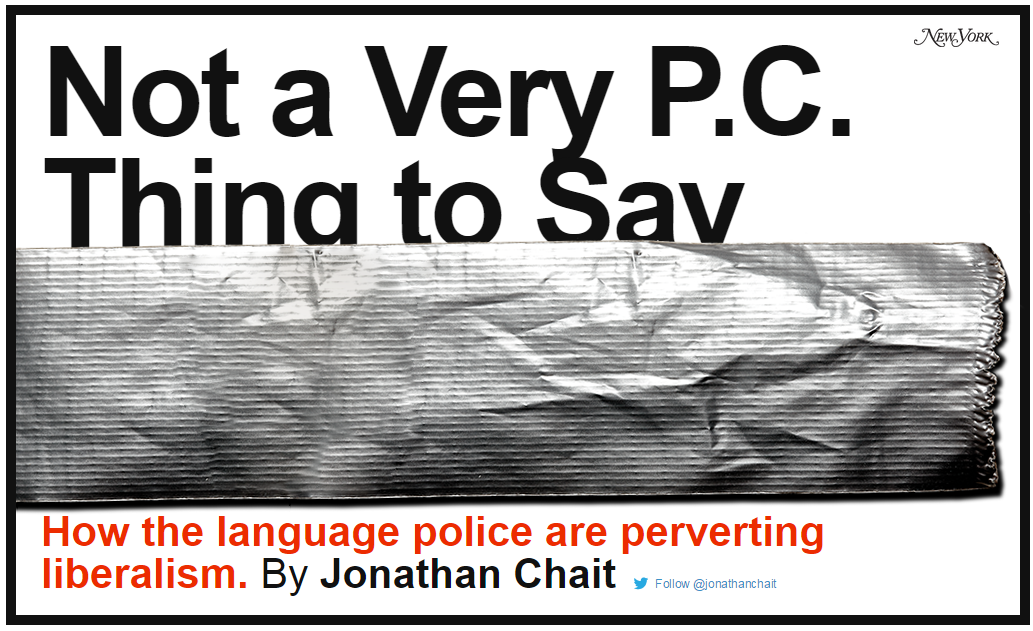
Jonathan Chait just wrote an article about the new political correctness that is absolutely required reading for anyone with any interest in modern American politics: Not a Very P.C. Thing to Say. The hardest part of me writing about it is that there are just too many quotes that I wanted to include! I’ll try to hit the highlights, but this is really an article you’ve got to read for yourself all the way through.

So, note on the subtitle “How the language police are perverting liberalism.” Chait is here referring to the old-school definition of liberalism as being concerned with individualism and civil liberties. He notes that this is actually distinct from the political left (a statement that veers between accurate and quaint). True liberals don’t buy into PC, but the left has been influenced by Marxist ideas that discount the notion of free speech entirely:

The Marxist left has always dismissed liberalism’s commitment to protecting the rights of its political opponents… as hopelessly naïve… Why respect the rights of the class whose power you’re trying to smash? And so, according to Marxist thinking, your political rights depend entirely on what class you belong to… The modern far left has borrowed the Marxist critique of liberalism and substituted race and gender identities for economic ones.

He absolutely gets that the fundamental, driving motivator behind political correctness is not actually a concern with fairness or social justice, but a love of a particularly vicious approach to politics in the 21st century. He writes that “political correctness is not a rigorous commitment to social equality so much as a system of left-wing ideological repression” and also:

Political correctness is a style of politics in which the more radical members of the left attempt to regulate political discourse by defining opposing views as bigoted and illegitimate. Two decades ago, the only communities where the left could exert such hegemonic control lay within academia, which gave it an influence on intellectual life far out of proportion to its numeric size. Today’s political correctness flourishes most consequentially on social media, where it enjoys a frisson of cool and vast new cultural reach. And since social media is also now the milieu that hosts most political debate, the new p.c. has attained an influence over mainstream journalism and commentary beyond that of the old.

Chait also makes a simple but profound observation about the new political correctness: “It also makes money.” It does this (to summarize) as a near-endless supply of tantalizing clickbait. The effects of this new political correctness–far more virulent than the old version that peaked in 1991–is truly disturbing, and this is where Chait makes some of his strongest arguments as he describes thinkers on the left who have been cowed into silence by the new regime. Here are some snippets without context to give you some sentiment for how people react to living under the constant threat of being ostracized and publicly humiliated for thought crimes:

  • “Everyone is so scared to speak right now.”
  • “This is an environment of fear… Every other day I say to my friends, ‘How did we get back to 1991?’”
  • “If you tweet something straight­forwardly feminist, you immediately get a wave of love and favorites, but if you tweet something in a cranky feminist mode then the opposite happens… The price is too high; you feel like there might be banishment waiting for you.”
  • “It seems to me now that the public face of social liberalism has ceased to seem positive, joyful, human, and freeing… There are so many ways to step on a land mine now, so many terms that have become forbidden, so many attitudes that will get you cast out if you even appear to hold them. I’m far from alone in feeling that it’s typically not worth it to engage, given the risks.”

Just to be clear, these are all quotes from people on the left of American politics. They are feminist academics and liberal journalists, and they are afraid they will be turned on by their own. As events like Gamergate show, they should be afraid.

Chait tries to leave us with a happy note, sort of, but it’s not much to go on. He says that “the p.c. style of politics has one serious, possibly fatal drawback: It is exhausting.” The hope, as far as I can tell, is that the tyrants will just get tired of all the effort of maintaining their intellectual tyranny. And there have definitely been moments in recent news when it seemed as though the entire social justice movement was about to dissolve into a round of catastrophic cannibalism.[ref]The biggest one was the chaotic death-spiral / victim olympics after a feminist video about cat-calling went viral. Examples of conservative glee here and here.[/ref]

It would be nice if the social justice movement self-destructed. There are definitely some deep tensions within the movement, for example between cis- and trans-women. When the Vagina Monologues gets shut down not by annoyed social conservatives but by trans-advocates who feel that it discriminates against women who lack a vagina, you start to realize the potential for a major civil war.

So yeah: it would be nice if social justice warriors just got exhausted with the labor involved or if the coalition fragmented into warring sub-tribes, but if that’s the best plan to protect democracy and civil liberties and the culture of open inquiry then we’re already in a very, very dark place.

But hey, if you want to end on a less grim note, there’s this: Army Deletes Tweet About ‘Chinks In Armor’ After People Cry Racism. Anyone with a large vocabulary can enjoy the fireworks when someone inadvertantly uses a word that sounds offensive but (if you are suitably literate) isn’t. Like when a student in my high school English class complained that heroin was a sexist name for a drug because it put female heroes in a bad light. She didn’t realize that they aren’t the same word: heroin vs. heroine.[ref]And I went to a school for the gifted![/ref] Of course, it’s less funny if you’re the guy who inadvertently uses an unusual word in the correct way and gets fired for it,[ref]like those sad saps who used the word “niggardly” in the 1990s.[/ref] but we’ve got to find some humor in the situation or we’re all going to go insane.

DeflateGate Meets Legit Data Analysis

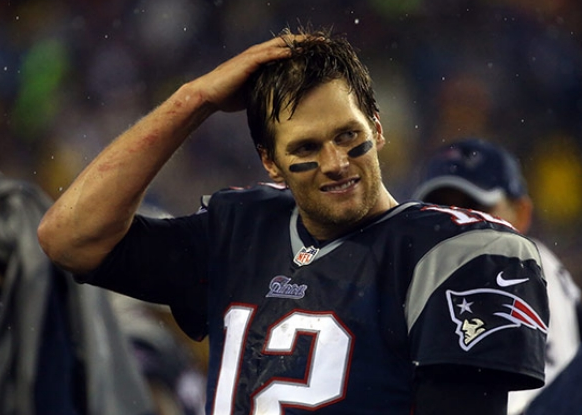
982 - Tom Brady

Slate’s got a great article about the backstory behind DeflateGate, complete with some really excellent data analysis. What can I say? I’m a data geek. Throw together some charts that tell a clear story that really deepens understanding of a current event and I’m ecstatic.

Now my buddy who is coming over to watch the Super Bowl on Sunday and is a huge fan of the Patriots? He might be less excited, because the article doesn’t make Tom Brady look very good.[ref]So, to make sure we watch the game on good terms, here is an article about why the whole controversy is stupid: Deflate-gate Is The Dumbest Sports Controversy Ever[/ref]

The story is basically this, Tom Brady (and Peyton Manning) urged the NFL to change the rules so that traveling teams could provide their own footballs for their own offense. Back in the day, the home team always provided the balls for both teams. After this change was made, suddenly the Patriots proved incapable of fumbling the football. Behold:

981 - Patriots Stats

They went from having about 42 plays per fumble (about average) to having 74 plays per fumble after the new rules went into effect (off the charts). Now, I’m not sure what he’s going for with his statistics mumbo-jumbo after that, but since I’m not getting paid I’m not going to do math. I’m just gonna say: that doesn’t look like chance to me. “The bottom line is,” according to the article, that “something happened in New England. It happened just before the 2007 season, and it completely changed this team.”

Oh, and a final thought, some folks have suggested that if you take a properly inflated ball from inside where it’s warm to outside where it’s colder it will lose pressure. Technically: yes. But (given actual weather conditions that day) probably not enough to explain DeflateGate.

Overcriminalization in America

984 - 150106_koch_police_gty

Politico Magazine ran an article a few weeks ago about overcriminalization in the US that was interesting in two ways. The first was the recitation of statistics and examples that show just how ridiculously overcriminalized our society has become. We have 5% of the world’s population. We have 25% of the worlds prisoners. Think about that: one out of every four human beings in a jail is in an American jail. That seems insane. What’s more, the sheer scope of our criminal code is absurd:

Congress creates, on average, more than 50 new criminal laws each year. Over time, this has translated into more than 4,500 federal criminal laws spread across 27,000 pages of the United States federal code. (This number does not include the thousands of criminal penalties in federal regulations.)

Not that we’re just addicted to criminal statutes, by the way. In How the Stock Market Works, Professor DeGennaro notes that:

The tax code contained just 11,400 words in 1914, one year after the Constitution was amended to permit the federal government to levy an income tax. It didn’t stay that way. Forbes contributor Kelly Phillips Erb said that the code was up to about 4,000,000 words by January 2013. That’s about four times as long as all of the Harry Potter novels combined. And you know what? That vastly understates the complexity of the US tax system. The code itself is just the law that tells the IRS what to do. The IRS has to devise regulations to put the law into practice. I doubt anyone really knows how many words are in the regulations, and the story gets worse.

The Forbes article he referred to is here, and it includes another jarring fact:

Since 2001, Congress has made nearly 5,000 changes to the Tax Code. That’s more than a change per day.

At this point we are way, way, way past the point where any normal human being could possibly be certain that they had not violated the law even if they made it their full-time job to do so. This is what led Harvey Silverglate to write his book Three Felonies a Day, suggesting that is how many felonies a typical American commits on a daily basis without ever knowing it. Sound crazy? So do some of the violations summarized in the Politico piece:

This explosion of criminal laws has led to imposing liability on activities that ordinary citizens would have no reason to believe would be criminal such as converting a wild donkey into a private donkey, bathing in the Arkansas Hot Springs National Park without a doctor’s note, and agreeing to take mail to the post office but not dropping it off. It has led to criminal liability for amateur arrowhead collectors who had no idea their hobby could be a federal crime, as well as criminal charges and a conviction for a former Indianapolis 500 champion who got lost while snowmobiling during a blizzard and unwittingly ended up on federal land.

So let me make one point (something not brought up in the article): the way Americans think about our government has a serious, serious flaw. We tend to view the job of legislators and the executive to get things done. Which, for most purposes, means to pass laws. When government doesn’t pass enough new laws you hear about gridlock and the assumption is that our government is defective. It is as though Americans have this bizarre picture in their minds that Washington DC is a factory for churning out legal statutes, and if we don’t get our quota than there’s something wrong with the factory. Why are more laws automatically better? Clearly we have too many laws already. Not every problem needs to be tackled by adding new laws. We can also think about repealing, reforming, consolidating, and streamlining the laws and the agencies we already have. But nobody gets elected by making enemies, and so our obsession with manufacturing new laws continues.[ref]This is not a politically neutral point, by the way. I still remember my high school government teacher explaining what he clearly thought was a brilliant theory that Republican politicians are systematically worse than Democratic ones because small government emphasis leads them to use their authority less. The implicit assumption was that politicians are better when they use their authority as frequently and extensively as possible. At the time it seemed off to me, but I couldn’t then express why.[/ref]

Here’s the thing, though, the average law-abiding, middle-class, educated American doesn’t have that much to fear from overcriminalization. Sure, you might get lost in a blizzard and end up on federal land and get slapped with a criminal charge, but for the most part if your life is more or less together before such a freak accident occurs, you can probably depend on your savings, education, friends and families, etc. to survive the ordeal. In this way, breaking the law (on accident) is a lot like having your house burn down or losing your job or other life emergencies: they are the biggest threat to the most vulnerable.

And that’s the second interesting thing about this article. It is written by Charles G. Koch and Mark V. Holden. Yes, one of the infamous Koch Brothers (Holden is General Counsel and Senior Vice President of Koch Industries, Inc.) And yet the primary point of the article is that overcriminalization is basically a form of systmatic, state-oppression of the poor and vulnerable. For example:

African-Americans, who make up around 13 percent of the U.S. population but account for almost 40 percent of the inmates, are significantly affected by these issues. According to Harvard sociologist Bruce Western: “Prison has become the new poverty trap. It has become a routine event for poor African-American men and their families, creating an enduring disadvantage at the very bottom of American society.”

Now, even if you’re very skeptical and you think that that Koch Brothers are just pretending to care about the African-American community, fine: you should still read the article. Whatever you think of their motives[ref]I, for one, like to give people the benefit of the doubt.[/ref], the fact remains that they have presented a very good argument for why overcriminalization is hurting America’s poor and even included a 6-step plan to fix it. Check it out.

Meg Conley on Operation Underground Railroad

985 - Meg Conley at OUR Premier

This is my friend Meg Conley. She  blogs at Meg In Progress, and she is awesome for a lot of reasons. One of those reasons is her involvement with Operation Underground Railroad. OUR is an independent non-profit with a very simple mission: they save children from sexual slavery. They do this by sending in former CIA agents, Navy SEALS, etc. in undercover sting operations (coordinated with local governments) to set up deals with sex traffickers. Once the money changes hands, local law enforcement comes in and arrests the dealers, and the children are freed. Putting bad guys away is a big deal, but OUR never takes their focus away from what matters most, the kids. Here’s Meg:

Yes in the movie, bad guys were caught and evil was disrupted. But the beauty of OUR is that they understand that while catching the criminals is necessary and invaluable, their focus remains on the children. We saw babies rescued from the filth and despair of an orphanage run as a front for child trafficking. We heard the stories of girls that had been rescued from a daily life of darkness infused with violation. Girls that hurt and never expected to stop being hurt. Girls that “never knew there were people out there that worried about girls like me.” Girls that even amidst the lingering pain and trauma are finally learning to dream again. To see the value in life and, oh my blessed heaven, to see the value in themselves. And we saw men and women willing to sacrifice hard-earned resources, time with their families, and physical safety to save even one life.

Meg knows about OUR because she has been on one of their sting operations. Here she is again:

In August, I went on an undercover sting with them in the Dominican Republic. While there, my skin was touched by human traffickers as we shook hands and I pretended to want they were selling.  My heart was branded with the faces of the children as they marched past me at the end of the operation, out the door and onto a different, better life. My life was changed. I know firsthand the, at times, miraculous works of O.U.R. And yet, the movie last night pushed me back into my seat and pulled my eyes wide open.

The movie Meg is talking about is The Abolitionists, which Meg saw at an early screening yesterday. The movie tells the story of OUR. Here’s what the trailer looks like:

There are a lot of problems in the world, and there are a lot of good organizations trying to fight them. Child sexual slavery is one of the worst problems. OUR is one of the best organizations. Please read the rest of Meg’s piece and then help OUR expand their efforts.

Speaking in Tongues and Building Bridges

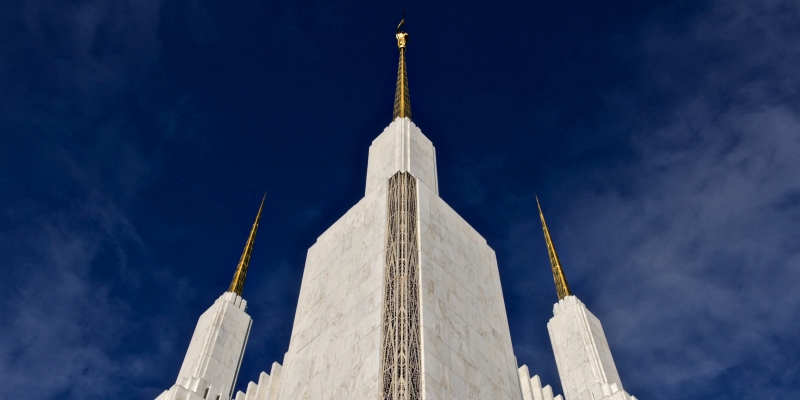
washington-dc-temple-lds-770754-wallpaper

I am religiously multilingual. I grew up in a devout Mormon family, I learned all the Mormon songs, heard all the Mormon stories, and read all the Mormon scriptures. I identified as a Mormon, and I still do. When I was in elementary school my best friends were all Mormon. But during that traumatic shake-up that happens to kids as they transfer from elementary school to middle school I missed my footing and fell out of favor with the other Mormon kids. For about the next decade, I didn’t have a single close Mormon friend I saw on regular basis, and the Mormons I did get along with most were those on the margins. Throughout the formative years of middle school, high school, and college the people I trusted, depended on, and interacted with outside of regular church meetings were almost exclusively with non-Mormons. And during regular church meetings? I was very lonely.[ref]I have close Mormon friends today, but that’s a recent development over the last 5 years or so.[/ref]

The upside of the loneliness was that I learned a religious version of code-switching. I’ve always had a keen interest in religion and politics and all the controversial topics you’re not supposed to discuss in polite company, and I spent all my time talking about those issues with non-Mormons. So I picked up some of the vocabulary, paradigms, values, and cultural touchstones of the Catholics, evangelicals, Jews, agnostics, and atheists around me.

One of the biggest impacts of religious multilingualism is that it changes how you view your own faith. The first realization is the most basic: you start to see how many of the unspoken assumptions about what you think and how you behave are not universal, but are particular to your own religious and cultural background. You start to realize just how much variety there is to the way different people view the world.

Along the way, you may also catch glimpses of your own religion reflected back to you in the eyes of others. This is a strange experience. It’s like vertigo or an out-of-body experience to see what is most familiar and close to your identity appear suddenly strange and distant. It’s a kind of radical dissociation, like what happens when you repeat an ordinary word until meaning and sound of the word separate. Try it, if you’re curious. The word “tub” is fun to use. Just start repeating it to yourself, out loud, at normal speed. Give it a couple of minutes at most, and suddenly you’ll feel like you’re making sounds instead of words.

Every now and then when I’m sitting in Elder’s Quorum and we’re saying a prayer I can’t help but look around at all the other guys in the room and think: “This is weird.” We’ve all got regular jobs with regular people and we know how to get along just fine in the regular world. But every Sunday we keep coming back to this brutally ugly meetinghouse, sitting in these weird pseudo-rooms made by moving giant curtains to subdivide a carpeted basketball court attached to a chapel, and we pray in front of each other like it’s the most mundane thing in the world. It is, by the experience of most of the American people, not a normal way to behave. For the non-religious the whole project is bizarre, and even for religious Americans the particular habits of Mormons—like our lack of formality or professional leadership—are definitively abnormal.

None of this is to say that I love my weird religion less. On the contrary, there are some things I appreciate about Mormonism that I wouldn’t have noticed without the experience of being religiously multilingual. High on that list is the fact that, as a general rule, Mormons proselyte with a positive message. That might seem obvious, but a Mormon living in the Bible Belt will soon be disabused of that notion. I’ve been told that I’m going to Hell simply for being Mormon on more than one occasion, and when I tried to join a Bible group on campus (because Institute seemed far away and, frankly, non-Mormons often know the Bible much better than we do), the leader staged what I can only describe as an intervention to try and rescue me from “Joe” Smith’s nefarious clutches. So, as it turns out, there are actually other ways to go about it. Of course individual Mormons fall short from time to time, but as a people we have nothing like the countercult movement, and I’m proud of that.

Being religiously multilingual has helped me be a better Mormon in other ways as well. As I’ve learned more about other faith traditions, I’ve grown to view them with respect and admiration. Treating other religions this way is an intrinsic aspect of the Mormon view on truth.  Joseph Smith said that “One of the grand fundamental principles of Mormonism is to receive truth, let it come from whence it may,”[ref]Discourses of the Prophet Joseph Smith, p. 199[/ref] and his successor Brigham Young reinforced that sentiment as well: “I want to say to my friends that we believe in all good. If you can find a truth in heaven, earth or hell, it belongs to our doctrine. We believe it; it is ours; we claim it.”[ref]Journal of Discourses, vol. 13, p. 335[/ref] Mormon scholar Terryl Givens[ref]Terryl Givens is my father.[/ref] described Joseph Smith’s belief in his calling as “an oracle of God, subject to moments of heavenly encounter and the pure flow of inspiration,” but also wrote that Smith was “insatiably eclectic in his borrowings and adaptations.”[ref]The Woman in the Wilderness: Mormonism, Catholicism, and Inspired Syncretism, p. 14[/ref]

This puts a very different light on the Mormon teaching that our church is “the only true and living church upon the face of the whole earth.”[ref]D&C 1:30[/ref] I do believe that the Church of Jesus Christ of Latter-day Saints is the one true Church, but to me that means something fairly narrow and limited. It means we’re the one authorized, formal institution. But it doesn’t mean we’re perfect, doesn’t mean we’re better, doesn’t mean we know it all, and doesn’t even mean we know the most. Mormons have no monopoly on truth. That is plainly evident from our leaders and in our scriptures. For example, Doctrine and Covenants section 49:8—a revelation given to Joseph Smith—talks about “holy men ye know not of,” cementing in scripture the principle that God is quite busy interacting with a lot of people other than Mormons to accomplish His purposes. Apostle Orson F. Whitney said the same thing in 1928 when he said that: “God is using more than one people for the accomplishment of His great and marvelous work. The Latter-day Saints cannot do it all. It is too vast, too arduous for any one people.”[ref]Orson F. Whitney, Conference Report, April 1928, p. 59[/ref]

I’ve become a huge fan of Krister Stendahl’s Three Rules of Religious Understanding and in particular rule number three: “Leave room for holy envy.” This isn’t a rule that I think Mormons have always fully grasped, but—as the quotes in the previous two paragraphs illustrate—it has always been a part of who we try to be.

I’d like to think that I’ve also been able to use my multilingual perspective in ways that have been constructive for other folks as well. Many years ago when Facebook groups had discussion boards, I was part of a particularly large group where the longest running-thread was titled “Protestants vs. Catholics” (or something similar). I often enjoyed participating in that discussion as the third leg of a tripod: Christian, but neither Protestant nor Catholic. No one ever really wins a debate of that nature, of course, but I think that changing the dynamic from simplistic one-on-one to a more fluid and stable three-way conversation sometimes improved the tenor and expanded the breadth of the discussion.

These, then, are the three primary benefits of religious multilingualism: an increased capacity for introspection, an increased capacity to learn from others, and an opportunity to engage more effectively in ecumenical discussions. Each of them, I believe, can be applied at the macro level to Mormonism as a whole just as I have seen them work in my own life.

One of the big surprises for the world travelers who came to Salt Lake during the 2002 Winter Olympics was that there were all of these conventional-looking white men and women who, at the drop of a hat, could hold forth in Spanish, Portuguese, Italian, Dutch, German, Tagalog, Mandarin, Cantonese, Japanese, and dozens of other languages.”Mormons Project Image As Diverse as Olympics,” wrote the New York Times. This is a natural consequence of the Church’s ambitious missionary program. There are about 50 languages taught at the Missionary Training Center (MTC) in Provo[ref]About the MTC[/ref] and the Church also runs MTCs in Argentina, Brazil, Chile, Colombia, the Dominican Republic, Ghana, Guatemala, Mexico, New Zealand, Peru, the Philippines, South Africa, Spain, and the United Kingdom.[ref]Wikipedia[/ref]

It’s obvious when you think about it: lots of Mormons serve missions, and so lots of Mormons speak foreign languages. Mormons don’t just learn the language when they live in foreign countries. They learn and come to love the culture. Talk to any Mormon missionary—even those who served stateside and didn’t learn a new language—and they will almost invariably be able to tell you about the best local cousine and speak with adopted pride about local traditions and history from wherever they served, be it Alabama or Albania.[ref]Yup, we’re there. I checked.[/ref]

All of this international exposure and cultural multilingualism means that Mormons—and especially American Mormons—have an opportunity and an obligation to try and separate our cultural heritage from the essence of Mormonism. If instead of a young American farmer named Joseph Smith, God had restored His church to a young Indian or a young Japanese farmer, what would the institution look like today? What part of what Mormon missionaries export is essential Mormonism and what part is Wassatch Front culture? These are murky and sensitive questions, but important ones.

The process of attempting to distill religion from culture is uncomfortable and can never yield truly definitive results, but it is important in understanding ourselves and reaching out and engage with a global audience. In years to come, it may very well be that one of the most important consequences of our global missionary effort is not what we teach to others but what, by seeing our faith refracted back in different languages and cultures, we learn about our own religion.

Of course it’s not just our own religion we should learn about, but the religions, traditions, and cultural insights of the people of the world. This is a matter of scriptural injunction for Mormons: “study and learn, and become acquainted with all good books, and with languages, tongues, and people.”[ref]Doctrine and Covenants 90:15[/ref] I also find it very interesting that the topic of faith crises is so prominent in our discussion these days, and is linked in our scripture to the command to learn: “And as all have not faith, seek ye diligently and teach one another words of wisdom; yea, seek ye out of the best books words of wisdom; seek learning, even by study and also by faith.”[ref]Doctrine and Covenants 88:118[/ref] We may come to learn that when it comes to faith crisis in our secular age, the best way out is through. The solution is not insularity, but greater exposure and the inoculation that comes with the habit of being exposed to many, many new ideas and developing the skill of synthesizing what we learn that is new into our traditions and beliefs.

Now that I’ve covered briefly how Mormons can use our cultural multilingualism to achieve greater introspection and learn from others, let’s consider the third benefit of multilingualism, engaging beneficially in ecumenical discussions.

The relationship between Mormonism and the broader Christian community has always been fraught. Mainstream Christian denominations have reacted to Mormonism’s stark claims to being the only truth Church by refusing to recognize Mormon baptisms. Mormons are occasionally miffed about that without realizing that Mormons don’t recognize anyone else’s baptisms either! The biggest sticking point in this relationship, of course, is that many other Christians denominations assert that Mormonism is not Christian at all.

Mormons, who unambiguously view themselves as Christians, are torn by conflicting desires to enter a broader ecumenical community and to maintain their distinctiveness. Mormon scholar Armand Mauss writes about this as the tension between assimilation and differentiation in, for example, The Angel and the Beehive . Early Mormons like the Pratt brothers emphasized Mormon distinctiveness, but more recently President Hinckley (who led the Church until 2008) oversaw a period of engagement that downplayed the more revolutionary teachings of Joseph Smith and emphasized common Christian doctrines.

Although clearly important, this emphasis on the relationship between Mormons and mainstream Christianity has distracted attention from a different set of bridges that Mormons could be building. In an age in which it often seems as though traditional religious voices are declining in prominence and importance, Mormonism may be uniquely positioned to enter into dialogue with rising secular voices, shifting the emphasis from intra-Christian discussions to inter-faith discussions where “secularism” is considered a faith group in its own right. That’s a controversial classification, of course, but other than that nomenclature there isn’t really that much to debate: secularism is clearly more than the mere absence of religion. In our society, secularism entails a suite of philosophical commitments (such as to materialism/physicalism and analytic reductionism) and cultural attitudes that function in ways that are broadly equivalent to a religion, and it is a religion with which Mormonism is uniquely positioned to interact with.

Mormonism has long held, for example, that there is no conflict between science and religion. Brigham Young taught that “Our religion will not clash with or contradict the facts of science in any particular,” and he even viewed that as a distinctive element of Mormonism that set it aside from other Christian denominations.[ref]Brigham Young, Journal of Discourses, vol 14, pg 116[/ref] Mormons have also long taught a kind of metaphysical monism that, while not necessarily identical to physicalism, is certainly more akin to it than to traditional Cartesian dualism. “All spirit is matter,” reads a canonized revelation to Joseph Smith.[ref]Doctrine and Covenants 131:7[/ref]

Mormons also reject the conventional Christian idea that God created the world ex nihilo, which means “from nothing.” Instead of God creating by conjuring something out of nothing, Mormons believe that the world was created by organizing materials that were already present. More importantly, Mormon scripture contains hints that some kernel of the human soul itself is fundamentally uncreated: “Man was also in the beginning with God. Intelligence, or the light of truth, was not created or made, neither indeed can be.”[ref]Doctrine and Covenants 93:29[/ref]

The precise philosophical implications of these beliefs are unclear, especially since Mormonism has no official theology and no authoritative theologians. But some general trends are clear. The first is that, in a sense, Mormons reject supernaturalism. Instead, we embrace a variant of Clarke’s Third Law: Sufficiently advanced technology is indistinguishable from miracles. How far Mormons run with this notion is a matter for individual deliberation, but the extreme position that posits God as a kind of super-evolved person is not inconceivable. And that is a definition of God that even Richard Dawkins could learn to live with.

And, even without precisely working out the theology, the Mormon perspective does have relevance to important topics like the Problem of Evil. How does one reconcile why bad things happen to good people? The most prominent response involves citing free will, but if you believe that God created human beings out of nothing then that explanation doesn’t work very well. Sure, we’re free to act out according to our sinful natures, but if God made us then He made our natures. Why didn’t He make them better? Discarding the doctrine of creation ex nihilo doesn’t solve the Problem of Evil in one fell swoop, but it does have a significant and meaningful impact on the conversation.

It is, however, not an ecumenical conversation. The Problem of Evil is an example of a theological problem that is of interest to anyone who  believes in a creator God and also serves as a linchpin in many atheist arguments. And so, rather than jumping into the Protestant vs. Catholic debate as I did many years ago, I have to wonder if Mormonism might be able to fill a similar role in the more general religious vs. secular discussion going on in our world. It would be a stretch to say that Mormonism has a foot in each domain, but it is at least in the unique position of being able to survey both landscapes from where it stands.

This may seem like an absurd position, so I want to spend just a little time on it. Lots of faiths can adapt to secularism by simply downplaying supernatural claims and reducing everything to symbolism. Mormonism is as capable as any other denomination of taking that route. There is nothing unique to Mormonism in that strategy. There’s also nothing interesting or useful in that strategy. Assimilating religion into a secular worldview does nothing good for either religion or secularism, and history shows that religions which go down that road gradually fade and die.

Instead, what Mormonism offers is the prospect of maintaining the vitality of historical religious propositions in a secular environment. To be clear: I’m talking about Mormons who believe a man named Jesus Christ walked the Earth 2,000 years ago, performed various miracles, died, and was resurrected. The Mormon difference isn’t to deny that miracles can happen, it’s to imagine that miracles do not violate the laws of physics but operate at a higher level. This is weird, yes, but quantum mechanics is weird. Again: the best way out of the religion vs. science conflict is through.

It is also worth noting that the idea of synthesizing religious and secular views is not a new one for Mormons. One of the greatest examples comes from Orson Scott Card’s greatest work The Speaker for the Dead. The book recounts how, after exterminating humanity’s rivals in the events of Ender’s Game, Ender created a new, secular religion. The religion is secular in the sense of not making any supernatural claims or even discussing God, and it is clearly modeled on the cultural place Mormonism actually occupies in American society. Mormonism is at once scoffed at by traditional religions for being irreligious in its conceptions of deity and by secular society for being overly religious in its belief in angels in the age of railways. Similarly, in Card’s writing, the religion of the Speakers is viewed with mistrust both by the futuristic Catholic Church and the dominant secular society. It’s an uncomfortable and strange place that Mormonism occupies, but also a potentially fruitful one.

Perhaps the biggest thing holding Mormonism back from this kind of bridge-building between religious and secular society is our own reticence. One of the reasons Mormonism seems weird is that in trying to emphasize our commonality with other Christian denominations we sometimes refuse to speak up clearly and plainly about beliefs that would emphasize our distinctiveness. And, since we suddenly go silent exactly where people are most interested in what we believe, it’s no surprise that the vacuum gets filled with tangential, obscure, or false versions of what we believe. Being more willing to speak explicitly about uniquely Mormon beliefs is an important part of being seen as less weird or, at least, being seen as weird for the right reasons.[ref]This is a big part of what inspired my parents, Terryl and Fiona Givens, to write their first book together: The God Who Weeps: How Mormonism Makes Sense of Life .[/ref]

Mormonism, both because of our unusual doctrine and our far-flung missions, is truly multilingual. We can and should use this trait to better understand ourselves, better learn from our neighbors, and more productively engage in the great religious discussions of our day, which is happening not within the overtly religious community, but between secular and religious philosophies.

Why John Dehlin Faces Church Discipline: Updated for Meridian Magazine

Meridian Magazine is running an updated story about the real reasons John Dehlin is most likely facing disciplinary action. The article merges and updates my Real Clear Religion post and my Difficult Run post.

This is not a topic I enjoy writing about for several reasons. First, I feel no ill-will towards Dehlin and therefore no happiness at all that he faces disciplinary council. It is simply sad. Second, there is a lot of material to read through in order to write a post like this, and none of the material is intrinsically interesting or uplifting. Lastly, this kind of post tends to bring out the more adversarial aspects of Internet communication, and that is something that I do not enjoy. My days of being excited at the prospect of a flamewar are long, long gone.

I wrote my initial piece[ref]The RCR and DR posts were one post before the RCR version got substantially edited for length[/ref] because I thought it was important for there to be a rigorous and balanced alternative to Dehlin’s narrative. When Meridian invited me to republish the post there, I did the work of merging and updating for the same reason. I hope I’ve accomplished that goal.

EDITED 2017-Mar-28: There was originally an image on this post. The image was a screenshot of an iOS device with a notification from the New York Times stating “Prominent Mormon Faces Excommunication for Backing Gay Marriage.” The person who took that image contacted me today and asked me to remove it and also his/her name, and so I have.

Foucault: A Possible Colleague of Neoliberals?

French philosopher Michel Foucault is a darling of the academic left; one that I have been strongly encouraged to read.[ref]One friend described him as “the prophet” and “seer” of modernity.[/ref] I own several of his works, but have yet to delve into his writing much. The release of a brand new book, however, has sparked my interest even more. In an interview with Jacobin, sociologist and editor Daniel Zamora explains,

Foucault was highly attracted to economic liberalism: he saw in it the possibility of a form of governmentality that was much less normative and authoritarian than the socialist and communist left, which he saw as totally obsolete. He especially saw in neoliberalism a “much less bureaucratic” and “much less disciplinarian” form of politics than that offered by the postwar welfare state. He seemed to imagine a neoliberalism that wouldn’t project its anthropological models on the individual, that would offer individuals greater autonomy vis-à-vis the state.

On those who often dismiss neoliberal intellectuals like Hayek, Becker, or Friedman, Zamora says,

The intellectual left…has often remained trapped in a “school” attitude, refusing a priori to consider or debate ideas and traditions that start from different premises than its own. It’s a very damaging attitude. One finds oneself dealing with people who’ve practically never read the intellectual founding fathers of the political ideology they’re supposedly attacking! Their knowledge is often limited to a few reductive commonplaces.

Reason‘s Brian Doherty writes that “Foucault saw something in “neoliberalism” that anyone who pretends to care about human liberty, possibility, or dignity should respect.” Several years ago, Doherty’s fellow Reason editor Nick Gillespie pointed out that

five years before his death in 1984, Foucault gave a generally appreciative series of Paris lectures on classical liberalism that have finally been translated into English. In The Birth of Biopolitics (Palgrave MacMillan), Foucault, always focused on the exercise of power and repression, tells his students to read Hayek and crew “with special care.” He found much to commend in their work. First and foremost, true liberalism is “imbued with the principle: ‘One always governs too much.’” As important, it asks (and answers) the question, “Why, after all, is it necessary to govern?”

This is encouraging. Tufts professor Daniel Drezner thinks “conservatives should embrace [Foucault] and his work. From a conservative perspective, the great thing about Foucault’s writing is that it is more plastic than Marx, and far less economically subversive. Academics rooted in Foucauldian thought are far more compatible with neoliberalism than the old Marxist academics.” Drezner’s article title goes even further: “Why Michel Foucault is the Libertarian’s Best Friend.”

Given my attraction to much of the rhetoric and concerns of the Left,[ref]Obviously, I differ on the means to achieving the desired ends of the Left.[/ref] I’m excited to begin my Foucault journey.

March for Life 2015

Photo of crowds at the 2013 March for Life. (CatholicPhilly.com)

The annual pro-life March for Life on Washington DC is huge, and it seems to be getting bigger (and younger) every year. Crowd estimates are very controversial, but here’s what the Wikipedia entry has just to give you a sense of the scale:

The march has previously drawn around 250,000 people annually since 2003, though estimates put both the 2011 and 2012 attendances at 400,000 each. The 2013 March for Life drew a claimed 650,000 people.

The March for Life in 2013 was the 40th anniversary of Roe v. Wade, which explains the huge numbers. Yesterday’s 2015 iteration was down from the high numbers, with early estimates of up to 200,000.

But don’t expect to hear about “hundreds of thousands” from mainstream media coverage. Don’t even expect to hear about “tens of thousands.” You might, if you actually go out and search for them, find an article about “thousands” of people marching. More likely, however, you’ll hear crickets chirping. This is one event the media does not like to cover.

For anyone who is already associated with the pro-life movement: you know how much this movement means. You know what is at stake in principles and in innocent lives. For anyone who might not know, however, let me just quote from an address given at the 2008 March for Life:

We contend, and we contend relentlessly, for the dignity of the human person, of every human person, created in the image and likeness of God, destined from eternity for eternity—every human person, no matter how weak or how strong, no matter how young or how old, no matter how productive or how burdensome, no matter how welcome or how inconvenient. Nobody is a nobody; nobody is unwanted. All are wanted by God, and therefore to be respected, protected, and cherished by us.

We shall not weary, we shall not rest, until every unborn child is protected in law and welcomed in life. We shall not weary, we shall not rest, until all the elderly who have run life’s course are protected against despair and abandonment, protected by the rule of law and the bonds of love. We shall not weary, we shall not rest, until every young woman is given the help she needs to recognize the problem of pregnancy as the gift of life. We shall not weary, we shall not rest, as we stand guard at the entrance gates and the exit gates of life, and at every step along way of life, bearing witness in word and deed to the dignity of the human person—of every human person.

You might not readily associate this quote, with its talk of support for young pregnant women and for babies even after they are born, because the stereotypes of the pro-life movement is sex-obsessed and devoid of compassion for anyone except the unborn. Well, whatever you may have heard, these words echo my convictions. They echo the conviction of every ardent pro-lifer I have ever met.

I encourage you to read the rest of the speech, which First Things reprinted today.

This is what we stand for.

This is who we are.