Some Articles about the Coming Demographic Winter

995 - demwinterchild

A friend gave some very high praise to The History of Fertility Transitions and the New Memeplex, and so it has been sitting amongst my Chrome browser tabs for a month or more. Last week, I read it, and it really is a very important, big-picture article. The basic idea is that memes compete via cultural transmission in much the same way that genes compete via biological transmission.[ref]This isn’t unique to the article. It’s memetics, which comes from Richard Dawkin’s famous book The Selfish Gene.[/ref] Historically, memes have been transmitted primarily through intergenerational transfer, which has given a strong advantage to cultures with high fertility. If you have more kids, and if the main way to pass on memes is to kids, than successful cultures are those that have lots of kids.

The advent of the printing press and other technological advancements turbocharged an alternative method of meme reproduction however: cultural diffusion. Now memes didn’t have to depend on having lots of children to carry them on. They could also be transmitted laterally in books.[ref]Lateral transmission was always possible but was not as powerful.[/ref] This resulted in a break between biological and cultural evolution, and it allowed cultures with low fertility to compete successfully by “infecting” other cultures with the meme for lower fertility.

Accordingly, there was a massive cultural transition that started in the 18th century with the American and French Revolutions and has since engulfed the entire world: all countries and regions in the world either already practice controlled fertility or are transitioning from uncontrolled / natural fertility to controlled fertility. At an individual level, this makes sense because it allows families to invest more resources per child, especially in education. And education is the key to maintaining and increasing social status. So the first consequence is a drastic reduction in the fertility rate. In many developed nations, the fertility rate[ref]excluding immigration[/ref] is already far below replacement. The second consequence is that the eugenic effects of natural fertility (in which couples with high intelligence and self-control have more children) have been replaced by dysgenic effects (in which couples with high intelligence and self-control have fewer children.) As the article puts it:

The benefits of the new pattern are increased material wealth per person, a reduction in disease, starvation, and genocide, and upward social mobility. The main drawback is the onset of a dysgenic phase that may end civilization as we know it.

The article is most impressive for the exhaustive, meticulously researched evidence that the transition has, in fact, occurred.[ref]Seriously, just scan to the bottom and check out the number of references![/ref] It doesn’t do as good a job at talking about the consequences of this transition, however. The dysgenic effect is not the only problem, and may not even be the most acute one. I happen to have recently watched a YouTube documentary about the demographic winter being created by declining fertility rates. It’s a demographic winter because, as fertility rates fall rapidly, the average age of a population rises dramatically. You still have all the old folks (from prior decades when fertility was higher), but there are far fewer children to replace them. As a result, children become relatively scarce.

This isn’t just sad. It’s very, very dangerous. Some of the most obvious problems have to do with entitlements for the elderly. When you have a huge population of old, retired folks and a much, much smaller population of active workers, this is bad. It gets much worse when you factor in immigration, since the racial characteristics of the two groups may be significantly different as well. In the United States, for example, you’ll have a lot of young Hispanics paying taxes to support retired whites. You’ll get a similar problem in Europe, with African and Middle Eastern immigrants taking the place of Hispanics.

Another point made by the documentary, and a plausible one, is that the economy tracks population with about a 48-year lag. The idea is that what really determines the stock market and overall economic performance is consumption, and people hit their peak consumption at about age 48. So when you have a very large cohort hit age 48, you get an economic boom. If the successive generations are much smaller, you will get economic contractions.[ref]In the video, you will see that the 2009 decline fits this trend almost perfectly, as the Baby Boom generation passes it’s peak spending in 2008.[/ref]

This might seem counterintutive. Aren’t more people a drain on resources? No, not necessarily. As this fascinating Wall Street Journal article outlines:

An odd thing about people, compared with other animals, is that the more of us there are, the more we thrive. World population has doubled in my lifetime, but the world’s income has octupled. The richest places on Earth are among the most densely populated.

Economic growth depends on the creative energy that comes from lots of people trading ideas in densely populated clusters. If population density declines, so too will economic and scientific progress.

Of course, the biggest argument in favor of limited population is environmental. Don’t more people take up more resources? But there’s a major problem with this criticism as well, which is that the unit of interest is not really individuals but rather households. In other words, if you have a situation where you’ve got 10,000 households and each has 4 people (for a total population of 40,000) and another situation where you’ve got 20,000 household and each has 2 people (for a total population of 40,000), then it’s pretty obvious that the population with more households is going to use up a lot more resources. Of course there is still a maximum aggregate population that the Earth can sustain, but the point is that the resource savings from low fertility are going to be much, much less than you  might initially think.

Looking ahead, I think the best case scenario is that we manage to survive the coming demographic contraction without some kind of horrific World War III followed by Mad Max scenario. But, ultimately, the aggregate fertility rate really needs to remain at replacement rate levels. Otherwise, we’re looking at the possibility of species suicide. Frankly, however, I would prefer that we see the return of positive population growth in the future coupled with some serious attempts at extra-planetary colonization. It is the nature of life to grow. I don’t believe stagnation is a long-run solution.

Is There Really a Wedge Between Production and Wages?

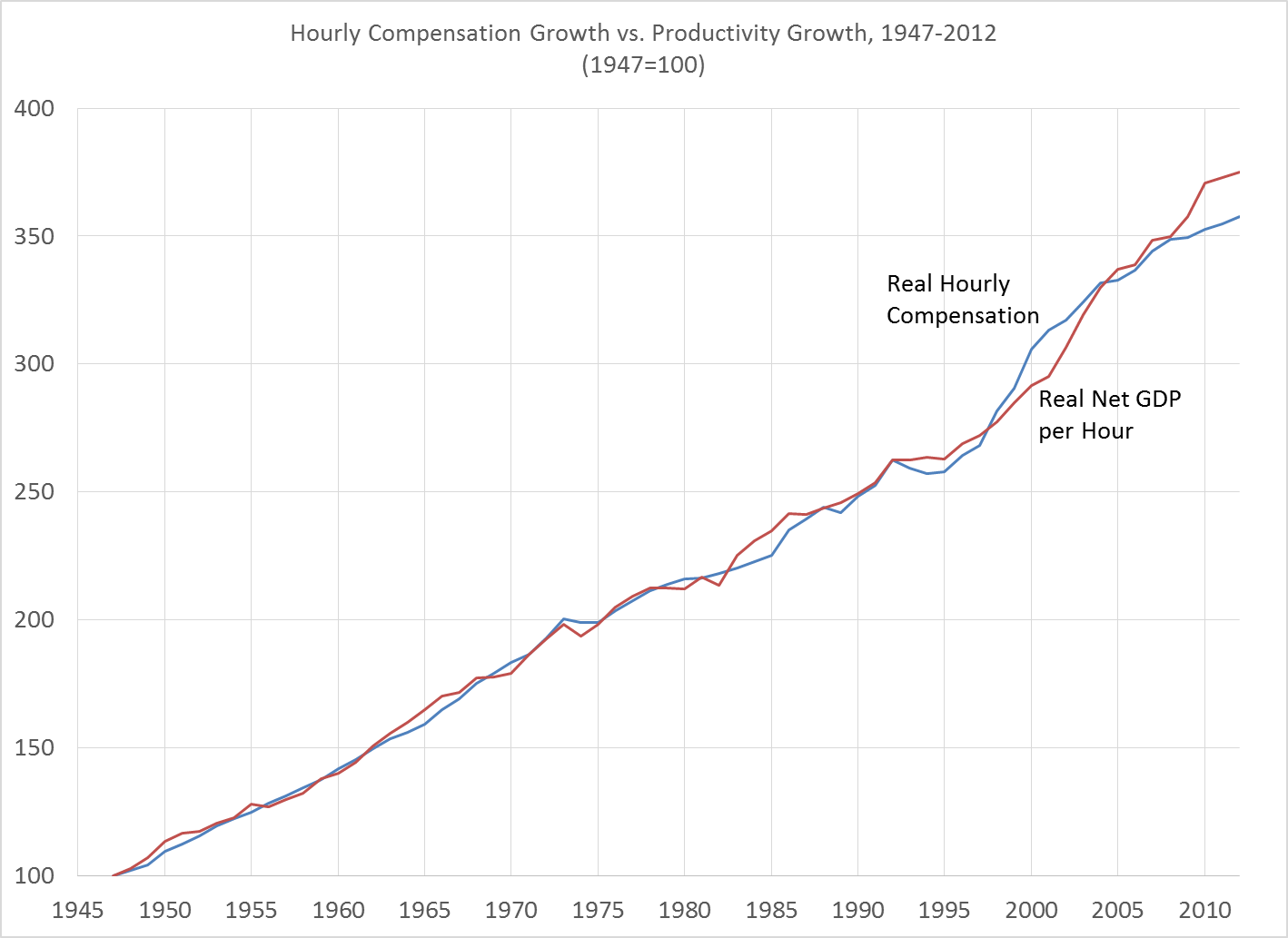
The above chart has been a talking point for the past couple years. Economic theory posits that an increase in capital per worker leads to increase output per worker which leads to increased income per worker. However, there has been a supposed wedge between productivity and worker compensation since the 1970s. Yet the Manhattan Institute’s Scott Winship argues otherwise. He lists 6 keys to properly analyzing production and wages:

  1. Look at hourly pay, not annual household or family income.
  2. Look at hourly compensation, not hourly wages.
  3. Look at the mean, not the median.
  4. Compare the pay and productivity of the same group of workers.
  5. Use the same price adjustment for productivity and for compensation.
  6. Exclude forms of income that obscure the fundamental question of whether workers receive higher pay when they produce more value.

Number four is especially important:

[The chart above] compares the compensation of production and nonsupervisory workers in the private sector to productivity in the overall economy. The twenty percent of the workforce that falls outside “production and nonsupervisory workers” are excluded from the compensation trend—a group that includes supervisors, who are higher-paid than non-supervisors. Meanwhile, the productivity trend includes them. If productivity has increased primarily among supervisory workers, then we wouldn’t expect compensation among other workers to track productivity growth.

In number six, he states, “Technically, if one is interested in whether workers are being fairly compensated, it probably makes the most sense to compare the growth of compensation to the growth of compensation plus profits. More broadly, one might be interested in whether compensation is growing in line with the income going to owners of capital generally (including those who receive rent or interest).”

He produces a new chart that looks at “hourly compensation and compare[s] it to “net” productivity (excluding depreciation and also proprietors’ income). Both apply to the “nonfarm business sector,” which excludes the parts of GDP produced from the farm, government, non-profit, and housing sectors, thereby avoiding the issues of homeowners renting to themselves and of indirect taxes (along with other measurement issues in the government sector).” Furthermore, it “use[s] the same price adjustment for both compensation and productivity.” Finally, it excludes proprietors’ income (income from one’s business), “as it is not at all clear how to allocate that category into income from labor and income from capital”:

Winship clarifies that ““labor” includes extremely well-paid executives as well as minimum-wage workers, so the fact that labor’s piece of the pie hasn’t shrunk does not mean that inequality between workers hasn’t grown. But it does complicate unified theories of rising inequality.”

Ahmed and Charlie

994 - We are Charlie
Over at Times and Seasons, Walter van Beek has an article in which he shares one of the most popular reactions to the murder of 12 at the headquarters of the French satirical magazine Charlie Hebdo: We are all Charlie. He’s getting some pushback in the comments. I’m torn. On the one hand, I agree very strongly with the commenters who are pushing back. Charlie Hebdo was, by my standards, a vile and disgusting publication. I do not wish to identify myself with it. And yet I wish very  much to identify myself with the principle of free speech, and also express some solidarity with those who are reeling in the wake of this traumatic event. Is there a way to do both?

Mormons have our own perspective on this, especially given the overwhelming popularity of The Book of Mormon musical. It’s long been fair game in the United States and elsewhere to make comments about Mormons that one would never make about most other religious groups. We don’t generally enjoy these kinds of attacks, but we don’t protest them either. We tend to just make the most of it and get on with our lives. As a Mormon, I support the right of  Trey Parker, Robert Lopez, and Matt Stone to publicly deride and mock my faith. But it doesn’t mean I have to identify myself with them.

Well, it turns out that there is an alternative to the “We are Charlie” sentiment. And it is “We are Ahmed.”

Two of those killed, 42-year-old Ahmed Merabet and 49-year-old Franck Brinsolaro, were police officers…Merabet was himself Muslim.

Merabet, then, died at the hands of one of his own — albeit its fanatical and dangerous minority. It is especially and darkly ironic given that the gunmen allegedly shouted, “We have avenged the Prophet Muhammad.” The name “Ahmed” shares linguistic roots with “Muhammad,” and the prophet was sometimes referred to as Ahmed.

He gave his life to protect Charlie Hebdo’s right to ridicule his religion.

Ahmed’s example[ref]I hope it is not assuming to much to presume that he wasn’t an avid fan of Charlie Hebdo, but was just there doing his job.[/ref] shows it is possible to bypass identification with vulgar and demeaning expressions of free speech and still give utmost dedication to the principle itself. I don’t have to like what everyone does with their free speech to be passionately dedicated to the ideal of free speech itself. There is a way to eschew vitriol and still defend the principle of those who chose to spew it. Ahmed showed us that example, and so I can say “We are Ahmed” with far less reservation than I could say “We are Charlie.”

New Christianity and Old Imperialism

Catholic Africans have made themselves heard at the recent Synod on the Family:

What was new at the extraordinary synod—and what helped make it “extraordinary” in the ordinary sense of that word—was the emergence of African Catholicism as a major factor in shaping the future of global Catholicism. African synod fathers were among the leaders in challenging the Kasper proposals [regarding divorce and receiving the Eucharist], arguing forcefully that the Christian idea of marriage had come to their cultures as a liberating force, especially for women. They also suggested, implicitly if not explicitly, that bishops representing dying local churches ought not be exporting Western decadence to the Global South, where Catholicism was growing exponentially by preaching the truths of the Gospel with compassion but also without compromise.

And representation of Asian countries in the Catholic hierarchy is growing along with the numbers of Catholics in those countries:

Pope Francis has just named 15 new “voting cardinals” to the body of prelates who will elect his successor, and his choices represent a further dilution of the power of the Italian bureaucracy which has hitherto constituted the hard core of global Catholicism. The new cardinal-electors hail from a total of 14 countries; only five come from Europe, and the European choices are somewhat unconventional.

With the growth of Catholicism and Christianity in general in Africa and Asia, Europeans and Americans are also finding something out: The new Christianity is the old Christianity. The Christianity of Africa and Asia is not the intellectualized Christianity of late Europe. It’s the Christianity of the New and Old Testament, complete with belief in miracles, the power of prayer, the importance of communal worship,the existence of angels and demons, and in the case of Catholicism, all the traditional Church views on abortion, marriage, divorce, and other topics.

Catholicism and Christianity are growing into a more truly global belief with voices heard from all nations. All Christians should be happy, right? Wrong.

In the interview [Cardinal] Kasper tries to dismiss the opinions of African bishops (which need not be accepted in whole to be taken seriously) as the product of mere taboo:

“Africa is totally different from the West. Also Asian and Muslim countries, they’re very different, especially about gays. You can’t speak about this with Africans and people of Muslim countries. It’s not possible. It’s a taboo. For us, we say we ought not to discriminate, we don’t want to discriminate in certain respects.”

Cardinal Kasper then went on to say how Africans “should not tell us too much what we have to do.” Turns out, Cardinal Kasper isn’t alone in his views on non-European Christians:

Ekeocha perceived Kasper’s words as typical of the dismissals she has encountered as an African Christian living in Europe. She’s heard it before, and now she hears it again:

“Reading this interview brought much tears to my eyes and much sadness to my heart because as an African woman now living in Europe, I am used to having my moral views and values ignored or put down as an ‘African issue’or an ‘African view point.’ I have had people imply that I am not sophisticated or evolved enough in my understanding of human sexuality, homosexuality, marriage, sanctity of human life from conception, openness to life and the so called ‘over-population.’

So as a result, in many circles, any contributions I make in discussions are placed in second or third rung. How can Africa stand shoulder to shoulder with other cultures if our views are considered uncouth or uncool by a standard strictly scripted by Western, worldly and wealthy nations?”

So as a bonus to finding out the new Christianity is just like the old Christianity, we’re also finding out that, for all the talk of diversity and respecting different points of view, we have the same old imperialism. Europe knows best, and anyone who disagrees just isn’t enlightened enough. It couldn’t possibly be that Europe is decaying while Africa and Asia are growing and renewing, even though all demographics and personal testimonies point to that conclusion. It couldn’t possibly be that Africa and Asia are holding to enduring values while Europe is busy progressing itself into cultural oblivion. Which reminds me of a favorite C.S. Lewis quote:

We all want progress. But progress means getting nearer to the place where you want to be. And if you have taken a wrong turning then to go forward does not get you any nearer. If you are on the wrong road progress means doing an about-turn and walking back to the right road and in that case the man who turns back soonest is the most progressive man.

I’m willing to bet Africans and Asians are the most progressive Christians on the planet by that definition.

Racism, Partyism, and the Outgroup

996 - Slate Star Codex

This is one of the best posts I’ve ever read on the topic of social psychology, in-group / out-group bias, and political polarization: I Can Tolerate Anything Except the Outgroup. It is long, but well worth the read. The central thesis is that the out-group doesn’t often look like what we think it does, starting with the central example of racist Nazis who were more willing to collaborate with extremely foreign cultures like Chinese and Japanese than with much more similar cultures like German Jews. As the author writes:

So what makes an outgroup? Proximity plus small differences. If you want to know who someone in former Yugoslavia hates, don’t look at the Indonesians or the Zulus or the Tibetans or anyone else distant and exotic. Find the Yugoslavian ethnicity that lives closely intermingled with them and is most conspicuously similar to them, and chances are you’ll find the one who they have eight hundred years of seething hatred toward.

That’s pretty interesting, but what really blew my mind were the following observations / revelations:

1. Tribalism > Racism

You’ve probably heard of the Implicit Association Test, which is a way to experimentally detect racist attitudes. The IAT is famous for demonstrating racism even in people who think they have no racist attitudes. What I had never heard before, however, was that a tweaked version of the IAT was used to compare racist attitudes to “partyist” attitudes:

Anyway, three months ago, someone finally had the bright idea of doing an Implicit Association Test with political parties, and they found that people’s unconscious partisan biases were half again as strong as their unconscious racial biases (h/t Bloomberg. For example, if you are a white Democrat, your unconscious bias against blacks (as measured by something called a d-score) is 0.16, but your unconscious bias against Republicans will be 0.23. The Cohen’s d for racial bias was 0.61, by the book a “moderate” effect size; for party it was 0.95, a “large” effect size.

Subsequent research confirmed that “partyism” is stronger than racism and that it exists “in the wild” and not just in laboratory experiments. I had no idea.[ref]The author points out that this doesn’t mean partyism is a bigger problem than racism, because the power balance of political parties is closer to parity than the power balance between majorities and minorities. The effect is stronger. That doesn’t mean the consequences are worse.[/ref] I changed the name from “partyism” to “tribalism” for reasons that will be explained in the next section…

2. “White” and “American” are code for “Red Tribe”

Building on that observation, the author argues that the real divide in this country is not along racial or cultural lines. It’s between a Red Tribe (conservative) and a Blue Tribe (liberal):

Every election cycle like clockwork, conservatives accuse liberals of not being sufficiently pro-America. And every election cycle like clockwork, liberals give extremely unconvincing denials of this… My hunch [is that] both the Red Tribe and the Blue Tribe, for whatever reason, identify “America” with the Red Tribe. Ask people for typically “American” things, and you end up with a very Red list of characteristics – guns, religion, barbecues, American football, NASCAR, cowboys, SUVs, unrestrained capitalism. That means the Red Tribe feels intensely patriotic about “their” country, and the Blue Tribe feels like they’re living in fortified enclaves deep in hostile territory.

He then points to the litany of anti-white articles that came out during the Ferguson controversy and observes that these anti-white articles were almost universally authored by… white males:

White People Are Ruining America? White. White People Are Still A Disgrace? White. White Guys: We Suck And We’re Sorry? White. Bye Bye, Whiny White Dudes? White. Dear Entitled Straight White Dudes, I’m Evicting You From My Life? White. White Dudes Need To Stop Whitesplaining? White. Reasons Why Americans Suck #1: White People? White.

He argues that actually criticizing your own in-group is very, very difficult to do. Whenever someone appears to be castigating their own in-group with glee and relish, chances are very good that they aren’t actually attacking their own in-group after all. Given the fact that we already know that partyism (Red Tribe vs. Blue Tribe) is stronger than racism (black vs. white) and the reasonable evidence that “America” often means “Red Tribe,” it’s not much of a stretch at all to assume that these uses of the term “white” also mean “Red Tribe.”

Taken together, these two observations amount to a subtle but profound shift in how we look at political polarization and racial and cultural division in the United States. And, although I’ve hit the highlights, I really do think you should read the whole thing.


Working Together to Save Youth in a Secular Age

996 - Working Together to Save Youth

The following trio of recent posts outline various perspectives on why Mormon youth and young adults leave the Church and what can be done about it.

The discussion has already become somewhat politicized, but I think that the similarities in Bokovoy’s and Wilson’s approach outweigh the differences. In this post I’ll talk about reconciling them, and also bring in Gee’s important, data-based perspective.

Bokovoy’s primary point is that the struggles young Mormons encounter with their faith are the result of encountering real, problematic facts from Mormon history. As a result, he asserts that:

We need to alter our approach and stop giving students the impression that there is never any good reason to doubt or question their faith. Instead, we need to help students incorporate questioning as a meaningful contribution to a spiritual journey.

Wilson, as the title of his post indicates, begs to differ. His primary argument is that “It is not the facts themselves that challenge the youth, but the narratives through which the facts are presented and contextualized that challenge them.” Superficially at least, we have a contradiction between Bokovoy and Wilson.

According to Wilson there’s a deeper problem, however: “The more fundamental problem is that often our youth, not to mention many adults, lack the kind of nuanced approach to information that they require to be able to evaluate the facts in distinction to the narratives about the facts.” He later writes that “both apologetic and critical explanations… are merely provisional explanations.” It seems to me that the nuance Wilson is calling for, and the ability to separate facts from narratives, is primarily about being able to avoid taking academic or scientific claims as non-provisional and authoritative and instead “to incorporate questioning.” (Those are Bokovoy’s words.)

The chief difference, then, is that Wilson wants to prepare youth to question secular authority (“They [members] should feel free to take a cafeteria approach to the secular and scholarly information.”) and he blames Bokovoy for stating instead that they should question prophetic authority. But I’m not sure Bokovoy actually did suggest greater questioning of religious authority and, as Wilson admits, both apologetic and critical perspectives are provisional. The two views can, to a substantial degree, be reconciled.

First, however, let me point out that Wilson’s critique of the role academia and science play in society is absolutely correct. He writes that “’Science’ is functionally little more than an appeal to a culturally acceptable authority which they are expected to accept largely on blind faith.” This is true. Nibley’s words about “the black robes of a false priesthood” apply even more today[ref]Leaders and Managers[/ref], and should be expanded to include the white lab coat along with the black graduation gown. This isn’t an attack on reason or the scientific method, but rather an observation that (not necessarily due to anyone’s intentions or desires) the combination of increasingly sophisticated and specialized scientific knowledge and increasing reliance of society on the results of that knowledge have conspired to create a situation where there is a serious risk that any sentiment packaged as scientific will be accepted as authoritative. To a lesser extent, this is true not just of science, but of academia in general.

This means that secularism now functions as a de facto religious outlook without being widely recognized as one. This allows narratives, philosophical claims, and normative judgments made under the banner of secularism to pass as objective and authoritative.[ref]This goes a long way towards explaining Neil deGrasse Tyson’s popularity and the rise of the New Atheists generally.[/ref] This in turn means that secular critiques of religion have an unearned advantage (to Wilson’s point) and also that when religious people encounter troubling facts about their own history that don’t require any particular secular narrative to seem troubling (to Bokovoy’s point), secularism is always there on the fringes as the default fall-back position. In either case: the playing field is slanted towards secularism.[ref]I’ve written more on the relationship between Mormonism and secularism that you can read here, here, and here.[/ref]

Getting back to a partial reconciliation of Bokovoy and Wilson’s perspectives, Wilson’s central point is a general one about epistemology: “Few narratives can successfully assimilate all of the known data, which, as I have mentioned, is always only a subset of reality anyway.” Or, to use language I’m more comfortable with, we’re all busily engaged in the act of constructing models or narratives from the raw material of the facts and ideas we encounter in our lives. We never succeed in constructing models or narratives that successfully integrate all the facts and ideas that we’re aware of, and even if we could, we’re only personally aware of a very small number of the facts and ideas that are available to be known. Therefore, all our models and narratives are provisional.

Wilson directs this observation primarily at secularism and as a matter of practicality that makes sense. Secular authority is ascendant and its status as quasi-religious authority is largely unrecognized. It cries out for critique. But the observation that all models and narratives are provisional is not limited to secularism, and it includes not only auxiliary, apologetic arguments offered to bolster and positively contextualize prophetic and scriptural statements, but the religious conception of the prophetic and scriptural statements themselves.

Assume for a moment that prophets and scripture are infallible and sufficient. Even in that case, we would still have to go through the messy, error-prone, human process of interpreting and synthesizing their words to construct our own narrative or model. Which means that the resulting narrative or model—even in a world with prophetic and scriptural infallibility and sufficiency—would remain provisional. This means that one can affirm Wilson’s trenchant criticism of secular authority and still make room for Bokovoy’s argument that we ought to “incorporate questioning as a meaningful contribution to a spiritual journey.” Not because we ought to necessarily question prophetic or scriptural authority more than we do, but because we need to be prepared to question the provisional models and narratives we construct from those authoritative statements.

This does not, of course, reconcile every difference between Bokovoy and Wilson. The greatest difference that remains is still the question of what is actually causing youth to leave. Is it, as Bokovoy asserts, the mere existence of troubling facts? Or is it, as Wilson argues, a nefarious suite of narratives which accompany those facts? The first response is that the common thread to Bokovoy’s and Wilon’s approach–espistemic humility and questioning–works in both cases. So there’s a sense in which it doesn’t matter, since the solution to both diagnoses is the same.

It’s still essential to ask the question of what is really going on, however. And what we find is that from a big picture perspective it might very well be that neither Bokovoy nor Wilson are right about the primary problem. This is where John Gee’s post comes in.  Gee’s post is based on analysis of data collected by the ongoing National Survey of Youth and Religion. The project involves tracking the religious lives of thousands of American youths and conducting in-depth interviews with them about their religious lives. As Gee notes:

Unfortunately, the data published by the NSYR does not directly address the issue of why some Latter-day Saint youth become atheist, agnostic, or apathetic. It does, however, delve into the reasons why youth in general choose that path.

Gee then outlines the main factors that (for youth as a whole) tend to lead out of religion and into secular life:

  1. Disruptions to routine
  2. Distractions
  3. Differentiation (e.g. attempt to create separate identity from parents)
  4. Postponed Family Formation and Childbearing
  5. Keeping Options Open
  6. Honoring Diversity
  7. Self-confident Self-sufficiency
  8. Self-evident morality (i.e. moral truths are so obvious that religion is superfluous)
  9. Partying

He concludes:

What is interesting about this list is that for the most part, intellectual reasons play a secondary role in conversion to secularism. This is not to say that intellectual reasons play no role, or that certain actions have no intellectual ramifications. The list is mainly behavioral or event driven rather than philosophically driven. Doubts in religiously held beliefs do not show up on the list.

It’s possible that Mormon youth are very different from the general trend, and that while youth of other traditions leave because of behavioral reasons, Mormons leave because of doubts. But that’s not a good starting point given the data, especially since advances in understanding of human behavior[ref]E.g. Jonathan Haidt’s The Righteous Mind[/ref] provide us with a model where intellectual deliberation serves as an after-the-fact rationalization of decisions made non-rationally on the basis of psychological, social, and emotional factors.

Luckily, as I’ve noted previously, Mormonism stands out as a group that is able to transmit behavior and information to rising generations better than other faith traditions. Based on our existing relative strength at transmitting theology, culture, and behavior, we are in a good position to pivot and meet this challenge. So let’s get to work on teaching epistemic humility and questioning now. Let’s take Bokovoy’s critique to heart, and prepare our youth to deal with uncomfortable facts. Let’s take Wilson’s critique to hear, and prepare our youth to view secular authority with due skepticism and discernment. And let’s also keep an eye open towards the data-based approaches like Gee’s to see what other changes, especially related to behavioral considerations, we can take to meet the challenge of keeping the flame of faith burning in a secular world.

Why Oil Prices Are Dropping

OilThe fact that I was able to fill my car’s gas tank for less than $17 yesterday made me want to post about dropping oil prices. The Economist has a nice summary, stating that four major things are affecting the price:

  1. “Demand is low because of weak economic activity, increased efficiency, and a growing switch away from oil to other fuels.”
  2. “[T]urmoil in Iraq and Libya—two big oil producers with nearly 4m barrels a day combined—has not affected their output. The market is more sanguine about geopolitical risk.”
  3. “America has become the world’s largest oil producer. Though it does not export crude oil, it now imports much less, creating a lot of spare supply.”
  4. “[T]he Saudis and their Gulf allies have decided not to sacrifice their own market share to restore the price.”

Check it out.

My Post on Gamergate at First Things

An example of typical response to my piece from Gamergate supporters on Twitter.

I forgot to mention that First Things ran a piece I wrote on Gamergate last Friday: Gamergate at the Beginning of 2015. I was pretty proud of the twin analyses I did for that piece, one explaining the reason for the radicalism of the social justice movement and the other explaining the tensions in the gaming community as it reacts to being mainstreamed. The loudest response to the piece so far, however, has been from Gamergate supporters who really don’t like that I wrote the phrase “Gamergate is dead” in the article.

I can understand their anger and, based on the Topsy charts they provided, they might have a point. It’s possible that I (and the folks I talked to) were premature in writing the movement off entirely. That would not be a bad thing at all in my book. There are times when you hope that you’re wrong. This is one of those times.

Sitting is the New Smoking

A friend sent me this article, which I found fascinating. I figure the article is also a nice break from the generally political, socioeconomic, and philosophical bent of Difficult Run.

But wait, you’re a runner. You needn’t worry about the harms of sedentary living because you’re active, right? Well, not so fast. A growing body of research shows that people who spend many hours of the day glued to a seat die at an earlier age than those who sit less—even if those sitters exercise.

“Up until very recently, if you exercised for 60 minutes or more a day, you were considered physically active, case closed,” says Travis Saunders, a Ph.D. student and certified exercise physiologist at the Healthy Active Living and Obesity Research Group at Children’s Hospital of Eastern Ontario. “Now a consistent body of emerging research suggests it is entirely possible to meet current physical activity guidelines while still being incredibly sedentary, and that sitting increases your risk of death and disease, even if you are getting plenty of physical activity. It’s a bit like smoking. Smoking is bad for you even if you get lots of exercise. So is sitting too much.”

So inserting exercise chunks into an otherwise sedentary lifestyle might help control calories and weight but not the big issues like heart disease, diabetes, cancer, depression, etc. What I want to figure out next, then, is how can we help people who are essentially trapped by their job sitting for 8-10 hours a day? Will standing desks make a difference? Would trying to avoid sitting everywhere outside the office make a big enough difference? How attainable is a non-sedentary lifestyle for the population at large? The costs of poor health are real, making this research extremely worthwhile and also proving that not a single Difficult Run article can pass without tying back to economics or politics somehow.

Thomas Sowell on Uncommon Knowledge

The 5th edition of economist Thomas Sowell’s classic work Basic Economics was recently released. In honor of this new edition, the Hoover Institution’s (where Sowell is a fellow) Uncommon Knowledge featured a lengthy interview with him. Sowell is a popular and fairly regular guest on the show, much to my glee. Sowell was my main introduction to economics and demonstrated why an economic outlook was important and vital for human well-being. I don’t always agree with his views, but whatever those views are, I take them seriously. Check out the interview below.