
A Little on Hamas

The Israeli-Palestinian conflict is deeply personal to me. I am Israeli, and still have family in Israel. I also have Palestinian friends and acquaintances. Death and suffering are not abstract or theoretical notions. They will always affect someone that I know. As such, it can be a painful topic for me to discuss, but I do want to raise some perspectives that I feel are missing from the popular debates on blogs and social media now that violence has escalated in the Gaza Strip. Needless to say, my views are my own. Difficult Run has multiple voices, and welcomes different views. Before I proceed, I would like to direct the reader to two even-handed and reasonable pieces written by people that I know personally. While I disagree with both to some extent (the Mercurio quote can get tiresome), I appreciate the way that they frame their views, and recommend reading them. It is worth the time.

In this post I want to look at a major aspect of Hamas, the terrorist organization that became the ruling party in Gaza. Recently there have been several voices arguing that Hamas has been “horrendously misrepresented.” Most recently, Cata Charrett claimed that Hamas should be seen as a “pragmatic and flexible political actor.” This is essentially the same argument made earlier by others like Jeroen Gunning who produced pioneering research on the political side of Hamas.[ref]Gunning’s important study, Hamas in Politics, should be read cum grano salis due to an apologetic stance which spoils many of his insights. For example, Gunning considers that Hamas has “broadly followed” the ceasefire because although it fired rockets, it did not send suicide bombers.[/ref]

Hamas’ position, though, is not merely political, but draws deeply from certain metaphysical assumptions which frame their struggle. I’ll grant that divergent opinions certainly exist amongst the Hamas leadership. Some are pragmatists, and many others are decidedly hardliners. However, they do share a certain world-view.

Hamas’ founder, chief ideologue, and spiritual leader, Sheikh Ahmed Yassin, considered Palestine a waqf, that is, something consecrated to God. He formulated this belief as article 11 of Hamas’ Covenant, its charter document.

“The Islamic Resistance Movement believes that the land of Palestine is an Islamic waqf consecrated for future Muslim generations until Judgment Day. It, or any part of it, should not be squandered: it, or any part of it, should not be given up. Neither a single Arab country nor all Arab countries, neither any king or president, nor all the kings and presidents, neither any organization nor all of them, be they Palestinian or Arab, possess the right to do that. Palestine is an Islamic waqf land consecrated for Muslim generations until Judgment Day… This is the law governing the land of Palestine in the Islamic Sharia…”

Treating the land that way means that any permanent concessions can be construed as blasphemy against God himself and Islam (which of course aren’t considered completely separate concepts). There is also no earthly authority that can do so because it cannot speak for all Muslim generations. Compromise can only be tactical, and thus, limited. It makes negotiating with Hamas to achieve a peaceful state of coexistence a decidedly tricky prospect. As the concept is part of their founding covenant, it cannot simply be laid aside, even when they somewhat moderate their stance, or express some discomfort with the wording.[ref]The main discomfort has been more with the phrases used than the ideas behind them. This article discusses a Hamas initiative to change the Covenant’s wording, but eight years have passed with no change.[/ref] For example, much has been made of Hamas dropping the call to destroy Israel from its 2006 election manifesto. However, the evidence suggests that this was downplaying a fundamental position in order to focus on domestic political ambitions. The fundamental position itself did not change. This is despite Charrett’s insistence that the 1988 covenant is irrelevant to understanding the contemporary Hamas. Ghazi Hammad, a Hamas politician, said in 2006, that “Hamas is talking about the end of the occupation as the basis for a state, but at the same time Hamas is still not ready to recognise the right of Israel to exist… We cannot give up the right of the armed struggle because our territory is occupied in the West Bank and East Jerusalem. That is the territory we are fighting to liberate.”

Hamas has sought not a lasting peace, but a hudna, a temporary, multi-year cessation of violence for which it demands a very high price. Yes, Hamas has offered to recognize the June 1967 borders, but only for 10-20 years, and conditioned on Israel granting Palestinians the right of return and evacuating all settlements outside of said borders. Those terms should be worked out, but as part of a lasting, normative peace. When the twenty years are up (or less), Israel will find itself disadvantaged, its very existence considered an act of aggression. Khalid Mish’al, Hamas’ current leader, wrote in 2006 that, “We shall never recognise the right of any power to rob us of our land and deny us our national rights. We shall never recognise the legitimacy of a Zionist state created on our soil in order to atone for somebody else’s sins or solve somebody else’s problem.” In order to obtain another hudna, Israel will have to make concessions just as big. The possibility of permanent peace is vaguely left to the judgment of the next generation.[ref]While the conclusions of this paper are debatable, the quotes presented are very useful.[/ref]

Now, there are Jewish metaphysics of the land, too. The most famous is it being the land promised by God to his people Israel. Rabbi Yaakov Moshe Charlap, a prominent member of Rabbi Kook’s circle in the first half of the 20th century, considered the land of Israel a part of the highest aspect of the Divine. ‘‘In days to come, [the land of] Israel shall be revealed in its aspect of Infinity [Ein Sof], and shall soar higher and higher… Although this refers to the future, even now, in spiritual terms, it is expanding infinitely.’’ Charlap further considered Jewish settlement of the land of Israel as an essential condition for holiness to spread throughout the world. His teachings were very influential amongst radical Jewish settlers in the West Bank and the Gaza Strip. More recently, R. Yitzchak Ginsburg taught that Chabad’s seventh rebbe was the manifestation of the Divine, and that in order to return him to this world the land of Israel must be saved from “Arab hands.”[ref]Jonathan Garb, The Chosen will become Herds: Studies in Twentieth Century Kabbalah (Yale University Press, 2009), 62, 67-68.[/ref]

The major difference that I see is that Israel-even under a right-wing government- has shown itself willing to act against groups with such metaphysical views. When unilaterally disengaging from the Gaza Strip in 2005, the Israeli government dismantled the Jewish settlements, and expelled the settlers. The settler ideology (particularly in the Gaza Strip), as I’ve mentioned, was highly informed by teachings like that of Charlap’s. Such metaphysics, though, do not form an integral aspect of Israeli policy. Israel may be right or wrong about many things like the Gaza disengagement, but that is beside the point. Although I love it dearly, it is certainly an imperfect state. What matters here is the ability to lay aside metaphysics of the land and carry out concessions that are unpopular with many of its constituents.

Perhaps Hamas will change into a truly moderate force. Perhaps.

 

I Am An Object

2014-07-22 Jubal Early

Last week I was carrying my laptop out of my home office to use in another room and I tried to close the door behind me. I was, at the moment, deeply engrossed in some speculation that seemed very important to me at the time, which is I why I completely forgot about the pullup bar that had been hanging there for the last couple of weeks until it crashed down on my head.

I was indignant.

It didn’t really hurt much–and the laptop was unscathed–but it just didn’t seem befitting of my status as an agent which is to say an originator of actions. I make things happen. Things do not happen to me. “There is a God,” says the Book of Mormon, “and he hath created all things, both the heavens and the earth, and all things that in them are, both things to act and things to be acted upon.'[ref]2 Nephi 2:14[/ref] I know which of these I consider myself to be, as a general rule.

But we don’t always get to choose.

My frustration turned to amusement and I chuckled at myself. We think we are agents–and in a sense we are–but we’re also objects. We inhabit physical bodies that are subject to physical laws, and the laws of physics don’t give a whit for concepts like “narrative” or “justice” or “intention.” Because we live comfortable, safe live and are careful to avoid injuring ourselves, most of us manage to forget this most of the time. It takes a pretty horrific event (like a car crash) or a silly frustrating one (like closing a door and making a pullup bar drop on your head) to be reminded that we’re not exempt from the rules. Not even when we think we’re thinking very, very clever and deep thoughts.

Last week I dreamed of car crashes. Or, more specifically, I dreamed of that long endless moment between loss of control and impact. The period where you have just enough time to realize two things: that a collision is coming and that there’s nothing you can do about. The dream always started with a sudden lurch in the pit of my stomach and then the eery lack of sensation as the tires left contact with the road. Then a sense of weightlessness. I was always the passenger, not the driver, and I could never see out of the windshield of the car. I didn’t know how high we were, when we would hit, exactly what the car’s orientation was, or if I would survive. And even if I had known, there wasn’t anything I could do about it. Then a momentary flash of impact, and the dream restarted: the wheels no longer touching the road and me helplessly wondering what would come next.

That’s not always how life feels. But I think it’s probably what is always going on. We’re all Jubal Early at the end of the last Firefly episode “Objects in Space.” Adrift, we have freedom of movement, but nothing to push off of. We can flail in whatever way we would like during our indeterminate wait for death.

No, that’s not really how bleak my outlook on life is. But sometimes it feels that way.

Case Study: Winning the Argument Through Framing

2014-07-21 Explaining Conservatism

What explains conservatism? Famous left-leaning magazine MotherJones wants to know, and Chris Mooney writes about new research that might explain the puzzle in a piece that’s making the rounds on Facebook: Scientists Are Beginning to Figure Out Why Conservatives Are…Conservative. Here’s a part of the solution to the puzzle, right from the article:

The occasion of this revelation is a paper by John Hibbing of the University of Nebraska and his colleagues, arguing that political conservatives have a “negativity bias,” meaning that they are physiologically more attuned to negative (threatening, disgusting) stimuli in their environments. (The paper can be read for free here.) In the process, Hibbing et al. marshal a large body of evidence, including their own experiments using eye trackers and other devices to measure the involuntary responses of political partisans to different types of images. One finding? That conservatives respond much more rapidly to threatening and aversive stimuli (for instance, images of “a very large spider on the face of a frightened person, a dazed individual with a bloody face, and an open wound with maggots in it,” as one of their papers put it).

In other words, the conservative ideology, and especially one of its major facets—centered on a strong military, tough law enforcement, resistance to immigration, widespread availability of guns—would seem well tailored for an underlying, threat-oriented biology.

The reason I love this paper is because it’s not often that life hands me an example of prejudicial thinking so perfectly gift-wrapped for analysis. In this case, there’s absolutely no reason why the exact same underlying experimental evidence couldn’t be presented using a totally different frame. Instead of talking about a “negativity bias” and wondering why conservatives are so negative and speculating that this might explain conservatism, one could take the exact same data and talk about a “Pollyanna bias” and wonder why liberals are so unaware of threats and speculate that this might explain liberalism.

This is how political partisanship works, folks. It’s not that conservatives and liberals have different conclusions. Sure, that’s what most of the debates are about (for or against gun control, abortion, gay marriage, etc.) Those debates never get anywhere, however, because they miss the point. Conservatives and liberals see the world in different ways, and the way their conflicting world views actually compete with each other for followers is by spreading the assumptions that–if you accept them–lead logically to their policy positions. The way to win a debate is not by having more evidence or better reasoning because people don’t actually pay very much attention to evidence or reason. The way to win the debate–or at least to gin up your own side–is to frame it in such a way that you must be correct before the debate even starts.

Thus, in this case, Mooney starts out with the question: how do we explain conservatism? What he doesn’t actually come out and say–but what is actually the most important part of his piece–is the assumption that conservatism is an aberration and liberalism is the norm. There’s nothing about liberalism we have to explain; it’s just natural. But conservatism? It begs for some kind of explanation. Once you accept that premise, there’s really not much left to talk about. C. S. Lewis even invented a term for this debate style: bulverism:

The modern method [of argumentation] is to assume without discussion that [your opponent] is wrong and then distract his attention from this (the only real issue) by busily explaining how he became so silly. In the course of the last fifteen years I have found this vice so common that I have had to invent a name for it. I call it Bulverism. Some day I am going to write the biography of its imaginary inventor, Ezekiel Bulver, whose destiny was determined at the age of five when he heard his mother say to his father — who had been maintaining that two sides of a triangle were together greater than the third — ‘Oh you say that because you are a man.’ ‘At that moment’, E. Bulver assures us, ‘there flashed across my opening mind the great truth that refutation is no necessary part of argument. Assume that your opponent is wrong, and then explain his error, and the world will be at your feet. Attempt to prove that he is wrong or (worse still) try to find out whether he is wrong or right, and the national dynamism of our age will thrust you to the wall.’ That is how Bulver became one of the makers of the Twentieth [and Twenty-First] Century.[ref]C. S. Lewis, “Bulverism,” in God in the Dock, p. 273, which I got from here.[/ref]

As pleased as I am to have such a clear case study of Bulverism / winning the argument through framing ready at hand from now on, the thing that makes me sad is that it isn’t just MotherJones engaging in it. The researchers, by using the term “negativity bias” without an accompanying “positivity bias”, are jumping right in as well. (The name of their paper is: “Differences in negativity bias underlie variations in political ideology.”) Although sad, it’s hardly surprising. Dr. Jonathan Haidt was quoted about this very problem in the NYTimes back in 2011. Commenting on total domination of social psychology by the political left, he has said:

Anywhere in the world that social psychologists see women or minorities underrepresented by a factor of two or three, our minds jump to discrimination as the explanation. But when we find out that conservatives are underrepresented among us by a factor of more than 100, suddenly everyone finds it quite easy to generate alternate explanations.

The article goes on to quote him again:

Dr. Haidt argued that social psychologists are a “tribal-moral community” united by “sacred values” that hinder research and damage their credibility — and blind them to the hostile climate they’ve created for non-liberals.

It’s bad enough to have MotherJones serving up the Kool-Aid, but it’s really quite sad to have academic researchers as their direct suppliers.

As a coda: I do think that there are real and interesting psychological differences to study with regards to politics. But I think that this research is most useful when, as Haidt’s own Moral Foundations Theory does[ref]The book-length exposition of this theory in The Righteous Mind is one of the best non-fiction books I’ve ever read.[/ref], it seeks to take all sides seriously and create room for understanding and common ground. And not when, as with the articles in question, it serves as a flimsy excuse to pathologize your political opponents.

Pro-Russian Separatists Probably Shot Down the Malaysia Flight 17

2014-07-18 Malaysian Flight 17
Image Source, NYT

By now I’m sure everyone has heard about the Malaysian airliner that was shot down over Ukraine yesterday, killing nearly 300 people including over 20 Americans and about 100 HIV experts who were traveling to a conference in Australia. The plane was flying at an altitude (about 30,000 feet) that is outside the range of shoulder-fired surface-to-air-missiles, but within the range of mobile (truck-mounted) rockets. These kinds of rockets are in the hands of the Ukrainians, the Russians and–alarmingly–also pro-Russian separatists within Ukraine.

Lots of folks are saying we shouldn’t rush to judgment, and that’s usually the position I take, but in this case I think the evidence is already pretty clear. Within hours of the tragedy, NPR and others were reporting that a leader of the pro-Russian separatists had bragged on Twitter about downing a Ukrainian military transport plane at approximately the same time the Malaysian flight went missing. No such Ukrainian transport plane is missing, and the tweet was quickly deleted.

“In Torez An-26 was shot down, its crashes are lying somewhere near the coal mine “Progress,” read the tweet, obtained by FoxNews.com and translated into English. “We have warned everyone: do not fly in our skies.”

The self-titled “Self-defence forces of the Donetsk People’s Republic” boasted in a June 29 press release of having taken control of Buk missile defense systems. The Buk, or SA-11 missile launchers, have a range of up to 72,000 feet.[ref]Source[/ref]

The wreckage of plane came down in a separatist held region, and the black boxes are reportedly already shipped off to Moscow. It’s very unlikely that we will ever get really open, credible evidence because it is probably damning for Russia (since they gave the rocket launcher to the separatists). Meanwhile, the Ukrainians want to blame not only the separatists, but Moscow directly by alleging that it was Russian military forces (and not just their hardware on loan to rebels) that shot down the plane. It’s because we’re unlikely to get good information going forward that we may as well tentatively conclude what happened at this point.[ref]”We” in this case refers to folks just reading the newspapers like you and me. I hope that the experts, of course, conduct as thorough and objective an investigation as possible.[/ref]

The other reason it seems OK to call a tentative conclusion at this point is that the political ramifications are just not as important as people believe they are. ABC has a list of commercial airliners that have been shot down, and it includes the Ukrainians accidentally shooting down an airliner from Air Siberia in 2001, the infamous downing of Iranian flight 655 by the United States Navy guided missile cruiser USS Vincennes in 1988 and a Soviet fighter jet shooting down a Korean Air Lines plane in 1983.[ref]There are eight instances on the list altogether, going back to 1973.[/ref]

I don’t mean to diminish the tragedy at all. Quite the opposite. In some ways what is most tragic about this is that, from a geopolitical standpoint, it probably won’t really have much of an impact. If the Ukrainians, Russians, and Americans have all shot down passenger planes before on accident (and there’s no reason to suspect this wasn’t an accident as well) and World War III was averted, it’s unlikely major changes will come from this either. It might serve as a goad or a pretext for the EU to stiffen their stance somewhat in regards to Russia’s role in Urkaine, but it’s not going to change the fundamental nature of the conflict. The only real result, and I saw this with a sense of resignation, will be that airlines give up a little bit in their fuel-saving algorithms and re-route flights around the region.[ref]Airplane flight paths almost never look like what you expect them to, by the way, because we’re not very good at thinking about the world as a sphere. Look how far “north” the SF-Tokyo route goes, for example. That’s why I’ve got no idea what routes might usually fly through this region.[/ref]

One more note: part of why I think the first theory (that pro-Russian separatists shot down the plane when they thought it was a Ukrainian military transport) is that it’s so non-conspiratorial. There’s no great mystery, just a case of mistaken identification in a warzone. Something that, tragically, happens all the time. But if you do need any additional perspective on why a conspiracy is unlikely, read this: Count to ten when a plane goes down… It’s the first-hand account of how a 23-year old techie accidentally ignited decades of conspiracy theories after that Korean Air Lines jet was shot down in 1983 with a single mistaken keystroke.

Steep Learning Curve Doesn’t Mean What You Think It Does

Earlier this morning I read an article in The Verge about the resurgence of rogue-like games, which the author characterized with three core traits: “turn-based movement, procedurally generated worlds, and permanent death that forces you to start over from the beginning.” So far so good, but the author then added one additional, non-essential characteristic:

They also often have steep learning curves that force you to spend a lot of time getting killed before you understand how things actually work.

And that’s when I lost my mind.

“Steep learning curve” does not mean what Andrew Webster thinks it does. Yes, yes, I know: someone is wrong on the Internet. Egads! We can also bring up the usual academic description: should linguistics be descriptive (merely documenting how people talk) or should it be prescriptive (laying down grammatical rules and standardized definitions). In the long run, words  mean whatever people think they mean. Nothing more and nothing less. So I might be appalled by the fact that everyone uses “enormity” as though it meant “enormousness” these days[ref]It actually means “great evil,” or at least is used to.[/ref], but as a general rule I sigh, shake my head, and get on with my life.

The reality, of course, is that most of us understand grammar as a mixture of following the rules and knowing when to ignore or break them. The Week published a list of 7 bogus grammar ‘errors’ you don’t need to worry about, and their last category was “7. Don’t use words to mean what they’ve been widely used to mean for 50 years or more.” For example, the word “decimate” originally meant to kill 1/10th. It derives from a particularly brutal form of Roman military discipline[ref]”cohort (roughly 480 soldiers) selected for punishment by decimation was divided into groups of ten; each group drew lots…, and the soldier on whom the lot fell was executed by his nine comrades, often by stoning or clubbing.” – Wikipedia[/ref] so it’s not a happy word, but it certainly doesn’t mean “to kill just about everyone.” Except that these days, it pretty much does, and you’ll get strange looks if you used it in any other way. How long before “enormity” goes on a similar list, and only out-of-touch cranks cling to its older definition and go on rants about ancient military laws?

It’s also worth pointing out that a lot of linguistic innovation is pretty fun and cool. For example: English Has a New Preposition, Because Internet.

But I draw the line at “steep learning curve” because we’re not just talking about illiteracy. We’re talking about innumeracy[ref]See? I’m down with neologisms[/ref].

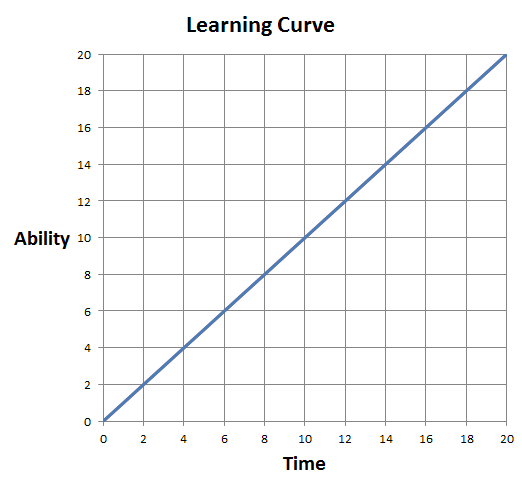
A learning curve is a graph depicting the relationship between time (or effort) and ability. Time is the input: we put time into studying, practicing, and learning. And ability is the output: it’s what we get in return for our efforts. Generally we assume that there will be a positive relation between the two: the more you practice piano the better you’ll be able to play. The more you study your German vocabulary, the more words you will learn.

Basic Learning Curve

The graph right above this paragraph shows a completely ordinary, run-of-the-mill learning curve.[ref]Don’t worry that it’s actually a straight line. That’s just faster to make in Excel.[/ref] What units are we measuring ability and time in? Doesn’t matter. It would depend on the situation. Time would usually be measured in seconds or minutes or whatever, but in physical practice maybe you’d want to measure it in calories burned or some other metric. And ability would vary to: number of vocab words learned, percent of a song played without errors, etc. Now let’s take a look at two more learning curves:

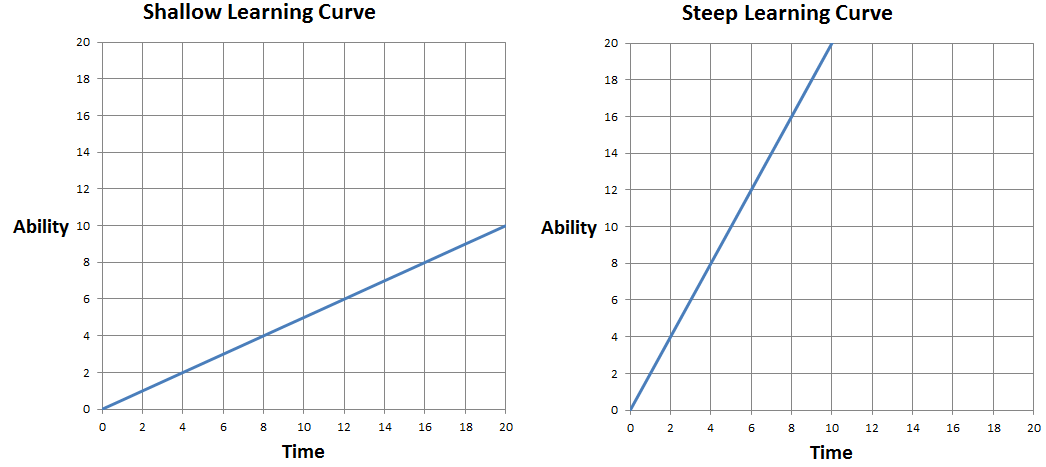
Learning Curve Comparison

The learning curve on the left is shallow. That means that for every unit of time you put into it, you get less back in terms of ability. The learning curve on the right is steep. That means that for every unit of time you put into it, you get more back in terms of ability. So here’s the simple question: if you wanted to learn something, would you prefer to have a shallow learning curve or a steep learning curve? Obviously, if you want more bang-for-the-buck, you want a steep learning curve. In this example, the steep learning curve gets you double the ability for half the time!

You might note, of course, that this is exactly the opposite of what Andrew Webster was trying to convey. He said that these kinds of games require “you to spend a lot of time getting killed before you understand how things actually work.” In other words: lots of time for little learning. In other words, he literally described a shallow learning curve and then called it steep. Earlier this morning my son tried to tell me that water is colder than ice, and that we make ice by cooking water. That’s about the level of wrongness in how most people use the term “steep learning curve.”

It’s not hard to see why people get confused on this one. We associate steepness with difficulty because it’s harder to walk up a steep incline than a shallow one. Say “steep” and people think you mean “difficult.” But visualizing a tiny person on a bicycle furiously peddling to get up the steep line on that graph is a fundamental misapprehension of what graphs represent and how they work. By convention, we put independent variables (that’s the stuff we can control, where such a category exists) on the x-axis  and dependent variables on the y-axis (that’s the response variable). Intuitions about working harder to climb graphs don’t make any sense.

Now, yes: it’s by convention that we organize the x- and y-axis that way. And conventions change, just like definitions of words change. And the convention isn’t always useful or applicable. So you could argue that folks who use the term “steep learning curve” are just flipping the axes. Right?

Wrong. First, I just don’t buy that folks who use the term have any such notion of what goes on which axis. They are relying on gut intuition, not graph transformations. Second, although the placement of data on charts is a convention, it’s not a convention that is changing. When people get steep learning curve wrong, they are usually not actually talking about charts or data at all, so they are just borrowing a technical term and getting it backwards. It’s not plausible to me that this single instance of getting the term backwards is actually going to cause scientists and analysts around the world to suddenly reverse their convention of which data goes where.

People getting technical concepts wrong is a special case of language where it does make sense to say that the usage is not just new or different, but is actually wrong. It is wrong in the sense that there’s a subpopulation of experts who are going to preserve the original meaning even if conventional speakers get it wrong and it’s wrong in the sense of being ignorant of the underlying rationale behind the term. Consider the idea of a quantum leap. This concept derives from quantum mechanics, and it refers to the fact that electrons inhabit discrete energy levels within atoms‘. This is–if you understand the physics at all–really very surprising. It means that when an electron changes its energy level it doesn’t move continuously along a gradient. It jumps pretty much directly from one state to the new state. This idea of “quanta“–of discrete quantities of time, distance, and energy–is actually at the heart of the term “quantum mechanics” and it’s revolutionary because, until then, physics was all about continuity, which is why it relied so heavily on calculus. If you use “quantum leap” to mean “a big change” you aren’t ushering in a new definition of a word the way that you are if you use “enormity” to mean “bigness”. In that case, once enough people get it wrong they start to be right. But in the case of quantum mechanics, you’re unlikely to reach that threshold (because the experts probably aren’t changing their usage) and in the meantime you’re busy sounding like a clueless nincompoop to anyone who is even passingly familiar with quantum mechanics. Similarly, if you say “steep learning curve” when you mean “shallow learning curve” then  you aren’t innovating some new terminology, you’re just being a dope.

Maybe it doesn’t matter, and maybe it’s even mean to get so worked up about technicalities. Then again, lots of people think the world would be a better place if people were more numerate, and I think there’s some truth to that. In any case, I’m a nerd and the definition of a nerd is a person who cares more about a subject than society thinks is reasonable.[ref]There’s a reason Cyrano de Begerac is my hero: “What? It’s useless? I know. A man doesn’t fight to win./It’s better when the fight is in vain.”[/ref]

Most importantly, however, if you get technical terms wrong you’re missing out. Because the term were chosen for a reason, and taking the time to learn that reason will always broaden your mind. One example, which I’ll probably write about soon, is the idea of a technological singularity. It’s a trendy buzzword you probably here futurists and sci-fi aficionados talking about all the time, but if you don’t know where the term originates (i.e. from black holes) then you won’t really understand the ideas that led to the creation of the term in the first place. And they are some pretty cool ideas.

So yeah: on the one hand this is just a rant from a crotchety old man telling the kids to get off his lawn.[ref]And turn down their music.[/ref] But my fundamental motivation is that I care about ideas and about sharing them with people. I rant with care. It’s a love-rant.

A History of Air Conditioning

Popular Mechanics has a fun timeline of air conditioning.  Given that it is the middle of summer and I live in Texas, I can’t imagine living without A/C. It is sometimes easy to forget that the first home-based air conditioning unit was installed for the first time 100 years ago “in the Minneapolis mansion of Charles Gates” and was “approximately 7 feet high, 6 feet wide, 20 feet long and possibly never used because no one ever lived in the house.” In 1970, only 36% of U.S. households had air conditioning. This percentage rose to 68% by 1993 and 87% by 2009 (this includes 81.6% of poor households). It also takes less energy in homes today, dropping to under 50% of U.S. home energy use. And to think no one before 1914 had one. 

So, enjoy your A/C along with an extra dose of gratitude.

More on the Minimum Wage

minimum wageWe’ve written a lot about minimum wage hikes here at Difficult Run. Here’s another to add to the list: economist David Neumark (who has published extensively on minimum wage) has an op-ed in The Wall Street Journal arguing that minimum hikes may indeed go to low-wage workers, this very different from saying they go to low-income families. “One might think that low-wage workers and low-income families are the same,” Neumark writes. “But data from the U.S. Census Bureau show that there is only a weak relationship between being a low-wage worker and being poor, for three reasons” (reasons that are “descriptive evidence” and “not disputed by economists”):

  1. “[M]any low-wage workers are in higher-income families—workers who are not the primary breadwinners and often contribute a small share of their family’s income.”
  2. “[S]ome workers in poor families earn higher wages but don’t work enough hours.”
  3. “[A]bout half of poor families have no workers, in which case a higher minimum wage does no good.”

The amount of low-wage workers from poor families dropped from 85% in 1939 to 17% by the early 2000s due to changes in social safety nets and family structure. Evidence indicates that only 18% of the benefits of a national minimum wage of $10.10 would go to poor families, while 29% would “go to families with incomes three times the poverty level or higher.” The benefits for poor families decline to 12% at 15 dollars, while benefits for the well-off would increase to 36 percent. Neumark further explains that “most studies…fail to find any solid evidence that higher minimum wages reduce poverty.”

He concludes, “The desire to help poor and low-income families is understandable. But increasing the minimum wage is a misguided way to do it.”

CDC Reports: Children’s Health and Family Structure

A couple new government reports have focused on the well-being of children in the United States. The first one focused on adverse family experiences[ref]Nathaniel had an excellent post about a year ago on adverse childhood experiences. Well worth the read. Note especially the impact adverse experiences have on future health and well-being.[/ref] and discovered that those “children living with neither of their parents are 2.7 times as likely as those living with both biological parents, and more than twice as likely as children living with one biological parent, to have had at least one adverse experience such as those shown in the figure below.”

What’s worse is that children “living with one parent are fifteen times as likely to have had four or more adverse experiences as those living with two biological parents, and for children in nonparental care that number rises to thirty.” It is important to point out that “researchers did not control for household income or other demographic factors, and that the reported adverse experiences, apart from financial deprivation, include those that occurred at any time in the child’s life. That means, for instance, that the many adverse experiences of children in foster care may have preceded (and led to) their being placed in foster care, or that the violence or drug use of one biological parent could have led to the child living exclusively with the other biological parent…Nevertheless, the figures are a striking illustration of how children in the care of both biological parents are most likely to escape adverse experiences.”

The second report provides a snapshot of children’s health in the United States and its relation to family structure. Overall, those in nuclear families (i.e. children “living with two parents who are married to one another and are each biological or adoptive parents to all children in the family”) fared better than those in other family structures. Children in nuclear families were least likely to be in “good,” “fair,” or “poor” health as opposed to “very good” or “excellent” health.

Percentages of Children in Good, Fair, or Poor Health by Family Structure

Data on chronic conditions and behavioral issues produced similar findings. “Although some confounding factors were controlled for…the researchers emphasize that since they simply measured family structure and child outcomes at a single point in time, their findings still cannot be used to make conclusions about causality. Prior research, they note, suggests that the arrow may go both ways…And obviously, family structure is one among many factors that matter for children’s health. In the CDC data, lower socioeconomic status (conditions of poverty or near-poverty, or parental educational attainment of no more than a high school diploma) was associated with worse health outcomes for children in every type of family, and sometimes it essentially drowned out the association between family structure and health. On the other hand, family structure and stability are associated with children’s health in many parts of the developing world, where access to health care is limited and where single-parent families are actually less likely than nuclear families to be socioeconomically disadvantaged. Teasing out all the determinants of children’s health will take more research than is currently available, but at this stage, family background seems in many cases to be one significant factor.”

Check out the full reports.

Essays on McCloskey

Over at the Online Library of Liberty there is an excellent group of essays covering economist Deirdre McCloskey’s work on the “Bourgeois Era”:  The Bourgeois Virtues: Ethics for an Age of Commerce (2006), Bourgeois Dignity: Why Economics Can’t Explain the Modern World (2010), and the forthcoming Bourgeois Equality: How Betterment Became Ethical, 1600-1848, and Then Suspect (2015).

The full amount of essays are still in the process of being posted, but so far you can read ones by economists Don Boudreaux, Joel Mokyr, and John Nye. Boudreaux captures many of my own feelings about McCloskey’s work, while Mokyr and Nye provide some excellent feedback and criticism.

Definitely worth checking out.

William Easterly: Poverty Is a Moral Problem

Christianity Today has an excellent interview with economist William Easterly on his new book The Tyranny of Experts: Economists, Dictators, and the Forgotten Rights of the Poor. In it, Easterly explains that poverty is a moral problem that cannot be easily fixed by technocratic solutions. The answer comes from treating the poor with the same dignity as everyone else. He explains,

I realized our attitude towards the poor is so often condescending and paternalistic. We think of them as helpless individuals. We don’t respect their dignity as individuals.

The next step was not to just avoid paternalism or condescension but actually to go back to first principles and think about the rights of the poor and what role those rights play in development. Economists’ research actually does give the institutions associated with individual rights a lot of the credit for the development in the West and the rest of the world. This combined with my own moral awakening that these rights are a desirable good in and of themselves. Whenever we violate them, we set back development.

Check it out.