The McKinsey Global Institute has a new report on global migration and the findings are worth reviewing:
Moving more labor to higher-productivity settings boosts global GDP. Migrants of all skill levels contribute to this effect, whether through innovation and entrepreneurship or through freeing up natives for higher-value work. In fact, migrants make up just 3.4 percent of the world’s population, but MGI’s research finds that they contribute nearly 10 percent of global GDP. They contributed roughly $6.7 trillion to global GDP in 2015—some $3 trillion more than they would have produced in their origin countries. Developed nations realize more than 90 percent of this effect.
…Extensive academic evidence shows that immigration does not harm native employment or wages, although there can be short-term negative effects if there is a large inflow of migrants to a small region, if migrants are close substitutes for native workers, or if the destination economy is experiencing a downturn.
Realizing the benefits of immigration hinges on how well new arrivals are integrated into their destination country’s labor market and intosociety.[ref]Protective labor laws don’t help.[/ref] Today immigrants tend to earn 20 to 30 percent less than native-born workers. But if countries narrow that wage gap to just 5 to 10 percent by integrating immigrants more effectively across various aspects of education, housing, health, and community engagement, they could generate an additional boost of $800 billion to $1 trillion to worldwide economic output annually. This is a relatively conservative goal, but it can nevertheless produce broader positive effects, including lower poverty rates and higher overall productivity in destination economies.
Just like Walker, the talk that stuck out to me from this session[ref]the Saturday morning session in October 1974[/ref] was Elder Ashton’s talk: Who’s Losing? His answer? Nobody.
All of us, young and old, will do well to realize that attitude is more important than the score. Desire is more important than the score. Momentum is more important than the score. The direction in which we are moving is more important than position or place.
I think this is fantastic, empowering, encouraging, and maybe even consoling advice. But I also think that there’s a particular application of his counsel that might surprise people. That comes a couple of paragraph later, when Elder Ashton says, “Proper attitude in this crisis-dominated world is a priceless possession.”
The juxtaposition of “proper attitude” with a “crisis-dominated world” seems even more relevant to me today in 2016 than in 1974.[ref]That might be easy for me to say, however: I wasn’t alive in 1974.[/ref] If there’s one thing that seems to dominate so much of our conversation in person and social media it is fear. Fear of terrorist attacks. Fear of a Donald Trump Presidency. Fear of racism and oppression. Fear of political correctness and the stifling of free speech. The nation—at least from my perspective—is crazy-drunk on fear.
Some of these threats are very real. Some of them less so. But it doesn’t really matter, because the answer to both kinds of fear—the rational and the irrational—is “a proper attitude.” Calm, resolved, pragmatic optimism is the best way to dispel the fears that are not grounded, to find solutions to the problems that are real but also solvable, or to face with dignity that fears that are real and also insurmountable. “We need to lead with good cheer, optimism, and courage if we are to move onward and upward.”
One of my favorite books of the New Testament is the first epistle of Peter. At a time when the struggling, nascent Christian faith was facing persecution and ridicule, Peter wrote:
13 And who is he that will harm you, if ye be followers of that which is good?
14 But and if ye suffer for righteousness’ sake, happy are ye: and be not afraid of their terror, neither be troubled;
15 But sanctify the Lord God in your hearts: and be ready always to give an answer to every man that asketh you a reason of the hope that is in you with meekness and fear:
This is what I mean by “pragmatic optimism.” There’s no false hope or blind refusal to see problems when Peter talks, quite frankly, about “suffer[ing] for righteousness’ sake.” I think vs. 15 gets quoted a lot, and people forget the context. If your life is going well, then there’s no reason for people to ask why you have hope. It’s only when your hope is inexplicable that there’s any cause to justify “the hope that is in you.” Optimism doesn’t deny the darkness. Optimism shines in the darkness. Thus:
We constantly need to build hope in ourselves and those about us. We need to personally make dark days bright ones. Isn’t it a joy, a lift, a light to see someone with heavy challenges and burdens moving forward to victory in the only contest that really matters. Hope makes it possible for us to know that even in temporary failure or setback there is always a next time, even a tomorrow.
The world says, “All I do is win,”[ref]Actually, it’s DJ Khaled, specifically, but it’s not like the song’s message is unique.[/ref] and the world is talking about money and fame. For a Christian—especially one who is persecuted or facing tragedy—to talk about winning makes no sense. Paul understood that, too. “For the preaching of the cross is to them that perish foolishness; but unto us which are saved it is the power of God.”[ref]1 Corinthians 1:18[/ref] But it only looks like foolishness from this side of the veil. We have hope that there’s more to the story. We know to “Fear not,” because “they that be with us are more than they that be with them.”
We believe that nothing is lost in Christ. We believe that when we lose our lives, we live. We believe that even as we die, all we do is win.
In the first half of 2010, Peter Drucker’s 1973 book Management: Task, Responsibilities, Practices sold over 300,000 copies in Japan. When compared to the 100,000 copies sold in the previous 26 years, the leap is pretty remarkable. “The unlikely catalyst for this cultish enthusiasm,” explains The Economist, “is a fictional teenager called Minami. Like many high-school girls in Japan, she becomes the gofer for the baseball team’s male coach. Unlike many of her compatriots, she is the kind of girl, as the book says, who leaps before she looks. Horrified by the team’s lack of ambition, she sets it the goal of reaching the high-school championships. She stumbles upon Drucker’s 1973 book, and it helps her turn the rabble into a team.” Minami is the main character of a popular 2009 Japanese novel entitled (in English) What If the Manageress of a High School Baseball Team read Drucker’s “Management”?, or Moshidora for short. A manga adaptation was launched in late 2010, while the film adaptation was released in 2011. I have yet to track down a copy of the novel or manga, though my, shall we say, less-than-stellar Japanese would be of no help when reading them. Furthermore, the movie wasn’t exactly Best Foreign Language Film material. However, the 10-episode anime TV series that aired in 2011 was quite good and actually captured what I love about management, management literature, and Drucker’s work in particular.
Episode 5 (“Minami Abandons Traditional High School Baseball”) stood out the most to me because it was able to demonstrate the principle of growth, the spirit of which can be applied personally from business to sports to spirituality. After Minami discovers the concept of “innovation” in Episode 4 and encourages the team’s coach to revolutionize high school baseball by means of it,[ref]I love Minami’s “a-ha” moments. The abstract scenery that Minami is placed within along with the accompanying music is an awesome portrayal of insight and inspiration.[/ref] Coach Makoto implements a “no bunt, no ball” strategy: in order to reduce the pitcher’s time on the field and increase defense, the pitcher throws only strikes. Sacrifice bunts are also eliminated, upping the chance of runs without taking an out. The team tests their new strategy at an exhibition game against a college team (whose players are on the national level). After the college team gains a 10-run lead, the strategy looks as if it is a failure. However, Minami realizes that her team’s pitch count and number of field mistakes are decreasing with each inning (they had cut it in half by the time Minami noticed). During the final inning, Minami’s team prevents their rival from scoring and gets their only two runs of the game. Even though the score was 34-2 (and ended early due to the mercy rule), Minami and her team were thrilled. Their strategy had resulted in significant growth and development, even within the course of one game. On the surface, the strategy looked like a failure. But in the long run, it took the team to the National Championship.
I was reminded of this during Marvin J. Ashton’s talk “Who’s Losing?“:
One warm evening during the past summer months Sister Ashton and I enjoyed a professional baseball game. During the early part of the competition our attention was diverted from the action by a late arriver. As he walked by, he spotted me and asked, “Who’s losing?” I responded with, “Neither one.” Following my answer, I noticed that he glanced at the right-field scoreboard, saw the game wasn’t tied, and walked on, undoubtedly wondering about me.
Seconds after he made his way to a distant seat, Sister Ashton said, “He doesn’t know you very well, does he?” “What makes you say that?” I replied. She responded with, “If he did, he would know you don’t believe anyone is losing. Some are ahead and some are behind, but no one is losing. Isn’t that right?” I smiled in approval with a warm feeling inside.
All of us, young and old, will do well to realize that attitude is more important than the score. Desire is more important than the score. Momentum is more important than the score. The direction in which we are moving is more important than position or place.
He goes on to remind us that we are “not losing if we are moving in the right direction.” He encourages us to have “good cheer, optimism, and courage if we are to move onward and upward.” He says we “need men with the courage to put proper attitudes into action. We need more men today with patience and purposeful endurance.” We need “resilience, the ability to cope with change. Adaptability cushions the impact of change or disappointment. Love can be a great shock absorber as we adjust in trial and tragedy.” He states, “Proper self-confidence lets every man know there is a spark of divinity within waiting to be nurtured in meaningful growth. Proper attitude enables us to live in harmony with our potentials.” He also lets us know that “[p]roper attitude toward self is an eternal pursuit. Positive personal attitude will insist that we deliver our best, even though less might seem adequate for the moment. Proper attitude demands we be realistic—even tough with ourselves and self-disciplining.”
All of this is about progress; it’s a process, a transformation. I’m reminded of something Nathaniel wrote years ago:
The reality is this: if we are sincere in our quest to be disciples of God, we will lose a taste for things that are not Celestial. It’s unnecessary and unhelpful to lash ourselves into a frenzy to try and vault to perfection in one leap. We lack the sensitivity to even know what that means. It would be like trying to waltz without proprioception: futile, grotesque, and ultimately expressing a lack of faith and a lack of humility. We are telling God: “You are not working in me fast enough.”
Let God work on you. Embrace the process and take notice of the small wins throughout your progression.
In Hungary, the absolutist project initially failed because a strong and well-organized noble class succeeded in imposing constitutional limits on the king’s authority. The Hungarian Diet, like its English counterpart, made the Hungarian king accountable to itself. Accountability was not sought on behalf of the whole realm but rather on behalf of a narrow oligarchic class that wanted to use its freedom to squeeze [373/374] is own peasants harder and to avoid onerous taxes to the central state. The result was the spread of an increasingly harsh serfdom for nonelites, and a weak state that ultimately could not defend the country from the Turks. Freedom for one class, in other words, resulted in a lack of freedom for everyone else and the carving up of the country among stronger neighbors.
We are taking the time to consider the Hungarian case for t simple reason: to show that constitutional limits on a central government’s power do not by themselves necessarily produce political accountability. The “freedom” sought by the Hungarian noble class was the freedom to exploit their own peasants more thoroughly, and the absence of a strong central state allowed them to do just that. Everyone understands the Chinese form of tyranny, one perpetrated by a centralized dictatorship. But tyranny can result from decentralized oligarchic domination as well. True freedom tends to emerge in the interstices of a balance of power among a society’s elite actors, something that Hungary never succeeded in achieving. (374)
This seems like a particularly useful lesson for Americans, who often view questions of government power as simply “How much?” without thinking carefully about the fact that there can be multiple, competing nexuses of political power. Historically, you had at least three:
A centralized state (usually a monarch)
An elite class (usually aristocrats, which are absolutely present in modern meritocracies)[ref]Suppose intelligence corrrelates with income. Suppose intelligence is heritable. Suppose people like to marry other people of similar intelligence. If all three of these reasonable conjectures are true, then a perfectly fair meritocracy would be indistinguishable in practice from an aristocratic society or even a caste system. How’s that for privilege?[/ref]
Everybody else
Seems to me, a lot of conservatives and liberals either can’t or don’t want to keep track of three separate groups and collapse things into just two.
Speaking in broad strokes, conservatives take the side of #3 against #1 and #2, which they see as basically interchangeable. Thus, you get terms like “crony capitalism” and “the establishment.” Liberals take the side of #1 and #3 against #2. Thus, you get lots of advocacy for new rules, regulations, and agencies to stand up against #2 on behalf of #3.
The reason the Hungarian case is so important, then, is to remind us of how dangerous it is to simply conflate the three groups into two for convenience. The familiar failure mode of a centralized, despotic regime (Fukuyama mentions ancient China above, but he’s about to talk about czarist Russia as well) is not the only failure mode available. In Hungary, the centralized state was limited, but instead of freedom the result was serfdom and ruin.
In Fukuyama’s reading of history, it took an incredibly delicate balance of three forces for liberal democracy to actually arise in England, and an overabundance of any one segment led to disaster. It was only due to that tradition that the American Revolution was spared the fate of virtually all other popular uprisings–like the French or the Russian–that, when they didn’t fail outright, merely served as object lessons in how mob rule and despotism are two sides of the same coin. The supremacy of #1 in France under the late monarchs led to the supremacy of #3 during the French Revolution which in turn led back to the supremacy of #1 in Emperor Bonaparte. Same basic deal in Russia, see-sawing back and forth from Czar to people’s revolution, to Lenin and Stalin.
Unfortunately, I don’t think this approach is going to be palatable to anyone in America. Both the left and the right seem so enamored with populism of late (Sanders or Trump, take your pick in this regard), that any nuanced talk about the importance of stabilizing elites is likely to fall on deaf ears.
“[M]aking the case for liberalism is a Sisyphean task,” writes Will Wilkinson at the Niskanen Center. “If the old truths are not updated for each new age, they will slip from our grasp and lose our allegiance. The terms in which those truths have been couched will become hollow, potted mottoes, will fail to galvanize, inspire, and move us. The old truths will remain truths, but they’ll be dismissed and neglected as mere dogma, noise. And the liberal, open society will again face a crisis of faith…Intellectual and moral infrastructure depreciates. There are ongoing costs of maintenance. You can’t successfully defend liberalism once and for all, just like you can’t install a sewage system and flush happily ever after without giving it another thought.” The fading of liberal ideas is captured in the recent work of political scientist Yascha Mounk, as reported last week in The New York Times.
“If we fail to constantly refurbish the case for and commitment to liberalism,” Wilkinson continues,
reinforcing it against the specific damage of the age, our institutions will drift toward generalized opportunistic corruption and declining popular legitimacy. Our culture will drift toward defensive avidity and mutual distrust. Our politics will drift toward primal zero-sum tribal conflict. All of which creates a fat political opening for would-be despots and ends-justifies-the-means zealots. Fascism and communism arose in liberal Europe because the liberal elites got complacent, nobody fixed the pipes, and then awful people with awful ideas rose to power promising to fix damage—and then caused massively more damage.
He concludes,
The fact that liberalism has become rote is central to our problem. Academic left-liberalism is doggedly utopian—and stale. Democratic Party liberalism is incoherent—and stale. Orthodox libertarianism is dogmatically blinkered—and stale. The “classical liberalism” of conservative-libertarian fusionism is phony—and stale. Each of our legacy liberalisms is, in its own way, corrupt. It’s all part of our pitted, pocked, cracked and creaking liberal cultural infrastructure. It doesn’t help to replace rotten wood with rotten wood, rusty pipe with rusty pipe…An effective defense of the open society must begin with an empirically-minded account of its complex inner workings and its surpassing value. Liberal political order is humanity’s greatest achievement. That may sound like hype, but it’s the cold, hard truth. The liberal state, and the global traffic of goods, people, and ideas that it has enabled has led to the greatest era of peace in history, to new horizons of practical knowledge, health, wealth, longevity, and equality, and massive decline in desperate poverty and needless suffering. It’s clearer than ever that the multicultural, liberal-democratic, capitalist welfare state is far-and-away the best humanity has ever done. But people don’t know this! We are dangerously oblivious to the nature of our freedom and good fortune, and seem poised to snatch defeat from the jaws of victory.
I can only hope that some of my posts here at Difficult Run have contributed to this project of making liberalism great again.
Building on the work of Stanford economist Nicholas Bloom and the World Management Survey, new research suggests that management quality matters for firm adaptability to adverse competitive shocks. The researchers explain,
Studying the way that corporations adjust to competitive shocks is difficult, and isolating the role of management even more so. New technology directly affects the productivity of firms, but it simultaneously transforms the competitive environment to which management needs to adapt. It is difficult to disentangle the role of external competitive forces from the direct effects of technological change. Policy shocks provide better opportunities to isolate the firm response because they do not directly emanate from an underlying process that is shaping the productivity of a firm. Recent research has therefore focused on policy shocks, such as a new trade agreement, unexpected exchange-rate shocks, or changes to the minimum wage.
Emerging markets might provide a better setting for a test of the relevance of management practice, because these markets have firms which differ more widely in their governance and management quality. Our recent research focuses on the productivity response of Chinese firms to external labour cost shocks (Hau et al. 2016). Many industries in China feature a large numbers of state-owned firms (SOEs), private Chinese firms, and foreign firms. Each have very different management practices…Chinese firms have undergone regular large labour cost shocks because of large revisions to the minimum wage set at the local level. In the seven-year period from 2002 to 2008 alone, there were more than 17,000 minimum wage increases in China’s 2,852 counties and cities…For firms with many workers at, or near, the minimum wage, these minimum wage increases often had a dramatic impact on average labour cost.
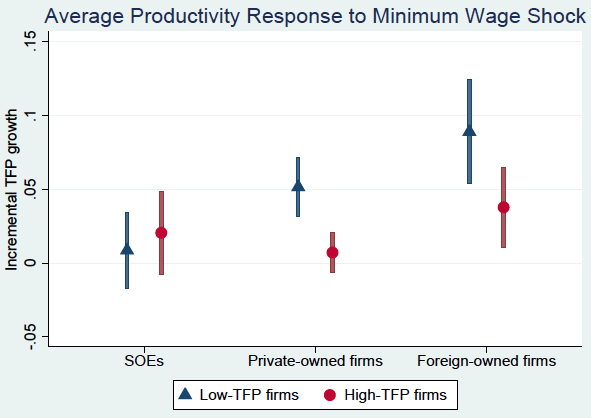
What were the firm responses to the 20% increase in the minimum wage?
The incremental productivity increase of SOEs [state-owned firms] was small and statistically insignificant (indicated by the vertical line representing a 95% confidence interval around the mean effect). Private firms show a statistically significant productivity response if their initial productivity is low, whereas foreign firms show by far the largest productivity increase in the year of the minimum wage increase. The point estimate of incremental TFP growth, just under 10%, is economically large and corresponds to almost a full year of trend growth. External competitive shocks therefore trigger large productivity improvements in some firms, but not in others. Ownership structure accounts for a large proportion of this variation.
Drawing on previous research, the authors draw up three dimensions to measure the quality of firm management:
Monitoring practices: The collection and processing of production information;
Target-setting practices: The ability to set coherent, binding, short-term and long-term targets; and
Incentive practices: Merit-based pay, promotion, hiring, and firing.
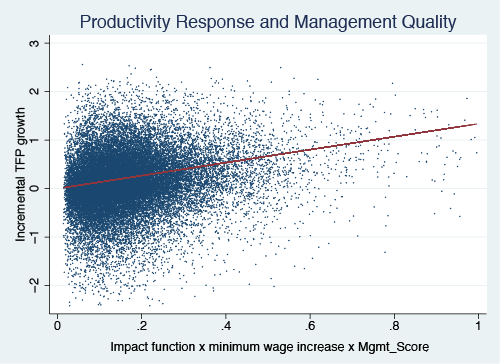
Their findings indicate that larger firms–especially foreign-owned–are better managed, while state-owned were the least well managed. The graph below “illustrates that the positive productivity response to the labour cost shock tends to be, ceteris paribus, larger for firms with a higher predicted management quality.”
“The horizontal axis shows the triple interaction between the impact function IF(ws/wmin), the (log) minimum wage increase and the predicted management score (Mgmt_Score). To keep the figure simple, we plotted only those 29,998 firm-year observations for which the minimum wage increase was larger than 20%. For the same minimum wage exposure (or value of the impact function) and the same large minimum wage increase, a firm observation with a low predicted management score will tend to be on the left. Those with a high predicted management score will be to the right.”
The “evidence indicates better-managed firms adapt better to adverse competitive shocks, and suggests that management quality matters for this adaptability.” In other words, management matters.
I’ve discussed the science of sleep here before. Elements of our arguably overstimulated society can make it difficult to get some truly good rest. Not only does this lead to highways full of practically drunk people, it also lowers our productivity at work. For example, new research from one pair of economists find that increased sleep gain lead to wage gains in both the short run and the long run. From the abstract:
We investigate the labor market effects of the single largest use of time—sleep. Motivated by a productive sleep model, we show that sleep is complementary to work in the short run and complementary to home production for non-employed individuals in both the short and long run. Using time use diaries from the United States, we demonstrate in both parametric and non-parametric frameworks that later sunset time reduces worker sleep and wages. After investigating these relationships and ruling out alternative hypotheses, we implement an instrumental variables specification that provides the first causal estimates of the impact of sleep on wages. A one-hour increase in location-average weekly sleep increases wages by 1.3% in the short run and by 5% in the long run.
Employees: Want a raise? Get some sleep.
Employers: Want more productive employers? Let them get enough sleep.
In his talk Be Valiant in the Fight of Faith Elder McConkie is unabashed in his embrace of the rhetoric of war. “Be valiant,” he says, “Fight a good fight. Stand true. Keep the commandments. Overcome the world.” And lest you think that words like “fight” and “overcome” are too subtle to be conclusive, a couple of paragraphs later he is even more clear:
As members of the Church, we are engaged in a mighty conflict. We are at war. We have enlisted in the cause of Christ to fight against Lucifer and all that is lustful and carnal and evil in the world. We have sworn to fight alongside our friends and against our enemies, and we must not be confused in distinguishing friends from foes. As another of our ancient fellow apostles wrote: “Know ye not that the friendship of the world is enmity with God? whosoever therefore will be a friend of the world is the enemy of God.”
This kind of us-vs-them logic is not very popular these days, but Elder McConkie was not shy about it, stating:
We are either for the Church or we are against it. We either take its part or we take the consequences. We cannot survive spiritually with one foot in the Church and the other in the world. We must make the choice. It is either the Church or the world. There is no middle ground. And the Lord loves a courageous man who fights openly and boldly in his army.
I want to make a couple of observations about this. First, it would be a mistake to write off the strong language of Elder McConkie as peculiar to his personality or to the particular time (the Cold War 1970s). The black-and-white view is not unique to his writing. It is a pervasive strain within scriptures. The quote above (“Know ye not that the friendship of the world is enmity with God?”) comes from James 4:4. Another stark example comes from Nephi: “Behold there are save two churches only; the one is the church of the Lamb of God, and the other is the church of the devil.”[ref]1 Nephi 14:10[/ref] And of course Jesus himself made the same kind of dichotomy, as in “If ye were of the world, the world would love his own: but because ye are not of the world, but I have chosen you out of the world, therefore the world hateth you.”[ref]John 15:19[/ref]
Second, we don’t need to water down these stark statements to avoid crazy extremism like occupying federal buildings. The war is real, but it is “not against flesh and blood, but against… spiritual wickedness in high places.”[ref]Ephesians 6:12[/ref] Or, to cite a couple of non-scriptural sources, we’ve got Sirius Black declaring, “the world isn’t split into good people and Death Eaters. We’ve all got both light and dark inside us.” Or, even more eloquently, Aleksandr Solzhenitsyn:
If only it were all so simple! If only there were evil people somewhere insidiously committing evil deeds, and it were necessary only to separate them from the rest of us and destroy them. But the line dividing good and evil cuts through the heart of every human being. And who is willing to destroy a piece of his own heart?
There is a war. In that war there are only two sides. At any time, a person is fighting for either the light or for the dark. We do not need to mitigate or explain away or rationalize the teaching that the world is at war, but we do need to understand it.
So, what is the point? If we’re in a war, but that war is not like a historical war with armies and swords or guns, then what’s the point of talking about war? One of the best explanations of this comes from one of my all-time favorite blog posts: The Military Mental Model of Mormonism. In it, MC explains precisely why viewing the conflict as a war is practically relevant in our day-to-day lives, and contrasts the “military mental model” with the “schoolhouse model.” Neither is the complete and total truth—the struggle of our mortal existence does involve leaning—but the military mental model has some particular insights that make it indispensable. I strongly urge you to read the entire post, but I’ll just summarize one of MC’s points (he makes three) which is that the military mental model answers the question: “Am I really going to be kept out of heaven for drinking coffee/wearing a bikini/watching vulgar movies? Is God really that uptight?” MC explains that:
… in the military model it’s a silly question. “I’m really going to get killed for not wearing my helmet during our transport to the base?” Maybe you will, maybe you won’t; depends whether you get attacked along the way or hit a roadside bomb. The rule is there to protect you, not to evaluate you. There will likely be many bikini-wearers in the Kingdom of Heaven (well, former bikini-wearers). But not everyone who makes the choice to dress immodestly will find that decision to be so free of spiritual consequences, as “way leads on to way.” It’s not fair. One guy never wears his helmet and never gets hit. The other takes it off just for a second to wipe his sweat and takes a bullet. That’s war. [emphasis added]
Lastly, I think it’s abundantly clear that Elder McConkie understood all of this, which is why the practical side of his talk is about self-examination. He doesn’t talk about how to identify if someone else is on the right side or not, but how to question if we ourselves are fighting valiantly with a long list of questions we are to use to gauge our own place in the war, not anybody else’s.
My approach to reading the council of prophets and general authorities is simple: I’m greedy about it. I don’t want to pick and choose. To the extent possible, I want to synthesize all of it into a single, cohesive, harmonious world-view: the scriptures, the General Conference talks, my personal experiences and beliefs, and everything I learn or think I understand about science, philosophy, history, psychology, and everyday life. I don’t have containers or boundaries: I want to incorporate it all.
It’s a tricky, error-prone process, and it’s never finished.[ref]Not in this lifetime, anyway.[/ref] There are always pieces that don’t fit quite right where I’ve placed them, pieces left over with no place to go, and holes in the model I’m building with no pieces that seem to fit there. The errors come from lots of places. Even if we believed scripture were absolutely perfect,[ref]As Mormons, we don’t.[/ref] I would still have to interpret and apply the words I read, and that introduces errors due to my own imperfections and limitations. Add to that the fact that the scriptures were written in languages I don’t know for audiences of cultures that are alien to me, and you can see how my problems multiply. Then, for good measure, toss in the fact that these leaders[ref]I’m thinking of General Conference talks in particular now[/ref] aren’t perfect and, for that matter, are given general rather than specific council.
All of this means we have plenty of excuses to set aside the council that seems outdated, naïve, or even embarrassing. I get it. All I can say is: stay greedy. Hold onto as much of it as you can. And the parts that don’t make sense just yet; set them aside if you must for the time being, but don’t discard them and don’t give up on the hope of one day seeing things in a new light and being able to make sense of them after all.
Sounds ridiculous, right? Especially when you start talking about including a “big, beautiful door.” But according to Peter Andreas of Brown University, “the wall will not only be for real, but it may be one of his biggest political successes.” After pointing out the fuzzy meaning of “wall” (Trump even said “certain areas” may be a fence), Andreas reminds us that “Trump’s predecessors carefully avoided calling any new border barriers a “wall.” Before Trump, the term was politically taboo, viewed as sending the wrong message to Mexico and to the world.” Trump’s breaking of this taboo made his rhetoric jarring to detractors and fresh to supporters, but it doesn’t change the fact that “[s]ince the early 1990s, politicians of all stripes have scrambled to show their commitment to border security. During that time, annual federal funding for border and immigration control mushroomed from $1.5 billion to $19.5 billion. According to one estimate, Washington spends $5 billion more on border and immigration control than for all other federal law enforcement combined.” The explosion in border control “has been lethal for many migrants trying to cross, with thousands of deaths to date, while enriching the smugglers on whom migrants must rely.” On top of this, “it has been politically rewarding for both Democrats and Republicans alike. Trump is simply taking it to the next level.” Despite Trump’s scoffs at our current border security, almost 700 miles of his proposed 1,000 mile wall “are already in place, and portions of it very much look like a formidable metal wall. It is hard to imagine Trump tearing all that fencing up and starting from scratch. What’s more realistic is That Trump will simply add more miles of fencing; reinforce existing fencing in key, visible places; and deploy even more border guards, stadium lighting, and the latest high-tech detection and surveillance equipment.”
An October article in Harvard Business Review asks, “Do immigrants take American jobs, or help our economy grow? Do immigrants drain our welfare funds, or can they help refill public coffers as our baby boomers retire?” Furthermore, “state and local governments have clamored to launch initiatives to attract more immigrant entrepreneurs, hoping they will found businesses and create more jobs. Globally, many countries are doing the same — for example, Chile pays overseas entrepreneurs to come visit for six months through its Start-Up Chile program, as a way to build global bridges and foster an entrepreneurial culture at home…Good statistics on immigrant entrepreneurship are exceptionally difficult to assemble, and therefore it’s challenging to create productive policies. Likewise, most standard government sources that are publicly accessible can only tell us about immigrant self-employment, which leaves a big question mark around job creation and economic growth.” The authors–one from Harvard Business School and the other a Senior Research Scientist at Wellesley Centers for Women–explain,
Our recent research aims to address this. We have built a platform that uses restricted-access Census Bureau datasets to explore differences in the types of businesses formed by immigrants and their medium-term survival and growth patterns. The core building block is the Longitudinal Employer-Household Dynamics (LEHD) database, but it incorporates other sources like the Longitudinal Business Database.
This platform gives us a comprehensive view of immigrant entrepreneurship over a long duration (1995 – 2008). The database currently covers 31 U.S. states, with more being added as their unemployment insurance (UI) filings data become available. It spans firms of all shapes and sizes, so long as they have one paid employee or more. For the first time, we can analyze a spectrum of companies — from “Main Street” businesses to VC-backed Silicon Valley firms. We can see what happens to these firms after they have been founded, and whether, for example, immigrant-founded firms perform differently from the start-ups of natives.
And what did they find?:
Immigrants constitute 15% of the general U.S. workforce, but they account for around a quarter of U.S. entrepreneurs (which we define as the top three initial earners in a new business). This is comparable to what we see in innovation and patent filings, where immigrants also account for about a quarter of U.S. inventors.
On the whole, immigrant entrepreneurship is somewhat stronger for VC-backed firms, with 31% of VC-backed founders being immigrants, compared to 25% of all entrepreneurs in 2005.
Immigrant founders launch firms that are smaller than native-founded firms. The average initial employment for firms founded by immigrants exclusively is 4.4 workers, compared to 7.0 workers for firms launched exclusively by natives. When both types of founders are present (i.e., “mixed founder team”), the average is 16.9 workers.
We quantify subsequent firm performance by analyzing employment growth and closure rates. The firms founded by immigrants close at a faster rate than firms founded by natives, but those that survive do grow at a faster rate in terms of employment, payroll, and establishments for the next six years. Previous research has found that this phenomenon — called “up or out” — is how young firms create more jobs. Compared to older firms, which show modest growth regardless of their size, young firms and new entrants have more dynamic patterns that foster greater job creation. Immigrant-founded firms display more of this behavior.
Now that we can study the age of arrival, we found that immigrants coming to the U.S. as children are more likely to start larger firms than immigrants arriving as adults. Moreover, firms created by immigrants who have grown up in the U.S. are generally associated with better outcomes, in terms of lower closure rates and higher representation among larger firms. Much remains to be done here, but we hope this serves a spring board to the study of other migrant traits.
The authors conclude, “Global talent flows will continue to be a fundamental force shaping the U.S. economic and business landscape. This is especially true for entrepreneurship given the economic dynamism that startups unleash and the disproportionate role of immigrants in this process.”



 The reason the Hungarian case is so important, then, is to remind us of how dangerous it is to simply conflate the three groups into two for convenience. The familiar failure mode of a centralized, despotic regime (Fukuyama mentions ancient China above, but he’s about to talk about czarist Russia as well) is not the only failure mode available. In Hungary, the centralized state was limited, but instead of freedom the result was serfdom and ruin.


.gif)