Protest Votes Exist

There's a reason for using a pic of an iceberg that you'll see below. But if it made you think of the Titanic well, this election year, that fits, too. (Photo by AWeith, CC BY-SA 4.0)
There’s a reason for using a pic of an iceberg that you’ll see below. But if it made you think of the Titanic well, this election year, that fits, too. (Photo by AWeith, CC BY-SA 4.0)

A Facebook friend shared a link to Clay Shirky’s Medium post (There’s No Such Thing As A Protest Vote) and tagged me. I had thoughts, and so I thought I’d share them.

I’m not sure if Shirky’s slapshot case is meant as a serious argument or merely a pretext for a rant. This paragraph, which comes towards the end when the tone shifts abruptly from reasoned to strident, highlights my confusion:[ref]Never go full rant[/ref]

Throwing away your vote on a message no one will hear, and which will change no outcome, is sometimes presented as ‘voting your conscience’, but that’s got it exactly backwards; your conscience is what keeps you from doing things that feel good to you but hurt other people. Citizens who vote for third-party candidates, write-in candidates, or nobody aren’t voting their conscience, they are voting their ego, unable to accept that a system they find personally disheartening actually applies to them.

Nevertheless, the first 1,000 words present a case, and so we’ll take it on the merits. But first, let us simply observe that accusations of disloyalty are Plan A when it comes to browbeating recalcitrant idealists into conformity.That’s not to say there’s never truth to the idea that we should sometimes put our personal preferences aside for the sake of a group’s welfare. It is to say that deploying the exact logic under which despotic regimes have justified silencing voices of protest throughout history ought to be treated as a red flag. Besides which, there’s a big difference between issues of personal taste and issues of conscience. That’s something we’ll return to in the end.

Shirky’s argument about protest votes boil down to two claims. First, it’s a “message no one will hear” and second, it “will change no outcome.” Both these claims are false.

When it comes to “no one will hear,” Shirky argues that since it doesn’t change the outcome of the vote, not voting and voting for a third-party candidate are equivalent. His argument seems to be that, since we can’t guess why a voter would pick Gary Johnson or Jill Stein or to abstain altogether, no information is transmitted. But if no information is transmitted, then we ought to be able to say absolutely nothing whatsoever about the differences in political preference between a group of Gary Johnson voters, a group of Jill Stein voters, and a group of non-voters. But we can infer all kinds of things about the preferences of these groups from the votes they cast. What’s more, if we can’t derive why they voted from the who they voted for, then that applies to voters who pick Hillary Clinton or Donald Trump as well. If we can’t say anything about third-party voters or non-voters based on their votes (or lack thereof), then we can’t say anything about anybody based on voting behavior.

On the other hand, maybe Shirky isn’t saying that it’s impossible to derive the why from the who, but just that nobody will take the trouble to do the derivation: “But it doesn’t matter what message you think you are sending, because no one will receive it. No one is listening.” This approach doesn’t fly either. As Shirky points out, in a parliamentary system the coalition-building happens after the votes are cast when various small, relatively ideologically pure parties have to form a coalition to govern. In a 2-party, winner-take-all system the coalition-building happens before the votes are cast, with the Republican and Democratic parties pulling together various constituencies to form coalitions. But how does he think that this happens if the respective parties don’t pay very careful attention to what they can infer about voters from every source available, including third-party votes? It is emphatically not the case that “no one is listening.” We have an entire industry of pollsters, analysts, and consultants who make a living by listening to the signals that voters send, and a protest vote is a pretty clear signal.

It’s easy to see how the argument that protest votes “will change no outcome,” falls immediately after the argument that they are a “message no one will hear.” The Democratic and Republican parties are not going to spend millions and millions of dollars every year on small armies of pollsters, analysts, and consultants to infer voter preferences for the purpose of crafting their coalition and then just ignore the results.

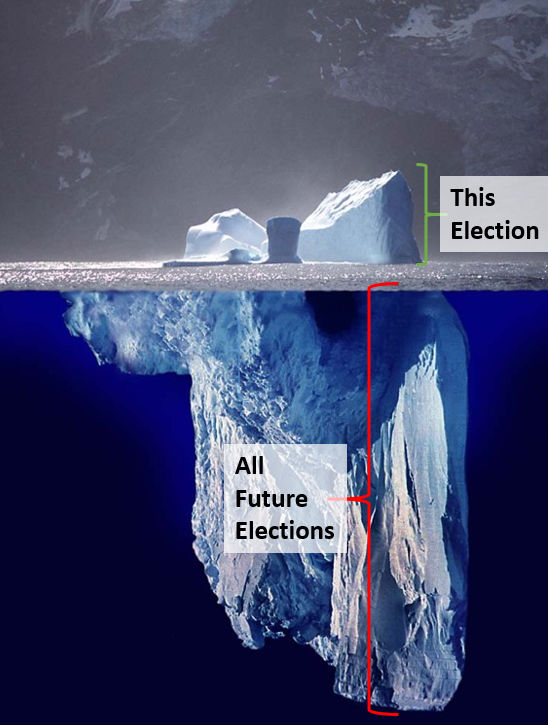
If literally the only thing that you are willing to consider is the result of one, particular election then–and only then–does it make sense to say that protest votes are indistinguishable from non-voting and therefore don’t exist. But pretending those future elections don’t exist doesn’t actually mean that they don’t.
icebergs-and-elections

If you want to change the behavior of one of the two major parties, then the best way to do it is not to stay home, but rather to vote for someone else. If you would like to change one of the two major parties to be more like the other one, than by all means switch from R to D or from D to R. In that case, protest votes don’t enter into it. But if you wan to move either (or both) of the major parties in a direction neither is amenable to, then the best and clearest way to send that signal is through a third party.

Of course, there is a cost associated with that. The protest vote is going to have no impact on today’s election and only a possible impact on future elections. And so the most reasonable theory of protest voting is to attempt to weigh the benefit of sending a corrective signal for the future against the cost of not influencing an election in the present. This is a very, very difficult calculation to make and the stakes are high. That is why reasonable people can come to differing conclusions, even when their political views are quite similar.

Notably, however, the simplest and most straight-forward explanation of protest voting is omitted from Shirky’s piece, which posits only three options: boycott, defection, or “step to third-party victory.” Each of these options has some validity to it, but none of them are as potent or as simple as the one given here. Most tellingly: none of them incorporate Shirky’s own analysis of the incentives of coalition-building in a 2-party system. Defection is closest to what I have in mind, but Shirky explains it only in terms of simplistic: “voters believe they can force a loss on either the Democrats or the Republicans, and thus make that party adopt their preferred policies, rather than face another such loss in the future.”

It is neither necessary nor possible for protest votes to “force a loss.” It is not possible for the simple reason that–like any complex event–there is never one, singular explanation for the outcome of a vote. It is not necessary because the two major parties are in constant competition with each other to build the bigger coalition. Protest voters do not need to threaten or coerce them–although that might help–but only to clearly communicate what they want.

One major thing to keep in mind: the entire point of having an election is that we don’t know ahead of time what people want. If we had perfect knowledge of preferences, we wouldn’t need to vote.[ref]We would still need a system for integrating those preferences into laws and policies and government actions, but that doesn’t require elections.[/ref] Ergo, the parties don’t actually know–with perfect precision–what constituencies exist out there and how best to appeal to them. Protest votes are an extreme form of conveying that information, and that is a much lower bar than the idea of having to “force a loss.”

Finally, the reactions to protest vote are going to be subtle, temporally distant, and often intentionally muted. They will be subtle because a major party is a coalition: a delicate balance of overlapping constituencies. They do not, with rare and historical exceptions, make abrupt changes in any direction because it threatens the cohesiveness of the overall balance. They will be temporally distant because the very earliest that a party can visibly react is the next election, a minimum of two years away, and in practical terms the lag will be even greater.[ref]It’s not like parties have the power to arbitrarily swap out candidates on a whim based on the most up-to-date information.[/ref] And they will often be intentionally muted because part of the narrative every party tries to present is that it’s always been right, and so changes–especially in reaction to third-party protest votes–will be deliberately downplayed in front of most audiences.

But the fact that the impact of protest votes is not easy to spot doesn’t mean that they don’t exist. To believe that, you’d have to believe either that protest votes convey no useful information about voter preferences or that Democrats and Republicans ignore useful information about voter preferences, neither of which is tenable.

Shirky’s argument is very hard to take seriously on its merits, since it requires us to ignore obviously relevant factors (like future elections) and accept flagrantly false premises (like the idea that protest votes either convey no useful information or that major political parties don’t care about that information). However, it does provide an approximately thousand-word pretext for the real payload of this article, which consists of claims like these:

  1. Advocates of wasted votes don’t bring up this record of universal failure, because their votes aren’t about changing political results. They’re about salving wounded pride.
  2. Citizens who vote for third-party candidates, write-in candidates, or nobody aren’t voting their conscience, they are voting their ego…
  3. The people advocating protest votes believe they deserve a choice that aligns closely with their political preferences.

This makes this whole piece an example of bulverism, a coin terms by C. S. Lewis.

You must show that a man is wrong before you start explaining why he is wrong. The modern method is to assume without discussion that he is wrong and then distract his attention from this (the only real issue) by busily explaining how he became so silly.[ref]I got the quote from Wikipedia, which has the original source.[/ref]

Another explanation of how bulverism works shows how it relates in this case:

Suppose I think, after doing my accounts, that I have a large balance at the bank. And suppose you want to find out whether this belief of mine is “wishful thinking.” You can never come to any conclusion by examining my psychological condition. Your only chance of finding out is to sit down and work through the sum yourself. When you have checked my figures, then, and then only, will you know whether I have that balance or not. If you find my arithmetic correct, then no amount of vapouring about my psychological condition can be anything but a waste of time. If you find my arithmetic wrong, then it may be relevant to explain psychologically how I came to be so bad at my arithmetic, and the doctrine of the concealed wish will become relevant — but only after you have yourself done the sum and discovered me to be wrong on purely arithmetical grounds. It is the same with all thinking and all systems of thought. If you try to find out which are tainted by speculating about the wishes of the thinkers, you are merely making a fool of yourself. You must first find out on purely logical grounds which of them do, in fact, break down as arguments. Afterwards, if you like, go on and discover the psychological causes of the error.[ref]Again, my immediate source is Wikipedia.[/ref]

I’ve also seen this general tactic referred to as “the heuristic of suspicion.” The general idea is that we give very short shrift to what our opponents actually think–to the objective case they are making–and instead rush quickly past it to psychological analysis that takes their error for granted and indulges in self-satisfied dissection of their inferiority. I’m not saying we can indulge in zero time spent on analyzing the motives or intentions of our interlocutors, but I do think we should try to shift the balance onto the arguments at hand and take them seriously. And, on that basis, Shirky’s argument that protest votes are indistinguishable from non-voting, simply do not hold up to any level of scrutiny.

Now, at the very end, I want to return to the first comment I made about personal taste and conscience. Here is the beginning of Shirky’s concluding paragraph:

None of this creates an obligation to vote, or to vote for one of the two viable candidates. It is, famously, a free country, and you can vote for anyone you like, or for no one.

If Shirky really believes that there is no obligation to vote for a major party candidate, than his entire essay collapses into nonsense. The whole point–from start to finish–is that protest voters are selfish egotists who are abdicating their duty and “making the rest of us do the work of deciding.” If that isn’t a violation of an obligation, then what on Earth could be?

That fact that we are allowed under the law to behave in a certain way is not the only nor the final word on what our obligations may or may not be. The set of things that are obligatory (in any sense) and the set of things that are legally required are not the same. So–far from celebrating a genuine sense of freedom in which government refrains from attempting to demarcate the boundaries of the permissible–Shirky is engaging in a kind of totalitarian thinking in which what we must do and what the law requires are assumed–despite all common sense–to be identical.

This is not an incidental misstep. It’s integral to Shirky’s case. After all, if a protest vote is really just a matter of personal preference–if I prefer Candidate Alice to Candidate Bob in the same way in which I prefer rocky road to mint chocolate chip or blue to red–then it would be the height or selfishness to become an absolute stickler on that point to the detriment of the group. This is a world of moral relativism, where all moral decisions are reflections of personal preference and can pretend to no greater validity.

It’s not a very coherent world. In it, Shirky first argues that protest votes are immoral because they place one’s personal preferences ahead of the common good. But, in this incoherent world, Shirky has to immediately repudiate his own argument. You are an arrogant, hypocritical egoist if you vote third party! Not that that means you can’t do it, of course. You can do whatever you’d like. Who am I to judge? I’m not saying. I’m just saying. The whole thing collapses into irrelevant, incomprehensible muttering.

But if there is such a thing as an objective moral reality, then when a person refuses to vote the way you’d like them to out of conscience, you can’t simply browbeat them for being selfish. Perhaps they are! But perhaps they are acting out of an earnestly held believe in a universally applicable moral stand, one that does not suddenly become irrelevant or disposable merely because it is unpopular or inconvenient. And so, in this world, the specifics actually matter. In this world, some people who vote third party are irresponsible and selfish and some are responsible and selfless. It’s frustrating that we can’t always line up the good guys and the bad guys based on how they vote. It’s downright dangerous when we try to do so anyway.

Shirky offers a thin pretense of not telling you how to vote, but in fact he not only tells you how to vote, but specifically who to vote for.[ref]Does anyone think for an instant he is voting for Donald Trump?[/ref] His post has a form of non-judgmentalism but denies the power thereof. I’ll do you the courtesy of not pretending to be neutral. Instead, I’ll just go ahead and tell you what I think you should do without any caveats or qualifications: you should vote, and you should vote informed, and you should vote your conscience. Consider the costs and the benefits of voting for one of the two candidates who will almost certainly win vs. the costs and benefits of voting for a candidate who will almost certainly not win. Take it it seriously, do your homework, and if you’re religious pray for guidance. Then vote accordingly.

And hey, if you’re looking for a silver lining during this awful election, here’s one. In the past, I always felt that there was a clear-cut candidate that should win. There was always a little strain and tension when family or close friends felt the same, but about the other guy. This year, I don’t have that strain. It’s all a mess, and I can see compelling cases for voting in a lot of different ways. I have people I respect voting for Clinton, voting for Trump, voting for Johnson, and voting for McMullin.[ref]No one I know is voting for Stein, that I’m aware of.[/ref] And–for the first time–I actually have absolutely zero reservations about their voting differently than I am. Not to say I agree with all of them–I don’t! I can’t!–but I can see where they are coming from. So that, at least, is a nice side-effect of this ongoing train wreck.
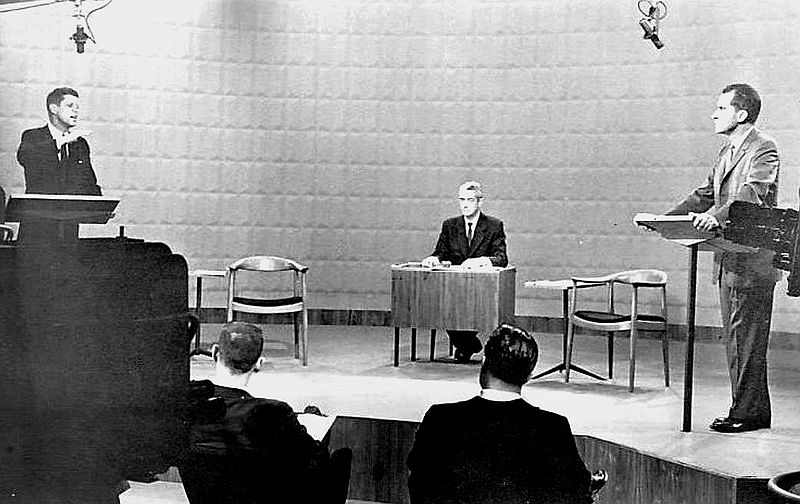
 

Guidelines for Voting

First 1960 Presidential Debate. (Wikimedia commons)

This post is part of the General Conference Odyssey.

The first talk of the first session of the April 1974 session was Guidelines to Carry Forth the Work of God in Cleanliness by President Spencer W. Kimball, and it had some interesting counsel, given that last night I was up later than I would have liked to be in order to watch the first presidential debate. President Kimball “reaffirm[ed] some vital members which concern us.”

One is our civil obligations. We are approaching election time, when we must choose again those persons who will represent us in positions of responsibility in our civil government—federal, state, and local.

I had to look up the 1974 elections. It was a midterm year, following just a few months after President Nixon’s resignation. What struck me the most about the counsel that followed, was how it called on us to be active participants in our nation’s politics. President Kimball quoted the twelfth article of faith:

We believe in being subject to kings, presidents, rulers, and magistrates, in obeying, honoring, and sustaining the law.[ref]Emphasis added.[/ref]

Then he cited from the 1835 “Declaration of Believe regarding Governments and Laws in general,”

We believe that all governments necessarily require civil officers and magistrates to enforce the laws of the same; and that such as will administer the law in equity and justice should be sought for and upheld by the voice of the people if a republic, or the will of the sovereign. [ref]Emphasis added.[/ref]

And then a 1951 First Presidency Statement:

A threat to our unity derives from unseemly personal antagonisms developed in partisan political controversy. The Church, while reserving the right to advocate principles of good government underlying equity, justice, and liberty, the political integrity of officials, and the active participation of its members, and the fulfillment of their obligations in civic affairs, exercises no constraint on the freedom of individuals to make their own choices and affiliations … any man who makes representation to the contrary does so without authority and justification in fact. [ref]Emphasis added.[/ref]

Of course, in addition to the call to active participation in politics, there were two more things that stuck out to me. First: the emphasis on the moral caliber of our representatives. (That’s not as clear in these quotes, but it’s a consistent theme.) Second: the concern about “partisan political controversy.”

People have to make up their minds how to vote this year as in all years, and I’m not going to try and sway anyone directly. I just wanted to remind people of those three basic facts:

  1. Mormons have an obligation to actively participate.
  2. We should support representatives of high moral caliber.
  3. We should avoid “partisan political controversy.”

And, as a final thought, in the end I think it matters a lot less who we vote for than why. And that is because the fabric of society—the individual lives of citizens and their relationships with each other that is based on personal values and culture—will always be more important for the fate of a nation than the particular legal system or leadership that it happens to have at any point in time. Laws can be reformed or changed with a pen stroke. Society goes deeper, is harder to corrupt when it is healthy, and harder to heal when it is broken.

Check out the other posts from the General Conference Odyssey this week and join our Facebook group to follow along!

The Basics of Syria’s War

There’s an excellent write-up in The New York Times titled “Straightforward Answers to Basic Questions About Syria’s War.” Foreign policy is not my strong suit and so articles like this are extremely helpful. The questions answered include:

  • Who is the Syrian civil war?
  • How did the war happen?
  • Which countries are involved?
  • Why is the war so bloody?
  • Why is it divided by religion?
  • How did the Islamic State form?
  • Why is the refugee crisis so large?

Check it out. It goes nicely with Vox‘s video below.

Don’t Trust Your Gut

Image result for empathy gifWhat works better when it comes to interpersonal relationships and inferring the feelings of others: trusting your intuition (your gut) or being systematic (facts and reason)? A new study suggests the latter. From the abstract:

To determine which view is supported by the evidence, we conducted 4 studies examining relations between mode of thought (intuitive vs. systematic) and empathic accuracy. Study 1 revealed a lay belief that empathic accuracy arises from intuitive modes of thought. Studies 2 through 4, each using executive-level professionals as participants, demonstrated that, contrary to lay beliefs, people who tend to rely on intuitive thinking also tend to exhibit lower empathic accuracy. This pattern held when participants inferred others’ emotional states based on (a) in-person face-to-face interactions with partners (Study 2) as well as on (b) pictures with limited facial cues (Study 3). Study 4 confirmed that the relationship is causal: experimentally inducing systematic (as opposed to intuitive) thought led to improved empathic accuracy. In sum, evidence regarding personal and social processes in these 4 samples of working professionals converges on the conclusion that, contrary to lay beliefs, empathic accuracy arises more from systematic thought than from gut intuition.

Yale psychologist Paul Bloom has actually argued against empathy in favor of a more distanced compassion.[ref]His book Against Empathy: The Case for Rational Compassion will be out later this year.[/ref] Bloom argues that empathy causes us to focus attention on suffering at the cost of the bigger picture, leading to harmful policies and outcomes (including an increased capacity for violence and aggression). The study above seems to indicate that a more distanced compassion–one that is a bit more cold and calculated–may be the answer to achieving the intended goals of empathy.


Think of the Children: Teacher Collective Bargaining

Cornell’s Michael Lovenheim and Alexander Willen had an article earlier this year in the journal Education Next discussing their research regarding teacher collective bargaining. “In this study,” they write,

we present the first evidence on how laws that support teacher collective bargaining affect students’ employment and earnings in adulthood. We do so by first examining how the outcomes of students educated in a given state changed after the state enacted a duty-to-bargain law, and then comparing those changes to what happened over the same time period in states that did not change their collective-bargaining policies.

We find no clear effects of collective-bargaining laws on how much schooling students ultimately complete. But our results show that laws requiring school districts to engage in collective bargaining with teachers unions lead students to be less successful in the labor market in adulthood. Students who spent all 12 years of grade school in a state with a duty-to-bargain law earned an average of $795 less per year and worked half an hour less per week as adults than students who were not exposed to collective-bargaining laws. They are 0.9 percentage points less likely to be employed and 0.8 percentage points less likely to be in the labor force. And those with jobs tend to work in lower-skilled occupations.

Lovenheim and Willen explain how states–beginning with Wisconsin in 1959–began passing “union-friendly legislation.” “Between 1959 and 1987, 33 states passed duty-to-bargain laws (see Figure 1); just 1 (New Mexico) has done so since. Of the 16 states without such a law, 9 have legislation that permits teachers unions and districts to bargain if both sides agree to do so. In the remaining 7 states (Arizona, Georgia, Mississippi, North Carolina, South Carolina, Texas, and Virginia), collective bargaining is prohibited either by statute or by court ruling[.]”

The debate over teacher collective bargaining is heated, which makes empirical evidence all the more important. The researchers found that teacher collective bargaining has several adverse long-term effects on children:

  • Earnings: “Attending school in a state with a duty-to-bargain law for all 12 years of schooling reduces later earnings by $795 dollars per year…This represents a decline in earnings of 1.9 percent relative to the average. Although the individual effect is modest, it translates into a large overall loss of earnings for the nation as a whole. In particular, our results suggest a total loss of $196 billion per year accruing to those who were educated in the 34 states with duty-to-bargain policies on the books.”
  • Hours worked: “exposure to a duty-to-bargain law throughout one’s school years is associated with a decline of 0.49 hours worked per week. This is a 1.4 percent decline relative to the average, and it suggests that a reduction in hours worked is a main driver of the lower earnings.”
  • Wages: “the evidence suggests a negative relationship between collective-bargaining exposure and wages. While this relationship is not statistically significant, it is consistent with our other results and suggests that teacher collective bargaining may also have a modest adverse effect on average wages.”
  • Employment: “when we use the share of individuals who are employed as the outcome variable, we find that duty-to-bargain laws reduce employment. Specifically, exposure to a duty-to-bargain law for all 12 years of schooling lowers the likelihood that a worker is employed by 0.9 percentage points.”
  • Occupational skill level: “being exposed to a duty-to-bargain law for all 12 years of schooling decreases the proportion of such workers in an occupation by almost half of a percentage point (or 0.6 percent relative to the average). This effect is modest in size, but it implies that teacher collective bargaining leads students to work in occupations requiring lower levels of skill.”
  • Educational attainment: “The reduced earnings and labor force participation associated with teacher collective bargaining raise the possibility that affected students may have completed less education. Our analysis, however, finds little evidence of bargaining power having a significant effect on how much schooling students completed…Even if students do not complete fewer years of education, they may be acquiring fewer skills while they are in school.”

The authors note that “in 2011 Wisconsin passed legislation that greatly reduced the ability of teachers to bargain with school districts…and in 2014 Michigan passed a public employee right-to-work law that sought to limit union negotiating power. Not surprisingly, teachers unions and their allies responded to these laws with fierce opposition.” Yet, the “results suggest that lawmakers in Wisconsin and Michigan have evidence on their side.”

Image result for think of the children gif


Assessing the Presidential Candidates’ Economic Proposals

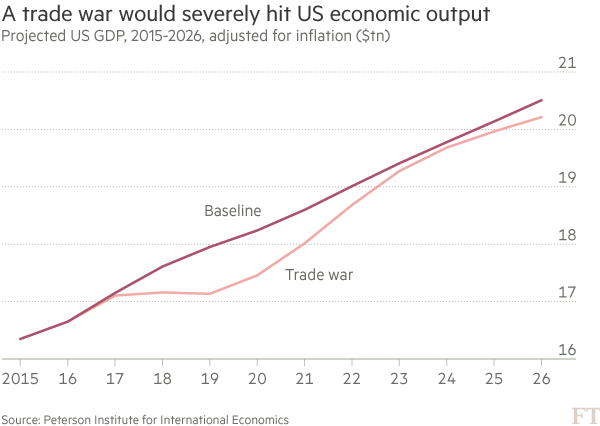
A brand new study analyzes the economic proposals of both Trump and Clinton and the results aren’t encouraging. As reported by Financial Times,

US Republican presidential candidate Donald Trump’s protectionist trade policies would send the US into recession, result in the loss of almost 4.8m private sector jobs and lead to shortages of consumer goods such as iPhones, according to the most detailed study yet of his plan.

…The study also offers a sceptical view of Democratic candidate Hillary Clinton’s trade policies, and particularly her opposition to the Trans-Pacific Partnership,[ref]According to a couple new studies, the TPP would increase annual real incomes in the United States by $131 billion and result in net liberalization. And further trade liberalization is a good thing.[/ref] a vast new Pacific Rim trade pact the US has negotiated with Japan and 10 other economies. 

But Mr Trump’s threats to rip up existing US trade agreements and impose punitive 45 per cent tariffs on goods from China and a similar 35 per cent levy on products imported from Mexico would probably set off a trade war and wreak huge damage on the US economy, the study found. 

“While [Mrs] Clinton’s stated trade policy would be harmful, [Mr] Trump’s stated trade policy would be horribly destructive,” said Adam Posen, the institute’s president. “His stated approach to the global economy of waging trade war and protecting uncompetitive special interests would be disastrous for American economic wellbeing and national security.” 

While the “biggest trade-related employment impact…would be in manufacturing and on states such as Washington,” it turns out “the biggest impact on jobs would come as the consequences of a trade war reverberate out across the economy hitting retail distribution hubs, grocery stores, restaurants and even hospitals, the study found. It also would likely lead to shortages and higher prices of consumer goods — including popular products such as smartphones — and potentially even have an impact on US retirement savings.”

That’s exciting.

Image result for we're screwed gif

What are the Chances?: American Deaths via Foreign Terrorists

Image result for skittles trumpWith skittles and terrorists in the news, it might be worth assessing the risks that immigrants pose to U.S. natives. How likely are Americans to be killed by a terrorist attack committed by a foreigner? A new policy analysis from the Cato Institute finds that the chances are vanishingly small:

Including those murdered in the terrorist attacks of September 11, 2001 (9/11), the chance of an American perishing in a terrorist attack on U.S. soil that was committed by a foreigner over the 41-year period studied here is 1 in 3.6 million per year. The hazard posed by foreigners who entered on different visa categories varies considerably. For instance, the chance of an American being murdered in a terrorist attack caused by a refugee is 1 in 3.64 billion per year while the chance of being murdered in an attack committed by an illegal immigrant is an astronomical 1 in 10.9 billion per year. By contrast, the chance of being murdered by a tourist on a B visa, the most common tourist visa, is 1 in 3.9 million per year. Any government response to terrorism must take account of the wide range of hazards posed by foreign-born terrorists who entered under various visa categories.

Given that Americans are as likely to be killed by falling furniture as a terrorist attack, maybe we should ban all new purchases of televisions and couches. Add this to the evidence that immigrants are less criminal than native-born Americans and we end up with nothing more than a fear-mongering blowhard.

Economic Freedom and Crises

Image result for capitalism crisis gif
Ha. No.

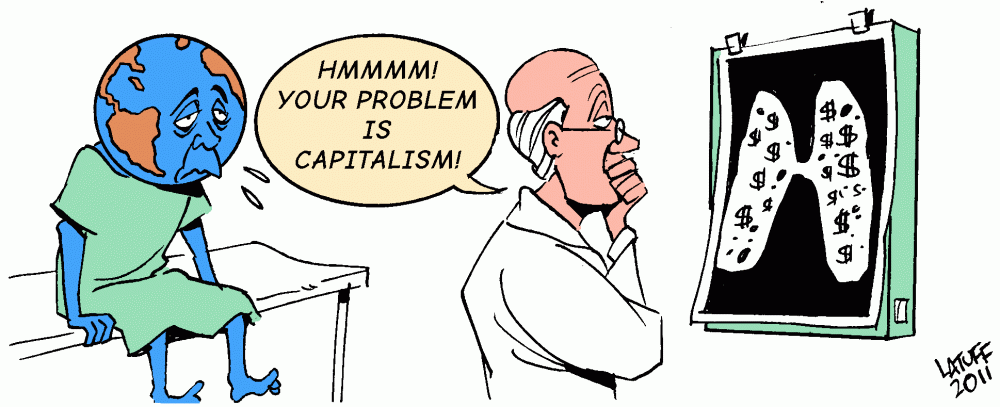
Economic crises are often blamed on the abstraction “capitalism.” But does economic freedom lead to economic crisis? A new study argues ‘no’:

In this paper, I explore the politically contested association between the degree of capitalism, captured by measures of economic freedom, and the risk and characteristics of economic crises. After offering some brief theoretical considerations, I estimate the effects of economic freedom on crisis risk in the post-Cold War period 1993–2010. I further estimate the effects on the duration, peak-to-trough GDP ratios and recovery times of 212 crises across 175 countries within this period. Estimates suggest that economic freedom is robustly associated with smaller peak-to-trough ratios and shorter recovery time. These effects are driven by regulatory components of the economic freedom index.

An ungated version of the paper can be found here. Check it out.

Deep Commitment

Underwater World, vai Wikimedia Commons

This post is part of the General Conference Odyssey.

First, an update. Today we’re covering the Sunday Afternoon session of the October 1973 General Conference, and that means we’re wrapping up our sixth GC since starting on this Odyssey. Next week—on September 27th—we’ll start with the Friday Morning Session of the April 1974 GC. Then the week after that—on October 4th—we’re going to be putting the GCO on a one-week hiatus. We’ll be posting that week, but our posts will be in reaction to the October 2016 GC. We’ll pick up again on October 11th with the Friday Afternoon session of April 1974 GC.

Now, back to the last session of the October 1973 GC. I found a definite theme in this section. In The Need for Total Commitment, Elder Burton defined a saint as “not necessarily a person who is perfect” (thank goodness!), “but a person who strives for perfection.”

I believe we must become so immersed in the gospel of Jesus Christ that we become physically as well as mentally more and more like the Lord himself. We must yield our whole hearts to him. What we then do is done not because we are asked to, nor because we are forced to, but because we want to. Neither pressure nor force can be exerted upon us from outside, when what we do is done because it is our own choice and desire. It then makes no difference to us what other men may think, or say, or do. Our hearts being committed wholly to God, what we do is done out of our love for and our trust in him. We then serve God in every way we can because we have been converted.[ref]I don’t understand the “physically as well as mentally” aspect of the quote, and I’m setting that aside for now.[/ref]

In God’s Way to Eternal Life, Elder Brockbank continued that theme:

We can attain perfection by knowing and loving God with all our heart, and with all our soul, and with all our mind; and by loving our neighbors as ourselves. This leaves no love for the devil or for the darkness of the world.

I particularly liked the end of his statement. One of the things I’ve been thinking about a lot over the past few years—although I haven’t managed to turn it into a post yet—is the importance of negative space. Of not doing something. Of not acting. Of simply being unmoved. I try so hard every day and every week to squeeze more of out of my time, to get closer to accomplishing every item on my list. I never make it, but—as I’m slowly starting to get closer—I’m learning again and again that what I don’t do is sometimes the only way to get to what I do want to do.

In any case, both of these statements brought a fresh understand to something (then) Elder Kimball said in the first talk of the session, The Rewards, the Blessings, the Promises. He said,

There are depths in the sea which the storms that lash the surface into fury never reach. They who reach down into the depths of life where, in the stillness, the voice of God is heard, have the stabilizing power which carries them poised and serene through the hurricane of difficulties.

It takes a great deal of commitment to “reach down into the depths of life,” but that is indeed where we can find “the stillness.”

Check out the other posts from the General Conference Odyssey this week and join our Facebook group to follow along!

Man in the Mirror

This is part of the General Conference Odyssey:

Mormons often talk about being in the world, but not of the world. Furthermore, it becomes The World™ in Mormon discourse. In the Gospel of John, there is a cosmic struggle between Jesus and Satan for “the world” (see John 12:31; 14:30; 16:11). Spiritual warfare is a prominent theme not only in John, but throughout the biblical narrative. The Christian life is to “struggle…not against enemies of blood and flesh, but against the rulers, against the authorities, against the cosmic powers of this present darkness, against the spiritual forces of evil in the heavenly places” (Eph. 6:12, NRSV). But, asks Assistant to the Quorum of the Twelve James Cullimore, “[w]hat do we mean by the “world”? President McKay refers to it as those “… alienated from the Saints of God. They are aliens to the Church, and it is the spirit of this alienation that we should keep ourselves free from.” (Conference Report, October 1911, p. 58.) Elder Bruce R. McConkie defines the “world” as “the social conditions created by such of the inhabitants of the earth as live carnal, sensuous, lustful lives, and who have not put off the natural man by obedience to the laws and ordinances of the gospel.” (Bruce R. McConkie, Mormon Doctrine, [Salt Lake City: Bookcraft, 1966], p. 847.) John, in his epistle, describes the “world” as “the lust of the flesh, and the lust of the eyes, and the pride of life.” (1 Jn. 2:16.)” In short, it “does not mean the sphere on which we live, but an environment created by individuals who live contrary to his teachings.” But Cullimore’s counsel is not to detach from the world, to leave it behind. “We would not want to be free of our responsibility of being in the world by being taken out of the world…” We “are to be a leaven wherever you are” according to Cullimore. Our best bet of overcoming evil in the world is–in the words of Elder Theodore Burton–to “seek to change [our] manner of living to conform more closely to the ways of the Lord.” Burton says,

A person’s attitude is perhaps the hardest of all personal attributes to change. If your attitude is right, then your life is made right. If your heart is touched, your mind and way of thinking will change and your life will change for the better accordingly. I believe we must become so immersed in the gospel of Jesus Christ that we become physically as well as mentally more and more like the Lord himself. We must yield our whole hearts to him. What we then do is done not because we are asked to, nor because we are forced to, but because we want to. Neither pressure nor force can be exerted upon us from outside, when what we do is done because it is our own choice and desire. It then makes no difference to us what other men may think, or say, or do. Our hearts being committed wholly to God, what we do is done out of our love for and our trust in him. We then serve God in every way we can because we have been converted, our attitude has been changed and we now desire to become like him both spiritually and physically.

Basically, as the King of Pop sang, start with the man in the mirror.

Image result for man in the mirror gif

Check out the other posts from the General Conference Odyssey this week and join our Facebook group to follow along!