Eternity Itself is Laid Bare

"Family Hands" by melissafong
“Family Hands” by melissafong

This post is part of the General Conference Odyssey.

I want to start this post by pulling out a few quotes from different talks that were given during the Friday afternoon session of the October 1973 General Conference

The Church has constantly stressed the importance of the home.

There Is Need for Repentance by ElRay Christiansen

As children of God, we cannot afford to forget our origin and destiny if we desire the realms of celestial glory.

The Path to Eternal Life by Delbert L. Stapley

[O]ne cannot forget mother and remember God. One cannot remember mother and forget God. Why? Because these two sacred persons, God and mother, partners in creation, in love, in sacrifice, in service, are as one.

“Behold Thy Mother” by Thomas S. Monson

I believe the second two quotes explain the first. “The Church has constantly stressed the importance of the home.” Why?

More often than not—among members and non-members alike—I think the answer is a kind of superficial association of Mormonism with good, old-fashioned, American values. Part of the history of our faith is that after brutal persecution and a period of hostile, mutual alienation, the Church worked incredibly hard to integrate into American culture and society. So Mormons are so family-centric because families are part of American values, and Mormons (at least in America) bought into the whole American dream from apple pies to patriotism to capitalism to family values.

I’m not saying that the pendulum swing between alienation and integration isn’t real, but I will say it obscures the fact that Mormonism’s emphasis on family goes much, much deeper. Our commitment to the ideals of family and home is not an affectation, it is at the core of our theology and central to our concept of life on Earth and in eternity.

The origin and destiny that Elder Stapley refers to are impossible to separate from family. We came from a home, a home where we had a loving Heavenly Father and a loving Heavenly Mother. Family and home are central to our origin. We are headed back home, to live with our Heavenly Parents again and—through the grace of Christ—to become them. Family and home are central to our destiny.

Elder (at the time) Monson’s paragraph is one that I can’t stop thinking about because it is such an arresting violation of the parallel that you expect. “God and mother,” not Heavenly Mother but earthly mothers, are “partners in creation, in love, in sacrifice, in service” and are “as one.”

I think I’ll be working through the implications of this one for a long time, but what we can say immediately is that—once again—the entire Plan of Salvation is inseparable from the concept of home and family and that includes our sacred obligation here on Earth to emulate to the best we can the heavenly home we don’t even remember.

We’re members of the house of God. And here we are on Earth—blind, fallible, and broken—playing at house. Playing at god. Nothing could be more absurd. Nothing could be more serious.

I’ll leave with one more quote:

The Spirit of the Lord will not dwell nor abide in a home where there is constant bickering, quarreling, arguing, discord, or disharmony… A happy Home is where the wife is treated like a queen and the husband is treated like a king.

There Is Need for Repentance by ElRay Christiansen

If that is the aspiration we’re striving for down here, then we can also understand this much about our hidden heavenly home: that’s what it was like. We all know that there was discord in Heaven on at least one occasion, but our home before this life was defined as a place where “[Heavenly Mother] is treated like a queen and [Heavenly Father] is treated like a kind.” That is how they regard each other. That is how they treat each other. That is the first home that we knew.

In those rare, beautiful moments of transient bliss when pure family love and harmony are revealed for a moment or two through a mundane, everyday experience, eternity itself is laid bare before us.

Check out the other posts from the General Conference Odyssey this week and join our Facebook group to follow along!

“Marriage Brings Adjustments”

This is part of the General Conference Odyssey.

A couple years ago, I highlighted President Henry B. Eyring presentation at The Complementarity of Man and Woman: An International Interreligious Colloquium at Vatican City. Julie Smith at Times & Seasons had an excellent insight about the following quote from President Eyring:

[My wife’s] capacity to nurture others grew in me as we became one. My capacity to plan, direct, and lead in our family grew in her as we became united in marriage. I realize now that we grew together into one—slowly lifting and shaping each other, year by year. As we absorbed strength from each other, it did not diminish our personal gifts.

Smith notes,

What I hear him saying is that men and women come to marriage with a different set of roles/characteristics,  but one goal of marriage is for them to teach each other and to adopt each other’s roles. I sometimes hear in LDS venues a rather opposite idea–one I find theologically problematic inasmuch as it suggests that men and women should maintain separate characteristics, something I find incompatible with both the idea of the perfection of Christ and his ability to serve as an example for all both men and women, as well as the idea of men and women striving to themselves become perfected. His thinking here can be a great bridge from older teachings about gender difference to a newer vision where those differences can still be acknowledged but won’t be seen as limiting. I especially like his idea that, as he took on nurturing and his wife took on leading, it didn’t diminish either of them. (Contra language we sometimes hear bemoaning the loss of femininity and masculinity.)

Smith’s observation reminds me of a point made by Texas A&M professor and fellow Latter-day Saint Valerie M. Hudson regarding the telos (“end,” “purpose,” “goal”) of marriage:

What we [Mormons] understand from our doctrine is that the telos of marriage is to ground every human family in real, lived, embodied gender equality.  And then, as a consequence, all reproduction would occur only within that context of gender equality.  If the ideal were lived, then every son and daughter of God would be born into a family that lived gender equality, and thus each would learn how to form such a relationship when they themselves came of age.  Reproduction is the fruit, not the root, of what God intended in establishing marriage. 

That is why it doesn’t matter who’s fertile, and whether a marriage of infertile people is a marriage is beside the point.  The test of whether you have a marriage or not is whether it is gender-equal monogamy.[ref]For Hudson, companionate heterosexual monogamous marriage is a matter of gender equality and human peace incarnate.[/ref]

I was reminded of this as I read from Elder Henry D. Taylor’s Oct. 1973 talk. In it, he states,

Marriage brings adjustments, because each has his or her own personality. Reared in homes with varying backgrounds, marriage naturally will require the making of adjustments.

Marriage, my beloved young brothers and sisters, should not be just taken for granted. It must be worked at, but realize that you can have the kind of marriage that you earnestly desire and for which you are willing to work. Marriage will require giving and taking; it will mean sharing, because life was meant to be shared. A happy and successful marriage means forgetting oneself and thinking of ways in which to make one’s companion happy. It might be well each day for the husband to think, “What can I do today to make Mary happy?” And Mary should say to herself, “What can I do today to make John happy?” A happy Home is where the wife is treated like a queen and the husband is treated like a king. And so, it is not only marrying the right partner, it is being the right partner.

Later, he says,

President Stephen L Richards, a former counselor in the First Presidency, once aptly remarked: “In the case of marital disagreement, which may lead to separation, the proper remedy is not divorce, but repentancerepentance usually on the part of both husband and wife, repentance for both acts committed and harsh words which have made a ‘hell’ instead of a ‘heaven’ out of the home.”

In order for a married couple to make a “heaven” out of their home, they must realize that repentance, love, faithfulness, humility, and forgiveness are basic essentials in achieving this noble and lofty goal.

A serene home must also be a place where the Spirit of the Lord will dwell and abide. The Spirit of the Lord will not dwell nor abide in a home where there is constant bickering, quarreling, arguing, discord, or disharmony.

Joseph Smith’s famous line about being a “rough stone rolling down [from] a [high] mountain” with “all hell knocking off a corner here and a corner there” is pertinent here. As we adapt, repent, and love within our marriages, we are polished and refined. We take on the positive attributes of the other. This is why the grand fundamental principle of Mormonism is friendship and heaven is made up of people: they make us into the gods we are meant to be.

Check out the other posts from the General Conference Odyssey this week and join our Facebook group to follow along!

Piketty vs. Evidence

Economist Thomas Piketty, author of “Capital in the 21st Century,” says rising inequality requires wealth taxes to redistribute gains. A new study says historical evidence challenges his theory.
Piketty

The Wall Street Journal reported on a new IMF study analyzing Piketty’s hypothesis “that income inequality has risen because returns on capital—such as profits, interest and rent that are more gleanings of the rich than the poor—outpaced economic growth.” IMF economist Carlos Góes

tested the thesis against three decades of data from 19 advanced economies. “I find no empirical evidence that dynamics move in the way Piketty suggests.” In fact, for three-quarters of the countries he studied, inequality actually fell when capital returns accelerated faster than output. Those findings support previous work by Daron Acemoglu of the Massachusetts Institute of Technology and political scientist James Robinson, now of the University of Chicago, suggesting Mr. Piketty’s thesis was far too simplistic for the complexities of real-world economies that are affected by politics and technology. Mr. Góes says his study also provides evidence that Mr. Piketty’s assumption that saving rates remain stable is flawed. Rather, the data shows changes in the savings rate are likely to offset most of the effects of an increase in capital share of national income.

I’ve written about the criticisms of Piketty before. They seem to be piling up.

Good Boss, Bad Boss: Lecture by Robert Sutton

This is part of the DR Book Collection.

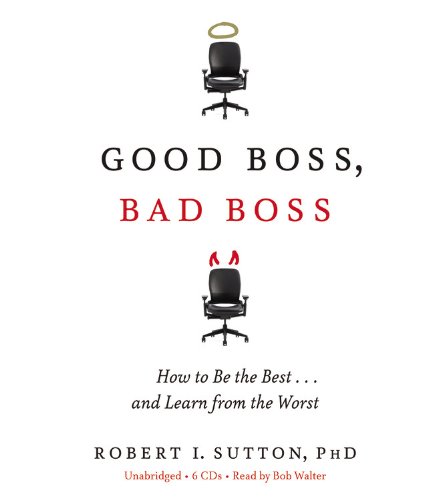
Stanford’s Robert Sutton is a favorite of mine among management experts. I’ve been a fan of his work ever since reading his HBR article “More Trouble Than They’re Worth” and the book-length version The No-Asshole Rule. His book Good Boss, Bad Boss: How to Be the Best…and Learn from the Worst is another well-researched, but highly enjoyable read. Sutton offers tremendous advice for those in leadership positions. These include:

  • “Don’t crush the bird”: find the balance between micromanaging and undermanaging.
  • “Grit gets you there”: perseverance toward long-term goals.
  • “Small wins are the path”: break down big challenges and long-term goals into smaller, achievable goals.
  • “Beware the toxic tandem”: be aware of how others perceive you and avoid selfish behavior.
  • “Got their backs”: protect and defend your people.

Sutton highlights this excellent, one-page summary:

You can see a lecture by Sutton below.


Raising the Drawbridges

“Is Poland’s government right-wing or left-wing?” asks a recent article in The Economist.

Its leaders revere the Catholic church, vow to protect Poles from terrorism by not accepting any Muslim refugees and fulminate against “gender ideology” (by which they mean the notion that men can become women or marry other men).

Yet the ruling Law and Justice party also rails against banks and foreign-owned businesses, and wants to cut the retirement age despite a rapidly ageing population. It offers budget-busting handouts to parents who have more than one child. These will partly be paid for with a tax on big supermarkets, which it insists will somehow not raise the price of groceries.

This represents a new kind of political divide; one that is “less and less between left and right, and more and more between open and closed. Debates between tax-cutting conservatives and free-spending social democrats have not gone away. But issues that cross traditional party lines have grown more potent. Welcome immigrants or keep them out? Open up to foreign trade or protect domestic industries? Embrace cultural change, or resist it?” As the British head of YouGov noted, the political ideologies are either “drawbridge up” or “drawbridge down.” The American context of all this is particularly depressing:

In America the traditional party of free trade and a strong global role for the armed forces has just nominated as its standard-bearer a man who talks of scrapping trade deals and dishonouring alliances. “Americanism, not globalism, will be our credo,” says Donald Trump. On trade, he is close to his supposed polar opposite, Bernie Sanders, the cranky leftist who narrowly lost the Democratic nomination to Hillary Clinton. And Mrs Clinton, though the most drawbridge-down major-party candidate left standing, has moved towards the Trump/Sanders position on trade by disavowing deals she once supported.

The two main forces driving the “drawbridge up” view “are economic dislocation and demographic change.” In turns out that “many mid- and less-skilled workers in rich countries feel hard-pressed. Among voters who backed Brexit, the share who think life is worse now than 30 years ago was 16 percentage points greater that the share who think it is better; Remainers disagreed by a margin of 46 points. A whopping 69% of Americans think their country is on the wrong track, according to RealClearPolitics; only 23% think it is on the right one.” It’s also true that

Rich countries today are the least fertile societies ever to have existed. In 33 of the 35 OECD nations, too few babies are born to maintain a stable population. As the native-born age, and their numbers shrink, immigrants from poorer places move in to pick strawberries, write software and empty bedpans. Large-scale immigration has brought cultural change that some natives welcome—ethnic food, vibrant city centres—but which others find unsettling. They are especially likely to object if the character of their community changes very rapidly.

This does not make them racist. As Jonathan Haidt points out in the American Interest, a quarterly review, patriots “think their country and its culture are unique and worth preserving”. Some think their country is superior to all others, but most love it for the same reason that people love their spouse: “because she or he is yours”. He argues that immigration tends not to provoke social discord if it is modest in scale, or if immigrants assimilate quickly.

There is an optimistic side to all this:

Although the drawbridge-uppers have all the momentum, time is not on their side. Young voters, who tend to be better educated than their elders, have more open attitudes. A poll in Britain found that 73% of voters aged 18-24 wanted to remain in the EU; only 40% of those over 65 did. Millennials nearly everywhere are more open than their parents on everything from trade and immigration to personal and moral behaviour. Bobby Duffy of Ipsos MORI, a pollster, predicts that their attitudes will live on as they grow older.

As young people flock to cities to find jobs, they are growing up used to heterogeneity. If the Brexit vote were held in ten years’ time the Remainers would easily win. And a candidate like Mr Trump would struggle in, say, 2024.

But in the meantime, the drawbridge-raisers can do great harm. The consensus that trade makes the world richer; the tolerance that lets millions move in search of opportunities; the ideal that people of different hues and faiths can get along—all are under threat. A world of national fortresses will be poorer and gloomier.

Your True Identity as a Human Being

Your True Identity as a Human Being

This post is part of the General Conference Odyssey.

President Harold B. Lee kicked off the October 1973 General Conference with a talk on Friday morning called Understanding Who We Are Brings Self-Respect. The talk was not what I expected at all. “My beloved brothers and sisters and friends who are listening by radio and television, may I now for a few moments make some comments about a condition which is of great concern to all of us today,” he began. And of course, you’re expecting something about wickedness. And, in a way, you’d be right. But he expressed it in a way that certainly brought me up short: “the shocking lack of self-respect.”

I stopped and thought for a while at the end of the first paragraph. And I decided it did make sense. After all, one of the examples of this lack of self-respect was “permissiveness.” As a parent, it’s easy to understand that just allowing your kids to do whatever they want is not a sign of love, or of respect, or of regard for them as human beings. As a parent, if you care for your kids than you try to erect structure and boundaries and routines to keep them healthy, to keep them safe, and to help them learn and grow. Discipline is a sign of regard. If for children, then why not for the self?

And if that’s true, than the kind of person who indulges in sating their every whim and desire is not, after all, acting out of high self-regard. They are, perversely, respecting their appetites at the expense of respecting their true selves.

So the talk won me over, but I couldn’t help but remain surprised all the same. At some points, the language about self-respect almost seemed Randian: the archest of right-wing avatars. And yet within paragraphs a quote like “The first thing to be done to help a man to moral regeneration is to restore if possible his self-respect,” would seem as bleeding-heart as they come. The talk even includes the phrase–not as common in the 1970s as it later became, I think–“self-esteem.”

It’s just another solid reminder that prophets–when they are speaking as prophets–don’t see the world the way we see it. We interpret the world according to our preconceptions and assumptions, and that means we can’t help but see what happens around us as part of a pre-existing narrative. Our politics, our tastes, our personal histories: none of us can prevent these things from traveling outside of ourselves and becoming a part of our perception of the outside world.

Prophets are human, too, and they have the same limitations. But when a prophet prophecies, I believe they catch a hold of a different vision and step outside of their individual perspectives. I think that’s part of what makes them so hard to understand, not to mention disconcerting. It’s also what makes them so important to listen to.

Check out the other posts from the General Conference Odyssey this week and join our Facebook group to follow along!

Forgiveness, Boundaries, and Reconciliation

This is part of the General Conference Odyssey.

And forgive us our debts, as we forgive our debtors (Matt. 6:12).

And forgive us our sins; for we also forgive every one that is indebted to us (Luke 11:4).

I, the Lord, will forgive whom I will forgive, but of you it is required to forgive all men (D&C 64:10).

Forgiveness is a topic that I think most Mormons struggle with. What does forgiveness actually mean? What does it look like in practice? Is forgiving the same as forgetting? How does one balance boundaries with that concept of forgiveness, especially those who have suffered violence and abuse? Or are boundaries and forgiveness not mutually exclusive?

There has been a fair amount of research on forgiveness. The Greater Good Science Center at the University of California, Berkeley offers this helpful explanation:

Psychologists generally define forgiveness as a conscious, deliberate decision to release feelings of resentment or vengeance toward a person or group who has harmed you, regardless of whether they actually deserve your forgiveness. Just as important as defining what forgiveness is, though, is understanding what forgiveness is not. Experts who study or teach forgiveness make clear that when you forgive, you do not gloss over or deny the seriousness of an offense against you. Forgiveness does not mean forgetting, nor does it mean condoning or excusing offenses. Though forgiveness can help repair a damaged relationship, it doesn’t obligate you to reconcile with the person who harmed you, or release them from legal accountability. Instead, forgiveness brings the forgiver peace of mind and frees him or her from corrosive anger. While there is some debate over whether true forgiveness requires positive feelings toward the offender, experts agree that it at least involves letting go of deeply held negative feelings. In that way, it empowers you to recognize the pain you suffered without letting that pain define you, enabling you to heal and move on with your life.

These findings coincide with Elder Marion D. Hanks’ October 1973 talk: “What is our response when we are offended, misunderstood, unfairly or unkindly treated, or sinned against, made an offender for a word, falsely accused, passed over, hurt by those we love, our offerings rejected? Do we resent, become bitter, hold a grudge? Or do we resolve the problem if we can, forgive, and rid ourselves of the burden? The nature of our response to such situations may well determine the nature and quality of our lives, here and eternally.” Elder Hanks recognizes that forgiveness, at least in part, is about our own well-being. “But not only our eternal salvation depends upon our willingness and capacity to forgive wrongs committed against us,” he says. “Our joy and satisfaction in this life, and our true freedom, depend upon our doing so. When Christ bade us turn the other cheek, walk the second mile, give our cloak to him who takes our coat, was it to be chiefly out of consideration for the bully, the brute, the thief? Or was it to relieve the one aggrieved of the destructive burden that resentment and anger lay upon us?” Hanks concludes, “God help us to rid ourselves of resentment and pettiness and foolish pride; to love, and to forgive, in order that we may be friends with ourselves, with others, and with the Lord.” We should always remember: “Christ gave his life on a cross; and on that cross he fully, freely forgave.”

Reconciliation is the ultimate purpose and intention of forgiveness. This seems to be an unavoidable conclusion. Forgiveness mends relationships and makes them sustainable. But forgiveness is not the same as reconciliation. Relationships are not individualistic, but by definition involve others and their choices. Relationships require trust, boundaries, etc. The violation of boundaries and the erosion of trust may make reconciliation in some instances unlikely. But the release of anger and resentment opens the doorway for relational and personal healing. It can be a fountain of empathy, compassion, and generosity. In short, this “ultimate form of love” can help us align ourselves with the Master we’ve chosen to follow.

Check out the other posts from the General Conference Odyssey this week and join our Facebook group to follow along!


A Little Pick-Me-Up on Violence in the World

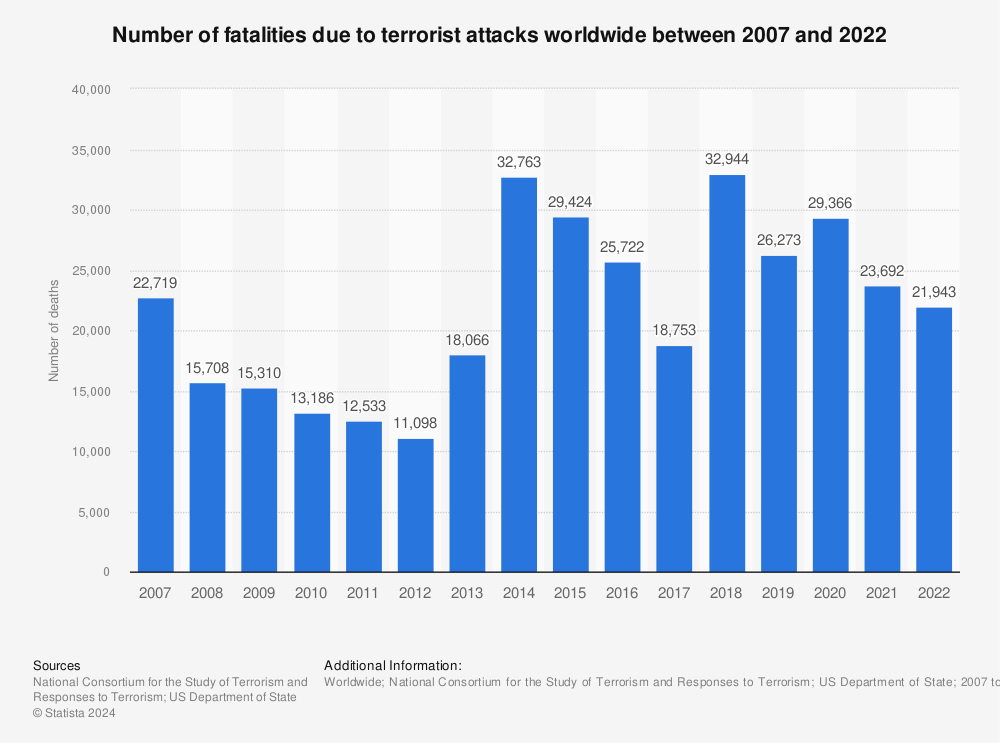
A number of terrorist incidents have taken place in this year alone. This doesn’t even begin to cover the controversies over police shootings (both of civilians and officers) or the number of violent episodes that go unnoticed by the public and unreported by the media. With the constant news of blood and horror on this earth, it is easy to think that the world is ready to implode. However, here is a little data-based pick-me-up on the state of violence in the world. In response to Hannity’s disbelief over President Obama’s speech at the White House Summit on Global Development toward the end of July, Reason writes,

Obama has made similar remarks before, and what he’s talking about is the fact, documented by Steven Pinker in his book The Better Angels of Our Nature, that humans are, broadly speaking, less likely to die violent deaths than ever before in recorded history. Contrary to what Hannity apparently thinks, that long-term trend—which includes deaths by war, genocide, terrorism, and other forms of mass killing as well ordinary homicide—is unaltered by whatever Fox News report happens to be uppermost in Hannity’s mind at any given moment. Updated graphs that Pinker published last year show, among other salutary trends, that the U.S. murder rate has fallen sharply since the early 1990s, that the worldwide death rate from genocide and other mass killings fell from 10 per 1 million people in 1996 to 1 in 2013, that the number of battle deaths per 100,000 people in 2013 was close to the all-time low since 1945, and that the number of civil wars worldwide, although up since 2010, was far lower in 2013 than in the ’90s. 

Looking specifically at deaths from terrorist attacks in Western Europe, which Hannity sees as a refutation of Obama’s claim, there was a spike last year, but the total was still lower than in 2004 and far lower than the averages for the 1970s and ’80s. Worldwide, according to a 2015 report from the Institute for Economics and Peace, the total number of deaths from terrorism has been rising since 2011, with five countries—Iraq, Nigeria, Afghanistan, Pakistan, and Syria—accounting for 78 percent of those deaths in 2014. But deaths from terrorism represent a small percentage of all deaths by homicide: less than 3 percent worldwide in 2012, based on data from the United Nations and the National Center for Counterterrorism. They represent an even smaller share of all deaths, and for Americans the risk of dying in a terrorist attack pales beside the risk of dying from a host of quotidian causes that get much less attention from Fox News. 

So, the next time you feel an overwhelming sense of despair regarding the direction of the world, check the numbers. You might feel better.


Writing Ourselves: An Interview with Jack Harrell

This is part of the DR Book Collection.

Over at Worlds Without End, I’ve written a review of Greg Kofford Books’ new publication Writing Ourselves: Essays on Creativity, Craft, and Mormonism by Jack Harrell. I explain,

As one who does not consider himself a creative writer (at least not a fiction writer), I was a bit hesitant to attempt a review of a book almost entirely dedicated to the art of writing. Yet, as I made my way from essay to essay, it became clear to me that Harrell was not merely talking about writing, but was describing the essence of Creation itself. In short, Harrell is discussing what has become known as the “cultural mandate” in Genesis 1 to become co-creators with God. And this in turn is about transformation and new creation; the first steps of eternal progression (at least from a Mormon perspective). As Harrell explains in the touching first essay, “…I’ve learned that God is with us in every desire to improve. Anyplace can be a starting place with him…Whatever we make of ourselves, whatever circumstances we come to, God can turn it to good.” He imagines God saying, “Now is a good time…This is a good place to begin” (pg. 5). For me, the essays are connected by two major strands of thought: a Mormon theology of creativity and the meaning and morals of the work itself.

…There is much more in Jack Harrell’s book that I have not touched on: the place of violence in literature, authenticity, the agenticity of imaginary characters, the euphoria of peak performance, etc. But the themes above struck me the most. Harrell’s way of weaving together tales from his childhood, reflections on Mormon theology, and writing insights as an expert craftsman calls for contemplation. It is a meditation on ordinary life; an invitation to construct meaning out of life’s chaos and disorder and put it into words. It encourages readers to be creative in their ventures, to become co-creators with God, and to transform this world for the better. It encourages them, much like the Maclean boys, to “glorify God, and to enjoy him” in their craft. But most of all, it encourages them to write about it. Readers will find themselves exploring old feelings and new thoughts. Even better, they may find themselves putting pen to paper soon after.

You can hear an interview with Jack Harrell on Greg Kofford Books’ Authorcast here.

DR Editor in New Book: As Iron Sharpens Iron

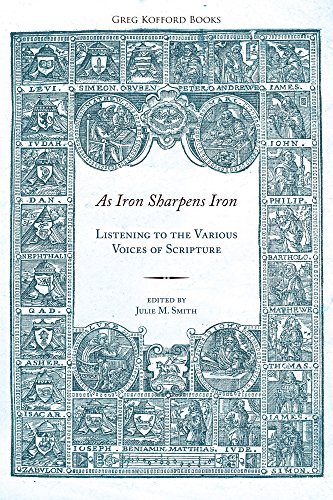
This past week, Greg Kofford Books–what I consider to currently be the best publisher in Mormon Studies[ref]I often describe it as a Mormon version of Eerdmans or IVP Academic[/ref]–released a new volume edited by Julie Smith titled As Iron Sharpens Iron: Listening to the Various Voices of Scripture. As the description explains,

Our scripture study and reading often assume that the prophetic figures within the texts are in complete agreement with each other. Because of this we can fail to recognize that those authors and personalities frequently have different—and sometimes competing—views on some of the most important doctrines of the Gospel, including the nature of God, the roles of scripture and prophecy, and the Atonement.

In this unique volume, fictionalized dialogues between the various voices of scripture illustrate how these differences and disagreements are not flaws of the texts but are rather essential features of the canon. These creative dialogues include Abraham and Job debating the utility of suffering and our submission to God, Alma and Abinidi disagreeing on the place of justice in the Atonement, and the authors Mark and Luke discussing the role of women in Jesus’s ministry. It is by examining and embracing the different perspectives within the canon that readers are able to discover just how rich and invigorating the scriptures can be. The dialogues within this volume show how just as “iron sharpeneth iron,” so can we sharpen our own thoughts and beliefs as we engage not just the various voices in the scriptures but also the various voices within our community (Proverbs 27:17).

I’m honored to be included among the contributors. My essay features a fictionalized dialogue between Mormon and the patriarch Jacob (Israel) on the subject of wealth. As I explain in the opening of my essay,

Mormon’s entire life was consumed by war and violence brought by what he saw as divisions created by wealth, vanity, and economic inequality. His abridgment of the Nephite records often highlights the pride of the rich and inequality as the source of conflict. Yet, the patriarch Jacob—later renamed Israel—is depicted in the Genesis account as being very prosperous and often pursuing wealth at the expense of others.

Be sure to check it out. You can read a Q&A with Julie Smith on the book here.