Want to increase production among low-output workers? Place them among high-output workers. From a new NBER paper:
Workers respond to the output choices of their peers. What explains this well documented phenomenon of peer effects? Do workers value equity, fear punishment from equity-minded peers, or does output from peers teach them about employers’ expectations? We test these alternative explanations in a series of field experiments. We find clear evidence of peer effects, as have others. Workers raise their own output when exposed to high-output peers. They also punish low-output peers, even when that low output has no effect on them. They may be embracing and enforcing the employer’s expectations. (Exposure to employer-provided work samples influences output much the same as exposure to peer-provided work.) However, even when employer expectations are clearly stated, workers increase output beyond those expectations when exposed to workers producing above expectations. Overall, the evidence is strongly consistent with the notion that peer effects are mediated by workers’ sense of fairness related to relative effort.
The internet and digital media have created the impression of limitless knowledge at our fingertips. But, by making us lazy, they have opened up a space that ignorance can fill. On the Edge website, the psychologist Tania Lombrozo of the University of California explained how technology enhances our illusions of wisdom. She argues that the way we access information about an issue is critical to our understanding – and the more easily we can recall an image, word or statement, the more likely we’ll think we’ve successfully learned it, and so refrain from effortful cognitive processing.
This lack of intellectual humility often leads to the trolling we see in online discussions:
Intellectually humble people don’t repress, hide or ignore their vulnerabilities, like so many trolls…People who are humble by nature tend to be more open-minded and quicker to resolve disputes, since they recognise that their own opinions might not be valid. The psychologist Carol Dweck at Stanford University in California has shown that if you believe intelligence can be developed through experience and hard work, you’re likely to make more of an effort to solve difficult problems, compared with those who think intelligence is hereditary and unchangeable.
One of the more exciting portions of the article is its discussion of the
Thrive Center for Human Development in California, which seeks to help young people turn into successful adults, is funding a series of major studies about intellectual humility. Their hypothesis is that humility, curiosity and openness are key to a fulfilling life. One of their papers proposes a scale for measuring humility by examining questions such as whether people are consistently humble or whether it depends on circumstances. Acknowledging that our opinions (and those of others) vary by circumstance is, in itself, a significant step towards reducing our exaggerated confidence that we are right.
The key takeaway, however, is the following:
Intellectual humility relies on the ability to prefertruth over social status. It is marked primarily by a commitment to seeking answers, and a willingness to accept new ideas – even if they contradict our views. In listening to others, we run the risk of discovering that they know more than we do. But humble people see personal growth as a goal in itself, rather than as a means of moving up the social ladder. We miss out on a lot of available information if we focus only on ourselves and on our place in the world (bold mine).
Most of my anxieties when it comes to research, writing, and learning are ultimately anxieties over my place in the social pecking order. I have a long way to go when it comes to learning intellectual humility.
I’ve been hearing a lot lately about how important it is to vote. Supposedly, if you vote for alternative Candidate X, then it is a de facto vote for Candidate Y. This Candidate Y could be either Trump or Clinton depending on the ideology of the one spewing this rhetorical nonsense. Nevermind that this line of argument places way too much stock in the value of a single vote. As political philosopher Jason Brennan points out, the disutility of driving to cast your ballot (i.e., the risk of harming others via an automobile accident) is higher than the actual utility of your single vote (i.e., the chance it has of changing the election outcome).[ref]See The Ethics of Voting, pgs. 19-20.[/ref] The value of a single vote is vanishingly small, even in swing states. You have a better chance of winning the Powerball jackpot 100+ times in a row than you do of casting the tiebreaker in a presidential election.
But when only 9% of the American public is behind the nominations of Trump and Clinton, shouldn’t we encourage more people to vote? I suppose that depends on how your political preferences match up with that of non-voters. So what are the preferences of non-voters? According to a 2014 Pew study, non-voters are a largely younger, poorer, uneducated, racially diverse group. More important, however, are their political affiliations and views: while the largest portion identified as Independents (45%), 29% identified as Democrats, leaving only 18% for Republicans. Furthermore, 51% indicated that they “lean Democrat” with only 30% “lean[ing] Republican” (20% said they had “no lean”). Fifty-three percent of non-voters held unfavorable views of Republicans (35% favorable), while only 40% held unfavorable views of Democrats (48% favorable). Their views on the Affordable Care Act were mixed (44% approved, 49% disapprove). Their views on government efficiency (54% think government is almost always inefficient, 43% think the government deserves more credit) and aid to the poor (44% said it did more harm than good, 51% said the opposite) were a bit more divided.
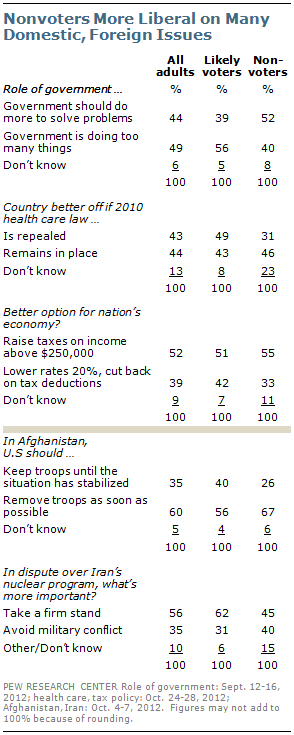
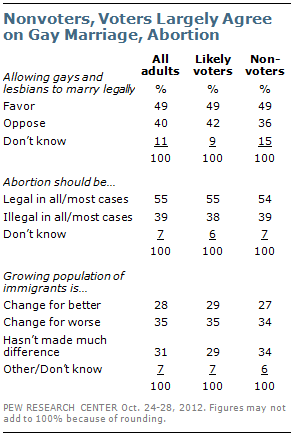
A 2012 Pew study highlighted the policies preferred by non-voters. At that time, Obama held a favorable view among non-voters (64%), 59% of which said they preferred him as their presidential candidate. The majority of non-voters believed that government should do more to solve problems (52%), should raise tax rates for incomes above $250,000, remove troops from Afghanistan ASAP (67%), allow same-sex marriage (49%), and legalize abortion in all/most cases (54%). They were more mixed on the United States’ stance toward Iran’s nuclear program (45% said take a firm stand, 40% said to avoid military conflict) and the growing population of immigrants (27% said it is a “change for the better,” 34% said it is a “change for the worse,” 34% said it “hasn’t made much of a difference”).
In 2013, the political scientists Jan Leighley, of American University, and Jonathan Nagler, of New York University, published the results of a study that compared, among other things, the political views of voters and non-voters, dating back to 1972. On most social issues (abortion, L.G.B.T. rights), there was no measurable difference between them. Non-voters were more inclined toward isolationism. (Leighley and Nagler thought this might be because non-voters knew more soldiers than voters, and were more reluctant to see them sent into conflict.) The difference on economic matters was much more dramatic. Non-voters, Leighley and Nagler found, favored much more progressive economic policies than voters did. They preferred higher taxes, and more spending on schools and health care, by margins that hovered around fifteen per cent. “The voters may be representative of the electorate on some issues,” Leighley and Nagler wrote, “but they are not representative of the electorate on issues that go to the core of the role of government in modern democracies.” That non-voters had the same partisan preferences as voters only seemed to strengthen the finding—they wanted more redistribution regardless of whether they were Democrats or Republicans.
These results have been substantiated elsewhere. As reported in The Atlantic,
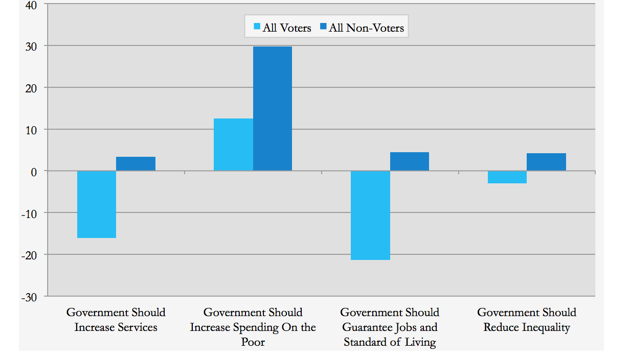
Four questions from the American National Elections Studies (ANES) data show a stark divide on issues related to economic inequality. Nonvoters tend to support increasing government services and spending, guaranteeing jobs, and reducing inequality—all policies that voters, on the whole, oppose. Both groups support spending on the poor, but the margin among nonvoters is far larger. Across all four questions, nonvoters are more supportive of interventionist government policies by an average margin of 17 points.
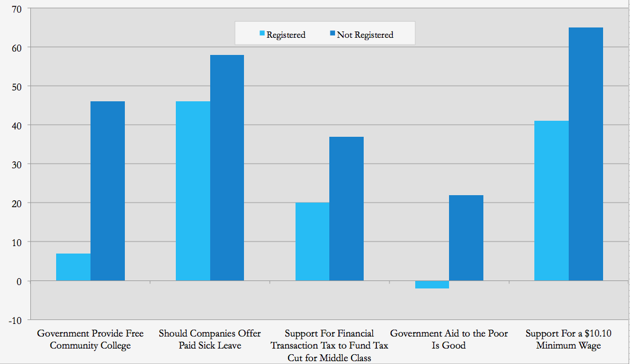
Similar results were found with numbers from Pew and YouGov comparing “registered voters with the non-registered population. These polls were not taken close to elections, so registration can serve as a rough proxy for the voting and nonvoting population. The polls show the same dramatic differences. In every instance, net support for greater government intervention in economic affairs was higher for the non-registered populations—sometimes dramatically so. For instance, while net support for free community college was 7 points for the registered population, it was 46 points within the non-registered population.”
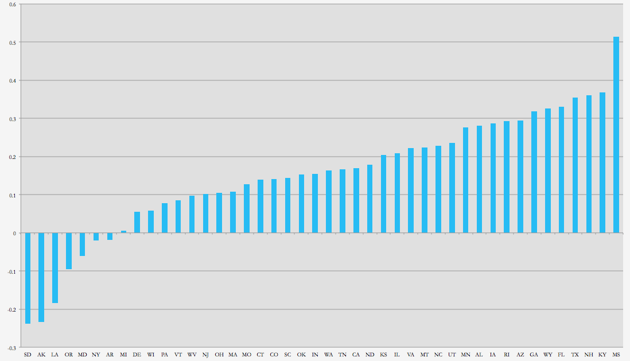
In short, non-voters tend to be more ideologically liberal than voters.
Positive numbers indicate that nonvoters are more liberal than voters. (Source: Griffin and Newman, 2005)
If you’re wanting to galvanize non-voters, you should know your audience. Liberals may have a more vested interest in doing so than conservatives. Libertarians will likely have mixed feelings.
I’ve mentioned the populist trade problem before. GMU economist Bryan Caplan has published on the irrationality of voters, demonstrating that voters tend to suffer from biases that disagree with the findings of actual economists. Given our current political climate, consider what he calls “anti-foreign bias”:
Harvard’s Greg Mankiw writes in The New York Times,
Voters clearly aren’t listening to economists. In a recent poll, an overwhelming number of leading economists agreed that Brexit would most likely lower incomes both in Britain and in the rest of the European Union.
Similarly, in the United States, most top economists agree that “past major trade deals have benefited most Americans” and that “trade with China makes most Americans better off.” But those aren’t sentiments we will be hearing anytime soon from Mr. Trump or Mrs. Clinton.
In one respect, it is easy to understand why. According to a CBS News/New York Times poll conducted last month, only 35 percent of registered voters thought the United States gained from globalization, while 55 percent thought it lost. On issues of international trade, the current crop of candidates is following public opinion. (Henceforth the president, rather than being our elected leader, may be called our elected follower.)
So why are voters so out of touch with the evidence? Mankiw explains,
In particular, Edward Mansfield and Diana Mutz, professors in the political science department of the University of Pennsylvania, have written a pair of research papers exploring attitudes toward free trade and offshore outsourcing. This work gives some clues about what may be happening inside the minds of today’s voters.
…In actuality…people’s attitudes about free trade and offshore outsourcing are unrelated to the characteristics of the industry in which they are employed. After analyzing their survey data on individuals’ attitudes and attributes, these political scientists conclude that voters embrace policies based on the broader national interest…The data analysis of Mr. Mansfield and Ms. Mutz suggests that skepticism about trade and outsourcing is closely related to three other sets of beliefs.
These beliefs are:
Isolationism: the belief that “the United States should stay out of world affairs and avoid getting involved in foreign conflicts. They are not eager for the United States to work with other nations to solve global problems like hunger and pollution.”
Nationalism: the belief that “the United States is culturally superior to other nations. They say the world would be better if people elsewhere were more like Americans.”
Ethnocentrism: the belief that the world is divided “into racial and ethnic groups and think that the one they belong to is better than the others. They say their own group is harder-working, less wasteful and more trustworthy.”
Mankiw concludes,
As Mr. Mansfield and Ms. Mutz put it, “trade preferences are driven less by economic considerations and more by an individual’s psychological worldview.” They also report that this isolationist, nationalist, ethnocentric worldview is related to one’s level of education. The more years of schooling people have, the more likely they are to reject anti-globalization attitudes…In the long run, therefore, there is reason for optimism. As society slowly becomes more educated from generation to generation, the general public’s attitudes toward globalization should move toward the experts’.
We’re covering the Sunday afternoon session of the April 1973 General Conference today, which means the General Conference Odyssey is wrapping up its fifth conference. There currently 51 general conferences on line—and two more get added every year—so you can see why we call this an “odyssey.”
The first and last talks from this session stayed with me. In the first talk, Elder Mark E. Petersen taught that “salvation comes through the Church” and that as a consequence, “if persons separate themselves from the Lord’s church, they thereby separate themselves from his means of salvation.”
This is one of those hard teachings for someone like me. I’ve never been a full-out spiritualist—the kind of person who says, “Why go to Church when you go be in nature?”—because it does makes sense to me that a religious life should be a communal life. We’re social animals. It’s in our (I believe) God-given nature to exist only in relationships with others. Whether or not you meet in a building is irrelevant, but meeting in groups is not. And, at its heart, that’s what the Church is: a group of people.
But the Church is also “a house of order,”[ref]D&C 109:8[/ref] and that’s the part with which I never feel comfortable. I have a problem with authority, and I don’t like large institutions. I don’t trust governments, I hate working for big companies, and I try to stay as far away from SLC and leadership callings of any description as I possibly can. I don’t want to have one myself, and I try to fly under the radar so that the people who do have them will basically leave me alone. As long as “order” is synonymous with “hierarchy,” it seems that my membership in the Church is going to be tinged with unease.[ref]Just to be clear: This is not a faith crisis. This is just life.[/ref]
President Harold B. Lee’s talk means a lot to me in this regard. It is called “Stand Ye in Holy Places,” which is a pretty profound way to make the point that I made earlier: for a group of people to share a cause and a faith they have to have a point (literal or metaphorical) at which they come together. As long as religions are communal, religions must have shared, holy places.
President Lee also makes this interesting point:
I call your attention to one of these requirements [of baptism], particularly that which has been stressed by direct and indirect words in this conference: “are willing to bear one another’s burdens that they may be light.” If I were to ask you what is the heaviest burden one may have to bear in this life, what would you answer? The heaviest burden that one has to bear in this life is the burden of sin. How do you help one to bear that great burden of sin, in order that it might be light?
What this tells me is that even our most personal struggles—our wrestles with our sins and weaknesses—can and should be communal in a sense. We should trust each other, help each other, and rely on each other.
President Lee made two more statements that I’m not sure are connected, but that I have not forgotten. First, he said “You cannot lift another soul until you are standing on higher ground than he is.” That’s another one of those statements that can grate on modern sensibility. When I was a kid I played a card game called Legend of the Five Rings. The game came with its own make-believe religion and spiritual text, the Tao of Shinsei, and I loved one of the quotes from that make-believe spiritual book from a card game for nerds: “One must bow to offer aid to a fallen man.” It’s a quote that hits the notes of egalitarianism and humility. It’s easy to love. President Lee’s quote, by contrast, does not have the same connotations. But it’s certainly just as true. You can’t help up someone who has fallen if you fall down next to them. Bowing is fine, falling over isn’t. Or, as President Lee said in his second quote, “You cannot light a fire in another soul unless it is burning in your own soul.”
So here are my two points:
First, the hard teachings are the most important teachings. What good is a religion that is comfortable in every way? It could, by definition, offer you no potential for growth. Being challenged by your own religion is not a bug. It’s a feature. We are disciples only to the extent that we are allowing an outside set of principles to act as a discipline on our lives.
Second, I don’t really understand why order requires hierarchy. I’m a complex systems guy. I’m all about emergence and spontaneous order. So I don’t really understand the leap from the necessity of having a Church—a group of people coordinating with each other to aid and support one another—to having a top-down, hierarchical institution like the Church of Jesus Christ of Latter-day Saints. I don’t get it.
But the goal of reuniting the human family is one I passionately believe in and I’m willing to get with the program based on faith. I don’t know why this is the road we have to take, but I know that the destination is where I want to be and I trust in God that He knows what He’s doing. And so, comfortably or not, I’m along for this ride.
It’s been a couple weeks since my last post on this. I don’t have much to say about this session. But a portion of Marion D. Hanks‘ talk really stood out to me:
Christ knows the worth of souls. He came as Isaiah had prophesied and as he affirmed in the synagogue in Nazareth: “… to preach the gospel to the poor; … to heal the brokenhearted, to preach deliverance to the captives, and recovering of sight to the blind, to set at liberty them that are bruised.” (Luke 4:18.)
He taught the parables of the lost sheep and the lost coin and the lost son, and he lunched with accused Zacchaeus; admonished men to emulate the compassionate act of the demeaned Samaritan—“Go thou and do likewise.” He exalted the humble Publican, who, in contrast to the self-righteous Pharisee, “would not lift up so much as his eyes unto heaven, but smote upon his breast, saying, God be merciful to me a sinner” (Luke 18:13); and he confronted the accusers of the repentant woman.
So closely is he tied with his fellowmen that in one of the most powerful parables he taught that bread given to one of the least of his brethren is bread given to him, and so is any kindness or act of grace or mercy or service. To deny help to one of the least of his brethren, he said, was to deny him.
His message is one of hope and promise and peace to those who mourn the loss of loved ones: “And ye now therefore have sorrow; but I will see you again, and your heart shall rejoice, and your joy no man taketh from you.” (John 16:22.)
To the lonely and the hopeless and those who are afraid, his reassurance reaches out: “I will never leave thee, nor forsake thee.” (Heb. 13:5.)
As Elder Hanks summarizes, these things “represent the manner of person [Christ] was.” Consider how inclusive this list is: the poor, the captive, the wayward, and even the rich. Both the Samaritan and Publican could be an example to all so long as they were compassionate and humble. More important, both were considered capable of these traits.
Something to consider before harshly judging others or yourself.
This book got off to a kind of rough start for some of the same reasons that Harry Markopolos had such a hard time getting the SEC to investigate Bernie Madoff in the decade leading up to Madoff’s enormous Ponzi scheme finally publicly immolating: he’s kind of an abrasive character who comes across as arrogant, confrontational, and self-promoting. I’m glad I stuck with the book, however, for two reasons. First of all, the grating tone is smoothed out substantially as you realize that–while perhaps a little melodramatic–Markopolos seems to be entirely sincere in his intentions and oblivious to his abrasiveness. Second, because–as far as I could tell from the book, which is laden with supporting material and testimony–he was exactly right. He did determine early on that Madoff was a fraud, he did everything in his power to bring it to the SEC, and the SEC did absolutely nothing to follow up on his claims, even though there were incredibly quick and easy ways for the fraud to be validated.
In Political Order and Political Decay, Francis Fukuyama makes a vibrant, international case for the importance of strong state institutions. Although he is associated with the American right, Fukuyama eschews the conventional more/less government for an emphasis on quality rather than quantity of state institutions. He spends a lot of time looking at what is required to make state institutions effective: a delicate balance of autonomy and accountability. It’s impossible to have read that book recently and not see connections again and again to the SEC as described by Markopolos.
For example, Fukuyama emphasizes the importance of professionalism–often accomplished through objective, standardized testing–in helping state institutions retain independence (because rigorous testing confounds political appointments) and high morale (because the testing acts as a kind of filter to create a cohesive social group within the institution) in addition to the more obvious benefits of competence and knowledgeability.
Markopolos makes the exact same points although–lacking Fukuyama’s framework and context–he doesn’t quite connect all the dots. He notes that the SEC is staffed primarily by lawyers with no quantitative expertise or practical industry experience and that this makes the incompetent and overly deferential to the businesses. He also faults the SEC for being far too deferential to industry and afraid to do its job and go after major fraud and abuse. He doesn’t quite make the connection between the two, however, noting that the low standards for SEC employees not only lead to inexperience workers, but also foster the subservience and passivity of the SEC directly.
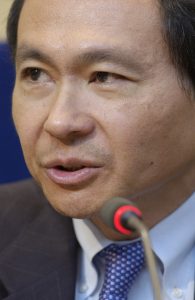
Francis Fukuyama Professor of International Political Economy at the KUB University of Braband at Tilburg Netherlands Photo: Robert Goddyn/UPA Photo
One of Fukuyama’s broader points is that, in the arena of modern liberal democracies, the United States has always lagged behind in terms of quality of state infrastructure. This is mostly because our democracy emerged before our institutions modernized, which historically is a recipe for disaster. The US was able to right the ship in the second half of the 19th century when a wave of progressive reforms professionalized the federal civil service and we ended up with fairly respectable institutions, although still nowhere near the quality (in terms of professionalism and efficiency) of states like Germany or Japan that modernized before they liberalized or states like the UK that–due to unique class structure–were able to fairly painlessly push through reforms in a matter of years that took the US a major national movement and decades to emulate.
The SEC was not one of the agencies that Fukuyama chose to focus on, but it could have been. His analysis would have fit perfectly with Markopolos’s, both in terms of the content and also in terms of the conclusion: America’s national institutions are once again in a period of deep corruption, inefficiency, and impotence.
One of the key points that Michelle Alexander makes in The New Jim Crow is that mass incarceration is primarily the result of the War on Drugs (rather than violent crime):
As numerous researchers have shown, violent crime rates have fluctuate over the years, and bear little relationship to incarceration rates, which have soared during the past three decades regardless of whether violent crime was going up or down. Today, violent crime rates are at historically low levels, yet incarceration rates continue to climb.
Moreover, whites and blacks violate drug laws at basically equal rates, but it is the black population that bears the overwhelming burden of suspicion, policing, prosecution, incarceration, and life with a criminal record while the white population–equally as likely to consume drugs–is blissfully ignorant and immune to the pointy end of the War on Drugs.
The question is: why? The laws and policies that constitute the War on Drugs are colorblind, not racist. One possible explanation is sheer racial animus: the police and prosecutors and legislators who enact and define the War on Drugs hate black people, and they deliberately–but covertly–use the War on Drugs to attack them. This is not plausible, however, and instead Alexander focuses on unconscious racism and incentives.
For example, the federal government–in an effort to win points by looking to be tough on crime–through massive resources into encouraging the War on Drugs by offering money to police departments that showed high numbers of drug convictions. And so:
It is impossible for law enforcement to identify and arrest every drug criminal. Strategic choices must be made about whom to target and what tactics to employ. Police and prosecutors did not declare the War on Drugs, and some initially opposed it, but once the financial incentives for waging the war became too attractive to ignore, law enforcement agencies had to ask themselves, if we’re going to wage this war, where should it be fought and who should be taken prisoner? That question was not difficult to answer, given the political and social context.
Miller Center of Public Affairs flickr page, Charlottesville, VA
The incentives made it clear that arrests would happen. The question was just: where would they take place? And the answer, inevitably, was “among populations with the least ability to fight back politically.” Thus, the War on Drugs is not an effect of pre-existing racism as much as it is a cause of racism. This does not make the War on Drugs unique, however. If there’s one thing I’ve come to learn from studying the history of racism in the US, it’s that racism is always instrumental. The first consideration is always power. Racism is a servant of that quest for power. And this goes back to the very beginning. The slave trade was initially not very racist, in that the gap between white indentured servants and black slaves was fairly minimal. Slavery was, for example, not hereditary. A black child was born free, not slave. After Bacon’s Rebellion, however, when white servants and black slaves rose up together to fight against the elites, slavery was reformed as an institution to make it racially defined. Why? Because that allowed elites to split the coalition of poor whites and poor blacks. So: the quest for power created the racial aspect of slavery which, in turn, created race.
The point is that power and class warped the War on Drugs so that affluent (predominantly white) neighborhoods are left in peace and poor (predominantly black) neighborhoods are treated like warzones. There’s crime everywhere, but it only gets enforced where it makes political sense to do so.
White collar crime is the mirror image of the War on Drugs, and that’s where the connection to No One Would Listen comes in. Markopolos makes it clear that Madoff was far from unique: the entire financial sector is riven with dishonest and blatant criminality. Here’s one example:
My younger brother had had similar experiences. At one point he was hired by a respected brokerage firm in New Jersey to run its trading desk. On his first morning there he walked into the office and discovered that the Bloomberg terminals that supposedly had been ordered hadn’t arrived. Then he found out that the traders didn’t have their series 7 licenses, meaning they weren’t allowed to trade. And then he learned that the CEO had some regulation 144 private placement stock which legally is not allowed to be sold. But the CEO had insider information that bad news was coming, and he wanted to sell the stock. My brother explained to the CEO, “You can’t sell this stock. It’s a felony.” The CEO assured him he understood. My brother went out to lunch with the Bloomberg rep to try to get the terminals installed that he needed to start trading. By the time he returned to the office, the unlicensed traders had illegally sold the private placement stock based on insider information. My brother had walked into a perfect Wall Street storm.
He called me in a panic, “What do I do?” I said, “These are felonies. The first thing to do is write your resignation letter. The second thing you do is get copies of all the trade tickets. Get all the evidence you can on your way out the door. And the third thing you do is go home and type up everything and send it to the NASD.” That’s exactly what he did. The NASD did absolutely nothing. These were clear felonies, and the NASD didn’t even respond to his complaint.
So Markopolos’s brother witnesses felonies, gathers the evidence, and alerts the NASD and then… nothing. Just as Markopolos realized what Madoff was doing, gathered the evidence, and alerted the SEC and then… nothing. He sent them at least three or four major document dumps over a decade. Later on, he put together 20 other whistleblower cases, tied them up with a bow, and delivered them to the SEC for prosecution and again: nothing. Every one was rejected.
Poor blacks are convenient targets. Police departments and municipal governments essentially extort them by unequal application of laws. Rich white investment bankers are inconvenient targets. Gov’t agencies assigned to regulate and monitor them essentially act as their servants by unequal application of laws. As Markopolos points out, the SEC and other agencies would go after fraud cases now and again, but only small fish. They’d never touch the big guys, the rich guys, the influential guys.
Putting together Markopolos, Fukuyama, and Alexander doesn’t lead to a cheery or rosy view of the state of the United States, but I do think it’s a useful view. And besides, one lesson of Fukuyama is that political decay can be reversed. Institutions can be revitalized. One lesson of the Civil Rights is that human dignity can be broadened and justice can move forward. And–while Markopolos did not succeed in convincing the SEC to stop Madoff before he his scheme had ballooned from $7B to $60B, he did become a professional fraud-fighter after that, and so even in his case there is the potential for good to come out of bad situations. I think we all sense that the nation is not in a good place, but having an accurate understanding of what is wrong is the first step to finding truly effective solutions, and these books–to me–seem to work together to provide a substantial piece of that understanding.
Multiple books[ref]For example, see David Aikman’s Jesus in Beijing: How Christianity Is Transforming China and Changing the Global Balance of Power and Rodney Stark and Xiuhua Wang’s A Star in the East: The Rise of Christianity in China.[/ref] over the last decade have focused on the rise of Christianity in China. In the newest edition of First Things, there is an incredible essay by Chinese writer and activist Yu Jie titled “China’s Christian Future.” Jie points out that “in 1949, when the Communist party defeated the Nationalists and founded the People’s Republic of China, Christians in China numbered half a million. Yet almost seventy years later, under the Chinese government’s harsh suppression, that population has reached more than sixty million, according to Fenggang Yang, a sociologist at Purdue University. The number grows by several million each year, a phenomenon some have described as a gushing well or geyser. At this rate, by 2030, Christians in China will exceed 200 million, surpassing the United States and making China the country with the largest Christian population in the world.” Jie names two major events that led to this rise: “the Cultural Revolution launched by Mao Zedong in 1966 and the Tiananmen Square massacre instigated by Deng Xiaoping in 1989. Countless innocent lives were lost as a result of these two cataclysms, and the people’s belief in Marxism-Leninism and Maoism was destroyed. These events opened up a great spiritual void, and the Chinese began searching for a new faith.”
Following the 1989 massacre, “Deng Xiaoping thought the key to keeping the regime in power was to make a select few wealthy. He made their economic dream of getting rich come true while sacrificing the political dream of many to live in a free society. Like a drug, however, money’s hold on people could only last so long. Man cannot live on bread alone. Beyond his material needs lie spiritual ones as well. Government leaders sensed a crisis, too. They started rummaging through the Confucianism and Buddhism they had tossed out, hoping to reclaim the former moral authority of these traditions for the party.”
But this supposed renewal of Confucianism isn’t what it seems:
Today…party officials clutch at Confucius like a drowning man clutches at straws. Without ever having apologized for what they did to destroy Confucianism, they now set up so-called Confucius Institutes around the world, no expense spared, to foster their agenda. The institutes offer financial assistance to scholars of China in the West, inviting them on luxury tours of the country in exchange for favorable reviews of the Chinese government. By the same token, they blacklist those critical of the administration and send their names to Chinese embassies around the world, which in turn deny them visas. The Confucius Institutes are political tools for maintaining power, not genuine sources for cultural renewal. Had the Communists not dug up his grave, Confucius would be spinning in it.
The growth of Christianity has made the Chinese president see it as “a threat: It is the largest force in China outside the Communist party. In China, home churches outnumber government-sponsored churches three to one. Against home churches that refuse to cooperate, the government has waged a large-scale cleansing campaign in the eastern coastal province of Zhejiang, particularly in the city of Wenzhou, known as “China’s Jerusalem,” where 15 percent of the population is Christian. In two years, more than two hundred churches in Zhejiang have been demolished, over two thousand crosses removed. The scene of the cross being removed from a church in Ya village, Huzhou city, on August 7, 2015, was typical.”
Yet, the transforming power of the Christian gospel is nonetheless continuing to spread throughout China. It has changed the lives of both the essay’s author and millions of others throughout his native country. Check out the rest of this powerful story in the full article.
[Trump] sees [trade] not as a form of cooperation where everyone wins but a contest where someone must lose for someone to win. “We already have a trade war, and we’re losing badly,” he declared last month.
It’s not just Mr. Trump who has embraced economics as a bleak zero-sum game; so have Democratic activists. Their platform this year calls the economy “rigged” in favor of the 1%, at the expense of everyone else.
In shifting their attention from how income grows to how it’s divided, the parties think they’re catering to reality.
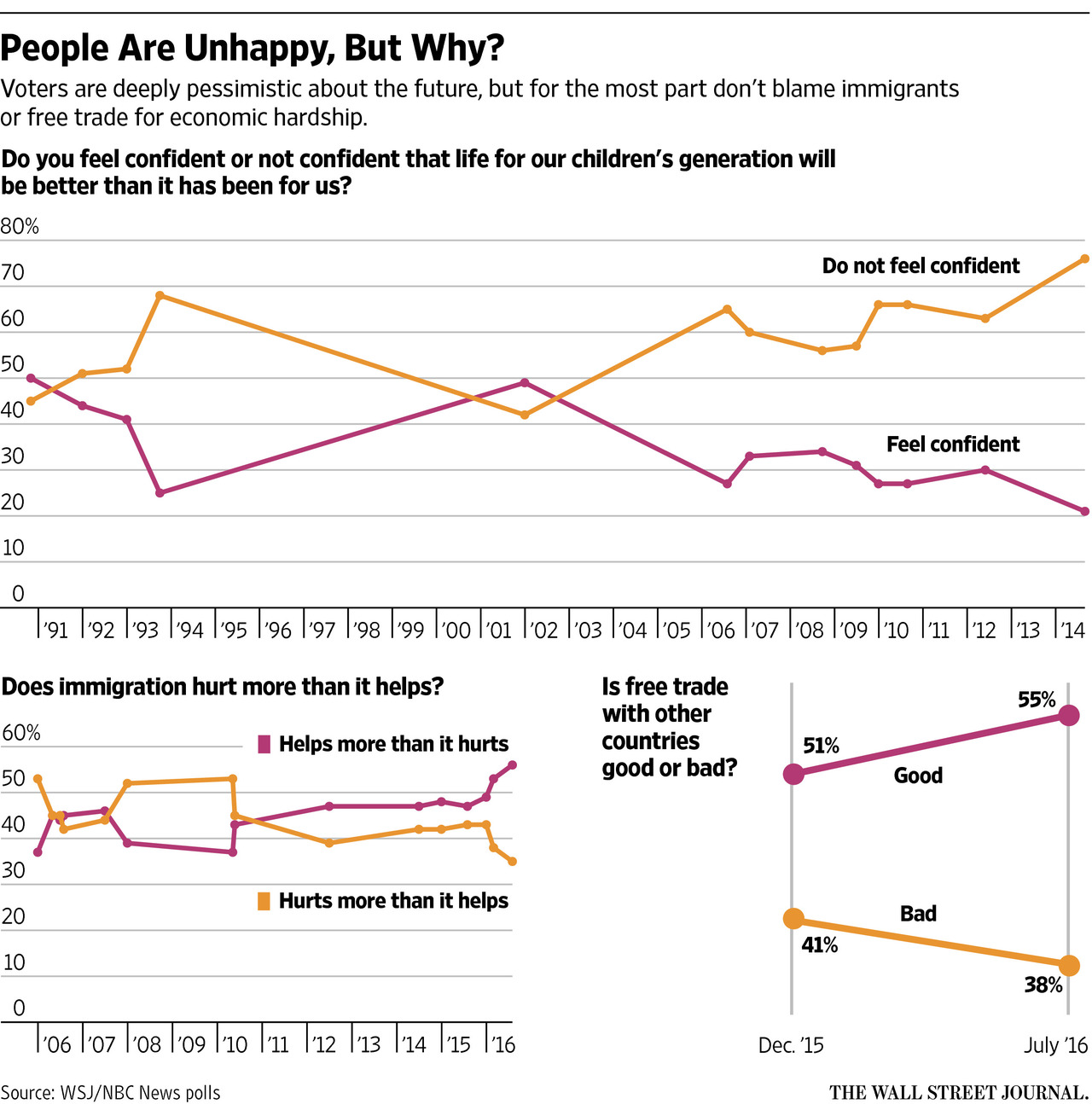
However, this seems to be out of touch with most voters:
The author concludes,
Yet less trade and less legal immigration will hurt U.S. growth and the average worker, not help them. Moreover, the median voter seems to get that: Net support for free trade is solidly positive, according to the latest WSJ/NBC News poll, while support for immigration among Democrats and independents is growing (it remains low among Republicans). Voters worry far less about inequality than whether they personally are getting ahead financially.
That is the irony: In a year when both parties are rallying their partisans by portraying the economy as a win-lose proposition, most Americans still think it’s win-win.




 Christ knows the worth of souls. He came as Isaiah had prophesied and as he affirmed in the synagogue in Nazareth: “… to preach the gospel to the poor; … to heal the brokenhearted, to preach deliverance to the captives, and recovering of sight to the blind, to set at liberty them that are bruised.” (


 For example, Fukuyama emphasizes the importance of professionalism–often accomplished through objective, standardized testing–in helping state institutions retain independence (because rigorous testing confounds political appointments) and high morale (because the testing acts as a kind of filter to create a cohesive social group within the institution) in addition to the more obvious benefits of competence and knowledgeability.