Walker joined Difficult Run as an editor in August 2013.
He graduated from the University of North Texas with an MBA in Strategic Management and a BBA in Organizational Behavior and Human Resource Management. He's currently a grad student in Government at Johns Hopkins University. He has been published in SquareTwo, BYU Studies Quarterly, Dialogue, Graziadio Business Review, and Economic Affairs. He also contributed to Julie Smith's (ed.) 'As Iron Sharpens Iron: Listening to the Various Voices of Scripture'. His other online writing can be found at Worlds Without End and Times & Seasons. He lives in Denton, Texas, with his wife.
Last month, Nathaniel penned a critique of criminal justice scholar Barry Latzer’s WSJ piece on the supposed “myth” of mass incarceration. The impact of the war on drugs tends to be minimized by counting the amount of drug offenders vs. violent criminals in the prison population (hint: there are more of the latter). In his critique, Nathaniel wrote, “Drug sentences are generally shorter than violent crime sentences, and so taking a headcount of prisoners artificially increases the appearance of violent incarceration simply because those criminals spent more time in jail.” This, of course, was noted by Michelle Alexander in her book The New Jim Crow. But what do the data say? According to Brooking’s Jonathan Rothwell,
There is no disputing that incarceration for property and violent crimes is of huge importance to America’s prison population, but the standard analysis—including Alexander’s critics—fails to distinguish between the stock and flow of drug crime-related incarceration. In fact, there are two ways of looking at the prison population as it relates to drug crimes:
How many people experience incarceration as a result of a drug-related crime over a certain time period?
What proportion of the prison population at a particular moment in time was imprisoned for a drug-related crime?
The answers will differ because the length of sentences varies by the kind of crime committed. As of 2009, the median incarceration time at state facilities for drug offenses was 14 months, exactly half the time for violent crimes. Those convicted of murder served terms of roughly 10 times greater length.
The picture is clear: Drug crimes have been the predominant reason for new admissions into state and federal prisons in recent decades.[ref]This is the finding of the National Academy of Sciences as well.[/ref] In every year from 1993 to 2009, more people were admitted for drug crimes than violent crimes. In the 2000s, the flow of incarceration for drug crimes exceeded admissions for property crimes each year. Nearly one-third of total prison admissions over this period were for drug crimes:
In short, Alexander was right when she saw drug prosecution as “a big part of the mass incarceration story.” It turns out “drug crimes account for more of the total number of admissions in recent years—almost one third (31 percent), while violent crimes account for one quarter:”
As Nathaniel concluded,
First, you don’t have to go to jail at all to get a felony conviction on your record. Second, that felony conviction is going to stay on your record long after you have “served your debt to society.” If the criminal justice system is unfair, it’s not just about incarceration. It’s about losing the right to vote. It’s about losing access to government programs like student loans or food stamps. It’s about the government banning your friends and family from supporting you (if they live in public housing) when you get out. And–most egregiously of all–it’s about a scarlet-F that will follow you to every job interview and ensure that long after you are outside the prison walls you are still practically barred from building a new life for yourself.
There’s lot at stake here, folks, and it’s not just about violent crime.
Eliminating policy barriers to international labor mobility would increase global wealth by between 50-150% of world GDP (pg. 13). “For all its radicalism, open borders’ main effects are fairly well understood. Open borders would dramatically increase global production. It would drastically reduce global poverty and global inequality. At the same time, open borders would make the remaining poverty and inequality much more visible for current residents of the First World” (pg. 185).
Immigration has little to no effect on native wages and employment. What effects there are tend to be negative, but small and temporary (pg. 30). In fact, it is mainly those without high-school degrees who lose out in the short run, yet see their wages increase in the long run (pg. 19).
Immigration generates an annual efficiency gain for Americans of between $5 and $10 billion (pg. 21).
Immigrants boost the demand side of the economy (pg. 42-43).
Immigration has little to no impact on the government budget (pg. 63). A typical immigrant may impose a $3,000 net fiscal cost herself, but her descendants have a positive net fiscal contribution of $83,000, producing an $80,000 surplus (pg. 61).
Immigrants today tend to assimilate more than they did a century ago (pg. 90).
New research finds “that greater immigration was associated with small improvements in economic institutions or had no effect at all” (pg. 211). In other words, immigrants don’t import negative institutions.
And much more. You can see a Cato Institute lecture on the book below by editor and Texas Tech economist Benjamin Powell.
Marvin J. Ashton’s talk had a few quotes that I think help remind us how to view others as Christ does. “Brothers and sisters,” he says, “we must learn to look beyond the flesh and see the spirit, the soul, the attitude, the real human being.” This was followed up with a short story about a recently engaged amputee and a happily married partially paralyzed woman. Seeing “the real human being” is what should inspire us to lift others up: the subject of Ashton’s talk: “In this great Church we must try to lift those who need us economically, socially, physically, and spiritually as we earnestly link hands with the Lord in “this is my work and my glory—to bring to pass the immortality and eternal life of man.” (Moses 1:39.)” Toward the end of the Book of Mormon, Moroni proclaims, “And who shall say that Jesus Christ did not do many mighty miracles? And there were many mighty miracles wrought by the hands of the apostles. And if there were miracles wrought then, why has God ceased to be a God of miracles and yet be an unchangeable Being? And behold, I say unto you he changeth not; if so he would cease to be God; and he ceaseth not to be God, and is a God of miracles” (Mormon 9:18-19). According to Ashton, “Certainly the greatest miracles of our day are the lifting and healing of troubled souls. Spiritual strength is a priceless possession available to those who will endure in righteousness. The healing of the troubled soul gives health and strength to those dead in things righteous. Purity, faith, hope, and charity are restored, making the once spiritually sick whole.” He states,
Certainly the day is here when, if we are to follow in [Christ’s] paths, we must take the weary, lonely, depressed, the troubled soul, and the gospel-hungry by the hand and lift and help. Yes, we also need to lift the dishonest, the self-condemning, and those who have chosen expediency over correct principles. Countless numbers today will be able to take their first steps in the right direction when we are willing to provide the lift of confidence and encouragement and give them back that self-respect spoken of by President Lee in the opening session of this conference and to help others retain that self-respect.
“How beautiful,” Ashton says, “in the eyes of the Lord are those who take the time to lift the needy hand.” There are plenty who need lifting. We need to see “the real human being” in all of them.
It’s no secret among social scientists that, on average, family breakdown (notably divorce) is associated with multiple negative outcomes for children. But is divorce the causal factor? Recent evidence suggests that it is. Drawing on research that finds “that individuals who have workplaces with a larger fraction of co-workers of the opposite sex are significantly more likely to divorce later,” the authors
aim to identify the causal effect of divorce for the child whose father left the family because he met a new partner at work. We argue that this research design evaluates a realistic divorce scenario and offers a well-balanced relationship between internal and external validity.
To assess the long-run effect of divorce, we analyse children’s human capital and demographic outcomes. First, we examine college attendance. In Austria, college attendance implies that this person graduated from a higher secondary school. Second, we check the labour market status (employed; unemployed; out-of-labour force) up to the age of 25 years. Third, we examine children’s own family formation behaviour (i.e. fertility and marriage). Finally, we investigate the probability of early mortality (below 25 years of age). Our results show that parental divorce – due to a high level of sexual integration in fathers’ workplaces — has a negative effect on children’s long-term outcomes.
These negative effects include:
Lower levels of educational attainment for both sexes.
Higher likelihood of early mortality and worse labor market outcomes for boys.
Increased likelihood of teenage pregnancy and out-of-wedlock births for girls.
The researchers conclude, “Our results also imply that the negative consequences of parental divorce on children’s long-term outcomes should ideally not only be internalised by parents, but also by policymakers who design policies affecting parents’ incentives to divorce, or programmes which support children from disrupted families.”
a fascinating new paper in The Journal of Democracy suggest[ing] that liberal democracy is losing ground even at home, in the West. Political scientists Roberto Stefan Foa and Yascha Mounk review data from recent World Values Surveys and observe some truly remarkable trends, especially among young people. Young people often reject the traditions of their elders; that’s nothing new. What they seem to be rejecting nowadays, though, in increasing numbers, is the tradition of liberalism itself.
For example, the percentage of people in Western Europe and the United States who say it is “essential” for them to live in a democratically-governed country has declined dramatically across generations. In the United States, less than one-third of millennials—defined as people born since 1980—say it is essential for them. Think about that: More than two-thirds of American young people say democratic government is not a crucial factor in where they would want to live.
According to Foa and Mounk, these numbers do not reflect growing indifference to liberal democracy, but growing opposition. In the surveys, young people increasingly express openness to authoritarianism—especially young people who are rich. An astonishing 35 percent of wealthy young Americans say it would be “a ‘good’ thing for the army to take over” the country! This is a profound change from prior generations, in which “affluent citizens were much more likely than people of lower income groups to defend democratic institutions.”
…The surveys reveal that younger Americans value civil liberties, such as free speech, less than their parents did. For example, only 32 percent of millennials say that civil rights are “absolutely essential” in a democracy, a steep drop from previous generations.
There are criticisms of democracy,[ref]For example, I look forward to reading the newly-published Against Democracy by Jason Brennan.[/ref] but the increasing support for authoritarianism and censorship[ref]The latest Freedom in the World report found that global freedom has declined for the 10th consecutive year.[/ref] is rather frightening.
Most research on the effects of immigration focuses on the effects of immigrants as adding to the supply of labor. By contrast, this paper studies the effects of immigrants on local labor demand, due to the increase in consumer demand for local services created by immigrants. This effect can attenuate downward pressure from immigrants on non-immigrants’ wages, and also benefit non-immigrants by increasing the variety of local services available. For this reason, immigrants can raise native workers’ real wages, and each immigrant could create more than one job. Using US Census data from 1980 to 2000, we find considerable evidence for these effects: Each immigrant creates 1.2 local jobs for local workers, most of them going to native workers, and 62% of these jobs are in non-traded services. Immigrants appear to raise local non-tradables sector wages and to attract native-born workers from elsewhere in the country. Overall, it appears that local workers benefit from the arrival of more immigrants.
The work of cultural psychologist Joseph Henrich has been brought up before and a recent post at Evonomics demonstrates why his work (along with others) is so important:
Innovations don’t require singular genius or Carlyle’s “Great Man”; instead both innovations and innovators are a product of the real Secret of Our Success—our social learning psychology, shaped by evolution to hone in on and learn from individuals with more knowledge, greater skill, and more success. When this selective learning plays out in our societies and social networks, these networks act as “collective brains”.
Innovations occur when previously isolated ideas meet. From the innovator’s perspective, it’s an independent discovery, but from the perspective of the collective brain, it is an inevitable consequence of spreading ideas that converge across an entire social system—a veritable “marketplace of ideas”. The upshot to the collective brain perspective is that increasing innovation means focusing not on individual talent, but rather on societal factors. The paper [by Henrich and Muthukrishna] identifies three key factors driving the rate of innovation: sociality, transmission fidelity, and cultural variance.
These three factors are defined as follows:
Sociality: “the degree to which society facilitates connections between people. Larger, more interconnected societies will have higher sociality, resulting in everyone being exposed to more people and more ideas.”
Transmission fidelity: “the replication of knowledge through formal and informal learning. In WEIRD societies—those that are Western, Educated, Industrialized, Rich, and Democratic—a primary form of transmission is formal schooling. Unsurprisingly, more educated populations have higher innovation rates and these rates should continue to rise with educational improvements[.]”
Cultural variance: “the variety of ideas that are created and tested. Although most new ideas are less than brilliant…society benefits from the rare game-changing unicorns. Muthukrishna and Henrich argue that weaker patent laws facilitate more recombination, as do stronger social safety nets, which give more “wantrepeneurs” the security to become entrepreneurs.”
In conclusion,
The work of Muthukrishna, Henrich, and their colleagues demonstrates that underneath any innovation, be it a steam engine or a mathematical equation, lies a package of psychology that allowed our species to acquire a second, independently evolving line of inherited information—culture.
And just as natural selection has produced complex designs without a designer, so too have individuals connected in collective brains, selectively transmitting ideas and learning information, produced complex inventions without the need for an inventor. Innovations, in other words, don’t require a specific innovator any more than your thoughts require a particular neuron.
Extreme poverty worldwide has been declining over the past few decades (unbeknowst to most Americans) with the chance of eradicating it by 2030. Organizations are testing new anti-poverty programs, including a 10-year experiment with guaranteed basic income in Kenya. One program titled Graduation “included 10,495 households in Ethiopia, Ghana, Honduras, India, Pakistan, and Peru. Almost half of the families in the study lived on less than $1.25 a day.” The results of this experiment were published last year:
The specifics of Graduation varied by country, but the basic premise was the same. All the Graduation programs gave families some kind of “productive asset,” such as sheep, goats, seed corn, bees, or small shops. They all provided training on how to build a business using the assets, and gave food or cash aid to the families for up to a year, in part to discourage them from eating or selling their “productive asset.” The programs also gave families access to a savings account, and some programs required that families contributed to the account regularly.
One year after the program ended, researchers found that Graduation families bought more, owned more, spent more time working, were more politically active, and missed fewer meals than similar families who hadn’t enrolled in the program. The changes were all statistically significant, but, the researchers note, not very large.[ref]”The exception was Honduras,” the author writes, “where families didn’t consume more one year after the end of Graduation (though they did immediately after the program ended). The driving factor there was likely that most Hondurans chose chickens as their productive asset, and most of the chickens died of illness a year after Graduation finished[.]”[/ref]
Admittedly, the program “is expensive, costing between $3,000 to $6,000 per household, depending on the country. But in five out of the six countries the researchers studied, Graduation provided a slight positive return on investment because households in those countries ended up consuming more — thus paying more money into their local economies — than it cost to aid them.”
I’m excited about these experiments and the future of evidence-based policies and programs. I’ve often complained (privately) over the years about the “solutions” to poverty by both the American Right and Left. To generalize in a rather cynical way, the Left assumes that if you throw money at the problem, it will go away. The Right, on the other hand, just thinks the poor should “pull themselves up by their bootstraps.” To soften it a tad, the Left believes in providing the poor with resources/capital. The Right believes that to truly rise out of poverty requires proper incentives, behaviors, and work. Programs like the one above might demonstrate that “the true answer to poverty requires a little bit of everything: Teaching people how to fish, giving them fishing nets, and giving them the fish too.”
There is another pharma scandal in the news over the astronomical increase in EpiPen’s price. Yet, before we begin to blame and denounce the abstraction “capitalism” for all our woes, it might be useful to recall my post on the Shkreli/Daraprim scandal and its discussion of healthcare regulations. This new case appears to be incredibly similar and the site Slate Star Codex has an excellent post contrasting the way the drug industry operates compared to the chair industry:
when was the last time that America’s chair industry hiked the price of chairs 400% and suddenly nobody in the country could afford to sit down? When was the last time that the mug industry decided to charge $300 per cup, and everyone had to drink coffee straight from the pot or face bankruptcy? When was the last time greedy shoe executives forced most Americans to go barefoot? And why do you think that is?
The answer?:
The problem with the pharmaceutical industry isn’t that they’re unregulated just like chairs and mugs. The problem with the pharmaceutical industry is that they’re part of a highly-regulated cronyist system that works completely differently from chairs and mugs.
If a chair company decided to charge $300 for their chairs, somebody else would set up a woodshop, sell their chairs for $250, and make a killing – and so on until chairs cost normal-chair-prices again.
And in his final act, he drives the point all the way home (worth quoting at length):
Imagine that the government creates the Furniture and Desk Association, an agency which declares that only IKEA is allowed to sell chairs. IKEA responds by charging $300 per chair. Other companies try to sell stools or sofas, but get bogged down for years in litigation over whether these technically count as “chairs”. When a few of them win their court cases, the FDA shoots them down anyway for vague reasons it refuses to share, or because they haven’t done studies showing that their chairs will not break, or because the studies that showed their chairs will not break didn’t include a high enough number of morbidly obese people so we can’t be sure they won’t break. Finally, Target spends tens of millions of dollars on lawyers and gets the okay to compete with IKEA, but people can only get Target chairs if they have a note signed by a professional interior designer saying that their room needs a “comfort-producing seating implement” and which absolutely definitely does not mention “chairs” anywhere, because otherwise a child who was used to sitting on IKEA chairs might sit down on a Target chair the wrong way, get confused, fall off, and break her head.
…Imagine that this whole system is going on at the same time that IKEA spends millions of dollars lobbying senators about chair-related issues, and that these same senators vote down a bill preventing IKEA from paying off other companies to stay out of the chair industry. Also, suppose that a bunch of people are dying each year of exhaustion from having to stand up all the time because chairs are too expensive unless you’ve got really good furniture insurance, which is totally a thing and which everybody is legally required to have.
And now imagine that a news site responds with an article saying the government doesn’t regulate chairs enough.
I’ve been out of town the last couple weeks, so I’ve missed the past two sessions. From the looks of it, I missed an excellent one last week. This week’s session yielded some great insights and few…well, we’ll get to that.
Marion G. Romney discussed how the “Church welfare is an approach to the law of consecration—the Lord’s perfect economic program.” He notes, “In light of these teachings [from the scriptures] it seems to me that every Church member, and particularly every priesthood bearer who wishes peace and joy here and eternal life hereafter, would give bounteously of his sustenance to the poor.” Yet, he made this important point: “The basis of God’s perfect economic program is labor.”[ref]He includes this quote from Brigham Young: “My experience has taught me and it has become a principle with me, that it is never any benefit to give, out and out, to man or woman, money, food, clothing, or anything else, if they are able-bodied, and can work and earn what they need, … This is my principle and I try to act upon it. To pursue a contrary course would ruin any community in the world and make them idlers.” (Discourses of Brigham Young, 1925 edition, p. 422.)[/ref] Why? Because “[t]he dignity and self-respect of the receiver must be preserved.” This attitude toward work is something I touch on in my article for BYU Studies Quarterly:
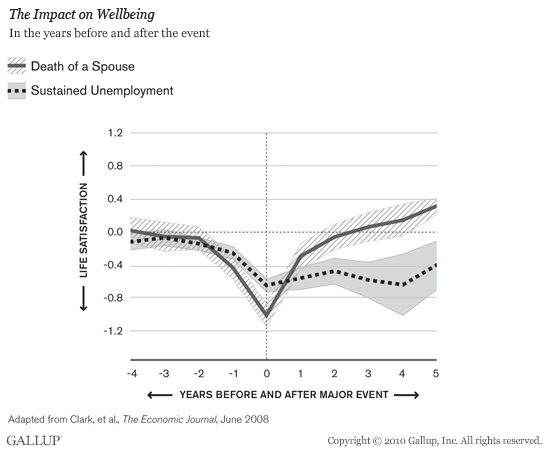
In their book Wellbeing, Gallup researchers Tom Rath and Jim Harter point to evidence that shows, given a few years, people recover from tragic events (like the death of a spouse) to the same level of well-being prior to the tragedy. “But this was not the case for those who were unemployed for a prolonged period of time—particularly not for men. Our wellbeing actually recovers more rapidly from the death of a spouse than it does from a sustained period of unemployment.” Based on data from the General Social Survey, economist Arthur Brooks also found that one of the key elements for achieving happiness and self-fulfillment is work. This is due to its connection to what Brooks calls “earned success”: the ability to create value in our lives and in the lives of others (pg. 173).
Unfortunately, Romney attempts to use the cursing of the ground following Adam’s disobedience to make his point:
[Adam’s] was not a vindictive decree. The Lord was not retaliating against Adam. He was simply placing Adam in a situation where he would have to work to live. The ground was cursed in the manner prescribed for Adam’s sake, not to his disadvantage. Had Adam and his posterity been able to live without working, the human race would never have survived. Idleness is pernicious.
The problem is that’s not what the phrase means. As the NET Bible Commentary explains, “The Hebrew phrase בַּעֲבוּרֶךָ (ba’avurekha) [“for your sake”] is more literally translated “on your account” or “because of you.”” For example, the NRSV translates it “because of you.” This is not done for Adam’s benefit, but is done because of his transgression. While I dig Romney’s point, his exegesis here is flawed. Nonetheless, it reminds of me this quote from Elder Christofferson a few years back:
By work we sustain and enrich life. It enables us to survive the disappointments and tragedies of the mortal experience. Hard-earned achievement brings a sense of self-worth. Work builds and refines character, creates beauty, and is the instrument of our service to one another and to God. A consecrated life is filled with work, sometimes repetitive, sometimes menial, sometimes unappreciated but always work that improves, orders, sustains, lifts, ministers, aspires.
Moving along, Elder Featherstone offered bishops some practical financial advise when it came to the welfare system:
Brethren, that is a great principle in welfare. Our home food bill is no more than it was six months ago or a year ago. We had to change the mix. We feel, bishops, you might well change the mix on those who are eating out of your bishops storehouse. When potatoes are $1.69 for ten pounds, let’s switch to rice. When meat is as high as it is, let’s not do as one bishop did, continue to give one family 67 pounds of beef each month. I don’t know that there are too many families here that are eating 67 pounds of beef each month. Those Saints receiving commodities through the bishops storehouse should not be receiving more than you are using in your homes. I hope this is a principle that we will remember and use very wisely…We are trying to spend the Lord’s sacred funds in the best possible way.
I don’t have much to say about this. I just thought it was an interesting topic to be addressed in General Conference. Church leadership isn’t just about abstract concepts and otherwordly concerns. It’s about the here-and-now. It’s about costs and benefits. It’s–in many cases–about economics. In other words, respond to with enlightened self-interest to the price system as any other consumer would.
N. Eldon Tanner talked about everyone’s favorite topic: obedience. “Obedience is the first law of heaven,” he says, “and it is obedience to the laws of God that I should like to talk about particularly, because these laws affect not only our happiness and well-being here upon the earth, but are essential to our eternal life.” I’ve mentionedmultipletimes the connection of the commandments to happiness and well-being and I’m always glad to see it discussed in General Conference. Some of his other comments cover familiar ground regarding self-discipline (which could be ultimately seen as the shaping of habits):
Self-discipline is the basis of our success. Man has been given a mind to think, to ponder, and to understand and decide what he wants to do and whether or not the sacrifice and discipline is worth it; and, in the Church, whether or not he can stand the ridicule and pressure of those with whom he associates. You have been called. You have been given the priesthood. You have been given the gospel. You are an example to the world. Be a good one. The measure of our success depends on our decision, our determination, discipline, and dependability.
Finally, President Lee urges the men the to take marriage more seriously. He states,
[Marriage] has lost its sanctity in the eyes of the great majority. It is at best a civil contract, but more than often an accident, or a whim, or a means of gratifying the passions; and when the sacredness of the covenant is ignored or lost sight of, then a disregard of the marriage vows under the present moral training of the masses is a mere triviality, a trifling indiscretion.
I think there is ample evidence to support President Lee’s claims. However, I’m always bummed when concerns I share are undermined by terrible advice. For example:
Teach those [married couples] who are having problems to go to the father of the ward, their bishop, for counsel. No psychiatrist in the world, no marriage counselor, can give to those who are faithful members of the Church the counsel from one any better than the bishop of the ward. Now, you bishops don’t hesitate to say, marriage is the law of God, and is ordained by him and man and wife are not without each other in the Lord, as the apostle Paul declared.
Um, no. This is why so many in the Church go to the bishop instead of a professional and never receive the counsel and tools they actually need. Thankfully, we’re seeing more and more bishops outsource these problems to professionals with the help of Church funds when necessary. A bishop can be useful, but authority and occasional inspiration doesn’t make you a therapist. We will likely do more harm than good if we encourage struggling couples to seek unlicensed and unprofessional help.
All in all, a mixed bag of a session. But when we look at the topics–work, finances, discipline, marriage–we see that the gospel is about everyday life. Let’s not forget that.



 Marvin J. Ashton’s talk
 a fascinating new paper

 The specifics of Graduation varied by country, but the basic premise was the same. All the Graduation programs gave families some kind of “productive asset,” such as sheep, goats, seed corn, bees, or small shops. They all provided training on how to build a business using the assets, and gave food or cash aid to the families for up to a year, in part to discourage them from eating or selling their “productive asset.” The programs also gave families access to a savings account, and some programs required that families contributed to the account regularly.
 …Imagine that this whole system is going on at the same time that IKEA spends millions of dollars lobbying senators about chair-related issues, and that these same senators vote down a bill preventing IKEA from paying off other companies to stay out of the chair industry. Also, suppose that a bunch of people are dying each year of exhaustion from having to stand up all the time because chairs are too expensive unless you’ve got really good furniture insurance, which is totally a thing and which everybody is legally required to have.