At least that’s what Reason‘s science writer Ronald Bailey has concluded based on various studies. “For example,” Bailey writes,
according to a study comparing outcomes in all U.S. states in the January 2014 issue of Contemporary Economic Policy by Illinois State University economist Oguzhan Dincer and his colleagues finds that reducing economic freedom actually tends to increase inequality. “On average, as the size and scope of government increases, so does income inequality,” Dincer tells Reason.
The authors go on to establish “Granger causality.” Simplistically stated, this means they show a causal feedback loop, in which economic intervention produces economic inequality, which in turn leads to more economic intervention. Politicians often react to rising inequality with policies that, on average, end up making inequality worse—say, by increasing the minimum wage. (That is not to say that some policies, such as raising the top marginal tax rate, could decrease inequality. But taken as a whole, the effect moves in the other direction.)
…A 2013 study in The Journal of Regional Analysis and Policy by economists at Ohio University and Florida State University bolsters Dincer’s findings. That study, also using Fraser state economic freedom index data, identified a Kuznets curve relationship between increasing economic freedom and trends in income inequality.Their analysis “suggests that beginning from a low level of economic freedom, increases initially generate more inequality as the upper part of the income distribution benefits relatively more than the lower part; however, as enhancements of economic freedom continue, this reverses and the lower part of the distribution experiences larger relative income gains.”
In their study, Dincer and his colleagues report that their results “support previous studies which find a positive relationship between economic freedom and per capita income.” Last November, a National Bureau of Economic Research study by the Mississippi State University economist Travis Wiseman found, all things being equal, that a one-point increase on the Fraser Economic Freedom of North America index is associated with about an $8,156 increase in real average market incomes.
Check out the whole article and the studies in full.
Income inequality is a big deal, and the biggest addition to the controversial discussion recently has Piketty’s tome Capital in the 21st Century. In very simple terms, Piketty’s argument was that when you get a greater return on capital investments than the rate at which the economy as a whole grows, then wealth invariably piles up in the hands of an elite. If true, this dire prediction means the only way to preserve equality is to implement a very progressive income tax and do it globally. Which, short of an alien invasion uniting us into one, hegemonic world government, is unlikely.
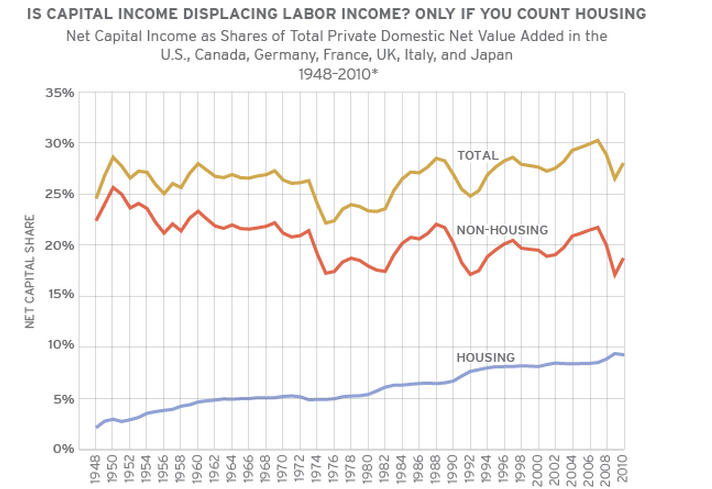
“But,” as Greg Ferenstein writes, “a 26-year-old MIT graduate student, Matthew Rognlie, is making waves for an alternative theory of inequality: the problem is housing.” Rognlie’s reply is pretty simple, conceptually. He points out that cutting edge technology–whether its hardware or software–depreciates at a very great rate. Think of how fast the price of a brand new cell phone falls: within 4-5 years you can easily go from $1,000 to basically $0. So, since “technology doesn’t hold value like it used to, so it’s misleading to believe that investments in capital now will give rich folks a long-term advantage.”
So if technology doesn’t hold value, then what does? Land. Thus Ferenstein concludes: “If Rognlie is correct and we really care about inequality, it might be wiser to redirect anger towards those who get in the way of new housing [often local governments with austere zoning regulations to protect the home prices of rich owners in exclusive areas], rather than rely on taxes to solve our problems.”
In a recent article in Christianity Today, pastor and professor A.J. Swoboda writes the following:
This is how it looked on Saturday.
Christians defend certain days of the Holy Weekend. For instance, we’ll defend the idea that on Friday Jesus actually died on a cross to save the world from its sin. Then we’ll turn around and defend Easter Sunday as the day that Jesus actually rose from the grave, defeating the powers of evil running loose in the world.
But nobody defends Saturday. Nobody writes apologetics defending the belief that Jesus actually lay dead for one long, endless day two thousand years ago. What’s the defense for that? If you’ve got the power to rise from the grave, why would you wait one whole long day to do it? Why not just rise from the grave, like, just a little later Friday night?
Then, he offers this startling reminder:
So much of Christian faith is Saturday faith. I call it “awkward Saturday”: that holy day to sit, wait, hope—unsure of what’s to come tomorrow. Saturday is the day that Jesus, and all understanding, lay dead…So much of faith is living in the awkward Saturday, living in the dark mesh of twilight between the moments of hopelessness and utter blinding hope. At times, we are all like the two disciples on their way to Emmaus who were really close to Jesus but didn’t always know it. In Luke 24, two disciples walked away from Jerusalem, where they’d just seen their Lord and Master die on the cross. Leaving, dejected, upset, hopeless, and broken, to find the next stage in their lives and careers. Unbeknownst to them, Jesus had been resurrected and was actually walking alongside them on their way to Emmaus. The hope of Sunday hadn’t dawned on them yet. The Gospels tell us that, on their way to Emmaus, the disciples were “downcast.”
That experience is the kind of experience Saturday is all about.
This profound realization goes hand-in-hand with The Crucible of Doubt by Terryl and Fiona Givens. In our quest for certainty,[ref]Certainty and eternal learning has an especially paradoxical relationship within Mormonism.[/ref] we often stigmatize doubts, fear, and/or a lack of understanding. And sometimes all you can do in response is show up, like Joseph of Arimathea did:
According to John—after the crowds fled and the slowly muffled screams of the executed ceased—Joseph made the sorrowful journey to receive Jesus’ body as Friday drew to a close. Slowly, carefully, Joseph lowered the cross, pulled the large Roman nails from Jesus’ fragile hands and feet, and carried him in his arms.
Allow your imagination to paint the devastation of pulling those nails and along with them uprooting your greatest dreams and hopes…Years earlier, most likely, Joseph had left behind his life of predictability and safety to follow an unknown Savior, only to have his vision crushed the night before. Now Joseph held his dead dream in his arms. He hadn’t signed up for this. This wasn’t in the fine print. What a failure. What a waste.
But Joseph still showed up.
Joseph asked for Jesus’ body. It wasn’t forced upon him. He experienced the burden of it by his own choice…Who would ask for the heaviness of Christ?
…A Christ-follower does.
The feelings of pain and hopelessness that often come with the burdens of mortal life are not signs of weakness or lack of faith. They are the feelings of Christ’s disciples the day before his glorious return.
In anticipation of this Easter Sunday, perhaps we should take a moment to reflect on awkward Saturday.
Sci-fi art by Cronus Caelestis in the Wikimedia Commons.
The Hugo award nominations will be announced publicly this Saturday.[ref]Why on earth they announce the ballot the Saturday before Easter is beyond me. Scalzi has explained how dumb this policy is, but apparently nobody is listening.[/ref] You might remember the Hugo awards vaguely from last year when there was a giant political kerfuffle. The way the Hugos work, anyone who wants to attend WorldCon or even just pay $40 for a non-attending supporting membership is eligible to nominate a work and vote for it. Historically, only about 10-20% of the approximately 10,000 WorldCon attendees have actually voted, however, and as a result science fiction’s most prestigious literary awards[ref]There are also awards in other categories, such as graphic novel, film, or even related academic / critical works, but the best novel, best novella, etc. awards are the headliners.[/ref] are decided upon by a very small group of people.
So last year, bombastic arch-conservative Larry Correia decided to prove that this small population of voters was not very representative of fandom generally and, more to the point, that there was actually an insular, politically rigid clique dominating the Hugos. To make his point, he suggested an alternate slate of nominees (mostly from the right end of the political spectrum) and then encouraged his fans to purchase memberships and vote. This initiative was called Sad Puppies 2. His fans responded in great numbers, several of his nominees made it onto the ballot, and–although none received an award–the entire sci-fi community was riven by controversy and anger. At Corriea (for politicizing the Hugos) or at the social justice advocates who opposed him (for politicizing the Hugos even earlier.)
Fast forward to a new year and a new Hugo season, and moderate conservative Brad Torgersen (whom Correia has affectionately referred to as “the Powder Blue Care Bear” among conservative sci-fi authors) decided to spearhead Sad Puppies 3. And, as I mentioned at the outset, the results of this third initiative will be announced on Saturday. Leading up to that announcement, however, Teresa Nielsen Hayden published an absolutely astonishing post on the blog she runs with her husband.
The Haydens, just so you’re aware, are prominent members of the social justice advocacy clique that vehemently opposed Sad Puppies 2 (under Correia) and 3 (under Torgersen). It may or may not be worth noting that, between the two of them (both editors at Tor), they have one Hugo award and fourteen nominations. In any case, her post was titled Distant thunder, and the smell of ozone, and here it is in its entirety[ref]There are going to be lots more quotes from Hayden. They all come from comments she made to this post.[/ref]:
I’ve been keeping an ear on the SF community’s gossip, and I think the subject of this year’s Hugo nominations is about to explode.
Let me make this clear: my apprehensions are not based on insider information. I’m just correlating bits of gossip. It may help that I’ve been a member of the SF community for decades.
If the subject does blow up, I may write about it in this space. In any event, watch that space.
I’ll be honest: I didn’t get the big deal when I first read that. It was only after reading a variety of pieces by Correia, Torgersen, and Sarah Hoyt (another conservative / libertarian sci-fi author) that I realized what was going on. And then I was both shocked and a little excited. Let me break it down for you.
Sad Puppies 3 is Working
Corriea explained the most plausible explanation for where Hayden got her information about the unannounced Hugo slate. First, he quoted Hayden’s description of how the notification process for the Hugo nominations works:
When you’re nominated for a Hugo, you’re contacted ahead of time by the Hugo administrators, who check to make sure you’ll accept nomination. If they’re going to have to add the next-highest nominee in a category, they want to do it before the general public sees the ballot, so that no one knows who’s the lowest-ranked nominee.
Then he drew the obvious conclusion: “Teresa is worried. Why? Because as an insider, the people she already knew were SUPPOSED to get Hugo nominations haven’t been contacted… ” This explains Hayden’s statement that “I think they’ve succeeded in f*cking up the ballot beyond all expectation.” If nobody in her clique is getting one of those phone calls, she must assume that the Sad Puppies 3 slate is going to dominate the final ballot. The ironic thing, of course, is that she outlined the Hugo process in order to complain that Sad Puppies organizers might coordinate to reverse-engineer the approximate votes:
If the SPs got all or most of their slate onto the ballot, and those people had their nominations confirmed by the Hugo administrators, and they were comparing notes behind the scenes, they’d be uniquely able to reconstruct most or all of the final ballot.
Apparently “comparing notes behind the scenes” is bad when the Sad Puppies folks do it, is perfectly justifiable when Hayden coordinates with her buddies (and then writes public, panic-tinged posts) doing the exact same thing.
The Truth is Coming Out
In another comment to the same post, Hayden wrote that:
Why are people talking about what would happen if everyone who reads SF voted in the Hugos? IMO, it’s not a relevant question. The Hugos don’t belong to the set of all people who read the genre; they belong to the worldcon, and the people who attend and/or support it. The set of all people who read SF can start their own award.
This is a very abrupt departure from rhetoric back in 2014. At that time, the ruling clique still had the power to kick the Sad Puppies around. After all, some of the Sad Puppies 2 works made it into the ballot, but none of them actually won an award. In fact, most of the prominent awards that year (Hugos and others) were a sweeping success for the social justice crowd, and there was much celebration. In those days, they emphasized the universality of the Hugos as the pre-eminent sci-fi award bar none. This was the genre’s award. But now that they sense they are losing control, they are suddenly eager to denigrate the awards and start gatekeeping overtly.
I should add that Hayden clarified her remark subsequently, writing that “When I say the Hugos belong to the worldcon, I’m talking about the literal legal status of the award.” It’s hard to see that backpedaling as genuine, however.
There was an even more remarkable admission from Hayden in the comments, however. She stated that
Indications are that a fair number of them [nominees on the Sad Puppy slate who got onto the ballot], maybe a majority, are respectable members of the SF community who, for one reason or another, are approved of by the SPs while not being ideologically Sad Puppies themselves.
First, let’s take a moment to ponder where she gleaned the identities of the SP folks who made it into the ballot. Correia’s theory explains how she could know the quantity, but if she actually knows who they are then her protests of not having “insider information” ring entirely hollow.
But what’s more important is that she is willingly conceding that the SP slate is not ideological. More on that in the next section. For now, let’s focus on why she is making the effort to separate the goats from the sheep, as it were, and point out that some of the folks put forward by SP3 aren’t really bad guys: You can’t call the dogs off of some folks without implicitly admitting that you’re happy to have them sicced on other folks. This is a big give-away from the social justice folks. She’s tacitly admitting what the Sad Puppies folks have always been alleging: that if you don’t toe the ideological line they will savage your reputation and torpedo your career. Sarah Hoyt, picking up on exactly this logic, wrote a powerful first-hand account of what it is like to live in that climate of fear: All The Scarlet Letters. Remember that the Haydens are editors. Teresa is a consulting editor, but her husband Patrick is Manager of Science Fiction, both for Tor which is one of the biggest sci-fi publishers out there. Then try to keep in mind how absolutely cutthroat the writing industry is: making your living as an author is the dream of a millions and the reality of a privileged few. Only a tiny fraction of authors out there (like Larry Correia, for instance, who was a self-publishing phenomenon and can thumb his nose at the publishing industry) are free to speak their minds without worrying about devastating ramifications for their careers. For folks who wield as much institutional and corporate power as the Haydens do to be so unabashedly political is frightfully immoral, but hey: at least they’re not hiding it anymore.
There’s Reason for Hope
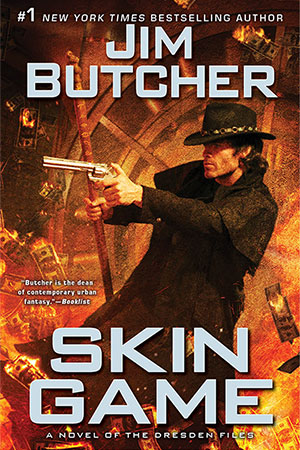
Let me backtrack a minute to talk about what I think is really the most important fact we can glean from Hayden’s comments: Sad Puppies 3 isa diverse slate. Sad Puppies 2 was not, and Correia made no bones about it. But Torgersen’s slate is a grab-bag that includes authors from across the political spectrum. Rather than attempt to prove how biased the typical Hugo voters were, Torgersen’s goal is to rehabilitate the awards by de-politicizing them. Pretty much the only criteria for his list was that a writer (1) have written something really good and (2) not be the kind of author who would usually be up for an award. A great example of this is Jim Butcher. Butcher is my favorite living author, and is best known as the man behind the Dresden Files, one of the all-time best-selling urban fantasy series. He is being nominated in the best novel category for Skin Game, which is his fifteenth novel in that series (and one of his best, in my opinion.) The last seven or eight consecutive novels in the series have all hit the NYT Bestseller List as soon as they come out. Butcher has, with one exception, never spoken out publicly about politics or controversial current events. Butcher is exactly the kind of guy who I think deserves an award, and also exactly the kind of guy who would never have stood a chance under the old regime.
If the victory of SP3 just meant a palace coup where one clique replaced another, that would be nothing to celebrate. And so you can see that I’ve saved the best for last. I’m not a partisan at heart, and the idea of the Hugos moving away from the ghetto of political insularity and becoming more mainstream (at least as far as sci-fi goes) is great. Not everything is coming up roses, of course. Correia, Hoyt, Torgersen, and others seem to think that nothing matters other than fun and popularity. I certainly think enjoyment matters, but I don’t think it’s the only metric that should be considered. I think sometimes important works–works that deserve recognition and awards–aren’t fun or enjoyable in any usual sense. But that is exactly the kind of quibbling I’d like to see happen where the Hugos are concerned instead of this knock-down, to-the-knife, existentialist ideological struggle that is happening right now.
There was a time when I would buy any book that had won a Hugo award without knowing a single other fact about the book or the author. That was all it took. Once I started reading them systematically, I learned quickly that there were a lot of duds in there as well. The Hugo system has never been perfect, and that’s fine. But these days sci-fi as a literary genre is struggling and the most important award is under a cloud of suspicion and animosity. I’d love to see some improvement and Hayden’s post–and her subsequent comments and the analysis from Correia, Torgersen, Hoyt and others[ref]like Michael Z. Williamson and Matthew Bowman[/ref]–have finally given me some hope.
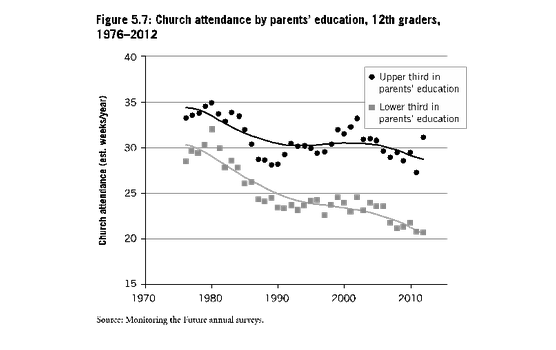
Sociologist W. Bradford Wilcox has had an excellent article in The Washington Post a few days ago largely drawing on the work of Harvard’s Robert Putnam. Drawing from Putnam’s latest book Our Kids: The American Dream in Crisis, Wilcox writes,
One of the tragic tales told by Harvard scholar Robert Putnam…is that America’s churches have grown weakest in some of the communities that need them most: poor and working-class communities across the country. The way he puts it, our nation’s churches, synagogues and mosques give children a sense of meaning, belonging and purpose — in a word, hope — that allows them to steer clear of trouble, from drugs to delinquency, and toward a bright and better future, warmer family relationships and significantly higher odds of attending college…The picture of religion painted by Putnam, a political scientist and the foremost scholar of American civic life, is part of a broader canvass in his book showing that kid-friendly institutions — not just churches, but also strong families and strong schools — are withering, but almost entirely in less-affluent communities.
While Putnam attributes some of this to the decline “in employment for less-educated men, divergent incomes for college-educated and less-educated men, and a “breathtaking increase in inequality”” in the 1970s, Wilcox notes that his research finds the “dramatic declines in religious attendance began in the 1960s, well before the economic factors stressed by Putnam kicked in a decade later.” “The timing of religious declines,” explains Wilcox, “paralleled and reinforced by the retreat from marriage that also began in the 1960s, leaving more and more kids in single-parent homes — suggests that America’s religious and familial capital was suffering well before the economic shocks of the 1970s.”
Wilcox continues to draw on Putnam’s work while adding fresh insights. The whole thing is worth reading. Check it out.
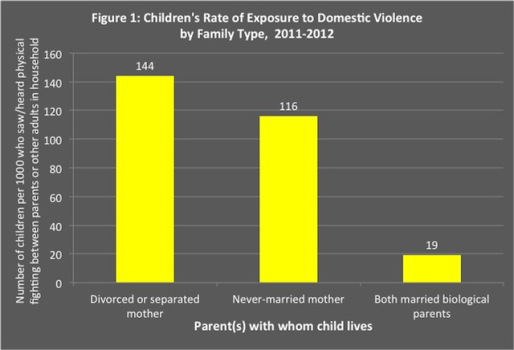
I wrote a post for Times and Seasons today: Privilege and the Family. The post borrows heavily from work that Walker Wright has done right here at Difficult Run collecting research and data (like the chart above) on the impact of marriage and family for children’s outcomes, and also seeks to answer a couple of questions raised at By Common Consent recently: Who has two thumbs and doesn’t give a crap about the Family? The questions are:
Why should we care about the family?
What does it mean to stand up for the family?
If that sounds like an interesting post to you, then you should check it out.
When the James Bond film Skyfall was coming out, I did a series of posts on the music of James Bond. That’s how obsessed I am with these films. I can’t express how excited I am that Sam Mendes (director of Skyfall) will be returning for the latest flick SPECTRE, especially given how incredible his first Bond film was. The cast is equally impressive, including Christoph Waltz (Inglourious Basterds, Django Unchained), Monica Bellucci (Irreversible, Malena, The Matrix Reloaded), Andrew Scott (BBC’s Sherlock), and Dave Bautistia (Guardians of the Galaxy). The return of SPECTRE (Special Executive for Counter-Intelligence, Terrorism, Revenge, and Extortion) is most welcome. It is a throwback to six of the first seven films. The oft-hidden, cat-stroking leader Ernst Stavro Blofeld (parodied brilliantly by Mike Myers in the Austin Powers films) seems to be making an appearance (perhaps in spirit if not in name) in the form of Waltz’s character (notice how his face is shadowed in the trailer below). And our first glimpse of it all was just released.
So without further ado, I give you the SPECTRE trailer.
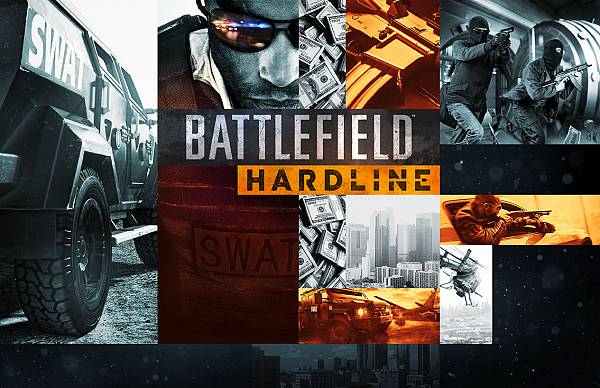
In the late 1990s and early 2000’s, first person shooter video games focused thematically on World War II with major franchises like Medal of Honor, Call of Duty, and Battlefield. Things started to change around 2005 when the Battlefield series released Battlefield 2: Modern Combat and the change in focus was cemented with the blockbuster release of Call of Duty 4: Modern Warfare in 2007. That’s pretty much where the genre has lived for the last 10 years. Recently, however, the Battlefield franchise has decided to shift focus again with their newest title Battlefield: Hardline which release earlier this month. The disturbing twist in the newest game, which you can see in the trailer, is that instead of soldiers fighting on a battlefield we now get militarized cops.
Obviously, this is not the very first time a video game has been controversial. I’m a gamer, but there are some games that I refuse to play because the depiction of violence reaches levels that I think are a little sick. Just to give a very simple example of that: I have played just enough of the Grand Theft Auto franchise to know that it will never be allowed in my home. I also have all kinds of political issues with the Call of Duty franchise,[ref]I will resist a tirade on the self-loathing anti-Americanism of the series and merely point out that in the Modern Warfare story arc, the bad guys always end up being the Americans and the playable American characters always die.[/ref] and even though the most controversial level of that that series[ref]The level is called “No Russian,” In it, you play an undercover CIA operative helping to massacre unarmed civilians in a Russian airport.[/ref] was made by a high school buddy of mine, I opted out. And these are, relatively speaking, the tame examples of controversial video games. The really nasty stuff I won’t even go into here.
So I’m not going to hyperventilate and argue that Battlefield: Hardline is the worst thing to have happened in video games. It’s not. It’s still pretty disturbing, however, and the video game press has taken notice. Chris Plante writes in Polygon:
The creators of Battlefield Hardline, while researching the militarization of the nation’s police force, understandably began to view the devices used by Americans against Americans as novel and fun. After all, they look identical to those being used in their previous games against fictional terrorists.
Here’s the image he was linking to, btw:
Now, there are some who have gone a little farther and suggested that video games like this in some way cause police militarization. I think that’s a little silly, in much the same way that I think blaming video games for causing general violence in society is pretty silly.[ref]Biggest problem: as video games get more realistic and more violent and more popular, the actual rate of violent crime is trending downward.[/ref] Thus, I largely agree with Erik Kain’s take in Forbes:
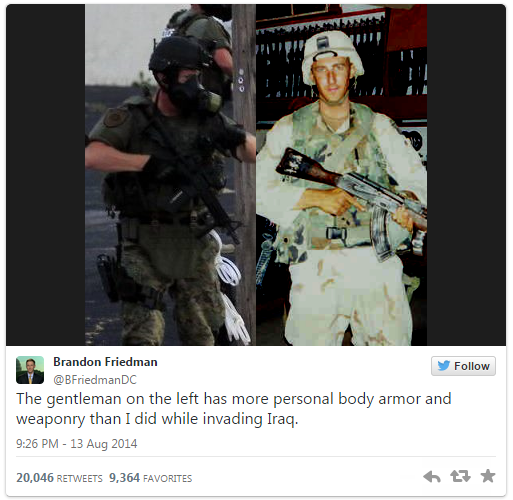
Alan Jacobs, writing at his blog, makes the connection between the Ferguson police and Call of Duty:
“I want to suggest that there may be a strong connection between the visual style of video games and the visual style of American police forces — the “warrior cops” that Radley Balko has written (chillingly) about,” writes Jacobs. ”Note how in Ferguson, Missouri, cops’ dress, equipment, and behavior are often totally inappropriate to their circumstances — but visually a close match for many of the Call of Duty games.”
Jacobs is arguing that the culture of first-person shooters—and the aesthetic—is being imprinted on our police forces. It’s not a bad argument by any means… [but] I’m not so sure.
Kain goes on to argue that the reason for his skepticism is simply that “these problems are structural rather than cultural.” He goes on:
The War on Drugs and the War on Terror are essentially the same war when it comes to beefing up law enforcement at the expense of personal liberty. The War on Drugs already provided a good excuse for law enforcement to overstep its bounds; the War on Terror has led to much better armed police forces and the sprouting up of SWAT teams all across the country.
There are now over 100 SWAT team raids a day in the United States, mostly for non-violent offenses, and often leading to horrible things like police throwing flash bang grenades into a baby’s crib, or the killing of a seven-year old girl while a SWAT team raided the wrong apartment looking for a murder suspect (who was in the apartment above and gave himself up without violence) while A&E filmed the entire event for a reality TV show.
The problems are deep and they are profound, but they are not likely to be caused by video games. On the contrary, what creeps me out about this game is simply that it reflects a kind of social nonchalance and acceptance of some pretty horrific, unnecessary police violence not to mention the systematized discrimination that goes along with it.[ref]I’ll be writing more about that very soon.[/ref] Consider what Scott Shackford had to say about gamer opinion in his piece for Reason:
The folks behind Battlefield Hardline might want to check out our Reason-Rupe analysis of poll responses by frequent gamers. We found they’re more likely to be concerned about the militarization of the police. From our survey, 70 percent of gamers think it’s too much for police forces to have access to military equipment and drones as tools for crime-fighting, compared to 57 percent of non-gamers. And nearly two-thirds of the gamers we polled believe that police officers aren’t held accountable for misconduct.
Shackford’s point appears to be something like: Hey, Battlefield, you’ve picked the wrong demographics here. Gamers are libertarian. They won’t go for this. But the logic is really kind of backwards. Gamers do tend to be left-libertarians, but that didn’t stop the game from becoming the #1 biggest selling 2015 launch (to date) in the UK. I’m not sure what the numbers look like in the US, but it’s clear millions of gamers are snatching up copies. If these guys–more suspicious of police militarization than the Average Joe–are untroubled by the game, what does that say?
So no: I don’t think violent video games lead directly to real-world violence and I doubt that a game glorifying police militarization is going to lead directly towards even more police militarization. But, even if Battlefield: Hardline is largely following a trend rather than setting one, it may still play a role in normalizing the police militarization we already have. For centuries we’ve had an American tradition of separating military and police forces, but that tradition doesn’t mean much anymore if the police and the military have become indistinguishable.
At this rate, I have to wonder if rising generations will even have a conceptual notion that there was ever a time when the police didn’t roll around in armored personnel carriers with fully-automatic weapons. And I think that just makes it a little bit harder to reverse the trajectory we’re currently on.
There were 4,428 changes to the Internal Revenue Code between 2001 and 2010, including an estimated 579 changes in 2010 alone. The tax code averages more than one change per day. The resulting complexity creates hidden compliance costs between $215 billion and $987 billion annually. To put this in perspective, total revenue collected by the federal government in 2012 was $2.5 trillion.
That’s bad enough, but a new article got me thinking about this issue in a different light. In The Income Tax is Immoral and Unconstitutional – and Not (Just) for the Reason You Think, Robin Koerner points out that the $2,000 he had to shell out to his accountant in order to generate 149 pages of tax documentation for his simple, small private business[ref]Koerner has no employees and the business revenue is small enough that he qualifies for major income-based subsidies[/ref] constitute a highly regressive tax burden. That’s the immorality of the tax code. The unconstitutionality, in Koerner’s view, comes from the fact that there is no practical way that a private US citizen is capable of filling out their taxes. Thus:
Finally, and most importantly – to any Constitutional attorney: I can’t pay you (see above), but I have a tax return that will make your eyes bleed. Get me in front of a jury or, better yet, the Supreme Court, and let us ask 12 or nine reasonable people if the burden of completing this particular tax return – a requirement I must meet to retain my liberty and my property – is reasonable or not. And if just one of the jury or bench believes that a reasonably educated person could accurately complete my tax return in a reasonable period, I’ll be happily defeated – as long as he shows me how.
Koerner is right. The American system of taxation is so monumentally and colossally stupid that no person could deliberately have concocted a scheme this awful. So why does it continue? Several reasons. Inertia is a big one. The fact that any attempt to reform gets mired in partisan gridlock is another. And then there’s the fact that the most sophisticated players in the world like it this way. It gives competitive advantages to large companies who can afford the expertise to fully leverage the tax code to their advantage, and also gives politicians one of their most prized trade goods to offer to backers in return for their support.
Oh, and Koerner isn’t kidding about the complexity. Last year, three different accountants tried to do my family’s taxes. All three failed to get them done correctly. When three different professional accounting firms can’t figure out how to pay your taxes for you, then you know the system has become a joke. Too bad it’s a joke that will have the severest repercussions for those least able to afford the punchline.
…A 2013 study in The Journal of Regional Analysis and Policy by economists at Ohio University and Florida State University bolsters Dincer’s findings. That study, also using Fraser state economic freedom index data, identified a Kuznets curve relationship between increasing economic freedom and trends in income inequality.Their analysis “suggests that beginning from a low level of economic freedom, increases initially generate more inequality as the upper part of the income distribution benefits relatively more than the lower part; however, as enhancements of economic freedom continue, this reverses and the lower part of the distribution experiences larger relative income gains.”