The great British-American neurologist Oliver Sacks recently discovered that he has terminal cancer. A rare tumor of the eye that left him blind in one eye metastasized and now occupies a third of his liver. Sacks is the author of several books, including The Man Who Mistook His Wife For A Hat, Musicophilia: Tales of Music and the Brain, and Awakenings (which inspired the moving, Oscar-nominated film of the same name starring Robin Williams and Robert DeNiro). Perhaps as a kind of farewell, he penned a wonderful article in The New York Times. He writes,
It is up to me now to choose how to live out the months that remain to me. I have to live in the richest, deepest, most productive way I can. In this I am encouraged by the words of one of my favorite philosophers, David Hume, who, upon learning that he was mortally ill at age 65, wrote a short autobiography in a single day in April of 1776. He titled it “My Own Life.” …I have been lucky enough to live past 80, and the 15 years allotted to me beyond Hume’s three score and five have been equally rich in work and love. In that time, I have published five books and completed an autobiography (rather longer than Hume’s few pages) to be published this spring; I have several other books nearly finished…I feel intensely alive, and I want and hope in the time that remains to deepen my friendships, to say farewell to those I love, to write more, to travel if I have the strength, to achieve new levels of understanding and insight. This will involve audacity, clarity and plain speaking; trying to straighten my accounts with the world. But there will be time, too, for some fun (and even some silliness, as well). I feel a sudden clear focus and perspective. There is no time for anything inessential. I must focus on myself, my work and my friends…I cannot pretend I am without fear. But my predominant feeling is one of gratitude. I have loved and been loved; I have been given much and I have given something in return; I have read and traveled and thought and written. I have had an intercourse with the world, the special intercourse of writers and readers. Above all, I have been a sentient being, a thinking animal, on this beautiful planet, and that in itself has been an enormous privilege and adventure.
I look forward to his forthcoming work and wish him and his family the best. May his precious few moments be as exciting and joyful as he hopes for above.
Thrice is my favorite band, and Dustin Kensrue is the reason why. His songwriting and lyrics are incredible. He’s already put out a couple of solo albums, starting with Please Come Home and followed up by a Christmas album and a praise album. Neither one of those was really my thing, but I’m thrilled that he’s coming out with another solo album in April: Carry the Fire. And you want to know what’s even more exciting? You can already listen to one of the songs: “Back to Back”.
This is what Kensrue had to say to Billboard about the album, by the way:
Much of our experience in this life is defined by some degree of suffering. Because of this, sometimes to love someone well means simply sitting with them in their suffering, entering into that suffering with them without offering hollow aphorisms, minimizations, or easy fixes. And this is true in the big things as well as the seemingly small. Whether someone didn’t get the job they were hoping for or whether they just found out they have three months to live, our love is truly shown as we weep with those that weep.
And that, ladies and gentlemen, is why I love Mr. Kensrue.
Note: This piece is cross-posted at Junior Ganymede because I think they are awesome and they said I could.
Almost all of the many articles and blog posts in the lead up to the 50 Shades of Grey release last weekend have been negative, so I had some hope that better sense would prevail and people would stay home rather than prove that controversy and porn are quick and easy paths to profit. That just goes to show you that my sense of cynicism has room to grow. “Box Office: ‘Fifty Shades of Grey’ Explodes With Record-Breaking $81.7 Million,” reads the headline at Variety, with the first paragraph providing the depressing details:
“Fifty Shades of Grey” sizzled at the weekend box office, setting new records for the highest-grossing Presidents Day holiday opener of all time and ranking among the biggest R-rated debuts in history.
Let’s start with some background. 50 Shades of Grey started out as an erotic Twilight fanfiction called Master of the Universe. When the book became massively popular online, E. L. James (who had written Master of the Universe under the penname “Snowqueen’s Icedragon”) rewrote it as independent book to avoid charges of copyright infringement. Apparently, she did this by basically using “find and replace” to change the names, because the supposedly stand-alone 50 Shades is more or less identical to the Twilight-derived Master of the Universe.[ref]Stephanie Meyer hasn’t sued yet, but then again she of the ostentatiously chaste vampire romance novels may be just as happy as E. L. James to downplay the connection.[/ref]
Fanfic is universally derided for poor quality compared to the source material, and Twilight is hardly great literature to begin with. Thus Sir Salman Rushdie: “[50 Shades of Grey] made Twilight look like War and Peace.” These books are truly, irredeemably bad. [ref]In case you’re curious: I did read Twilight. I have read many excerpts from 50 Shades, but not the entire thing. I’m willing to sacrifice for you, dear reader, but I have my limits.[/ref]
Poor quality didn’t hurt sales, however, and by 2014 50 Shades had sold more than 100 million copies worldwide. In June 2012 when sales were at their peak, “nearly one in five adult fiction books purchased for women in June were from the 50 Shades Trilogy.” (Yes, world, there are two more: 50 Shades Darker and 50 Shades Freed. There will be movies. I’m sure we’ll all do our best to quell our rapture and maintain a decorous façade.) That quotes is from Jo Henry, by the way, who is the Director of Bowker Market Research which described the 50 Shades audience as “more likely to be women, live in the Northeast, and have a significantly higher household income.”
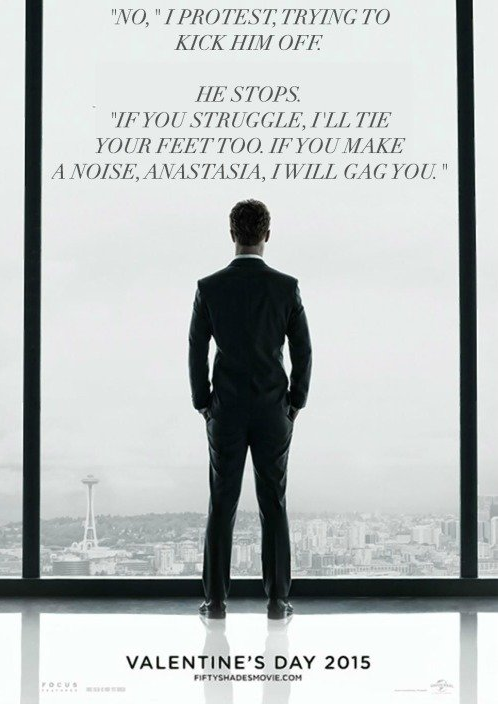
Actual 50 Shades movie poster with actual 50 Shades book quote. (the6thsiren)
And this is where we come to a real puzzle. It’s not that 50 Shades is popular despite being awful. There’s no accounting for taste, after all. It’s not even that 50 Shades is popular despite being pornographic. That is, tragically, just a sign of the times. It’s that 50 Shades is popular specifically with women (80% of the audience) despite being (according to a plethora of writers) deeply and irredeemably misogynistic. The series is basically a tale of how one powerful man grooms one vulnerable woman, isolates her from her family and support network, stalks her, assumes domineering control over her life (the classes she takes! the clothes she wears!), and eventually abuses and rapes her. And then they get married and live happily ever after. (Sorry, spoilers.) Who says romance is dead?
I am, of course, not the first person to hazard an explanation for 50 Shades’ popularity, and I think many of the extant explanations have merit. One of the best comes from Kirsten Andersen who explains the story’s appeal this way:
All we know about each girl [Bella from Twilight, Ana from 50 Shades] is that she’s ordinary – like, so ordinary that if you looked up the word “ordinary” in the dictionary, you would find their pictures – only you wouldn’t; you’d find a little mirror reflecting your own face back at you, because that’s the entire point. You’re meant to insert yourself into the story, and suddenly it’s you, in all your banal lack of glory, who has proven irresistible to these powerful, godlike, beautiful, deeply damaged men, and only you can help them find their humanity again. The best part? You didn’t have to do anything to capture their undying devotion but be yourself.
The wish fulfillment angle is especially ironic given the reactions of the stars who play Christian and Ana in the film. Jamie Dornan (who plays the abusive billionaire) found his role “a massive challenge” compared to playing other characters who were “sick dudes, serial killers.” For her part, Dakota Johnson (who plays Ana) said simply “I don’t want anyone to see this movie.” The people who come closest to having fulfilled this particular wish don’t appear to have enjoyed the experience.
Andersen certainly has the voyeuristic narcissism pegged, and she also explains the appeal of “damaged men” by a need to be simultaneously saved and savior. Despite all the filth, she insists this reveals that the “core” of the story is “about unconditional love and redemption.” Not that Andersen has been beguiled. She points out that “in reality, Christian’s all-consuming “love” would warrant a restraining order, and Ana’s refusal to leave him would eventually land her at a battered women’s shelter or dead.”
I like Andersen’s explanation a lot, but there’s one aspect it doesn’t resolve. Christian is not just a damaged man in need of saving. He is a dangerous, abusive, manipulative rapist. What’s the appeal there?
It may be that there is some reality to conventional wisdom that girls prefer the bad boys and that nice guys finish last. Last year a Newsweek article reported on a study that determined that heterosexual men view kindness (measured as emotional responsiveness) as a favorable trait when evaluating potential mates. Women, by contrast, were less attracted to men that they rated as more responsive. One of the researchers speculated that “women may perceive a responsive man as… less dominant.”
The idea of dominance cropped up in another study, this one reported in the Telegraph, which found that marriages are stronger when one partner is dominant. The study also found that in more than three quarters of cases, the dominant partner was the male partner. A German study covered in Psychology Today reached more nuanced conclusions. According to that study, women prefer more aggressive men (“who often embody the Dark Triad, a personality constellation that encompasses Machiavellianism, psychopathy, and narcissism.”) for short-term relationships, but preferred “less masculine” men for long-term relationships. The authors theorized that this strategy allows women to “maximize their reproductive success” because “appetitive-aggressive” violence (commonly found in stereotypical bad boys) might actually “be an advertisement of good genes.” If that’s the case, then a short-term relationship with a (genetically superior) bad boy followed by a long-term relationship with a (more reliable and supportive but genetically inferior) good guy could be the optimal evolutionary strategy.
Now, I’m not going to try and draw a straight line from popular journalistic accounts of a few academic studies to the sales figures for 50 Shades. If that worked, the best-seller lists would be dominated by professors cashing in on their expertise. Human nature is too complex for that and evolutionary psychology is particularly vulnerable to tendentious etiologies. At the same time, however, it would be foolhardy to presume that millions of years of evolution suddenly ceased to have an effect on human sexual behavior in the last few tens of thousands of years.
Unfortunately, that is exactly what the dominant feminist theory of today days. Christina Hoff Sommers identified this strain of feminism as gender feminism in Who Stole Feminism? She contrasted it with the older school of feminism she calls equity feminism. Equity feminism is about equal legal rights for men and women. Gender feminism is dedicated to ending sexism and defeating patriarchy.
Steven Pinker identified gender feminism as a part of the larger project of denying human nature in The Blank Slate. He wrote that this denialism is “entrenched in intellectual life” and specifically described gender feminism this way:
Gender feminism is an empirical doctrine committed to three claims about human nature. The first is that the differences between men and women have nothing to do with biology but are socially constructed in their entirety. The second is that humans possess a single social motive—power—and that social life can be understood only in terms of how it is exercised. The third is that human interactions arise not from the motives of people dealing with each other as individuals but from the motives of groups dealing with other groups—in this case, the male gender dominating the female gender.
The reason that gender feminism is so compelling is that it has such a simple story to tell. If all the differences between men and women are socially constructed and artificial, then the path to equality is obvious: eradicate those socially constructed differences. Furthermore, because gender feminism sees society strictly in terms of power and dominance, the assumption is that any difference is not only an unnecessary impediment to equality, but an instance of oppression.
This is why gender feminists fixate on differences in gender representation, quickly assuming that whenever there are fewer women this is proof of successful male domination. This seems credible when we’re talking about fewer female CEOs, political leaders, or academics in STEM fields. It’s less clear how gender feminism’s belief in universal male domination holds up in the context of some other discrepancies, however, such as fewer women in prison, more women in college, fewer women unemployed, more women winning custody of children, and fewer women dying in workplace accidents.
Equity feminism, with roots in individualism and classical liberalism, is much more flexible. An equity feminist can examine gender differences on a case-by-case basis to determine when differences are the result of sexism or discrimination and when they might be the result of individual choices. But, where equity feminism may win on nuance or flexibility (not to mention compatibility with basic science), the conceptual simplicity and ability to manufacture unlimited amounts of righteous indignation make gender feminism perfectly adapted to our viral, outrage-addicted society.
The end result is that the most dominant form of feminism is also the one that is dogmatically opposed to any and all gender roles. Combine that with the fact that biology and anthropology both reveal that gender roles are a part of our innate human nature, and we have a recipe for trouble.
Of course, claiming that gender roles are innate is not one of those things that you’re supposed to do in modern discourse, so it’s worth pointing out that Pinker includes a bullet-point list of the evidence in The Blank Slate that is impossible to summarize because it goes on for five full pages. As a couple of highlights, for example, he notes that “All cultures divide their labor by sex, with more responsibility for childrearing by women and more control of the public and political realms by men. (The division of labor emerged even in a culture where everyone had been committed to stamping it out, the Isreali kibbutz.)” He also observes that “many of the psychological differences between the sexes are exactly what an evolutionary biologist who knew only their physical differences would predict.” He concludes by saying that “If that [social constructionism] were true, it would be an amazing coincidence that in every society the coin flip that assigns each sex to one set of roles would land the same way.”
So, going back to the research stated earlier, it is entirely possible that many women are attracted to men who show stereotypically masculine traits like aggression and domineering. The mistake that drives many people away from an understanding of evolved human nature is to erroneously assume that if we have innate characteristics then everything is pre-determined. That’s not true, because in many cases our innate characteristics conflict. The most important reason for being open-minded and accepting about the science of human nature is that—far from reducing us to impotent fatalism—it provides more control.
This is particularly true of maladaptations. Citing Pinker again:
The study of humans from an evolutionary perspective has shown that many psychological faculties (such as our hunger for fatty food, for social status, and for risky sexual laisions) are better adapted to the evolutionary demands of our ancestral environment than to the actual demands of the current environment.
So, in an ancient setting where calories were scarce, a hunger for fatty food made sense. In a modern setting where calories are plentiful, the same trait is one reason why obesity is a leading cause of death. And yet many techniques for combatting this maladaptation work by tapping into other innate characteristics. Think of a dieting group like WeightWatchers; it taps into our innately social natures and allows us to leverage mentor and friend relationships to win the battle against our drive to eat fatty food. Innate characteristics is not the same thing as genetic determinism.
So in a world where innate characteristics and gender roles are openly discussed and considered, it is possible to bend them in useful directions. A lot of this already happens without any conscious direction on our part. Organized sports, for example, can form a more civilized, pro-social alternative to violent aggression between men.
But we don’t live in that world. We live in a world where gender feminism is categorically opposed to all gender roles, and therefore overt, potentially beneficial, and healthy avenues for exploring female attraction to male aggression and dominance are categorically ruled out. Men are actively discouraged from enacting these roles, and women are actively discouraged from appreciating them. Dating and courtship are dead, long live the hookup culture.
In simple terms: if you see huge demand for an inferior good, the most reasonable conclusion to draw is that there must be a dearth of the superior good. There are some major works with overt and pronounced depictions of gender roles (Twilight was one of them), but by and large any major book or movie has to go out of its way to apologize for, downplay, or offset any appearance of traditional gender roles. If you want to unabashedly celebrate gender roles, you’re going to run afoul of the gender feminism dogma police. It is therefore absolutely no surprise to find the pre-eminent example (50 Shades) coming from the margins of our entertainment ecosystem. There just aren’t enough dogma police to patrol every pornographic, self-published, fanfic out there.
In a healthier environment, 50 Shades would face competing models of male leadership, but gender feminism’s take-down of gender roles has left 50 Shades as pretty much the only game in town. It represents the collision of deep human desires for gender roles with an ascendant political ideology that is dedicated to eradicating them. It’s possible that the rape, abuse, and general misogyny play no role in attracting women to Christian Grey, but when it comes to finding someone to represent that aggressive male role there just aren’t a lot of options. When gender roles become monstrous in the eyes of society, only monsters like Christian Grey are left to enact them.
Actual 50 Shades movie poster with another actual 50 Shades book quote. (the6thsiren)
Le Gouffre (“The Gulf”) is a short film that was Kickstarted back in October 2013 with $24,155 out of $5,000 raised.[ref]Canadian dollars, if you care.[/ref] I heard about the finished version from The Verge, and I have to say: it’s pretty incredible. So watch it now or bookmark it for later because it is definitely worth 10 minutes of your time.
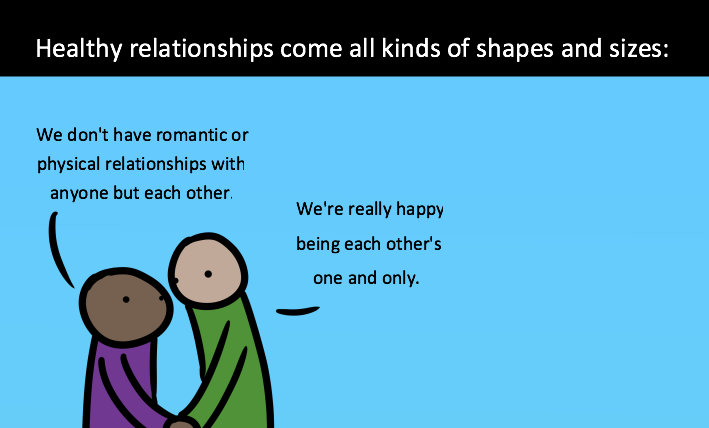
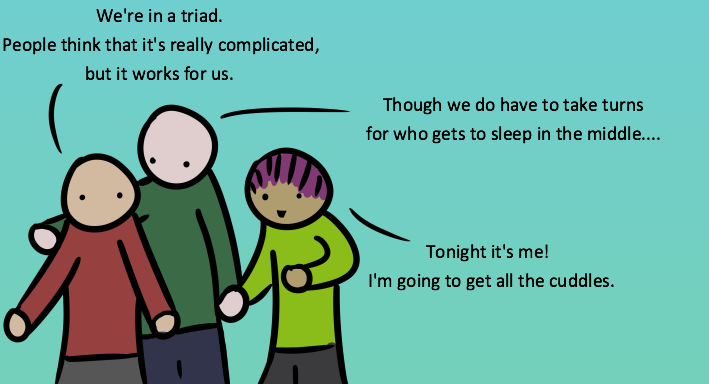
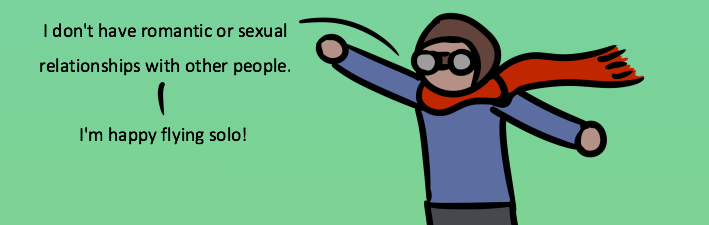
EverydayFeminism.com would like you to know that healthy relationships come in all shapes and sizes. The image starts with a monogamous couple (albeit gender-neutral) and then depicts a variety of relationships including:
Asexual (“We don’t have sex… but we sure enjoy cuddling!”)
Mixed Sexual/Asexual (“She fills her sexual needs with other people.”)
Open (“We also have romantic and sexual relationships with other people. That doesn’t make our love any less valid.”)
Polyamarous (“We do have to take turns for who gets to sleep in the middle” / “Tonight it’s me! I’m going to get all the cuddles.”)
BDSM / Kink (“Who’s a good boy?” / “ruff”)
None (“I’m happy flying solo.”)
The one thing that all of these relationships have in common is that they are defined exclusively in terms of their utility to the voluntary participants. Once you accept that premise, the rest follows. If relationships exist for the pleasure, security, comfort, and fulfillment of the parties to the relationship, then any relationship that meets those needs is an equally valid relationship.
It’s a nice picture, but it’s leaving somebody out. This is a worldview for the privileged and the powerful. Not in terms of gender or sexuality or class distinctions, but in terms even more profound: adults vs. children. Children have no vote about the relationships they enter into. They get no say in the circumstances of their conception, nor do they have any influence over the environment in which they are raised. They are truly and completely powerless and vulnerable.
Because children are held hostage to the behavior of the adults who care for them, they will face the consequences–for good or ill–of how adults choose to manage their romantic lives. Regardless of how effective polyamorous, asexusl[ref]Yes, I’m aware of where children come from, but just as someone in a homosexual relationship today might have children from a past relationship, so might someone in an asexual relationship[/ref], etc could be at providing a good home for children, that only works if children are in the picture to begin with. How can a theory of romantic / sexual relationship that doesn’t even admit to the existence of children possibly serve to protect their interests? It can’t.
As positive as it may attempt to be, what this image implies (but does not show), is a world where the needs of children come a definitive second to the adult pursuit of happiness.
Since the Enlightenment, humans have demonstrated dramatic moral progress. Almost everyone in the Western world today enjoys rights to life, liberty, property, marriage, reproduction, voting, speech, worship, assembly, protest, autonomy, and the pursuit of happiness. Liberal democracies are now the dominant form of governance, systematically replacing the autocracies and theocracies of centuries past. Slavery and torture are outlawed everywhere in the world (even if occasionally still practiced). The death penalty is on death row and will likely go extinct sometime in the 2020s. Violence and crime are at historic lows, and we have expanded the moral sphere to include more people as members of the human community deserving of rights and respect. Even some animals are now being considered as sentient beings worthy of moral consideration. Abstract reasoning and scientific thinking are the crucial cognitive skills at the foundation of all morality.
His evidence?:
“Numerous studies from the 1980s onward, for example, find that intelligence and education are negatively correlated with violent crime. As intelligence and education increase, violence decreases, even when controlled for socioeconomic class, age, sex, and race.”
“[N]ewer evidence that shows a positive correlation between literacy and moral reasoning, most particularly between reading fiction and being able to take the perspective of others.”
Negative correlation between high cognition and low demands for punitive punishment.
Positive correlation between high intelligence and classical liberal views.
“Positive correlation between the IQ of British children at the age of 10 and their endorsement of anti-racist, socially liberal, and pro-working women attitudes at the age of 30, holding the usual potentially intervening variables constant.”
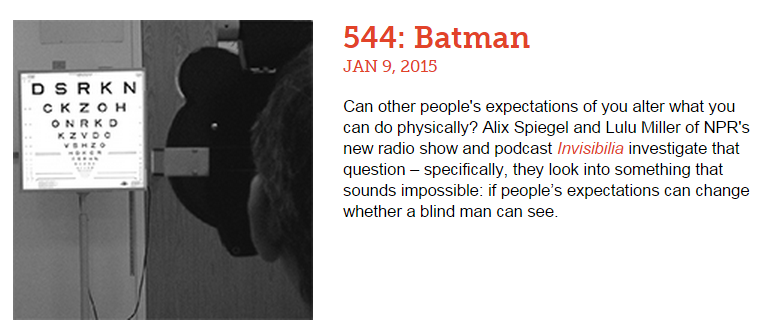
This American Life episode #544 has a lame title but really profound content. It got me to thinking about the nature of love and also the nature of symbolism. So I wrote a post for Times and Seasons: When Symbolism isn’t Symbolic. You should check it out.
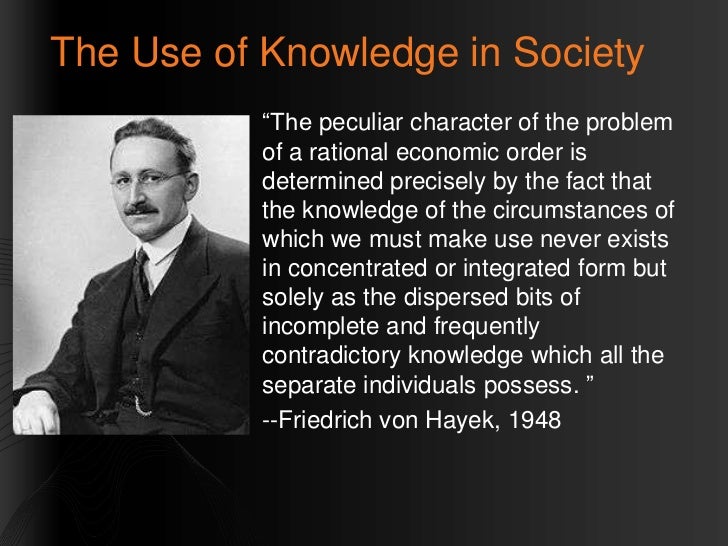
The latest issue of Econ Journal Watch has papers from the Mercatus-sponsored symposium “Economists on the Welfare State and the Regulatory State: Why Don’t Any Argue in Favor of One and Against the Other?” The issue features articles from economists like Robert Higgs, Arnold Kling, and Scott Sumner. However, the two that seem the most interesting to me are the articles by Swedish economist Andreas Bergh and social psychologist Jonathan Haidt. I’ve referenced Bergh’s work elsewhere due to his dispelling of several of myths regarding the Swedish welfare state (from both the Right and Left). His symposium contribution argues that a Hayekian welfare state can exist in theory by combining “low regulation with social insurance schemes that are not terribly vulnerable to the knowledge problem.”[ref]This might go well with philosopher Erik Angner’s view on Hayek and redistribution.[/ref]
In Haidt’s paper (with co-author Anthony Randazzo), the two surveyed economists and “found a relationship between views on empirical economic propositions and moral judgments.” Furthermore, in footnote #3, it says that Haidt is working on a book on capitalism and moral psychology. I imagine it will look something like his Zurich.Minds presentation.
Thomas Merton has remained one of my favorite spiritual writers for some time now. I often contemplate one passage in particular from his writings:
The West has lived for thousands of years under the sign of the Titan, Prometheus, the fire stealer, the man of power who defies heaven in order to get what he himself desires. The West has lived under the sign of will, the love of power, action, and domination. Hence, Western Christianity has often been associated with a spiritual will-to-power and an instinct for organization and authority. This has taken good forms, in devotion to works of education, healing the sick, building schools, order and organization in religion itself. But even the good side of activism has tended toward an overemphasis on will, on action, on conquest, on “getting things done” and this in turn has resulted in a sort of religious restlessness, pragmatism, and the worship of visible results.
There is another essential aspect of Christianity: the interior, the silent, the contemplative, in which hidden wisdom is more important than practical organizational science, and in which love replaces the will to get visible results. The New Man must not be a one-sided and aggressive activist: he must also have depth, he must be able to be silent, to listen to the secret voice of the Spirit. He must renounce his own will to dominate and let the Spirit act secretly in and through him…
I have seen this attitude both within myself and within Western Christianity in general. We are the do-something Christians, the sons and daughters of Protestant work ethic (even when we’re Catholic!). And like Merton says, this attitude has its positives. We are called to live out our faith in works of mercy and education.
Yet more and more I have come to appreciate that all the work in the world is fruitless and possibly dangerous without the guidance of the Holy Spirit, without interior direction from prayer and contemplation. Without this guidance, we can go out and do one thousand things, and for all we know, all one thousand of those things are misguided, unhelpful, or just wrong. I think this is especially true in our everyday actions, where we’re running on auto-pilot or caught off guard. In those moments when we’re not actively thinking, whatever resides in our innermost being will come out, and if our innermost being is not attuned to Christ, something less-than-helpful is probably going to come out. And whereas people without any particular belief are only responsible for themselves, we affect how people view the entire body of Christ. The stakes have been raised. Our need for direction is dire.
Prayer and contemplation also do more than preventing missteps. We can focus in on the parts of our lives that really matter, that bring us closer to Christ, and discard what does not matter. We can lay ourselves bare to the will of Christ in ways that we cannot do in passing daily thought. Speak, Lord, your servant is listening. Truly, only from love of Christ can all good things come. We cannot earn it. We cannot win it. We cannot buy it.
How indeed those persons delude themselves who locate holiness anywhere but in loving God. Some see perfection in austerities, others in almsgiving, others in prayer, others in frequenting the sacraments. For my part, I know of no other perfection than that of loving God with all the heart, because without love all the other virtues are nothing but a pile of stones. – Saint Frances de Sales
The action attitude also bleeds into other aspects of Christian life. For example, how often have we felt, even though we know better, that praying isn’t ‘doing something.’ I know I’ve had this thought before. As a Christian, this has got to be the silliest thing I can think if I know anything about the Gospels or the Bible in general, and yet I still sometimes have to walk myself through the simple logic of prayer. If God exists, and if God is a personal God who listens to prayers and answers them, then prayer is doing something. I recall the words of the Centurion in Luke 7:
Lord, do not trouble yourself, for I am not worthy to have you come under my roof;therefore I did not presume to come to you. But say the word, and let my servant be healed.For I am a man set under authority, with soldiers under me: and I say to one, ‘Go,’ and he goes; and to another, ‘Come,’ and he comes; and to my slave, ‘Do this,’ and he does it.”
The centurion says “I am a man set under authority.” In other words, I know how these things work. I will that something be done, and it is done. You, Lord, have ultimate power and authority. If you will it to be so, shall it not be so? So prayer goes. We need but ask and trust that the Lord will see it done, although not always in ways and times that we expect.
Your word is a lamp for my feet, a light for my path.
So let us turn at all times and listen to what the Lord is saying. We live in a busy world, busy with works, busy with responsibilities, busy with the thoughts of the day. Let’s step back for a moment. What do I want done, and what does the Lord want done. I abdicate my will. Let thy will be done this day.
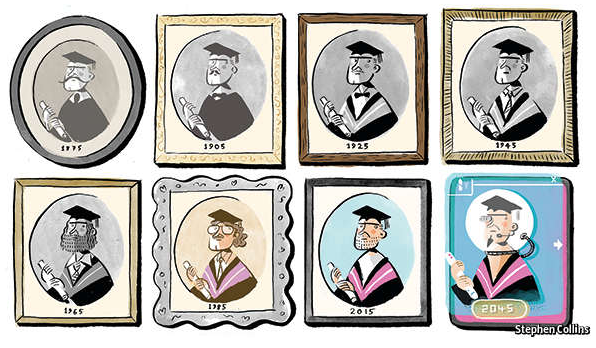
Today’s elite is a long way from the rotten lot of West Egg. Compared to those of days past it is by and large more talented, better schooled, harder working (and more fabulously remunerated) and more diligent in its parental duties. It is not a place where one easily gets by on birth or connections alone. At the same time it is widely seen as increasingly hard to get into.
The rest of the article tries to explain why this is so, citing assortative mating as one big reason. Perhaps because of the same social attitudes that have led more women into the workplace and to getting college degrees, “between 1960 and 2005 the share of men with university degrees who married women with university degrees nearly doubled, from 25% to 48%, and the change shows no sign of going into reverse.” These pairs are much more likely to be correlated in terms of intelligence and other genetic factors that help people be successful, for one thing. But even if you set aside the genetic component, successful people are likely to raise successful children because they value success and they obviously understand what it takes to be successful. So the more you have assortative mating, the more a meritocracy ends up looking a lot like an aristocracy after all.
So… what do we do about? The Economist article has nothing to suggest.
But, writing nearly three years ago, David Brooks did. In Why Our Elites Stink he argues, similarly to The Economist that “today’s meritocratic elites achieve and preserve their status not mainly by being corrupt but mainly by being ambitious and disciplined.” Although wealth is obviously a factor, he argues that “the real advantages are much deeper and more honest.” So, are meritocracies just fundamentally flawed? Brooks doesn’t think so:
The corruption that has now crept into the world of finance and the other professions is not endemic to meritocracy but to the specific culture of our meritocracy. The problem is that today’s meritocratic elites cannot admit to themselves that they are elites.
Brooks’ argument is definitely not a popular for a lot of reasons. First, he doesn’t want to overthrow the meritocracy. He wants to work with it. I don’t think that this is because he likes it. I think it’s because he has that conservative tragic vision of the human condition: that life is fundamentally unfair and the only way to combat that unfairness is to recognize it. Some people are born smarter, stronger, and better looking than others. That will always be true. So life isn’t fair. There will always be elites. If the elites know they are elites, they can actually respond to that in appropriate ways (e.g. by being more service-oriented). But if we deny the fundamental unfairness of life, then we’re saying that people who have all the advantages don’t have to take any particular special care to help others.
The best of the WASP elites had a stewardship mentality, that they were temporary caretakers of institutions that would span generations. They cruelly ostracized people who did not live up to their codes of gentlemanly conduct and scrupulosity. They were insular and struggled with intimacy, but they did believe in restraint, reticence and service.
Today’s elite is more talented and open but lacks a self-conscious leadership code. The language of meritocracy (how to succeed) has eclipsed the language of morality (how to be virtuous). Wall Street firms, for example, now hire on the basis of youth and brains, not experience and character. Most of their problems can be traced to this.
If you read the e-mails from the Libor scandal you get the same sensation you get from reading the e-mails in so many recent scandals: these people are brats; they have no sense that they are guardians for an institution the world depends on; they have no consciousness of their larger social role.
Although it wasn’t a focus of his, I think another major element to this is the problem of America’s obsession with individualism. We have gone overboard in rejecting our collective, social nature. That is why modern hotshots have no sense of being “guardians for an institution the world depends on.”
Life will never be fair. There will always be elites. Saying that terrifies people, because they immediately think of racial or cultural or religious bigotry. But we can’t be so paralyzed by fear that we fail to heed reality. Also, the fear are largely unfounded, as The Economist observes that elites “included people with skin of every shade but rarely anyone with parents who worked blue-collar jobs.” So here we are, in a world that is unfair where elite people will pass down their elite traits to their elite kids. We can either try to redistribute everything (which will kill all incentives and lead to total social ruin) or we can instill an ethos of service and humility in elites. It’s not a perfect solution, but it seems like the best one.
 The great British-American neurologist Oliver Sacks recently discovered that he has terminal cancer. A rare tumor of the eye that left him blind in one eye metastasized and now occupies a third of his liver. Sacks is the author of several books, including The Man Who Mistook His Wife For A Hat, Musicophilia: Tales of Music and the Brain, and Awakenings (which inspired the moving, Oscar-nominated film of the same name starring Robin Williams and Robert DeNiro). Perhaps as a kind of farewell, he penned a wonderful article in The New York Times. He writes,



 Science writer Michael Shermer argues that we are in the