Relieving Existential Anxiety

Psychologists hypothesize Tylenol may relieve existential anxiety as well as physical pain.

New research shows Tylenol may have the unseen psychological side-effect of easing existential dread. The findings suggest anxiety about finding meaning in life and feeling physical pain may be rooted in the same part of the brain.

“When people feel overwhelmed with uncertainty in life or distressed by a lack of purpose, what they’re feeling may actually be painful distress,” said study researcher Daniel Randles, a doctoral student in psychology the University of British Columbia.

“We think that Tylenol is blocking existential unease in the same way it prevents pain, because a similar neurological process is responsible for both types of distress,” Randles wrote in an email to LiveScience.

Previous studies have shown that acetaminophen may also ease the blow of social snubs, and some researchers have argued that both physical pain and feelings of rejection are caused by activation in the brain’s dorsal anterior cingulate cortex.

“We’ve suspected that this brain region also is central in managing violations of expectations and errors, and as such predicted Tylenol would have the same effect on manipulations of uncertainty or existential unease that it has on headaches or ostracism,” Randles said in an email.

Admittedly the sample sizes are small, consist of pre-existing groups (such as college students), and the methodologies are… odd, but this research raises some interesting implications. My immediate thoughts, as per usual, go to the book Brave New World, which features the omnipresent drug Soma:

In the book, soma is a hallucinogen that takes users on enjoyable, hangover-free “holidays”. It was developed by the World State to provide these inner-directed personal experiences within a socially managed context of State-run “religious” organisations; social clubs. The hypnopaedically inculcated affinity for the State-produced drug, as a self-medicating comfort mechanism in the face of stress or discomfort, thereby eliminates the need for religion or other personal allegiances outside or beyond the World State; the book describes it as having “all the advantages of Christianity and alcohol, none of their defects.”

Now this is the point in my post where I flail my arms and yell “We’ve arrived in the Brave New World, just as predicted!!!”

But seriously, I think this research, if true, reveals one more aspect of the trend in society where, instead of facing problems, we ignore them in the hopes that they’ll go away. We distract, we medicate, we divert, we do anything but actually build the emotional maturity necessary to face life’s difficulties because that would require experiencing unpleasant feelings and situations. And now we have one more tool to realize that goal, at least as far as the emotional implications of our actions and beliefs.

Or maybe I’m just old and grumpy.

The Science of a Meaningful Life

greater goodThe website for the Greater Good Science Center at the University of California, Berkeley is one I check on a regular basis. Positive psychology is a major interest of mine and overlaps fairly well with management and organizational theory (many management professors are actually psychologists by education). The site recently posted “The Top 10 Insights from the “Science of a Meaningful Life” in 2014,” which should be of interest to anyone seeking to understand and increase one’s well-being. Without further ado, the top 10 insights are:

1. Mindfulness can reduce racial prejudice–and possibly its effects on victims.

2. Gratitude makes us smarter in how we spend our money.

3. It’s possible to teach gratitude to young children, with lasting effects.

4. Having more variety in our emotions–positive or negative–can make us happier and healthier.

5. Natural selection favors happy people, which is why there are so many of them.

6. Activities from positive psychology don’t just make happy people happier–they can also help alleviate suffering.

7. People with a “growth mindset” are more likely to overcome barriers to empathy.

8. To get people to take action against climate change, talk to them about birds.

9. Feelings of well-being might spur extraordinary acts of altruism.

10. Extreme altruism is motivated by intuition–our compassionate instincts.

Check out the link for further details and the actual studies.

The Christmas Truce

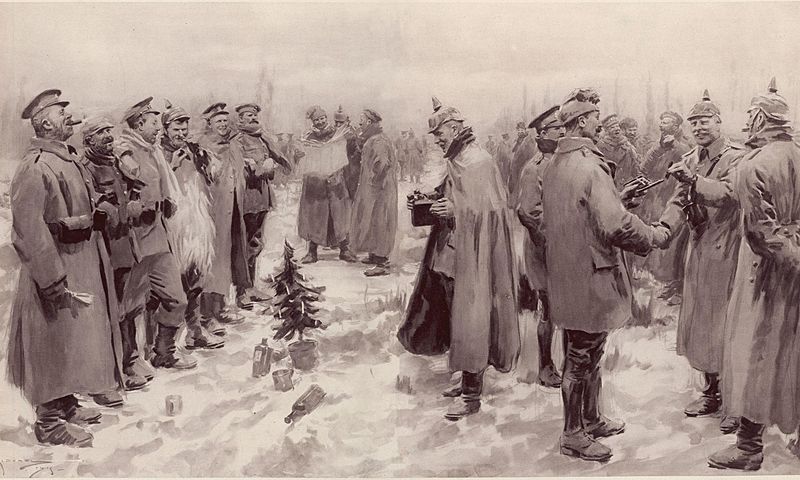
Though we’re a couple days past Christmas, I think this message is worth carrying into the New Year. Reason highlights the soldiers who basically ended WWI for a couple weeks during Christmas 1914. It was in the midst of this truce that one solider wrote, “Never…was I so keenly aware of the insanity of war.” Implicitly recognizing the evils of the political machine in contrast to the basic decency within us all, truce participant Sir H. Kingsley Wood of the British House of Commons commented, “I…came to the conclusion that I have held very firmly ever since, that if we had been left to ourselves there would never have been another shot fired.” A British lieutenant wrote home about the truce, describing the German soldiers who helped the British bury their dead as “extraordinarily fine men.”

The article explains,

The truce was a series of unofficial and widespread cease-fires that extended over two weeks. The truce between mostly British and German troops centered on the Western Front, defined by lines of trenches that stretched across France from the North Sea to the border of Switzerland. The trenches were often close enough for the combatants to exchange shouted words and to smell food their adversaries were cooking.

One German soldier

reported that hymns and Christmas songs were being sung in both trenches. German troops foraged for Christmas trees that they placed in plain view on the parapets of their trenches. By the time Christmas Eve arrived, so much interaction had occurred between the British and Germans that Brigadier General G.T. Forrestier-Walker had officially forbidden fraternization.

…Some officers threatened to court-martial or even to shoot those who fraternized, but the threats were generally ignored. Other officers mingled with enemies of similar rank. The Germans reportedly led the way, coming out of their trenches and moving unarmed toward the British. Soldiers exchanged chocolates, cigars, and compared news reports. They buried the dead, some of whom had lain for months, with each side often helping the other dig graves. At its height, unofficial ceasefires were estimated to have occurred along half of the British line. As many as 100,000 British and German troops took part. On Christmas morning, the dead had been buried, the wounded retrieved and the “no man’s land” between the trenches was quiet except for the sound of Christmas carols, especially “Silent Night.”

Pressure and threats of disciplinary action from the high ranks began to diminish to fraternization until the truce finally petered out. As the article concludes,

War is against the self-interest of average people who suffer not only from its horrors but also from its political fallout. Those who benefit from both are the ones who threaten to shoot those who lay down their guns: politicians, commanders and warmongers who profit financially. But even the powerful and the elite cannot always extinguish “peace on earth, goodwill toward men,” even in the midst of deadly battle.

May 2015 be a more peaceful year.

Christianity and Paganism

Merry Christmas everyone! Tis the season for comparisons of Christianity to paganism. I’ve made it a regular ritual to watch Lutheran Satire on the matter:

For years I had accepted that Christianity had probably at least borrowed the date of Christmas from pagans. Turns out that’s not even true. Christians used some interesting math to determine Christ’s birthday, but it had nothing to do with paganism:

If the birth of Jesus was not celebrated by the early church, it also was because there was not a consensus as to when it had occurred. Writing shortly after the assassination of Commodus on December 31, AD 192, Clement of Alexandria provides the earliest documented dates for the Nativity. One hundred ninety-four years, one month, and thirteen days, he says, had elapsed since then, which corresponds to a birth date of November 18 or, if the forty-nine intercalary days missing from the Alexandrian calendar are added, January 6. Moreover, “There are those who have determined not only the year of our Lord’s birth, but also the day” (Stromata, I.21), including dates in April and May, as well as another day in January.

Hippolytus, a younger contemporary of Clement, does state that the Nativity had occurred on December 25 (Commentary on Daniel, IV.23.3). Although the statement may be a later interpolation, he reiterated several decades later (in AD 235) that Jesus was born nine months after the anniversary of the creation of the world, which Hippolytus believed to have been on March 25 (Chronicon, 686ff). The Nativity then would be on December 25.

In about AD 221, Julius Africanus wrote the Chronographiae, the first Christian chronology. Although he does not specifically mention the Nativity, he did believe that Jesus had been conceived on March 25. In AD 243, Cyprian is the first Christian writer to associate the birth of Jesus with the Sun: “O! The splendid and divine Providence of the Lord, that on that day, even at the very day, on which the Sun was made [March 28], Christ should be born” (De Pascha Computus, XIX). Creation itself was on March 25, the vernal equinox, and the Sun created on the fourth day, March 28. It followed, then, that the “Sun of righteousness,” in Malachi’s phrase, would be born on the same day.

And pagans might have even revived their winter solstice celebrations in response to Christianity:

Hijmans presents a critical re-evaluation of the History of Religions hypothesis and the notion that the early church incorporated the feast of Sol Invictus into its own liturgy, positing instead that the pagan festival was “‘rediscovered’ by pagan authorities in response to the appropriation of the winter solstice by Christianity.” The festival of Sol Invictus, in other words, may not have been identified with December 25 until after the first Christmas had been celebrated on that day. Nor, he argues, should the cosmic symbolism attached to the winter solstice, which may have led the church to adopt December 25 for its feast of the Nativity, be confused with a cult of Sol on that date.

The winter solstice, when the light of day finally begins to lengthen, would have a natural association with the “Sun of righteousness.” Indeed, Tertullian writes that “It is therefore due to a want of heed and reflection that many are offended by the mere fact that heresies have so much power. How much would they have if they did not exist?” (On the Prescription of Heretics, I). Here, the paradox is that the absence of heresy would confound the predictions of Scripture, as when one is admonished to “beware of false prophets” (Matthew 7:15).

Some pagan influences would creep in later (such as Yule), but by that time the Christian foundations of Christmas were well set, and pagan elements were a peripheral cultural attachment, not a fundamental aspect of the celebration.

Scientific Skepticism

Turns out Bill Nye isn’t entirely fond of GMOs:

I stand by my assertions that although you can know what happens to any individual species that you modify, you cannot be certain what will happen to the ecosystem.

Also, we have a strange situation where we have malnourished fat people. It’s not that we need more food. It’s that we need to manage our food system better.

So when corporations seek government funding for genetic modification of food sources, I stroke my chin.

Yet even though I’m in favor of GMOs, I think he’s perfectly fine signalling caution about the difficulty of studying cause/effect within whole ecosystems and potential political/corporate interests in science. As scientists and engineers, we should always be questioning how our theories and models can be inaccurate or inadequate, and as human beings, we should always be wary of outside influences on science. Yet by Bill Nye’s own standards, he’s a denier. There are no studies to indicate environmental problems with GMOs, and if the amount of corporate and political influence in GMOs worries Bill Nye, he should be equally suspicious about climate change.

As a practicing engineer, this is what drives me bonkers about many supposed science advocates who brook no dissent on their chosen topics. You either find out that they have little known reservations about other topics where the science is “clear” (like Bill Nye), or they have zero reservations or skepticism about anything scientific consensus says, in which case they are professing the most anti-scientific belief possible (like Neil DeGrasse Tyson). The heart of science is realizing that all theories are provisional, that at best our theories can be well attested, never absolutely proven true. Karl Popper, the famous philosopher of science, believed that:

Scientific theories…are not inductively inferred from experience, nor is scientific experimentation carried out with a view to verifying or finally establishing the truth of theories; rather, all knowledge is provisional, conjectural, hypothetical—we can never finally prove our scientific theories, we can merely (provisionally) confirm or (conclusively) refute them; hence at any given time we have to choose between the potentially infinite number of theories which will explain the set of phenomena under investigation. Faced with this choice, we can only eliminate those theories which are demonstrably false, and rationally choose between the remaining, unfalsified theories. Hence Popper’s emphasis on the importance of the critical spirit to science—for him critical thinking is the very essence of rationality. For it is only by critical thought that we can eliminate false theories, and determine which of the remaining theories is the best available one, in the sense of possessing the highest level of explanatory force and predictive power.

I suppose people will now want to know what I believe about climate change, or conversely, if I say nothing people will probably start assuming. I know the earth is warming up. That’s not very hard to measure. I know that humans contribute to that warming. Again, not very hard to measure nor controversial. I do not know, though, to what extent humans contribute to the warming, nor to what extent reducing our greenhouse gas output a reasonable amount would actually slow this warming. That’s where the science of the matter gets difficult, because now we’re dealing with a whole ecosystem (like with GMOs), and sussing out cause and effect in a whole ecosystem is tricky. So currently, I have no strong opinion one way or the other. We could be contributing greatly to warming. Or our input could be modest. Modeling these effects and predicting warming rates is finicky to say the least.

Then when we get to the politics and economics of global warming, the situation is even messier. Will carbon taxes actually reduce greenhouse gas output in any significant amount worth the economic costs? Can we even reduce our greenhouse gas output any appreciable amount that won’t send the American public into shock? This is where global warming gets beyond my expertise.

So generally I just support measures that benefit us anyways with the side effect of combating greenhouse gas output. I support monitoring and regulating pollution output. I support continuing research into alternative energy sources, which isn’t just solar and wind for the record. We have geothermal, hydroelectric, wave energy, biomass, and more. I realize many of these methods are limited in their production capacity, location, and reliability, but they are capable of producing power amounts that aren’t insignificant.

More importantly, I support nuclear power, which has none of the above limitations. Now this is where all the talk about supporting science gets really odd. Nuclear power plants have a very good safety record (despite what the news says), and engineers are constantly working to make them better. On top of that, add the context of nuclear safety versus other sources of power. On top of that, add some perspective on radiation amounts (yes I cited XKCD). On top of that, add the oft cited dire effects of global warming. In that context, how can opposing nuclear power be anything short of anti-scientific and ridiculous, using the vocabulary abundant in discussion of global warming? And yet, people do it. Many climate scientists are jumping on board the nuclear train, but there’s still plenty of opposition. People proclaim the inviolability of scientific consensus in one context and then turn around to challenge it in a different context.

So, what general principles can we derive from this long-winded analysis? I would say people need to be able to simultaneously hold two seemingly contradictory concepts in their mind: Science is a quest for understanding the natural world, and science can never finally prove anything. With that knowledge, we should respect the explanatory power of science but also realize that science relies fundamentally on a critical spirit. We cannot crush dissent, nor should set ourselves up as arbiters of what constitutes “valid” dissent, which is really just crushing dissent by a different name. Rather, we must continually attempt to falsify our own theories, and if they survive the continuing ordeals, we can begin to call them well attested. But even then we must not close our minds, even as we defend theories we believe to be well attested. Newtonian physics reigned 300 years before general relativity showed up.

How do these principles look practically? I would say they manifest themselves in simultaneously laying down what we know while maintaining a spirit of humility. For example, I have defended evolution numerous times contra creationism. I don’t resort to telling people they’re scientifically illiterate (even though people who try to tell a chemical engineer how the 2nd law of thermodynamics “actually” works might qualify). I don’t demand they accept the consensus of science over their doubts (which would be horrifically anti-scientific). Rather, I just tell them what I know and demonstrate the explanatory power of evolution. You’d be surprised how well that works. Even if people don’t change their minds right then and there, it gets their minds thinking, and it allays their fears that I have an ulterior motive for defending evolution.

I believe these principles would serve science advocacy well. There is no contradiction between lacking absolute certainty and seeking scientific knowledge. In fact, the two work together. By realizing our own limitations, we can continually revise our understanding to better reflect what we see and what we know of the natural world. To say that we have finally and definitively figured out the answers ends the scientific quest and permanently extinguishes the scientific spirit.

Spoiling Christmas the Wright Way

In a 2012 First Things piece, theologian Peter Leithart captures brilliantly what reading N.T. Wright does for one’s understanding of the New Testament:[ref]Some readers may remember that N.T. Wright made my Honorable Mentions list.[/ref]

…N. T. Wright has spoiled every Jesus film. Once you’ve read Wright, you realize that none of the movies get Jesus right. Pharisees and scribes are reduced stock villains with caricatured Jewish features. Pilate has to make an appearance, and Herod, but we are given no sense that first-century Israel was the powder keg that it actually was.

…In the movies, Jesus is a hippy peace-child, a delicate flower of a man, a dew-eyed first-century Jewish Gandhi. Why would anyone want to hurt Him? Maybe because He’s so annoyingly precious; but that’s not the story of the gospels.

Just this year, I had another realization. N. T. Wright has spoiled Christmas too.

This spoilage comes from a contrasting of Advent and Christmas hymns:

Advent hymns, as you’d expect, are full of longing, and the language of the prophets. Advent hymns are about Israel’s desperations and hope, and specifically hope that the Christ would come in order to keep Yahweh’s promise to restore His people, and through them to restore the nationsAdvent hymns are about Israel. They are deeply and thoroughly and thrillingly political. Advent hymns look forward not to heaven but the redemption of Israel and of the nations, the coming of God’s kingdom on earth.

When we turn to Christmas hymns, these themes almost completely drop out. How many Christmas hymns mention Israel?

…What did Jesus come to do? Listening to Advent hymns, you’d think He comes to restore Israel, comfort Jerusalem, bring light to the nations, to do some global geo-political restructuring. Listening to Christmas hymns, you’d think He comes to do something quite different…It’s as if the whole history of Israel has been bypassed. It’s as if Jesus was born just outside Eden, immediately after Adam’s sin.

…Biblical Christmas hymns are very, very different. They are explicitly rooted in the history of Abraham, Moses, David, exile, and the longing for return. They are overtly, even uncomfortably, political.

In conclusion, Leithart says,

What [Wright] stole was a false Christmas, a de-contextualized and apolitical Christmas. But we shouldn’t have bought that Christmas in the first place, and should have been embarrassed to display it so proudly on the mantle. Good riddance, and Bah humbug.

Merry Christmas everyone.

Pointless Existence

I’ll just start with my thesis: the only rational and consistent outlook of materialist atheism (hereafter referred to simply as atheism for brevity) is that life is pointless. Believing otherwise inevitably involves some degree of delusion or distraction.

I suppose them fightin’ words need support. First, I would point out the following. I will die. You will die. Everyone we know, helped, or hurt will die. Everything we ever accomplished will disappear. The earth will cease to support life. The sun will go supernova. And eventually the ultimate heat death of the universe will occur, beyond which nothing will ever occur again (at least in this universe, but let’s leave out multiverse theory). In that context, how can anything matter?

The most common response I hear is that you create your own purpose, sometimes followed by quotes from existentialist philosophers. Within an atheistic point of view, that sounds like the equivalent of saying ‘I will believe in stories that give my life purpose or distract me from my inevitable and permanent non-existence,’ which should appear disturbingly similar to the purpose of religion as understood by many atheists.

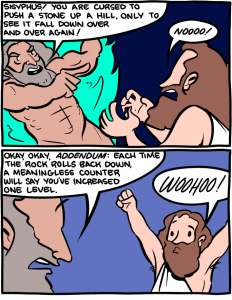
Furthermore, saying you create your own purpose seems like saying that Sisyphus would’ve had a purpose if the gods had attached a rolling-counter to his boulder to keep him occupied. SMBC wrote a comic to that effect.
meaning of life 2

Sisyphus could have attached any personal purpose imaginable to his existence, and we would still say his existence is pointless because it has no final point or purpose. The boulder goes up the hill, and then it goes down, leaving Sisyphus with a net nothing. We expect to meet the same fate under an atheistic point of view. We spend our existence pushing our boulder of accomplishments up the hill of life, and whether in a few decades, a century, or a millennium, that boulder will come right back to where it started. We will be forgotten, and everything and everyone we influenced will cease to exist. We ultimately did it all for no objective purpose.

The next response is usually that my opinion doesn’t really count since I’m not an atheist. I would bring up that I was an atheist, and this question mattered to me, but I think it’s more effective to point that this isn’t my opinion originally. It’s the opinion of many atheist and agnostic thinkers throughout history. For example, the Stanford Encyclopedia of Philosophy notes about Albert Camus that:

Camus sees this question of suicide as a natural response to an underlying premise, namely that life is absurd in a variety of ways. As we have seen, both the presence and absence of life (i.e., death) give rise to the condition: it is absurd to continually seek meaning in life when there is none, and it is absurd to hope for some form of continued existence after death given that the latter results in our extinction.

Leo Tolstoy searched for meaning in life and ultimately found none within a material framework, bringing him to the edge of suicide before his conversion to Christianity. He wrote in his book Confessions:

I sought in all the sciences, but far from finding what I wanted, became convinced that all who like myself had sought in knowledge for the meaning of life had found nothing. And not only had they found nothing, but they had plainly acknowledged that the very thing which made me despair–namely the senselessness of life–is the one indubitable thing man can know.

My question–that which at the age of fifty brought me to the verge of suicide–was the simplest of questions, lying in the soul of every man from the foolish child to the wisest elder: it was a question without an answer to which one cannot live, as I had found by experience. It was: “What will come of what I am doing today or shall do tomorrow? What will come of my whole life?”

Differently expressed, the question is: “Why should I live, why wish for anything, or do anything?” It can also be expressed thus: “Is there any meaning in my life that the inevitable death awaiting me does not destroy?”

Somerset Maugham, a famous 20th century writer and agnostic, stated:

If one puts aside the existence of God and the survival after life as too doubtful . . . one has to make up one’s mind as to the use of life. If death ends it all, if I have neither to hope for good nor to fear evil, I must ask myself what I am here for, and how in these circumstances I must conduct myself. Now the answer is plain, but so unpalatable that most will not face it. There is no meaning for life, and life has no meaning.

Personally, my favorite answer comes from Hume. In the face of life’s inevitable end, Hume recommended the very modern solution of distraction:

Where am I, or what? From what causes do I derive my existence, and to what condition shall I return? … I am confounded with all these questions, and begin to fancy myself in the most deplorable condition imaginable, environed with the deepest darkness, and utterly deprived of the use of every member and faculty.

Most fortunately it happens, that since Reason is incapable of dispelling these clouds, Nature herself suffices to that purpose, and cures me of this philosophical melancholy and delirium, either by relaxing this bent of mind, or by some avocation, and lively impression of my senses, which obliterate all these chimeras. I dine, I play a game of backgammon, I converse, and am merry with my friends. And when, after three or four hours’ amusement, I would return to these speculations, they appear so cold, and strained, and ridiculous, that I cannot find in my heart to enter into them any farther.

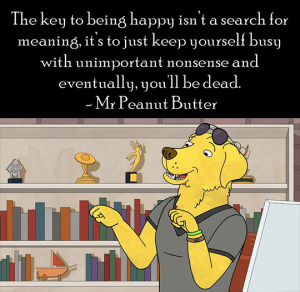
Which I would wager is the most common answer today. I suppose every person feels like they live in an age of unparalleled distraction, but I truly believe that the amount of distraction available to human beings today is greater than almost any period of history. In that context, nobody really needs to bother with whether life has meaning or not.
meaning of life

A brave new world indeed.

Mostly, I write this post as a call for consistency and rationality. I came of age in an atheism that espoused facing the truth, no matter how bleak. Here is the truth. Under an atheistic point of view, life has no objective meaning, so the the options are making up your own (unprovable) story, finding sufficient distraction until you die, or nihilism. Or as my friend Reece succinctly put it:

In my mind, there are really only two kinds of atheists.  There is make-believe pretend atheism, and then there is nihilism.

Ultimately, we won’t know until we’re dead who is right. However, we can know in this life who lives consistently with what they believe.

Why I Like Oaths

Solemn oaths today seem to strike people as some combination of quaint, naive, and constricting. They’re the kind of thing for a person long on overactive imagination and short on worldly experience. But personally, I like them very much. I find them to be an excellent vehicle for holding myself accountable. I also like them because I think there’s something inherently weaselly about human nature. If we don’t swear to something, we’re more likely later to revise our personal narrative to fit what we ended up doing. True, one can always re-interpret the oath, but that act should be, to a a person at very least trying to be honest, a sign he or she has gone astray.

Most importantly, I like that a good oath has specific points you can either uphold or fail to uphold, and again to anyone at least trying to uphold their word, success or failure will be apparent. For example, I’m very fond of the oath of the Knights of the Round Table from Le Morte D’Arthur (updated from Middle English to modern English):

This is the oath of a Knight of King Arth[u]r’s Round Table and should be for all of us to take to heart. I will develop my life for the greater good. I will place character above riches, and concern for others above personal wealth, I will never boast, but cherish humility instead, I will speak the truth at all times, and forever keep my word, I will defend those who cannot defend themselves, I will honor and respect women, and refute sexism in all its guises, I will uphold justice by being fair to all, I will be faithful in love and loyal in friendship, I will abhor scandals and gossip-neither partake nor delight in them, I will be generous to the poor and to those who need help, I will forgive when asked, that my own mistakes will be forgiven, I will live my life with courtesy and honor from this day forward.

So I can ask myself: Have I developed my life for the greater good, or have I spent my time playing video games and drinking beer? Have I placed character and charity above riches, or have I sought wealth before character and concern for others?  Do I say or think unfair things about women? Do I boast? Do I gossip? Do I forgive?

That’s a really hard list. Beer and distraction are way more fun than personal improvement. Money buys me beer and makes me feel comfortable. Sexist thoughts and comments about women are tempting. And it feels like a week let alone a day doesn’t go by without some temptation to boasting or gossiping. But I really, really like trying to hold myself to this standard because it makes me aware of the things I do that might not be right or just and would go unnoticed by myself if I didn’t actively pay attention.

The Beatitudes aren’t really an oath, but they’re similarly structured in a way that you can evaluate yourself:

“Blessed are the poor in spirit,
    for theirs is the kingdom of heaven.
Blessed are they who mourn,
    for they will be comforted.
Blessed are the meek,
    for they will inherit the land.
Blessed are they who hunger and thirst for righteousness,
    for they will be satisfied.
Blessed are the merciful,
    for they will be shown mercy.
Blessed are the clean of heart,
    for they will see God.
Blessed are the peacemakers,
    for they will be called children of God.
10 Blessed are they who are persecuted for the sake of righteousness,
    for theirs is the kingdom of heaven.

11 Blessed are you when they insult you and persecute you and utter every kind of evil against you [falsely] because of me. 12 Rejoice and be glad, for your reward will be great in heaven. Thus they persecuted the prophets who were before you.

The wording isn’t entirely concrete, but I think it’s clear enough. Have I been poor in spirit? Meek? Merciful? Clean of heart? Have I sought peace and reconciliation wherever possible? These are prime metrics by which I may judge whether I have walked rightly or not if I have the integrity to evaluate myself impartially, and again, they ask a great amount. Being meek and clean of heart is a continuous struggle. Peace and reconciliation are often far from our thoughts.

Lastly, I like oaths because they are a commitment to faithfulness and call to action. I took an oath upon my confirmation in the Catholic Church at 23:

For “by the sacrament of Confirmation, [the baptized] are more perfectly bound to the Church and are enriched with a special strength of the Holy Spirit. Hence they are, as true witnesses of Christ, more strictly obliged to spread and defend the faith by word and deed.”

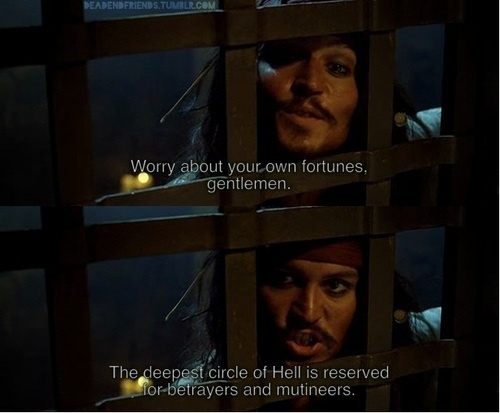
I have given God my word that I will uphold and defend the faith by word and deed. If I go back on that word, I will know that I am a liar and traitor for all of my life.

betrayers and mutineers

And that fact applies to everything I do. When I fail to live as Christ taught, in the Beatitudes and elsewhere, I fail to live by my oath. I bring disrepute upon the Church and the greater Christian communion. The only answer then, if I am to be faithful to my word, is to continually bring my life closer to the life of Him whom I have sworn to serve.

How to Respond to Terrorism with Love

Earlier this morning, a tense standoff in Australia ended in gunfire. A single hostage-taker initially held 17 hostages, of whom 12 had been released. When police heard gunfire inside the building, they responded immediately. The hostage taker and two hostages are dead. Three people are injured, including one police officer. All this info comes from an ABC News article, which also includes an apparent connection to radical Islam:

Two people inside the cafe were seen holding up a flag with Arabic writing on it that has been used by extremists in the past — raising fears that a terror attack was unfolding in Australia’s largest city.

Also this morning, I found an article with the headline: Australians Just Showed the World Exactly How to Respond to Terrorism With #IllRideWithYou. The article describes the origins of the #IllRideWithYou hashtag in which Australians are volunteering to accompany Muslims who wish to wear their religious clothes (e.g. hijab) on public transportation but are afraid of animosity or retaliation in the wake of the hostage crisis. The pictures–and the sentiment behind them–are noble and touching.

2014-12-15 I'll Walk With You
Read the bottom one first.

I agree with the idea of #IllRideWithYou. Even if you take–simply for the sake of argument–the strong and controversial position that the scripture or theology of Islam tend towards violence, it does not follow that all Muslims are violent. So, even in this extreme case, the correct response to peaceful, law-abiding Muslims is support and compassion.

But I do not agree with the headline. This is not the one true correct way to respond to terrorism. There are two correct responses. #IllRideWithYou is one half. Here’s what the other half looks like:

2014-1215-AP-Australia-Police-Operation

That photo[ref]from coverage at USA Today[/ref] shows one of the hostages running into the arms of a police officer moments after escaping the chocolate store through a side entrance. As lovely, as beautiful, and as necessary as the compassionate outreach of Australian commuters may be, none of that was what you would have been praying for if you were a hostage or had a family member held hostage in that store. There is also bravery and even love in the willingness to use violence–and be subject to the threat of violence–in lawful defense of the innocent.

A courageous and just society needs both of these responses. Not just one or the other.

This fits very nicely with Walker’s post from earlier today. He pointed out an article by Hernando de Soto in the WSJ arguing that–in the long run–you overcome terrorism not just with dronestrikes but also with economic development that gives people a better life.[ref]Walker and I wrote about this connection between love and economics for the journal SquareTwo: “No Poor Among Them”: Global Poverty, Free Markets, and the “Fourfold” Mission[/ref] As coldly calculating as the discipline of economics and the emphasis on free markets may appear, a focus on economic liberty and investment and development is really nothing but a sincere and informed desire for other humans to prosper and draw closer to us in webs of trade, communication, mutual interest, and interdependence.

Love of fellow man doesn’t always look like what we expect it to. Sometimes it comes in the form of sympathetic hashtags. Sometimes it wears body armor and wields automatic weapons. And sometimes it spouts statistics, theories, and economic jargon. We need to broaden our concept of what it means to love if we are to love as expansively as these dark times require of us.


The Capitalist Cure for Terrorism

As the U.S. moves into a new theater of the war on terror, it will miss its best chance to beat back Islamic State and other radical groups in the Middle East if it doesn’t deploy a crucial but little-used weapon: an aggressive agenda for economic empowerment. Right now, all we hear about are airstrikes and military maneuvers—which is to be expected when facing down thugs bent on mayhem and destruction.

But if the goal is not only to degrade what President Barack Obama rightly calls Islamic State’s “network of death” but to make it impossible for radical leaders to recruit terrorists in the first place, the West must learn a simple lesson: Economic hope is the only way to win the battle for the constituencies on which terrorist groups feed.

So begins Hernando de Soto’s WSJ piece on economic freedom as a way to combat terrorism. He tells the fascinating story of his home country Peru and how it defeated the terrorist group Shining Path through a “new, more accessible legal framework in which to run businesses, make contracts and borrow—spurring an unprecedented rise in living standards.”

Worth the read.