This is the title of a brand new study out from the National Marriage Project at the University of Virginia. Perhaps unsurprisingly, the study found that having a child before marriage, beginning a relationship by “hooking up,” having multiple sexual partners before marriage, and serial cohabitation can lead to lower marital quality in the future. The data indicate that making intentional decisions rather than simply sliding through relationship transitions increases marital quality. What was especially interesting to me was that formal weddings can actually increase marital quality. Furthermore, the number of wedding attendees can also impact marital quality.
My wife just forwarded me a blog post by Lindsay Lansing, who was in my ward[ref]Mormon congregation[/ref] growing up. It was profoundly moving, and so I wanted to share it. It’s called Did God Answer Your Prayer?, and it’s a sacrament talk[ref]Mormons have no paid clergy. Instead of sermons, 2 or 3 members give prepared talks during worship services ever week[/ref] that Lindsay gave in her ward recently.
The talk is about a variety of prayers–serious, earnest, desperate prayers–that were not answered, including Lindsay’s frantic rush through heavy traffic to try and get her son–who was struggling with a heart condition–to the hospital in time:
William was screaming in the back of my car, and I was trapped. I couldn’t console him, I couldn’t help him. I couldn’t even get out of the car to hold him because the traffic was so bad. I came to a fork in the road and I had to choose which way to the hospital. As tears streamed down my face, I said a prayer out loud, pleading for the Lord to tell me which way to go. There was no prompting. I chose one way, and it turned out to be awful. I realized the other way was better, and it then took me 10 minutes to just turn around, all while little William was screaming in the back. I thought he was going to die. I prayed for the Lord to turn my car into a hover craft… to fly me to the hospital. That didn’t happen. I prayed for all the stoplights to turn green, but they all turned red. I prayed for the crazy lady in front of me to hurry up and pay the teller in the parking garage and get into the parking deck. But she had no money. I prayed to find a parking spot close to the hospital, and there were none.
I kept waiting for the time when Lindsay would talk about the prayer that was answered, and how then everything was OK. And it all made sense. And it was all worthwhile. I never got there. That moment, from what I can tell, hasn’t come for Lindsay yet.
And that’s what made this such a profound article. It wasn’t the stereotypical Ensign story[ref]The Engisn is an official magazine of the LDS Church. It often contains short spiritual stories submitted by members, often of miraculous answers to prayers.[/ref] with a beginning, middle, and happy end. It was a real life story: just an interminable, senseless middle.
These are issues that have occupied me as well. Lindsay says, at one point, “I had always heard stories about people losing their keys, praying to find them, and then miraculously being led to find them under the couch.” It’s one of those stereotypical everyday miracles, and prompted me to write Does God Help Find Car Keys? last year. And then, at the end, she writes:
I do not know why God heals some by their faith and others he does not. I do not profess to know the meaning of all things. But I will not let the things that I do not know, affect the things that I do know. One of them is that God loves us. That we are his children. And the Lord’s Will is always the best. I am grateful that the Savior, in his most desperate moment in the Garden of Gethsemane, when he asked that the cup be removed from him said, “nevertheless not my will, but thine be done.” It wasn’t easy for the Savior of the world. He had to drink from the bitter cup –and he absolutely did not shrink. And if I am to be his disciple and follower, how dare I ask it to be easy for me, when it was never easy for Him. In my experience and through it all, I add my testimony to John’s that when I allow the two ideas of faith that the Lord CAN help me, but also complete submission to his will, I have found greater comfort and peace. I hope one day to know the meaning of all things, but until then, I will walk by faith.
I am humbled by Lindsay’s faith, which strengthens with my own. In dark times, I’ve also tried to hold onto the personal conviction that my Father loves me, even if I can’t reconcile that love with the pain and heartache so abundant in this world. We all have our burdens in life, but the burden Lindsay is bearing–caring for a seriously ill child–is one I have never had to labor under. The blessing I often repeat to myself when things are looking really bad is precisely that: at least my children are safe and healthy.
We are made to suffer. But why does it have to be so much for so many people? I think part of it might simply be that the kind of grace, bravery, love, sacrifice, and fidelity that Lindsay is living is only possible in a life that has both pain and confusion. Perhaps we need this senseless, unfair, chaotic, painful existence because it is what makes virtue possible. Even if that’s the answer, it won’t ever be something that allows us to sleep easy. That’s the point, after all. It doesn’t make sense in this life. So all we can do is what Lindsay is doing: hope to one day know the meaning of all things, and walk by faith until then.
– Veteran Cop: ‘If You Don’t Want To Get Shot,’ Shut Up — Even If We’re Violating Your Rights (Huffington Post)
– To the Cop Who Told Me Not to Resist: Go F— Yourself (some random politics site)
– ‘If you don’t want to get shot, just do what I tell you,’ cop with Colorado ties writes (Fox affiliate)
– Column defending cops in Ferguson sparks online fury (CNN)
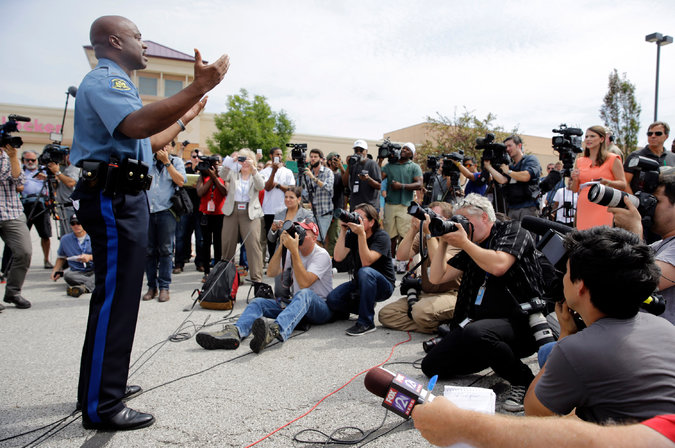
Let me first point out that, although most articles just call him “cop” and that might leave you the impression that he’s a stereotypical white police officer[ref]A little hefty, sporting a buzz cut, and wearing cheap wrap-around sunglasses.[/ref], he’s actually an immigrant who was born and raised in Jaipur, India, a “scholar of Urdu mystical poetry and an Indian classical music form called Dhrupad,” and “a professor of homeland security at Colorado Tech University,” in addition to being a cop with the LAPD. For somebody with such an interesting background to show up in the midst of one of the most contentious episode of racial tension in the United States is worth noting. Life has a funny way of not fitting the narratives we expect it to.
The angry reactions to his post are also misguided. Dutta is actually making a reasonable case that doesn’t include limitless authority for cops. As he writes:
I know it is scary for people to be stopped by cops. I also understand the anger and frustration if people believe they have been stopped unjustly or without a reason. I am aware that corrupt and bully cops exist. When it comes to police misconduct, I side with the ACLU: Having worked as an internal affairs investigator, I know that some officers engage in unprofessional and arrogant behavior; sometimes they behave like criminals themselves. I also believe every cop should use a body camera to record interactions with the community at all times. Every police car should have a video recorder.
His point is simply that reacting aggressively to a cop is not a good response when the cop is issuing lawful orders and even, in almost all cases, when the cop has overstepped his or her bounds. There are checks and balances for holding individual cops accountable for individual abuse and also for holding entire units accountable for systematic abuse. Now, you could argue that those checks and balances are broken. That’s a serious consideration, but it doesn’t really have anything to do with Dutta’s argument. Even if the checks on police abuse are broken, responding by aggressively resisting police authority is illegal (in most cases) and stupid (in all cases).
Cops have wives and children they want to go home to, and they have to defend themselves in life-threatening situations. This includes situations where they are dealing with an unarmed person.
There are no national statistics on how many times officers’ guns are taken away. But the FBI says that of the 616 law enforcement officers killed on duty by criminals from 1994 through 2003, 52 were killed with their own weapon, amounting to 8 percent. (PoliceOne.com)
So the mere fact that you don’t have a gun doesn’t mean that a cop doesn’t see you as a threat. You are a threat, and cops know that because they know nearly one in 10 of their fallen brothers and sisters was brought down with their own weapon. One of the problems here is that cops understand violent encounters. Bystanders and arm-chair lawyers don’t. Civilian reactions of “couldn’t the cop have used a taser?” or “couldn’t they have shot him in the leg?” or “why did they have to shoot him so many times?” are almost invariably founded in ignorance.
The deeper reality is that government is defined by the exclusive right to exercise force. We can go back almost 100 years to the political theorist Max Weber. He defined the state as a “human community that (successfully) claims the monopoly of the legitimate use of physical force within a given territory.” A state is defined as the group with the monopoly on violence. In practice, individual people are invested with the monopoly on violence. We call them law enforcement officers. It’s not fair and it’s not supposed to be fair. It’s a monopoly. They have broad legal rights to use force on you. You don’t, except in very narrow and practically useless situations[ref]You have a right of defense against unlawful arrest, but in practice attempting to exercise that right will get you dead.[/ref], have a right to use force on them.
Unless you reject all government, this is a state of affairs you will have to learn to live with. That doesn’t mean that we can’t change anything about our current system. Arguments about how the police use their authority to boss people around are reasonable. Arguments about whether the police can boss people around are not. Rejecting the authority of cops wholesale–which is what a lot of the anger seems to boil down to–is like getting upset that in a democracy sometimes the majority does the wrong thing. It’s s defect, but there’s no better alternative.
If there’s one criticism I have of Dutta’s piece, it’s that he acknowledges individual acts of police corruption but not the possibility of systemic injustice. That is the real issue here. It still doesn’t change his central point, however, and no amount of anger will.
I wanted to share a couple more thoughts on this topic. First, I was listening to Rush Limbaugh today[ref]Don’t judge. I need talk radio in the car and NPR has none in the afternoon around here.[/ref] and he was arguing that the idea that white cops are killing black kids is a myth. To back up his claim, he asked what people were using as the most recent example of police brutality prior to Ferguson. He answered his question: Rodney King. Nothing of note relating to cops assaulting or killing black men had happened, according to Rush, since 1992.
Say what?
I don’t think I’ve heard Rodney King’s name mentioned a single time, for one thing, and even I can think of multiple controversial shootings that are much more recent. OK, we’ll set Trayvon Martin aside on a technicality if you want (because George Zimmerman wasn’t a copy), but that still leaves (and these are just off the top of my head): the BART police killing of Oscar Grant (2009), the Danziger Bridge shooting (2005), and the shooting of Amadou Diallo (1999). All of those made national headlines, but the Root has a list of several more that weren’t as familiar to me (although they include security guards and tazers).
Meanwhile, on the other side of crazy, some of the critiques I’m reading from surprisingly legitimate sources are disturbing in their rush to judge everyone who hasn’t already made up their mind that Michael Brown was gunned down in cold blood. Case in point, this article featured at Quartz (which is operated by Atlantic Media Company, who run The Atlantic): 12 things white people can do now because Ferguson. In it, Janee Woods can’t figure out why white people aren’t spreading the word about the evil that was done in Ferguson, writing:
But an unarmed black teenager minding his own business walking down the street in broad daylight gets harassed and murdered by a white police officer and those same people seem to have nothing urgent to say about pervasive, systemic, deadly racism in America?
Instead of a bunch of white Americans failing to be bothered by the harassment and murder of a black kid by a white cop, might I suggest that many Americans simply aren’t sure if that’s the correct version of the events? Sometimes the cops do shoot and kill in horrific, illegal, and immoral ways.[ref]And sometimes the victim is white.[/ref] But sometimes cops also do shoot and kill because it’s what they have to do, even against unarmed assailants. In this case, Darren Wilson (the police officer) claims that Michael Brown attacked him and tried to take his gun, and that Brown was charging him when Wilson fired to protect his life. I am not rushing to judge that this story is true, but it might be. Right-wing news outlets are all saying that the officer suffered severe physical injures when Brown assaulted him, including a fractured orbital lobe, but I haven’t seen that picked up by the main stream press yet other than FoxNews.[ref]Insert obligatory joke that FoxNews <em>is</em> a right-wing outlet.[/ref]
I think it’s also worth noting that plenty of white Americans did protest early and loudly that the crowd control measures were inept and immoral. The first wave of criticisms involved a whole bunch of combat vets joking that the Ferguson cops were outfitted in more body armor than they had had in Iraq or Afghanistan. A lot of those vets were white. Meanwhile, libertarians have been attacking the militarization of the police since way before Ferguson, and (as I noted in my last piece on this topic) there were even early rumblings that this would be an issue where left and right could unite.
I don’t think it’s too early to conclude that the crowd control was wrong, and also that the rioting and looting was wrong. That’s safe. But it is too early to assume that Michael Brown’s death was a murder. It’s irresponsible and dangerous to make that assumption, let alone to accuse anyone who doesn’t go along of moral cowardice or racial prejudice.
That picture, from this Imgur thread, is a working hard disk drive created entirely inside the game Minecraft. Minecraft, for those of you who live underneath a rock, is sort of like Legos but for video games: you can use cubes from a variety of different materials to build whatever you want in the game. In addition to the standard cubes, there are some rudimentary machines (like railroad carts and pistons) that you can power using something called redstone, which basically works like electricity.
Well, if you can build electric circuits then you can build a computer. So someone did. Well, the hard drive anyway.
By using a whole bunch of pistons and some basic logic circuits made out of redstone, they created a fully-working, one kilobyte hard disk drive.[ref]Modern hard drive capacity is measured in gigabytes, which are millions of kilobytes. So it’s not a very large-capacity hard drive.[/ref] There’s a control room that allows you to specify a location in the hard drive and then either read the data (see what is stored there) or write new data to that location. It even has indicator lights to let the operator know when the drive is busy and when it is available for new operations.
It’s a little bit past what my kids are ready for–although I did teach them to build redstone-powered roller coasters already–but it just goes to show how truly creative people can be when you give them the right tools. And Minecraft is a pretty nifty tool. As one commenter put it:
one day we will build a full computer in minecraft, then play minecraft on it.
In principle, there’s no reason why someone couldn’t do that. Give it another year or two, and we probably really will have have a fully-functioning Minecraft version of the Apple II or a Babbage difference engine.
I just finished reading Brandon Sanderson’s monstrous tome: Words of Radiance. It’s his second book in the Stormlight Archives and, like the first, clocks in at over 1,000 pages. The expression on the clerk’s face in Barnes and Nobles when she picked up the book to hand it to me was priceless: “Wow,” she said as she nearly dropped the book, “This is a commitment!”
I’ve never liked high fantasy taken as a genre, but I did love The Lord of the Rings (which launched the genre) and I am enjoying Sanderson’s Stormlight Archives. Despite the fact that I’m enjoying them, however, they display the systematic problems that have plagued the genre ever since (but not including) Tolkien.
High fantasy, if you’re not familiar with the term, refers to the kinds of fantasy books that have maps in them. Not to mention a glossary, pronunciation guide, appendices, and maybe an index, too. This is because high fantasy is defined largely by its setting: an imaginary world with its own history, cultures, religions, languages, and—of course—magic.[ref]Close relatives of high fantasy include medieval fantasy and epic fantasy. The antithesis (within the fantasy genre) is urban fantasy like the Dresden Files because those books are located primarily within a recognizable version of the world.[/ref]
Tolkien’s own cover illustration for The Fellowship of the Ring.
For all practical purposes, Tolkien invented high fantasy. Of course all the pieces came from Saxon and Norse myths and folklore, but what he created when The Lord of the Rings was first published in the 1950’s was something new. The books were very successful from the early years and have gone on to sell more copies than any other novel (150 million thus far) except A Tale of Two Cities.[ref]Tolkien proves he’s still the king[/ref] The corpus of high fantasy has been and continues to this day to be a long line of Tolkien imitators.[ref]This is starting to change with recent blockbusters like George R. R. Martin’s A Song of Ice and Fire and Patrick Rothfuss’s Kingkiller Chronicles that emphasize created worlds but also depart from high fantasy conventions. Tolkien remains the paramount figure in the genre, however.[/ref]
The problem is that they have all learned the wrong lesson. They understand that setting defines high fantasy, and they understand that Tolkien’s mastery of world-building fueled his artistic and commercial success, but they fundamentally mistake the product (The Lord of the Rings as a narrative text) with the process (Tolkien’s actual beliefs and practices for world-building).
To correct this confusion we must start with the realization that Tolkien’s world-building was inextricable from his religious faith. He was a devout Roman Catholic and what we call world-building he called sub-creation, which is a term with obvious and deliberate religious connotations. As the Tolkien Gateway puts it:
‘Sub-creation’ was also used by J.R.R. Tolkien to refer [to the] process of world-building and creating myths. In this context, a human author is a ‘little maker’ creating his own world as a sub-set within God’s primary creation. Like the beings of Middle-earth, Tolkien saw his works as mere emulation of the true creation performed by God.
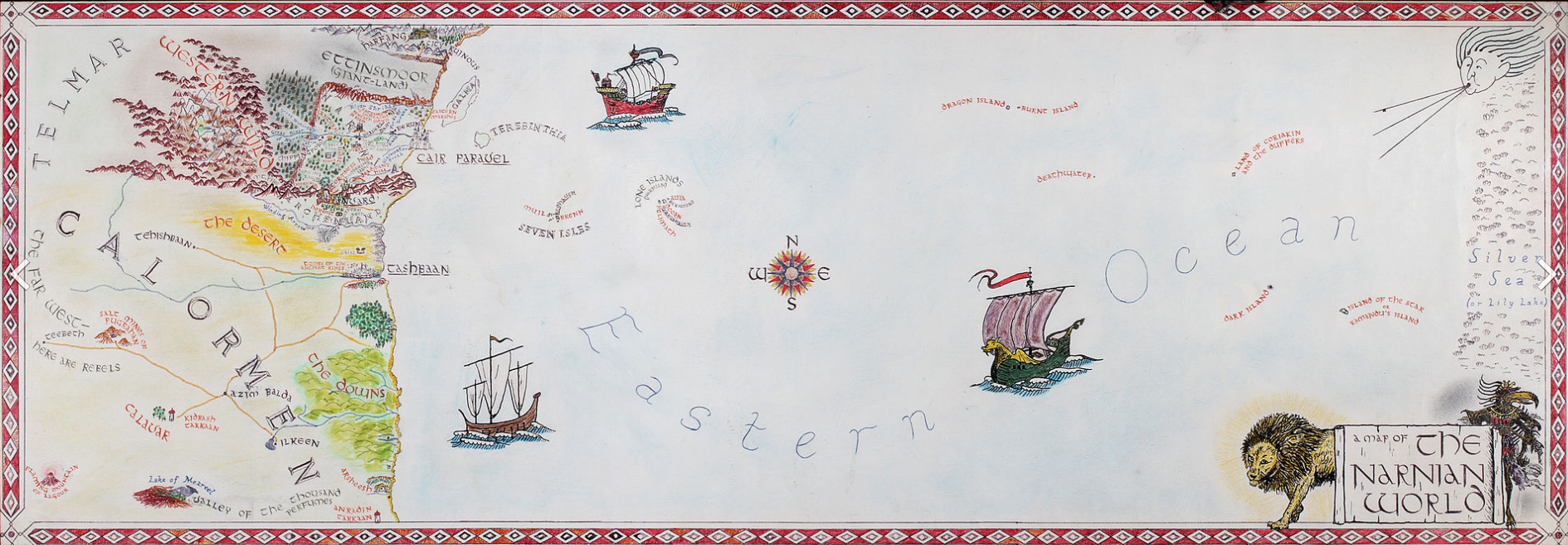
As we delve deeper into Tolkien’s theory of sub-creation, it is useful to contrast his view with that of his friend C. S. Lewis, as Professor Downing has done in a paper called “Sub-Creation or Smuggled Theology: Tolkien contra Lewis on Christian Fantasy” at the C. S. Lewis Institute. C. S. Lewis’s Chronicles of Narnia certainly deserves mention as co-founding the subgenre of high fantasy and, for the most part, his reverence for the work of sub-creation paralleled Tolkien’s. But there were important differences, and those differences are very clear in the different tones and styles of the works and also in the supremacy of The Lord of the Rings over Chronicles of Narnia in historical and literary impact.
Downing points out that, for Tolkien, “engaging one’s creativity is an imitation of God and a form of worship.” For Lewis, by contrast, a work of art had to have a higher purpose than the creative impulse itself. In his famous essay “Sometimes Fairy Stories May Say Best What’s to be Said,” Lewis propounded a dualistic account of artistic creation. The Author writes for the sake of writing, but The Man harnesses this impulse towards some external end. As Downing summarizes Lewis: “[A] writer can’t even begin without the Author’s urge to create, but… he shouldn’t begin without the Man’s desire to communicate his deepest sense of himself and his world.”
The Lewis-Tolkien dialogue on sub-creation is a particularly interesting one for a Mormon to enter because of theological differences over the term “creation.” As Downing notes, C. S. Lewis referred back to the orthodox Christian theology of creation ex nihilo in his discussion of artistic creativity. Lewis wrote in a letter to Sister Penelope:
‘Creation’ [as] applied to human authorship seems to me entirely misleading term. We rearrange elements He has provided. There is not a vestige of real creativity de novo in us. Try to imagine a new primary colour, a third sex, a fourth dimension, or even a monster which does not consist of bits and parts of existing animals stuck together. Nothing happens. And that surely is why our works (as you said) never mean to others quite what we intended: because we are recombining elements made by Him and already containing His meanings.
For Downing, this is a point against Tolkien. Tolkien stressed the independence of sub-created worlds but—as Downing and Lewis point out—there is no such thing as independent creation. Humans create by dividing or combining elements that are already available, not by making new elements. From a strictly orthodox Christian theological perspective, this is a fairly serious indictment of Tolkien’s theory of sub-creation because it draws a deep chasm between the kind of creation in which God engages and the kind of sub-creation in which we may participate. How can we be worshipfully imitating our Father when it turns out that the process in which we are engaged is actually a totally distinct process that only happens to share the same label by linguistic happenstance?
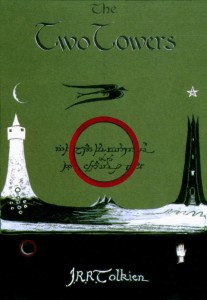
Tolkien’s own cover art for The Two Towers.
As it turns out, however, a rejection of creation ex nihilo is one of the defining aspects of Mormon theology. As many non-Mormon Christian theologians have also observed the Creation (as depicted in Genesis) is almost exclusively a depiction of creation the way that Tolkien and Lewis and all other writers create: by re-arranging pre-existing materials. After “let there be light,” God’s work is all about separation: light from dark, sea from dry land, and so forth. He doesn’t seem to create the earth, moon, stars, sun, or anything else by calling them into being out of the void, but rather by molding unformed materials. For a Mormon like me, at least, sub-creation is more akin to the Creation of God, not less.
In any case, however, what really matters is that Tolkien viewed sub-creation not merely as just another tool in the writer’s tool belt (along with plotting and characterization, say) but rather as a stand-alone activity that had merit in and of itself. This belief is what allowed Tolkien to be such a profligate world builder. He created vastly more material than ever made it into his books. He called this trove of linguistics, geography, history, myth, culture and genealogy the Legendarium, defined by the Tokien Gateway as “the entirety of J.R.R. Tolkien’s works concerning his imagined world of Arda.”
The relationship between The Legendarium and his literary works (like The Hobbit or The Lord of the Rings) an important one in two ways. First, as noted, the Legendarium is far larger. According to Downing, for example, “Quenya, the elvish tongue… had a vocabulary of several hundred words, with consistent declensions and etymologies” by the time he completed The Lord of The Rings, but only a sparse handful of those words appear in the text. The second is that they are, to a large degree, independent. The Legendarium was not completed for the purpose of writing The Lord of the Rings but as an independent exercise undertaken for its own merits. The stories came later, not as an afterthought, but as a distinct labor with their own objectives and process.
Of course in practice the two activities—the world-building and the story-telling—were intertwined. The point is simply that there were two activities, and Tolkien loved them both.
His reckless and extravagant acts of creation are what, to a large extent, made his fiction seems to vibrant and real. Early in The Lord of the Rings, Frodo is nearly killed by a barrow-wight. If you consult Appendix A you will learn that he had been trapped in the cairn of the last prince of Cardolan. Who was that prince? What was Cardolan? I have no idea, but I also have no doubt that Tolkien’s Legendarium contains the answers to both questions. This is just one example of many—to many to count!—where the characters in The Lord of the Rings came across an abandoned place that was steeped in history and drama not directly related to the story.
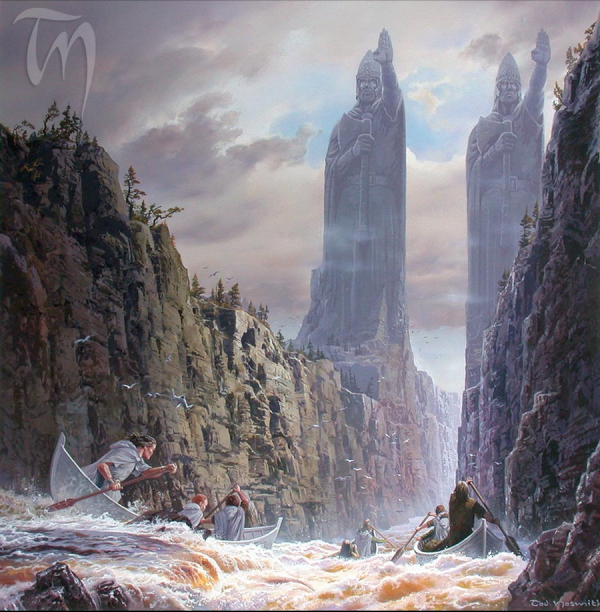
Argonath as envisioned by Ted Nasmith.
Argonath is, among these many examples, the one that has haunted me for the longest. Here’s the passage, which comes from the chapter “The Great River” near the very end of The Two Towers, that has haunted me since I first read it in a pop-up camper in Tennessee on a summer vacation when I was only 11 or 12 years old:
Upon great pedestals founded in the deep waters stood two great kings of stone: still with blurred eyes and crannied brows they frowned upon the North. The left hand of each was raised palm outwards in gesture of warning; in each right hand there was an axe; upon each head there was a crumbling helm and crown. Great power and majesty they still wore, the silent wardens of a long-vanished kingdom.
What impressed me then and has remained with me ever since is that Arganoth has basically nothing to do with the rest of the story. Sure, it marks the historic northern boundary of Gondor, but by the time we get to The Lord of the Rings, Gondor has already shrunk far from those boundaries. And sure, Strider / Aragorn is a descendent of the antecedents of Gondor, but does that really matter for the story? No, it doesn’t, and that’s why it makes Middle Earth beautiful. It is creation for creation’s sake. I knew, even as a kid, that Tolkien understood perfectly who had built these strange, forgotten pillars and why and the knowledge that he knew things that weren’t in the book is what made the book seem so real. Just like the real world: there’s always more history in Tolkien’s work than you can take in at once. [ref]My confidence was not misplaced, as it turns out. “It was originally constructed about TA 1340 at the order of Rómendacil II to mark the northern border of Gondor,” according to The Lord of the Rings Wiki.[/ref]
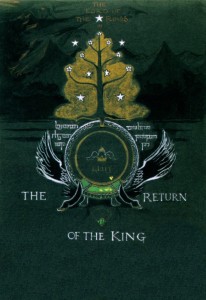
Tolkien’s cover for The Return of the King
So Tolkien loved sub-creation for its own sake, which caused him to do quite a lot of it, which in turn made the setting of The Lord of the Rings vivid beyond compare, which in turn led to the widespread popular love of those books, which in turn helped found the genre of high fantasy. Now, over a half century later, high fantasy is a genre cluttered with books full of maps of fantasy countries and continents, but none of them have remotely captured the grandeur of Tolkien’s original because they have tried to imitate his product without understanding the process that led to it. And Brandon Sanderson’s Words of Radiance (despite being a very fine book) is the perfect example of how it has all gone sideways since Tolkien.
High fantasy writers since Tolkien have created less and showed off more. The bigger problem is not that they have created less in total but rather that the ratio of what they have created for the setting to what they show you on the pages of their novels has diminished substantially. Sanderson’s Stormlight Archives are a great example of this problem because I get the feeling that he very well might, by the time he’s done, eclipse Tolkien in terms of sheer creative output, but he also seems bound and determined to shoehorn every last thought he has ever had about his creations directly into the text. [ref]I’m sure he’s leaving lots out by his own estimation, but compared to Tolkien there’s pretty much nothing left to the imagination at all.[/ref] This has three bad consequences.
First: it makes the stories bloated. Sanderson seems preoccupied with making sure you know exactly how the magical system he has created works. How does that help the story? Did Tolkien need to tell us how Gandalf’s magic worked in excruciating detail? And even if you argue that Sanderson’s strong suit is magical systems where Tolkien’s was language, the metaphor still holds: no one reads The Lord of the Rings and feels like someone tried to sneak a lecture on linguistics into their fantasy novel. The linguistics are there, of course, but Tolkien doesn’t feel the need to beat you over the head with them, whereas large portions of Words of Radiance revolve around nothing other than frog-marching the reader through a tour of Sanderson’s fabricated lore. [ref]Come hell or high water, anyone who finishes the novel will understand the difference between an Honorblade and a Shardblade.[/ref]
Second: it makes the worlds seem flimsy. Far from having an abundance of lost cities and forgotten heroes to populate the fringes of the story, Words of Radiance is rife with extra characters and stories (in the Interludes sections especially) that over-explain the universe. You rapidly get the impression that nothing—no religion, concept, magical power, artifact, civilization, or anything else—is going to be introduced in this book without being explained to death. Reading The Lord of the Rings feels like visiting another world because you know that there is a story underneath every stone, far more than you will actually experience in the text. Reading Words of Radiance feels like visiting a theme park ride by comparison: you have the impression that if you take even one step off the beaten path you’d see the 2×4’s holding up the painted backdrops. No matter how much you create, you have to hold something back or the reader is going to see through your creation.[ref]You can always publish it later in The Silmarillion if you need to.[/ref]
Third: it requires a very specific scope. Because high fantasy authors feel the need to cram every part of their sub-creation into the stories they write and because they often invent their worlds from the very moment of first creation, they trap themselves into writing only cosmic stories. This is bad because Big Questions are easy to raise but hard to answer, and so right off the bat high fantasy writers are painting themselves into a difficult corner. But even if they can pull it off, the fact remains that they are only capable of writing mega-epics. Which, to be clear, is a category that excludes the founding high fantasy story: The Lord of the Rings. Did you notice that the definition of Legendarium included the “world of Arda.” What, exactly, is that? You wouldn’t know, based on reading The Lord of the Rings, just as you would never have heard of Eru Ilúvatar (“the supreme God of Elves and Men” and “the single omnipotent creator”) nor of the Ainur (“divine spirits, the ‘Holy Ones’” who actually shaped Middle Earth).
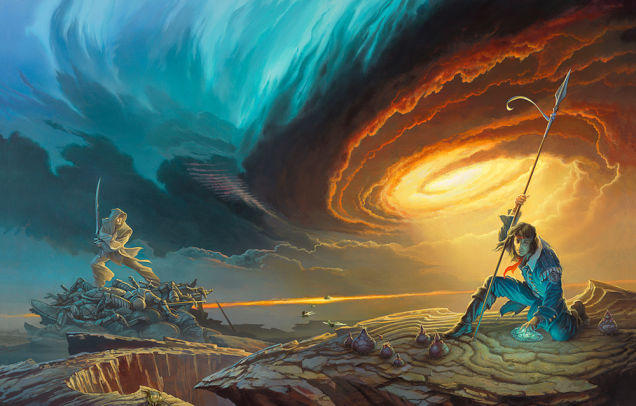
Cover illustration for Way of Kings (Stormlight Archives #1)
Tolkien did all the work of sub-creation back to the Big Bang of Middle Earth, and you can read all about it in The Silmarillion, but none of truly foundational lore shows up in The Lord of the Rings at all. It’s true that Sauron is a pretty epic bad guy, but the scope of the The Lord of the Rings is actually quite limited. It’s the story of one particular time that one particular bad guy threatened the peace of one particular region of the world. Gandalf is clear that this isn’t some ultimate final battle or anything like it. He calls the last military campaign “The great battle of our time.” (emphasis added) and when Frodo says “I wish the ring had never come to me. I wish none of this had happened,” Gandalf replies: “So do all who live to see such times. But that is not for them to decide. All we have to decide is what to do with the time that is given to us” (emphasis added). Eru never shows up. Neither do the Ainur. The story of The Lord of the Rings is, compared to the majestic backstory Tolkien had available, mundane. It is almost an anti-epic. It’s emphatically not a story that tries to be about everything all at once and it’s in that specificity that it becomes singular and glorious. I generally dislike high fantasy as a genre precisely because it has lost sight of imperative of specificity that underlies the very definition of narrative.
It’s worth noting at this point an important fact: Tolkien originally tried to include The Silmarillion for publication in the same book as The Lord of the Rings.[ref]According to Wikipedia, but with citations.[/ref] It wasn’t his foresight that saw The Lord of the Rings published as a standalone text, but rather the imposition of editors and publishers who viewed the former work as uninteresting to the public. And they were right: The Silmarillion (which I have read and very much enjoyed) is only good because The Lord of the Rings is great.
The point of this essay is therefore not that Tolkien was an omniscient genius who is the only one to do high fantasy the right way, but simply that his theory of sub-creation is deeply important to the success—both artistically and commercially—of The Lord of the Rings and that anyone who wants to emulate that aspect of his success should study it, understand it, and emulate it.
Tolkien believed in sub-creation as an independently worthy action and engaged in it as a form of worship, and that explains the creation of the vast Legendarium. This was the well from which he dipped to draw out works like The Hobbit and The Lord of the Rings, and it makes sense to think of them as two separate kinds of projects: the world-building vs. the narrative itself.
Subsequent high fantasy authors have failed to fully appreciate this distinction and especially the worthwhile endeavor of sub-creation for its own sake. This is understandable. Writers get in the business to tell stories, not to write thousands of pages of backstory and setting that no one will ever see. They see world-building as necessary to telling fantasy stories, and they see Tolkien praised for the central place his world-building played in The Lord of the Rings, but they end up emulating the final product without fully understanding the process that went into it. They build the world for the story instead of for itself.
What’s more, the process is daunting. It requires an extraordinary amount of work that, in a way, seems wasteful. Why create an entire language—grammar, vocabulary, etymology and all—when just a few fun-sounding syllables here and there will do? The temptation to short-change the world-building and to only build what you need is overwhelming for authors who are not generally flush with cash and are often working on deadlines. How is it possible to justify the kind of exorbitant labor of love that Tolkien has engaged in?
For most people, it isn’t possible, and that is one major reason why The Lord of the Rings still stands alone. No one else seems able or willing to do what Tolkien did. They keep trying to get similar results, however, and I guess that’s good enough for fantasy’s audience.
If all of this sounds a little bit too harsh, let me restate what I said at the outset: even if I hold the genre of high fantasy in low regard as a whole I love The Lord of the Rings and I also like the Stormlight Archives quite a lot. I expect to read all of them.
But I stand by my criticism. It’s not that Sanderson hasn’t invested enough in world-building (he probably has), but it’s more that he just doesn’t seem willing to view that world-building as both intrinsically valuable and distinct from the narrative. He seems to want to cram all of it into the books. And that’s a bad thing. The Stormlight Archives are still excellent, in my opinion, but they are not nearly as good as they could be if they were treated as truly independent stories rather than vehicles for delivering world-building content. An abridged treatment would really, in this case, be a better story. Sanderson could have more focus without Interludes so tangential they make you want to pull your hair out [ref]I read them all, but my brother just started skipping them[/ref], a richer and more immersive world, and greater freedom in the scope he chose to pick. Sanderson is a great writer, but there is still only one J. R. R. Tolkien.
After taking a break from posting at Times And Seasons for the last couple of months, I posted this morning about the necessary role of pain and suffering in human life and our society’s maladaptive response to it. I have lots more posts in progress, so I will be returning to every Monday or at least every other Monday for the foreseeable future.
I was on vacation all last week, and so I’ve been catching up on the events from Ferguson, MO over the past couple of days. CBSNews has a pretty good rundown. I’ve seen one particular article that grabbed my attention, however: What I Did After Police Killed My Son.
Yes, there is good reason to think that many of these unjustifiable homicides by police across the country are racially motivated. But there is a lot more than that going on here. Our country is simply not paying enough attention to the terrible lack of accountability of police departments and the way it affects all of us—regardless of race or ethnicity. Because if a blond-haired, blue-eyed boy — that was my son, Michael — can be shot in the head under a street light with his hands cuffed behind his back, in front of five eyewitnesses (including his mother and sister), and his father was a retired Air Force lieutenant colonel who flew in three wars for his country — that’s me — and I still couldn’t get anything done about it, then Joe the plumber and Javier the roofer aren’t going to be able to do anything about it either.
Michael Bell (who wrote this piece) is absolutely correct. I hope that issues of police accountability and police militarization can provide some much needed common ground. Based on articles like this one from the New Yorker, I think that hope might not be misplaced:
But over the past two days — as the police in Ferguson have responded to very angry protests with an alarmingly heavy hand, looking and reacting as if they were not the community’s own peace officers but an invading army — something remarkable has happened. The longstanding liberal concerns about police racial hostility has seemed to merge with the longstanding libertarian concerns over police militarization. It isn’t just that no one is defending the cops. It’s that many of the criticisms from the left and the right sound very similar.
The only thing I’d add to that is that initiatives like badge cameras and independent review of lethal shootings are not about attacking the police. They are about making a better police force, and improving trust between law enforcement and the communities they seek to serve.
A major theme that the DREditors often write about is the importance of seeing past political partisanship and engaging people from different backgrounds in meaningful discussion on controversial topics. So we’re very happy to have a diverse group of commenters who express themselves intelligently, constructively, and politely on a wide range of issues. Good comments are gold on the Internet.
Unfortunately, bad comments are toxic waste. For that reason, DREditors reserve the right to delete comments that don’t contribute to the tone of the site and/or to ban users (by IP address or other means) for repeated infractions. So far we haven’t had to do this very often. As of August 2014 only a very small number of comments (less than 1% of those that make it through the Akismet spam filter) have ever been deleted, and no users have ever been banned. The comments deleted were so egregious that no warning or explanation was provided to the poster, but if you do feel that a comment was deleted unfairly and would like to make your case, please use the contact form to get a hold of us.
Anyone who has used the Internet for a long time understands that it is a waste of time to try and codify exactly what constitutes acceptable vs. unacceptable comments. Frankly, if you’re trying to find that line then you’re missing the point. The hope is to have great comments, not marginally acceptable ones. So we’re not going to provide a bullet list or other set of criteria. However, just to give some basic guidance, please keep in mind that what we’re interested in is open-minded conversation and respect for intellectual differences. What we’d like to avoid are things like insults, flamewars, trolling, and drama.
Difficult Run is a participant in the Amazon Services LLC Associates Program, an affiliate advertising program designed to provide a means for sites to earn advertising fees by advertising and linking to amazon.com. We started the associates program in 2014. We have placed a few adds around the site and also place links in some of our posts (usually for books that we like). If you click one of those links to Amazon and then purchase one those products or any other product, then we get a small percentage: usually between 4% and 6%. (You can find more details about how the program works here.)
DR will publicize the total amount of revenue gained from advertising at the end of every year because transparency is cool. In 2014, when the program was being tested, we earned $0.66[ref]Details here.[/ref] Since we added more ads to the site in January 2015, we’ve earned about $13.00.[ref]As of January 22, 2015.[/ref] All revenue raised will go towards paying for the hosting of this blog, which is currently about $30/month. We really appreciate your support.
 This is the title of a brand new study out from the National Marriage Project at the University of Virginia. Perhaps unsurprisingly, the study found that having a child before marriage, beginning a relationship by “hooking up,” having multiple sexual partners before marriage, and serial cohabitation can lead to lower marital quality in the future. The data indicate that making intentional decisions rather than simply sliding through relationship transitions increases marital quality. What was especially interesting to me was that formal weddings can actually increase marital quality. Furthermore, the number of wedding attendees can also impact marital quality.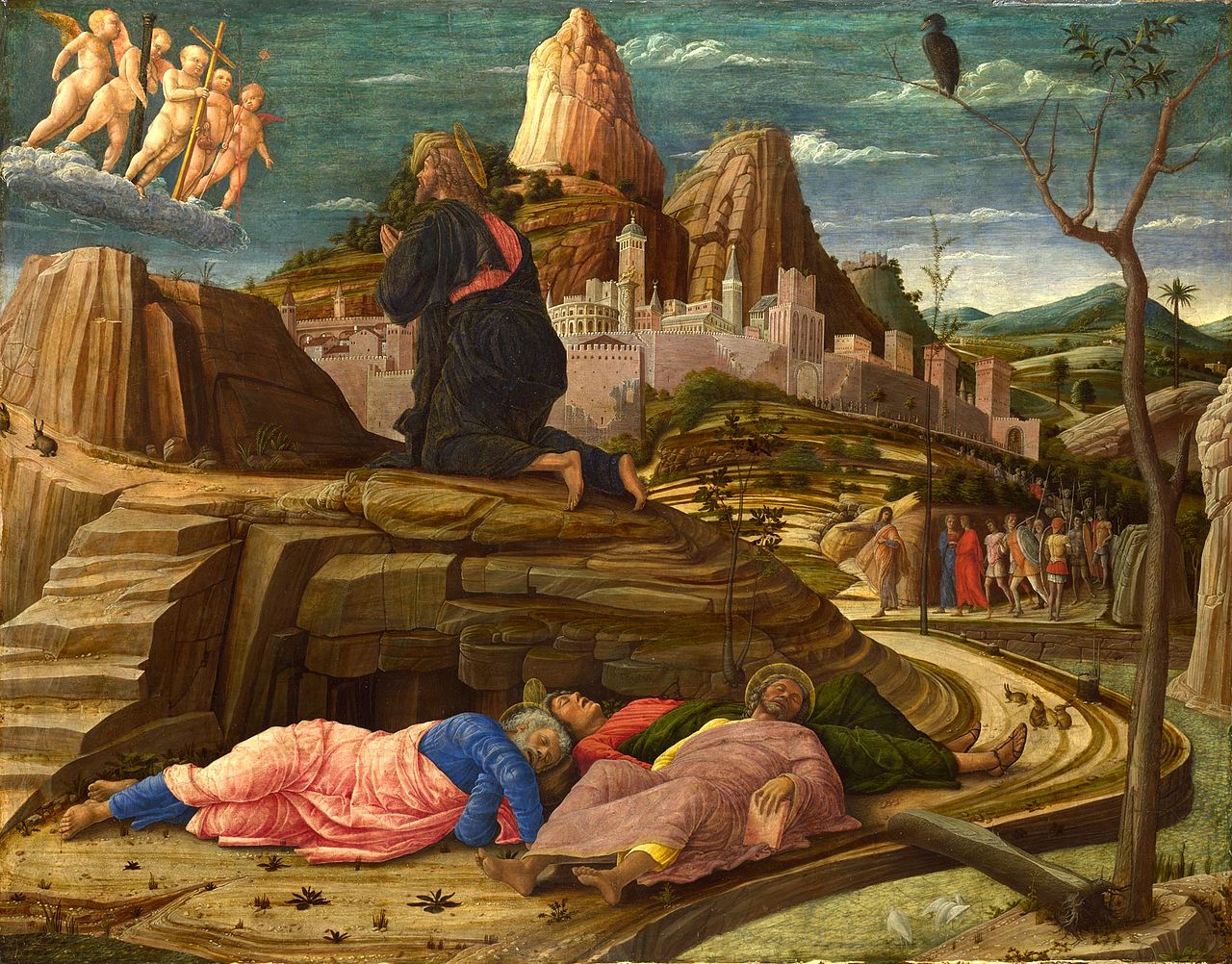






 because those books are located primarily within a recognizable version of the world.[/ref]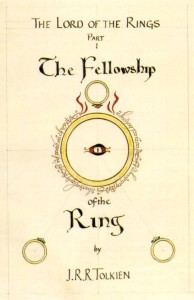
 and Patrick Rothfuss’s
  that emphasize created worlds but also depart from high fantasy conventions. Tolkien remains the paramount figure in the genre, however.[/ref]