The Middle East in Maps

20616

My dad likes to say that a book is only good if it contains maps.

I’ve heard this half-serious maxim all the time while growing up, and although it can seem silly, what he really means is that maps provide a unique visual tool to help you organize what you are reading about into a coherent whole, and thus give you a better perspective and more appreciation for whatever the topic may be. This is something that even fantasy writers and readers find helpful.

All the more so, then, when it comes to a complex region like the Middle East, frequently featured in the headlines.

I saw on a friend’s Facebook page that Vox recently posted 40 maps which in their words “explain the Middle East.” I’m not sure that I would consider Afghanistan as part of the Middle East (to me, that is defining the term too broadly), and I would probably have included at least one map showing the contrast between fertile land and arid wilderness, as well as another on military topography, since both factors have played a tremendous role in forming the history, culture, and ethnic makeup of the Middle East. I also disagree with some of the conclusions drawn from the data, but it is still a fantastic resource. Check it out if you have any interest at all in the region.

No Safe Level of Alcohol

“Responsible drinking” has become a 21st-century mantra for how most people view alcohol consumption. But when it comes to cancer, no amount of alcohol is safe. That is the conclusion of the 2014 World Cancer Report (WCR), issued by the World Health Organization’s International Agency for Research on Cancer (IARC).

So begins a new medical report on alcohol consumption. A few years ago, psychiatrist David Nutt had an article in The Guardian claiming “there is no such thing as a safe level of alcohol consumption.” His views now seem to have even more backing.

Check it out.

Trigger Warnings and Sanity

2014-05-02 Trigger Warnings

If you aren’t familiar with the term, trigger warnings are disclaimers that folks put at the top of blog posts (or other written materials) which they believe may cause post-traumatic stress reactions in some readers. As The Guardian describes it:

In the early days of feminist blogging, trigger warnings were generally about sexual assault, and posted with the understanding that lots of women are sexual assault survivors, lots of women read feminist blogs, and graphic descriptions of rape might lead to panic attacks or other reactions that will really ruin someone’s day. Easy enough to give readers a little heads up – a trigger warning – so that they can decide to avoid that material if they know that discussion of rape triggers debilitating reactions.

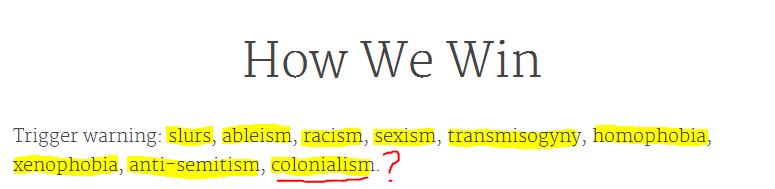
This makes sense to me. Although I do not have traumatic experiences in my own past, and am grateful for that fact, even I have been seriously affected by particularly tragic or graphic news stories. I have also seen people have real-world reactions to topics of rape or sexual assault that have convinced me that there is a legitimate concern.[ref]See also: Rape Trauma Syndrome.[/ref] I don’t know that I”m really up-to-speed on exactly when and how to issue a trigger warning, but the general principle seems both sensible and compassionate. Recently, however, I came across a piece in my exploration of the sci-fi political controversy that had nine trigger warnings:[ref]The piece was linked by John Scalzi, which is how I found it.[/ref] “slurs, ableism, racism, sexism, transmisogyny, homophobia, xenophobia, anti-semitism, colonialism.”

I found the whole list a bit odd. I try to be empathic and compassionate, but this seemed to be pushing it. When I got to to “colonialism” there at the end I found I had passed my limit. I just can’t take that seriously. In fact, I think such absurd over-sensitivity is downright counter-productive. For starters, it seems disrespectful to those suffering with Rape Trauma Syndrome to put them in the same category as people who are sad about the history of colonialism. It turns the whole thing into a joke. And that’s not just bad for victims of rape. It’s bad for all of us because it makes people who care about these kinds of issues look totally insane. Which is why we get pieces like  Big Boy Panties from the Mad Genius Club (a group blog run by conservative sci-fi writers):

Seriously. You now need to put a warning label on a blog post or something because somewhere, somehow, someone might have a reaction to something that may or may not cause them to react in a way… that’s a lot of stinking cow excremental right there. Aside from our usual society response to any sort of speech which might deemed “racist” (oh yeah, I used air quotes when I typed that), we now have this burning need to placate individuals who forgot their big boy panties and now must be warned before reading something.

See, if trigger warnings were used exclusively for discussion of rape and sexual assault I would respond to someone like this by saying, “No, you don’t really get it. There’s a legitimate reason for this.” But I can’t really do that now, because this person will just point to “trigger warning: colonialism” and collapse in a fit of hysterical laughter. I want to stake out a moderate middle position, but it’s hard when the left and right are both doing the absolute darnedest to live down to their stereotypes: irrational sentimentality on the one hand and unflinching callousness on the other. Not that conservatives are the only ones to complain that the trigger warning thing has gone way, way too far. The article from the Guardian that I quoted at the top is actually headlined: We’ve gone too far with ‘trigger warnings’, and it has an even more impressive list of trigger warnings then the one I found, including:

misogyny, the death penalty, calories in a food item, terrorism, drunk driving, how much a person weighs, racism, gun violence, Stand Your Ground laws, drones, homophobia, PTSD, slavery, victim-blaming, abuse, swearing, child abuse, self-injury, suicide, talk of drug use, descriptions of medical procedures, corpses, skulls, skeletons, needles, discussion of “isms,” neuroatypical shaming, slurs (including “stupid” or “dumb”), kidnapping, dental trauma, discussions of sex (even consensual), death or dying, spiders, insects, snakes, vomit, pregnancy, childbirth, blood, scarification, Nazi paraphernalia, slimy things, holes and “anything that might inspire intrusive thoughts in people with OCD“.

Seriously. We’ve gone from “rape” to trigger warnings for spiders, holes, and slimy things. But it’s much worse than just over-sensitivity. Colleges are starting to either require trigger warnings or just encourage teachers to remove material from the curricula that might be triggering.

Oberlin College recommends that its faculty “remove triggering material when it does not contribute directly to the course learning goals”. When material is simply too important to take out entirely, the college recommends trigger warnings.
2014-05-02 Things Fall ApartAnd we’re not talking hardcore stuff, here. The classical work Things Fall Apart (which I read as a freshman) is listed as an example, and requires trigger warnings for: “racism, colonialism, religious persecution, violence, suicide, and more.” I realize that a trigger warning is not the same thing as outright censoring, but the trend is deeply disturbing and illustrates the conservative case that even if your intentions are laudable the end result can be sinister. The trigger warning logic isn’t just about adding disclaimers to what you read, it’s about reading less. It’s about removing objectionable work (and all work can be classified as objectionable on the basis of triggering someone somewhere). It’s not about individuals opting out of particular works as a matter of conscience (as conservatives sometimes do), but about applying rigidly overprotective standards for everyone.

It is deeply and tragically ironic that important literary works by minority voices who come from cultures that have suffered under colonial imperialism are now on the verge of being suppressed by the folks who claim to be the most concerned with colonial imperialism. Shouldn’t we be encouraging more  people to read a book by Africa’s leading literary voice that includes discussions of the impact of colonialism on Africa precisely because the history is so tragic that it can be distressing?[ref]What’s next: are we going to scrub all historical references to the Holocaust and expunge it from history? Sometimes the things that are hardest to look at are the most important not to forget.[/ref] Is this what it looks like when radical ideology begins to eat its own tail?

Even The New Republic can see that this trend, especially when it comes to colleges, is both absurd and ominous: Trigger Happy: The “trigger warning” has spread from blogs to college classes. Can it be stopped? The article starts with another collegiate example:

Last week, student leaders at the University of California, Santa Barbara, passed a resolution urging officials to institute mandatory trigger warnings on class syllabi. Professors who present “content that may trigger the onset of symptoms of Post-Traumatic Stress Disorder” would be required to issue advance alerts and allow students to skip those classes.

Sounds OK in principle, but in practice it makes you wonder if there’s anything that won’t need a trigger warning. Over at Rutgers, a “sophomore suggested that an alert for F. Scott Fitzgerald’s The Great Gatsby say, “TW: suicide, domestic abuse and graphic violence.” Really, is there a single work of serious literature that wouldn’t require a whole slew of trigger warnings? Off hand, I can’t think of one.

This, my fellow moderates and sane people on the left and right, is why we can’t have nice things. And let it no longer be said that censorship is primarily a hobby of the right![ref]And yes: I haven’t forgotten that trigger warnings aren’t the same thing as censorship, but when it comes to meddling with syllabi and asking teachers to avoid teaching certain books we’re clearly playing both games in the same ballpark.[/ref] On the plus side, evangelical Christians who protested that Harry Potter promoted satanism will at least now have some company out there in loony town. Let this be further evidence that the real conflict is not left vs. right, but rather reasonable vs. not-reasonable.

Now, maybe this kind of insanity is just part of life on Earth. I’m sure there’s some truth to that. This is hardly the first time ever that someone has taken an otherwise good idea too far. That’s pretty much what history is all about. But in conjunction with the political infighting that is splitting the sci-fi community apart and partisanship in the US to all-time highs I have to wonder if there’s something about social media and the way it lets us democratize the spread of ideas that is turning what used to be a nuisance into a major hazard. Think about the way improving technology led ancient societies to gradually shift from rural to urban communities. A lot of good came from that, but sticking so many people in confined areas created new problems for the spread of disease. Well, on the Internet, “some dumb idea” is the effective equivalent of disease. The whole trigger warning nonsense (and it has become nonsense, even if it didn’t start out that way) is no dumber than stupid ideas of the past, but it has a chance to spread much more widely and quickly.[ref]I guess, compared to the Black Death, hyper-sensitive trigger warnings aren’t that bad.[/ref]

That’s the downside to free flow of information, folks. You all get to go and watch TED talks and get your minds expanded, but stupid fads like trigger warnings for spiders and holes get a chance to infect our brains, too. It’s all fun and games when your relatives send stupid stories that they should have checked on Snopes first, but once these infectious idiocies start sprouting up as official policies on college campuses we’re officially in trouble. As long as this is an Internet-only phenomena, it’s just one more thing to complain about. Once it hits the real world

World Bank: World Is More Equal

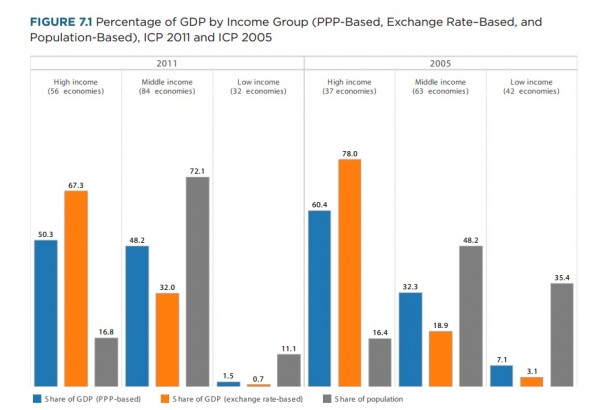
The World Bank released a summary of the findings of the 2011 International Comparison Program (ICP), which analyzes PPP and real expenditures worldwide. The report describes

the interaction between the real sizes of GDP for 177 economies with the relative price levels for major aggregates and per capita expenditures based on their population sizes. The results indi­cate that only a small number of economies have the greatest shares of world GDP. However, the shares of large economies such as China and India have more than doubled relative to that of the United States. The spread of per capita actual individual consumption as a percentage of that of the United States has been greatly reduced, suggesting that the world has become more equal (pg. 89; bold mine).

The report explains that this should be “interpreted with caution” due to “changes in the ICP methodology and country coverage…” Nonetheless, this is fantastic news. Pope Francis and the rest of us should be rejoicing.

This is just one more source lending support to what Nathaniel and I argued in SquareTwo: global poverty and inequality are declining largely thanks to globalization.

What Does It Mean That Animals Play?

OLYMPUS DIGITAL CAMERA

On one level, this (below) is just a cute video of a baby elk playing in a puddle. But it made me think.

I don’t think I will ever be 100% vegetarian, and I certainly have limited patience for people who seem to be more worried about saving animal lives than saving human lives, but the older I get the more I feel like there is some kind of sacred responsibility we owe to living creatures. Eating meat might not violate that trust, but mistreating animals (which is often a part of how we get more meat cheaper) certainly does.

I guess the only way I can describe it is say that while animals are not people, they are certainly not things either. A little creature that has a sense of enjoyment is a little creature that has a self in a way that, even if not human, is still important. To be honest, playing in a puddle is much more meaningful to me than traditional tests of intelligence. [ref]Also, I’m really fascinated by the fact that dolphins really do save people in danger, and sometimes other mammals too.)

What Brendan Eich’s Resignation Tells Us About Tolerance

1024px-Rainbow_flag_breeze

As Nathaniel has already touched on, a few weeks ago newly-minted Mozilla CEO Brendan Eich resigned from his post amid outrage from gay activists over his contribution to Prop 8 in California six years ago. Those opposing his support for Prop 8 made clear their demands: recant or resign. Eich, presumably because he is a man of conscience, chose the latter.

Now, to be clear, Eich was not forced out under any sort of legal pressure, so anyone claiming Eich’s right to free speech was being suppressed isn’t correct. There’s no reason gay activists can’t express outrage at an opinion they find reprehensible, even to the point of boycotting the company he leads (as misguided as such a tactic may be), just as Eich can express that opinion.

But the activists have still got it wrong, and not just because the same coercive tactics used against them would be met with justifiable indignation, but because the entire premise of their anger is misplaced. Their stated or implied claims are:

  1. Eich’s contribution to the Prop 8 campaign makes him hateful, and a bigot.
  2. Intolerance of intolerance is ethical.

Those claims, by necessity, assume gay activists hold the moral high ground, and therefore can dictate what opinions are or are not acceptable to hold in our society. The problem is that gay activists do not hold any such ground. Modern society’s acceptance of homosexuality is not predicated on any sort of objective morality that flows pure and clean out of the fabric of reality, but rather the whims of the same society that just forty years ago considered homosexuality to be a clinical mental disorder.

The fact is the morality of gay activists is ascendant not because there is some universal law that compels it but because we have arbitrarily decided that’s what we want. Because it’s the popular thing to do. They refuse to acknowledge this because when viewed through that lens it puts the views of the bigots, racists and bullies on equal footing with their own. Instead of being able to arbitrate right and wrong from a position of unassailable moral authority, they’re forced to realize society is, fundamentally, only interested in its own survival, that justice and equal rights are of secondary importance–a luxury, really, and optional when the chips are down.

That’s a hard thing to realize, and even voicing such a notion runs you the risk of being labeled a bigot. And that’s part of the problem. Even asking the question “is homosexuality normal?” is enough to get you fired and treated as a pariah.

And why not? Homosexuals can’t help how they were born, so how can we justify treating them differently? Well, the reality is we treat people differently based upon how they were born all the time. I could be born with a tendency toward attraction to multiple partners, but I’m not allowed to marry more than one of them at a time. Is such a proscription morally defensible?

Maybe that’s too easy. Let’s try a harder one. What about pedophiles? We treat pedophiles differently because of how they were born.[ref]Please note that I am not equating pedophiles and homosexuals in any way other than pointing out that they both qualify as a deviation from the norm of adult heterosexuality.[/ref] In the past, our society found both pedophilia and homosexuality to be immoral, just as we continue to find pedophilia immoral today. What has changed? We must accept that either morality is a malleable, changeable aspect of our society, or that we are uncovering an immutable morality as civilization marches on.

The notion that there is some discoverable, objective morality would seem to imply that nature itself has some vested interest not only in the survival of our society, but in values like equality and human rights, and yet we have no evidence that nature is anything but utterly indifferent to our values and our society. It therefore seems overwhelmingly likely that morality is subject to change based on prevailing notions of “what’s best.” We agree as a society to limit ourselves to behaviors which are not detrimental to our current explicit or implicit goals. The sexual abuse of children runs contrary to those goals, and is thus considered to be immoral. We react with disgust and outrage at the behavior of pedophiles because we are empathetic creatures able to identify with the suffering of others and because we instinctively regard harming innocent humans as damaging to our collective survival. So while a pedophile may not be able to help how he was born, that doesn’t exempt his behavior from the harsh judgment of his fellow men, nor does it render that judgment unjustified.

Is it therefore unjustified to regard homosexuality as immoral? It certainly hasn’t always been, but now we are moving into a time in which a majority of society and the prevailing wind of reason, not to mention science, tells us that homosexual behavior has no harmful effect on its participants nor on society as a whole, and even goes so far as to state that regarding homosexual behavior as immoral is itself harmful, and therefore immoral.

Let’s examine these claims in turn:

1) Homosexual behavior is not harmful to its participants.

I can’t think of any reason this might not be true. In a non-religious context, I can’t see any harm done to two consenting adults doing whatever they want together.

2) Homosexual behavior is not harmful to society.

This is a bit more complicated. Certainly birth rates would decrease (roughly) proportionately to the rate of homosexuality in a given society. Taken to an extreme, there would be a real risk of societal catastrophe if, say, we all woke up one day attracted to our own sex and not the opposite.[ref]Obviously this is extremely unlikely, but it makes me wonder, would such a society deem homosexuality immoral in a bid for survival, despite it going against instinct?[/ref] Are we then prepared to say that homosexuality is only conditionally not harmful to society? Because that would necessarily mean that homosexuality is conditionally harmful to society. What does that tell us about the morality of gay activists? What then do we make of the outrage against those backwards bigots who still consider homosexual behavior to be sinful?

3) Claiming that homosexual behavior is immoral is itself immoral.

At the risk of repeating myself, this again is a way of saying that the morality of one group takes precedence over another. This is certainly true, but not for the reasons that gay activists think. That is, not because any ascendant morality is inherently better for society. “Tolerance” is not a panacea, as evidenced by the fact that we still do not permit plural marriage and we still put pedophiles in prison when they act on their inborn tendencies. The morality of gay activists happens to be largely identical to those they oppose with a few notable exceptions. That doesn’t make it “better,” which leads to the implicit claim:

4) Intolerance of intolerance is ethical.

This is, simply, wrong, for all the reasons I’ve just mentioned. Intolerance of intolerance is a way of punishing others for rejecting your morality, which, as we’ve clearly established, is fundamentally arbitrary. If you are upset with someone for opposing what you believe to be “right,” then say so, explain yourself, and back your claims. Do not attempt to marginalize your opponents by pretending that blanket censure, shouting down, censoring or oppression of dissenting opinions is an appropriate response to disagreement.

I am deeply disappointed by the behavior of the gay activists who spoke out against Brendan Eich. They are engaging in the very behavior they should be actively fighting. Instead of being driven by the equality, love and fairness that has allowed them to accomplish their goals in the first place, they viciously attack anyone who might not feel the way they do without recognizing in themselves that same hatefulness and spite they fight so hard against in their opponents. I would expect a supposedly “enlightened” society to do better.

C.S. Lewis: “You Don’t Want to be Lectured . . . on Dinosaurs by a Dinosaur.”

C.S. Lewis
C.S. Lewis

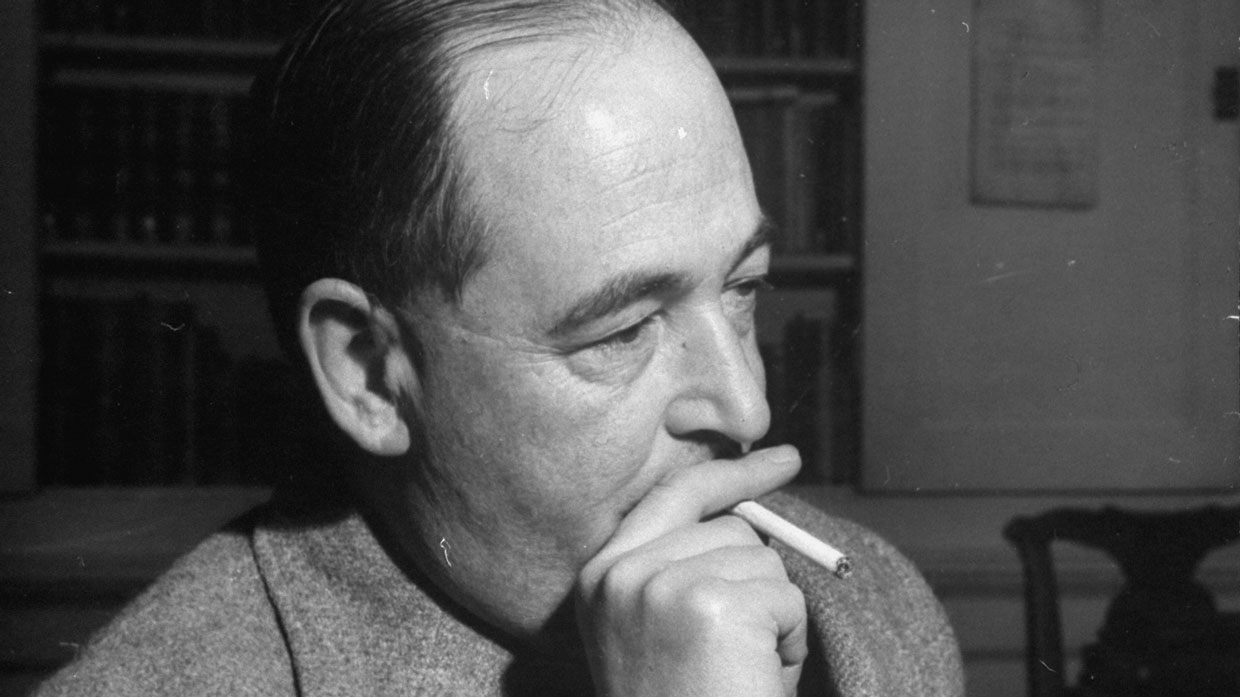
Christianity Today has an interesting article on C.S Lewis and his suspicion of so-called “progress.” In “his inaugural address to his professorship in medieval and Renaissance literature at Cambridge, Lewis claimed to be more a part of the old Western order than the present post-Christian one. He admitted, “You don’t want to be lectured . . . on dinosaurs by a dinosaur.”” The article focuses largely on Lewis’ 1958 Observer article “Willing Slaves of the Welfare State,” in which he said, “I believe a man is happier, and happy in a richer way, if he has ‘the freeborn mind.’ But I doubt whether he can have this without economic independence, which the new society is abolishing.” Lewis believed that the modern welfare state “entrusts power over many to a few, “none perfect; some greedy, cruel, and dishonest.” The more that people in government control our lives, the more we have to ask “why, this time power should not corrupt as it always has done before?””

Check it out.

College that Opposes Gay Marriage Loses Accreditation

2014-05-02 Trinity Western

The first caveat is that this story comes from Canada, and of course legal systems vary greatly from country to country. I don’t know how their religious liberty protections compare to those in the United States. But this story definitely has some of my fellow Mormons worried, because they can’t help but note the parallels between Trinity Western University (a small, private, religious college in Ontario) and Brigham Young University (a large, private, religious college in Utah[ref]And Hawaii and Idaho.[/ref]

The story comes from the Ottawa Citizen, which reports that:

The Law Society of Upper Canada has voted against accrediting a private Christian university in B.C. that forbids intimacy outside heterosexual marriage… the vote means graduates of Trinity Western University’s future law school will not be eligible for admission to the Ontario bar.

The policy that triggered the backlash required that students

abstain from gossip, obscene language, prejudice, harassment, lying, cheating, stealing, pornography, drunkenness and sexual intimacy “that violates the sacredness of marriage between a man and a woman.”

That’s a pretty basic statement of conventional Christian (and Jewish and Islamic) morality. I guess that renders traditional Christians, Jews, and Muslims unfit to practice law in Canada. As I’ve written before, stories like this make me worried for the future of my kids.

The Scientific-Mystical Objectivity of Pavel Florensky

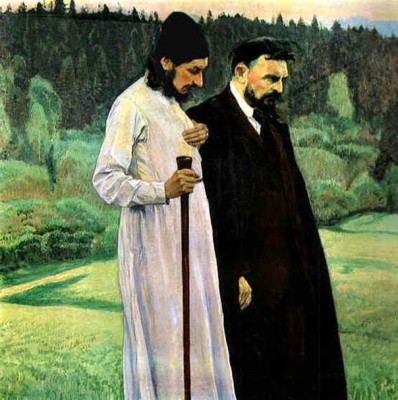
Pavel Florensky and Sergei Bulgakov.

Nathaniel’s recent post on Newton and Parsons raises some very good points about science and the very things that it supposedly opposes, such as magic and the occult. As far as I understand things (feel free to correct me if I’m wrong), a fundamental belief for both scientists and esotericists is that the world follows certain patterns, and is governed by forces and laws that can be discovered, harnessed, and sometimes even manipulated, be it for good or for bad. It really shouldn’t be terribly surprising that an interest in one can include an interest in the other, yet the current, popular scientific narrative wouldn’t touch the esoteric with a ten-foot pole.

Pavel Florensky (1882-1937) is another of those immensely influential scientists that hardly anyone knows. He was also a mystic, Russian Orthodox priest, theologian, Symbolist, art critic, and martyr. Florensky’s book, The Pillar and Ground of the Truth, written as a sort of a vast dialogue with Christ on the topics of “Divine Truth, Beauty, and Goodness” as “revealed and manifested in Creation,” is filled throughout with dozens of mathematical formulas! If that weren’t odd enough, the math itself is explained in theological terms.[ref]“[Consubstantiality] expressed not only a Christological dogma but also a spiritual evaluation of the rational laws of thought.” Rationality- the teachings of Aristotle- lost.[/ref] This refusal to see the natural sciences as divorced from divine, spiritual matters allowed Florensky to make important contributions to both. He was led to radical developments in set theory by his interest in the mystical doctrine of Name-Worshipping, and during the early years of the Soviet Union he wrote scientific textbooks, helped electrify the country, and invented a non-coagulating machine oil while still serving as a priest.

georgia6   www,nikitafirct.com_.ua_Florensky grew up in the Caucasus. He claimed that his childhood there lent him “an objective, noncentripetal perception of the world, a kind of inverse perspective” which allowed for a “penetration into the depth of things.” The Caucasus is a wild and mysterious region with snow-capped mountains, deep ravines, and roaring rivers. It exerted a tremendous influence on Russian writers, and although I had read extensively on it, nothing prepared me for my first glimpse of it. Pictures can never convey just how remarkable it is. I then understood instinctively Tolstoy’s laconic cry, “the mountains, the mountains,” and I confess to being a little awestruck even today.[ref]Some of my favorite books on this topic are Leo Tolstoy’s Hadji Murat, Mikhail Lermontov’s A Hero of Our Times, and Lesley Blanch’s The Sabres of Paradise: Conquest and Vengeance in the Caucasus. These give an idea of the pull that the Caucasus can have on the imagination.[/ref] I share this because there really is a feeling there of a “native, solitary, mysterious and infinite Eternity, from which everything flows and to which everything returns,” as Florensky described it. Paradoxically, it was this other-wordly feeling that Florensky claimed enabled one to see the world as it really is. “The child has absolutely precise metaphysical formulas for everything other-worldly, and the sharper his sense of Edenic life, the more defined is his knowledge of these formulas.” It is hard to imagine someone like Wallace Stegner concurring with Florensky’s definition of objectivity, yet as Nathaniel noted, the scientific narrative has increasingly tended to absorb and adapt religious ones, resulting in something not far removed from Florensky’s objectivity.[ref]See the multiple examples in Carl Youngblood’s recent MTA paper.[/ref]

Florensky’s religious convictions eventually led to his imprisonment in a labor camp, where he was murdered in 1937.


Character Gaps & Social Mobility

James Heckman
James Heckman

The Character and Opportunity Project at the Brookings Institution has a wonderful series on character traits and their relation to social mobility. So far there are five in the series. Whether more are to come will have to be seen. I think this is an important project, which features the work of Nobel economist James Heckman. As researcher Richard Reeves says in one of the posts, “If character and opportunity are inescapably intertwined, we need to open a new front in the war for opportunity, one that treats the inaptly labeled “soft” skills as vital ingredients in the creation of a more equal, more mobile, and more prosperous society.”