Amy Chua is the infamous author of Battle Hymn of the Tiger Mother, which is one of those books I suspect everyone hates but no one has actually read. I’m a little guilty of that, in that I haven’t read the book but–based on articles by Chua and her daughter–I’m deeply suspicious of the basic premise. Which is that Asian-style parenting (i.e. remote and harsh) makes for better kids. Some of Chua’s stories about her domineering and cruel parenting techniques were downright alarming.
Now Chua is back with a new book, cowritten with her husband, about cultural superiority. As the New York Post covers it, the new book (The Triple Package) outlines 8 enviable cultures who get it right and contrasts them with basically everyone else. (If you’re curious, and I was, the list includes: Jewish, Indian, Chinese, Iranian, Lebanese-Americans, Nigerians, Cuban exiles, and Mormons.) As with Battle Hymn, I haven’t read this one yet. But the vociferous and angry reaction is making me curious.
A friend happened to send me an old essay (from 2004) about What You Can’t Say the other day. It’s all about techniques for finding our own unquestioned assumptions and taboos (because, like fashion, culture is invisible when you’re in the thick of it). Well, no one doubts that Chua has put her finger right on a raw American nerve and, like What You Can’t Say argues, I can’t help but believe part of the reason the nerve is so raw is that her argument isn’t as ridiculous as everyone wants to believe.
Consider Maureen Callahan’s takedown in the New York Post. She claims that Chua leaves Muslims alone because they are “too controversial to warrant a mention.” Whenever you see a combination of high vitriol and low common sense, you should be suspicious. Chua doesn’t address Muslims because “Muslim” is not a cultural group, just as “Christian” is not a cultural group. The criticism makes no sense, especially when you observe that Iranians (one of the 8 elite cultures) are predominantly Muslim.
In the United States we a have a deep and abiding fear of anything that looks like racism, but we’re not always really clear about what exactly “racism” entails, or why it’s wrong. Our paranoid avoidance of the topic doesn’t actually promote tolerance. Just silence. Ever since my sophomore English teacher had the class read and analyze an article defending The Bell Curve, I’ve believed that the best way to handle sensitive topics like this is openly and honestly. But everyone I see rushing to condemn Chua seems to be interested in shouting her down as opposed to countering her ideas, which is why you get arguments as bad as Callahan’s. (Did she even read the book? I suspect not.)
The problem with Battle Hymn, for me, is not that it in asserting Asian superiority it violates a taboo, but rather that I’m skeptical of the evidence. I’ve read a little bit about Asian success in the United States, and one of the observations is that while Asians as a group tend to stand out academically they are curiously absent from the top (like CEOs). Some have attributed this to a culture that emphasizes conformity and obedience over leadership qualities. Maybe Chua’s parenting style is great for raising engineers who can spend their time working for WASP CEOs? Similarly, I’ve read many critiques of Triple Package that question the validity of using immigrants because of selection problems, and that’s a great response, but are we so afraid of the mere idea that some cultures may be better at certain things than others that we’re not actually willing to even have the conversation?
Ultimately it doesn’t make sense to ask if culture A is better than culture B in general because “in general” is too broad a category. But if you identify specific variables (say, college graduation or median income) and are careful with the statistical analysis there’s no reason, in principle, that you wouldn’t be able to identify cultures that stood out and even try to learn what allowed for their success. I’ve got no idea if Chua is just pushing buttons for fun and profit or if she has a legitimate case to be made (no reason it couldn’t be both), but I do think that the rapidity with which her book has been trashed because it violates our current social taboos is both sad and silly.
A long time ago when I was young and stupid, my new friends at college decided that having a Mormon friend was fun and decided to name me “the Stormin’ Mormon.” This is about the world’s most unoriginal name for a Mormon, but I tried it out on various message boards because, like I said, I was young and stupid.
I quickly learned that the Internet does not like Mormons. [ref]This was the 90’s. Only later did I come to realize that the Internet generally doesn’t like anyone.[/ref] No matter where I went or what I wanted to talk about, I invariably attracted hordes of otherwise normal netizens[ref]That’s ‘Net + denizens. The 90’s were great.[/ref] who felt an inexplicable need to try and convince me that their dad had secret blueprints that revealed the upside down, subterranean pentagram beneath the Washington D.C. temple.[ref]The rule “pics or it didn’t happen” hadn’t been invented yet which is sad because I’m not sure what an upside down, subterranean pentagram looks like.[/ref]
I did the only sane, reasonable, mature thing: I immediately started using the nickname “theStorminMormon” absolutely everywhere I could. Steam handle? theStorminMormon Xbox Live handle? theStorminMormon. Back when I posted way, way too often on Slashdot? The very same. Skype username? Yeah, you guessed it. [ref]Which can be awkward when I use the account for business. Oops.[/ref] It was just my little way of saying, “Don’t like Mormons? Well bring it on, Internet. Bring it.”
I’ve used it in so many different locations, that I’ve already got several variants worked out for places that don’t let me use all 16 characters. For 15 characters, I go with “theStormnMormon,” and for 12 just “storminMormon”.[ref]Fringe benefit: watching people stumble over the pronunciation when they feel compelled to sound it out over Xbox Live game chat.[/ref]
I’ve used it for so long that I often forget about it. A friend asked for my Steam account today and I had to go and check which variant I was using, which is what brought it to mind. Whenever I play Call of Duty online (which isn’t that often these days), I still never know if the random stranger who says “Hey, are you really Mormon?” is going to say “Cool, me too!” or ask me how many wives I have. It’s about a 50/50 split, in my experience.
I’m not the only stormin Mormon, of course. When I first started blogging many years ago there was a random girl studying accounting (I think) who blogged under that name at theStorminMormon.com. She shared way too much information for a while[ref]I vaguely recall that she had a very, very deep emotional bond with Pink Floyd lyrics[/ref], then seemed to get offended when I messaged her and asked if she was still using the domain. (It had been months since her last update.) I think she was like “how did this guy find out about me?” and I’m like “if you want to write a private journal… don’t use a top-level domain with no privacy settings at all.” I haven’t run into many more, but it’s still a name that’s often already taken when I show up late for a party.
And then I wonder: who else uses the name? Why did they pick it, and what are they up to? They must be drawing just as much fire as I used to. I wonder if they have the same motivation that I did. If someone mocked what they considered holy and they said, “Hell with this, now I’ve got to use the name.” [ref]If they are a better Mormon than I, they said “heck with this.”[/ref]
I don’t know, but I’d like to think so.
My tolerance for Internet flamewars is a lot lower than it used to be, so every now and then I shorten the nickname to just “stormin.” It’s a pretty simple way to avoid being badgered by random strangers about my religion. But as long as I know that badgering is occuring, I sort of feel like I’m not doing my duty if I don’t make sure some of it comes my way. It’s probably silly, and I’ve got minimal interest in antagonizing the Internet these days, but I’m never going to stop being proud of who I am and where I come from. Insisting on the same, corny nickname might not be the most sophisticated way to express the sentiment, but I guess maybe I’m just not that sophisticated of a guy. So, for now anyways, I’m sort of stuck with it.
Greg Mankiw points out that the President’s recent remarks about economics research into the impact of increasing minimum wage were somewhat misleading. The President said “there’s no solid evidence that a higher minimum wage costs jobs.” That makes it sound as though the concern is a mere ideological fabrication. In reality, however, it’s a hotly contested question even among economists and Mankiw pointed out a poll (of economists) that showed equal support from those who think that minimum wages help vs. hurt.
My own take is that minimum wages hurt, overall. I think the reason that this isn’t more obvious is that the effects take place over a long period of time. McDonald’s isn’t going to go out and fire all of the workers tomorrow because of a minimum wage hike because they’d have to replace them with computers and that’s an enormous, unplanned expenditure. But if McDonald’s believes minimum wages hikes are here to stay (e.g. if they are pegged to inflation as the President supposes), then they absolutely will gradually phase workers out and replace them with automated systems over time.
This isn’t just a pet theory I invented, the idea came from economist Miles Kimball blogging about Isaac Sorkin’s work. (Sorkin was in my PhD cohort at Michigan.) In the paper, Sorkin argues that we haven’t seen dramatic impacts from minimum wage policies in the US because they’ve always been temporary. President Obama’s proposal isn’t. So there’s very solid theoretical evidence and much less clear empirical evidence to suspect that the policy is going to be harmful for precisely the people it’s supposed to benefit.
At a minimum, folks should understand that when conservatives oppose minimum wage policies on humanitarian grounds, they are being sincere and reasonable.
Brenda Cronin had an op ed in the Wall Street Journal on Saturday arguing that if you want to decrease the gap between what men and women make, then you need to make work more flexible. This puts me in a bit of a philosophical bind because:
I’m decidedly not committed to the idea that equal pay for gender is an intrinsically valuable goal. If men and women are paid on equal bases, but men gravitate towards more remunerative fields, why should I care? When inequality is the result of choice, it’s not necessarily a bad thing.
On the other hand, I am committed to the idea of more flexible work culture. For knowledge workers, the antiquated mores of industrialized work places just don’t make sense.
In any case, I found the research pretty illuminating. For men and women who graduate with an MBA there is initially no pay gap, but it starts to appear after 5 years and is pretty entrenched at 15. What drives the gap?
Three factors explain 84% of the gap. Training prior to MBA receipt, (e.g., finance courses, GPA) accounts for 24%. Career interruptions and job experience account for 30%, and differences in weekly hours are the remaining 30%. Importantly, about two-thirds of the total penalty from job interruptions is due to taking any time out.
So about a quarter of the gap isn’t going to go away because it’s based on gender-neutral criteria (what classes you take and how well you did). Another 60% of the gap is simply based on time worked. If you work more, you will get paid more. This isn’t rocket science. I think it’s pretty stupid, however, because it leads to a culture of conspicuous chair-time instead of actual results. I’d love for companies to modernize work expectations because it’s the smart thing to do (and also because–as a man–I like having time with my family, too). And if that results in more gender equality: so much the better.
The taglines for Difficult Run are picked by the DREditors and come from song lyrics. Here’s an inventory of all the past choices, in case you’re curious. (It’s in reverse chronological order, newest first.)
I had another dream, I had another life
October 18, 2019 – ?
This song hooked me immediately when I caught on my Release Radar playlist from Spotify. The lyrics sort of speak for themselves. Here’s the first verse.
Yeah, the face
The face of evil is on the news tonight
We see the darkness over light
But have we ever really lived in better times?
Hey, strange, they say we’re coming to the end of the line
But is there still a chance to change your mind?
Or have all the colors turned to black and white?
Ever thought from here on in your life begins and all you knew was wrong?
June 15, 2019 – October 18, 2019
Another one from Walker (since no one else seems to want to change it): “Arriving Somewhere But Not Here” by Porcupine Tree. Walker is a prog-rock fan, but he’d never listened to these guys until recently. Their style sounds like the lovechild of Tool and Pink Floyd. Quality stuff.
Lost in the dark, I feel like a shadow of myself
February 26, 2019 – June 15, 2019
Another pick from Walker: “Elevate” by The Winery Dogs. This group was an accidental discovery: one of those YouTube rabbit holes. But it features Mike Portnoy (formerly of Dream Theater) on drums, Billy Sheehan (formerly of Mr. Big and Steve Vai) on bass, and Richie Kotzen (formerly of Poison and Mr. Big) on guitar and vocals.
Hell has no room for your crime here
January 5, 2019 – February 26, 2019
This is Walker’s pick and comes from “No World for Tomorrow” by Coheed and Cambria. Walker was lame and never really listened to C&C until recently, but their progressive post-hardcore style mixed with sci-fi lyrics made him a fan.
Wounds from a friend, severe mercy
July 25, 2018 – January 5, 2019
Nathaniel finally stopped being lame and update the tagline. This one comes from Josh Garrels’ song “The Arrow” from his 2015 album, Home. It’s a great song from a great singer. Here are the lyrics in context, where their meaning is not exactly subtle:
How long did I fool myself
Believing I, I didn’t need nobody’s help
A fool trusts in his power and his wealth
Until he’s brought down low
Unto a shadow of himself
The arrow was sent to intervene
It pierced my bones and shook me from my dream
Lord You know exactly what I need
Wounds from a friend, severe mercy
Tearing at the walls in the corners of my mind.
February 7, 2018 – July 25, 2018
This one comes from Walker. He’s been on an anime kick over the last year and this tagline comes from the song “Re:Re:” by Asian Kung Fu Generation, which was the OP song for the series Erased. This particular line is fudged a little and based on a couple Englishcovers. Google translates it as “cried in the corner of my heart.” Other translations read, “I always tear myself up, crying in the corner of my heart.” Either way, the line is dope.
Beautifully struggle every day.
April 12, 2017 – February 7, 2018
This one comes from Walker. The song is “Sparkle” by Radwimps from the amazing anime film Your Name. The tagline comes from the English version,[ref]Another way I’ve seen the lyrics translated is “I struggle so beautifully.”[/ref] but the video above is the original Japanese. It was picked so that those who haven’t seen the film might be inspired to do so. It’s seriously one of the best films Walker has seen in a long time.
We couldn’t all be cowboys; some of us are clowns.
October 3, 2016 – April 12, 2017
One of the problems with picking the DR taglines is that the times when I hear a line and think, “That’d be a great tagline” and the times when it’s actually time to pick a new tagline don’t always line up. But if I don’t do it right away, I’ll forget. So, when I heard this line in the Counting Crows song “Goodnight Elisabeth” from their Recovering the Satellites album, I had to update it right away. It was just too perfect. So, sad as I was to bump Lecrae after less than a week, he had to go.
Why? Well, most of the taglines are pretty serious, and it was about time for one that wasn’t.
If I fall, I fell in the right direction
September 30, 2016 – October 3, 2016
The only one who can compete with Dustin Kensrue in providing me lyrics to live by is Lacrae. This line comes from the song “Free from It All” off of his Gravity album, and it’s another one of those lines that seems to fuse the best of existentialism–shout into the darkness, create the meaning the world lacks–with the best of Christianity–one day the veneer of chaos will be lifted and a universe of order and meaning will be revealed. Existentialism is for this world. Hope is for the next.
My heart is filled with songs of forever
August 17, 2016 – September 30, 2016
Look, folks, if someone doesn’t intervene, I will probably end up making just about all of the taglines for Difficult Run come from Thrice. Can you blame me? They are, basically, the best.
I can’t hear cause you ain’t talkin bout nuthin
July 26, 2016 – August 17, 2016
These words come from the song “Nuthin” off of Lecrae’s 2014 Anomaly album. It’s “a battle cry for substance in music” (according to Lecrae himself, in the second video.) I won’t say anything to explain it, because you can listen to Lecrae explain it from a show in Hong Kong:
When the song actually starts, however, the audio is pretty terrible. So if you want to hear the song itself (and you should! it’s great!) skip to the last video in this section. Before that, however, here’s one more of Lecrae talking about writing this song:
And now, here’s the track with high-quality audio:
Helping words aren’t always kind.
April 26, 2016 – July 26, 2016
I couldn’t find a better video for Thrice’s song “The Beltsville Crucible” than this one, which is a shame, because it’s a great song, write from the first lyrics: “true friends stab you in the front.” I have a friend who likes to say, “caring is overrated.” He’s right, of course. I don’t think this kind of music would appeal to him, but I’m pretty sure the sentiment would. Caring is nice. Helping is better. And helping doesn’t always feel like kindness on the surface. Sometimes, the truth has to cut before it sets you free. Thus: “you’re more and less than you first had believed / you’ve so much to give and there’s so much you need.”
And, of course, “helping words aren’t always kind.”
Love can mend your life. But love can break your heart.
April 1, 2016 – April 26, 2016
This tagline was chosen by Walker and comes from The Police’s famous song “Message in the Bottle.” The song deals with the feelings of loneliness and alienation, but this particular line has a C.S. Lewis-esque quality to it (see The Four Loves). Plus, Stewart Copeland is a beast on the drums.
You are the ghost of everything that I’m not and I want to be.
December 11, 2015 – April 1, 2016
The lyrics to this song are pretty conventional love lyrics (if you’re a screamo band), but this one particular line has always stood out for me.
We’ll be heroes or ghosts, but we won’t be turned around.
October 7, 2015 – December 11, 2015
This tagline comes from another Thrice track: “Burn the Fleet” off The Alchemy Index, Vol I: Fire.
Why this line? Because it’s awesome, that’s why. Only trouble I had was picking just one snippet from a song that is basically nonstop awesome from start to finish.
In this dark night we stand or fall We are kings now, or nothing at all Check your armor; Light up your torch Touch the flame to the sail before you head for shore.
And we will burn the fleet, We can never go home; It’s to victory or under ground. Burn the fleet, we’ll be heroes or ghosts But we won’t be turned around.
There are days–lots of days–when I’m not sure why I work so hard. I’m not one of those folks who has one, abiding, passionate focus. The thing I want more than anything, as far as “mortal achievements” goes, is to be a writer. But I’d rather be a good dad and husband than a good writer. So, as far as the image of the passionate genius goes, I fail. The work I’m trying to build is an entire life. And that’s not a work that is really available for public consumption.
When I’m done with it, when I’m done spending whatever time I’ve been allotted by God to create this work, I believe He will go over it with me. He’ll show me what I did right, and where I went wrong, and I’ll see the big picture. I’ll see the finished product. Until then? I’m just a blind man carving by a feel a statue that is too large for me to feel all at once. Songs like this give me a little boost to keep going, chisel in hand, when I’d really rather sit on the sofa and watch tv or go and take a nap.
Fun fact: I actually meant to go with the line “We are kings now, or nothing at all,” but for the entire time I had “We’ll be heroes or ghosts, but we won’t be turned around.” Oh well, I’ll use the line I meant to some time in the future.
Keep that hate on hiatus.
Aug 24, 2015 – Oct 7, 2015
Can’t believe this is the first time that Lecrae made our tagline but I just checked and it is. Definitely won’t be the last. “Put that hate on hiatus” is from the song “I Know” on the album Gravity. Lecrae is awesome for some of the same reasons that Thrice is awesome: unapologetically religious lyrics competing for space in secular spaces instead of cordoned off in some kind of designated Christian ghetto-genre. And that’s exactly what the lyrics in this song are about:
No they thinkin I’m blind But I just pay them no mind Yeah I know they be lyin They misquotin my lines They like “What you think you doin puttin hope in yo’ rhymes?” You would think I’m shootin folk or puttin coke in my rhymes I just give ’em bass for free and push the dopest of lines Boy you trippin, I know Cr-Cr-Crae you slippin, I know I done heard this all before; just sit back enjoy the show Yeah, I know they go’n hate us Type they blog up, debate us They be fishin for attention but don’t know how to bait us Keep that hate on hiatus
These guys–Lecrae and Thrice–are an inspiration to me. Discipleship is all-encompassing, and so there is no topic that a Christian can’t write about. There’s more to praise than praise music.
Clouds are making way for me.
May 11, 2015 – Aug 24, 2015
Nathaniel picked these lyrics from “Setting Sail, Coming Home,” which is the end theme for one of the greatest video games of all time: Bastion. The soundtrack is incredible. The surrounding lyrics are:
Lie on my back,
Clouds are making way for me
I’m coming home, sweet home
I see your star,
You left it burning for me;
Mother, I’m here.
Welcome to my broken song.
March 24, 2015 – May 11, 2015
Nathaniel picked this one because we haven’t had a Matisyahu lyric yet, and it was time.
And if I close my mind in fear, please pry it open
January 7, 2015 – March 24, 2015
This line, from “The Outlaw Torn” on Metallica’s Load album, also comes from Walker Wright. Nathaniel had to swallow a bit of his anti-Metallica sentiment.
Some will sell their dreams for small desires
Sep 27, 2014 – January 7, 2015
Walker picked this line from the song “Subdivisions” by Rush off their Signals album. I’m sure we’ll be seeing Rush lyrics crop up on DR again in the future.
Who I am is who I want to be.
Aug 24, 2014 – Sep 27, 2014
This one comes from the Reba McEntire song “I’m a Survivor,” and Ro (who picked it) found a live version of the song.
And higher than the heights of what we often think we know.
July 24, 2014 – Aug 24, 2014
Incubus, “Nice to Know You,” Morning View. This is another one comes from Walker, who suggested it a month or more ago but I’ve been out of things. Walker has good taste.
This is a story full of restless nights.
April 24, 2014 – July 24, 2014
It’s not hard to see why I love this song even just by looking at some of the lyrics.
This is a story full of restless nights Of do or do not ’cause there is no try Across a decade we flew high and we fell low And getting up when we’re dragged down is all we’ve known
We were born to be the ones To show the faithless what we’ve done And there’s a fire inside We were born to be the ones To show the faithless what we’ve done And there’s a fire inside It burns like the surface of the sun
Oh yeah, you can expect me to come back to this song again at some point down the road.
Got no patience to search for peace of mind.
March 23, 2014 – April 24, 2014
Got no patience to search for peace of mind.
This one comes from the song “No Excuses” by Alice In Chains, originally on their Jar of Flies album. It’s another pick from Walker. The song is supposedly about guitarist Jerry Cantrell’s relationship with heroin-addicted lead singer Layne Staley. Walker has written at The Slow Hunch about the power behind their music (which was introduced to him by his church youth/Scout leader).
A calculated risk to further bless your name.
February 22, 2014 – March 23, 2014
It’s a miracle that I managed to hold off on a Thrice song this long, and I’ll have to struggle to not make every single tagline from here on out another Thrice lyric. I’ll do my best. This one comes from the song “Identity Crisis” on the album of the same name. I picked an acoustic version to embed above, but if you want the original screamo (and why wouldn’t you?) here you go. The lyrics from the song are incredible, and here is the stanza from which I took this phrase:
This is my voice, all shadows stayed this is my heart, upon the altar laid
Please take all else away, hear my cry, I beg, I plead, I pray
I’ll walk into the flame, a calculated risk to further bless your name
So strike me deep and true, and in your strength I will live and die both unto you.
The song opens with “I put all my faith in you,” but ends with describing the sacrifice as “a calculated risk.” That, to me, is the absolute essence of faith. It is the trust of a confused child. It is fidelity to an ideal without knowing for sure if all will be well.It is something we attempt, but fail to do. It is like the father tearfully begging Jesus to save his son who said, “Lord, I believe; help thou mine unbelief.” (Mark 9:24)
I want something good to die for, to make it beautiful to live.
Jan 4 2014 – February 22, 2014
This comes from the song “Go With the Flow” by Queens of the Stone Age. Walker suggested it way back in fall 2013, but I was slow getting it updated. He picked an acoustic version of the song, and it’s great.
Packing my bags and giving the academy a rain check.
September 1, 2013 – Jan 4, 2014
This one comes from the song “It’s Time” by Imagine Dragons, and Mahonri picked it.
Everybody wants to be naked and famous.
August 2013 – September 1, 2013
This was the first tagline we went with when I launched the site redesign in August 2013, and Ro picked it. The lyrics to this song are amazing. So good!
Another year, another annual report on Difficult Run from WordPress. I made this year’s report public, so if you’re curious you can check it out yourself. Here are some highlights from the report and other thoughts about the blog at the dawn of a new year.
Traffic
2013 was the first full year of Difficult Run’s existence, and we had about 57,000 visits over the course of the year. Traffic has been going up month-over-month pretty much since the blog started, with a couple of exceptions.
Web traffic to Difficult Run, captured about 10:00am on Jan 4, 2014.
June 2013 was a big month because of the post I did on health insurance vs. food insurance. It got picked up on Reddit and generated over 5,000 views in one day. We had another uptick in August when I launched a site design and brought the Difficult Run Editors on board. And then December 2013 was a low month because there were very, very few posts for the second half of the month.
The reason I put this info out there is mostly just that I’m always interested to get insight into what traffic other blogs are generated. So I thought it’d be nice to be transparent about traffic here. I don’t have any ads or generate revenue from this site in any way, so in a sense it doesn’t matter that much, but obviously if I and the rest of the DREditors publish our thoughts on a blog, we’d like to think that folks are coming along to read them. I’d always love to see more traffic, of course, but I’m pretty happy with the growth so far. My basis philosophy is to concentrate on making good content and then as a secondary consideration work to make it easy to find and then just wait. I’ll let you know in 2015 how that has worked out for us.
Top Posts
The health insurance vs. food insurance post was so big that it made June 2013 the biggest month, so that dominated in terms of traffic. Here the entire top-5 list for 2013:
Some observations on that list. First, 4 of the 5 are original content. A lot of the posts at DR are links to other articles that we find interesting, sometimes with a little bit of commentary, but this list is comprised almost entirely of longer pieces rather than links to other stuff. Except the “True Math Facts” piece. For some weird reason, I’ve noticed that almost every single day there are people who search for terms like “math facts blow mind” and find that link. It’s always interesting, and weird, to see where the traffic goes. It reminds me of trying to explain stock market movements: no one can predict them ahead of time, but everyone likes to come up with a story after the fact.
Second: Orson Scott Card shows up twice and, with Elizabeth Smart, three of the top five stories are about famous Mormons.
Lastly: there’s quite a lot of variety in that list. I know that the conventional wisdom about starting a new blog is to pick some niche and become its master. I recognize the wisdom of that advice, and if my goal were “make a successful blog” I would probably follow it. But the trouble is I like writing about a diverse array of topics. So do the rest of the DREditors. We might be able to grab more traffic faster by honing in on one topic and dominating it, but I’m content to take a more patient approach and just write as well as we can about the things that seem important and interesting. And, based on the variety of topics that have garnered traffic, I’d like to think it’s going to work out over time.
Site Changes
My friend Chris Walsh did a redesign of the site for August, and he gave me everything I asked for and it was fantastic. Trouble is, over time I decided that what I’d asked for wasn’t what I wanted. In particular, the full-width layout for reading individual posts felt wrong (even though it’s what I’d asked for). Rather than ask for another redesign, I realized that I was probably going to end up wanting to tweak the site no matter what it looked like, so I picked a theme I liked and started making my own modifications.
The current look, which I launched yesterday, is based on the Minimum Pro theme from StudioPress. I’m still tweaking all kinds of details and it’s definitely not as finished as I wanted it to be, but with the holidays, a new house, and now sick kids it was the best I could do. I wanted a new site for the new year, and I’ve got it.
I’ll continue to tinker with the site over the coming weeks but, for now at least, I think the basic look works really well. I particularly like how fast the site loads now that I’ve gotten rid of most of the images.
Coming in 2014
Based on what I’ve learned from 2013, I’m going to try fewer original pieces per week (probably just 1 or 2 at the most) but with more emphasis on the polish and research for those pieces. I’ve seen that it’s not impossible to get a post to go fairly viral on Reddit if I just have the confidence to invest a lot of work in a single post. More and more I think that the Internet does respond, over time, to quality. (That’s not the only thing it responds to, of course!) I’ll encourage the other DREditors to do the same, but I’m going to keep posting short snippets as well (just links to other articles with brief commentary) because A) it’s a compulsion for me and B) it’s the sort of thing I like to see in the blogs I read. I may move some of that off to Twitter, however, instead of posting all of them to Difficult Run. (Trying to squeeze my commentary into 140 characters is also good practice for me.)
I’m also going to expand into some guest posts. I have one very important post in the works right now from a guest blogger that I’m looking forward to posting, and a couple more in the works. Difficult Run is my personal blog, but I can think of nothing better to do with my tiny patch of Internet that invite my smartest friends to come and share their thoughts.
So, those are my musings on the year that was and the year that will be. What about y’all? I’d love to get some feedback on what folks would like to see more of in 2014. (Or less of. That’s not as exciting, but it’s just as useful.)
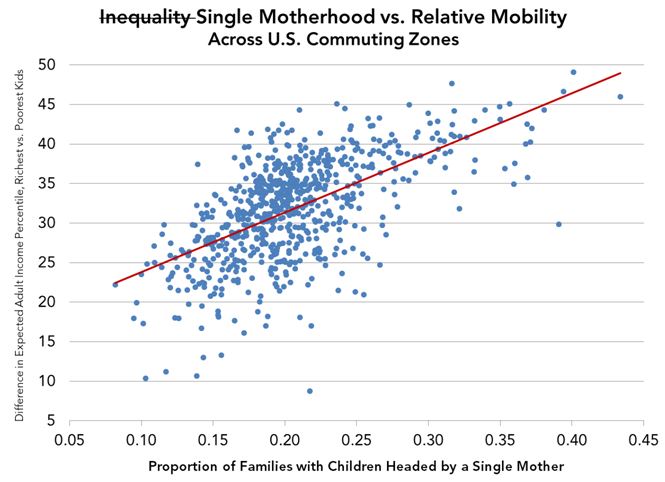
Scott Winship and Donald Schneider have a recent piece at the Manhattan Institute’s e21 on the widely-cited Great Gatsby Curve. Their detailed analysis demonstrates that income inequality (of various sorts) has little statistical relation to economic mobility. What does, however, is single motherhood.
Each dot represents a “commuting zone,” i.e. “metropolitan areas or county groupings in rural parts of the country—think of them as local job markets.” Inequality increasing from left to right; immobility (not mobility) rising from bottom to top.
As Nathaniel wrote elsewhere, “This strongly correlates with the idea (discussed here previously) that…the ultra-wealthy are not (intrinsically) the problem. The problem is a fracturing of society that is evident not at the extremes, but closer to the middle, where the functional and dysfunctional sides of America are slowly pulling apart.”
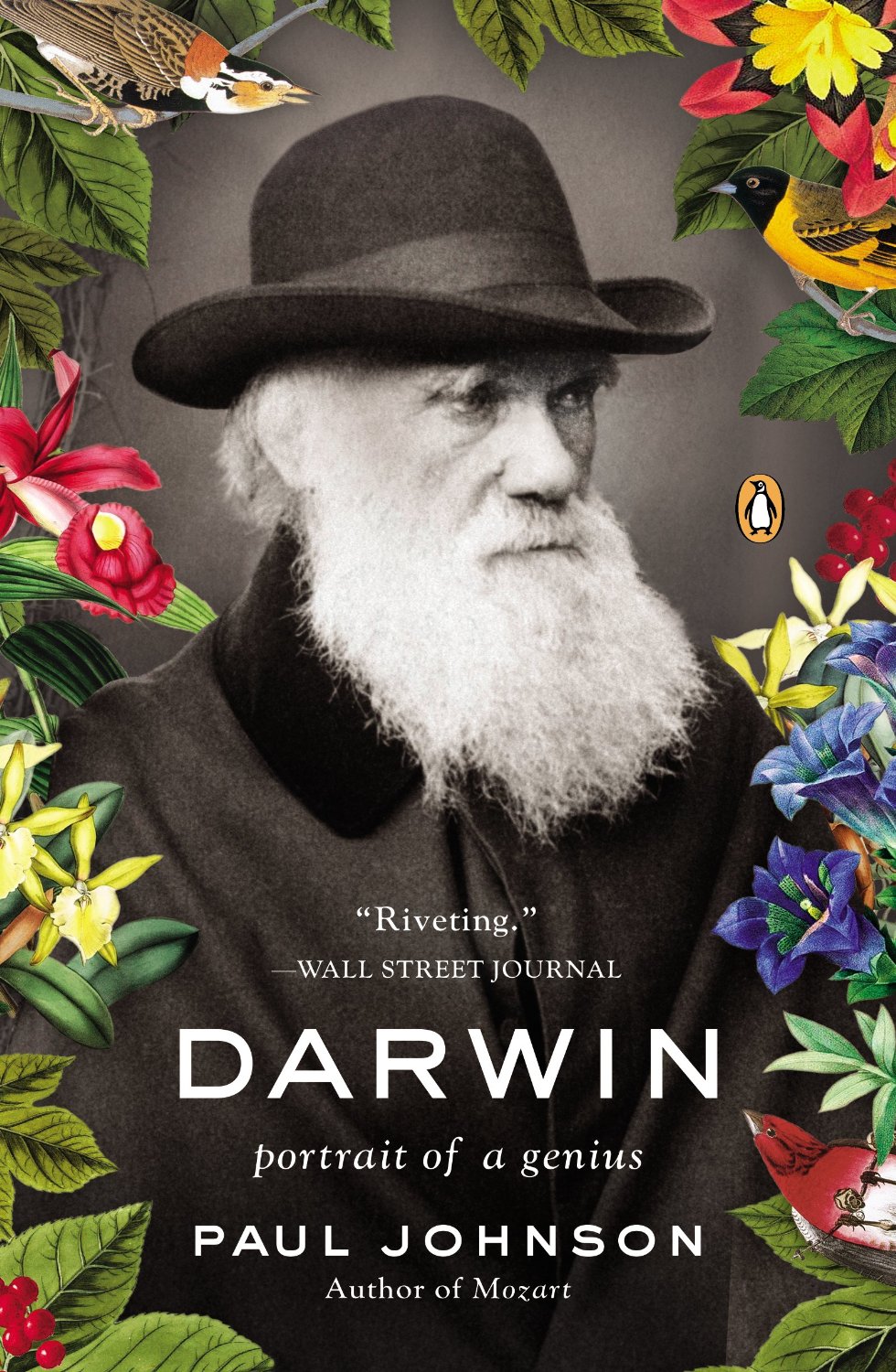
Paul Johnson, Darwin: Portrait of a Genius (New York: Viking, 2012).
Popular historian Paul Johnson’s slim biography/analysis of Charles Darwin and his theory is a surprisingly satisfying read in light of its relatively short length (clocking in under 200 pages). While likely of passing interest to scholars and those already well-acquainted with Darwin’s life, Johnson’s brief, but informative overview will be of value to the general reader. Johnson does a fine job of accurately describing what Darwin actually wrote and distinguishing it from those things that are often placed in his mouth. While he engages in a bit of pop psychology to support some of his sweeping statements, Johnson is nonetheless fresh and thoughtful in his writing. Most important, Johnson is able to paint a vivid picture of the broader context from which Darwin’s ideas emerged. This is consistent with one of Johnson’s major themes: ideas matter and often take on a life of their own. Thus, Darwin’s Malthusian interpretation of the evidence viewed evolutionary life as a vicious, violent struggle for existence. This outlook in turn aided other ideologies and movements that sought to use Darwinism to bolster their own worldviews, including eugenics, Nazism, and Communism. It is this latter portion on which some negative reviewers have focused their attention, despite the fact that it consists of only one chapter (Ch. 7 “Evils of Social Darwinism”). Mark Stern at Slatewrites that Johnson’s “discussion of the world’s reaction to The Origin of Species” is “admittedly engaging.” Furthermore, he sees “Johnson’s overview of Darwin’s theory of evolution” as “clear, rich, and accurate.” Yet, the majority of his review is dedicated to explaining that there is “intellectual harm, historical harm, and moral harm” in linking Darwin to any of the 20th-century atrocities. The review’s subtitle describes the book as “the latest effort to smear evolution by natural selection.” Of course, Stern explains that such a book obviously comes from “a conservative, family-values-promoting British intellectual” who “has spoken out against divorce, liberation theology, unions, atheism, the Enlightenment, and even the Beatles.” Another (albeit shorter) review in the New Scientist bluntly states that Johnson’s book is nothing more than “a vendetta, an agenda-driven hatchet-job.” There is some truth to these criticisms. Johnson does emphasize that Darwin was a “poor anthropologist” who “did not bring to his observation of humans the same care, objectivity, acute notation, and calmness he always showed when studying birds and sea creatures, insects, plants, and animals” (pg. 29). For example, Johnson points to Darwin’s opinions of the Fuegan “savages” during his voyage on the Beagle as evidence of his lacking in anthropology. While an important factor, I’m reminded of another scholar’s take on the matter:
When incautious scholars or blinkered fundamentalists accuse Darwin or [German Darwinist Ernst] Haeckel of racism, they simply reveal to an astonished world that these thinkers lived in the nineteenth century.[ref]Robert J. Richards, “Myth 19: That Darwin and Haeckel Were Complicit in Nazi Biology,” Galileo Goes to Jail: And Other Myths About Science and Religion, ed. Ronald L. Numbers (Cambridge: Harvard University Press, 2009), 174.[/ref]
I think most Utahns, for or against, anticipated this would happen at some point. While Judge Shelby’s decision does not at first blush smell of blatant activism, decisions made by “the people” being rendered moot by a imperious federal government is a sore point for many across the nation, especially in a conservative stronghold like Utah.
Expect an appeal, especially since the LDS Church, which staunchly opposes same-sex marriage and shows no signs of relenting on the matter, counts among its members many high-ranking civil servants throughout the state. I would also expect the appeal to fail, or if it succeeds, to be reversed eventually. If a state like Utah can be forced to abide policy with which a majority of its citizens do not agree, it causes me to wonder how far a leap it is to the next steps, such as forcing religions to perform same-sex marriage ceremonies (despite same-sex marriage proponents’ protestations that that will never happen). I believe a truly unbiased observer would see it as likewise inevitable.