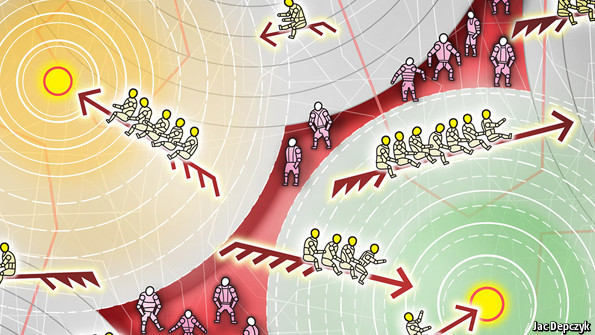
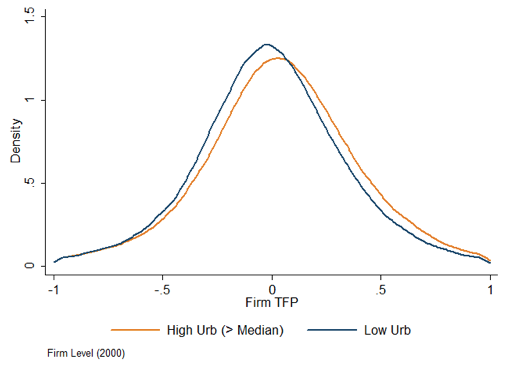
A new study finds evidence that denser populations are more productive:
Is it selection, or the sorting of talents (Behrens et al. 2014) that leads only the most productive firms to locate in denser areas? Or do agglomeration economies explain why firms located in less dense environments are less productive? Empirical evidence suggests that the main driver of differences in productivity is not selection (i.e. tougher competition inducing less productive firms to exit the market) but agglomeration economies (Combes et al. 2012). The usual suspects are the higher availability of services, better infrastructure, sharing of public goods, a denser labour market allowing for better matching, and technology spillovers (Duranton and Puga 2004). Using firm-level data for France, we confirm in a recent study that misallocation has a spatial dimension: resource allocation and the associated effect on productivity are related not only to firms’ characteristics, but also to the environment in which they operate (Fontagné and Santoni 2016). Denser commuting zones seem to offer a better match between employers and employees.
It’s a bit technical, but interesting nonetheless. Check it out.
In their book Nudge, authors Richard Thaler and Cass Sunstein advocate what they call “libertarian paternalism”: a kind of governmental choice architecture that seeks to influence the choices choosers make. This restructuring tends to rely on small tweaks to the system, recognizing that people are often biased and irrational in their decision-making.
What if the choice architects are subject to psychological bias? This could come from biases of regulators, politicians, or even economists. It can also come from the psychological biases of the voters who hire and fire political agents.
Teoh and I argue that important features of financial and accounting rules and regulation are shaped by psychological bias on the part of the architects, rather than as a useful remedy for the biases of the decision makers being acted upon. Typically the resulting regulation is far from libertarian, as well.
We call the approach to understanding regulation as coming from smart and benevolent architects `Good Rules for Bad Users.’ (Libertarian paternalism is slightly different: `Good Suggestions for Bad Users.’) We feel the other side of the coin has been neglected, that the architects themselves may be biased, resulting simply in `Bad Rules.’ (This is not to say that all regulation is bad, but it does say that bad rules will sometimes be approved.) We call this perspective the psychological attraction approach to financial and accounting regulation.
Specifically, we argue that some forms of regulatory ideas are good at ensnaring the attention, emotions, and cognitive biases of regulators and the public. Such regulations do not necessarily help others, on the whole, and indeed may have highly perverse effects. But people are attracted to certain rules because they are superficially appealing. This point applies even to accounting rules, which have evolved over centuries through the interactions of different users. Rules concerning what firms have to expense, what they can capitalize, whether they are required to be conservative in reporting their performance—all, we argue, have been influenced by heuristic intuitions, not just economic efficiency.
The biases of regulators have been addressed before by other researchers. It’s a glaring oversight among “nudge” advocates that needs to be continually studied.
…reveal the United States to be treading water in the middle of the pool. In math, American teenagers performed slightly worse than they usually do on the PISA — below average for the developed world, which means they scored worse than nearly three dozen countries. They did about the same as always in science and reading, which is to say average for the developed world.
But that scoreboard is the least interesting part of the findings. More intriguing is what the PISA has revealed about which conditions seem to make smart countries smart. In that realm, the news was not all bad for American teenagers.
Vertical: Math ranking; Horizontal: Spending, ages 6-15
The good news is that–although “the United States had not raised its average scores”–its
measures of equity…had improved. One in every three disadvantaged American teenagers beat the odds in science, achieving results in the top quarter of students from similar backgrounds worldwide.
This is a major accomplishment, despite America’s lackluster performance over all. In 2006, socioeconomic status had explained 17 percent of the variance in Americans’ science scores; in 2015, it explained only 11 percent, which is slightly better than average for the developed world. No other country showed as much progress on this metric. (By contrast, socioeconomic background explained 20 percent of score differences in France — and only 8 percent in Estonia.)
But what countries had the best outcomes overall?
Generally speaking, the smartest countries tend to be those that have acted to make teaching more prestigious and selective; directed more resources to their neediest children; enrolled most children in high-quality preschools; helped schools establish cultures of constant improvement; and applied rigorous, consistent standards across all classrooms.[ref]For example, see the Smithsonian on Finland’s school system.[/ref]
Of all those lessons learned, the United States has employed only one at scale: A majority of states recently adopted more consistent and challenging learning goals, known as the Common Core State Standards, for reading and math. These standards were in place for only a year in many states, so Mr. Schleicher did not expect them to boost America’s PISA scores just yet. (In addition, America’s PISA sample included students living in states that have declined to adopt the new standards altogether.)…Standards like the Common Core exist in almost every high-performing education nation, from Poland to South Korea.
With the Sunday afternoon session of the October 1974 General Conference, we’ve come to the end of our eighth general conference. It’s hard to believe that we started this Odyssey way back in December 2015. There were several talks that I really liked from this session, but the one I’m writing about is President Spencer W. Kimball’s Ocean Currents and Family Influences.
The central metaphor is right in the title: “Currents have much more power to control its course than the surface winds.” President Kimball urges us to develop powerful currents in our homes:
I have sometimes seen children of good families rebel, resist, stray, sin, and even actually fight God. In this they bring sorrow to their parents, who have done their best to set in movement a current and to teach and live as examples. But I have repeatedly seen many of these same children, after years of wandering, mellow, realize what they have been missing, repent, and make great contribution to the spiritual life of their community. The reason I believe this can take place is that, despite all the adverse winds to which these people have been subjected, they have been influenced still more, and much more than they realized, by the current of life in the homes in which they were reared. When, in later years, they feel a longing to recreate in their own families the same atmosphere they enjoyed as children, they are likely to turn to the faith that gave meaning to their parents’ lives.
But here’s the line that stood out to me the most:
My brothers and sisters, the home is our peculiarity—the home, the family, is our base…family life, home life, children and parents loving each other and dependent upon each other. That’s the way the Lord has planned for us to live.
It connected two different themes: the family and being a peculiar people. In addition to President Kimball’s talk, President Hinckley’s talk (A City Set Upon a Hill) and Elder Victor L. Brown’s talk (The Blessings of Peace) also talked about being “a peculiar people.” In what sense are we becoming a peculiar people? Well, as the world goes in one direction, the Church will refuse to go along. And, apparently, a central point of divergence will be the family.
Today I’ve been thinking about a First Things piece by Orthodox philosopher David B. Hart written several years ago on the festivities of New Year’s. He notes
that my family never observed the day when I was growing up, and always made a point of going to bed well before midnight on New Year’s Eve.
In part, I think, this was simply because everyone in my family tends to be of a somewhat reclusive temperament, and so is generally averse to loud noises, close crowds, or forced jollity. In larger part, though, I think we always saw New Year’s Day—when treated as a kind of feast day of its own—as a profane intrusion on the twelve days of Christmas, which was by far our favorite time of year. From Christmas Eve to Twelfth Night, we were fairly good at keeping the festal flames alight and really had no need of any other excuse for our good spirits.
There is, of course, a feast of the Church traditionally celebrated on January 1st: to wit, the Feast of the Circumcision, considered important not merely as a commemoration of an episode from the biography of Christ, but as a remembrance of the first blood shed by Christ for the sake of the world’s redemption. But that obviously has nothing whatever to do with the arrival of the new year. In fact, throughout the Middle Ages, there was little firm agreement regarding what day really marked the inauguration of a new year, even though the Roman mensal calendar was in continual use.
The traditional Christian celebration of Christmas is exactly the opposite [of the modern version]. The season of Advent begins on the fourth Sunday before Christmas, and for nearly a month Christians await the coming of Christ in a spirit of expectation, singing hymns of longing. Then, on December 25, Christmas Day itself ushers in 12 days of celebration, ending only on January 6 with the feast of the Epiphany.
Exhortations to follow this calendar rather than the secular one have become routine at this time of year. But often the focus falls on giving Advent its due, with the 12 days of Christmas relegated to the words of a cryptic traditional carol. Most people are simply too tired after Christmas Day to do much celebrating.
…The three traditional feasts (dating back to the late fifth century) that follow Christmas reflect different ways in which the mystery of the Incarnation works itself out in the body of Christ. December 26 is the feast of St. Stephen—a traditional day for giving leftovers to the poor (as described in the carol “Good King Wenceslas”). As one of the first deacons, Stephen was the forerunner of all those who show forth the love of Christ by their generosity to the needy. But more than this, he was the first martyr of the New Covenant, witnessing to Christ by the ultimate gift of his own life. St. John the Evangelist, commemorated on December 27, is traditionally the only one of the twelve disciples who did not die a martyr. Rather, John witnessed to the Incarnation through his words, turning Greek philosophy on its head with his affirmation, “The Word was made flesh, and dwelt among us” (John 1:14, KJV).
On December 28, we celebrate the feast of the Holy Innocents, the children murdered by Herod. These were not martyrs like Stephen, who died heroically in a vision of the glorified Christ. They were not inspired like John to speak the Word of life and understand the mysteries of God. They died unjustly before they had a chance to know or to will—but they died for Christ nonetheless. In them we see the long agony of those who suffer and die through human injustice, never knowing that they have been redeemed. If Christ did not come for them too, then surely Christ came in vain. In celebrating the Holy Innocents, we remember the victims of abortion, of war, of abuse.
…In the Middle Ages, these three feasts were each dedicated to a different part of the clergy. Stephen, fittingly, was the patron of deacons. The feast of John the Evangelist was dedicated to the priests, and the feast of the Holy Innocents was dedicated to young men training for the clergy and serving the altar. The subdeacons (one of the “minor orders” that developed in the early church) objected that they had no feast of their own. So it became their custom to celebrate the “Feast of Fools” around January 1, often in conjunction with the feast of Christ’s circumcision on that day (which was also one of the earliest feasts of the Virgin Mary, and is today celebrated as such by Roman Catholics).
Hart explains that as an adult his own family somewhat celebrates New Year’s Eve/Day. “But, on the whole,” he writes, “it is still a minor observance for us, and nothing to compare to the celebrations we like to hold on Twelfth Night, the eve of Epiphany, when the last of the Christmas presents are opened, games are played, and the decorations come down from the tree. (I know many Americans think of Christmas as a single day and like to clear away the trappings of the season well before the fifth of January, but that is sheer barbarism, if you ask me, morally only a few steps removed from human sacrifice, cannibalism, or golf.) The long and the short of it, then, is that I have really nothing much to say about New Year’s Day.” He concludes, “Whatever the case, I hope any of you who plan to spend [New Year’s Eve] chasing after strange gods will find something of interest in it. At my house, however, we will still be celebrating Christmas.”
All in all, I find this appealing. Mormonism doesn’t have much of a Christmas tradition outside the American version, but this doesn’t mean we can’t draw on the traditions of our Christian neighbors. Perhaps celebrating “the first blood shed by Christ for the sake of the world’s redemption” on January 1st isn’t such a bad idea.
Emma Green at the Atlantic posted a conversation with Michael Wear, a conservative evangelical Christian who worked on Obama’s staff as a faith-outreach director. In it, Wear describes the current problems with political tribalism on hot-button issues, with focus on (non-)religiously based views. You can read the whole thing here: Democrats Have a Religion Problem, and I’ve pulled out some gems below.
On religious illiteracy:
[Wear] once drafted a faith-outreach fact sheet describing Obama’s views on poverty, titling it “Economic Fairness and the Least of These,” a reference to a famous teaching from Jesus in the Bible. Another staffer repeatedly deleted “the least of these,” commenting, “Is this a typo? It doesn’t make any sense to me. Who/what are ‘these’?” (Green)
On divisiveness:
No matter Clinton’s slogan of “Stronger Together,” we have a politics right now that is based on making enemies, and making people afraid… It’s much easier to make people scared of evangelicals, and to make evangelicals the enemy, than trying to make an appeal to them. (Wear)
On emotion:
I’ve been speaking across the country for the year leading up to the election, and I would be doing these events, and without fail, the last questioner or second-to-last questioner would cry. I’ve been doing political events for a long time, and I’ve never seen that kind of raw emotion. And out of that, I came to the conclusion that politics was causing a deep spiritual harm in our country. We’ve allowed politics to take up emotional space in our lives that it’s not meant to take up. (Wear, emphasis added.)
Perhaps politics is taking up a space that religion used to take up. This seems to be true on both sides of the political aisle.
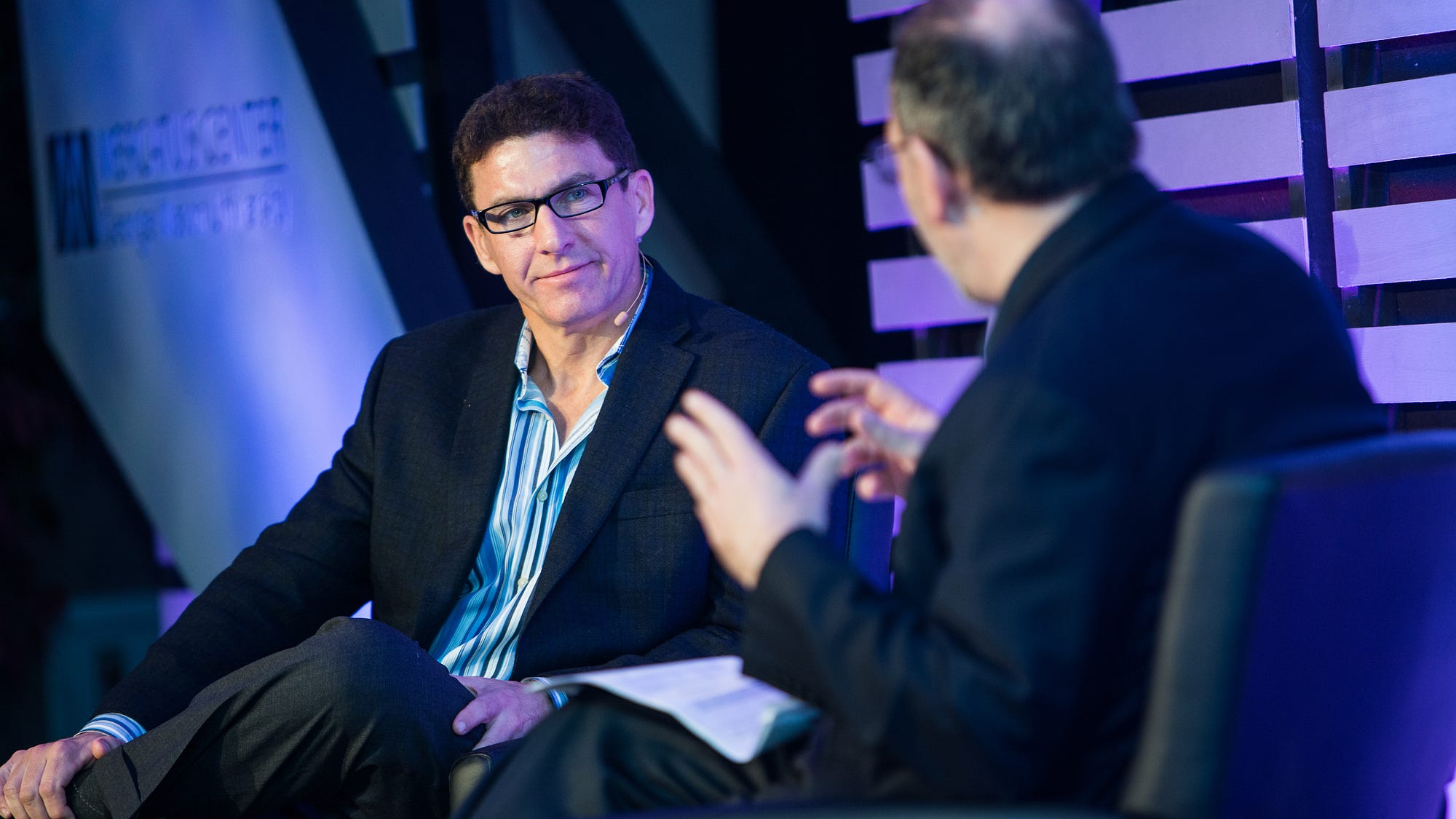
He recently sat down with economist Tyler Cowen for a segment of Conversations with Tyler at GMU’s Mercatus Center. The interview is fascinating as they discuss Henrich’s work on cultural evolution and its implications for both today and the future. What perhaps excited me the most was Henrich’s discussion of his work-in-progress on marriage norms and the development of Western individualism:
In my latest project I’m really looking at the kind of spread of the Western church into Europe and how it transformed the social structure in ways that I think led to individualism, it led to a different kind of cultural psychology that would eventually pave the way for secular institutions and economic growth. The church is the first mover in that account…When the church first began to spread its marriage-and-family program where it would dissolve all these complex kinship groups, it altered marriage. So it ended polygyny, it ended cousin marriage, which…forced people to marry further away, which would build contacts between larger groups. That actually starts in 600 in Kent, Anglo-Saxon Kent. Missionaries then spread out into Holland and northern France and places like that. At least in terms of timing, the marriage-and-family program gets its start in southern England.
This project is in its early stages (according to the email Henrich sent me), but it’s something I’m greatly anticipating. The entire interview is worth watching/listening to. Cowen provides both insightful feedback and even pushback, making the discussion a productive one. Check it out.
Last summer, two consultants at the Minneapolis Fed published a paper entitled “On the Ethics of Redistribution.” They begin by framing the discussion with a global perspective:
A typical American in the lowest 5 percent of income (for America) has a higher income than 95 percent of Indians, 80 percent of Chinese and 50 percent of Brazilians. In the United States, 99 percent of households have indoor plumbing (a toilet with a sewer connection). In India, it’s 12 percent. For Americans below the poverty line, nearly three-quarters have a car (and 31 percent have two or more) and 97 percent have air conditioning. In India, only 5 percent of all households have cars and 2 percent of all households have air conditioning.
This then begs the following question: Are policies that purport to help the comparatively well-off (those at, say, the poverty line in developed countries) at the expense of the superlatively well-off (the rich in developed countries) desirable from the behind-the-veil perspective assuming that that perspective is global?
Increasing world trade is an example of the tension between policies that help those in developing countries versus those that help those lower in the income distribution in developed countries. According to a World Bank Study, in the three decades between 1981 and 2010, the rate of extreme poverty in the developing world (subsisting on less than $1.25 per day) has gone down from more than one out of every two citizens to roughly one out of every five, all while the population of the developing world increased by 59 percent. This reduction in extreme poverty represents the single greatest decrease in material human deprivation in history.
But this decrease in extreme poverty in the developing world has coincided with a marked increase in income inequality in the developed world, and the latter has received much more attention, at least from policy analysts in these richer nations.
The authors then move to the subject of skilled/unskilled labor and the effects of redistribution:
In a world with just two countries, one developed and the other poor, output is produced in each by a combination of skilled workers and unskilled workers. When they’re young, unskilled workers have the opportunity to become skilled by working with older, skilled workers.
…A rich-country policy to tax high incomes will redistribute income (within that country) from those with high innate abilities (and, by assumption, with the ability to become highly skilled) to those with lower innate abilities. In so doing, that policy will reduce inequality within the rich country, but it will also create disincentives there to becoming highly skilled and thereby reduce the global supply of skilled workers. This reduced supply of skilled workers from the developed country then reduces opportunities for young workers in the poor country to become skilled.
Applying the Harsanyi-Rawls behind-the-veil-of-ignorance criterion but considering only people in the developed country would appear to make this a beneficial policy because it helps the poor of that rich country. But, in our example, it hurts the poorest of the poor in the world, those in the developing nation. A proper application of the behind-the-veil-of-ignorance criterion—one that takes all people in all countries into consideration—can thus lead to the implication that such a policy is extremely undesirable. At the very least, a proper application of the criterion says that redistribution within rich countries imposes costs on people in other countries which need to be taken into account.
They conclude, “A giant literature in public finance justifies such social welfare functions by appealing to the veil-of-ignorance. Our point simply is that those who use this criterion should weight the welfare of poor people in Chad, the world’s poorest nation, very heavily. To our knowledge, very little if any of the relevant research does so.”
Does geography contribute to unemployment? “In a paper published in 1965,” reports The Economist,
John Kain, an economist at Harvard University, proposed what came to be known as the “spatial-mismatch hypothesis”. Kain had noticed that while the unemployment rate in America as a whole was below 5%, it was 40% in many black, inner-city communities. He suggested that high and persistent urban joblessness was due to a movement of jobs away from the inner city, coupled with the inability of those living there to move closer to the places where jobs had gone, due to racial discrimination in housing. Employers might also discriminate against those that came from “bad” neighbourhoods. As a result, finding work was tough for many inner-city types, especially if public transport was poor and they did not own a car.
Is there any data to back up this theory?
A new paper,[ref]This is a 2014 article.[/ref] published by the National Bureau of Economic Research…looks at the job searches of nearly 250,000 poor Americans living in nine cities in the Midwest. These places contain pockets of penury: unemployment in inner Chicago, for instance, is twice the average for the remainder of the city. Even more impressive than the size of the sample is the richness of the data. They are longitudinal, not cross-sectional: the authors have repeated observations over a number of years (in this case, six). That helps them to separate cause and effect. Most importantly, the paper looks only at workers who lost their jobs during “mass lay-offs”, in which at least 30% of a company’s workforce was let go. That means the sample is less likely to include people who may live in a certain area, and be looking for work, for reasons other than plain bad luck.
For each worker the authors build an index of accessibility, which measures how far a jobseeker is from the available jobs, adjusted for how many other people are likely to be competing for them. The authors use rush-hour travel times to estimate how long a jobseeker would need to get to a particular job.
If a spatial mismatch exists, then accessibility should influence how long it takes to find a job. That is indeed what the authors find: jobs are often located where poorer people cannot afford to live. Those at the 25th percentile of the authors’ index take 7% longer to find a job that replaces at least 90% of their previous earnings than those at the 75th percentile. Those who commuted a long way to their old job find a new one faster, possibly because they are used to a long trek.
Governments could seek to “help workers either to move to areas with lots of jobs, or at least to commute to them. That would involve scrapping zoning laws that discourage cheaper housing, and improving public transport. The typical American city dweller can reach just 30% of jobs in their city within 90 minutes on public transport. That is a recipe for unemployment.”[ref]AEI’s James Pethokoukis has a good piece expanding on this.[/ref]
As usual, some of the best talks from this General Conference come from the Sunday session. In particular, I’m really developing an appreciation for President Hunter. He was only prophet for a very brief period when I was a young man (June 1994 – March 1994) and I’m sorry to say that my main takeaway at the time was a kind of disappointment. My father had often told me of how you developed a special connection to the prophet who was alive when you were developing your own testimony—often in your teens—and so I thought that President Hunter would be that man. When he died so quickly—before he could leave much of a mark of his own—I felt a tiny sense of betrayal.
I confess I haven’t thought a lot about him in the years sense, but that started to change when I taught Elder’s Quorum a couple of weeks ago using Chapter 21 of the manual based on his writings. I was shocked at how sophisticated the lesson was, and at how much time President Hunter spent dealing explicitly with one of my pet issues: the relationship between faith in science and in religion. For example:
Whether seeking for knowledge of scientific truths or to discover God, one must have faith. This becomes the starting point.
The idea that faith plays a role in both faith and in science is one that bowled me over when I first read David Hume in light of Alma 32 as an undergrad. Since then plenty of people have made similar arguments—so I’m making no claims to originality—but I was still surprised to see the topic handled so directly by a prophet.
As it turns out, that manual was drawing from his talk in this session: To Know God. In the talk, he makes the case even more clearly than the manual, writing that “scientific research is an endeavor to ascertain truth, and the same principles which are applied to that pursuit are used in the quest to establish the truth of religion as well.”
Also, continuing that first quote from him, her references Hebrews and the idea that “faith is the substance of things hoped for, the evidence of things not seen,”[ref]Hebrew 11:1[/ref] and relates that directly to science as well:
The scientist does not see molecules, atoms, or electrons, yet he knows they exist. He does not see electricity, radiation, or magnetism, but he knows these are unseen realities. In like manner, those who earnestly seek for God do not see him, but they know of his reality by faith. It is more than hope. Faith makes it a conviction—an evidence of things not seen.
I’m a little embarrassed to ride my hobby horse this far off down a tangent, but—since I know that equating faith in religion and science is bound to tick off plenty of people and confuse even more—I’ll provide a succinct overview that, I hope, falls in line with what President Hunter is saying.
The first point comes from David Hume, and it’s a simple one: we don’t observe causation directly. We infer causation. The implications might not be immediately obvious so—just to give a sense of what a huge problem this was—consider that one of the most famous philosophers of all time (Emannuel Kant) “changed[ed] his entire career after he [read] Hume.”[ref]This quote, and most of the one to follow, are from Science Wars: What Scientists Know and How They Know It by Steven L. Goldman.[/ref]. Why? Because if causality must be assumed, then no amount of observation or experimentation can jump the chasm from a collection of facts about what has happened to have taken place in the past to certain knowledge about how the universe works.
Now, why does this matter? Because, of the “inextricably realist character that is woven into the rhetoric of science.”[ref] Science Wars: What Scientists Know and How They Know It by Steven L. Goldman.[/ref] In other words: science—the way it is discussed in the media and among scientists themselves—is the business of uncovering facts (certain knowledge) that are about the world. Which, if Hume is right, is quite impossible.
And, in fact, if you press philosophically sophisticated scientists on the topic (speaking historically), they’ll concede the point for the simple reason that nobody has found an adequate rebuttal to Hume. And so there’s a “parade of absolutely first-rate scientific thinkers who have insisted that science is not about an independently existing reality,”[ref] Science Wars: What Scientists Know and How They Know It by Steven L. Goldman.[/ref] but the reality is that nobody really has that in mind. When the Higgs Boson was discovered, everyone—from the physicists to the journalists to the general public—took the realist view for granted. There’s this idea of a particle-thingy and scientists have discovered it and so now we know that the particle-thingy is really out there, a part of an independent reality that exists beyond human mental constructs.
Professor Goldman goes so far as to call the scientific establishment “schizophrenic” in this regard. They plainly talk and act as though they are learning facts about the real world (that’s the realist view) despite the awareness—now centuries’ old—that this is impossible to do with certainty.
There are basically three solutions to this conundrum.
On the one hand, you can just give up on rationality entirely. I won’t say much for this course because, once you’ve decided to just abandon making sense, there’s nothing left to talk about. But I suppose—for the sake of completeness if nothing else—I ought to mention that you can try that course if you’d like. Hume proved that deriving certain knowledge of the world through experimentation and observation is impossible, but you can just pretend that he didn’t if that suits your fancy.
Now, if you’re not willing to jettison logic and reason, you have two remaining options. On the one hand, you can retreat. You can agree that—because causality is never observable—science is basically just a game where we invent explanations for our experiences, and no explanation is ever really “true.” Scientific theories and laws are more or less coherent with each other and with our experiences and they have varying degrees of simplicity or aesthetic beauty, but in the final analysis they are socially constructed and subjective and that’s that.
On the other hand, you can stand your ground and assert that science is about something objectively real. That there are things out there—matter and energy and laws governing them—that have a kind of independent and objective experience and that—no matter how imperfectly or partially—science is in the business of learning about those things. But if you want to take this view, you have to swallow the reality that science rests on faith. Faith, for example, that although we may not be able to see or observe something (for example: causality), it’s still there, undergirding our experiments and observations and building a faith-based connection between science and reality.
We’ve gone rather far afield at this point, so let me wrap it up. If none of the philosophy appeals to you: that’s fine. Let me just say that it’s exciting—and unexpected—that in reading old talks from the 1970s I’d come to such a greater appreciation for a man who served as President for less than a year while I was a teenager. This General Conference Odyssey has already covered some unexpected new territory in just the first year, and we have more than ten more to go.






 In a world with just two countries, one developed and the other poor, output is produced in each by a combination of skilled workers and unskilled workers. When they’re young, unskilled workers have the opportunity to become skilled by working with older, skilled workers.