Ignorance Is Not a Virtue

This is part of the General Conference Odyssey.

Nathaniel quoted from Elder Haight’s talk, saying, “Modern man must replace uncertainties and doubt with a desire to know more of Jesus.”

I thought this went hand-in-hand with Franklin D. Richards’ talk on testimony:

[T]o obtain a testimony one must have a real desire to know the truth and must be willing to exert considerable effort.

The interested person must study the gospel, and the gospel is to be found primarily in the Bible, Book of Mormon, Doctrine and Covenants, and Pearl of Great Price, the four standard works of The Church of Jesus Christ of Latter-day Saints.

In this dispensation the Lord has counseled us to “seek … out of the best books words of wisdom: seek learning, even by study. …” (D&C 88:118.)

Jesus said, “… know the truth, and the truth shall make you free.” (John 8:32.)

I feel sure that part of this freedom Jesus refers to must be freedom from ignorance, as ignorance is a deterrent to happiness, growth, and development.

Through study of the scriptures we can understand our relationship to God and how the basic gospel principles apply to our daily lives. Our study, however, should be constant and intensive, for the gospel of Jesus Christ embraces all truth.

Hugh B. Brown once wrote,

We should all be interested in academic research. We must go out on the research front and continue to explore the vast unknown. We should be in the forefront of learning in all fields, for revelation does not come only through the prophet of God nor only directly from heaven in visions or dreams. Revelation may come in the laboratory, out of the test tube, out of the thinking mind and the inquiring soul, out of search and research and prayer and inspiration. We must be unafraid to contend for what we are thinking and to combat error with truth in this divided and imperiled world, and we must do it with the unfaltering faith that God is still in his heaven even though all is not well with the world.

As much as the scriptures warn against “the learned [who] think they are wise” (2 Nephi 9:28), modern leaders also preach against ignorance. The difficulty is finding the balance between continual learning and intellectual humility. Nonetheless, it should be clear that ignorance is not a virtue.

Image result for i know everything gif

The Opposite of Uncertainty

This post is part of the General Conference Odyssey.

Modern man must replace uncertainties and doubt with a desire to know more of Jesus.

This statement, from Elder Haight’s talk What Does Jesus Mean to Modern Man?, has been stuck in my brain for days now. It confounds expectations. Certainty is the opposite of uncertainty, right? But we can’t manufacture certainty.

Or rather, we can, but it’s a terrible idea. Manufacturing certainty preempts faith and precludes growth. Pretending to know—when really you don’t know—is worse than blind belief, it’s like gouging out your spiritual eyes. Real conviction is not something we claim. It’s something we’re given. And—like any blessing—it’s not the kind of thing that we are necessarily given right away, the moment we ask for it.

And so if you are struggling with doubt and uncertainty, you can’t just replace them with knowledge and certainty because you want to. So, from a practical standpoint, what can you do?

I can think of no better approach than what Elder Haight suggests.

Check out the other posts from the General Conference Odyssey this week and join our Facebook group to follow along!

The Consequences of Minimum Wage: Youth Edition

Time for yet another study on the minimum wage, this time by economist Charlene Marie Kalenkoski from March of this year. Do minimum wage laws have negative effects on youth employment and income?

Wait for it…

Yes. Yes they do.

Image result for die from not surprise gif


Kalenkoski writes,

Policymakers often propose a minimum wage as a means of raising incomes and lifting workers out of poverty. However, improvements in some young workers’ incomes as a result of a minimum wage come at a cost to others. Minimum wages reduce employment opportunities for youths and create unemployment. Workers miss out on on-the-job training opportunities that would have been paid for by reduced wages upfront but would have resulted in higher wages later. Youths who cannot find jobs must be supported by their families or by the social welfare system. Delayed entry into the labor market reduces the lifetime income stream of young unskilled workers (pg. 1).

A few selections on employment:

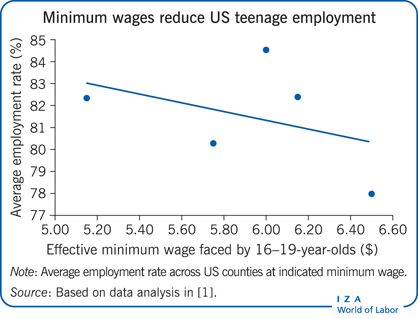
There is a substantial body of empirical evidence on the effects of a minimum wage on youth employment. Most of the studies have found negative effects on youth employment. A 1992 study of youth employment in the US found that a 10% increase in the minimum wage led to a 1–2% decline in the employment of teenagers and a 1.5–2% decline in the employment of young adults. A 2014 study of youth employment in the US showed a decline of 1.5% for teenagers. Thus, the estimated negative effect of minimum wages on employment in the US has been fairly consistent over time. However, these estimates are national averages, which obscure regional effects. A 10% increase in the minimum wage has been found to reduce regional employment by as much as 7%. One study that looked at teenage unemployment rates in the US instead of employment found that minimum wages indeed increase teen unemployment rates, as the standard economic model predicts (pg. 3).

Minimum wages reduce US teenage employment

And income:

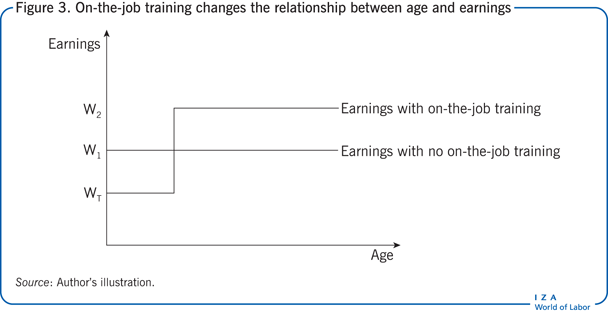
How might the imposition of a minimum wage affect whether grocery store employers offer on-the-job training? If the minimum wage were set at W1 in Figure 3, for example, grocery store employers would be unable to offer on-the-job training to their grocery bagger employees. Workers would find themselves on the horizontal age-earnings profile at W1 and would thus earn less income over a lifetime than they might have had they been able to receive on-the-job training (pgs. 6-7).

On-the-job training changes the relationship between age and earnings

Kalenkoski concludes,

Rather than using a minimum wage to increase youths’ current incomes, policymakers should consider policies that improve the labor market opportunities of youths but do not increase the cost to employers of hiring young workers. Policies that would achieve both goals include providing cash welfare payments to youth if their earned income falls below some guaranteed level and providing in-kind support, such as food or housing assistance. Such policies create their own distortions (for example, causing some benefit recipients to choose not to work) but would not reduce the total number of jobs available or create unemployment (pg. 9).

Check out the full publication.

What Are the Reasons Behind Late-Term Abortions?

Trump has been catching a lot of heat for his rather bungled remarks about abortion. Clinton in turn defended late-term abortions by claiming that these cases are often due to the mother’s health being jeopardized or complications with the pregnancy. There was even a heartbreaking story by a Mormon woman going viral that relayed the horrific experience of late-term abortion due to pregnancy complications. It turns out that the majority of Americans would likely approve of abortion in her situation. Gallup has found that 50% of Americans think abortion should be legal only under some circumstances, while 29% think it should be legal in all cases and a mere 19% think it should be illegal in all cases. When specifics are given, they found that 82% believe it should be legal when the mother’s physical health is endangered and 75% believe it should be in cases of rape or incest. Even the official stance of the LDS Church would fall under the “legal only under some circumstances” category (though members should realize just how seriously Church leadership takes this subject).

Nonetheless, the American population of women has basically been split in half on this matter for over a decade. The latest Gallup poll found the percentage of pro-choice women to be 54 percent, though it’s averaged at about 48.5% between 2001-2015. This squares with Pew’s finding that 50% of women view abortion as morally wrong. However, a 2016 Marist poll found that 82% of women would restrict abortion to the first three months of pregnancy (this is much closer to a large number of European countries).

Why would so many women object to late-term abortions if these are so often due to complications as Clinton said? There are probably many reasons, but one of them could have to do with the fact that Clinton’s reasoning is misleading. Granted, the majority of abortions take place early on in the pregnancy. As The Washington Post reported,

One-third take place at six weeks or pregnancy or earlier; 89 percent occur in the first 12 weeks, according to the Guttmacher Institute, which supports abortion rights. Only 1.2 percent of abortions—about 12,000 a year– take place after 21 weeks. (The Supreme Court has held that states may not prohibit abortions “necessary to preserve the life or health” of the mother.)

On top of that, Guttmacher says that 43 states already prohibit some abortions after a certain point in pregnancy, such as fetal viability, in the third trimester or after a certain number of weeks. So this is already a rare procedure that is prohibited in much of the country.

So are late-term abortions mainly due to later complications? A 2013 study by the Guttmacher Institute may suggest otherwise. Writing at the pro-life Charlotte Lozier Institute, Elizabeth Johnson expounds on Guttmacher’s data:

For many years, abortion-rights advocates have asserted that abortions after 20 weeks are performed because of maternal health complications or lethal fetal anomalies discovered late in pregnancy. However, wider data from both the medical literature and late-term abortion providers indicates that most late-term procedures are not performed for these reasons. Previous survey studies of late-term abortion patients have confirmed that most late-term abortions are performed because of a delay in pregnancy diagnosis and for reasons similar to those given by first-trimester abortion patients:  financial stressors, relationship problems, education concerns or parenting challenges.

A recent paper entitled, “Who seeks abortion at or after 20 weeks?” supports these conclusions. The study, published in Perspectives on Sexual and Reproductive Health, a journal of the Guttmacher Institute, marks a notable departure from previous statements by abortion rights advocates that late-term abortions were rarely elective.  Authors Foster and Kimport highlight the characteristics of women seeking abortion at or after 20 weeks gestation.  The authors acknowledge that, in fact, wider “data suggests that most women seeking later terminations are not doing so for reasons of fetal anomaly or life endangerment.” The study explores reasons for delay in seeking abortion services, comparing first-trimester and late-term abortion groups.  While there are numerous limitations to the study, the authors suggest that the characteristics of women who seek both first-trimester and late-term abortions are substantially similar.

She concludes,

The characteristic similarities and delay commonalities observed across first trimester and late-term abortion groups suggest that women who seek abortion share similar characteristics across gestational ages.  The stressful circumstances of unprepared pregnancy, single-motherhood, financial pressure and relationship discord are primary concerns that must be addressed for these women.  However, these circumstances are not fundamentally alleviated or ameliorated by late-term abortion.  Indeed, late-term abortion places these women at greater risk of surgical complications, subsequent preterm birth, and mental health problems, while simultaneously ending the life of an unborn child. As a medical profession and society, we rightly seek alternative, compassionate responses for the women seeking late-term abortion procedures for such challenging yet elective reasons.

It is reasons like this that some fact checkers have called Clinton out on her previous late-term abortion comments. It is interesting that in Reason‘s useful rundown of late-term abortions in America there are no figures provided to support the claim that these abortions “are generally a last resort” and “involve situations where the mother’s life or health is in jeopardy.” The blog Secular Pro-Life Perspectives drew on a couple studies to further demonstrate the rarity of health problems as a reason for abortion:

This 1988 study surveyed 399 women seeking abortion at 16+ weeks. The study found women were obtaining late-term abortions instead of earlier-term abortions (i.e. reasons for delaying) because:

  • 71% Woman didn’t recognize she was pregnant or misjudged gestatio
  • 48% Woman found it hard to make arrangements for abortion
  • 33% Woman was afraid to tell her partner or parents
  • 24% Woman took time to decide to have an abortion
  • 8% Woman waited for her relationship to change
  • 8% Someone pressured woman not to have abortion
  • 6% Something changed after woman became pregnant
  • 6% Woman didn’t know timing is important
  • 5% Woman didn’t know she could get an abortion
  • 2% A fetal problem was diagnosed late in pregnancy
  • 11% Other

It continues:

According a 2004 study by Guttmacher, 1,160 women seeking abortion (not just late-term) gave overall reasons for obtaining an abortion at all stages (may list more than one):

  • 74% Having a baby would dramatically change my life
  • 73% Can’t afford a baby now 
  • 48% Don’t want to be a single mother or having relationship problems
  • 38% Have completed my childbearing
  • 32% Not ready for a(nother) child
  • 25% Don’t want people to know I had sex or got pregnant
  • 22% Don’t feel mature enough to raise a(nother) child
  • 14% Husband or partner wants woman to have abortion
  • 13% Possible problems affecting the health of the fetus
  • 12% Physical problem with my health
  • 6% Parents want me to have an abortion
  • 1% Woman was victim of rape 
  • <0.5% Became pregnant as a result of incest

The same Guttmacher study has statistics for later term abortion (13+ weeks gestation). According to Guttmacher, 21% of women who had abortion at or past 13 weeks were doing so for fetal health concerns, and 10% for personal health concerns. 

Abortion is a complex issue, especially when it comes to the legal aspects.[ref]This is why I’m currently reading through philosopher Christopher Kaczor’s The Ethics of Abortion.[/ref] But accuracy is important. While better data may indeed show that health complications are the culprits behind late-term abortions, the current evidence suggests that they are not.

Image result for abortion parks rec gif

UPDATE: Thanks to Margot in the comments for pointing out this 2014 study. She summarizes: “A more recent study (published in 2014) on all women referred to the Yale hospital for late-term abortions from 2002 to 2011 found that 69% were for a poor prenatal diagnosis–fetal anomaly (41.6%), aneuploidy (15.7%) or multiple anomalies (12.7%)–and another 9.6% were for pregnancy complications or maternal disease. Just over 20% were for unwanted pregnancies, perhaps where the mother either didn’t know she was pregnant earlier or had problems accessing abortion.” This is the kind of evidence mentioned above that could help identify health complications as the main culprit. Good data are hard to come by, so this was an excellent find. For the pro-life crowd, the near 21% of late-term abortions performed because the pregnancy was “unwanted” will still be alarming. But if this study is generalized, it could provide more weight for Clinton’s remarks. However, it is worth pointing out that these numbers are taken from Yale New Haven Hospital between 2002 and 2011. Multiple demographic factors (income, education, marital status, etc.) are at play when it comes to the numbers of a single hospital, which should make us cautious about drawing broad conclusions from them. Other numbers tell a different story. For example, since 2012, 91% of 14-20 week and 80% of 21+ week abortions in Arizona have been elective (i.e., not due to maternal or fetal medical conditions). In Florida, 87% of 13-24 week abortions have been elective since 2013 (it’s even higher when you consider the fact that things like “emotional/psychological health of the mother” and “social or economic reasons” are filed under “non-elective”).[ref]Secular Pro-Life has made it easier on us by crunching the numbers from Arizona and Florida.[/ref] Diana Greene Foster–one of the authors of the 2013 Guttmacher study above–told FactCheck.org “that “[t]here aren’t good data on how often later abortions are for medical reasons.” She said based on limited research and discussions with researchers in the field that abortions for fetal anomaly “make up a small minority of later abortions,” and that those for life endangerment are even harder to characterize. This is because many of the women who fall into that category would be treated under emergent circumstances at hospitals rather than at a dedicated abortion clinic, making numbers harder to obtain, Foster said.” In other words, better data and research are needed.


The Importance of Consumer Credit

I recently reread a 2014 Forbes article by GMU law professor Todd Zywicki and former Fed economist Thomas Durkin based on their Oxford-published Consumer Credit and the American Economy and thought it was worth sharing. The authors explain that despite the claims of people like Elizabeth Warren,

economists have long understood why consumers borrow. Although there are exceptions to any rule, for most it bears little resemblance to Senator Warren’s picture of hapless victims goaded into debt by rapacious credit card issuers. Instead, consumers borrow for essentially the same reasons that businesses borrow: for capital investments and to smooth disruptions in income and expenses. And paternalistic regulations that make credit more expensive and less available typically makes people poorer.

Zywicki and Durkin use the example of a washing machine:

A washing machine is no frivolous bauble; its value is in not having to schlep to the laundromat every Saturday with a pocket full of quarters. While a washing machine costs much more on the front end to acquire, it generates a stream of benefits over years. In that sense, it is no different from a construction company that borrows money to purchase a backhoe to dig a ditch instead of hiring ten guys with shovels. 

The “hand-wringing about how other people use consumer debt is as old as debt itself. For example, the New York Times warned in the 70s that American consumers were “borrowing trouble”—the 1870s, that is.” They point out that

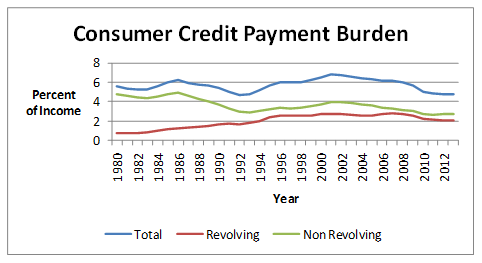
40 years ago if you needed $400 for a car repair, you would visit your bank, credit union, or a local personal finance company for a loan to be repaid over 12-24 months. If you bought a refrigerator or new bedroom set, you would finance it through the appliance store or department store and repay it “on time.” Today, you likely would just put it on your credit card. In fact, even despite the astonishing surge of student loan debt over the past two decades (it now exceeds credit card debt), the non-mortgage debt repayment obligation as a share of income is actually lower today for the typical household, including the typical low-income household, than in 1980 (see chart below).

Finally,

while well-designed regulation can improve competition and consumer choice, economic history demonstrates that heavy-handed regulations that restrict product offerings frequently harm their intended beneficiaries. For example, who uses payday lending? Those who don’t have access to credit cards or would max out their cards if they used them. So what happens when well-intentioned regulators take away payday lending? Many payday lending customers shift to other alternatives, such as bank overdraft protection or pawnbrokers, which are often even more expensive. Eliminating options for low-income consumers (especially those options that they are actually using) doesn’t eliminate their need for credit.

The whole article is worth reading. Check it out.

The Future of Technological Advancement

Image result for technological progress
Not the most profound example, but it works.

Many critics today believe the notion that the days of economic growth and technological innovation are behind us. Yet, Oxford’s Ian Goldin and Chris Kutarna argue that these critics are mistaken.[ref]Economic historian Joel Mokyr also thinks the critics’ arguments are overblown.[/ref] The critics, they argue, imagine “technological innovation to be like pulling balls from an urn, each ball representing a new idea. In the beginning, the urn was full and the spheres were large, but each time we’ve gone back to the urn, we’ve had to reach deeper than the last, and the spheres have dwindled into marbles.” In their view, however,

this metaphor, while intuitive and compelling, is backwards (Goldin and Kutarna 2016). Innovation is more like mixing compounds in an alchemist’s lab. Each compound is an existing idea or technology, and in the beginning we had just a few – maybe some salt, sugar, and common liquids. But then we tried mixing them together, and some of them reacted with one another to form new compounds…This metaphor is far closer to the present experience in research laboratories. Across the sciences, the pace of discovery is generally rising, not falling. For reliable evidence, consider the pharmaceuticals industry (a good litmus test because it invests more into R&D than any other industry, except aerospace). The year 2013 set a new record for total drugs launched world-wide (48) – a record that was promptly beaten in 2014 (61). With another 46 drugs launched in 2015, the last three years have been the industry’s three most productive in its history. Recent major discoveries include new weapons against heart failure, which in an aging world is now the leading cause of death; immunotherapies, which help to defeat cancers by boosting the body’s own immune response; and a viable pathway to effective Alzheimer’s medications within a decade. In part thanks to the accelerating pace of pharmaceutical achievements like these, average life expectancy across advanced economies is now rising an unprecedented four to five hours per day.

Goldin and Kutarna defend their view in a way that would make Julian Simon smile:

The broader cause for these emerging paradigm shifts is the inflation in human brainpower that has taken place over the past 25 years. Thanks to giant medical successes against childhood disease and aging over the past quarter-century, the present global cohort of adults is humanity’s largest and healthiest ever. It is also the best-educated. In just a generation, illiteracy has fallen from nearly half to just one-sixth of humanity. In 30 years, we’ve added three billion literate brains to our ranks. Meanwhile, the rapid expansion of higher learning in Asia means that the number of people alive right now with a university degree is greater than the total number of degrees awarded in history prior to 1980. Most importantly, the present generation is history’s best-connected, thanks principally to a quartet of big events – the end of the Cold War, waves of democratisation across Latin America, much of Asia and sub-Saharan Africa, China’s emergence from autarky, and the advent of digital communications.

Neither history, nor the present-day pace of scientific discovery supports the notion of diminishing returns to technological innovation. The challenge for growth economists is that analytic models are poorly suited to capture, and set society’s expectations for, these impending disruptions…Growth economics is powerful. At its best, it is an empirical science that helps determine how to lift human wellbeing – one of civilisation’s most important tasks. But it is unable to capture the dynamism of our new age of discovery for a reason. Much that matters is still beyond its sight.

We need an economy and a government that support dynamism and provide fertile ground for innovation.

CBO on Trade

How Preferential Trade Agreements Affect the U.S. Economy

The Congressional Budget Office (CBO) released a new report in September titled “How Preferential Trade Agreements Affect the U.S. Economy.” The report is timely given rising hostility toward trade among voters and presidential candidates. The report states the following:

International trade yields several benefits for the U.S. economy. Trade increases competition between foreign and domestic producers. That increase in competition causes the least productive U.S. businesses and industries to shrink; it also enables the most productive businesses and industries in the United States to expand to take advantage of profitable new opportunities to sell abroad and obtain cost savings from greater economies of scale. As a result, trade encourages a more efficient allocation of resources in the economy and raises the average productivity of businesses and industries in the United States. Through that increase in productivity, trade can boost economic output and workers’ average real (inflation-adjusted) wage. In addition, U.S. consumers and businesses benefit because trade lowers prices for some goods and services and increases the variety of products available for purchase.

Not everyone benefits from trade expansion, however. Although increases in trade probably do not significantly affect total employment, trade can affect different workers in different ways. Workers in occupations, businesses, and industries that expand because of trade may make more money, whereas workers in occupations, businesses, and industries that shrink may make less money or experience longer-than-average unemployment. Such losses can be temporary or permanent. Nevertheless, economic theory and historical evidence suggest that the diffuse and long-term benefits of international trade have outweighed the concentrated short-term costs.[ref]I address these short-term costs here.[/ref] That conclusion has consistently received strong support from the economics profession.

The rhetorical war on trade needs to stop.

An Old, Old Wooden Ship and Economic Institutions

Last week, I made the unfortunate decision to engage in a political/economic debate on Facebook. I rarely do this because (1) it makes friends into enemies, (2) it sucks up a lot of time with continual responses, and (3) it slowly turns me into a hostile person. Nonetheless, one of the topics discussed was immigration. The concerns expressed by my debate opponent were that new immigrants may not be assimilating and could very well undermine the values and culture that make America work. Having already explained what the economic literature says about immigration, I reminded him that there has been surprisingly little research on the effects immigrants have on institutions. But the research we do have[ref]An earlier version of this paper can be found here.[/ref] suggests that immigrants not only have no negative effects on institutions, but may even have positive effects on institutional quality.

A brand new study published this August could lend support to the findings above. From the abstract:

Using several measures of diversity, we find that higher levels of ethno-linguistic and cultural fractionalization are conditioned positively on higher economic growth by an index of economic freedom, which is often heralded as a good measure of sound economic management. High diversity in turn is associated with higher levels of economic freedom. We do not find any evidence to suggest that high diversity hampers change towards greater economic freedom and institutions supporting liberal policies. The effect of diversity, moreover, is conditioned positively by higher democracy. Our results raise serious doubt about the centrality of social diversity for explaining economic failure, nor is there evidence to suggest that autocratic measures are required under conditions of social diversity to implement growth-promoting policies. This is good news because history and culture seem to matter less than rational agency for ensuring sound economic management.

While this is mainly discussing development economics, I think the correlation between high diversity and high economic freedom is important. Barring members of other ethno-linguistic groups and cultures from entering the country may actually be holding back higher-quality institutions.

You can see an older, ungated version of the paper here.

Image result for old wooden ship civil war era

The Vision of All: Review at Worlds Without End

This is part of the DR Book Collection.

Image result for the vision of all spencerPhilosopher Joseph M. Spencer has already made some incredibly impressive contributions to Mormon Studies, including Book of Mormon research. For example, his An Other Testament is one of the most engaging and enlightening books on the Book of Mormon I have ever read. And yet, his latest from Greg Kofford Books–The Vision of All: Twenty-five Lectures on Isaiah in Nephi’s Record–surpasses it. Spencer is one of the most careful readers of scripture in Mormon Studies and this book puts his skill on full display. While a stellar combination of close textual analysis, biblical scholarship, and theology, Spencer nonetheless makes the subject(s) accessible to a wider audience by writing in lecture format rather than a line-by-line commentary (which he believes “gets dull fast and alienates most readers”). Spencer spends multiple chapters dissecting the sections of Isaiah quoted in the Book of Mormon and follows them up with how various prophetic voices within the Book of Mormon–namely Nephi, Lehi, and Jacob–interact with Isaiah’s text. One of the major strengths of Spencer’s analysis is his willingness to let the different voices (and textual variants thanks to Royal Skousen’s work) speak independently, even if they are sometimes in conflict. He also allows Isaiah to speak for Isaiah, placing his writings in their proper historical context (he mentions the problem of Deutero-Isaiah, though he doesn’t necessarily seek to resolve it).

“[T]he whole point of Nephi’s record,” according to Spencer, “is to get us to read Isaiah carefully” (pg. 47). But why? Spencer beautifully summarizes:

The purpose of the Book of Mormon, according to Nephi’s vision, is to refocus Christianity on its Abrahamic foundations, to restore to Christianity the idea that the Gentiles aren’t a kind of replacement Israel, but that they’re to be grafted into the everlasting covenant that’s still vouchsafed to Jacob’s children…Take a look at what the very title page of the Book of Mormon has to say about its primary purpose. It’s “to show unto the remnant of the house of Israel how great things the Lord hath done for their fathers, and that they may know the covenants of the Lord, that they are not cast off forever.” …It’s this vision of the Book of Mormon’s purpose (to save Christianity from itself!) that drew Nephi’s attention to Isaiah. Nephi found…the most brilliant available biblical explanation of the complex relationship between covenantal Israel and non-covenantal Gentiles. The book that bears Isaiah’s name is nothing if it isn’t a kind of systematic attempt to make sense of Abraham’s covenant in the richest way possible (pg. 11).

The Vision of All is easily one of the best books in the genre. Not only is it top-notch scholarship, but it’s also a profound and enriching theological treatise on the role of the Restoration in covenantal history as well as an implicit call to the responsibilities associated with this role. In short, it is a reminder of why we study the scriptures in the first place.

I recently penned a more detailed review of the book over at Worlds Without End (I pretty much borrowed everything above from it). Check it out and be sure to pick up Spencer’s book, which came out today.

UPDATE: You can listen to a podcast with Spencer discussing Isaiah at LDS Perspectives.

The Paths We Walk

046-paths-we-walk-small

This post is part of the General Conference Odyssey.

One of the most memorable of the talks I’ve read so far was Lost Battalions, which I read near the start of the General Conference Odyssey. The talk was by (then) Elder Thomas Monson. He has been serving as an apostle since 1963, when he was just 36 years old. That’s longer than I’ve been alive by almost two full decades. And yet because (to be perfectly honest) I haven’t paid such close attention to GC talks in the past, I’m only now beginning to get a real feel for his voice. And there’s more to it than just “tells stories.”

His talk for this week was called The Paths Jesus Walked, and it was filled with a lot of the same pathos as his earlier talk about the Lost Battalion. He described how Jesus walked the paths of disappointment, temptation, and pain. Not exactly cheery stuff, but definitely uplifting and encouraging when we feel our own paths are not all sunshine and roses:

Yes, each of us will walk the path of disappointment, perhaps due to an opportunity lost, a power misused, or a loved one not taught. The path of temptation, too, will be the path of each. . . Likewise shall we walk the path of pain. We cannot go to heaven in a feather bed. The Savior of the world entered after great pain and suffering. We, as servants, can expect no more than the Master. Before Easter there must be a cross.

I think I have heard somewhere—and I wish I could remember it—that because the Savior suffered, he made suffering sacred. Sometimes things just happen. Sometimes we or others make choices that inflict needless pain. And so not all the pain that we experience in life is necessary. But all of it can be made meaningful.

President Monson also laid out the paths we can walk, as disciples, to find that meaning. We can walk the paths of obedience, of service, and of prayer. Obedience and service make sense; they cover a lot of ground. Walking the path of prayer seems more interesting, but I like that it is included. “It is by walking the path of prayer that we commune with the Father.”

I was struck by two more things from the talk. First:

Jesus changed men. He changed their habits, their opinions, their ambitions. He changed their tempers, their dispositions, their natures. He changed men’s hearts.

And so we have to ask the question: in what ways is our discipleship changing us? Are our habits, opinions, or ambitions changing? Our tempers, disposition, and natures? Can you look inside at your own life and point to the specific ways in which your heart has been changed? If not: why not? After all, “The passage of time has not altered the capacity of the Redeemer to change men’s lives. As he said to the dead Lazarus, so he says to you and me: ‘… come forth.’”

Second, speaking of Paul (then Saul) in the time just before his conversion, he said of the Old Testament that “For some reason, these writings did not reach Paul’s need.” This struck me as an unusually penetrating and frank insight to make. We almost always hear that the scriptures are powerful. And they are, nothing here contradicts that. But they are not always—by themselves—sufficient. It’s a reminder of the limitations of men and of the limitations of any one aspect of the Gospel. It implies that discipleship has to be full spectrum or there is no guarantee that it works. We have to strive to be well-rounded saints, or we won’t be saints at all.

Check out the other posts from the General Conference Odyssey this week and join our Facebook group to follow along!