
Future Mormon: An Interview with Adam Miller

This is part of the DR Book Collection.

Over at Worlds Without End, I’ve written a review of Mormon philosopher Adam Miller’s new book Future Mormon: Essays in Mormon Theology. Those interested in a larger engagement should check it out, but as I describe it there, Miller’s book is an attempt at “a future tense apologetics” that models “a thoughtful and creative engagement with Mormon ideas while sketching, without obligation, possible directions for future thinking” (pg. xii). If future Mormons are anything like what I read here, then they will (compared to my experience with the average present-day Mormon):

  • Place grace at the center of the gospel where it belongs.
  • Take the materialist metaphysics of Mormonism seriously.
  • Be more aware of the implications of their unique and/or innovative doctrines.
  • Find the sacred in the mundane and embodied.
  • Take a more holistic, almost cosmic view of Mormonism.
  • Read the scriptures carefully and recognize the people within them as people, warts and all.

Whether you agree with everything (or anything) in Future Mormon is beside the point. Miller wants you to wrestle with these ideas. The book is meant to start conversations, get the mental wheels turning, and transform the reader into a theologian. In it, he helps lay the foundation for a more thoughtful, earthy, and creative Mormonism; all while extending his hand to readers as an invitation to join him in the process. At least in my case, his hope of inspiring “a thoughtful and creative engagement with Mormon ideas” has not been in vain. And when you pick up Future Mormon and reflect on its pages, I think you’ll find your case to be similar.

You can hear an interview with Adam Miller on Greg Kofford Books’ Authorcast here.

Have Wages Stagnated?

The common claim that wages and living standards have stagnated in the U.S. has been disputed before, but The Washington Post recently reported on a new San Francisco Fed study that suggests the claim is based on a “statistical fluke”:

Workers continuously employed in full-time jobs received wage increases higher than inflation from 2002 to 2015. Last year, the gain was a 3.5 percent increase after inflation, up from 1.2 percent in 2010.

Typically, the median wage — the wage exactly in the middle of all wages — is cited as evidence of stagnation. Indeed, the Fed study confirms this. Median wage increases have fluctuated around 2 percent, unadjusted for inflation. But the median wage is misleading, the report argues, because it’s heavily driven by demographic changes: an influx of young and part-time workers whose relatively low wages drag down the median; and the retirement of baby-boom workers whose relatively higher pay no longer lifts up the median.

This should hopefully calm some of the public hyperventilation that has taken place over the supposed stagnation of wages.

The larger implication is that the study compromises the prevailing economic narrative, which emphasizes the stagnation of wages and living standards. Clearly, millions of households — especially the recently unemployed — have suffered large losses, and the gains of many others are underwhelming. But the impression that most people in the middle class are slipping backward seems overwrought. The anxiety about the future is real, but its causes must be more complicated than commonly thought.

How to Deal With the Top 1%: Competition

“Curbing this inequality requires a clear understanding of its causes,” writes Brooking’s Jonathan Rothwell. “Three of the standard explanations—capital shares, skills, and technology—are myths. The real cause of elite inequality is the lack of open access and market competition in elite investment and labor markets. To bring the elite down to size, we need to make them compete.” He explains that–despite the claims of people like Robert Reich–corporate profits actually represented a lower share of GDP (4.9%) between 1980 and 2014 than between 1950 and 1979 (5.4%).

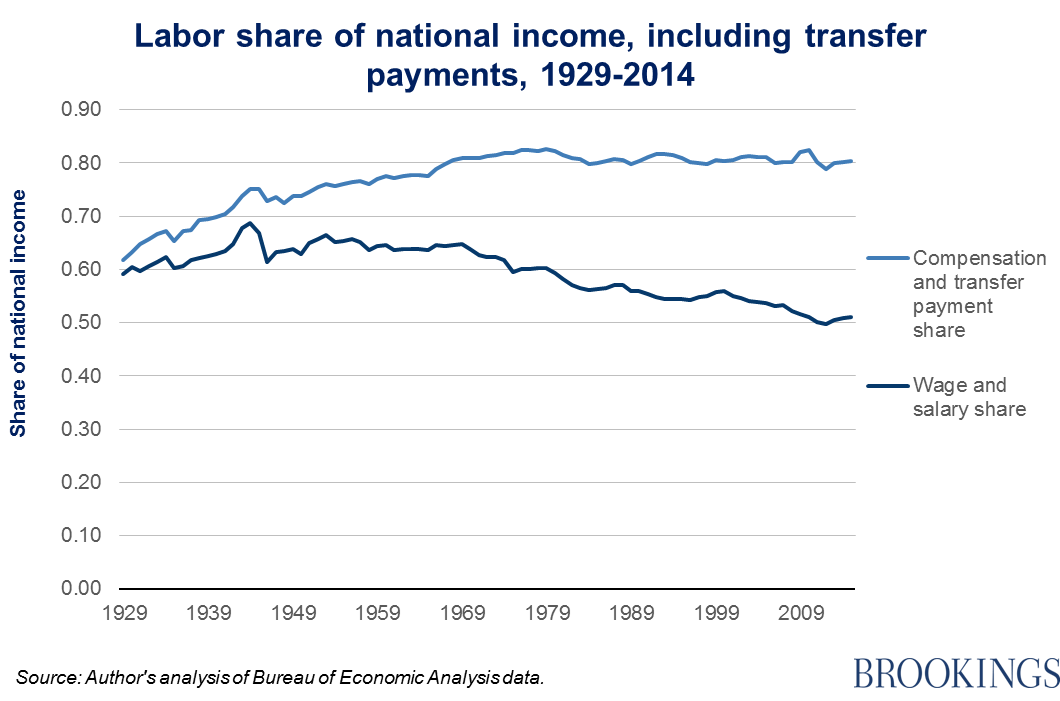
So, what’s going on here? The simple explanation is that wages and salaries are an inadequate measure of the share of economic benefits flowing to labor. Wages and salaries have declined as a share of total income, largely for two reasons. First, total national income includes government transfer payments, which are rising because of an aging population (e.g., Social Security and Medicare). Second, companies have greatly increased non-salary compensation (e.g., healthcare and retirement benefits). Total worker compensation plus transfer payments have actually slightly increased as a share of total national income, from 79 percent between 1951 and 1979, to 81 percent for the years from 1980 to 2015:

Rothwell 32516001

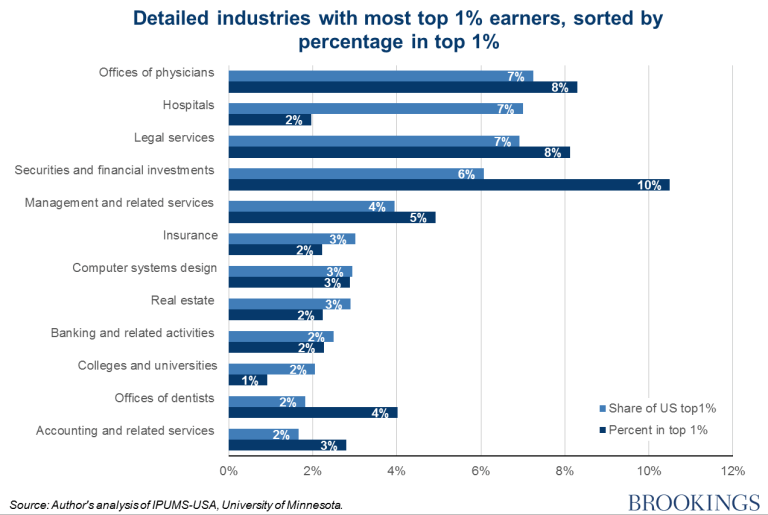
As for the claims that elite earnings are driven by advanced skills and IQ, Rothwell states, “It is certainly true that rising relative returns to education have driven up inequality. But as I have written earlier, this is true among the bottom 99 percent. There is no evidence to support the idea that the top 1 percent consists mostly of people of “exceptional talent.” In fact, there is quite a bit of evidence to the contrary.” Finally, while some entrepreneurs grow rich by founding an innovative technology, the rich are most often found in the doctor’s office. “No industry has more top earners than physicians’ offices, with 7.2 percent. Hospitals are home to 7 percent. Legal services and securities and financial investments industries account for another 7 and 6 percent, respectively. Real estate, dentistry, and banking provide a large number, too.”

So what is leading to inequality according to Rothwell?

One way that the top 1 percent cements their position is by occupying the financial sector, and accessing above-market returns on their investments…The accredited investor rule has mostly been ignored by scholars of inequality. But legal scholars Houman Shadab, Usha Rodrigues, and Cary Martin Shelby are an exception. They have each written persuasively about how the rules contribute to inequality by giving the richest investors privileged access to the best investment strategies. Shadab points out that other countries (with less inequality) allow retail investors to access hedge funds. The law has also inflated the compensation of hedge fund workers—roughly $500,000 on average—by restricting competition. Mutual funds—which charge tiny fees by comparison—are currently barred from using hedge fund strategies because they have non-rich investors. If the law was changed to allow mutual funds to offer hedge fund portfolios, hundreds of billions of dollars would be transferred annually from super-rich hedge fund managers and investment bankers to ordinary investors, and even low-income workers with retirement plans.

But that’s not all.

At the same time, we need more competition at the top end of the labor market. As economist Dean Baker points out, politicians and intellectuals often champion market competition—but what they mean by that is competition among low-paid service workers, production workers, or computer programmers who face competition from trade and immigration, while elite professionals sit behind a protectionist wall. Workers in occupations with no higher educational requirements see their wages held down by millions of other Americans denied a high-quality education and competing for relatively precious vacancies. For lawyers, doctors, and dentists— three of the most over-represented occupations in the top 1 percent—state-level lobbying from professional associations has blocked efforts to expand the supply of qualified workers who could do many of the “professional” job tasks for less pay.

Ultimately, Rothwell suggests that we increase the competition for the top 1 percent.

Before Marx, Adam Smith provided a framework for political economy that is especially useful today. Smith warned against local trade associations which were inevitably conspiring “against the public…to raise prices,” and “restraining the competition in some employments to a smaller number than would otherwise…occasion a very important inequality” between occupations. For earnings to be distributed more fairly, our goal is not to stand in the way of markets, but to make them work better.

Mow the Lawn, Do the Dishes, Save Your Soul

This is part of the General Conference Odyssey.

Last year, journalist Roger Cohen wrote this wonderful little insight in The New York Times:

Life is a succession of tasks rather than a cascade of inspiration, an experience that is more repetitive than revelatory, at least on a day-to-day basis. The thing is to perform the task well and find reward even in the mundane…Want to be happy? Mow the lawn. Collect the dead leaves. Paint the room. Do the dishes. Get a job. Labor until fatigue is in your very bones. Persist day after day. Be stoical. Never whine. Think less about the why of what you do than getting it done. Get the column written. Start pondering the next.

The more I look at it, the more I’m convinced that Joseph Smith’s elevation of the mundane–and consequently the everyday tasks that come along with it–was one of his most inspired doctrines and deepest insights into the human condition. It is within the boring that we discover, as the article puts it, our “personal sliver of the divine.” And it is this affinity for the everyday that tends to be one of the most frequent themes in the General Conference talks we’ve covered so far. President Hinckley’s October 1972 address is no different. In it he celebrates the “small day-to-day decisions will determine the course of your lives.” He determines that the ability to “grow in favor with both God and man…is not beyond your capacity. The course of our lives is not determined by great, awesome decisions. Our direction is set by the little day-to-day choices which chart the track on which we run.” Hinckley admonishes his audience, “Be smart…Be clean. Be obedient. Be prayerful. To do so will require a measure of discipline, the exercise of which will bring strength and capacity for great and demanding tasks that lie ahead of you in building the kingdom of God and in filling places of useful service in the work of the world. Your lives will be satisfying and your joy will be eternal.” Day-to-day choices and the discipline to make good ones are what it’s all about. This even extends into the realm of work:

I have concluded that the work of the world is not done by intellectual geniuses. It is done by men of ordinary capacity who use their abilities in an extraordinary manner. As a member of this church you have the obligation to seek learning and to improve your skills. It matters not whether you choose to be merchant, teacher, carpenter, plumber, mechanic, doctor, or to follow any other honorable vocation. The important thing is that you qualify to be useful workers in society…You cannot afford ever to do cheap or shoddy work. You bear the priesthood of God.

I think part of the reason I (we?) find General Conference so boring is because that’s exactly what they talk about. As Cohen says,

I am less interested in the inspirational hero than I am in the myriad doers of everyday good who would shun the description heroic; less interested in the exhortation to “live your dream” than in the obligation to make a living wage.

When you think of Sisyphus — the Greek mythological figure whose devious attempt to defy the gods was punished with his condemnation to pushing a boulder up a hill and repeating the task through all eternity when it rolled down again — think above all that he has a task and it is his own. Rather than a source of despair, that may be the beginning of happiness.

I’m sure the future Eden will still need its lawn mowed.

Other Noteworthy Quotes & Insights

Marion G. Romney on the helping the poor and needy:

The ultimate test: “In [Matt. 25], the Master declared that the test on which the division would be made on that great day would be the care given to the poor and the needy.”

The necessity of voluntary charity:

In this modern world plagued with counterfeits for the Lord’s plan, we must not be misled into supposing that we can discharge our obligations to the poor and the needy by shifting the responsibility to some governmental or other public agency. Only by voluntarily giving out of an abundant love for our neighbors can we develop that charity characterized by Mormon as “the pure love of Christ.” (Moro. 7:47.) This we must develop if we would obtain eternal life.

The principles of welfare: “Simple as was this program, it was nevertheless founded upon the two basic principles of action operative in all inspired welfare programs, namely: (1) those who have are to give, and (2) those who receive are to work.”

And yet, “As positive, however, as is this commandment against idleness, a disregard of it by the receiver does not justify Church members in failing to impart of their substance “according to the law of [the] gospel, unto the poor and the needy.” (D&C 104:18.)”

Building Zion: “The operation of these two principles, philanthropy by the giver and industry by the receiver, was so perfected in the days of Enoch that “the Lord called his people ZION, because they were of one heart and one mind, and dwelt in righteousness; and there was no poor among them.” (Moses 7:18.)

Interesting tidbits from Harold B. Lee:

Faith-promoting rumors:

I understand that there is a widely circulated story that I was alleged to have had a patriarchal blessing (I don’t know whether any of you have heard about that) that had to do with the coming of the Savior and the ten tribes of Israel. In the first place, a patriarchal blessing is a sacred document to the person who has received it and is never given for publication and, as all patriarchal blessings, should be kept as a private possession to the one who has received it. And second, with reference to that which I was alleged to have had, suffice it to say that such a quotation is incorrect and without foundation in fact. There is one thing that shocks me: I have learned, in some instances, that those who have heard of these rumors are disappointed when I tell them they are not so. They seem to have enjoyed believing a rumor without substance of fact. I would earnestly urge that no such idle gossip be spread abroad without making certain as to whether or not it is true.

Political agendas and violent/illegal activism:

There seem to be those among us who are as wolves among the flock, trying to lead some who are weak and unwary among Church members, according to reports that have reached us, who are taking the law into their own hands by refusing to pay their income tax because they have some political disagreement with constituted authorities. Others have tried to marshal civilians, without police authority, and to arm themselves to battle against possible dangers, little realizing that in so doing they themselves become the ones who, by obstructing the constituted authority, would become subject to arrest and imprisonment. We have even heard of someone claiming Church membership in protest against pornographic pictures being displayed in theaters, having planted bombs, and therefore becoming subject to punishment by the law and subsequently standing judgment before the disciplinary bodies of the Church.

Doomsdayers:

There are among us many loose writings predicting the calamities which are about to overtake us. Some of these have been publicized as though they were necessary to wake up the world to the horrors about to overtake us. Many of these are from sources upon which there cannot be unquestioned reliance. Are you priesthood bearers aware of the fact that we need no such publications to be forewarned, if we were only conversant with what the scriptures have already spoken to us in plainness?

Check out the other posts from the General Conference Odyssey this week and join our Facebook group to follow along!

The Pebbles In Our Shoes

2016 05 31 Pebbles In Our Shoes

This post is part of the General Conference Odyssey.

This is how I pick which talk to write about every week: I pick the one I can’t stop thinking about. This means that there are basically two kinds of talks that I write about.

First, I write about my favorites. These are the talks that strike me when I first read them, and that continue to resonate in my mind and heart long after I have reached the end. Elder Marvin J. Ashton’s talk Love of the Right from the April 1971 General Conference is one of those, and I ended up quoting from it in my Sunday School lesson on Sunday. This week, I liked Elder Gordon B. Hinckley’s talk Watch the Switches in Your Life, and especially one line that I took as a great comfort: “the work of the world is not done by intellectual geniuses. It is done by men of ordinary capacity who use their abilities in an extraordinary manner.”[ref]I’ve met some really brilliant people in my life, and so I’ve long since realized that in terms of raw mental power, I don’t have much to offer. Two things keep me going. The first is that there aren’t enough geniuses to go around, and so there’s lots of important work left for mere mortals to attend to. The second is this idea that Hinckley refers to: effort probably matters more than talent in practice.[/ref]

Second, I write about the talks that confound, puzzle, or even discomfit me. The first are talks I don’t want to leave behind, the second are talks that don’t want to leave me alone. This week, that would definitely be President Harold B. Lee’s concluding address to the priesthood session: Admonitions for the Priesthood of God.

There was an awful lot that I highlighted from this talk. Here’s one part that has been troubling me since I read it. President Lee recounts a question a sister asked “concerning the promise made that if one would keep the Word of Wisdom he should run and not be weary and should walk and not faint.” The sister asked, ““How could that promise be realized if a person were crippled?”

This is the kind of technicality my 7-year old son is always asking me about. It seems that every time I ask him to do something, or give an explanation, or basically say anything at all, he turns into a pint-sized lawyer and finds the exceptional case and then asks me about it (if I’m lucky) or does it (if I’m not lucky).

So sure, the question seems a little pedantic to me. General promises aren’t fulfilled in a perfectly regular, obvious, and transparent way without exceptions. And for good reason. That would turn Heavenly Father into a sort of cosmic vending machine. As with many hardships we face on Earth, the chaos and confusion of this fallen world are features, not a bugs. And yet here was President Lee’s response, “Did you ever doubt the Lord? The Lord said that.”

Well.

President Lee then goes on:

The trouble with us today, there are too many of us who put question marks instead of periods after what the Lord says. I want you to think about that. We shouldn’t be concerned about why he said something, or whether or not it can be made so. Just trust the Lord. We don’t try to find the answers or explanations. We shouldn’t try to spend time explaining what the Lord didn’t see fit to explain. We spend useless time.

If you would teach our people to put periods and not question marks after what the Lord has declared, we would say, “It is enough for me to know that is what the Lord said.”

Some of this, I love. The phrase, “too many of us… put question marks instead of periods after what the Lord says” is refreshing and memorable. But the thing is that if you were to boil everything I write about religion down into its distilled essence, you would be left with “try[ing] to find the answers or explanations.” That is, by and large what I do. And it is this which President Lee dismisses as “useless time” spend trying to “[explain] what the Lord didn’t see fit to explain.”

Well.

I, for one, certainly preferred Elder Tanner’s tone in the preceding talk: “let us listen to the prophet’s voice and follow him, not blindly but by faith”[ref]emphasis added[/ref] then President Lee’s sternness.

The peril for you, dear reader, is that when I pick talks the way I do, I don’t always know quite how to process them. I’m afraid that if this is a troubling passage for you, as it is for me, we must simply be troubled together.[ref]If it’s not troubling for you, then you’re probably one of the folks who already thought these kinds of pieces were wastes of time. So why are you reading it? :-)[/ref]

In this case, my provisional understanding is that President Lee’s primary point is that we should not let our questions or searches for explanations interfere with our obedience in the meantime. The pattern of faith emphasizes experimentation. If you try to work out all the pros and cons of (for example) following the Word of Wisdom without every trying it for yourself, then the quest for theoretical knowledge will crowd out and replace more valuable experience.

Rationalization? Cherry-picking? Perhaps.

There is no member of the Church who couldn’t benefit from prophetic guidance. We’re all wrong about something. That much is a given. It’s the reason we have prophets in the first place. But I don’t think that rushing precipitously from one view to its opposite is the best approach. The most important doctrines are the one that are repeated most frequently and most plainly, and that is where our attention should be focused.

For lesser issues—such as the precise implementation of the principles President Lee was teaching in this passage—I think the most important thing we can do is allow ourselves to be bothered by what we hear and read. Dismissing it out of hand is obviously folly. But rushing to try to adopt it before we really understand is another, lesser species of folly.

There are lots of quotes about how you should be kind to everyone you meet because everyone is fighting some battle, carrying some burden, wrestling some demon. This is both dramatic and, for the most part, true.

But it’s also true that everyone you meet is walking around with pebbles in their shoes. Little things that don’t make sense. That they haven’t figured out. Little irritants that remind them that they have something to learn, something to change, something to do, but they haven’t figure out just what or how quite yet.

If you have pebbles in your shoes, as I have in mine, that’s OK. Don’t ignore them, because they mean you have something to learn, but don’t obsess over them either, because there are probably bigger concerns.

In time, you will figure many of them out. And when you do, they will be replaced with new pebbles. And that, too, is OK. A kid who graduates from pre-algebra to algebra may feel equally challenged by both subjects, but they’re still progressing. That’s how it is for us a lot of the time, too. We learn and grow, but so do our challenges. It’s OK. Be patient. Trust God. He’s a good teacher.

Check out the other posts from the General Conference Odyssey this week and join our Facebook group to follow along!

You Are What You Love: A Lecture by James K.A. Smith

This is part of the DR Book Collection.
I already mentioned this book in my last General Conference Odyssey post, so I won’t repeat too much.

In You Are What You Love: The Spiritual Power of Habit, philosopher James K.A. Smith argues against the modern idea that we are simply “brains on a stick” and that Christian life is achieved by downloading the right spiritual data into our heads. We are not so much thinking creatures as we are lovers, i.e. creatures of desire and habit. He points out the gap between what we think and what we actually want. More disturbingly, he notes that we may not actually love what we think. Our wants are often shaped by what he calls “secular liturgies”: repetitive practices and rituals that orient our desires and shape our habits. Take for example (as Smith does) the mall: the mall doesn’t tell you what to think. It doesn’t hand out a tract with a list of propositions that the mall believes. Instead, it shapes your consumerist desires as it assaults your senses with sights, smells, comforts, etc. This is why Christian liturgy is important and necessary. Christianity is not just a rival worldview, but a rival set of desires. And those desires are shaped through repetition.

You can see Smith lecturing on this idea at Biola University below:

Cultural Intelligence

In the Spring 2016 issue of National Affairs, economist Arnold Kling has an engaging article on the concept of cultural intelligence:

Thanks to work in a number of related fields, collected in some exceptionally important books published in just the past few years, it is becoming increasingly apparent that progress tends to arise from the evolution of decentralized trial-and-error processes more than from grand schemes launched by planners and revolutionaries.

Economists and scholars of public policy are not the only ones conducting this research; students of human behavior are also finding support for Burke and Hayek’s theses — that the knowledge embedded in social norms and practices is vast compared to the knowledge of even the brightest, most educated individuals. As individuals, we cannot figure out very much by ourselves, but we learn a remarkable amount from others. In short, some social scientists in recent years have been building (or rebuilding) a powerful case for cultural intelligence.

One implication of their findings and arguments is that two sets of institutions in particular — markets and traditional social and familial practices — are the most important products of the process of social evolution building on cultural intelligence because they are the foremost means by which that process operates in free societies. It should hardly surprise us, therefore, that these two sets of institutions are also the foremost targets and objects of scorn of today’s progressive planners.

Drawing on the work of cultural psychologists and anthropologists like Joseph Henrich, Kling argues against the the heavily centralized, top-down worldview of the “engineers” and instead embraces the bottom-up adaptability of the “ecologists.” One school of thought centralizes power and decision-making into the hands (minds?) of a few intelligent elites, while the other recognizes that the collective brain matters more than individual ones in terms of knowledge. “Henrich,” Kling writes,

even goes so far as to argue that, as isolated individuals, humans are not particularly intelligent in comparison with chimpanzees. It is not the hardware of our brains that makes us superior. It is instead the software that is loaded into our brains by cultural learning. In fact, Henrich’s central thesis, in terms of this metaphor, is that the hardware of human brains evolved to be able to run the software of cultural learning, and that we are the only species that evolved in this manner. To use a different computer metaphor, we are not born with much in the way of individual intelligence and knowledge. Instead, we download cultural information from the “cloud”: our family and friends, teachers and mentors, books, electronic media, markets, and other cultural institutions.

…This…is highly reminiscent of Friedrich Hayek’s views about how markets work. Markets coordinate across many people the tacit knowledge that resides with individuals. In contrast, the would-be economic planner, who makes decisions by “applying causal models, rational thinking, or cost-benefit analyses,” works with an information set that is woefully inadequate to the task.

The whole thing is worth reading.

Mass Flourishing: A Lecture by Edmund Phelps

This is part of the DR Book Collection.
In debates over capitalism and everything else, it is easy to forget that economies do far more than merely provide goods, services, and wages. Innovation doesn’t just apply to the iPhone, but to art, literature, jobs, etc. According to Harvard’s Edward Glaesar, this is one major takeaway from Nobel economist Edmund Phelp’s Princeton-published book Mass Flourishing: How Grassroots Innovation Created Jobs, Challenge, and Change:

The book eloquently discusses the culture of innovation, which can refer to both an entrepreneurial mind-set and the cultural achievements during an age of change. He sees modern capitalism as profoundly humanist, imbued with “a spirit that views the prospect of unanticipated consequences that may come with voyaging into the unknown as a valued part of experience and not a drawback.” The dismal science becomes a little brighter when Mr. Phelps draws the connections between the economic ferment of the industrial age and the art of Beethoven, Verdi and Rodin.

The book also provides an epic takedown of the enemies of economic dynamism: socialism and corporatism. Even though this is well-traveled ground, it is nice to have a Nobel laureate addressing these ideologies head-on in an academic publication given their growing popularity among young people. For those who may wonder about the connection between “the good life” (flourishing) and economics, this book is for you.

You can see Edmund Phelps present at the Royal Society for the Encouragement of Arts, Manufactures and Commerce (RSA) below:

Anti-Trade Ancient Greeks

Can the ancient Greeks teach our present-day, anti-trade politicians anything? According to Cornell historian Barry Strauss, they sure can. In a recent article in The Wall Street Journal, Strauss explains that, at first, “Athens’s free-trade zone fostered prosperity, democracy and the soaring confidence that built the Parthenon and fired the Golden Age of Greece. Athens also had a magnetic appeal to immigrants. They came from far and wide and represented rich and poor. Immigrants competed with natives for jobs but not for political power since they were rarely allowed to become citizens.” But the backlash produced three disheartening developments:

  • Nativism: “Athens’s old landed elite disliked democracy and despised the immigrants. So, when extreme conservatives seized power in a coup d’état after Athens lost the Peloponnesian War (431-404 B.C.), they evicted immigrants from the city limits and targeted the wealthiest for murder and property confiscation.”
  • Demagoguery: “In Athens, for the first time in history, demagogues emerged. They were popular leaders of unrestrained vulgarity and crassness. They shouted, used abusive language, and instead of keeping their hands modestly tucked inside their cloaks, they raised their garments and introduced hand gestures into oratory. Although wealthy and well educated, they spoke in populist accents and criticized the establishment.”
  • Endless conflict: “Athenian foreign policy should have built an international order that shared prosperity and encouraged allies to stay loyal. Instead, it chose Athens First.”

In short, “Athens had given people an impossible choice: prosperity or freedom. In the end, all they got was the more than quarter-century-long Peloponnesian War, the ancient Greek equivalent of our world wars. The long struggle weakened all of Greece but especially Athens, which by 404 B.C. lost its alliances, its ships and its prosperity.”

Political leaders take note.

Stop Multitasking, Start Monotasking

See if you can get through this very short blog post without getting distracted. Devote all your energy and attention to it. Why? Because, as The New York Times reports,

multitasking, that bulwark of anemic résumés everywhere, has come under fire in recent years. A 2014 study in the Journal of Experimental Psychology found that interruptions as brief as two to three seconds — which is to say, less than the amount of time it would take you to toggle from this article to your email and back again — were enough to double the number of errors participants made in an assigned task.

Earlier research out of Stanford revealed that self-identified “high media multitaskers” are actually more easily distracted than those who limit their time toggling.

So, in layman’s terms, by doing more you’re getting less done.

This is because “humans have finite neural resources that are depleted every time we switch between tasks, which, especially for those who work online, [Manoush] Zomorodi said, can happen upward of 400 times a day, according to a 2016 University of California, Irvine study. “That’s why you feel tired at the end of the day,” she said. “You’ve used them all up.” The term “brain dead” suddenly takes on a whole new meaning.”

Monotasking is making a much-needed comeback. Give it a try by reading the entire NYT piece here.