Quick Thoughts on Trump and Predictions

Now that Donald Trump has wrapped up the GOP nomination, there are two kinds of articles flooding the national conversation:

  1. Surely this is a sign of the End Times.
  2. Pundits are dumb!

I can’t really contest #1 because, in a nutshell, I agree.[ref]And yes, I realize my second Tweet is the Platonic ideal of grasping at straws.[/ref]

But let me talk about #2 for a second. First: yes, articles like this one and this one and this one that are full of  screenshots of pontifications about how Trump has no chance are funny now that he is the winner of the primary after all. But hold on a second. Does the fact that somebody was wrong about a prediction actually mean that they were dumb? That their prediction was a stupid one? Not necessarily.

If you bet your life savings on being able to flip a coin 5 times in a row and get heads every time, I am going to say you have made a dumb decision. You’ve got about a 97% chance of losing everything and only a 3% chance of winning. But lets say you ignore me, place your bet, and you manage to get lucky and win. This doesn’t make you a genius. It makes you an idiot who got lucky.

People are terrible at statistical reasoning. We like reality simple and we like it deterministic. That means we like to believe that if Y happened, then it’s because of X and obviously X had to cause Y and couldn’t have caused W or Z or coconut soup.

But reality is messy. Sometimes good predictions fail because there was systematic information that nobody had access to. Sometimes good predictions fail because of just plain old dumb luck (like in my example with coin flips). The point is just that even someone who is right 95% of the time is going to get it wrong 5% of the time, and that doesn’t mean that in those 5% of cases where they get it wrong there was actually anything they could or should have predicted differently.

Take a guy like Nate Silver. Unlike your average pundit, he’s got a track record of getting things right by using objective, transparent, quantitative methods. He was largely right in 2008, 2010, and 2012. And this year, he was one of the leading voices telling people to calm down and not worry too much about Trump.[ref]I know, because I was one of the folks who cited him.[/ref] As a result, he is now being singled out by name by, for example, Business Insider: NATE SILVER: ‘We basically got the Republican race wrong’ as one of those silly propeller heads we never should have listened to in the first place.

Not so fast.

First, this is actually a meaningful question. Journalistic credibility is already at historical lows, and that has dire consequences for society. A strong, free press is a bedrock institution of democracy, and if the press is perceived to be hopelessly biased or suborned or just plain old incompetent, that’s bad for our nation. And it matters whether the perception is real or false. In reality, it’s probably a little of both. My read on Nate Silver (who fulfills the role of a journalist even if he doesn’t fit the old, pre-21st century conception) is that he’s an honest guy doing good work. On the other hand, there is a legitimate argument that journalism is fracturing into a thousand click-bait seeking echo chambers. If we, the reading public, don’t discern between episodic mistakes and systematic corruption, then we can’t provide the necessary incentives for the good ship Free Press to right herself.

It’s also meaningful because we need to know what happened with Trump. Yes, obviously Silver (and most everyone else) predicted the wrong outcome. But the question is why were they wrong? Was it incompetence? Was it information nobody had access to? Or did Trump keep getting heads every time he flipped the coin? Almost none of the articles I’ve read address this question. They just assume that if your prediction fails it was a bad prediction. In other words, they are assuming incompetence. And this means we’re likely to draw all the wrong conclusions about what Trump’s victory means.

So–even though he got it wrong–I strongly recommend reading Silver’s take. In it, he raises this important question explicitly:

What’s much harder to say is whether Trump is a one-off — someone who defied the odds because a lot of things broke in his favor and whose success will be hard to repeat — or if he signifies a fundamental change in American politics.

In answer, he notes the three ways his prediction was systematically off:

  1. Voters are more tribal than I thought.
  2. GOP is weaker than I thought.
  3. Media is worse than I thought.

It’s not clear if these are things Silver should have known or if these are new facts that we only know now because of Trump’s victory, but the point is that–because they are systematica rather than merely random–these are new facts that can help us understand and predict the world going forward.[ref]Until they change again, of course.[/ref]

But there is also room for randomness. Take a look at this chart:

 

silver-postin-1

Prior to the New York state primary, Trump had never taken a majority in a GOP primary. Since then, he’s never not taken the majority. What happened? Silver’s guess is that voter rationally and deliberately evaluated Trump’s argument that whoever gets the most votes should get the nomination (even if they fall short of a majority) and so decided to make sure Trump got the majority to avoid a contested election. To me, this makes very little sense, because “rationally and deliberately” are not adverbs I usually apply to voter action. And I’m not making a dig at Trump’s voters, I just mean that group action seldom has that kind of rational, deliberate nature without some kind of elaborate infrastructure to support it.[ref]This is where I could make a long tangent on complex systems, spontaneous order, emergence, and the price system, but I won’t. This time.[/ref]

My guess? Well, two of the big stories leading up to New York were Ted Cruz’s statements about “New York values” and his machinations to win delegates without winning elections in Colorado and Maine. So, what do you think happens when a populist demagogue leading a movement of voters who feel bitter, dispossessed, and disenfranchised by a corrupt, elitist system gets to tar his top challenger as a conniving insider using questionable technicalities to steal votes? Oh, and he insulted you, too. Cruz walked face-first into Trump’s zeitgeist, and that–I am guessing–fueled Trump’s unprecedented win in New York state which, in turn, snowballed into his further victories after that.

Who knows if I’m right or not, though, and that’s my point. This is basically the blind luck category. If I’m right, then it took the coincidence of Cruz and Trump being pretty much right where they were leading up to New York in the polls, plus the rules being what they were in Maine and Colorado, etc. You can find explanations for all of that, but at a certain point we’re just making stories up after the fact to explain what is, in reality, an essentially chaotic reality. Or hey, maybe I’m wrong, in which case nobody knows.

Either way, this matters a lot for the big question: is Trump a one-off? Or a sign of the new reality? I don’t know the answer definitively, but I do know the shallow and vapid articles where some pundits make fun of other pundits for not punditting well enough are just a distracting waste of time.

The Cumulative Cost of Regulation

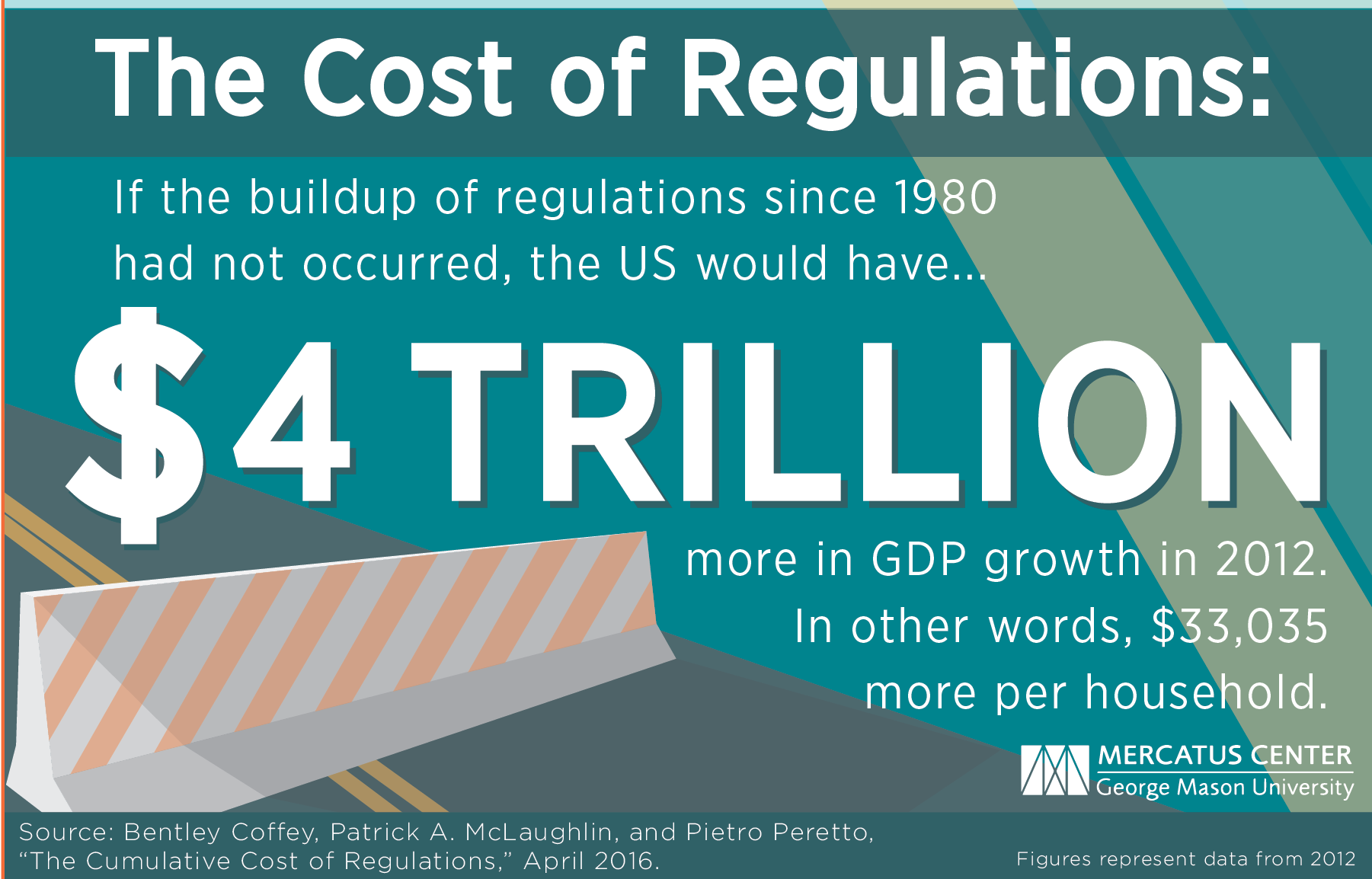
A recent study out of George Mason University concludes that “[b]y altering investment decisions and disrupting the innovation that comes from investment in knowledge creation, regulations have a cumulative and detrimental effect on economic growth—and, over time, have a real impact on American families and workers.” The key findings:

  • If regulation had been held constant at levels observed in 1980, the US economy would have been about 25 percent larger than it actually was as of 2012.
  • This means that in 2012, the economy was $4 trillion smaller than it would have been in the absence of regulatory growth since 1980.
  • This amounts to a loss of approximately $13,000 per capita, a significant amount of money for most American workers.

Check it out.

The Darkness of Game of Thrones

There will be Game of Thrones spoilers in this post. 

The cover of Game of Thrones, back before it went mainstream.

George R. R. Martin can write.[ref]Well, given how slow his progress has been recently, I suppose I should be more specific. When Mr. Martin writes, it’s very good.[/ref] I’ve known that since I read A Game of Thrones nearly 20 years ago. I was bothered by crippling a child in one of the first scenes, and by the time I got to Ned Stark’s execution at the end of the book I knew that the series wasn’t for me. I haven’t read any other books in the series, and I haven’t watched a single episode of the HBO adaptation. But, because I follow a lot of pop culture with interest, I do keep up with most of the memorable moments. From the Red Wedding to the death of Jon Snow, I keep tabs.

And it’s pretty grim stuff.

It turns out that Jon Snow’s not dead after all, by the way. This is the big reveal in the most recent episode, but it was overshadowed by, you know, brutally feeding a mother and her child to a pack of ravenous dogs. Here’s what Kelly Lawler wrote about it:

So in an episode where fans were given what might be the greatest news they could hope for, they were also treated to a mother and newborn child being eaten alive by dogs. Why? I couldn’t tell you, but I can tell you that an episode like “Home” demonstrates what is the fundamental underpinning of this show: It will do anything in its desperation to shock you. And while having actors and producers flat-out lie for a year in the press is the more innocent end of that spectrum, we certainly hope we’re not forced to listen to more infants being eaten alive. Because that’s not the shock we’re looking for.

Lawler goes on:

And so the audience was treated to the sounds and very nearly the sight of a woman and her newborn son being ripped apart by dogs. We’ve already seen countless women raped, a young girl burned alive by her own father, not to mention the weekly grind of violence and death we’ve become accustomed to. Sure, some of that is par for the course with the genre and the path this show has decided to take, but even for the most ardent fans, for the most faithful viewer, when is enough enough? Is there no line this show won’t cross?

There is something that people do not seem to understand about values, and it is this. Particular values are subjective and contingent. But having values at all is objective and universal. Where a society chooses to draw lines in what is acceptable and what is not changes with history and location and context. That societies draw lines is not.

Lawler seems to think that the important question is, how far do you go? But that doesn’t really matter, because different societies–and different individuals–have their own tolerances and their own lines in the sand. Location is largely meaningless. What matters is direction. Lawler writes that the show “will do anything in its desperation to shock you.” Why desperation? Because the more you shock the audience, the less sensitive they become.

No matter what your tolerances are, the danger–I believe–comes in crossing them habitually and for no higher purpose and in so doing desensitizing yourself. The world we live in certainly does not need less sensitivity. It certainly does not need less empathy. It does not need less light.[ref]FYI, A Game of Thrones is very, very far from the darkest stuff out there. If you really want to read a book with lots of child-torture and child-rape, then you should skip George R. R. Martin and head straight for N. K. Jemisin.[/ref]

Just something to think about.

The Dog Whistle Dilemma

dog whistle 800x400

Political polarization is bad enough, but sometimes partisan arguments are worse than merely polarizing. One example of this is the response to the controversial topic of political correctness and so-called “social justice warriors.”

Now, I’m not a huge fan of the term “social justice warriors” because—as a term that was initially a pejorative and is still primarily used that way—it carries a lot of baggage. But I do think that concerns about political correctness are legitimate, and I documented a lot of thinkers (primarily from the American left) who have agreed in recent months in Difficult Run’s most widely read article of 2015: When Social Justice Isn’t About Justice. This view—that political correctness, social justice activism, microagressions, tolerance, etc—have gone a little too far seems to be an emerging consensus. But there are still holdouts.

Not surprisingly, the holdouts come from within the social justice movement itself. One prominent, sympathetic voice is John Scalzi. He’s a best-selling, award-winning science fiction author who famously signed a multi-million-dollar publishing deal with Tor last year.[ref]Big enough to get its own article in the New York Times, the LA Times, and other venues.[/ref] He’s a prominent, influential voice on social justice issues, and according to him—and thousands who agree—there is no conceivable, legitimate concern to be had on this topic. For example, back in 2014, he wrote that:

“Political Correctness” is a catchphrase which today means one of two things. The first is, “I have done no substantial thinking on this topic in at least twenty years and therefore anything I say past this point cannot be treated with any seriousness.” The second is “It is more important for me to continue my ingrained bigotry than it is for you not to be denigrated or offended by my bigotry, because I am lazy and do not wish to be bothered.” If in fact you do not intend to convey either of these two things, you should not use, nor sign on to a document which uses, the phrase “political correctness.”

In November 2015, at precisely the time that opinion across much of the spectrum of American politics was starting to really take political correctness seriously as a threat, he wrote:

I’m always embarrassed for the people who use these phrases [“political correctness” and “social justice warriors”] thinking they’re cutting, when in fact what they signal to the rest of the world is that the utterer is dog-whistling to a low-wattage, bigoted rabble in lieu of making an actual argument.

You can immediately see the polarization and absolutism of Scalzi’s statements. If we take Scalzi’s argument at face value then we must write off folks like Andrew Sullivan, John McWhorter, Jeannie Suk, Jonathan Chait, Laura Kipnis, Asam Ahmad, Damon Linker, Greg Lukianoff and Jonathan Haidt[ref]These are the folks I quoted in When Social Justice Isn’t About Justice [/ref] as ignorant bigots. That’s a pretty diverse list of gay and straight, male and female, white and black thinkers (almost none of whom are conservative or Republican), but in one fell swoop Scalzi says you can ignore anything they say. Which is the whole point: you can make the world a much simpler place by inventing reasons to completely ignore your opponents. This is what political polarization is all about. We’ve seen this before.

But when we look at the specifics of Scalzi’s argument, we see another problem. The key concept in Scalzi’s argument is the concept of dog whistling. A dog whistle is “a type of whistle that emits sound in the ultrasonic range, which people cannot hear but some other animals can, including dogs and domestic cats, and is used in their training.”[ref]Quote is from Wikipedia, which notes that it is also known as a “silent whistle.”[/ref] So, in politics, the idea of dog whistling is that someone disguises racism behind a veneer of apparently neutrality. For example, they will talk about “thugs” (when discussing issues of race and crime, perhaps) as a stand in for just using the n-word. This accusation is true. It is a real thing that really happens.

The problem is that Scalzi isn’t leveling the accusation against a particular thing said by a particular person in a particular context. He is saying that anyone who says anything in any context about political correctness or social justice warriors is engaging in dog whistling.

Intended or not, the inevitable consequence of this move is that it subjectifies arguments. Making an argument about a person’s motivations or private beliefs is always tricky, but in most cases we can build a case by using publicly available, objective facts like their words, their behavior, the consequences of their actions, and so forth. But that’s not possible when we make categorical statements about the motivations and private beliefs of a wide range of people without any recourse to external facts. The only way to enact the total dog whistle accusation as Scalzi does is to abandon objectivity.

The case for abolition relied on objective claims like all people deserve human rights and human rights are incompatible with slavery as an institution. The 20 century civil rights movement also relied on objective claims such as segregation is incompatible with genuine racial equality. But the all-encompassing dog whistle accusation eschews recourse to any publicly available, objectively valid facts and so eschews objectivity itself.[ref]This is a common theme in modern social justice activism, by the way. Microaggressions are essentially subjective, although in that case it’s not the alleged intention of the microaggressor that matters, but the perceptions of the microaggrieved.[/ref]

Why does this matter? It matters because once an argument becomes subjective, it no longer makes sense to talk about who is more correct. Instead, arguments inevitably devolve into contests to see who is more powerful. When objective truth is no longer a recourse, all that remains is appeal to power. [ref]This is why so much contemporary social justice activism revolves around mass-shaming. It only takes one person to present a true argument, but it takes a mob to properly browbeat someone. You could argue that it takes a lot of people to amplify a true argument, but that clearly doesn’t apply to mass-shamings. If there’s just a single person being subjected to a massive barrage of negative attacks, clearly disseminating information broadly is not the primary objective. I’m also not saying the left invented mass shaming or has the monopoly on it, but it’s certainly distinctive of contemporary social justice activism.[/ref]

This makes the dog whistle accusation an ultimately self-defeating tool from the standpoint of genuine concern for social justice, because once the argument becomes a question of power, it is a foregone conclusion that it can no longer constitute a genuine challenge powers in high places. You cannot speak subjective truth to power because subjective truth is power.

The practical reality is that the ultimate consumers of social justice activism are nice, college-educated, open-minded, prosperous, white Americans who are desperate to find the magic words to say to absolve themselves of any perceived guilt from profiting off of historical exploitation or collaborating in ongoing, systemic oppression. Social justice activism, unmoored from sternly objectivist claims, cannot resist the universal solvent of American consumerism and is already far on its way to becoming just another luxury good. Social justice arguments rooted in subjectivism are no harder for elites to absorb and appropriate than any other cultural artifact, and when that happens the tactics, rhetoric, and infrastructure of social justice are deployed to serve the interests of those elites rather than to challenge them. This is true even when social justice ends up being deployed against minorities. Weapons, even rhetorical ones, don’t care who they are aimed at.

Consider Conor Friedersdorf’s recent Atlantic piece: Left Outside the Social-Justice Movement’s Small Tent. The story describes Mahad Olad’s journey into and then estrangement from social justice activism. Why? He had the temerity to question trigger warnings and attempts to shut down conservative speakers. The result? “I was accused of being outrageously insensitive and apparently made three activist cohorts have traumatic breakdowns,” (for questioning trigger warnings) and “I was accused of being a ‘respectable negro,’ ‘uncle tom,’ ‘local coon’ and defending university officials to continue to ‘systemically oppress minorities,” (for questioning silencing of conservative speakers).

This is just one example of social justice turning against minorities, but there are plenty more. There are articles like That awkward moment when I realized my white “liberal” friends were racists and The Unchecked Racism Of The Left And The Platinum Rule and The Disturbing Story Of Widespread Sexual Assault Allegations At A Major Progressive PR Firm and What Happens When a Prominent Male Feminist Is Accused of Rape?. [ref]Note that, predominantly, these examples do not rely on subjectivist claims. Rape and sexual assault, unlike universal dog whistles and microaggressions, are not subjective.[/ref]

As long as the dog whistle accusation is used as a blanket condemnation of all who have the temerity to question social justice activism and political correctness, social justice will be subjectified and therefore vulnerable to subversion by the privileged.[ref]Crucially: this happens without malice or even conscious awareness. It’s not that privileged people are evil, in this case, it’s just that goods and services are systematically warped to serve their interests, as social justice activists well understand in other contexts.[/ref] On the other hand, if the dog whistle accusation is only employed when there’s some kind of objective evidence for it, some bigots will get away with dog whistling because there won’t be enough convincing, objective evidence. This is the dog whistle dilemma, and it is intractable.

That’s the bad news. The good news is that our society is fully of intractable problems. The entire criminal justice system is a giant apparatus set up to confront exactly this kind of intractable problem. We balance the principle of presumed innocence and Miranda rights (to protect the innocent) against warrants and imprisonment (to punish the guilty) knowing full well we’re balancing incompatible interests. With fewer legal protections for the accused, we punish more of the guilt, but also more of the innocent. With more legal protections, we protect the innocent but also let the guilt get away. That’s not to say that we’re complacent about the tradeoff, and it’s certainly not to argue that we have the balance correct today. It’s simply to illustrate that the idea of an irreconcilable tradeoff between competing and incompatible values is not new.

The fatal flaw in the contemporary social justice movement is myopia. A criminal justice system that only cared about punishing the guilty would, in short order, discard all civil liberties in the pursuit of that objective, resulting in a nightmare.

No one wants to live in a society where sometimes murderers get away on a technicality. No one wants to live in that kind of society, that is, until we stop to really consider the alternative. A world where courts and prosecutors do not have to abide by the rule of law is even worse.

The same applies here. A world where some people can get away with racism as long as they cloak it in a thin veneer of plausible deniability is not anybody’s idea of a utopia. But a solution like Scalzi’s is even worse, because it’s not only a world riven by polarization and discord, but also a world where social justice itself becomes subjectified and then perverted to serve the interests of entrenched elites.

Mormonism and Becoming

DSCF3589 - Small

This post is part of the General Conference Odyssey.

Last week we covered the last session of the April 1972 General Conference. In July of that year, President Joseph Fielding Smith passed away, so this week we’re covering the first session during which President Harold B. Lee served as President.

It also means that during the three-year period from 1970 – 1972, there were three different Presidents of the Church[ref]as President Kimball noted in his talk.[/ref]. Change for the Church continued rapidly, since President Harold B. Lee passed away in 1973, meaning that the Church had 4 different Presidents in just a 5-year period.

Change was the central theme of one of the talks this session, Elder John H. Vandenberg’s Becoming a Somebody. “Who is there who has reached that point in life,” he asked, “where he can afford to allow himself to stop growing or to stop improving?”

This idea of constant progress and growth is at the core of who we are as Mormons, and Elder Vandenberg did an excellent job of trying it to our foundational principles and ordinances. It starts with faith, of course, but then “repentance follows faith as naturally as the day follows dawn.”

Once again, we’re unearthing that connection in Mormonism between knowing and loving. When we see Christ, we want to be nearer to Him. And that means becoming more like Him. And so faith leads to repentance, and then to baptism which—“as it cleanses the reborn person”—initiates a whole new journey of growth that is guided by the Holy Spirit. And so Elder Vandberg concludes:

In these principles we find the unfailing power to change… As one acquires knowledge of the gospel principles and pursues his course, he can successfully apply those principles to his individual circumstances, whether his position be one of great or meager possessions; whether it be early in life, during his economic production period, or in retirement. The gospel is meant to temper life and to bring it into true balance and fruition.

Thus we see the Gospel as middle way: calling us to strive for ideals beyond everyday experience, but at the same time calling us to spend our days and years in mundane work and service. Mormonism makes us grow because, when we are truly trying to live it, we refuse to let go of either Heaven or Earth and find ourselves stretched between the two.

Two final points stuck out from this talk. First, President Vandenberg said that “the Lord has decreed that ‘the Church hath need of every member.’” Last week, news broke of Tyler Glenn’s new song from his solo album. Glenn, the lead singer of the band Neon Trees, had recently been a positive spokesperson for the Church but, it seems, has come to believe that the Church has no need of him because of his same-sex attraction. That’s not true, and it’s not what the Church teaches. We are all sinners, and the Church needs us all anyway. That need is absolute and—like the Savior’s love—it is not contingent on our worthiness or righteousness. Glenn’s loss is also our loss—as it is with every member who stumbles—and I hope one day he comes home.

And then there is this final question: “I ask you, brethren, sisters, where would we be, where would you be, where would I be, if it were not for the power of the gospel of Christ?” It’s a sobering question, and one well worth asking of ourselves.

Check out the other posts from the General Conference Odyssey this week and join our Facebook group to follow along!

“Things Won Are Done; Joy’s Soul Lies In Doing”

This is part of the General Conference Odyssey.

In The Happiness Hypothesis, social psychologist Jonathan Haidt writes,

Richard Davidson, the psychologist who brought us affective style and the approach circuits of the front left cortex, writes about two types of positive affect. The first he calls “pre-goal attainment positive affect,” which is the pleasurable feeling you get as you make progress toward a goal. The second is called “post-goal attainment positive affect,” which Davidson says arises once you have achieved something you want. You experience this latter feeling as contentment, as a short-lived feeling of release when the left prefrontal cortex reduces its activity after a goal has been achieved. In other words, when it comes to goal pursuit, it really is the journey that counts, not the destination. Set for yourself any goal you want. Most of the pleasure will be had along the way, with every step that takes you closer. Th e final moment of success is often no more thrilling than the relief of taking off a heavy backpack at the end of a long hike. If you went on the hike only to feel that pleasure, you are a fool. People sometimes do just this. They work hard at a task and expect some special euphoria at the end. But when they achieve success and find only moderate and short-lived pleasure, they ask (as the singer Peggy Lee once did): Is that all there is? They devalue their accomplishments as a striving after wind. We can call this “the progress principle”: Pleasure comes more from making progress toward goals than from achieving them. Shakespeare captured it perfectly: “Things won are done; joy’s soul lies in the doing” (pgs. 83-84).

I was reminded of this while reading John H. Vandenberg’s October 1972 talk. In it he explains that the Church “extends the invitation to all who so desire to partake of the power of the gospel, which will lift an individual out of oblivion and, in so doing, will give a feeling of satisfaction and happiness not to be found elsewhere. It provides the sources of control for self-improvement, a stable character, and a truly successful life.” In Vandenberg’s eyes, the gospel is about–to borrow Haidt’s term–progress: “It is highly doubtful that there is even one soul upon the earth, regardless of station or age, who does not have ample room for personal growth and improvement. Quoting the words of one of the Lord’s prophets: “If we are no better tomorrow than we are today, we are not very useful.” (David O. McKay, Pathways to Happiness [Bookcraft, 1957], p. 292.)” This fits with Joseph Smith’s original vision of the divine:

Being versus Becoming, Process versus Perfection, Creation, Time, and Eternity…The Great Chain of Being–unchallenged paradigm of a static, orderly, and harmonious universe–was buried beneath the emergent model of chaos, flux, radical transformation, and conflict…If there was one prevailing sense in which Joseph Smith was a child of his age, it was in the avidity with which he reflected this dynamic, fundamentally Romantic view of the world, an orientation that suffused his cosmology, his human anthropology, and even his doctrine of deity.[ref]Terryl Givens, Wrestling the Angel, 52.[/ref]

For Vandenberg, the concept of repentance is “the very essence of change; it embodies the powerful principle of obedience to God’s law and discipline of self. When applied to our lives, it provides a cleansing joy which surges through us.” This doesn’t say, “And when you finally get to the end, you’ll feel joy.” But the constant state of improvement–of “small wins“–brings happiness:

In these principles we find the unfailing power to change. As to the effective use of our leisure time, we have, in the gospel, unnumbered opportunities. As one acquires knowledge of the gospel principles and pursues his course, he can successfully apply those principles to his individual circumstances, whether his position be one of great or meager possessions; whether it be early in life, during his economic production period, or in retirement. The gospel is meant to temper life and to bring it into true balance and fruition…The individual power is attested to in this scripture: “Verily I say, men should be anxiously engaged in a good cause, and do many things of their own free will, and bring to pass much righteousness; For the power is in them, wherein they are agents unto themselves. And inasmuch as men do good they shall in nowise lose their reward.” (D&C 58:27–28.)

Mormons need to remember that it’s about the journey: not the achievement of some static perfection.

Have Mormons Checked Out of the Political Process?

On the very large sample size of my Facebook friends and my own personal feelings (so clearly, sound and publishable data), I’ve noticed that Mormons (read: my Facebook feed and myself. Except, I guess, not me at this moment.) are kind of quiet about the election this year. I’ve never seen it happen (on my Facebook feed).

I’m going to extrapolate from this great sample of data: I wonder if this silence has to do with the following.

This year we have a super rich guy with multiple marriages, multiple failed businesses, no government experience, no experience turning around a failed business, no (previously) conservative values, who is vulgar, rude, hates immigrants, hates women, speaks without learning, and is doted upon by the media (even when they are making fun of him its with a gentle glee that their (read: Democratic) nominee will surely beat this buffoon).

Mitt-MissMeYetOnce upon a time we had an amazing anti-Trump candidate (other than he was also rich, but only 1/18th as rich as Trump). But this candidate had this YUGE personal problem. He was a Mormon. And that just won’t do. The media, Republican establishment, and core Republican (conservative? evangelical? INSANE?) voters just could not allow a stand-up guy like this to be the nominee, unless of course it was against a sitting president, a set-up for failure.

This is what you have done to us media (Democrats?) and Republicans. But they haven’t just done it to Mormons. They’ve done it to America.

The Happiness Hypothesis: An Interview with Jonathan Haidt

This is part of the DR Book Collection.

Over the past couple years, I’ve done several conference presentations on the subject of a Mormon theology of work. Recently, I compiled much of the research from this various presentations and submitted it to BYU Studies Quarterly. I was thrilled to find out earlier this year that they will in fact be publishing it. The last section of the article looks at insights from management literature. I was fairly satisfied with it, but then I picked up Jonathan Haidt’s The Happiness Hypothesis: Finding Modern Truth in Ancient Wisdom and began kicking myself for not reading it sooner and incorporating it into my paper. Haidt explores the divide between conscious and unconscious mental processes, the social nature of reciprocity and hypocrisy, and the benefits of love, adversity, and sacredness. But what jumped out at me was his overview of the “pursuit of happiness”: happiness rarely comes from achieving goals (that emotional high is fleeting), but from striving to achieve them. It is making progress that brings up happiness. I read Haidt’s The Righteous Mind first, but I enjoyed this one just as much.

Check out the interview with Jonathan Haidt below.

Is Globalization Good for the Poor?

World-Poverty-Since-1820

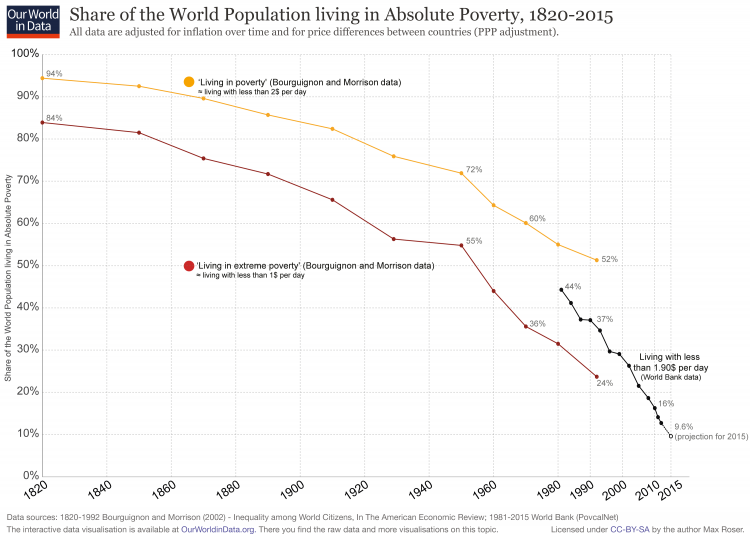
Absolute poverty is declining. This is a fact. “But,” asks Swedish economist Andreas Bergh, “why is poverty falling? Is it happening because of globalization, or perhaps despite globalization?”

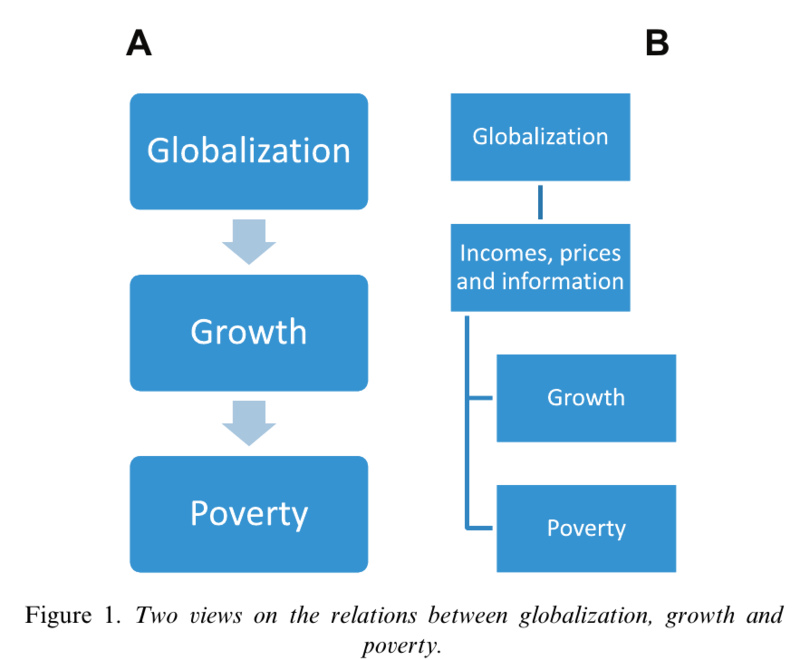
His recent blog post on the matter seeks to answer just that. Drawing on some of the latest research, he points out that “more globalization is indeed followed by decreasing poverty, but only a small part is explained by the growth of average income levels.” It seems that globalization via trade liberalization not only brings about income growth, but also increased information. In fact, lower trade restrictions and larger information flows seem to be the major factors behind decreasing poverty.

However, this is arguably the most important finding:

Using various components from the International Country Risk Guide to quantify institutions such as government stability, law and order, bureaucratic quality, corruption and democratic accountability, in combination with the data from Bergh & Nilsson (2014), we showed in a follow-up paper (Bergh, Mirkina and Nilsson 2015) that the poverty-decreasing effect of globalization is bigger in countries where institutions are worse. The graph below shows how the marginal effect of information flows on poverty varies depending on the level of bureaucratic quality. The slope looks the same for all institutional indicators, suggesting that globalization is especially important for the poor in countries with high corruption levels and inefficient public sectors.


Bergh concludes, “[T]he data show rather convincingly that globalization has been good for the poor, but you should still be careful when giving policy advice to countries.”

“Peace Be Unto You”

This is part of the General Conference Odyssey.

I’ve been slowly working through a couple books on scripture, theology, and peace with the hope that the insights gleaned from them will blossom into a future publication. One book focuses on the New Testament, while the other relies specifically on Mormon scripture and tradition: Covenant of Peace: The Missing Peace in New Testament Theology and Ethics and War & Peace in Our Time: Mormon Perspectives. New Testament scholar and Covenant of Peace author Willard Swartley argues that the themes of kingdom of God, gospel, and peace are interwoven throughout the New Testament. In summary, he finds:

  1. The over-arching emphasis of Scripture presents God as Peacemaker who is also the Divine Warrior fighting against evil to establish and maintain peace and justice. God’s people are called to trust in God for the divine victory, and are not to take vengeance and judgment into their own hands…

  2. Jesus comes as divine warrior to overcome and defeat the powers of evil…Exorcisms and healings play a major role in his ministry, to announce the breaking in of God’s reign.

  3. In Jesus’ combat against and the victory over evil, his disciples are called not to fear, but to believe, have faith…

  4. Jesus refuses easy identification with Jewish expectations of the Messiah (Mark 8:29-33) because those hopes violated God’s way for the victory to be won. Jesus denounces the domination system with its redeemer myth that lives by violence. Instead, Jesus identifies himself with the Danielic “Son of humanity” and indirectly with the Isaiah “servant” traditions, in which victory comes through suffering. Jesus’ entry into Jerusalem on a donkey shows him as king of peace, based on humility and trust in God.

  5. Jesus includes “the enemy” in his circle of ministry: the marginalized Jews, the Samaritans, and the Gentiles. This incarnates his teaching: “Blessed are the peacemakers, for they shall be called the children of God.” Love of the enemy and nonretaliation are cardinal teachings of the gospel. So also is confrontation of and expulsion of demonic spirits–God’s kingdom against Satan’s kingdom…

  6. Luke provides us with twin themes in his travel narrative in which peace and justice are Jesus’ gifts through his ministry, on the one hand, and presuppose, on the other, this onslaught against and victory over Satan and the demonic powers…

  7. The Pauline teaching on the powers is a gospel proclamation of the theological meaning of Jesus’ ministry…[Walter] Wink is correct that the method of Christ’s defeat of the powers is the nonviolence of the cross…[ref]Willard M. Swartley, Covenant of Peace: The Missing Peace in New Testament Theology and Ethics (Grand Rapid: Eerdmans, 2006), 51-52.[/ref]


In his essay “A Non-Violent Reading of the Book of Mormon,” Joshua Madson writes,

A rough outline of the Book of Mormon history would consist of the following acts: (1) Creation of Lehites, (2) Fall of Lehites and their division, (3) Nephite and Lamanite conflict, (4) Jesus and Zion, (5) Apocalypse. These acts form parts of a larger narrative–and although there are “multiple smaller narratives, some of them pulling this way and that within the larger one, sometimes even seemingly in opposite directions” within this grand narrative, this is to be expected and only a problem if we shrink the grand narrative from its full implications. Therefore, justifications for violence taken from teachings and actions in the third act of the Book of Mormon should not trump the corrective teachings of Jesus in Act 4 and the results of continuing to live as if he never came in Act 5. It is not to Captain Moroni, for example, that we should look for our views on war but to the larger narrative and subsequent acts, especially as they resolve or explain the problem of violence…When read in this manner, the Book of Mormon presents a strong critique of violence as a solution to conflict. It presents us with a thousand-year case study and addresses the question: how should we respond to our enemies? Ultimately it presents us with two options: we can either imitate Christ in loving our enemies and seek at-one-ment with them, or we can resort to violence, which leads to individual and communal annihilation.[ref]Madson, “A Non-Violent Reading of the Book of Mormon,” in War & Peace in Our Time: Mormon Perspectives, ed. Patrick Q. Mason, J. David Pulsipher, Richard L. Bushman (Salt Lake City: Greg Kofford Books, 2012), 15-16.[/ref]

I was reminded of these books when I read the talks by Eldred G. Smith and John H. Vandenberg in the April 1972 Conference. Mining through several quotations of Jesus, Elder Smith states,

How is it that we have not discovered the secret of peace when we have been looking for it all through the ages? I’ll tell you. We are looking for someone to create it for us—to bring it to us. Edna St. Vincent Millay said: “There is no peace on earth today, save the peace in the heart at home with God. … No man can be at peace with his neighbor who is not at peace with himself. …” (“Conversations at Midnight,” Collected Poems, Harper & Row, Copyright 1937 and 1964.)

Have you experienced that peace within you because you helped your neighbor rake his lawn or mow his lawn? Have you felt that peace within because you helped your neighbor pick his fruit or harvest his crops? Have you witnessed that peace within because you shoveled the snow off your neighbor’s walks? Have you felt that peace which came because you helped someone solve a problem and get a new lease on life? Have you “cheered up the sad, and made someone feel glad”?

His point?:

A key to peace, then, is service. Christ said: “But he that is greatest among you shall be your servant.” (Matt. 23:11.)…The Lord has said: “For behold, this is my work and my glory—to bring to pass the immortality and eternal life of man.” (Moses 1:39.) Is this not the ultimate of service? To become as God is, then, we must eliminate enmity, greed, and selfishness, and all our efforts must be in service to others. The Lord said: “… he who doeth the works of righteousness shall receive his reward, even peace in this world, and eternal life in the world to come.” (D&C 59:23.)

He concludes:

If each person would have peace within his soul, then there would be peace in the family. If there is peace in each family, then there is peace in the nation. If there is peace in the nations, there is peace in the world. Let us not just sing, “Let there be peace on earth and let it begin with me,” but let us mean it. Make it my goal—your goal. When the Savior comes again—and he will come—he will bring peace only as we will accept and follow his teachings of service to others and eliminate enmity and unrighteousness…His kingdom is already here on earth and is growing rapidly to prepare for his coming. Yes, he shall surely come and bring peace to the earth, but only as we are willing to follow his teachings. This is his work, and his kingdom, which is the only way to world peace and eternal peace.

Elder Vandenberg in turn teaches that “paths of avarice, ambition, envy, anger, and pride” lead us away from peace. “Surely the greatest enemy of peace is selfishness and with it the desire to pile up treasures on earth.” Sadly, “an encyclopedia shows that during the period from 1496 B.C. to A.D. 1861 there were 227 years of peace compared with 3,130 years of war. Ambition, either privately or collectively, gives little hope for the achievement of peace.” Yet, Vandenberg has little faith in achieving peace by “making a sign or by writing words on fences. It must come first and most completely to the individual through his own efforts in keeping the commandments of our Lord and Savior, for God made all men to enjoy such peace.” Drawing on 4 Nephi (part of Act 4 mentioned above), he finds that “there is no quicker way to enjoy inner peace than by serving one another.” The Nephite Zion society was “a marvelous period of time when this peace did indeed banish avarice, ambition, envy, anger, and pride from men’s hearts.”

Peace begins with us. And it comes from imitating Christ.

Other Noteworthy Quotes & Insights

Bernard P. Brockbank:

Knowing God does not solve life’s problems, but gives purpose and strength to master them. Jesus, with his knowledge of his Heavenly Father, still had his problems to meet and to work out.

Sterling W. Sill:

He recognizes the importance of reading and intellectual stimulation:

Over the door of the library in the ancient city of Thebes, an Egyptian king once carved an inscription that said: “Medicine for the Soul.” Like all thoughtful people, this wise ruler understood that if the mental, spiritual, and emotional health of his people was to be properly cared for, it must be constantly nourished. And because ideas, ideals, and ambitions can be most effectively supplied through books, this great king had provided an ample literary storehouse as a place where his people could get the necessary help for thinking good ideas, building up proper attitudes, vitalizing their faith, motivating their ambitions, and increasing their righteousness, that they might help themselves to save their souls…One of the most effective cures for all of our present-day problems is found in the literary remedy that comes from thinking uplifting thoughts and living the great principles of the gospel. The science of writing has probably made books our greatest invention. Writing is preserved speech; it is potential ambition. By effective study we can acquire knowledge, build faith, and develop an enthusiasm that will lead us to any desired accomplishment…Someone has pointed out that books are among life’s most precious possessions. They are the most remarkable creation of man. Nothing else that man builds ever lasts. Monuments fall, civilizations perish, but books continue. The perusal of a great book is as it were an interview with the noblest men of past ages who have written it.

Of course, this includes the scriptures:

Our present state of malnutrition is not because of any famine for bread nor a thirst for water, but it is for the hearing and the obeying of the word of the Lord. That is, our many soul-deaths do not occur because a remedy is not available; it is only because we are failing to take that medicine which has already been provided and has already proven its effectiveness…Our present most urgent needs are that we should read more and understand more and think more and do more and be more and live more. Jesus emphasized his own mission by saying, “I am come that they might have life, and that they might have it more abundantly.” (John 10:10.) We must not allow the holy scriptures to sit on our shelves unopened while we continue to starve to death spiritually because we fail to practice those great success laws on which the eternal exaltation of our souls depends.