In the comments on my last post, Robert C made an important point based on his own experience that “the poor in the U.S. experience a high degree of social, emotional, and psychological stress in comparison to the lack of such stress among the relatively rich in other countries.” My interest in economics and data is largely about providing proper context and analysis, but sometimes it can make me look like a cold-blooded bastard.
Robert is right though. The working class in America does face major problems. The experiences of those growing up in working-class neighborhoods are often traumatic and these experiences have negative effects on economic outcomes (let alone well-being). David Lapp, a research fellow at the Institute for Family Studies, had a powerful reply to a couple recentarticles blasting the American white working class. As Lapp tells it,
No true calamity or awful disaster has befallen the white working class?
Try telling that to [the boy] whose own mother abused him and whose parents left him. Try telling that to the girl molested by her mother’s boyfriend, or the little girl whose mom and boyfriend passed out in the McDonald’s parking lot because of a heroin overdose, or the 10-year-old boy who walked into his parents’ bedroom to find his dad having sex with a stranger. (Those are just some of the typical stories we heard in our interviews with members of the working class in Ohio.) As one young man told me, “Besides killing a small child I would say that divorce is the second-worst thing that can ever happen. Because divorce is the symbol of violently breaking apart. Like in my case, my dad and my mom separating, it tore the family apart, literally. It was the symbol of breaking apart and shards went everywhere.”
I understand the point that Williamson and French are trying to make: when we speak of divorce and abuse and heroin and father absence, we are not talking about the factory that left, but acts perpetrated by adults with moral responsibilities. But that is no solace to the young victims—yes, we must speak of victims—of those traumatic events.
Because the divorce culture is a true calamity for generations of young people growing up in the aftermath. Nor should we imagine that just because a cause is cultural or familial, and not economic, that it involves no victims. As Rod Dreher writes in a response to Williamson’s post, “Children are not empty receptacles into which we can insert knowledge. If they live in homes filled with noise, chaos, violence, and contempt, it doesn’t matter what race they are, they are going to be very lucky to make it.”
Families are in trouble, but people aren’t making bad decisions in isolation. The family is in trouble because marriage is a social institution, and many young people have seen their own parents, grandparents, and great-grandparents divorce (sometimes two, three, and four times). Whatever the reasons for divorce that the pioneers of the divorce revolution had, the young people walking into marriage today—or looking bewilderingly at it from the outside—are left feeling broken. That raises serious questions.
…We can always point to some people who grew up in troubled families and nevertheless succeed. We admire their courage and perseverance. Still, isn’t it self-evident that a child who suffers his parents’ divorce, or the absence of his father, or parental abuse, is much less likely to form good and lasting relationships as an adult? More likely to despair and resort to Oxycontin and heroin? And shouldn’t that fact matter for how we think and talk about the problems that confront the poor and working class, many of whom suffer these traumas?
Lapp recognizes that narratives about the poor often fall into two extreme categories and that he could easily adopt one of these extremes in telling of the story of those he’s interviewed. One extreme highlights external factors and lack of resources (typically the political left), but this largely ignores the poor’s “own words about how things could have been different if they had made different choices.” The other extreme focuses “almost exclusively on these young adults’ own moral responsibilities, and downplay the cultural and economic forces and trauma clearly impinging on their lives” (typically the political right). “The true story,” Lapp says, “…is one that shows how cultural and economic forces and trauma intersect with people’s own free decisions.” To “scold the “downscale” people about their sins and “entitlement” and their communities “that deserve to die”” is to assume that “a person suffering from years of trauma and deprived of good models of family life could just snap out of it with a few good rebukes.” When we do this, we fail “to look squarely at not just “the problem,” but the person in front of us.”
The complexities of poverty demonstrate the need for strong communities, families, churches, charities, and yes, even government programs. I still think economic growth does far more to lift the poor out of poverty than anything else. But when traumatic home life retards your emotional, psychological, educational, and economic development, this is not something that should be shamed. It’s something that should be dealt with through integration into a supportive social network.
And this–to borrow language from one of the recent critiques of the working class–requires us to “get off our asses” and help them out.
Perhaps the best irony about the GOP candidates’ rhetoric against the refugees is that it technically, according to the Bible, makes them Sodomites.
This was my friend Stephen Smoot‘s Facebook status a while back, referring to Ezekiel 16:49-50: “Behold this was the guilt of your sister Sodom: she and her daughters had pride, excess of food, and prosperous ease, but did not aid the poor and needy. They were haughty and did an abomination before me. So I removed them, when I saw it” (ESV). I was reminded of this with the launch of the Church’s new relief effort “I Was a Stranger.”
One thing more I should like to state. We are having come into the Church now many people of various nationalities. We in the Church must remember that we have a history of persecution, discrimination against our civil rights, and our constitutional privileges being withheld from us. These who are members of the Church, regardless of their color, their national origin, are members of the church and kingdom of God. Some of them have told us that they are being shunned. There are snide remarks. We are withdrawing ourselves from them in some cases.
Now we must extend the hand of fellowship to men everywhere, and to all who are truly converted and who wish to join the Church and partake of the many rewarding opportunities to be found therein. To those who may not now have the priesthood, we pray that the blessings of Jesus Christ may be given to them to the full extent that it is possible for us to give them. Meanwhile, we ask the Church members to strive to emulate the example of our Lord and Master Jesus Christ, who gave us the new commandment that we should love one another. I wish we could remember that.
These days, there are many people who believe that the Church’s emphasis on family is something new and misguided, but I have long thought that—at a level even deeper than teaching or doctrine—the Church has long expressed a reality that family is primary and Church is secondary. What is this deeper level? Well, one way of looking that the Church is as modern day Sadducees: keepers of the temple. And what is the point of the temple? To seal families together.
In many ways that’s the most fundamental mission of the Church: to knit the entire human family together in one extended act of reconciliation. The Atonement is the center of the Church—both in practice and in belief—and the emphasis on family is like the ripples emanating out from that central act, echoes of reconciliation expanding and flowing throughout humanity, restoring what is broken and making us whole again not just as individuals, but as a collective.
Among the talks I read for this week, there was a line in Elder Victor L. Brown’s talk (The Aaronic Priesthood – A Sure Foundation) that made me think I could be on to something. He wrote:
The position of the Church is to aid the parents and the family.
It’s not definitive enough to hang your hat on all by itself, but it’s certainly something to think about. The Church exists to serve the family, not the other way around. And by “family” I mean both senses of the word. I mean my family and your family, our individual little clans here on Earth. And by “family” I also mean: all of us.
We teach our children to sing “I Am a Child of God.” And we take it seriously. In our words, in our songs, but most importantly in our actions.
Over at the Harvard Business Review, there’s a great post on the importance of human connection at work. It starts off by explaining that some research finds that employees prefer happiness at work to larger pay:
So what leads to employee happiness? A workplace characterized by humanity. An organizational culture characterized by forgiveness, kindness, trust, respect, and inspiration. Hundreds of studies conducted by pioneers of positive organizational psychology, including Jane Dutton and Kim Cameron at the University of Pennsylvania and Adam Grant at Wharton, demonstrate that a culture characterized by a positive work culture leads to improved employee loyalty, engagement, performance, creativity, and productivity. Given that about three-quarters of the U.S. workforce is disengaged at work — and the high cost of employee turnover — it’s about time organizations start paying attention to the data.
Research suggests that the most powerful way leaders can improve employee well-being is not through programs and initiatives but through day-to-day actions. For example, data from a large study run by Anna Nyberg at the Karolinska Institute shows that having a harsh boss is linked to heart problems in employees. On the other side of the coin, research demonstrates that leaders who are inspiring, empathic, and supportive have more loyal and engaged employees. So checking in with employees about their families once in a while may help more than offering a mindfulness class at lunchtime.
This is a powerful reminder that “organizations are first and foremost places of human interaction, not just transaction. Research shows that our greatest need after food and shelter is social connection — positive social relationships with others. If we create work environments characterized by these kinds of positive and supportive interactions, we create organizations that thrive.”
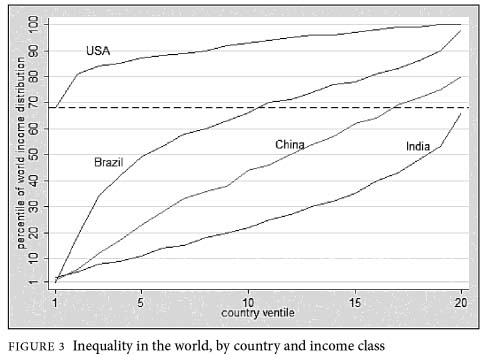
The graph shows inequality within a country, in the context of inequality around the world. It can take a few minutes to get your bearings with this chart, but trust me, it’s worth it.
Here the population of each country is divided into 20 equally-sized income groups, ranked by their household per-capita income. These are called “ventiles,” as you can see on the horizontal axis, and each “ventile” translates to a cluster of five percentiles.
The household income numbers are all converted into international dollars adjusted for equal purchasing power, since the cost of goods varies from country to country. In other words, the chart adjusts for the cost of living in different countries, so we are looking at consistent living standards worldwide.
Now on the vertical axis, you can see where any given ventile from any country falls when compared to the entire population of the world.
Now the clincher:
Now take a look at America.
Notice how the entire line for the United States resides in the top portion of the graph? That’s because the entire country is relatively rich. In fact, America’s bottom ventile is still richer than most of the world: That is, the typical person in the bottom 5 percent of the American income distribution is still richer than 68 percent of the world’s inhabitants.
Now check out the line for India. India’s poorest ventile corresponds with the 4th poorest percentile worldwide. And its richest? The 68th percentile. Yes, that’s right: America’s poorest are, as a group, about as rich as India’s richest.
This goes hand-in-hand with yesterday’s post about GDP per capita (PPP). Should provide some much-needed context when we talk about inequality and “the rich.”
Economist Mark Perry has put together an eye-opening chart based on data from the Bureau of Economic Analysis and the World Bank that compares GDP per capita (PPP) in the United States (state-by-state) and other countries, including those of Europe. As Perry explains,
Adjusting for PPP allows us to make a more accurate “apples to apples” comparison of GDP per capita among countries around the world by adjusting for the differences in prices in each country. For example, the UK’s unadjusted GDP per capita was $45,729 in 2014, but because prices there are higher on average than in the US (for food, clothing, energy, transportation, etc.), the PPP adjustment lowers per capita GDP in the UK to below $40,000. On the hand, consumer prices in South Korea are generally lower than in the US, so that increases its GDP per capita from below $28,000 on an unadjusted basis to above $34,000 on a PPP basis.
And what does he find?
“As the chart demonstrates,” Perry writes,
most European countries (including Germany, Sweden, Denmark and Belgium) if they joined the US, would rank among the poorest one-third of US states on a per-capita GDP basis, and the UK, France, Japan and New Zealand would all rank among America’s very poorest states, below No. 47 West Virginia, and not too far above No. 50 Mississippi. Countries like Italy, S. Korea, Spain, Portugal and Greece would each rank below Mississippi as the poorest states in the country.
The Cato Institute’s Daniel Mitchell adds a few more points, including the OECD’s Individual Consumption Index:
He concludes,
None of this suggests that policy in America is ideal (it isn’t) or that European nations are failures (they still rank among the wealthiest places on the planet).
I’m simply making the modest — yet important — argument that Europeans would be more prosperous if the fiscal burden of government wasn’t so onerous. And I’m debunking the argument that we should copy nations such as Denmark by allowing a larger government in the United States (though I do want to copy Danish policies in other areas, which generally are more pro-economic liberty than what we have in America).
That’s one takeaway from a recent post by Brookings fellow Beth Akers:
Essentially, does higher education succeed in lowering intergenerational “stickiness” of socioeconomic status?
Unfortunately, the evidence doesn’t paint as rosy of a picture as we’d like to see. New evidence shows that a college degree might be worth less if you’re raised poor. We can’t say for sure why this is the case, but it’s easy to imagine a number of reasonable explanations. For instance, it’s likely that students who grown up in poorer families attend lower quality institutions. The disparity in returns is so large that individuals who are born into poor families (the lowest quintile of the income distribution) and manage to graduate from college have the same chance of staying in the bottom income quintile as people who are born into rich families (higher income quintile) and don’t complete high school.
Another one is to ignore (or at least temper) the increasingly popular notion that a college education is about knowledge, not a path to higher income:
For a long time we’ve hesitated to talk about education as a financial investment, but that has a done a disservice to the students who can’t really afford the luxury of turning a blind eye to the economic consequences of their decisions. We need to empower students to make good decisions by publishing data on the labor market returns of each program of study covered by the federal student aid program. A large step on this front was taken last year when earnings data for each college was published on a government website. But program level information is also necessary so that students can choose courses of study that are likely to lead them to jobs that will make their college costs worth it.
She adds that we should seek ways to “reduce the risk of investing in higher education including a more robust income driven repayment system in the federal loan program, private market financial products that offer insurance to student borrowers and new business models that offer guarantees to students.”
Long before Tuesday’s terror attacks in Brussels, it was clear that Belgium had become a breeding ground for Islamist extremists. Hundreds of Belgian Muslims — as many as 500, according to one estimate — have gone to Syria and Iraq to fight for ISIS, making Belgium by far Europe’s leading supplier of foreign jihadists. Last November’s horrific slaughter in Paris was masterminded by a Belgian radical, Abdelhamid Abaaoud, and at least four of the men who carried out those attacks were from the Brussels district of Molenbeek. One of them was Salah Abdeslam, who was captured in Molenbeek, after an intense manhunt, on March 19.
For Islamist imams and terrorist ringleaders, such neighborhoods — heavily Muslim, densely populated, with high unemployment and crime rates — have proved fertile territory for recruiting violent jihadists. “There is almost always a link with Molenbeek. That’s a gigantic problem, of course,” Belgium’s prime minister said after the Paris atrocities.
The article continues by explaining that “Muslim communities are not inherently predisposed to violence. The presence of a sizable Muslim population in a non-Muslim-majority country does not inevitably presage jihadist bloodshed or demands for the imposition of sharia. It is true that some 650,000 Muslims live in Belgium, but five times as many — 3.3 million — live in the United States. Why hasn’t America become a hotbed of Islamic extremism? Why aren’t American Muslims by the thousands flocking to fight for ISIS, Al Qaeda, and other terrorist organizations?” Drawing on Pew Research data, the columnist points out that the “United States has been far more successful at assimilating and integrating Muslim immigrants into American society and culture than has Western Europe.” And this is all despite the wars in Afghanistan and Iraq. In other words, “America’s melting pot still works.”[ref]Which is why Trump and Cruz should really shut their mouths.[/ref]
Much of this is surely cultural. But are there any economic factors involved? Journalist and Reason analyst Shikha Dalmia thinks so. “The standard explanation,” she writes, “is that Europe has admitted more Muslims than it can afford to integrate…Failure to spend money on integration means consigning these refugees to segregated Muslim ghettos or banlieues without jobs and without prospects — other than their monthly welfare check — where they become sitting ducks for radicalization.” But this narrative is flawed:
Immigrants don’t need job programs. They need jobs. And, for a variety of reasons, Europe provides much more of the first and America much more of the second. Europe has an army of social workers in various NGOs whose job is to prepare immigrants for jobs. Not so much in America, which may be partially why America has a far better assimilation track record than Europe. Jobs offer immigrants not just a paycheck, but also an entry into their new society, providing them with both the means and motive to learn its language and customs, all of which eliminates the need for formal programs. What is striking in any conversation with Syrian refugees in America is just how ready and willing they are to take just about any job, no matter how lowly or arduous…Yet many European countries have gone out of their way to deny or severely limit job opportunities for asylum seekers and refugees.
…Even after refugees obtain work permits, their upward mobility is greatly restricted in Europe, thanks to the exceedingly rigid labor market in many countries. The unemployment rates of France and Belgium are nearly twice that of the United States. This dismal job market affects immigrants much more than the native born, thanks to Europe’s tough minimum wage laws and other labor regulations that protect incumbents at the cost of newcomers…Europe’s tough hiring-and-firing provisions, demanded by labor unions, are poison for immigrants. Why? Because immigrants inevitably involve more risk and uncertainty than natives, and if employers can’t fire them, notes George Mason University’s Alex Tabarrok, they won’t hire them either. It is not surprising that Muslims in France, which has some of the most protective labor laws in the industrialized world, are two-and-a-half times less likely to receive job interviews than non-Muslims.
This counterintuitive explanation is worth considering.
I just finished listening to a bunch of science fiction stories in rapid succession so that I could cast informed votes for the annual Hugo awards and post the reviews to my new blog.[ref]The Loose Canon is where I will do most of my future blogging about science fiction.[/ref] That done, I returned to some of the non-fiction audiobooks I’ve been waiting to get into, especially Redefining Reality: The Intellectual Implications of Modern Science. It’s been a fantastic spring day, and there was an exquisite, gentle evening breeze as I walked the dog. Meanwhile, Professor Steven Gimbel explained the impact of World War II on the field of social psychology:
In the first half of the 20th century, psychology had the luxury of debating whether a subconscious mind existed and whether scientific methodology required limiting the field of study to stimulus and response, but after the horrors of World War II, psychology changed… The specter of the Holocaust raised deep and troubling question about the human mind and its relation to authority… The reaction to Nazi atrocities in the scientific world is shaped by what are perhaps the three most famous psychological experiments: Stanley Milgram’s obedience study, Solomon Asch’s group think study, and Philip Zimbardo’s Stanford prison study. [ref]The quote is my own transcription, and I added the hyperlinks.[/ref]
I think Millgram’s and Zimbardo’s experiments are the most famous. At least, those are the ones that I’ve read about and seen the most. I was familiar with Asch’s study as well, but I haven’t seen it come up as often, and I was unprepared for how deeply a simple remark made by Gimbel would strike me. It hit so forcefully that I hit pause on the audiobook (to keep that thought forefront on my mind), came home, opened my laptop, and began this blog post.
In Asch’s study, participants were given a simple task. They had a reference image that showed a vertical line, and then another image that showed three vertical lines. One of the three matched the vertical line in the reference image, and all they had to do was pick out the correct match. They were asked to do this 18 times. The trick is that the participants were seated at a table with seven other people who were secretly in on the experiment. On the first two rounds, these seven individuals all gave the same answer, and it was the correct one. But on the third trial, these individuals all gave the same incorrect answer. Over the course of the next 15 trials, the seven plants gave the wrong answer 11 times, and in each case all seven of them gave the same incorrect answer.
So you’ve got eight people seated around a table answering a perfectly obvious question. Seven of them have just given the identical, incorrect answer. The point of the experiment was to find out what the eighth person–the only real subject of the study–would do. Given that this is considered one of the “three most famous psychological experiments” you can guess how it turned out even if you don’t already know: 75% of subjects went with the group consensus (even though it was obviously wrong) at least one out of the 12 times when the seven fake participants picked the wrong answer.
There are all kinds of interesting details to the study, especially when it comes to the rationales that the participants gave afterwards to explain why they had refused to go along with the group or why they had, at least some of the time, opted to go along with the group despite what was clearly true. But here’s what Gimbel said about the study that so arrested me:
Asch expanded the study to see what would happen. He showed that the bigger the majority, the stronger the pull to conform, but that if even one person dissented before the test subject, that the test subject was then more likely to voice his different view. Asch showed empirically that having someone else agree with you is a powerful tool in making people willing to take a contrary position. But, if that person [the test subject] were deserted by his fellow dissenter, conformity followed rapidly.[ref]I transcribed this quote from the audio and then added emphasis to the text version.[/ref]
Now, before I continue, I want to take a moment to explain that–contrary to popular opinion–I’m not interested in attacking conformity. Conformity gets a bad rap in movies like Dead Poet Society.
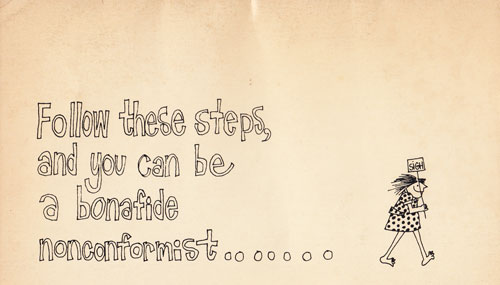
The sentiment in that clip is hogswash. Unfortunately, so is most anti-non-conformity sentiment. There’s an entire guide to being a non-conformist, but–like all such ironic anti-non-conformity statements–the actual point is that non-conformity is bad because it’s a kind of conformity.
So, even the anti-non-conformists are trapped in an non-conformity mindset. Conformity can’t catch a break. Which is a shame, because conformity is actually pretty important in helping to form human society and–because we are social animals–to form who we are as well.
In The Righteous Mind, Jonathan Haidt introduces this concept in a chapter called “The Hive Switch.” He starts with an example of exactly the kind of military drill (e.g. marching) that Dead Poet Society maligns, citing Wiliam McNeill (a World War II veteran) describing drill this way:
Words are inadequate to describe the emotion aroused by the prolonged movement in unison that drilling involved. A sense of pervasive well-being is what I recall; more specifically, a strange sense of personal enlargement; a sort of swelling out, becoming bigger than life, thanks to participation in collective ritual.[ref]The Righteous Mind, page 221[/ref]
After his service, McNeill studied this kind of conformity (which he called “muscular bonding”) and found that it “enabled people to forget themselves, trust each other, function as a unit.”[ref]The Righteous Mind, page 222[/ref] What works like Dead Poet Society miss[ref]And it is far from alone in this regard.[/ref] is that conformity is a path to collective consciousness. In the same chapter that begins with marches and drills, Jonathan Haidt goes on to discuss ecstatic mass dancing, awe in the presence of nature, hallucinogens, and raves. One of the roles of conformity, in other words, is to enable humans to access a “hive switch” that flips our identity from individualist to collective. The term “collective” often has negative connotations (like conformity itself), until one realizes that it also implies (as McNeill points out) selflessness and trust.
Writing in The Origins of Virtue, Matt Ridley emphasizes a similar point. One of the grand puzzles of human nature is that–alone of all animals in existence–we have the capability to come together in large groups to work for collective goals without close genetic ties.[ref]Ant colonies and bee hives work together, but they are also all (effectively) siblings, and so there is no mystery here, genetically speaking.[/ref] In his book, he surveys a lot of literature on evolutionary psychology and game theory trying to explain why it is that human beings, in practice, are able to escape the prisoner’s dilemma. The prisoner’s dilemma is the most famous game theory scenario, and it proves that–if humans were strictly self-interested and rational–we would effectively never cooperate in large groups. And yet, we do cooperate in large groups. Is there any theoretically explanation for this? Yes, it turns out, there is. The only kind of society in which cooperative strategies can survive without being overwhelmed by cheating free-loaders is a conformist society.
There is one kind of cultural learning that makes cooperation more likely: conformism. If children learn not from their parents or by trial and error, but by copping whatever is the commonest tradition or fashion among adult role models, and if adults follow whatever happens to be the commonest pattern of behavior in the society—if in short we are cultural sheep–then cooperation can persist in very large groups.[ref]The Origins of Virtue, page 181[/ref]
So, instead of just making fun of non-conformists for also being conformists, it’s worth keeping in mind that conformity is a route to selflessness and, perhaps, the key to humanity’s unique ability to successfully cooperate in large, unrelated groups. But, if that’s not enough, keep in mind that things like language itself only work because of conformity. If we all tried to be non-conformists in our language, then communication would be literally impossible.
This was a long digression, but it’s something I’ve been meaning to get around to for a while anyway. To get things back on track: I don’t think non-conformity is a laudable goal in itself, but I do think that diversity matters a lot. I worry about echo chambers and I worry about group think and I worry about bubbles. And I worry about that eighth person, sitting at the table, staring at the line, wondering what on Earth could be happening that everyone else is reporting a reality that is the opposite to what he feels. I’m not really worried about whether or not this person gives the correct answer (more on that at the end), but I am very worried that this person feel empowered to give their honest answer.
This is what I had in mind when I recently read an older Slate Star Codex piece: All Debates Are Bravery Debates. In the piece, Scott Alexander argues for being charitable about extreme positions as follows:
Suppose there are two sides to an issue. Be more or less selfish…
There are some people who need to hear both sides of the issue. Some people really need to hear the advice “It’s okay to be selfish sometimes!” Other people really need to hear the advice “You are being way too selfish and it’s not okay.”
It’s really hard to target advice at exactly the people who need it. You can’t go around giving everyone surveys to see how selfish they are, and give half of them Atlas Shrugged and half of them the collected works of Peter Singer. You can’t even write really complicated books on how to tell whether you need more or less selfishness in your life – they’re not going to be as buyable, as readable, or as memorable as Atlas Shrugged. To a first approximation, all you can do is saturate society with pro-selfishness or anti-selfishness messages, and realize you’ll be hurting a select few people while helping the majority.
In terms of explanation, Scott Alexander is right on the money. He says, for example:
This happens a lot among, once again, atheists. One guy is like “WE NEED TO DESTROY RELIGION IT CORRUPTS EVERYTHING IT TOUCHES ANYONE WHO MAKES ANY COMPROMISES WITH IT IS A TRAITOR KILL KILL KILL.” And the other guy is like “Hello? Religion may not be literally true, but it usually just makes people feel more comfortable and inspires them to do nice things and we don’t want to look like huge jerks here.” Usually the first guy was raised Jehovah’s Witness and the second guy was raised Moralistic Therapeutic Deist.
That sounds familiar, and I think we all have friends who used to be really extreme in one direction, and now they’ve gone overboard in the other extreme.[ref]In The Bonobo and the Atheist, Frans de Waal pokes fun at New Atheists in general and Christopher Hitchens in particular: “Some people crave dogma, yet have trouble deciding on its contents. They become serial dogmatists.” (page 89)[/ref] Where I disagree with Scott Alexander, however, is in accepting that this kind of overreaction is basically acceptable. In my experience, both Ayn Rand (who says greed is good) and Peter Singer (who argued against any special concern for family members[ref]Frans de Waal, also in The Bonobo and the Atheist, points out that when Singer’s mother actually did become gravely ill he used his money to hire private care for her in direct contradiction of his own dogmatic utilitarian ideology. Singer said “perhaps it is more difficult than I thought before, because it’s different when it’s your mother.” De Waal commented: “The world’s best-known utilitarian thus let personal loyalty trump aggregate well-being, which in my book was the right thing to do.” (page 184-185)[/ref]) are just plain bad. I don’t care how selfish you are, Peter Singer is still overkill. I don’t care how selfless[ref]In a pathological sense.[/ref] you are, Ayn Rand is still crazy.
So this is the world I find myself in. When I look around, I feel like the eighth guy at the table on several issues. To pick just one that we talk about a lot here at Difficult Run, go with minimum wage. I’m looking at the discussions around me,[ref]I don’t mean our commenters here at Difficult Run. I think you guys are pretty great. I mean the debates as I see them unfolding on my Facebook feed, etc.[/ref] and I just can’t really believe what I’m hearing.
But when I look around for people who will stand up with me and dissent, what I see is a lot of what Scott Alexander is describing. Take “socialism.” The term, in almost all debates you will see today, has no solid meaning. It’s just a flag. And on one side you’ll see these “taxation is theft” ultra-libertarians charging against the flag of socialism and on the other side you’ll see all these people who seem to have forgotten the second half of the twentieth century rallying around the flag of socialism. Maybe some of the “taxation is theft” folks escaped Soviet oppression (as Ayn Rand did, not by coincidence) and a lot of the “Mao? Stalin? Who were they?” socialists do come from elite backgrounds in the world’s leading capitalist economy, so “to a first approximation” their points are valid. That doesn’t mean they are actually helping matters when they add their extreme, absolutist viewpoints to the discussion. Technically, the “taxation is theft” guys are going to side with me to oppose minimum wage hikes, but I really wish they wouldn’t.
Too often it seems like your choices are either (1) conform to the political fad of the day or (2) engage in extreme, overreactions. Pick your poison.
But I don’t want to pick my poison.
I don’t, for example, want to have to pick and choose between conformity and diversity. I value both. Conformity is essential for language, is vital for social cohesion, and is–in short–the glue that holds the fabric of our society together. Anyone who says they are a nonconformist is lying or a sociopath, just like anyone who says that they don’t care what other people think about them is lying or a sociopath. Everyone is a social animal, everyone cares what (some) other people think, and everyone conforms (to some group). But if you overemphasize conformity, then you get group-think. You stifle creativity, restrict free inquiry, stifle scientific curiosity, and hamstring debate and compromise. We need diversity, too. We need both.
Here’s the reason I wrote this post. Here’s the thing that Gimbel said, about the Asch experiments, that really stood out. What did it take to empower that eighth person to answer honestly? They didn’t need anything extreme. They didn’t need any theatrics. They didn’t need Ayn Rand and they didn’t need Peter Singer. All it took was one person just calmly, quietly validating what they saw.
In Asch’s experiment, the truth was obvious. In the real world, on most issues where there is a lot of debate, the truth isn’t obvious. What’s more, I’m going to be publishing a post (hopefully soon) called “Nobody Gets It All Right” that will say just that: based on my understanding of history and various biographies, everybody is wrong about most of what they believe. And I take that to heart. I have a lot of opinions. Most of them are probably wrong, at least in the sens that–two decades or two centuries from now–the things I think are true will be either discredited or (more likely) irrelevant.[ref]Don’t get too excited. The same is true for you, too.[/ref]
So I do want to dissent. I do want to raise my voice–calmly, politely, modestly–and say that the emperor’s got no clothes on when it appears to me that the emperor, in fact, does not have clothes on. But the basis of my dissent is not “I am confident that I am right.” At this point in my life, that conviction alone is not enough to stir me to publish a post. Instead, my motivation is something like, “I am dedicated to living in the kind of world where people speak their minds honestly.” Because, if I have to pick just a few areas where I want to place a very high degree of confidence–like only two or three–that’s going to be one of them.
There’s a bit of conventional wisdom about Internet debating. The point of the debate is never to persuade the other guy. The debate is always for the sake of the audience. There’s truth to that, but it can be taken too far, and made into a philosophy where arguing online is a gladiatorial spectator sport with both sides essentially playing to their respective fan bases with no interest in sincere, honest interaction with each other’s points. That’s not what I want to do.
Instead, I just want to be the one guy at the table who says, “I see things differently” that thereby enables the eighth guy to have an easier time in saying the same thing.
That, in a nutshell, is one of the fundamental reasons Difficult Run exists.
The Economist reported on a new study that should provide a glimmer of hope to econphiles and cause the discipline’s critics to give pause:
In a paper just published in Science, Colin Camerer of the California Institute of Technology and a group of colleagues from universities around the world decided to check. They repeated 18 laboratory experiments in economics whose results had been published in the American Economic Review and the Quarterly Journal of Economics between 2011 and 2014. For 11 of the 18 papers (ie, 61% of them) Dr Camerer and his colleagues found a broadly similar effect to whatever the original authors had reported. That is below the 92% replication rate they would have expected had all the original studies been as statistically robust as the authors claimed—but by the standards of medicine, psychology and genetics it is still impressive. One theory put forward by Dr Camerer and his colleagues to explain this superior hit rate is that economics may still benefit from the zeal of the newly converted. They point out that, when the field was in its infancy, experimental economists were keen that others should adopt their methods. To that end, they persuaded economics journals to devote far more space to printing information about methods, including explicit instructions and raw data sets, than sciences journals normally would. This, the researchers reckon, may have helped establish a culture of unusual rigour and openness. Whatever the cause, it does suggest one thing. Natural scientists may have to stop sneering at their economist brethren, and recognise that the dismal science is, indeed, a science after all.
Granted, the sample size is small compared to other replication studies. Nonetheless, it suggests that economics may well be the “dismal science,” but at least it is actual science.
 Lapp recognizes that narratives about the poor often fall into two extreme categories and that he could easily adopt one of these extremes in telling of the story of those he’s interviewed. One extreme highlights external factors and lack of resources (typically the political left), but this largely ignores the poor’s “own words about how things could have been different if they had made different choices.” The other extreme focuses “almost exclusively on these young adults’ own moral responsibilities, and downplay the cultural and economic forces and trauma clearly impinging on their lives” (typically the political right). “The true story,” Lapp says, “…is one that shows how cultural and economic forces and trauma intersect with people’s own free decisions.” To “scold the “downscale” people about their sins and “entitlement” and their communities “that deserve to die”” is to assume that “a person suffering from years of trauma and deprived of good models of family life could just snap out of it with a few good rebukes.” When we do this, we fail “to look squarely at not just “the problem,” but the person in front of us.”







 So, even the anti-non-conformists are trapped in an non-conformity mindset. Conformity can’t catch a break. Which is a shame, because conformity is actually pretty important in helping to form human society and–because we are social animals–to form who we are as well.
 Writing in