We’re Here to Play Bad Cop / Worse Cop

934 - Hardline Art

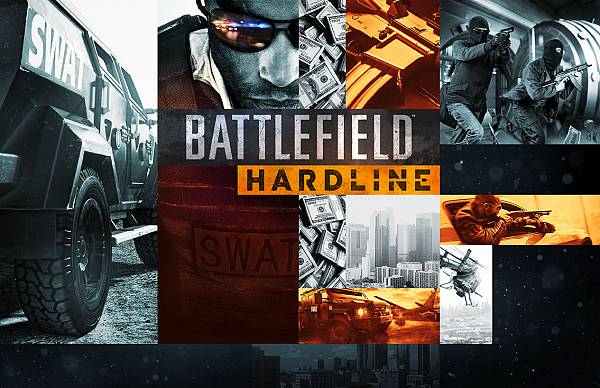
In the late 1990s and early 2000’s, first person shooter video games focused thematically on World War II with major franchises like Medal of Honor, Call of Duty, and Battlefield. Things started to change around 2005 when the Battlefield series released Battlefield 2: Modern Combat and the change in focus was cemented with the blockbuster release of Call of Duty 4: Modern Warfare in 2007. That’s pretty much where the genre has lived for the last 10 years. Recently, however, the Battlefield franchise has decided to shift focus again with their newest title Battlefield: Hardline which release earlier this month. The disturbing twist in the newest game, which you can see in the trailer, is that instead of soldiers fighting on a battlefield we now get militarized cops.

Obviously, this is not the very first time a video game has been controversial. I’m a gamer, but there are some games that I refuse to play because the depiction of violence reaches levels that I think are a little sick. Just to give a very simple example of that: I have played just enough of the Grand Theft Auto franchise to know that it will never be allowed in my home. I also have all kinds of political issues with the Call of Duty franchise,[ref]I will resist a tirade on the self-loathing anti-Americanism of the series and merely point out that in the Modern Warfare story arc, the bad guys always end up being the Americans and the playable American characters always die.[/ref] and even though the most controversial level of that that series[ref]The level is called “No Russian,” In it, you play an undercover CIA operative helping to massacre unarmed civilians in a Russian airport.[/ref] was made by a high school buddy of mine, I opted out. And these are, relatively speaking, the tame examples of controversial video games. The really nasty stuff I won’t even go into here.

So I’m not going to hyperventilate and argue that Battlefield: Hardline is the worst thing to have happened in video games. It’s not. It’s still pretty disturbing, however, and the video game press has taken notice. Chris Plante writes in Polygon:

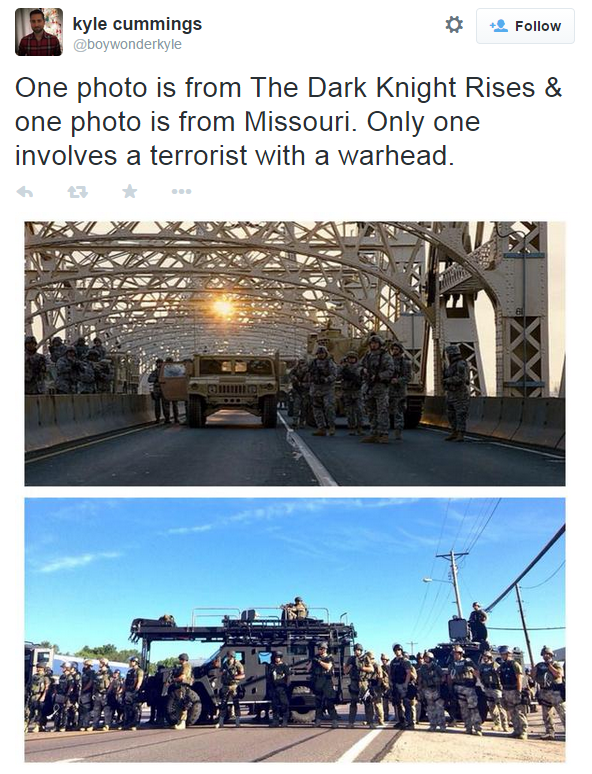
You used to be able to tell the difference between a cop and a soldier by how they looked. Soldiers had fancy gear, camouflage and heavy weaponry. Cops had a badge with their name and officer number. Times have changed, and now cops at a peaceful protest can look like the soldiers saving Gotham from a nuclear weapon.

The creators of Battlefield Hardline, while researching the militarization of the nation’s police force, understandably began to view the devices used by Americans against Americans as novel and fun. After all, they look identical to those being used in their previous games against fictional terrorists.

Here’s the image he was linking to, btw:
936 - Warrior Cops

Now, there are some who have gone a little farther and suggested that video games like this in some way cause police militarization. I think that’s a little silly, in much the same way that I think blaming video games for causing general violence in society is pretty silly.[ref]Biggest problem: as video games get more realistic and more violent and more popular, the actual rate of violent crime is trending downward.[/ref] Thus, I largely agree with Erik Kain’s take in Forbes:

Alan Jacobs, writing at his blog, makes the connection between the Ferguson police and Call of Duty:

“I want to suggest that there may be a strong connection between the visual style of video games and the visual style of American police forces — the “warrior cops” that Radley Balko has written (chillingly) about,” writes Jacobs. ”Note how in Ferguson, Missouri, cops’ dress, equipment, and behavior are often totally inappropriate to their circumstances — but visually a close match for many of the Call of Duty games.”

Jacobs is arguing that the culture of first-person shooters—and the aesthetic—is being imprinted on our police forces. It’s not a bad argument by any means… [but] I’m not so sure.

Kain goes on to argue that the reason for his skepticism is simply that “these problems are structural rather than cultural.” He goes on:

The War on Drugs and the War on Terror are essentially the same war when it comes to beefing up law enforcement at the expense of personal liberty. The War on Drugs already provided a good excuse for law enforcement to overstep its bounds; the War on Terror has led to much better armed police forces and the sprouting up of SWAT teams all across the country.

There are now over 100 SWAT team raids a day in the United States, mostly for non-violent offenses, and often leading to horrible things like police throwing flash bang grenades into a baby’s crib, or the killing of a seven-year old girl while a SWAT team raided the wrong apartment looking for a murder suspect (who was in the apartment above and gave himself up without violence) while A&E filmed the entire event for a reality TV show.

The problems are deep and they are profound, but they are not likely to be caused by video games. On the contrary, what creeps me out about this game is simply that it reflects a kind of social nonchalance and acceptance of some pretty horrific, unnecessary police violence not to mention the systematized discrimination that goes along with it.[ref]I’ll be writing more about that very soon.[/ref] Consider what Scott Shackford had to say about gamer opinion in his piece for Reason:

The folks behind Battlefield Hardline might want to check out our Reason-Rupe analysis of poll responses by frequent gamers. We found they’re more likely to be concerned about the militarization of the police. From our survey, 70 percent of gamers think it’s too much for police forces to have access to military equipment and drones as tools for crime-fighting, compared to 57 percent of non-gamers. And nearly two-thirds of the gamers we polled believe that police officers aren’t held accountable for misconduct.

Shackford’s point appears to be something like: Hey, Battlefield, you’ve picked the wrong demographics here. Gamers are libertarian. They won’t go for this. But the logic is really kind of backwards. Gamers do tend to be left-libertarians, but that didn’t stop the game from becoming the #1 biggest selling 2015 launch (to date) in the UK. I’m not sure what the numbers look like in the US, but it’s clear millions of gamers are snatching up copies. If these guys–more suspicious of police militarization than the Average Joe–are untroubled by the game, what does that say?

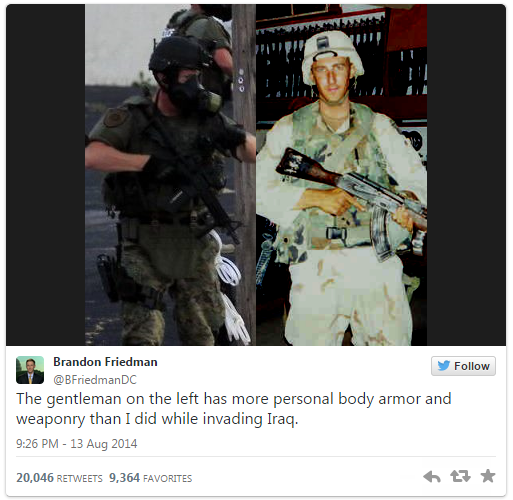
So no: I don’t think violent video games lead directly to real-world violence and I doubt that a game glorifying police militarization is going to lead directly towards even more police militarization. But, even if Battlefield: Hardline is largely following a trend rather than setting one, it may still play a role in normalizing the police militarization we already have. For centuries we’ve had an American tradition of separating military and police forces, but that tradition doesn’t mean much anymore if the police and the military have become indistinguishable.
935 - Police Militarization

At this rate, I have to wonder if rising generations will even have a conceptual notion that there was ever a time when the police didn’t roll around in armored personnel carriers with fully-automatic weapons. And I think that just makes it a little bit harder to reverse the trajectory we’re currently on.


College Safe Spaces: Therapeutic or Intellectually Stifling?

The New York Times has a brand new article on “safe spaces” in college. Judith Shulevitz defines these spaces as “an expression of the conviction, increasingly prevalent among college students, that their schools should keep them from being “bombarded” by discomfiting or distressing viewpoints. Think of the safe space as the live-action version of the better-known trigger warning, a notice put on top of a syllabus or an assigned reading to alert students to the presence of potentially disturbing material…In most cases, safe spaces are innocuous gatherings of like-minded people who agree to refrain from ridicule, criticism or what they term microaggressions — subtle displays of racial or sexual bias — so that everyone can relax enough to explore the nuances of, say, a fluid gender identity.” While there is nothing inherently wrong with this, “the notion that ticklish conversations must be scrubbed clean of controversy has a way of leaking out and spreading. Once you designate some spaces as safe, you imply that the rest are unsafe. It follows that they should be made safer.” And this brings us to the heart of the matter:

…while keeping college-level discussions “safe” may feel good to the hypersensitive, it’s bad for them and for everyone else. People ought to go to college to sharpen their wits and broaden their field of vision. Shield them from unfamiliar ideas, and they’ll never learn the discipline of seeing the world as other people see it. They’ll be unprepared for the social and intellectual headwinds that will hit them as soon as they step off the campuses whose climates they have so carefully controlled. What will they do when they hear opinions they’ve learned to shrink from? If they want to change the world, how will they learn to persuade people to join them?

Is this “safe” mentality on college campuses a good idea? Should students, say, be banned from participation due to controversial views? Check out the article and give it some thought.

Wealth’s Impact on Child Outcomes: Evidence from Sweden

Drawing on a large sample from Sweden, a new working paper suggests that wealth may not have much impact on child outcomes. From the abstract:

In adults, we find no evidence that wealth impacts mortality or health care utilization, with the possible exception of a small reduction in the consumption of mental health drugs…In our intergenerational analyses, we find that wealth increases children’s health care utilization in the years following the lottery and may also reduce obesity risk. The effects on most other child outcomes, which include drug consumption, scholastic performance, and skills, can usually be bounded to a tight interval around zero. Overall, our findings suggest that correlations observed in affluent, developed countries between (i) wealth and health or (ii) parental income and children’s outcomes do not reflect a causal effect of wealth.

These findings should give us pause. Perhaps we as citizens and policy makers should be looking at other factors that truly impact the long-term well-being of children.

NYT: Writing Your Way to Happiness

There was a fascinating article in The New York Times in January that I just came across that discusses the personal power of writing:

The scientific research on the benefits of so-called expressive writing is surprisingly vast. Studies have shown that writing about oneself and personal experiences can improve mood disorders, help reduce symptoms among cancer patients, improve a person’s health after a heart attack, reduce doctor visits and even boost memory.

Now researchers are studying whether the power of writing — and then rewriting — your personal story can lead to behavioral changes and improve happiness.

The concept is based on the idea that we all have a personal narrative that shapes our view of the world and ourselves. But sometimes our inner voice doesn’t get it completely right. Some researchers believe that by writing and then editing our own stories, we can change our perceptions of ourselves and identify obstacles that stand in the way of better health.

It may sound like self-help nonsense, but research suggests the effects are real.

This reminds me of the research on fiction reading. There are a few examples of this kind of writing here at Difficult Run. Perhaps I should engage in this style of writing more for the sake of my health.

America’s Most Profound Comic Strip

Calvin and Hobbes were fans of print journalism—or at least the comics.

In 1985, American newspaper readers met an appalling little boy. He taunted his mother (“Prepare for annihilation, pitiful Earth female”), tormented a classmate by telling her he had brought a “thermos full of phlegm” for lunch and kept a sign on his bedroom door that read “Enter and die.” Millions fell in love with him.

Running in hundreds of papers for the following decade, Bill Watterson ’s “Calvin and Hobbes” was not only the strangest American comic strip. It was also the funniest, the most touching and the most profound.

So begins a fantastic article on Calvin & Hobbes in The Wall Street Journal yesterday. The title captures my sentiments exactly: “‘Calvin & Hobbes’: America’s Most Profound Comic Strip.”

Check it out.

Marriage: Safe Haven in Unsafe Neighborhoods

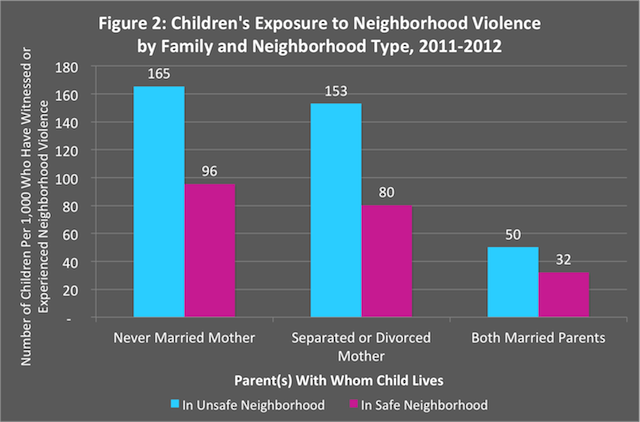
Research has found that children in two-parent families are less likely to be victims of a crime compared to those in single parent households, but it has been ambiguous as to whether this is due to marriage or the neighborhoods in which married families choose to live. A recent analysis on the 2011-2012 National Survey of Children’s Health, however, “shows that even when their families live in unsafe neighborhoods, children in married two-parent families are less likely to be exposed to violent crime than children of never-married and divorced parents.” Family scholar Nicholas Zill explains,

When I looked at combinations of neighborhood safety and family type in which children lived, those living with never-married mothers in unsafe or unsupportive neighborhoods unsurprisingly had the highest rate of encountering neighborhood violence: 165 children per 1,000. This was five times the rate of violence exposure for children living with both married parents in safe and supportive neighborhoods: 32 children per 1,000. Children living with separated or divorced mothers in unsafe neighborhoods were not far behind their peers with never-married mothers: 153 children per 1,000. While children in intact families who resided in unsafe neighborhoods had a higher risk of encountering violence than similar children in safe neighborhoods, their rate of exposure was lower than that of children of never-married or divorced mothers who lived in safe and supportive neighborhoods.[ref]Of course, “these comparisons are adjusted for differences across family types in the average age, sex, and race/ethnicity of the child; family income and poverty status; and the parent’s education level.”[/ref]

Zill offers three possible explanations for his findings:

First is the stress of conflict between parents and the strain of raising children as a lone parent in reduced financial circumstances. These can lead to a lack of vigilance and the overlooking of simple precautions, such as making sure that doors and windows are locked in houses and vehicles. Second, if they have broken up with their child’s other parent, a single parent will usually begin dating and trying to find a new partner. This process often involves being out of the house at night, sometimes leaving children with no or inadequate supervision. Third, as children become adolescents, the peers they become involved with in their less-than-ideal neighborhoods and schools are often troubled ones, who can lead them into hazardous situations and activities.

For me, this is just more evidence as to why those who are concerned about social justice should be the biggest advocates of marriage.

Occupational Licensing: Enriching the (Relatively) Few

A new study from the Mercatus Center at George Mason University explores the growth of optician licensing in the U.S. Though licensing is often advocated for in the name of “public safety,” this study finds that strict licensing laws reduce competition and enrich opticians with no measurable benefits for consumers (such as vision insurance or optician malpractice insurance premiums). A new NBER study found similar results, concluding that those with occupational licenses in the labor market “earn higher pay, are more likely to be employed, and have a higher probability of retirement and pension plan offers.” Writing in The New York Times, the University of Minnesota’s Morris Kleiner explains,

In the 1970s, about 10 percent of individuals who worked had to have licenses, but by 2008, almost 30 percent of the work force needed them. With this explosion of licensing laws has come a national patchwork of stealth regulation that has, among other things, restricted labor markets, innovation and worker mobility…Occupational licensure has a large and growing impact on labor markets and consumers, but has yet to draw significant public attention or scrutiny. The left and right seem to be in agreement that policy makers need to revisit the process for creating licensure regulations and consider amending or rolling back existing laws in favor of lesser forms of regulations such as certification. Ultimately, we all would benefit from wiser, not more, occupational licensing.

Worth thinking about.

Bourgeois Terrorism

The late scholar John Bowyer Bell described terrorists as “real gunmen in imaginary gardens.” By emphasizing the ideological world-view of terrorists- their perceived reality– Bell was going against popular wisdom. It is easy to form the impression that terrorists are driven to desperate measures by harsh, hopeless economic realities. In other words, an environment of poverty and no jobs leaves angry young men with no choice but to lash out violently against the government. This is more or less what Malcolm X meant by a “sociological explosion.”

Is terrorism, though, really about poverty and jobs? A new piece by Peter Bergen argues that it is not. If anything, terrorism is largely a middle-class phenomenon. A terrorist is likelier to be an educated professional such as a surgeon, engineer, or computer programmer than an unemployed laborer. Some, like Osama Bin Laden, are fabulously wealthy. “These are not the dispossessed. They are the empowered.”

If the empowered are the ones resorting to terrorism, it is hard to argue that it is due to economic oppression. These, after all, are people with degrees that epitomize western ideals of applied science and progress, not some sort of unwashed masses. Basically, creating jobs and business opportunities is important, but unlikely to stop radicalized programmers from becoming terrorists. Effectively responding to terrorism requires responding to terrorist ideologies with perceived grievances, and there is no getting round that.

Bergen’s piece draws from top-notch studies providing interesting information on the socioeconomic backgrounds of terrorists, so check it out.

Some Thoughts on Art in Education

958 - Art in Education

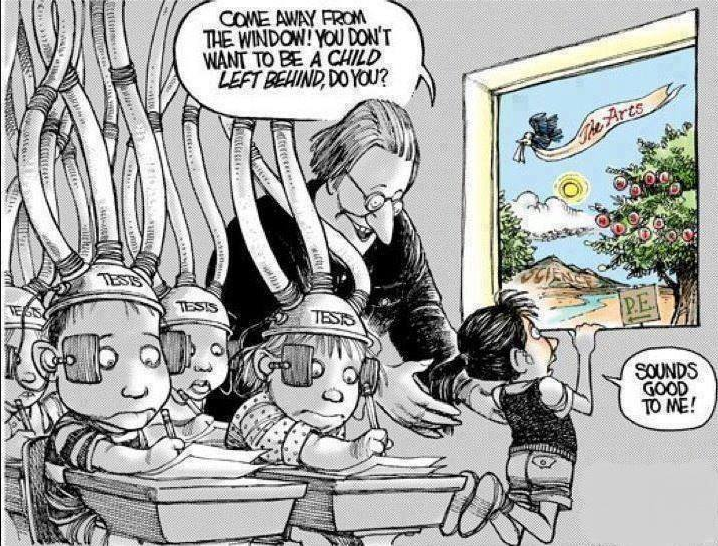
I saw this political cartoon making the rounds on Facebook a week or two ago. I didn’t think much of it until I finished reading The Secret Agent by Joseph Conrad on Saturday. I picked it up on a whim at Audible because the description made it sound like an espionage book, and I’ve been meaning to read some of those. Well, it really wasn’t an espionage book in any conventional sense. But what it was a mind-blowing work of literature in which Conrad floored me again and again with his effortless supply of novel and forcefully evocative metaphors and his profligate characterization. It was stunning.

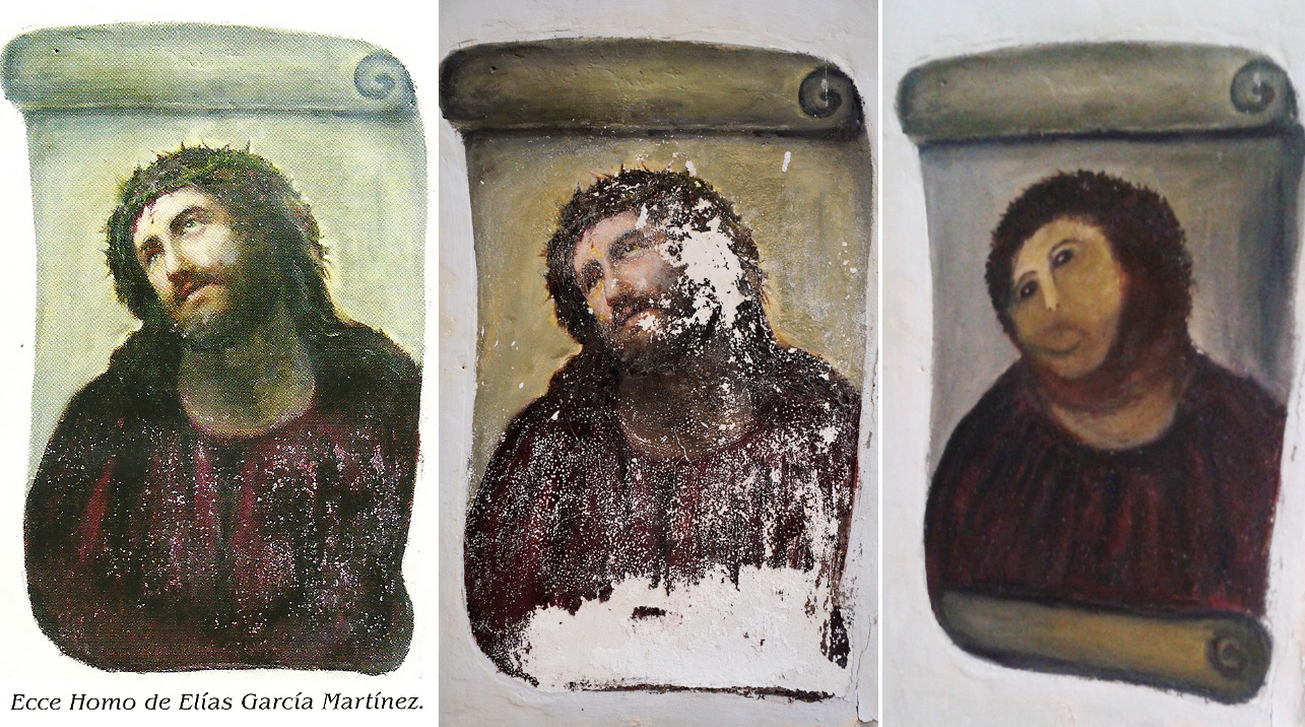
Here’s the thing: I read Joseph Conrad in high school, both Heart of Darkness and “The Secret Sharer.” I remember them as somewhat impressive and a bit dark, but the truth is that nothing much that I was required to read at the time really meant very much to me. How could they have? How much depth, really, does your average 14 year old have? Even the thought of 18 year olds sitting in a college classroom conducting “literary analysis” just reminds of the story of that poor old woman who tried to restore the famous painting of Jesus. The results aren’t pretty.

958 - Retouching Gone Wrong

Call me a cynic, but my view is that your high school English teacher is probably not going to be able to expand your mind to the point where you fully appreciate Joseph Conrad because artistic appreciation is largely something that comes with age and experience. The older I get, the more powerful art is to me. Any attempt to try and cram that sense of wonder and power into a required curriculum strikes me as not only premature, but kind of perverse. Could there be a more apt application of the phrase “pearls before swine?” At 15, Kurt Vonnegut was bizarre, remote, and alien. At 33, I had to stop on several pages just to allow the power of his writing to sort of wash over me before I could keep going.

I’m not arguing against teaching the arts at all, but I do have two thoughts. First, I think we should be more worried about teaching economics, statistics, and basic computer literacy. Those are the skills we need to have an informed electorate and–yes–for people to be able to go out and get a job. They–in addition to basic math and basic literacy–ought to take priority in school because they are needed earlier in life and because, if we’re going to be honest, the ability to appreciate new art at 30 (or 40 or 50) is a lot more likely than the ability to take up calculus or physics. Art stays with you for life. Why rush it?

Second, I’d like to see a whole lot less emphasis on trying to teach kids how to analyze or critique art. In other words: teach the canon. When you invite students to spend their time on analysis you’re turning the whole thing into a farce. If the works are really monuments of intellectual and artistic greatness, than it’s stupid to think that a classroom of random kids will have anything particularly insightful to bring to the table. If the works are really amenable to analysis by a pack of high-schoolers who maybe read 1/2 and skimmed the rest, then obviously there is not really that much to them.

Instead, I’d like to see a whole lot more time on providing the history (and especially the intellectual history) that contextualizes those works. I think lots of folks are worried that the canon might be incorrect, but the reality is that teaching the canon is not primarily an exercise in indoctrination. What is important is not that the kids accept the framework, but that they recognize it and are therefore free to accept, amend, or reject it as informed readers. Ping-ponging around from Socratic dialogues to Herman Hesse to Kurt Vonnegut (just a sample of the high school reading I remember) and treating each one individually and critically is a recipe for disaster.

I’m not confident that this is an approach that would work across-the-board. I don’t think any approach does that. But I do think that the overall emphasis is sound. School should be primarily about learning the stuff that (1) you wouldn’t learn on your own and that (2) must be learned quickly and early on. Focus on skills that are relevant and that can’t be easily picked up alone. An appreciation for art is absolutely essential, but there isn’t as much need to rush the issue in that case.


Second Thoughts On Social Media Shaming

966 - Tweet Shaming

A couple of weeks ago, the New York Times ran a really good story called How One Stupid Tweet Blew Up Justine Sacco’s Life. It’s not really just about Justine Sacco, though. It’s about a litany of folks who made a stupid joke on Twitter or posted a stupid photo on Instagram and were then subject to massive social media shaming and had their lives ruined. Now here’s the thing: most of the jokes or images that drew people’s ire were pretty inexcusable as far as things go. But the repercussions seem disproportionate and–most worryingly–the shaming has taken on an kind of barbaric, carnival cruelty aspect. If there’s one thing to take away from this, it’s that social media is shockingly anti-social.