There was an article in the New Yorker last month called The Square that pretty well encapsulates why I am deeply suspicious of both modern art and professional philosophers. The eponymous painting is above. A sample of the text follows:
In 1913, or 1914, or maybe 1915—the exact date is unknown—Kazimir Malevich, a Russian painter of Polish descent, took a medium-sized canvas (79.5 cm. x 79.5 cm.), painted it white around the edges, and daubed the middle with thick black paint. Any child could have performed this simple task, although perhaps children lack the patience to fill such a large section with the same color. This kind of work could have been performed by any draftsman—and Malevich worked as one in his youth—but most draftsmen are not interested in such simple forms. A painting like this could have been drawn by a mentally disturbed person, but it wasn’t, and had it been it’s doubtful that it would have had the chance to be exhibited at the right place and at the right time.
After completing this simple task, Malevich became the author of the most famous, most enigmatic, and most frightening painting known to man: “The Black Square.” With an easy flick of the wrist, he once and for all drew an uncrossable line that demarcated the chasm between old art and new art, between a man and his shadow, between a rose and a casket, between life and death, between God and the Devil. In his own words, he reduced everything to the “zero of form.” Zero, for some reason, turned out to be a square, and this simple discovery is one of the most frightening events in art in all of its history of existence.
Here is what irks me: the painting only works within the context of a bunch of fairly esoteric and inside-baseball talk. The picture, itself, represents nothing. It means nothing. It is, more or less, nothing. Not in some pseudoprofound “Zero, for some reason, turned out be a square” nonsense, but in the mundane, “not much to see here” sense.
I suppose you could argue that it’s a matter of taste, and I’m sure to some extent that is true. Some people like art that speaks to them. Others, for whatever reason, prefer art that requires a thesis-worth of material outside the work in question to be able to find a voice. Call me a grouchy old man, but if you listen to a section of Carl Orff’s Carmina Burana or stand before a Gothic cathedral or stare up at the Sistine Chapel, you’re going to feel something. You might feel much more if you are a musician, or an art historian, or an architect, but just anybody is going to feel something. [ref]Carmina Burana was finished in 1936, by the way, so I’m not just fetishizing old stuff.[/ref]
And that is what I fundamentally don’t like about modern art. Or about professional philosophers. They are elitist to the point of nihilism. They are belligerent and arrogant in their intentional impenetrability. They are fundamentally hostile to the everyman. And, quite frankly, ain’t nobody got time for that. Give me art, any day of the week, that is actually trying to communicate something to me as I am. Not that is intentionally whispering to only a chosen, select few. Even if I can hear, I have no interest in being part of that anti-humane snobbery.
So, my take on this issue is actually more extreme than the headline of the article that inspired it, which is pretty rare for me. The article in question is The U.S. Navy’s Big Mistake — Building Tons of Supercarriers, and the case it makes is pretty simple.
First, aircraft carriers are really, really easy to sink.
Soviet Adm. Sergei Gorchakov reportedly held the view that the U.S. had made a strategic miscalculation by relying on large and increasingly vulnerable aircraft carriers. The influential U.S. Adm. Hyman Rickover shared this view. In a 1982 congressional hearing, legislators asked him how long American carriers would survive in an actual war.
Rickover’s response? “Forty-eight hours,” he said.
Things have gotten much, much worse since 1982, by the way. Long-distance, very-fast, relatively cheap, shore-based anti-ship missiles are a problem. So are diesel-powered submarines, which are actually quieter than nuclear subs. But the US military has been deliberately hiding the vulnerability of their prized carriers.
Now let’s take a look at the unofficial record derived from war games. In 2002, the U.S. Navy held a large simulated war game, the Millennium Challenge, to test scenarios of attacks on the fleet by a hypothetical Gulf state — Iraq or possibly Iran.
The leader of the red team employed brilliant asymmetric tactics resulting in 16 U.S. ships, including two supercarriers, going to the bottom in a very short span of time. The Navy stopped the war game, prohibited the red team from using these tactics and then reran the exercise declaring victory on the second day.
When I shared this quote in a Skype chat with some friends, one responded instantly with “that is f—ing treason.” And I was just getting started with the juicy quotes.
One carrier, the USS Kitty Hawk, used up three of its nine lives having been run into by an undetected Soviet sub in 1984, overflown by two undetected Russian planes — an Su-24 and an Su-27 — in 2000, and surprised by a Chinese Song-class attack submarine that surfaced undetected inside its perimeter and within torpedo range in 2006.
What that tells you is that the only reason that no one has sunk an air craft carrier of ours since World War II is that nobody has tried. I should say, “sunk in real life,” of course. The simulated sinkings are apparently not few nor far between.
In March of this year, the French Navy reported that it had sunk the USS Theodore Roosevelt and half of its escorts in a war game, but hurriedly removed that information from its website.
And yet, despite this dismal track record and the even gloomier future prospects, we’re sacrificing other, more capable ships to keep building super-carriers.
The reason the article irritated me so much is that it’s just one of a ton of examples. Consider, for example, the asinine efforts of the Air Force to kill the A-10 Warthog. Cheap, slow, and ugly, the A-10 continues to be one of the most important aircraft in our inventory because of it’s incredible prowess at close-air support. The Air Force wants to get rid of it to fund shiny new toys like the F-35, despite the fact that the F-35 doesn’t offer any genuine opportunity to fill the role the A-10 fills.Things got so bad that an Air Force general told officers if any of them praised the A-10 to lawmakers it was “treason.”[ref]Luckily, he got fired, but only after public outcry. It just shows the pressure going on behind the scenes to lie or be silent to the detriment of our troops.[/ref]
Then there’s the F-35 itself, which is a late, overbudget, maintenance queen that can’t even replicate the dog fighting abilities of the 40-year old F-16. The sad thing? That’s not even the worst of it. The fact that we’re investing this much in manned aircarft at all shows that we’re not thinking seriously about the future. Putting a human in the cockpit means taking up space and weight and–more importantly–means limiting the aircraft’s performance to what the human body can withstand. The day of manned aircraft is over. We need to catch up with that reality.
Here’s the thing: maybe you think the US spends too much on military. That’s fine. Maybe you think the US should continue to maintain military dominance. That’s fine, too.[ref]And closer to my position. I believe Pax Americana is under-appreciated.[/ref] But regardless of how much we spend, the money should be spent efficiently. There’s no excuse for what is happening now. It’s a disgrace.
It’s difficult to see how the nationwide legalization of gay marriage could have any kind of significant negative repercussions for anybody who’s not gay. Difficult – but not impossible. Because now that the US government formally recognizes marriage equality as a fundamental right, it really shouldn’t skew the tax code so as to give millions of dollars in tax breaks to groups which remain steadfastly bigoted on the subject.
I’m talking, of course, about churches.
Gay marriage was legalized by the SCOTUS in no small part as a reflection of public will, as the majority of justices saw it. And that public will was based largely in the rhetoric of civil liberties and live-and-let-live. One of my concerns all along has been that it will not stop there, however.
It is too early to say the sky is falling. And, in any case, skies tend to fall slowly. But it’s worth thinking about.
How many backers of theoretical gay marriage will regret the reality of gay marriage? As a matter of policy, it doesn’t matter much anymore. And I have no moral qualms about same-sex marriage itself. I don’t believe it destabilizes the institution or ruins the lives of children. Then again, it doesn’t exist in a vacuum, either. If same-sex marriage isn’t just a pathway to happiness, freedom, and equality for gay citizens, but a way to pummel religious Americans into submission, it will be a disaster.
We’ll see how things go, but I have a hunch I already know. The same people who told me again and again that I was being silly to fear these kinds of repercussions will, one by one, begin to ask me, “Well, why shouldn’t this follow logically?” Which, as I’ve always known, is precisely the point.
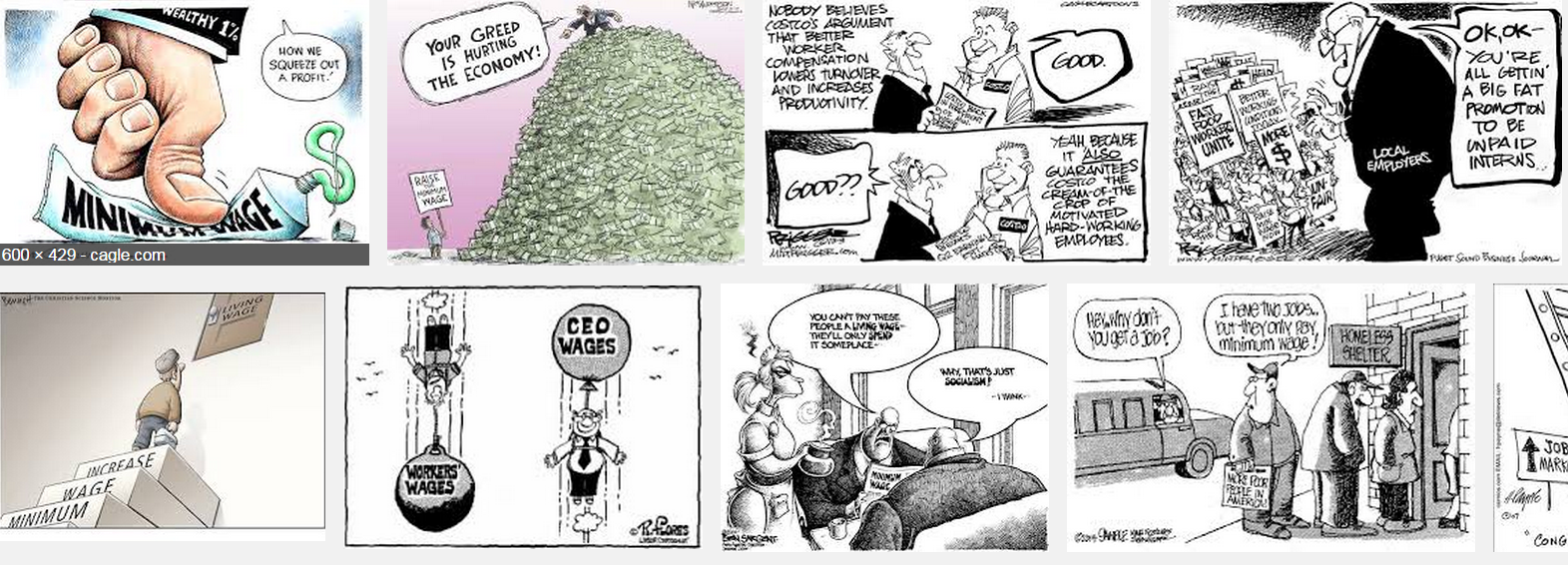
Results of Google Image search for “minimum wage political cartoon.”
Conservatives are heartless. Everyone knows this. Working poor can’t afford to put food on the table, but conservatives still oppose increases to the minimum wage. Why? Either because they are rich and want to keep their profits, or because they are not rich but they are being manipulated by rich conservatives who play on their fears like Rick Wakeman plays a keyboard.[ref]If that reference confused you, watch this video. Skip to just before minute 3 if you’re impatient.[/ref]
That’s one of the reasons the minimum wage issue frustrates me so much, and it’s why we write about it so often at Difficult Run. Some conservatives oppose the minimum wage because they care about the poor. Another response–probably a more common one–is to make sure that you are not confused for those backwards, bigoted, Bible-thumping conservatives by establishing yourself as someone who is conservative economically but doesn’t share their weird religious hangups. For example: Bleeding Heart Libertarians or the Secular Right.
But, in this post, I just want to explain one more reason why conservatives can appear heartless to their liberal friends and families: hoaxes and hysteria.
Not long ago, you may have seen the story of the woman who received a letter from a neighbor that her yard was “relentlessly gay” because she has rainbow-colored lamps in it. This kind of thing validates all your fears about those bigoted conservatives and their intolerant ways, and it was shared widely. Conservatives like me, however, were a bit skeptical. Especially when the article was linked to a crowdfunding campaign to make her yard even more gay [ref]Seriously, what does that even mean?[/ref] Well, it turns out that conservatives were probably right to be skeptical:
Anti-hoax consumer activists raised suspicions as soon as the fundraiser began, because Baker’s own idiosyncratic capitalization and punctuation matched the style of the alleged letter from her neighbor. Quoth LaCapria: “…Although Baker had stated the previous day that police were “satisfied” with her claim, the detective to whom we spoke said that Baker was either unwilling or unable to produce the letter in question, and that she had maintained it was no longer in her possession. The detective also indicated that he had attempted to meet with Baker in person the previous day but was unable to do so.”
This isn’t an isolated incident. In another example, I saw all kinds of liberal friends on Facebook react with horror to the story of how a gay Utah pizzeria worker had been viciously assaulted for being gay. It turns out that this attack was also staged:
A man who reported someone beat him and carved a homophobic slur into his arm staged the attacks, authorities in rural Utah said Tuesday. Millard County Sheriff Robert Dekker said Rick Jones, 21, could face charges after officers investigating the series of reported attacks found inconsistencies in the evidence. The Delta man eventually acknowledged faking the harassment, Dekker said.
His lawyer says it was “a cry for help,” and that seems reasonable to me. My heart goes out to someone who, for whatever reason, thought that this might be something that would make their life better. I’m not mad at the people who shared the story either, because I know they were acting out of a desire to do good by showing solidarity for (as they thought) a victim of a hate crime. But I am saddened (thought not surprised) that the news that the attack was staged will not make the rounds as the news of the initial assault did. I wonder, what percent of people who saw the initial story will miss seeing this followup?
Here is just one more example. You may have heard of Sir Tim Hunt, the Nobel laureate biologist who was fired within days of apparently making sexist remarks such as:
Let me tell you about my trouble with girls. Three things happen when they are in the lab. You fall in love with them, they fall in love with you, and when you criticise them, they cry.
It really was hilarious, but my mirth was tinged with sadness. First, because I was pretty sure that a man smart enough to be a knight and a Nobel prize winner probably wasn’t dumb enough to say something that absurdly sexist even if it reflected his true beliefs, and secondly because it’s depressing to think that so many people live in a world where they think that kind of rampant misogyny is common and unsurprising.
Well, it turns out that the critical account of Hunt’s words came from a single source, and that source has a track record of lying and dissembling, primarily by either falsifying her CV or just claiming things that sound way more impressive than they actually are:
Elsewhere in the six-page CV is a section devoted to ‘Qualification and Training’. In it, St Louis trumpets the fact that she is ‘a member of the Royal Institution’.
Again, very prestigious. Or so it seems, until a spokesman for the Royal Institution told me: ‘Anyone can be a member. It’s simply a service you pay for which entitles you to free tickets to visit us and gives you a discount in our cafe.
‘It’s like having membership of your local cinema or gym.’
Why would someone include such a thing on their CV?
‘Actually, that’s a bit of a problem,’ the spokesman added. ‘We have heard of a few people using membership on their CV to imply that they have some sort of professional recognition or qualification. But it means nothing of the sort. It’s very, very odd to see this on a CV.’
This woman’s uncorroborated (and now, contradicted) testimony is all that it took to trash a successful scientist’s 50-year career.
As far as I understand it, the primary reason that social liberals don’t talk about these hoaxes very much is that they are concerned that admitting to the prevalence of hoaxes will erode their position and make people apathetic about racism and sexism. The problem is that refusing to talk about the hoaxes actually does the same thing, but the effect is even stronger. It gives conservatives the impression that social liberals are either intentionally using false events for political gain or, at a minimum, are reckless in their handling of the truth.
At the same time, however, the fears of liberals are not unfounded. There is a very real chance that conservatives tend to dismiss the real costs of inequality and prejudice because this parade of hoaxes (these three articles are all from just one week) creates a festering cynicism.
So what should we do? Well, I’d like to see more data-centric articles to tell the truth. I’m really tired of breathless, sensationalist reporting that rushes to judgment and completely fails to take any context into account. For example, there are numerous articles out these days about spate of fires in predominantly black churches. How bad is this problem? Is it a new trend? How many of the fires are definitely arson? None of the articles I have seen go into that, which seems bizarre given how incredibly important this story is.
Something else I’d love to see: a little more generosity in how we evaluate each other’s motives. Here’s a great example of how not to do it: Amanda Marcotte’s Talking Points Memo piece The Real Reason Why Conservatives Like Ross Douthat Oppose The Gay Marriage Ruling. The article Marcotte is referring to is Gay Conservatism and Straight Liberation in which Douthat argues that “the gay rights movement has won twice over. Its conservative wing won the right to normalcy for gay couples, while rapid cultural change has made the definition of normalcy less binding than the gay left once feared.”
Clearly Douthat is a conservative, and so I would hardly expect for Marcotte to agree with him. But her article is breathtaking in its vicious assumptions about his motives and not just his arguments. According to her, Douthat “declines to spell out exactly what parts of traditional marriage he would like to keep.” That’s absurd: the parts he wants to keep are: monogamy, permanence, and an orientation towards procreation. This is the same for all conservatives. But by pretending that Douthat is unclear, she gives herself license to put words in his mouth, noting that “the human past is one where women were treated as chattel to be passed from father to husband, legally and socially regarded merely as extensions of their husbands instead of people in their own right” (which is true) and alleging that Douthat is pining for precisely that ancient misogyny (which is absurd). She concludes that Douthat–and all conservatives–oppose gay marriage because “it redefines marriage as an institution of love instead of oppression.”
This is hysterical nonsense that exists on the same level as Dinesh D’Souza’s conspiracy theories about President Obama dedicating his entire life to becoming President of the United States so that he could intentionally destroy the country from within to honor his absent father’s anti-colonial ideology and thereby win his ghostly approval. Or something.
Please, America, just walk away from this stuff. There are monsters out there, that is true, but most of your neighbors are not monsters. Your conservative neighbors don’t hate gays and your liberal neighbors don’t hate America. When you see another article making the rounds on Facebook that says something else, either speak up against it[ref]I mean that liberals should speak out against the idea that all conservatives hate gays and that conservatives should speak out against the idea that all liberals hate America. It doesn’t do much good the other way around.[/ref] or just let it go without a like or a comment or a share.
I’m not saying that both sides are equal. I have chosen a side. I am a conservative. I’m not hiding that. I’m not pretending that I think all views are equally correct. But it really is time to back away from the crazy brinkmanship and hysteria.
This is an older article, from way back in 2004, but I just discovered it recently and found it really powerful. In it, Mary Eberstadt does an admiral job of surveying the “bad” music of the late 90s and early 2000s (the kind of stuff parents wish their kids didn’t listen to) and drawing some interesting and poignant conclusions. She begins:
I would like to turn that logic about influence upside down and ask this question:What is it about today’s music, violent and disgusting though it may be, that resonates with so many American kids?
What follows is a haunting and well-documented account of how the music she surveys (Papa Roach, Everclear, Blink-182, Good Charlotte, Eddie Vedder and Pearl Jam, Kurt Cobain and Nirvana, Tupac Shakur, Snoop Doggy Dogg, Eminem) all share a common them: rage at the pain they endured as children of broken homes. She cites not just song lyrics, but band interviews stating explicitly that the music is truly inspired by the real-world trauma of divorce and that this really is a source of deep–albeit tragic–connection with fans.
You should really read the article, but here’s the haunting conclusion:
And therein lies a painful truth about an advantage that many teenagers of yesterday enjoyed but their own children often do not. Baby boomers and their music rebelled against parents because they were parents — nurturing, attentive, and overly present (as those teenagers often saw it) authority figures. Today’s teenagers and their music rebel against parents because they are not parents — not nurturing, not attentive, and often not even there.
Couple of additional comments. First: yeah, there are a couple of silly statements in here that I can’t really take seriously. But overall I’m impressed with Eberstadt’s willingness to take the music at face value and learn from it.
Second: this piece was kind of hard for me to read. It hit home in a particular way. Not because my family was unstable. Far from it, my parents had a strong and happy marriage and our home life was stable and loving. I didn’t experience this kind of pain first-hand. But I saw an awful damn lot of it second-hand. I started doing the numbers after I read this article, and most of my closest friends came from broken homes. And in every case, I saw the grief and pain and hardship it caused them.
Divorce is one of those things we don’t think about a whole lot. We’ve been conditioned by society to accept it as normal or even healthy. Mostly, that’s a lie. It’s a lie included by Hollywood in family movies to assuage the guilt of parents, but–in too many cases–the guilt is there for a reason.
I know that sometimes divorce is necessary, and that sometimes a family is broken by the horrible decisions of one spouse. I’m not about blaming or judging here. But I think we’ve gone too far in the opposite direction. We’re so interested as a society in being non-judgmental about failed marriages and broken homes and single parents that we’ve whitewashed the tragic consequences for children.
Well, except for folks like Eminem. In this regard, at least, he tells it like it is. Which is why Eberstadt gave the article the headline: “Eminem is Right.”
The above comes from the University of Chicago’s IGM Forum, featuring numerous economists of diverse ideological views. Since our political discussions revolving around stagnant wages and upward mobility largely focus on income only, the absolute nature of wealth is often ignored. This is what a recent article in The Washington Post points out:
But even if we have less money, you know what we do have that we didn’t 15 years ago? Smartphones and social networks, Netflix and HD TVs, apps and whatever other technology you prefer to waste time on. Now, it’s true, you can’t eat an iPad, but it’s also true that these things make our lives better in ways that are hard to measure. Economists try to, but because it’s so uncertain, they’re pretty conservative with their estimates. Specifically, they try to adjust for the quality of a good when they calculate how much its price has changed. If you paid $400 for an HD TV today, for example, and $400 for a regular TV 10 years ago, did you really pay the same price? Technically, yes. But the fact remains that you got something better for the same amount of money than you would have before. And that’s even trickier when you’re talking about things that didn’t even exist back then, like smartphones, that are really every electronic device from the 1990s rolled into one pocket-sized piece. Or as economist Austan Goolsbee puts it, “so much of day is spent doing things that didn’t exist [in 1980] that it’s hard to believe the numbers fully account for new products.”
Then, the clincher:
Try this thought experiment. Adjusted for inflation, would you rather make $50,000 in today’s world or $100,000 in 1980’s? In other words, is an extra $50,000 enough to get you to give up the internet and TV and computer that you have now? The answer isn’t obvious. And if $100,000 isn’t enough, what would be? $200,000? More? This might be the best way to get a sense of how much better technology has made our lives—not to mention the fact that people are living longer—the past 35 years, but the problem is it’s particular to you and your tastes. It’s not easy to generalize.
I just read David Brooks’ most recent column: The Next Culture War. In a nutshell, he argues that Christians ought to abandon their decades-long, fighting retreat against the sexual revolution. “Consider putting aside,” he writes, “the culture war oriented around the sexual revolution.” Channeling Disney’s Frozen, he argues that Christians should just let it go. After all, aren’t there enough other problems to tackle? “We live in a society plagued by formlessness and radical flux, in which bonds, social structures and commitments are strained and frayed,” he writes.
I have a lot of respect for David Brooks. He’s one the people I’d most love to have a lunch conversation with.[ref]Others, if you’re curious, include John McWhorter, Megan McArdle, and Jonathan Haidt.[/ref] But, he doesn’t seem to understand that his suggestion asks for Christians to bail the water out of a sinking boat while ignoring the hole in the hull.
You see, the sexual revolution is the reason that we live in a society that is “plagued by formlessness and radical flux.” In The Social Animal, Brooks argues against the atomization of society on both the left and on the right, with each side focusing myopically on divisible, separable, self-contained individualism. The left argues that human individuals can construct their own gender and sexual identities free from repercussions and it therefore sees free birth control and elective abortion as fundamental rights. The right views collectivism with a hostile gaze, channeling Ayn Rand at times, and argues for personal responsibility sometimes to the point of callousness. These are twin heads of the same coin, and Brooks is right to focus on it. It is one of the defining philosophical tragedies of our age.
But what he seems to fail to grasp is that this radically individualized view of human nature follows in part directly from the sexual revolution. To the extent that the sexual revolution has been about excising sex from the context of marriage and family, it has been an assault on the biological family unit. And this unit–including the bond of husband and wife to each other and also to their children–comprises the two most essential bonds in human society.
To put it simply, social conservatism is animated in no small part by the conviction that biological families are irreplaceable. And so, to the extent that Brooks’ invitation is for social conservatives to give up and try to replace them, he is asking something of us that we simply cannot provide.
As a brief caveat, it’s not entirely clear that that is what he’s asking. He writes that we ought to “help nurture stable families.” I’m just not sure how he imagines this should be accomplished in practice. At one point, he suggests that conservatives abandon the culture wars while at another point he says that “I don’t expect social conservatives to change their positions on sex.” Which is it? Because conservative positions on sex are their participation in the culture wars. It may be the he merely thinks we should keep those beliefs quiet, but again: how does one practically “help nurture stable families” while abandoning resistance to the sexual revolution? Subjective sexual morality, open relationships, sex before marriage, pornography: these are not incidental things that happen to exist alongside “formlessness and radical flux.” These are the acids in which the stable family–as a normative and aspirational social beacon–dissolves.
And this cuts both ways, by the way. To the extent that social conservatives are unwilling to abandon their commitments, their opponents are equally unlikely to let the issue go. Thus, I have to express a deep skepticism of the upside of Brooks’ plan. His idea is that–if we assume for a moment that it is possible to meaningfully nurture families without participating in the culture wars–that suddenly religion will be well-thought of in the world. All of a sudden, we would be known as “the people who converse with us about the transcendent in everyday life.”
This is impossible, because the commitment social conservatives have to their values is mirrored by the commitment social liberals have to their mutually contradictory values. And as long as social liberals dominate the opinion-making sectors of our society their animosity will continue to be expressed in part by ongoing negative characterization of social conservatives as backwards bigots. And, make no mistake, social liberals do dominate the opinion making sectors of our society: academia, the press, the entertainment industry, and the Internet. Even if social conservatives did go quiet on their beliefs, I have very, very little confidence that our image would suddenly be rehabilitated.
Graph from Business Insider article about political makeup of American industries. Click image for link to article.
Here is the reality: social conservatives are fighting the sexual revolution–despite it being a losing proposition thus far–because we believe that nothing does more good for children than being raised by their biological parents and that very little does more harm than for little children to be deprived of this natural right.[ref]The extreme cases where one or both of the parents is abusive or neglectful are those exceptional cases.[/ref] This belief necessitates viewing sex as more than merely a recreational activity or even a question of strictly intrapersonal, subjective meaning to be negotiated between the willing adult participants. The belief that immature human beings have a strong moral claim on their parents for protection logically requires a view of sex as a deeply significant act for which consenting adults–male and female together–ought to be morally, socially, and legally responsible.
There is certainly room for compromise and innovation within this conflict. The idea that social conservatives want to wholesale turn back the clock to an imaginary 1950s is an unfair stereotype. Much of the progress–both for women and for minorities–since the 1950s comes to us as precious treasure, dearly purchased and should be treated with humility, gratitude, and respect. Many of the contentious technologies that have fueled this debate–from the pill to IVF–are morally neutral technologies which can certainly coexist with a thoughtful, robust view of normative sexual ethics. There is room for these views to be better articulated within social conservatism, and for some social conservatives to take them more seriously and moderate their positions.
And so I do not want to meet Brooks’ call with a hardline refusal. It’s worth considering. What I wish to convey is that social conservatism is restricted in its freedom to adapt. That is not a design flaw. The point of having principles at all is that–while they may be interpreted or applied in innovative or flexible ways–there is a limit to that flexibility. There are some things that a person cannot do without abandoning principle. For social conservatives, the central principle is the care and protection of society’s most vulnerable, which means our children (before and after birth). An additional article of faith is that no institution can replace the biological family in filling that role. As a result, social conservatives not only will not abandon their opposition to the sexual revolution, they cannot do so and remain social conservatives. Can we do more without abandoning that opposition? I’m sure we can, and I hope we never stop being motivated by that question.
The New York Times has an interactive article titled “How We Changed Our Thinking on Gay Marriage.” It features interviews with a Republican Congresswoman, a Baptist pastor, and even the president of the Institute for American Values and former Proposition 8 witness. Given the Supreme Court’s ruling yesterday on same-sex marriage nationwide, I thought I’d post a piece from a couple years back that helped me formulate my own outlook on gay marriage. The essay is by William & Mary law professor Nate Oman.[ref]I’ve cited it before.[/ref] When it boils down to it, I ultimately share his view: “I am neither entirely joyful about gay marriage nor entirely pessimistic. Rather, I am worried. I think that gay marriage has the potential to be a positive social phenomena, as well as having the potential to be destructive. I don’t purport to know what its ultimate effects will be, and I suspect that they will be mixed.”
Nate Oman
Instead of virtually reposting Nate’s whole paper (which you really should take the time to read) by means of huge quotes, I’ve highlighted a few main points that really stand out to me:
Function vs. Equality: As much as I love the rhetoric of liberty and equality, such rhetoric may miss the point. “I do not think that marriage is primarily about equality,” writes Oman. “I do not think that it is a special status conferred on heterosexuals as a reward for being heterosexual, one from which homosexuals are excluded in order to convey a message of social inferiority. Rather, I think that is an institution that does certain things, serves certain functions.” Oman’s approach to the institution by means of processes and functions instead of abstract principles resonates with me.[ref]Reminds me of Thomas Sowell’s Knowledge and Decisions.[/ref] Marriage’s functions as identified by Oman include
Bonding couples together via legal commitment and social pressures/norms, resulting, on average, in more productive and resilient people.
Legitimating sexual activity and cutting down on the emotional, physical, and social risks of illicit sex.
Providing a context for child rearing and shielding their vulnerability.
Traditional Values vs. Hedonism: “Gay marriage,” Nate writes, “is potentially most powerful as a conservative retrenchment, an effort to impose a more traditional model on the unruly riot of family structures that already dominate the lives of many children.” Furthermore, he thinks “that one of the greatest potential benefits of gay marriage is that it makes possible gay chastity.” Swedish economist Andreas Bergh once described Sweden has heading in a more market-oriented direction, while the U.S. tends to move in a more socialist direction. I think of the two communities in similar ways. Broadly speaking, it seems that heterosexual relationships are becoming increasingly fragile and fragmented, while homosexual relationships are moving in a more stable, domestic direction.
Nate concludes,
To homosexuals who are now going to get married, I say congratulations. I hope that you have happy and fulfilling lives.[ref]I couldn’t help, but get a little emotional when I read about the first same-sex marriage in Dallas County: after 54 years together, Jack Evans (85) and George Harris (82) were married.[/ref] I hope that your marriages are strong, and I hope that they become an example that will discipline and orient the lives of others. To the advocates of gay marriage, I hope that you will stop talking so much about freedom and equality and will start talking about marriage, about how it should organize people’s sexual lives and give structure to their families. I hope that your new found enthusiasm for marriage translates into the revival of some of the informal social pressures and expectations that signal to everyone that marriage is not simply a choice or a right but a preferred way of life…I don’t expect the language of liberty and equality around gay marriage to recede from the public stage but having lost the political battle on gay marriage, social conservatives should embrace the rhetorical and social possibilities it provides for talking about the good of marriage as opposed to its alternatives. A focus on gay marriages as a superior structures for gay families rather than on gay marriage as a marker of social equality strikes me as the best road going forward. In the end, I don’t know what will happen. I think that marriage will be good for gay families. I am less sanguine about the effects of the gay marriage debate on our shared public understanding of marriage. I fear it has reinforced ideas that are destructive to marriage at the margins. The good news is that I may be wrong, which would make me happy.
It was deeply fascinating to watch how strikingly contemporary American audiences from coast to coast found Shakespeare’s Othello — painfully immediate in its unfolding of evil, innocence, passion, dignity and nobility, and contemporary in its overtones of a clash of cultures, of the partial acceptance of and consequent effect upon one of a minority group. Against this background, the jealousy of the protagonist becomes more credible, the blows to his pride more understandable, the final collapse of his personal, individual world more inevitable. But beyond the personal tragedy, the terrible agony of Othello, the irretrievability of his world, the complete destruction of all his trusted and sacred values — all these suggest the shattering of a universe.
I was reminded of these words after reading Dana Dusbiber’s post on why Shakespeare should not be taught. In a nutshell, he is difficult, white, and long dead. How could someone like that be relevant in today’s diverse classroom? The words at the top of the page were written not by any white academic in an ivory tower, but by Paul Robeson, the singer, athlete, actor, and black activist. Growing up, Paul Robeson was a hero to me. I always felt a little out of place, and though Robeson died before I was born, his story was inspiring. He had talent, courage, and conviction, speaking always with a profound dignity. Electrifying. The man was like a king. His lifelong struggle was to create a society in which all people were treated equally because he knew how awful the alternative was. Robeson was the first black actor in the twentieth century to play Othello, using the role to break down barriers against integration both on stage and off it. In the play, Othello is at the top of his profession. He is a key man in Venice, is wealthy, and has married into Venetian society. Despite all that, Othello feels insecure because he is an outsider, and his rivals use that insecurity to destroy him. Why wouldn’t such a play be relevant to “very ethnically-diverse and wonderfully curious modern-day students?” Even if you share the majority’s skin pigmentation, why would Othello not have anything to say to the kid that never feels that he fits in, no matter his accomplishments? I was that kid. Let’s not hurry to dismiss Shakespeare just because he happens to be white and dead.








 , Brooks argues against the atomization of society on both the left and on the right, with each side focusing myopically on divisible, separable, self-contained individualism. The left argues that human individuals can construct their own gender and sexual identities free from repercussions and it therefore sees free birth control and elective abortion as fundamental rights. The right views collectivism with a hostile gaze, channeling Ayn Rand at times, and argues for personal responsibility sometimes to the point of callousness. These are twin heads of the same coin, and Brooks is right to focus on it. It is one of the defining philosophical tragedies of our age.