The Slow Hunch: 2014 Mormon Transhumanist Association Conference

Fellow DR editor Allen Hansen presented a paper we wrote together at the 2014 Conference of the Mormon Transhumanist Association this April. Its title is “Worship Through Corporeality: Mormonism, Hasidism, and Management.” In it we look the Hasidic concept of “worship through corporeality” through the lens of Judaism, Mormonism, and business management. I have the video, paper summary, and additional information posted at The Slow Hunch.

Check it out.

The Barbarians at the Gate of Sci-Fi

You might not have heard, but the sci-fi community is currently embroiled in a civil war. Then again, you might actually have heard. Things have gotten so bad that the story hit both USA Today and then the Washington Post this week. I want to share the story, and my perspective on it, for two reasons. First: I love sci-fi. But second, and more relevant to a broader audience, the way that political partisanship has torn the sci-fi community apart is pretty good case study of how partisanship damages the fabric of larger communities.

The Literature of Ideas
2014-04-30 Tom Swift Jr

I love science fiction because it is, as Pamela Sargent called it, “the literature of ideas.” For me the animating spirit of sci-fi is the spirit of inquiry. The genre has less to do with with outer trappings of spaceships or robots and more to do with the simple question: “What if?” This has been true since some of the earliest science fiction works, like Mary Shelley’s Frankenstein. Dr. Frankenstein’s futuristic technology for reanimating corpses is central to the plot and intrinsically interesting, but it’s there in order to support moral questions about the duty of the creator to the created.[ref]You can tell a lot about the genre of sci-fi just by noting that the full title of the book is Frankenstein, or The Modern Prometheus.[/ref] That setup, envisioning alternate technology in order to frame questions that couldn’t be examined so clearly without the imaginary technology, is the essence of science fiction. That is the sense in which it is truly the literature of ideas.

I understand that Frankenstein isn’t necessarily the first book that people think of when they think of science fiction and that my definition isn’t universal. But it’s not just my random personal opinion, either. In addition to Sargent, sci-fi legend Ursula K. Le Guin recently told the Smithsonian Magazine (speaking about the impact of science fiction on real-world society), “The future is a safe, sterile laboratory for trying out ideas in, a means of thinking about reality, a method.” That method is exactly what I fell in love with.

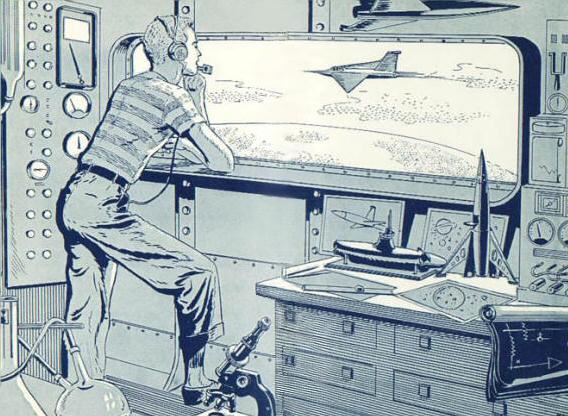
The first science fiction that I ever read was 1950’s era series Tom Swift, Jr. Even though it was mostly ghost-written fluff for little kids, it couldn’t help but convey a sense of the importance of ideas. Ideas matter. Ideas change how see the world, and can therefore change what we make of the world. Science fiction isn’t about predicting the future. It is, in a small but real way, about shaping the future.

Politics in Sci-Fi

2014-04-30 John Harris

Of course you can’t get all poetic about the literature of ideas without expecting to find a good deal of politics along for the ride. The Tom Swift, Jr. novels all conveyed a surplus of good ole American patriotism in the best tradition of 1950s Cold War sentiment. Meanwhile, Le Guin’s The Left Hand of Darkness is an inquiry into the social role of gender by examining a hermaphroditic alien race while The Dispossessed explores the tension between human nature and left-wing, Utopian political ideals.

Part of what I love about the genre is that it explicitly talks about all that stuff that you’re not supposed to bring up in polite company: politics, religion, and morality. Sci-fi has always been full of wildly divergent ideas for better and for worse. Mostly for better, in my experience. When writers care more about their craft–about engaging the audience and telling a good story–this usually forces them to be at least a little nuanced and careful in their politics. Most of us don’t like preachy characters or message fiction, even when we might largely agree with them. That’s why I’ve always viewed Heinlein’s writings with a mixture of admiration and tolerant patience, sort of like a crazy uncle who can be forgiven his occasional political ranting because he otherwise tells a good story.[ref]And, just to be clear, I like a lot of what Heinlein has to say about politics, as in The Moon Is a Harsh Mistress.[/ref] A lot of my favorite authors (Le Guin, but also C. J. Cherryh and Lois McMaster Bujold) are folks who, I’m pretty sure, have politics that are far, far away from mine. I love their stuff anyway. And for writers who are closer to my world view, like Larry Correia, there’s no guarantee that I will like what they write just because I agree with some of their political views.[ref]I loved Hard Magic: Book I of the Grimnoir Chronicles and the rest of the Grimnoir series. I didn’t really get into Monster Hunter International (Monster Hunters International).[/ref]

I have no idea how right-wing and left-wing authors got along in decades past, but as far as I can tell they managed just fine. I’m basing this on the fact that some of the old guard have reacted with annoyance and disdain to the politicizing of the current crop of sci-fi authors, but we’ll get back to that in a bit. Meanwhile, the audience had no trouble picking and choosing from a variety of authors. If you wanted to find authors who agreed with your politics, you probably could. Traditional, conservative folks like me might have to work a little harder to find a common voice, but they were out there. And, most importantly, you probably had no real strong desire for political conformity. The audience was perfectly happy to go along with a wide-range of political, religious, and ethical viewpoints. It was part of the experience, and usually a beneficial one all around.

The Political Polarization of Sci-Fi

2014-05-01 Stranger-in-a-Strange-Land

In recent years, this happy little equilibrium has collapsed. It’s impossible for me to know if the reason is technological or political, but it’s probably both. The technological changes include social media and self-publishing. Social media makes it easier for sci-fi authors to interact directly with their fans and also to interact with each other in impersonal and public ways. Self-publishing forces more and more authors to do just that. It’s called platform building, and the idea is that authors have an obligation to get out there and build a brand name. This is especially true for self-published authors, but even traditionally published authors feel the pressure to get out there and be as visible as possible to boost their sales.[ref]I’m not an author, so I’m basing this on what I’ve heard from various traditional and self-published authors whose blogs I follow.[/ref]

It is absolutely not a coincidence that two of the central figures in the current civil war–John Scalzi and Larry Correia–are both relative newcomers to the genre and both at the forefront of those respective technologies. For his part, John Scalzi runs the incredibly popular blog The Whatever, which he’s maintained since 1998 (before “blogging” was even a thing). The most prominent recurring feature on The Whatever is a segment called “The Big Idea” in which Scalzi turns over the mic to authors with a book coming out to discuss and promote their work. Scalzi’s blog promotes his own stuff, too, of course. He mentions his Hugo-eligible books and stories whenever nomination time comes around and announces new projects, too, but he also uses his platform to help out others. It is a very big platform by now. Scalzi also self-published his first sci-fi novel, Old Man’s War before it was bought by Tor. Scalzi is an outspoken liberal who penned the incredibly famous article about white-male privilege: Straight White Male: The Easiest Difficulty Setting There Is.

On the other side we’ve got Larry Correia. Whereas Scalzi has been a professional writer throughout his entire career (he did film reviews, non-fiction, and corporate writing before he broke into sci-fi in 2005), Correia is an even more recent entrant to the field of professional writing. His breakout hit, Monster Hunter International, was self-published in 2007 before it was picked up by Baen and republished in 2009. He currently has 9 sci-fi books in print (which is about the same as Scalzi, I think) and runs his own blog incredibly popular blog called Monster Hunter Nation. Where Scalzi is an outspoken liberal, Correia is a Mormon and proud gun-nut with generally conservative views.[ref]That makes Correia a lot closer to me on the political and religious spectrums, in case you haven’t been reading this blog very much.[/ref]

Both of these gentleman have a lot of readers and fans, both of their books and also of their blogs. As you can imagine, this is a recipe for trouble. In the old days, neither Correia nor Scalzi would have been so well known for their political views because for the most part the sci-fi audience had to guess at politics from what the fiction that author published. If they even thought about it at all. Which, unless the book appeared to take an overt stance, they probably didn’t. Now there is more awareness but, unfortunately, there are also sides. The blogs are not just a source of information, but also a virtual space for like-minded fans to congregate. It’s no surprise that Scalzi’s blog is stuffed to the gills with commenters who generally agree with his views and applaud his willingness to write about them publicly, and the same goes for Correia, although perhaps less-so since Correia takes a more hands-off approach to comment moderation. It’s hard to imagine that this homogeneity doesn’t radicalize the views of Scalzi and Correia at least a little bit simply because human nature is what it is, and it definitely radicalizes the communities themselves. When contrarians come around to pick a fight,they are seen not just as someone who disagrees, but as representative of the other tribe. And then, last but not least, there’s the fact that these politicized leaders of politicized tribes can shout at each other in public. Thanks to social media, authors not only interact with their fans more (and in public) but also with each other more (and in public).

None of this is anybody’s fault, really. There are no villains thus far. It’s just the way things are. Technology has consequences for society, and one of the consequences of social media in all its many forms is to make it easier for people to sort themselves into like-minded groups, whether that’s their intent or not. This is why the civil war in sci-fi is perhaps just a smaller example of the larger trends taking place across our society as a whole.

Of course, it’s also possible that Scalzi, Correia, or both are just more politicized than the Old Guard. (I’ve noticed, for example, that a much more experienced writer like C. J. Cherryh definitely has her opinions, but has so far kept completely out of internecine combat, even when it touches on issues that she personally cares about.) I’m not as interested in the theory that newer writers are just more political for two reasons. First: I just don’t think there’s any way to judge. Second: even if they are, you might still wonder if there’s some reason for that fact. In other words: it might still come back to a consequence of coming into your own as a professional writer in an era of social networking and platform building. In any case, I’m sticking with a technology-based explanation of political radicalization in the sci-fi community for this post.

What Hath Partisanship Wrought?

2014-05-01 Fahrenheit 451

So what is actually going on? Well, if you ask the liberals, they are just trying to make the sci-fi community safe for minorities by chasing out hatemongers and bigots. If you ask the conservatives, they are trying to keep the sci-fi community safe for free-thinkers by resisting political correctness. The sad irony is that a central strategy of the conservatives is to say intentionally provocative things (you can’t keep a right if you don’t exercise it) and a chief strategy of the liberals is to interpret whatever conservatives say in the worst possible light (to validate their claim that the racists, sexists, etc. have got to go). It looks almost as though the two sides just decided to have the biggest, nastiest, most convoluted fight they could possible have, and came up with the perfect strategy to escalate and perpetuate it. Call it cooperation or call it co-dependency; it’s ugly by any name. The saddest part? Both sides contain a mix of decent people who really think they are trying to do the right thing, people who seem to have some serious issues unrelated to politics, and plain old trolls. Good luck sorting that out.

In practical terms, there’s an ongoing feud at the SFWA (that’s the professional organization for sci-fi writers, artists, and editors) that culminated in a particularly controversial conservative named Theodore Beale (who writes under Vox Day) being formally ejected from the organization. You can read a self-declared liberal-slanted recap of that mess here. Lest that make you think that the conservatives were being unreasonable, the liberals worked hard to show they could be just as insane when they went bananas over the announcement that Jonathan Ross was going to host the 2014 Hugo awards. Jonathan Ross, a British comedian who is married to Hugo-winner Jane Goldman, had no idea that he was walking into a minefield because (like most of humanity) he didn’t know about the ongoing SFWA feuds. So when a couple of liberals protested (based on no evidence at all that I can see) that he would make fat-jokes and this would make the ceremony hostile for overweight people, he didn’t handle their concerns with kid gloves. The spat blew up on Twitter with sci-fi author Seanan McGuire getting into a fight with Ross’s daughter who tried to defend her dad by saying: “I’m Jonathan’s overweight daughter and I assure you that there are few men more kind & sensitive towards women’s body issues.” Yeah, it was that ugly. Understandably, Ross said “the Hell with this”[ref]Not an actual quote, so far as I know/[/ref] and backed out. Liberals, as a general rule, celebrated their victory although there were exceptions. Neil Gaiman, for example, said that he was:

seriously disappointed in the people, some of whom I know and respect, who stirred other people up to send invective, obscenities and hatred Jonathan’s way over Twitter (and the moment you put someone’s @name into a tweet, you are sending it to that person), much of it the kind of stuff that they seemed to be worried that he might possibly say at the Hugos, unaware of the ironies involved.

But things really blew up when the Hugo nominations were announced on April 19. It didn’t take long for folks to notice that there were a lot of unexpected names on the list, and that those names corresponded to a slate of nominations from conservative-leaning authors Larry Correia had promoted on his own site starting back on March 25. Worst of all? The list included a novellete by none other than Vox Day / Theodore Beale. Scalzi responded immediately, although in stark contrast to his polemics during the controversy so far he took a moderate, calming approach, headlining his piece: No, The Hugo Nominations Were Not Rigged. Other than throwing a bone to his political allies, dog-whistle style[ref]It was a smart move. He pacified his allies by giving them a platform, but refrained from further escalating the fight himself.[/ref], Scalzi has essentially gone radio dark on politics since then.[ref]There was one exception, but by ignoring the Hugo controversy itself it continued the pattern of expressing general support for the liberal side of this war without actually joining in.[/ref] My theory is that Scalzi is smart enough to realize that the fight is now getting to a point where it’s going to start threatening the genre as a whole. Or, he might just be biding time to unleash after the Hugos, which is what others have explicitly stated that they are doing[ref]I’m afraid I’ve forgotten the name and lost the link of the particular author who stated this, but it was someone who is also up for a Hugo this year. I’ll try to recover it.[/ref]. Meanwhile others, like Tor author John C. Wright (who is friends with Correia and other conservatives) isn’t waiting. He publicly resigned from SFWA in an open letter.[ref]Notably, however, he did not sever his relationship with Tor.[/ref]

So now the sci-fi community has officially lost its mind. What bothers me the most, however, is to see that even the publishers are starting to get involved. John Scalzi’s editor and friend Patrick Nielsen Hayden has been a loud voice criticizing the conservative side (you have to go into the comments to find it, try #501 or #502). He is also senior editor at Tor, which recently published a controversial article arguing that sci-fi writers should stop using binary gender in their books.[ref]I’m not exaggerating. The first line is: “I want an end to the default of binary gender in science fiction stories.”[/ref] Tor is also where Scalzi publishes. Meanwhile Baen, where Correia lives, is cultivating it’s reputation as the place where conservatives can flee oppressive liberal Manhattan editors. This sentiment is reflected by Baen author Brad Torgersen along with Larry Correia himself. Meanwhile Baen editor Toni Weisskopf (guest-posting at Baen author and conservative Sarah Hoyt’s website) gives the impression that Baen as a corporate entity is at least marginally OK with their status as political refuge.

Let’s recap: back in the day authors put their politics in the books. Fans, editors, and publishing houses, as far as I can tell, didn’t have any stark partisan divides. Today, authors put their politics out there in blog posts and tweets, which become rallying cries for groups of like-minded fans. Then the fans and the authors get into fights with each other over politics. And, because the community is so small, these fights get personal and nasty very quickly.

Where Does It End?

2014-05-01 Bradbury Cover

I don’t want politics out of sci-fi books, but I do wish we could get politics out of the sci-fi publishing world. I’m not really sure if we can just roll the clock back to where things were before. I suspect not, and that makes me sad. On the other hand, this is one of those situations where markets and profit-seeking tend to make people behave more decently rather than less. I suspect money, consciously or unconsciously, has a lot to do with Scalzi’s sudden moderation. And that it had to do with Wright quitting the SFWA but not Tor. Baen publishes Lois McMaster Bujold (who I suspect is not conservative) and Tor publishes David Weber (who most definitely is), and these refugees give hope that we can stop things from sliding into full-on, open warfare with the publishers as intentional ideological mouthpieces.

My perspective is one of both fan and hopeful author. I hope that when I’m ready to start submitting my stories, probably in a couple of years, sci-fi will still boast the free-wheeling intellectual, religious, and political diversity that I’ve always loved. Look, I know that as a conservative I will always be viewed with faint suspicion and find myself the odd-man-out, but part of being a conservative is being willing to deal with bad luck (like finding yourself in a minority position) without complaining. I’m willing to accommodate myself to that reality. All I want is a chance to participate in one, big, giant conversation. I don’t want it to be my turn to try writing and find that instead of this chaotic tapestry of audience and texts I’ve got a regimented set of ideologically homogeneous boxes, and that I’ve got to pick just one.

Sci fi, as the literature of ideas, cannot survive under those conditions.

Disclaimer (added as an update)

I mentioned a lot of individuals by name in this post. I do not know any of them personally, nor do I have any inside information. When it comes to my guesses as to the motivations of named individuals, I’ve tried to be generous and conservative (not in the political sense) but I might still get it wrong. In any case: talking about people individually is not the point. It’s just there to provide the story, as best I understand it. The overall trend of political polarization is unmistakable and is based, as I suggest, primarily on general technological trends rather than the actions of any particular author or editor. I really do think there are good and decent people on both sides of the political divide here. And I really think there are people who have behaved very poorly, but I have not focused on that in this post.


Protecting the Reputation of Science from Scientists

2014-05-01 Jack Parsons
Jack Parsons, near the future site of the JPL, is on the far right.

Here’s one of the more ironic passages I’ve read in my life:

Sir Isaac Newton’s accomplishments border on the uncanny, as does his image in the world of science. As the historian Mordechai Feingold has written, “With time, the historical Newton receded into the background, overshadowed by the very legacy he helped create. Newton thus metamorphosed into science personified.” So what is that legacy? What were those accomplishments? Here, familiarize yourself with Newton’s greatest contributions.

Here’s the irony of this quote (which comes from the PBS show NOVA): Feingold was talking about the way Isaac Newton as a human being has been lost to history because his image has been co-opted as a poster child for science. Getting back to the real Isaac Newton would entail rescuing his humanity. Such as, perhaps, his devout and sometimes odd religious views. He was, by the standards of his day, a heretic. He is, by the standards of our day, an occultist.

There is no grand conspiracy to hide the truth, and it’s out there if you take a look, but there’s a definite reluctance on the part of modern intellectuals to embarrass one of the titans of the tradition. Newton has become in a real way a kind of sacred cow. He represents, as NOVA put, science itself.[ref]It’s instructive to contrast the way that Newton’s legacy is treated with laboratory care with the revisionist callousness to the legacy of the Founding Fathers. Nobody wants to blemish Newton, but taking down Jefferson or Franklin or others is the intellectuals version of big-game hunting.[/ref] So it would be really rather awkward for everyone if folks were made aware of the extent to which he wrote about his very literal interpretation of the Biblical text. This is part of how science preserves its reputation today: by controlling the narrative.

So here’s another, more recent example: Jack Parsons. Never heard of him? That’s kind of the point. And yet he was a founding father of rocket science in general and of the famous Jet Propulsion Laboratory in particular (it was jokingly referred to as the Jack Parsons Laboratory for a while). So what happened to Parsons? Well, he had some really weird occult beliefs, for one thing, and a penchant for orgies for another. In his own lifetime this led to his fall from grace (because the US government didn’t like sexual occultists in the 1950s any more than they liked communists) and since then his legacy has been borrowed.

Not because there’s a secret Star Chamber out there controlling our history books, but for the much more prosaic but even more effective reason that nobody really wants to embarrass the modern narrative of bold, rational, scientific progress. And so it is, from Galileo to Newton to Parson, that what we think we know about the history of science and the actual history of science diverge radically.

Rags to Riches to Rags

Mark Rank, professor of social welfare at Washington University, has an excellent piece in The New York Times on income inequality and mobility that further supports the video above:

But is it the case that the top 1 percent of the income distribution are the same people year in and year out? Or, for that matter, what about the top 5, 10 and 20 percent? To what extent do everyday Americans experience these levels of affluence, at least some of the time? …It turns out that 12 percent of the population will find themselves in the top 1 percent of the income distribution for at least one year. What’s more, 39 percent of Americans will spend a year in the top 5 percent of the income distribution, 56 percent will find themselves in the top 10 percent, and a whopping 73 percent will spend a year in the top 20 percent of the income distribution.

This demonstrates that

most American households go through a wide range of economic experiences, both positive and negative…Ultimately, this information casts serious doubt on the notion of a rigid class structure in the United States based upon income…Rather than talking about the 1 percent and the 99 percent as if they were forever fixed, it would make much more sense to talk about the fact that Americans are likely to be exposed to both prosperity and poverty during their lives, and to shape our policies accordingly. As such, we have much more in common with one another than we dare to realize.

Check it out.

Deafness: Disability or Culture?

2014-04-30 Cochlear Implant

This is a very, very long article about deafness, but it’s a very interesting one for people who are not familiar at all with deaf culture. I’m hardly an expert myself, but I took 2 years of ASL in high school, and part of our coursework was learning about deaf culture. What we learned surprised me. The two things that stick out the most are first, the fact that so much deaf humor is based on making fun of hearing people (like you and me). We’re the butt of most of the jokes, and we’re usually depicted as stupid and greedy. Given that I didn’t even realize there was such a thing as deaf culture before taking the class[ref]As a simpler option than other foreign language requirements to graduate high school, no less[/ref], I can see where that resentment and disdain comes from.

The second is that the deaf community[ref]Most folks believe that there is no such thing as “blind culture” because blind people communicate in the same language as seeing people do.[/ref] do not see the inability to hear as a defect. It’s the ticket to entry into their unique culture. For this reason, there are many who view attempts to cure deafness as literally attempts to exterminate their culture and community. Specifically: cochlear implants. These are little electronic devices that bypass the tiny hairs in our ears that help us hear (which are missing, for people that can benefit from CIs) and instead translate vibration directly to electrical signals to your nerves. It’s hearing, sort of. The quality is substantially lower than what people with full hearing can experience, although it is enough to understand speech and advancements are starting to make even listening to music possible.

There are two major problems, however. The first is that children can be diagnosed and given a CI at a very young age, and that once they learn to speak and hear with their CIs, the chance of them ever learning to sign or joining the deaf community are minimal. The second is that many deaf children are born to hearing parents who, overwhelmingly, opt for CIs. As a result, as some in the deaf community see it, they are essentially being robbed of new entrants to the deaf community by a hearing population that doesn’t even really know that they exist.

It’s not hard to imagine a future where virtually all forms of deafness can be cured. Would that be akin to the complete extinction of an entire culture? These are some of the questions raised by this article, which I definitely recommend.

And, the next time someone shares one of those touching YouTube videos of a baby or grown person hearing a loved one’s voice for the first time, just think that the very video that brings tears of joy to a hearing person can bring sadness and loss to a deaf person.

Bitcoin: More Important Than You Think

2014-01-25 Bitcoins

I’ve noticed a couple of really interesting articles going around about how, in order to create Bitcoin, Satoshi Nakamoto[ref]That’s the pseudonym of the creator of Bitcoin[/ref] may have actually created something much more important than even the biggest fans of Bitcoin realize. As Business Insider reports:

By many accounts, Satoshi came up with a real-world solution to a longstanding computer science paradox known as the double-spend problem, or the Byzantine General’s problem (the professor who named it explains why he did so here). The challenge is how to send and receive money online without the need for a trusted third party, such as PayPal, ensuring that the same digital credit standing in for the amount being exchanged isn’t being spent twice…Satoshi does not appear to have been looking to solve this problem when he created Bitcoin. But his design for the blockchain, which he spelled out in his 2008 Bitcoin spec paper[ref]It’s only about 10-12 pages, by the way, and is fairly comprehensible. If you have any comp sci or math background at all, you should read it.[/ref] (PDF), has profound implications.

Look out for that word “blockchain.” You might start hearing it a lot. The concept of the blockchain is, in a way, nothing less than a solution to the problem of distributed trust. It’s not a perfect solution. If you read the paper, you’ll see that being able to trust a transaction in Bitcoin depends on the honest nodes in the network having more combined CPU power than any collection of attacking nodes, and even when the majority of the network nodes are honest you don’t get guaranteed validity. You get pobabilistic validity. In other words: there’s a chance that someone could try to spend their Bitcoins twice (think of someone dropping a coin into a vending machine and then yanking it back out again to reuse), but it’s a very small chance. That’s a mature approach to security. In the real world you can’t really prevent attacks. You can just make them too expensive to be worth the effort.

Well, what if instead of using the blockchain to verify transactions, you use it to verify files? Turns out somebody has already done that:

Perhaps the most straightforward example of a post-Bitcoin service using Satoshi’s blockchain is Proof of Existence. Created by Manuel Araoz, a 25-year-old developer in Argentina, the site allows you to upload a file to certify that you had custody of it at a given time. Neither its contents nor your own personal information are ever revealed — rather, all the data in the document gets digested into an encrypted number. Proof of Existence is built on top of the Bitcoin blockchain (there’s a 0.005 BTC fee), so the thousands of computers on that network have now collectively verified your file.

There are other ideas too, and they could be really, really important. For example, what about replacing ICANN (the organization that oversees web addresses on the Internet) with a blockchain? You know all those fights about whether the US should maintain control of the Internet or hand it over to the UN? They could potentially (potentially) be sidestepped.

The folks at TechCrunch are even more excited:

You see, it’s not that hard to imagine other blockchain-based systems which aren’t currencies and don’t attract as many “colorful personalities.” Suppose you replaced the Internet’s centralized Domain Name System with a blockchain for Internet names (like Namecoin) such that every DNS request included some proof-of-work effort. Or you used any blockchain (including Bitcoin’s) as a notary service. Or you built a new blockchain for crowdfunding. Or you replaced a centralized system which absolutely does need to be scrapped — that horrific barrel of worms known as TLS/SSL Certificate Authorities — with a blockchain-based solution powered at the browser level.

Or you built a new distributed email service, with a blockchain for email addresses, and every time you checked your email you contributed to the network. Or a new distributed social network, with a blockchain verifying identities, powered by code that ran every time its users launched its app or visited its web page.

For me, this is a really big “ah ha” moment. It’s always been a bit confusing that a serious guy like Andreessen Horowitz would put his capital into what was, until now, basically understood to be more of a goldrush / speculative gamble than a new technology. Well, it turns out that he’s been talking about this for months already.[ref]That’s what he means when he says “All over Silicon Valley and around the world, many thousands of programmers are using Bitcoin as a building block for a kaleidoscope of new product and service ideas that were not possible before.”[/ref] Horowitz gets it, and now I get why a serious guy like Horowitz is so vested in Bitcoin. It’s not about Bitcoin. It’s about the blockchain. It’s about a distributed trust system.

This is a big deal. If you’re interest is as piqued as mine was, here are a couple more articles for you to check out.

Bitcoin 2.0: Unleash The Sidechains

“Cryptocurrencies will create a fifth protocol layer powering the next generation of the Internet,” says Naval Ravikant. “Our 2014 fund will be built during the blockchain cycle,” concurs Fred Wilson. And Andreessen Horowitz have very visiblydoubled down on Bitcoin.

Tomorrow’s Apps Will Come From Brilliant (And Risky) Bitcoin Code

The bitcoin platform (or blockchain) allows for the deployment of decentralized applications that combine the benefits of cloud computing — in terms of ubiquity and elasticity — with the benefits of P2P technologies in terms of privacy and anonymity.


The Humanity of Markets

OLYMPUS DIGITAL CAMERA

This is an older Wall Street Journal article (from October 2010), but it’s one of those great articles that is at once intrinsically interesting and also really offers a glimpse into how us anti-social free-marketeers see the world: Why Some Islanders Build Better Crab Traps. The research is pretty simple: scientists found a way to quantify the complexity of crab traps made by various Pacific tribes, and then they compared complexity of traps to population size.

What they found was that the bigger the population, the more varied and more complex the tool kit was. Hawaii, with 275,000 people at the time of Western contact, had seven times the number and twice the complexity of fishing tools as tiny Malekula, with 1,100 people.

But it’s not just the size of the population on the island group that matters, but the size of the population it was in contact with. Some small populations with lots of long-distance trading contacts had disproportionately sophisticated tool kits, whereas some large but isolated populations had simple tool kits. The well-connected Micronesian island group of Yap had 43 tools, with a mean of five techno-units per tool, while the remote Santa Cruz group in the Solomon Islands, despite having almost as large a population, had just 24 tools and four techno-units.

This is what makes markets great: it’s a way of pulling together more people to cooperate, exchange information, and have a better life for everyone. Markets are, by their nature, impersonal but by that token so are penicillin and electricity. What matters in all three cases is the good they do for all of us.

Couple of minor corollaries: every now and then I’ll hear a serious academic talk about how things aren’t really better in the modern world. Like Jared Diamond who, apparently in all seriousness, decried agriculture as The Worst Mistake in the History of the Human Race. These people are idiots. I suppose if an academic sang the praises of subsistence living and then actually left the modern world to adopt that lifestyle I might take them seriously. Or at least think that they weren’t a raving hypocrite. Until such time: the fact that rich and famous academics aren’t willing to trade medicine, literacy, and travel for the pleasures of 20-hour work week with the Hadza nomads in Tanznia suggests that they are either trolling or insane when they write such articles.

Which might sound like some kind of cultural smugness (aren’t we so much better than “primitive” tribes) if it weren’t for the second corollary:

Archeologists suggest that the ephemeral appearances of fancy tool kits in parts of southern Africa as far back as 80,000 years ago does not indicate sudden outbreaks of intelligence, forethought, language, imagination or anything else within the skull, but simply has a demographic cause: more people, more skills.

In other words: I have no basis whatsoever for feeling that I am in any way personally superior to a human who lived 80,000 years go or to someone from a less-technologically sophisticated civilization today. People are just people. The difference isn’t who we are, it’s where we live. The convenience of modern society doesn’t reflect any superior intellectual or moral sophistication on our part, but is just a natural result of having so many people all contribute to a shared social project.

The proper attitude is not arrogance for what we have, but rather humility for what we’ve been given.

The Good Kind of Envy

2014-04-28 Old Man's WarThis Wall Street Journal article didn’t ring any bells with me at first because it started with the description of Facebook as an envy-generator. I don’t really get that. I’ve read about the research that shows the more you use Facebook the worse you feel, but it just doesn’t really match my experience. I suppose FB could make me sad in a subtle way that I wouldn’t notice, but I think I would notice if my friends FB statuses were making me feel envious of their awesome lives. And… I just don’t feel that. Not ever, really.[ref]OK, after thinking about it I can think of one example. But other than the occasional update from this one law professor about how cushy the tenured life is, there’s really nothing there.[/ref]

So… I didn’t get it. But then this:

Psychologists and other experts aren’t immune to these feelings either. “There’s a man in my field who has made a big name for himself by so brilliantly promoting his work,” says executive coach Marcia Reynolds. “Whenever I hear his name, I feel something in the pit of my stomach.” But instead of dismissing her envy, she reflects on it and asks herself, “What’s holding me back? Can’t I play at his level too?”

Now that resonated. The paragraph thunked home like an arrow hitting the bulls-eye, and I vibrated to the core reading it, and especially the question at the end: “Can’t I play at his level too?”

For me, my nemesis/role-model (although he has no idea I exist) is John Scalzi. I vividly remember not only reading his excellent novel Old Man’s War, but also the sense of overt jealousy at the blurb on the cover that compared him to Heinlein (Heinlein!), and even more so at the discovery that he ran one of the most-viewed blogs on the entire web, and had been running it since the 1990s (before the word “blog” was a word). In fact, the very launch of this blog back in 2012 was heavily influenced by the years I spent reading John Scalzi, following his blog, following his Twitter, and thinking about what he did that could work for me and what he did that couldn’t.

It might seem a bit weird to focus just one guy that much, but John isn’t the only one. Every time I read a sci-fi book I’m thinking, “What works here?” and “What doesn’t?” And the more I like what I read, the more I try to learn from it. The difference with John Scalzi is just that he was the first author who burst onto the scene while I was watching, as it were. I read Old Man’s War, which was his first novel, within a year of it coming out. So I’ve been able to follow his career from first novel to his winning of the Hugo for Redshirts: A Novel with Three Codas last year.[ref]Not my favorite book.[/ref] The other folks I’ve been envious of include Jim Butcher and Larry Correia: two other relatively young writers who write books I like and whose careers I have been studying and following as they unfurl before me.

So yeah… now that I think about it, I do get this notion of envy. I think the researchers are right:

“Those painful pangs of envy are there for an evolutionary reason,” says Texas Christian University researcher Sarah E. Hill, “alerting us that someone has something of importance to us.”

It’s not malicious at all, for me. These guys are my heroes (even if I disagree strongly with some of their political views). And it’s not competitive either. I don’t want to defeat anyone. I want them to keep writing, and write more books and better books. I’m a fan! And it’s not just imitation either, but I’m acutely aware that I’ve got to do my own thing. But, when I think about it, there really isn’t a better word for how I feel than “benign envy.”

Is Donald Sterling Brendan Eich Part 2?

dm_140427_dm_140427_Clippers_Take_Off_Warmup_Jerseys

I wrote a post about the Brendan Eich situation and was going to post it this morning but a recent controversy has prompted me to address something else first.

Last week the owner of the Los Angeles Clippers was (allegedly) recorded making racist comments to his girlfriend, telling her he prefers she not associate herself or the team with black people in public. The recording, made by his girlfriend (who, by the way, is apparently black and latina), was released to the public (likely by her) and has set off a storm of criticism and outrage. The Clippers team itself engaged in a protest by hiding the Clippers logo on their warmup jerseys and then dumping them midcourt (see photo) before their first round playoff game on Sunday.

This is not the first time Donald Sterling has been known to utter an unpopular sentiment. In the past he has allegedly made comments far worse than what he was caught saying to his girlfriend, comments which I will not duplicate here. Simply put, he’s not a very nice person, and not many in the Clippers organization have nice things to say about him. Now, however, his behavior may cost him his team. The NBA is under pressure to force Sterling to sell the Clippers as his very presence will now surely drive advertisers away and will fuel the refusal of popular figures in and out of the league to support the team. Already current and former players have publicly voiced their displeasure with Sterling. This isn’t something that will just go away.

I read an article over the weekend written in response to this controversy that criticizes those who came to Brendan Eich’s defense when he was basically forced to resign as CEO from Mozilla when his support of Prop 8 several years ago was made public. The article states that anyone defending Eich’s support of Prop 8 but unwilling to defend Sterling’s racism is a hypocrite.

I take exception to this for a couple reasons:

  1. Brendan Eich did not oppose gay people for being gay. He opposed the action of their getting married. This is very different than Sterling, who appears to simply not like black people in general. Conflating the two is misleading and dishonest. There is a difference between someone’s behavior and who they are. There is no evidence that Brendan Eich dislikes gay people. It is unfortunately a common refrain from gay marriage activists that anyone opposed to gay marriage, gay sex or anything else labeled “homosexual” behavior must also necessarily hate gay people as well, which is obviously ridiculous.
  2. Many of those who came to Eich’s defense did not defend or justify his support of Prop 8. They simply defended his right to support Prop 8 so and urged those in disagreement not to harass, threaten or professionally destroy him for it. Surely Donald Sterling is allowed to have his private feelings about black people, even if most people find those feelings abhorrent? Should someone who does not want to associate with people of a particular race in public be barred from owning a business in which the majority of the workforce is made up of that race? Or, in this day and age, are we justified in telling people “you can’t think a certain way and still work here”? Does punishing people for expressing unpopular sentiments solve anything or does it simply sweep the issue under the rug? Certainly Sterling’s ouster will not change his opinion of black people. Is that good enough? He can think whatever he wants as long as we don’t have to know about it and as long as he’s not in charge? Something about that just doesn’t feel right to me.

If I worked for someone who I knew disliked people of my race, I would feel very uncomfortable working for him. At the same time, demanding he resign and shuffling him off for someone else to deal with feels wrong. I want to believe people can change. Ostracizing and punishing them for their personal feelings will only entrench their negative perceptions. Doesn’t it seem like the better approach to show them love and kindness despite their hurtful words? There is a time for protest, for boycott, but we must also recognize that we live in a time of equality and progress and if we want continue along that path the goal should be to uplift those caught behind, not push them further away.

I will have more to say about this within the next few days.

Times And Seasons: Should I Stay or Should I Go?

2014-04-28 Dresdenfiles Quote

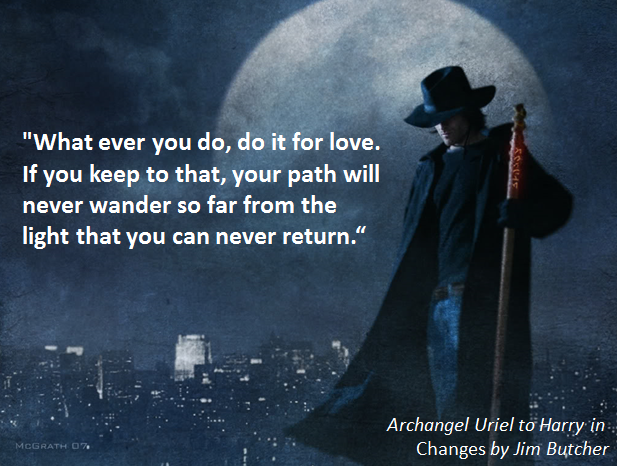
I have a new post up at Times And Seasons this morning, continuing the series of posts that has, intentionally or not, sort of become my Internet testimony. Not sure that’s how it comes across to others, but it’s pretty much how I see it. The post also features a quote from my favorite Dresden Files book. Some might take a quote from popular urban fantasy to be an indication that I’m not taking my subject matter seriously. They would actually be underestimating how seriously I take my urban fantasy. I say this partly in jest, partly because of how much I genuinely love the Dresden Files, and partly because I just really like the idea of finding serious lessons about serious topics in unexpected, mundane places.[ref]This is why I’m excited about the new focus for fellow DR Editor Walker Wright’s own blog, The Slow Hunch. He’s a genius at this topic, especially when it comes to business.[/ref]

Also, in case y’all missed the announcement, Walker and I got published in Square Two with an article called “No Poor Among Them”: Global Poverty, Free Markets, and the “Fourfold” Mission. It’s about the topic of poverty and religion, and you should all read it because it’s awesome.[ref]I am not biased.[/ref]