This needs no introduction.
OMG, This Is Awesome: Mitt & Jimmy Slow Jam
This needs no introduction.
I had another dream, I had another life
This needs no introduction.

This New York Times piece is by far the best one I’ve read yet on the impact of Bitcoin. It’s interesting, then, that it’s also one of the most positive. In the post Marc Andreessen puts Bitcoin in context as the culmination of decades of computer science research rather than just some weird, ultra-libertarian pipe-dream. He explains what really matters about the new currency (mostly: eliminating the 2-3% charged by credit cards and making transactions almost literally costless). And lastly, he responds to some of the complaints that it is a criminal paradise (“Much like email, which is quite traceable, Bitcoin is pseudonymous, not anonymous.”)
Definitely worth the read.
And almost enough to convince me to join a mining pool…
This post is reprinted with permission from Secular Pro-Life:
When arguing about abortion, I’ve seen a lot of people claim “sex isn’t a contract.” Other variations of this idea include:
The problem is, when it comes to reproduction, these arguments only apply to women.
If a man gets a woman pregnant–be it his wife, girlfriend, affair, or one night stand–he is legally bound to provide support for that child. In other words, because the man participated in the child’s conception (because the man had sex), his rights are altered. It doesn’t matter if the man was only consenting to sex, and not to reproduction. It doesn’t matter if he used birth control. It doesn’t matter that sex isn’t a crime. He fathered the kid, so the law considers him responsible for the kid.
And the law takes a pretty hard line on the subject. Courts can require a father to pay child support based not just on what he earns, but on what courts believe he has the ability to earn. Child support obligations remain even if a father goes to prison, or declares bankruptcy. Even if he wants to terminate his parental rights (and therefore his parental responsibilities), the courts usually won’t allow it unless there is another adult prepared to adopt the child and take over that responsibility. And there are many methods for enforcing child support. A man’s tax refunds can be intercepted, his property seized, business or occupational license suspended, and in some states his driver’s license can be revoked. If he still fails to make payment, he can be held in contempt and given jail time.
In short, if a man has sex he runs the risk of being (rather tightly) legally bound to any new life he creates. In the essay “Abortion and Fathers’ Rights“, author Stephen D. Hales summarizes the situation:
…the father, having participated in conception, cannot escape the future duties he will have toward the child. The father can decide that he cannot afford another child, that he is not psychologically prepared to be a parent, that a child would hinder the lifestyle he wishes to pursue, and so on, to no avail.
Sound sad? If a man is forced to pay child support, that could mean serious emotional, psychological, financial, and social repercussions for him. So why do we have child support laws? Is it because we hate sex, and want to punish people for having sex?
No, of course not. And interestingly, you rarely see anyone even suggest as much. No, it’s clear to most people that we have child support laws in order to, you know, support children. Child support laws aren’t enforced to punish men for having sex—they’re enforced because it’s best for the child. In the same way, abortion shouldn’t be outlawed to punish women for having sex—it should be outlawed to protect fetal life. In both cases, it’s not about punishment, it’s about protection.
And that’s as it should be.
I’d love to live in a world in which there are no unplanned pregnancies and no unintentional parents. I think people should have control over whether they become parents, in the sense that people should have control over whether they get pregnant or get someone pregnant. That’s why I support comprehensive sex education: I want people to understand their own fertility and, if they do choose to have sex, I want them to understand how they can best prevent pregnancy while being sexually active.
However, once pregnancy has happened, once there’s already a new human organism in the picture, it changes everything. I think the people whose actions created that new life should be responsible for its protection.
Of course, many people disagree. Abortion rights advocates place reproductive freedom over protecting the lives we create, at least when it comes to women and pregnancy. How would this mentality look if they also applied it to men and child support? Hales has an idea:
A man has the moral right to decide not to become a father (in the social, nonbiological sense) during the time that the woman he has impregnated may permissibly abort. He can make a unilateral decision whether to refuse fatherhood, and is not morally obliged to consult with the mother or any other person before reaching a decision. Moreover, neither the mother nor any other person can veto or override a man’s decision about becoming a father. He has first and last say about what he does with his life in this regard.
(And if we’re being really consistent, he doesn’t have to inform the woman he impregnated, or anyone else, about his decision to refuse fatherhood.)
It seems to me that consistency requires abortion rights advocates to argue for the man’s right to choose as well as the woman’s: the pro-choice mentality means that, as women can “walk away” from their pregnancies, men should be able to walk away from the women they have impregnated.
Not very uplifting, is it?
Or we could strive for a different kind of consistency–the kind that holds both men and women to a higher standard. This is why I’m for child support laws, and this is why I’m against abortion.

Terryl and Fiona Givens (Nathaniel’s parents) were here in Texas this past weekend at the invitation of the Miller Eccles Study Group and the Genesis Group. Their presentations were based on their books The God Who Weeps and the upcoming The Crucible of Doubt. I’ve written up a brief commentary at Worlds Without End on their Saturday presentation (based largely on Crucible), sprinkling it with a bit of neuroscience.
Check it out.

Of course we can be cynical about a company that sells beer making a commercial that says if you’re really having fun you’re going to drink less beer, but I still think it’s a great message. Don’t get me wrong: as a Mormon I don’t drink any beer so on the one hand it doesn’t apply to me. But, also as a Mormon, I don’t think there’s anything at all wrong with other folks drinking, as long as they’re being reasonable and not hurting themselves of encouraging others to hurt themselves.
What I really liked about the video is simply this: I grew up having a lot of fun without ever drinking. I often hear about how alcohol is a “social lubricant” that helps people loosen up, but in my experience Mormons never needed any help. One of the best times I ever had was when I hung out with a bunch of other Mormon kids (all of us teenagers) and we played hide-and-seek in someone’s house. Yes, a bunch of adolescents with driver’s licenses for real played hide-and-seek, and it was amazing. Hilarious. Fun.
So if Heineken wants to tell people they can shift their attention from the drinking to the dancing (or whatever), I think that’s pretty cool. And if it helps them sell more Heineken, that’s fine.
As long as folks don’t, you know, drink them all at once. :-)

Sociologist W. Bradford Wilcox (Director of the National Marriage Project at the University of Virginia) has a piece at National Review on the new Shriver Report. The report suggests that “government, business, and other institutions must accommodate themselves to the “profound change in the makeup and reality of American families,” especially the dramatic increase in single motherhood.” Wilcox points out “three profoundly unequal and regressive trends in American life” that would result from the “deal with change” proposals of the report:
See the piece for details why.

Nathaniel recently argued that minimum wage hikes were dumb, largely due to the policy harming those it intends to help. New research (2012 working paper version here) examines turnover rates in relation to minimum wage increases. The researchers
find that when the minimum wage is higher, all low educated workers face jobs that are more stable (in the sense that they are less likely to end in a lay-off) but harder to get. This shifts the debate over the usefulness of minimum wages to the question of whether workers are better off with improved job stability or improved chances of finding a job when unemployed. It also means that minimum wages affect a much larger part of the labour market than is usually recognised and potentially raises the stakes in the policy debates…Thus, the policy debate should not just be about the employment rate effects of minimum wage increases but about the trade-off between good jobs with higher wages and more job stability versus easier access to jobs. And the debate is relevant for all of the low educated labour market, not just teenagers.
There’s been a lot of good press recently about the false and impossible standards set by photoshopped fashion models. This time it’s not Photoshop to blame, so much as just good old fashioned optical trickery used in before and after weight loss photos. To make the point, a person trainer from Australia staged her own before and after shots.

The catch? The elapsed time between these two photos is about fifteen minutes. She wrote:
Wanna know my secret? Well firstly I ditched the phonewallet (fwallet) cause that *** is lame, swapped my bather bottoms to black (cause they’re a size bigger and black is slimming), smothered on some fake tan, clipped in my hair extensions, stood up a bit taller, sucked in my guts, popped my hip, threw in a skinny arm, stood a bit wider #boxgap, pulled my shoulders back and added a bit of a cheeky/I’m so proud of my results smile. Zoomed in on the before pic, zoomed out on the after and added a filter. Cause filters make everything awesome.
It’s definitely worth it to read more of her thoughts on the issue of body image and health and expectations because she’s got a lot to say, and it’s important stuff.
asfd
This article at Business Insider is one of those articles for political moderates who want to know about practical, non-ideological, expert-approved policies we can do to grow our economy. The premise of the article is that demand-side economics (think: government intervention and redistribution) has been the right response to the fiscal crisis, but that in the long run sustainable growth depends on supply-side economics (think: deregulation). Rather than a return to the supply-side theories of prior decades, however, the article lists 8 new supply-side policies, and a lot of them are exactly the sane, sensible policies that could make our country better.

Precisely because they are sane, sensible, and not easily classifiable as left or right, they will probably be totally ignored. Don’t let my cynicism get you down, though! At a minimum, if you read the article you can trot them out whenever you feel the need to browbeat your partisan friends (from either end of the spectrum) into submission the next time they explain why it is that their particular political ideology is the One True Way for America.
And that’s…. something, right?
Yesterday, I posted “War on Poverty: The Results” with a rather depressing graph from economist Lawrence McQuillan. However, the post may have struck readers as odd, given that I tend to actually be optimistic about the rise of living standards all over the world (including the U.S.). I’ve also mentioned before that there is a difference between statistical categories and flesh-and-blood people (i.e. “the poor” in 1970 are likely not “the poor” of 2014). But frankly, the U.S. Census data (which McQuillan’s graph was based on) is, as Washington Post columnist Robert Samuelson writes, “a lousy indicator of people’s material well-being. It misses all that the poor get — their total consumption. It counts cash transfers from government but not non-cash transfers (food stamps, school lunches) and tax refunds under the EITC. Some income is underreported; also, the official poverty line overstates price increases and, therefore, understates purchasing power.” In fact, one could argue that “the poor will always be with you” if we take the U.S. Census Bureau’s approach to measuring poverty:
The current poverty thresholds do not adjust for rising levels and standards of living that have occurred since 1965. The official thresholds were approximately equal to half of median income in 1963-64. By 1992, one half median income had increased to more than 120 percent of the official threshold (pg. 1).
Due to rising standards of living, poverty must become relative to the surrounding standards:
Adjustments to thresholds should be made over time to reflect real change in expenditures on this basic bundle of goods at the 33rd percentile of the expenditure distribution (pg. 2).
While the U.S. Census data can be useful (hence my original post), it is woefully inadequate. As a mentioned above, a major thing it misses is the material well-being of the poor. As science writer Matt Ridley explains,
Yet looking back now, another fifty years later, the middle class of 1955, luxuriating in their cars, comforts and gadgets, would today be describe as ‘below the poverty line’…Today, of Americans officially designated as ‘poor’, 99 per cent have electricity, running water, flush toilets, and a refrigerator; 95 per cent have a television, 88 per cent a telephone, 71 per cent a car and 70 per cent air conditioning. Cornelius Vanderbilt had none of these. Even in 1970 only 36 per cent of all Americans had air conditioning: in 2005 79 per cent of poor households did. Even in urban China 90 per cent of people now have electric light, refrigerators and running water. Many of them also have mobile phones, inter net access and satellite television, not to mention all sorts of improved and cheaper versions of everything from cars and toys to vaccines and restaurants.[ref]Ridley, The Rational Optimist: How Prosperity Evolves (New York: HarperCollins, 2010), 16-17.[/ref]
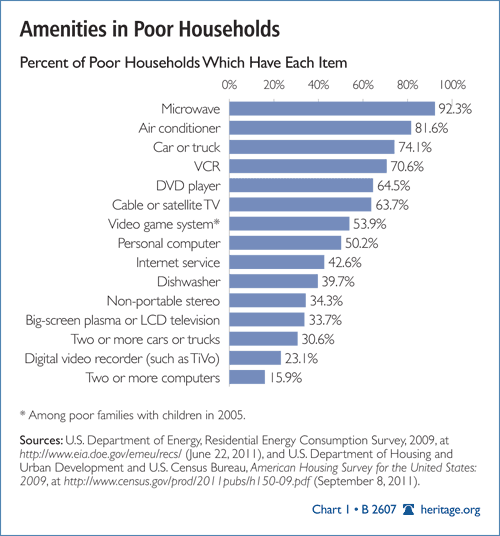
(From the Heritage Foundation)
While poverty by certain standards may not have budged, the literal material well-being of the underprivileged in America has increased dramatically. The safety net has played (and should arguably continue playing) a role in protecting the poor from some of the most brutal blows poverty has to offer. But when you consider the many life-easing materials mentioned above, I think you’ll find that LBJ had little to do with the market forces that brought them about.