Modesty is more than just clothes

do-what-i-wantWhile reading through a Facebook argument on modesty (my time could have been better spent, I know), I realized that for those who hate modesty, their arguments are equivalent to those who hate political correctness (that’s not the right phrase, anymore, right? I can’t keep up.) The argument is pretty much summed up by “What I do isn’t about you and doesn’t affect you, and if it does affect you, fix yourself, not me.” It’s a very come-together, selfless, flower-and-rainbows kind of argument, amirite?

Often I see the same people who argue against modesty also argue for an end to offensive speech, and vice versa. But really both groups of people have picked their preferred form of modesty, will accept no less, and think your form of modesty is oppressive, wrong, and maybe even evil.

The truth is modesty covers both dress and speech because it covers appearance and behavior. And, like it or not, modesty is intertwined with respect. Because what we do and say affects who we are and also affects the way people perceive us. (Clearly our dress is only a small part of what we do.) We aren’t just inanimate blobs floating around that no one can see or hear (and therefore never be offended by us). To say our speech or our dress doesn’t matter because “I’ll do what I want” is not going to engender a polite society.

This is not to say you should be assaulted for what you wear! (I know this is a particular pet peeve of the anti-modesty crowd.) And, similarly, you should not be assaulted for what you say. [ref]I’m pretty sure assault does not fall under the umbrella of modesty.[/ref] But respect goes both ways, and certain places and people require an amount of appropriateness in both dress and speech. [ref]I love my friends “do not use your underwear as an accessory” version of modesty. I haven’t come across a good, simple saying for speech yet.[/ref] I think you should be modest for nice people not for the scum of society.

I also don’t think we should spend much time policing one another (this is my hope that the internet shuts up, I know, very likely). There are always lines to be drawn. But if you really cling to wear whatever you want/say whatever you want or cover every inch/zip your lip, you’re probably being too inflexible and should chill a bit. puritan Nicely dressed meteorologists don’t need to put a sweater on, but we don’t need to see celebrities naked (or even nearly-naked) selfies (sorry, no link). College graduates don’t need protection from Secretaries of States from politically different administrations, but women should not be harassed online for doing their jobs.

Overall, if you spend any time on the internet, you should realize that many aspects of our society could benefit from a little modesty. But that doesn’t mean we all need to become Puritans.
 

Home is Heaven’s Construction Site

Isaac_a_Lover_of_Peace

This post is part of the General Conference Odyssey.

The Saturday morning session of the October 1972 General Conference was another one of those sessions where there was one talk that stood out to me in a singular way. This time the talk was Altar, Tent, Well by Elder M. Theodore Tuttle.

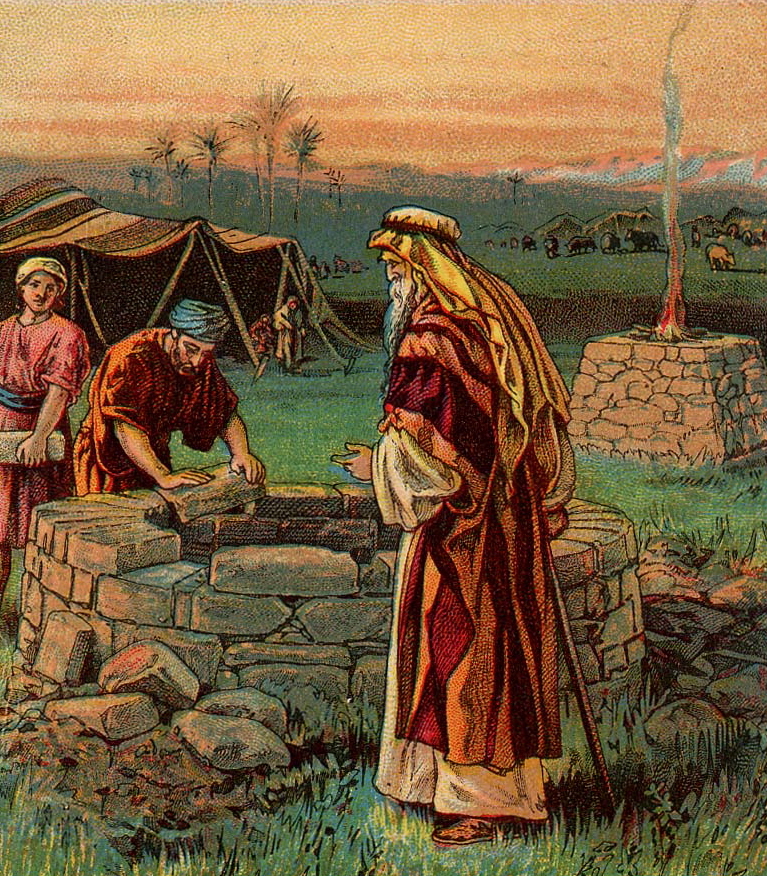
Elder Tuttle begins by quoting from Genesis 26:25: “And Isaac builded an altar there, and called upon the name of the Lord, and pitched his tent there: and there Isaac’s servants digged a well.”

Then Elder Tuttle notes contrasts Isaac with is father (Abraham) and his son (Jacob):

[Isaac] did not reach the heights of Abraham… nor was he as impressive as his son Israel… yet Isaac is loved and revered. He worshiped God, cared for his home, and pursued his work. He is remembered simply as a man of peace. The eloquent simplicity of his life and his unique ability to lend importance to the commonplace made him great.

Isaac’s life, Elder Tuttle says, can be a template for our lives. His day to day concerns are our day to day concerns: altar, tent, and well: worship, home, and work. Elder Tuttle notes, “These basic things of life signified his relationship to God, his family, and his fellowmen. Every person on earth is touched by these three.”

In just a couple of short paragraphs, Elder Tuttle has captured the essence of Mormonism as a practical experience. This, to a great extent, is what it means to live as a Mormon: we seek holiness through the mundane by work and by relationships. Mormons do not try to escape the world to seek our destiny. We realize that many aspects of the world enable us to find that destiny right here and right now.

And so there is nothing poetic about Elder Tuttle’s statement that “To Latter-day Saints, the home is a holy place.” That’s not a metaphor an exaggeration. It’s our theology. The home is “patterned after the celestial home whence we came.” We affirm that God is our Father. We believe that we also have a Mother. We believe our parents want us to become like them. Home is the place where that happens. Home is not heaven quite yet—none of our families are perfect—but home is heaven’s construction site.

This work is mundane. The task of building heaven is not a task of great deeds or dramatic confrontations. It is a chore of practicing kind responses when we’re stressed and tired. It’s the discipline of constantly having to reconsider our priorities. It’s the labor of wrestling our recalcitrant personalities into congruence with love in countless small, unnoticed battles day in and day out. It is learning and growth as imperceptible and, when God blesses our lives, as relentless as a tree taking root in the soil and spreading branches towards the sun and the stars.

The work is relational. Of all the virtues we seek after, none is higher than love. And love is a virtue that only exists in the context of relationships. You can be honest with a stranger. You can deal generously with a stranger. But you cannot love a stranger, because love is friendship. Mormon congregations are determined by geography, and this means we can’t shop for a congregation we like. We don’t pick the people we set next to in the pews, and we don’t pick the bishop we like the most either. But this is just a shadow of the blood bonds that make up a family. Not being able to choose your fellow congregationalists is nothing like not being able to choose your parents, your siblings, or your children. The aim of all our mundane work, the objective to which our daily discipline is directed, is nothing but the cultivation of these relationships so that we may, with God’s grace, bring ourselves into harmony with each other.

One consequence of all this emphasis on the family is that, for Mormons, the institution of the Church of Jesus Christ of Latter-day Saints exists to serve the family and not the other way around. “The Church… is a family church,” says Tuttle, and “we may say that a prime purpose of this church is to perfect and exalt the family.”

Elder Tuttle concludes his talk:

How little things have changed since Isaac’s day—the things that really matter. There is the same God of Abraham, Isaac, and Jacob, the same family roles to fill, the same need to work. Altar, tent, and well: these things are essential. Placed in proper perspective by God’s revealed word, they provide at once our greatest challenge and achievement.

Altar, tent, and well. These are why we are here.

Check out the other posts from the General Conference Odyssey this week and join our Facebook group to follow along!

Family Factors and Crime

“Figuring out what causes crime could be the key to reducing it,” says a recent post over at the Institute for Family Studies blog. However, the question of crime causality

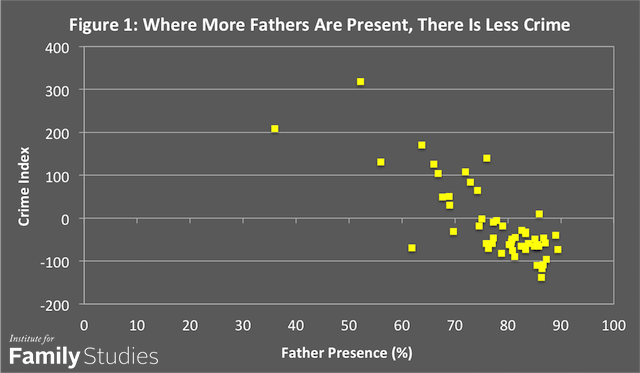
has still proven tricky to answer. Some blame culture; others blame poverty or inequality; still others blame a lack of good government. A new study looks at the question through a different lens: Maybe crime is one manifestation of a “fast life-history strategy”—a bundle of traits, unified by a wide-ranging evolutionary theory, that also includes adolescent fertility and low paternal investment. The results suggest that, indeed, nations with young mothers and absent fathers also tend to have high crime, even after other potential causes have been accounted for.

While there are nuances and caveats to be made, it is interesting that “the strongest correlation is between crime and paternal presence, which I was able to chart because the authors kindly provided me their dataset”:


The study’s findings are, of course, far more complicated, but the paper nonetheless “buttresses the argument for stable marriages and delayed childbearing, and it suggests that policymakers should familiarize themselves with the details of life-history strategies so that they might think about how to change them.”

Check out the full post.

Transgenderism

I want to visit this topic briefly because, while the subject never seems to leave the news, the fundamentals of the subject come up rarely. In keeping with the confusion that reigns regarding many subjects, transgenderism ultimately is not a question of science. Rather, the question lies in philosophy.[ref]As a quick disclaimer, I am not a professor of anything. Your mileage may vary on my analyses[/ref] I would sum up the question this way: What is the really real which defines a person’s identity? More specifically, in a mismatch between the body and the mind, is the body or the mind in error?

For this reason, the scientific facts of transgenderism only make sense in the light of choosing an answer to the above philosophical question. The possession of a penis or a vagina only proves definitive if you have answered the above question with “The physical aspects of our body define our identity.” Conversely, the fact that transgender people often possess a brain structure somewhere in between men and women definitively rules in this case only if you have first answered “The mental defines our identity.”

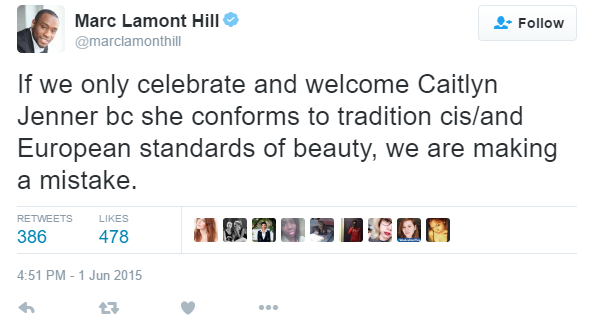
In other observations, the debate over transgenderism has seemingly brought gender essentialism back to circles from which it was long ago banished, because you cannot be something unless that something has fixed traits. One clever professor and journalist caught onto this trend during Caitlyn Jenner’s transition:

jenner comment

Now, what is my opinion? I identify the real with the physical body. The topic of transgenderism is, so far as I can tell, the only subject where we identify the real with the mind. When a person experiences a phantom limb, we all identify the really real with the fact that they lack a limb, not with their mind which believes the body still has that limb. On the flip side, when people profess a desire to amputate a healthy limb based on their mental image of themselves as an amputee, we do not amputate the limb because, once more, we identify the body as real and the mind as in error. We also show an abhorrence to amputating a healthy limb based on desires. I believe, in all cases except transgenderism, we unanimously identify the real with the body for good reason. Namely, a common human experience is the individual (and sometimes even the collective) mind in error compared what is real.[ref]I’m going to elide a massive epistemological discussion there. In short: I subscribe to the correspondence theory of truth.[/ref] Making the individual mind into the sole arbiter of the real cannot help but lead to conclusions both absurd and damaging.

As a final thought, I do not want to leave this subject without acknowledging that an immense amount of human suffering is bound up in this topic. We’re not just discussing abstract theories of the really real. We’re discussing people’s lives. I try to be sensitive to that fact. I doubt my opinion will change on this subject, but I am always open to people sharing their experiences because, even if no one changes their opinion, I find it helpful to know what people are experiencing.

A Grand Fundamental Principle

DTS_Photography_Movie4

This post is part of the General Conference Odyssey.

Elder Marvin J. Ashton gave the first talk of the Friday afternoon session in October 1972, and it was fantastic. What Is a Friend? is timely in so many ways, and is one of my favorite talks since starting the General Conference Odyssey last year.

One of the things I’m sure people noticed when reading it, is Elder Ashton’s push back against the conventional wisdom that “A friend is a person who is willing to take me the way I am.” In contrast to that view, Elder Ashton taught that “we are something less than a real friend if we leave a person the same way we find him.”  He expounded:

There seems to be a misunderstanding on the part of some men today as to what it means to be a friend. Acts of a friend should result in self-improvement, better attitudes, self-reliance, comfort, consolation, self-respect, and better welfare. Certainly the word friend is misused if it is identified with a person who contributes to our delinquency, misery, and heartaches. When we make a man feel he is wanted, his whole attitude changes. Our friendship will be recognizable if our actions and attitudes result in improvement and independence.

This became the central theme of the talk; friendship requires that we be willing to

  1. take a person as they are and
  2. leave them improved.

We need both, but so often the world teaches only the first. It teaches that a friend is “a person who passively nods approval,” rather than one who will “suggest and render the best for us regardless of the immediate consequences.”

I also loved the idea of friendship as Elder Ashton applied it to the priesthood hierarchy. “President Less is our friend,” he wrote, and also said, “I love President Tanner and I love President Romney because they are my friends.” This contrasts to starkly with the conventional view of leadership in the world. One example of this is the dichotomy between enlisted and officers in most military forces. The distinction, which hearkens back to class differences, has a useful purpose in a human institution. In On Killing, he wrote about “the paradox of war” saying that “to be a good leader you must truly love (in a strangely detached fashion) your men, and then you must be willing to kill (or at least give the orders that will result in the deaths of) that which you love.”

The officer / enlisted distinction serves to create that “strange detachment” that allows officers—even those who love their men—to send them to their deaths according to the cold calculus of war. This pattern of leadership persists across much of our society, even when there is no such rational basis for it. Leaders are different. They are aloof. They are separate.

But not in the Church. In the Church, there are not officers and enlisted. We’re all enlisted. There are no such barriers between the clergy and the lay members, we’re all lay members. And so we’re all—or we should all be—friends.

And then, Elder Ashton extended this principle even farther, citing several passages from the scriptures that describe God as our friend and concluding, “We need God’s friendship. He pleads for ours.” This is a concept that is only possible with the correct view of friendship, that love motivates both acceptance of a person and an unmitigated desire to help that person become better.

Of course, in our relationship with each other, we have to be wary of motes and beams, but the fundamental motive to help each other rise higher is fundamental to friendship, and it is that principle that animates our friendship with God who—unlike us—always knows exactly what we need to continue our ascent to be more like Him.

And so it is that, as Joseph Smith said, “friendship is one of the grand fundamental principles of ‘Mormonism’.”

Check out the other posts from the General Conference Odyssey this week and join our Facebook group to follow along!

“I’ll Be There For You”

This is part of the General Conference Odyssey.

Friendship is the grand fundamental principle of Mormonism.[ref]Quoted in Don Bradley, “‘The Grand Fundamental Principles of Mormonism’: Joseph Smith’s Unfinished Reformation,” Sunstone (April 2006): 33.[/ref]

So preached Joseph Smith in 1843. Years earlier, when asked how Mormons differed from other Christians, Joseph answered, “We believe the Bible and they do not.”[ref]Ibid.: 37.[/ref] Yet, within the same month as the friendship quote above–and after many theological innovations that put more distance between Mormonism and traditional Christianity–Joseph answered the same question with: “In reality & essence we do not differ so far in our religious views but that we could all drink into one principle of love.”[ref]Ibid.[/ref] By the end of his life, Joseph had, in the words of Mormon historian Philip Barlow, found

broken or incomplete virtually every essential dimension of how humans related to one another: their rudderless sectarian religion, their baseless sources of authority, their social classes which no longer cohered, and their politics and economies. He made bold assertions about how people may know what they know, what they in essence are, their connection to God, their means and understanding of “salvation,” and their entrapment by the great barrier of death. It was not merely that the Prophet inhabited a time of “rapid social change” and consequent “social dislocation,” which various historians have used to explain the Smith phenomenon. It was rather that the universe of relations and conceptions itself was splintered, which included but cannot be reduced to social dislocation. All of this required repair, and the worldly philosophers and sectarian preachers, Smith thought, could not put Humpty-Dumpty together again. The prophet aspired to mend a fractured reality.

The year following his declaration of friendship as the essence of Mormonism, Joseph taught in his now famous King Follett Discourse, “You have got to learn how to make yourselves Gods in order to save yourselves and be kings and priests to God the same as all Gods have done–by going from a small capacity to a great capacity from a small degree to another from grace to grace until the resurrection of the dead from exaltation to exaltation–till you are able to sit in everlasting burnings and everlasting power and glory as those who have gone before sit enthroned” (pg. 201). It seems that friendship and progression had become fused in the Prophet’s mind late in life, even to the point of mending intergenerational relations: “And now, my dearly beloved brethren and sisters, let me assure you that these are principles in relation to the dead and the living that cannot be lightly passed over, as pertaining to our salvation. For their salvation is necessary and essential to our salvation, as Paul says concerning the fathers—that they without us cannot be made perfect—neither can we without our dead be made perfect” (D&C 128:15).

This fusion of friendship and progression seems to be at the heart of Marvin J. Ashton’s October 1972 talk:

Acts of a friend should result in self-improvement, better attitudes, self-reliance, comfort, consolation, self-respect, and better welfare. Certainly the word friend is misused if it is identified with a person who contributes to our delinquency, misery, and heartaches. When we make a man feel he is wanted, his whole attitude changes. Our friendship will be recognizable if our actions and attitudes result in improvement and independence.

It takes courage to be a real friend. Some of us endanger the valued classification of friend because of our unwillingness to be one under all circumstances. Fear can deprive us of friendship. Some of us identify our closest friends as those with the courage to remain and share themselves with us under all circumstances. A friend is a person who will suggest and render the best for us regardless of the immediate consequences.

He relates this concept to James 1:27 and “pure religion”: “Our responsibility to the widow and the fatherless is to accept them as we find them, but to not leave them without improvement.” A true friend, in Ashton’s mind, “is a person who is willing to take me the way I am but who is willing and able to leave me better than he found me.”

A friend should not just fill a social need. A friend should better us as well.


The Long-Term Effects of Disruptive Peers

Class disruptions are known to worsen educational achievement in the short run, but new research demonstrates that being exposed to disruptive peers can even lead to worse adult outcomes:

Results indicate that there are persistent effects on both test scores and educational attainment. We estimate that exposure to one disruptive peer in a class of 25 throughout elementary school is associated with a 0.02 standard deviation reduction in test scores during high school, and nearly a one percentage point reduction in the likelihood of receiving a college degree. This suggests that the impact of disruptive peers does persist with respect to educational outcomes years afterward.

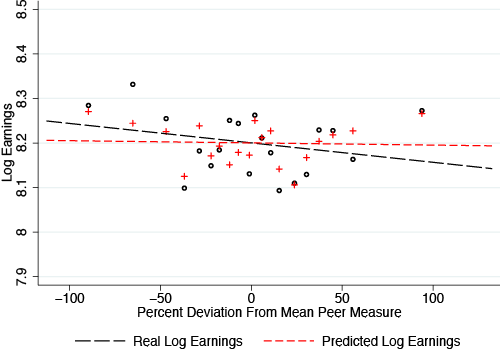
…Figure 1 shows that while individuals who have idiosyncratically low exposure to disruptive peers (those on the left-hand side) tend to earn more than predicted, those with idiosyncratically high exposure tend to earn somewhat less than predicted. Specifically, we estimate that exposure to one disruptive peer in a class of 25 throughout elementary school reduces earnings by 3–4%, with effects being driven by exposure to disruptive boys.

The researchers conclude,

Our findings…speak to the extent to which differential exposure to disruptive students can lead to income inequality later in life. We calculate that the increased exposure to disruptive peers by students from low-income families can explain 5–6% of the earnings gap between adults who grew up in low versus high-income households. This is significant given that we have only one particular measure of disruptive peers in our sample, and it highlights the extent to which sorting into schools can lead to the persistence of long-term income inequality across households.

While the researchers look specifically at children in families exposed to domestic violence, their findings have broader implications about family breakdown, behavioral problems, and income inequality. As Princeton sociologist Sara McLanahan and Harvard’s Christopher Jencks explain, family breakdown can lead to more behavioral problems in children:

[A] father’s absence increases antisocial behavior, such as aggression, rule breaking, delinquency, and illegal drug use. These antisocial behaviors affect high school completion independent of a child’s verbal and math scores. Thus it appears that a father’s absence lowers children’s educational attainment not by altering their scores on cognitive tests but by disrupting their social and emotional adjustment and reducing their ability or willingness to exercise self-control. The effects of growing up without both parents on aggression, rule breaking, and delinquency are also larger for boys than for girls. Since these traits predict both college attendance and graduation, the spread of single-parent families over the past few decades may have contributed to the growing gender gap in college attendance and graduation. The gender gap in college completion is much more pronounced among children raised by single mothers than among children raised in two-parent families.

This new research suggests that the retreat from marriage has a spill-over effect: the behavioral problems of children from broken families not only negatively affect their own educational and financial outcomes, but the outcomes of their peers. When we consider that marriage tends to decrease the chances of children being exposed to both domestic violence (the study’s selection of choice as mentioned above) and violent crimes within neighborhoods, the importance of healthy, stable marriages becomes all the more clear.

Intact families are necessary for the flourishing of children and the adults they will eventually become.

The Science of Alcohol Consumption

Is alcohol good for you? According to The Economist, the debate rages on:

Pro-oenological forces point to a large body of evidence demonstrating wine’s positive effect on both the cardiovascular system and longevity. This viewpoint was given additional support this week by a new study in mBio led by Ming-liang Chen and Man-tian Mi of the Third Military Medical University in China. Using mice, the team showed that resveratrol, a molecule found in grapes and berries, reduced the formation of plaques in arteries—a cardiovascular condition known as atherosclerosis that limits blood flow and can trigger heart attacks and strokes.

…But anti-alcohol advocates can claim a victory of their own in the Journal of Studies on Alcohol and Drugs. Tim Stockwell of the University of Victoria in Canada and Tanya Chikritzhs of the National Drug Research Institute at Curtin University in Australia carried out a meta-analysis of 87 epidemiological investigations. They concluded that so-called moderate drinkers do not benefit from a reduction in mortality compared to abstainers. This finding strikes a blow at the very heart of the imbibers’ claim.

Why is the science of public health so fraught with mixed messages? The article concludes,

First, the statistically significant results reported in journals are often not biologically relevant, because a measurable outcome may be so small that it has no meaningful effect on patients. Second, animals are imperfect models for humans. Third, findings from the laboratory, for reasons not always fully understood, often do not translate to the field. The difficulty of reconciling multiple conflicting lines of evidence means the alcohol debate will rage on. Cheers! 

Less Marriage, More Inequality

“In a word,” writes sociologist W. Bradford Wilcox and Anna Sutherland,

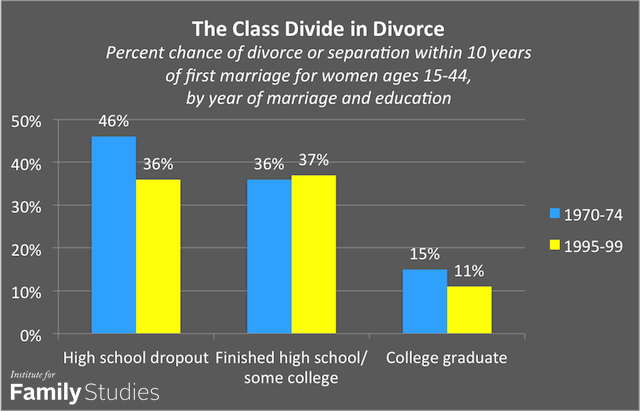
the increasingly “separate and unequal” character of family life in the United States is fueling economic, racial, and gender inequality. How is family life “separate and unequal”? First, Americans exhibit a growing class divide in marriage where the college-educated are more likely to enjoy high-quality, stable marriages than the less-educated. For instance, since the divorce revolution of the 1970s, divorce has fallen among college-educated Americans, while remaining comparatively common among Americans without college degrees.

class divide

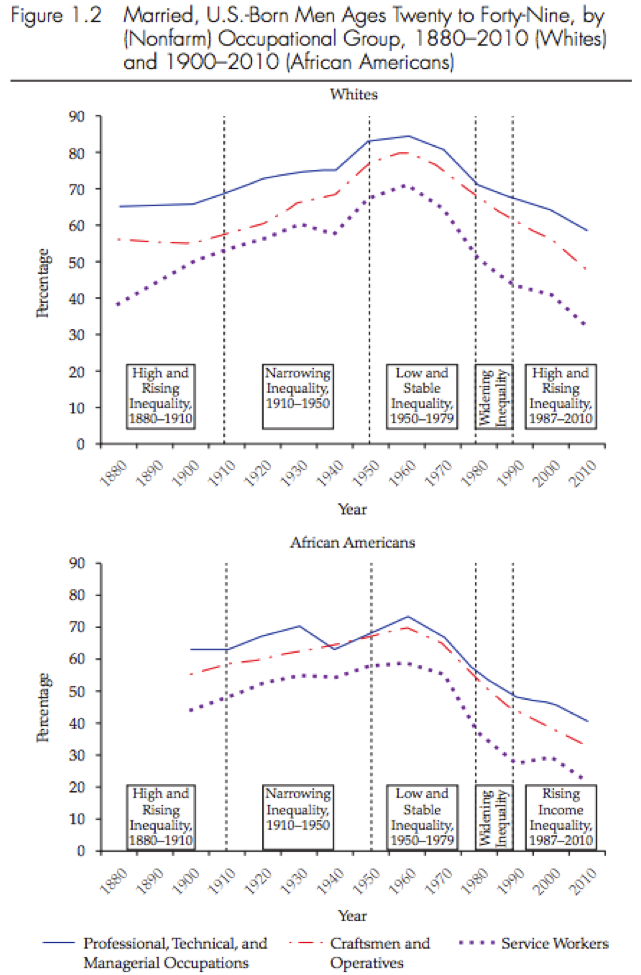
Furthermore, the timing of these trends provides “strong evidence that family change preceded growing economic inequality. Specifically, the rise of nonmarital childbearing and divorce date back to the 1960s, well before economic inequality began growing in the late 1970s.”

The authors find that “scholarly research demonstrates that America’s growing marriage divide has helped to fuel three forms of economic and social inequality”:

  1. “First and foremost is inequality in Americans’ family income, which has risen since the 1970s.”
  2. “The retreat from marriage also looms large in another form of economic inequality in America: racial inequality.”
  3. “Third, the growing marriage divide is fueling a historically unusual type of gender inequality in low-income communities…”

There’s much more. The research is both compelling and important. Check out the full post.

The Science of Sexual Orientation

This is a photo of a couple holding hands.A new report in the journal Psychological Science in the Public Interest provides “a comprehensive review of the scientific research on sexual orientation.” Based on the latest research, the researchers draw several conclusions:

  • Across cultures, a “small but nontrivial” percentage of people have non-heterosexual feelings. The specific expression of sexual orientation varies widely according to cultural norms and traditions, but research suggests that individuals’ sexual feelings are likely to develop in similar ways around the world.
  • Men’s and women’s sexual orientations manifest in different ways: Men’s sexual orientation is more closely linked to their patterns of sexual arousal than women’s sexual orientation is.
  • Various biological factors—including prenatal hormones and specific genetic profiles—are likely to contribute to sexual orientation, though they are not the sole cause. Scientific evidence suggests that biological and non-social environmental factors jointly influence sexual orientation.
  • Scientific findings do not support the notion that sexual orientation can be taught or learned through social means. And there is little evidence to suggest that non-heterosexual orientations become more common with increased social tolerance.

Lead author J. Michael Bailey argues, “Sexual orientation is an important human trait, and we should study it without fear, and without political constraint. The more controversial a topic, the more we should invest in acquiring unbiased knowledge and science is the best way to acquire unbiased knowledge.”