What are the Chances?: American Deaths via Foreign Terrorists

Image result for skittles trumpWith skittles and terrorists in the news, it might be worth assessing the risks that immigrants pose to U.S. natives. How likely are Americans to be killed by a terrorist attack committed by a foreigner? A new policy analysis from the Cato Institute finds that the chances are vanishingly small:
Including those murdered in the terrorist attacks of September 11, 2001 (9/11), the chance of an American perishing in a terrorist attack on U.S. soil that was committed by a foreigner over the 41-year period studied here is 1 in 3.6 million per year. The hazard posed by foreigners who entered on different visa categories varies considerably. For instance, the chance of an American being murdered in a terrorist attack caused by a refugee is 1 in 3.64 billion per year while the chance of being murdered in an attack committed by an illegal immigrant is an astronomical 1 in 10.9 billion per year. By contrast, the chance of being murdered by a tourist on a B visa, the most common tourist visa, is 1 in 3.9 million per year. Any government response to terrorism must take account of the wide range of hazards posed by foreign-born terrorists who entered under various visa categories.

Given that Americans are as likely to be killed by falling furniture as a terrorist attack, maybe we should ban all new purchases of televisions and couches. Add this to the evidence that immigrants are less criminal than native-born Americans and we end up with nothing more than a fear-mongering blowhard.

Economic Freedom and Crises

Image result for capitalism crisis gif
Ha. No.

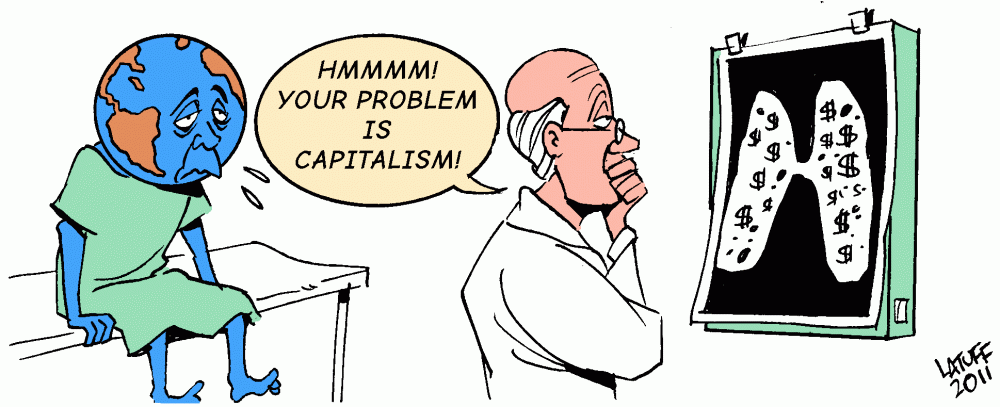
Economic crises are often blamed on the abstraction “capitalism.” But does economic freedom lead to economic crisis? A new study argues ‘no’:

In this paper, I explore the politically contested association between the degree of capitalism, captured by measures of economic freedom, and the risk and characteristics of economic crises. After offering some brief theoretical considerations, I estimate the effects of economic freedom on crisis risk in the post-Cold War period 1993–2010. I further estimate the effects on the duration, peak-to-trough GDP ratios and recovery times of 212 crises across 175 countries within this period. Estimates suggest that economic freedom is robustly associated with smaller peak-to-trough ratios and shorter recovery time. These effects are driven by regulatory components of the economic freedom index.

An ungated version of the paper can be found here. Check it out.

Man in the Mirror

This is part of the General Conference Odyssey:

Mormons often talk about being in the world, but not of the world. Furthermore, it becomes The World™ in Mormon discourse. In the Gospel of John, there is a cosmic struggle between Jesus and Satan for “the world” (see John 12:31; 14:30; 16:11). Spiritual warfare is a prominent theme not only in John, but throughout the biblical narrative. The Christian life is to “struggle…not against enemies of blood and flesh, but against the rulers, against the authorities, against the cosmic powers of this present darkness, against the spiritual forces of evil in the heavenly places” (Eph. 6:12, NRSV). But, asks Assistant to the Quorum of the Twelve James Cullimore, “[w]hat do we mean by the “world”? President McKay refers to it as those “… alienated from the Saints of God. They are aliens to the Church, and it is the spirit of this alienation that we should keep ourselves free from.” (Conference Report, October 1911, p. 58.) Elder Bruce R. McConkie defines the “world” as “the social conditions created by such of the inhabitants of the earth as live carnal, sensuous, lustful lives, and who have not put off the natural man by obedience to the laws and ordinances of the gospel.” (Bruce R. McConkie, Mormon Doctrine, [Salt Lake City: Bookcraft, 1966], p. 847.) John, in his epistle, describes the “world” as “the lust of the flesh, and the lust of the eyes, and the pride of life.” (1 Jn. 2:16.)” In short, it “does not mean the sphere on which we live, but an environment created by individuals who live contrary to his teachings.” But Cullimore’s counsel is not to detach from the world, to leave it behind. “We would not want to be free of our responsibility of being in the world by being taken out of the world…” We “are to be a leaven wherever you are” according to Cullimore. Our best bet of overcoming evil in the world is–in the words of Elder Theodore Burton–to “seek to change [our] manner of living to conform more closely to the ways of the Lord.” Burton says,

A person’s attitude is perhaps the hardest of all personal attributes to change. If your attitude is right, then your life is made right. If your heart is touched, your mind and way of thinking will change and your life will change for the better accordingly. I believe we must become so immersed in the gospel of Jesus Christ that we become physically as well as mentally more and more like the Lord himself. We must yield our whole hearts to him. What we then do is done not because we are asked to, nor because we are forced to, but because we want to. Neither pressure nor force can be exerted upon us from outside, when what we do is done because it is our own choice and desire. It then makes no difference to us what other men may think, or say, or do. Our hearts being committed wholly to God, what we do is done out of our love for and our trust in him. We then serve God in every way we can because we have been converted, our attitude has been changed and we now desire to become like him both spiritually and physically.

Basically, as the King of Pop sang, start with the man in the mirror.

Image result for man in the mirror gif

Check out the other posts from the General Conference Odyssey this week and join our Facebook group to follow along!

Are America’s Poor Worse Off Today?

AEI’s Robert Doar highlights a fairly new review in The New York Review of Books that, in Doar’s estimate, “provides two very strong caveats” to the some of the recent claims by sociologists Edin and Shaefer “that some single parent families are dramatically worse off than they were before the passage of the 1996 welfare reform legislation, which replaced a federal entitlement to cash welfare (AFDC) with a block grant to states to implement work-focused cash assistance programs (TANF).” Harvard’s Christopher Jencks (the review’s author) points out that

estimates of extreme poverty change when they treat the value of EITC refunds, food stamps, and rent subsidies like income. The second row of Table 1 shows that including these resources reduces the estimated prevalence of extreme poverty among households with children from 1.7 to 1.1 percent in 1996 and from 4.3 to 1.6 percent in 2011. Because the reduction is so much larger in 2011 than it was in 1996, the increase in extreme poverty between 1996 and 2011 falls from 2.6 to 0.5 percentage points. In other words, the growth of EITC refunds and noncash benefits offsets about four fifths of the decline in extremely poor families’ pretax money income between 1996 and 2011.

Jencks_figure1

Doar expounds, “Edin and Shaefer acknowledge that they focus only on “cash” income and they argue that vouchers which pay for food or housing are not cash, and don’t cover all the needs of a family.  But for most readers of their book, and certainly for all of those who just hear the headline about families living on $2 a day, the distinction goes unnoticed: Living on $2 a day means that is all they have to purchase food and housing.  That is, after all, what it customarily means when used in the developing world context from which Edin and Shaefer drew the statistic.” Jencks’ second caveat is summed up as follows:

The fourth line in Table 1 shows that when Shaefer counted only those who had spent three or more months living on resources worth less than $2 a day, the prevalence of extreme poverty among households with children fell from 1.7 to 0.5 percent in 1996 and from 4.3 to 1.0 percent in 2011. This more stringent definition of extreme poverty among households with children clearly leads to a sharp reduction in its estimated prevalence. But it does not change the upward trend. The prevalence rises from 0.5 percent in 1996 to 1.0 percent in 2011, and the actual number rises from 189,000 to 373,000 households with children.

All this makes Doar suspicious: “Could it be that the small increase in extreme poverty was caused by the bad economy in the wake of the Great Recession? Did the fact that federal policymakers decided against incorporating strong work requirements in their expansions of assistance programs affect this in any way? Is it possible (if not likely) that the increase is due in part to more underreporting of income on surveys such as the one used by Edin and Shaefer?” Jencks is also skeptical, concluding that the claim about welfare reform “is not the kind of speculation that can be either verified or refuted; but it is worth serious consideration nonetheless.”

All of this demonstrates why consumption is a superior metric for measuring the economic well-being of the poor. A Brookings report from a couple years ago found that when measured for consumption, virtually no one in the United States lives on $2 a day.[ref]Based on his own research, Scott Winship at the Manhattan Institute says, “In truth, practically no one in the United States gets by on $2 a day in any meaningful sense for any meaningful length of time.”[/ref]Poverty in the U.S. has declined substantially since the 1960s with major material gains for the poor and middle class. While there is still much to do, accurately assessing the situation is necessary in order to determine what steps to take next.

What is Recent Research Saying About the Gender Wage Gap?

Image result for gender pay gap
Well, about $0.06 cheaper.

We’ve discussed the gender wage gap here on Difficult Run before. My last post on the subject covered a lot of the research. In the comments, I made mention of a couple more 2016 studies that should be included in the analysis. However, I thought I’d highlight them in a post for educational purposes. In a paper soon to be published in the Journal of Economic Literature, Cornell economists report,

Using PSID microdata over the 1980-2010, we provide new empirical evidence on the extent of and trends in the gender wage gap, which declined considerably over this period. By 2010, conventional human capital variables taken together explained little of the gender wage gap, while gender differences in occupation and industry continued to be important. Moreover, the gender pay gap declined much more slowly at the top of the wage distribution that at the middle or the bottom and by 2010 was noticeably higher at the top. We then survey the literature to identify what has been learned about the explanations for the gap. We conclude that many of the traditional explanations continue to have salience. Although human capital factors are now relatively unimportant in the aggregate, women’s work force interruptions and shorter hours remain significant in high skilled occupations, possibly due to compensating differentials. Gender differences in occupations and industries, as well as differences in gender roles and the gender division of labor remain important, and research based on experimental evidence strongly suggests that discrimination cannot be discounted. Psychological attributes or noncognitive skills comprise one of the newer explanations for gender differences in outcomes. Our effort to assess the quantitative evidence on the importance of these factors suggests that they account for a small to moderate portion of the gender pay gap, considerably smaller than say occupation and industry effects, though they appear to modestly contribute to these differences.

Five interesting facts from the study are:

  1. The gender pay gap shrank the most in the 1980s.
  2. Wage-gap narrowing wasn’t tied to government policies.
  3. Gender differences in occupations and job roles matter the most.
  4. High-income women have seen the smallest wage-gap closing.
  5. Findings are fuzzy about the impact of family-leave policies.

A 2016 study from Glassdoor yields further support for #3. When “comparing [male and female] workers with the same job title, employer and location, the gender pay gap in the U.S. falls to 5.4 percent (94.6 cents per dollar).”[ref]There is a consistent 4-6% adjusted gap across countries.[/ref] But it turns out that “the single biggest cause of the gender pay gap is occupation and industry sorting of men and women into jobs that pay differently throughout the economy. In the U.S., occupation and industry sorting explains 54 percent of the overall pay gap—by far the largest factor.” And “while overt forms of discrimination may be a partial cause of the gender pay gap, they are not likely the main cause. Instead, occupation and industry sorting of men and women into systematically different jobs is the main cause.”

In short, the gender pay gap has shrunk considerably and is far smaller than one typically hears in political discourse.[ref]Women actually out-earn men in numerous college majors right after graduation, though this dissipates by mid-career.[/ref] Nonetheless, a gap remains. The Glassdoor study finds that “employer policies that embrace salary transparency can help eliminate hard-to-justify gender pay gaps, and can play an important role in helping achieve balance in male-female pay in the workplace.” Perhaps this and similar policies going forward can help us eradicate the (adjusted) gender pay gap indefinitely.

Media Fragmentation and Political Polarization

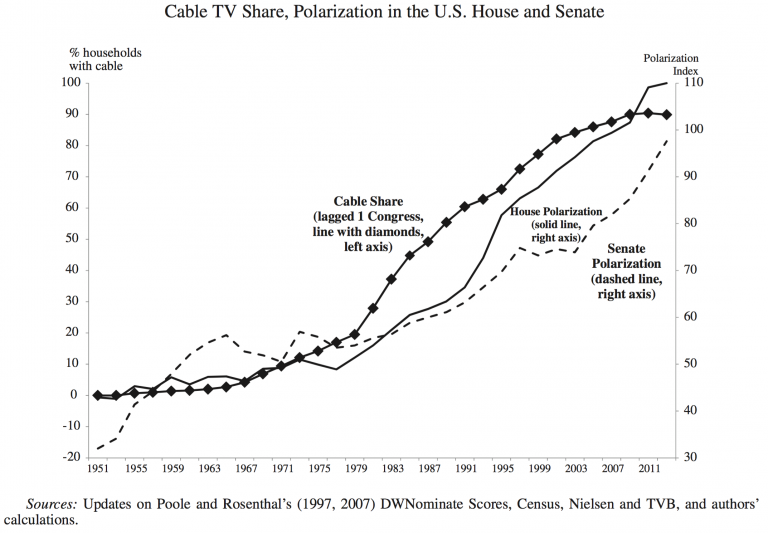
I’ve written about political polarization beforeRecent research suggests that media fragmentation is the culprit behind growing political polarization. A new study[ref]An older version can be found here.[/ref] finds that

  • The growing plurality of news sources as well as the increasing access to cable television made the greatest contribution to political polarization. Two phenomena, or a combination of the two, are responsible: Individuals seek out “self-reinforcing viewpoints rather than be exposed to a common ‘nightly news’ broadcast” — this is sometimes called siloing. Also, individuals are jettisoning news programming for entertainment, “thereby reducing incidental or by-product learning about politics.”
  • The decreasing exposure to alternative views and the increasing buttressing of one’s own views has combined to create less sympathy for others’ views and less of an ability to understand others’ views. “This may be reinforced by a tendency for political differences to be decreasingly addressed through genuine debate and increasingly replaced with media coverage of political vilification or grandstanding.”
  • Inequality — the divide between rich and poor — may have contributed to political polarization, but less than media fragmentation.
  • Duca and Saving test for a number of trends but find no statistically significant associations with generational attitudes, voter partisanship, economic conditions or campaign contributions. But they do find associations with income inequality and media fragmentation.
  • There is some evidence that Congress is more polarized at the beginning of a president’s second term.

Despite these findings, there may be room for caution. According to a new paper by Stanford political scientist Morris Fiorina, the average American has not followed the political class to the fringes. Reason‘s write-up draws five lessons from Fiorina’s work:

  1. The political class is becoming more polarized: “If you limit its scope to elected officials and professional activists, the polarization thesis has some truth to it. Since the early ’70s, the parties have gone through a sorting process, to the point where the most left-wing Republican in either house of Congress is now more conservative than the most right-wing congressional Democrat.”
  2. The general public has not followed suit: “Over the last four decades, there has been little change in how Americans describe themselves ideologically—the most popular category in such surveys is still “moderate,” without a big exodus to the liberal and conservative poles. Opinions have shifted on some specific topics, but not always in the same direction: Americans have gotten more liberal on certain issues, such as health insurance, and more conservative on others, such as aid to minorities.”
  3. The more politically active you are, the less well-informed you are about these trends in grassroots opinion: “Both normal Americans and the political class tend to exaggerate the extent that the general public is polarized. But the politicos do much more of this, projecting their divisions onto the electorate at large. “Ironically,” Fiorina writes, “the great majority of Americans whose lives do not revolve around politics are more accurate in their political perceptions than their more politically involved compatriots.””
  4. The stronger your partisan affiliations, the more likely you are to misconstrue what life is like at the other end of spectrum: For example, “Democrats think that 44 percent of Republicans make more than $250,000 per year, when the actual percentage is 2, and that 44 percent of Republicans are senior citizens, when the actual percentage is 21. For their part, Republicans think that 36 percent of Democrats are atheists or agnostics, when the actual percentage is about 9, and that 38 percent of Democrats are LGBT, when the true percentage is about 6. Once again, the more politically involved the respondent, the greater the misperception.”
  5. We’re not retreating into smaller bubbles: “A paper on Twitter users…found that “Twitter networks tend to be fairly heterogeneous politically, in part because many of those in them are connected by only ‘weak ties.’ Contrary to the fears expressed by those worried about ideological segregation, social media actually may lessen people’s tendency to live in echo chambers.””

All of this reinforces something Georgetown professor Peter Jaworski said: “Partisan politics corrupts your character. Instead of trying to get votes for your favoured tribe, try to make money instead. Engaging in markets makes mean people nicer, makes you more trustworthy, more charitable, and more beneficent.”

Religion and the U.S. Economy

Economist Steve Horwitz once made the point, “Critics of markets sometimes say “you can’t eat GDP.” What they miss is that you can’t eat, or learn to read, or go to school, or leave a bad marriage, or do pretty much any of the basics that we might see as required for a flourishing life without the wealth and time created by the market economy.” This is why I tend to focus on economic growth: it is growth that lifts people out of poverty. This is why I’m happy to report that religion, according to a new study, is good for the economy.[ref]Religious freedom is good for business as well.[/ref] As reported in Christianity Today,

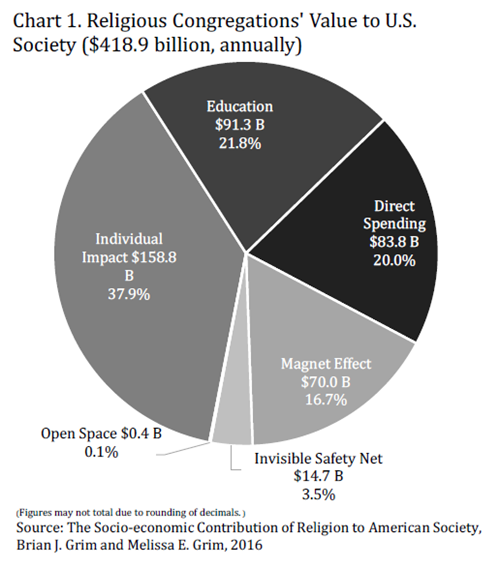
Specifically, religion is a $378 billion to $4.8 trillion boost to the US economy, the Grims found. Even at the lowest estimate, religious organizations make more than the global revenue of Apple and Microsoft combined; at the high end, religion makes the roughly the same amount as a third of the United States GDP.

The researchers’ first estimate only takes into account “the revenues of faith-based organizations falling into several sectors: education, healthcare, local congregational activities, charities, media, and food.” The largest chunk of these–healthcare–raises about $161 billion a year. Congregations raise $84 billion a year, religious schools raise $74 billion, and religious charities bring in $45 billion. Furthermore, the money is increasingly spent on social services like food assistance, parenting classes, and drug and alcohol abuse recovery programs ($9 billion in 2012).

“Their second estimate—that religion has an economic value of $1.2 trillion—adds in the price of social services provided by congregations,” the article continues.

Churches sponsor more than 1.6 million social services programs in America each year, and provide 7.6 million volunteers. More than 9 in 10 congregations actively recruit volunteers for outside projects (93%), half allow their building to be used for non-congregational purposes (50%), and close to half have groups that think about how to meet community needs (48%).

The Grims also added in the halo effect a community receives from the benefits of having a church nearby: it encourages investment in family and children; stimulates the local economy by buying goods and services; provides a place to host weddings, funerals, or large community events; may run schools or day cares; provides outdoor space for leisure activities; and augments the city’s social services.

The result: $418.9 [billion] worth of value.

When religious businesses are considered, the estimate is $1.2 trillion. “The study wasn’t perfect, the Grims admitted. It didn’t add in any of the financial or physical assets of religious groups, or subtract any negative impacts of religious groups, like fraud or abuse of children by clergy…Still, they wrote, “the data are clear.””

Glad to see religion making a big impact in the real world.

Economic Freedom of the World Report: 2016

The Fraser Institute just published its Economic Freedom of the World 2016 Annual Report. The degree of economic freedom is measured using 5 broad areas:

  1. size of government (expenditures, taxes, enterprises)
  2. legal structure and property rights
  3. access to sound money
  4. freedom to trade internationally
  5. regulation of credit, business, and labor

The ten most economically free countries are:

  1. Hong Kong
  2. Singapore
  3. New Zealand
  4. Switzerland
  5. Canada
  6. Georgia
  7. Ireland
  8. Mauritius
  9. United Arab Emirates
  10. Australia (United Kingdom was tied with Australia)[ref]The United States currently resides at #16.[/ref]

One of the most important findings of past reports that is once again confirmed in the latest is the following:

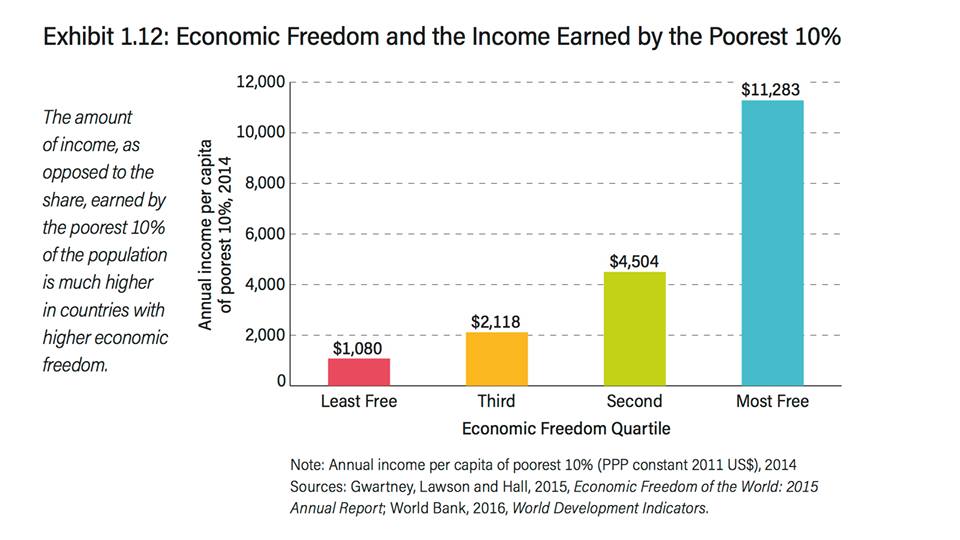
The share of income earned by the poorest 10% of the population is virtually the same from the least (2.45%) to the most (2.75%) free countries. It is unaffected by economic freedom. But, as shown above, the amount of income earned by the poorest 10% of the population is significantly higher in freer countries. In other words, the poorest of the population are better off in countries that are more economically free.

The rest of the report includes articles on gender disparity in legal rights, Venezuela, Ireland’s growth, and economic freedom in the United States.

Check it out.

Economic Perception and Voting LEAVE

Recent research finds that the way people perceived the economic outcomes of immigration influenced whether or not they voted “Leave” in the Brexit referendum:

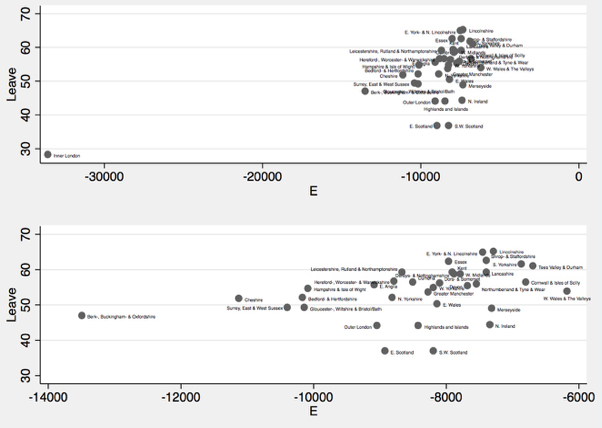
The pattern of voting in the referendum reflects differences in the share of the over-65 group and the less educated across regions (with these two groups more likely to vote for Brexit).  A high rate of immigration and low levels of GDP per capita also correlated with greater propensities to vote to leave. These variables explain not only the voting patterns but also the attitude towards immigrants as neighbours, the perceived dangers posed by immigrants to society, and feelings of apprehension towards the EU. Figure 2 shows the relationship between the latent economic variable E[ref]This was done by “by assigning coefficients to the rate of unemployment for each region, GDP per capita, the share of the working-age population with low education, the rate of immigration, and the share of the population over 65 in each region.”[/ref] and the leave vote by region.

The researchers also found that “an increase in GDP per capita of €5,000…will lower the share of the leave vote by 0.55%. An increase of 5% in the share of the population over the age of 65…will increase the leave vote by 3.3%. A 5% increase in the share of the population with low education…will increase the leave vote by 4.8%.”

The authors summarize,

We have found that old people and those with low education and low income tend to dislike immigration and fear the influence of the EU, and therefore voted for Brexit. A likely reason is that they feel vulnerable to immigration from other European countries. However, the empirical evidence on the adverse effect of immigration on the labour market is weak, although there is some evidence that the lowest-skilled workers in the UK may be adversely affected by immigration…Given the limited effect on wages, an exaggerated fear of immigration in public debate may have influenced voters to want to leave the EU. Thus, voters perceive the numbers and effects of immigrants as being much greater than they actually are.

The Economic Impact of NAFTA

Image result for nafta

Trump wants to “renegotiate” or even withdraw from it. Clinton is up for “adjusting” it. With trade coming under fire (even from previous supporters), it is no wonder that NAFTA has taken some heat. But what do experts says about the economic impact of NAFTA? According to an excellent brief by the Council on Foreign Relations,

Economists largely agree that NAFTA has provided benefits to the North American economies. Regional trade increased sharply (PDF) over the treaty’s first two decades, from roughly $290 billion in 1993 to more than $1.1 trillion in 2016. Cross-border investment has also surged, with U.S. foreign direct investment (FDI) stock in Mexico increasing in that period from $15 billion to more than $100 billion.

Admittedly, “experts also say that it has proven difficult to tease out the deal’s direct effects from other factors, including rapid technological change, expanded trade with other countries such as China, and unrelated domestic developments in each of the countries.” And like any trade deal, there is debate over “NAFTA’s legacy on employment and wages, with some workers and industries facing painful disruptions as they lose market share due to increased competition, and others gaining from the new market opportunities that were created.”

But what has happened to the U.S. economy since NAFTA?:

In the years since NAFTA, U.S. trade with its North American neighbors has more than tripled, growing more rapidly than U.S. trade with the rest of the world. Canada and Mexico are the two largest destinations for U.S. exports, accounting for more than a third of the total. Most estimates conclude that the deal had a modest but positive impact on U.S. GDP of less than 0.5 percent, or a total addition of up to $80 billion dollars to the U.S. economy upon full implementation, or several billion dollars of added growth per year.

Such upsides of trade often escape notice, because while the costs are highly concentrated in specific industries like auto manufacturing, the benefits of a deal like NAFTA are distributed widely across society. Supporters of NAFTA estimate that some fourteen million jobs rely on trade with Canada and Mexico, while the nearly two hundred thousand export-related jobs created annually by the pact pay 15 to 20 percent more on average than the jobs that were lost.

Furthermore, “economists like Gary Clyde Hufbauer and Cathleen Cimino-Isaacs of the Peterson Institute for International Economics (PIIE) emphasize that increased trade produces gains for the overall U.S. economy. Some jobs are lost due to imports, but others are created, and consumers benefit significantly from the falling prices and often improved quality of goods created by import competition. A 2014 PIIE study of NAFTA’s effects found that about 15,000 jobs on net are lost each year due to the pact—but that for each of those jobs lost, the economy gains roughly $450,000 in the form of higher productivity and lower consumer prices.” Interesting enough, NAFTA may have “helped the U.S. auto sector compete with China. By contributing to the development of cross-border supply chains, NAFTA lowered costs, increased productivity, and improved U.S. competitiveness. This meant shedding some jobs in the United States as positions moved to Mexico, he argues, but without the pact, even more would have otherwise been lost.”

Many critics, however, focus less on the U.S. and more on Mexico. How has the country south of the border done since NAFTA?:

NAFTA gave a major boost to Mexican farm exports to the United States, which have tripled since NAFTA’s implementation. Hundreds of thousands of auto manufacturing jobs have also been created in the country, and most studies have found (PDF) that the pact had a positive impact on Mexican productivity and consumer prices.

NAFTA was “the continuation of a decade of economic liberalization that saw [Mexico] transition from one of the world’s most protectionist economies to one of the most open to trade. Mexico had reduced many of its trade barriers upon joining the General Agreement on Tariffs and Trade (GATT), the precursor to the WTO, in 1986, but still had a pre-NAFTA average tariff level (PDF) of 10 percent. Mexican policymakers saw NAFTA as an opportunity to both accelerate and “lock in” these hard won reforms to the Mexican economy.” Unfortunately, “Mexican unemployment also rose, which some economists have blamed on NAFTA for exposing Mexican farmers, especially corn producers, to competition from heavily subsidized U.S. agriculture.” However, many experts argue that

Mexico’s recent economic performance has been affected by many non-NAFTA factors. The 1994 devaluation of the peso drove Mexican exports, while competition with China’s low-cost manufacturing sector (PDF) likely depressed growth. Unrelated public policies, such as land reform, made it easier for farmers to sell their land and emigrate. As UCSD’s Hanson has argued (PDF), Mexico’s struggles have largely domestic causes: poorly developed credit markets, a large and low-productivity informal sector, and dysfunctional regulation.

Overall, as economist Douglas Irwin summarizes,

NAFTA has promoted the growth of a middle class in Mexico that now includes nearly half of all households. And since 2009, more Mexicans have left the United States than have come in. In the two decades since NAFTA went into effect, Mexico has been transformed from a clientelistic one-party state with widespread anti-American sentiment into a functional multiparty democracy with a generally pro-American public. Although it has suffered from drug wars in recent years (a spillover effect from problems that are largely made in America), the overall story is one of rising prosperity thanks in part to NAFTA.

I expect anti-foreign bias from voters. The problem is that smart politicians will say stupid things to appeal to these voters. I just hope the policies don’t match the rhetoric.