Credit where credit is due: I heard an NPR report recently about opposition to President Obama fast-tracking a trading deal with countries in the Pacific (called the TPP for Trans-Pacific Partnership) and–though I didn’t yet know the details–I was surprised and impressed that he was willing to take a stand against his own party for a common sense but unpopular policy. The NYT has been reporting on the story as well, with an April 16th story emphasizing the internecine struggle to come (“In what is sure to be one of the toughest fights of Mr. Obama’s last 19 months in office, the “fast track” bill allowing the White House to pursue its planned Pacific trade deal also heralds a divisive fight within the Democratic Party, one that could spill into the 2016 presidential campaign.”) and an April 21st story describing GOP efforts to broker a compromise between Obama and the left-wing of his own party (“Republican lawmakers and the White House have agreed to subject any trade deal negotiated by President Obama to a monthslong review by Congress and the public, a concession aimed at winning the support of Democrats who view trade agreements as a threat to American workers.)
This is all a bit sad because, as Greg Mankiw wrote for the NYT on April 24th, that this fight was a prime example of what Alan Blinder called Murphy’s Law of economic policy: “Economists have the least influence on policy where they know the most and are most agreed; they have the most influence on policy where they know the least and disagree most vehemently.” As Mankiw puts it:
Among economists, the issue is a no-brainer. Last month, I signed an open letter to John Boehner, Mitch McConnell, Nancy Pelosi and Harry Reid. I was joined by 13 other economists who have led the President’s Council of Economic Advisers, a post I held from 2003 to 2005. The group spanned every administration from Gerald Ford’s to Barack Obama’s.
If the issue is so clear-cut, why is it so divisive? Mankiw discusses that as well, citing Caplan’s book The Myth of the Rational Voter: Why Democracies Choose Bad Policies. According to Caplan’s research, the public isn’t just ignorant about economic policy. Ignorance would not be so bad, because mistakes would at least be random and therefore might cancel each other out. Nope, the public is systematically biased in particularly unhelpful ways, all of which are at play in this debate:
The first is an anti-foreign bias. People tend to view their own country in competition with other nations and underestimate the benefits of dealing with foreigners. Yet economics teaches that international trade is not like war but can be win-win.
The second is an anti-market bias. People tend to underestimate the benefits of the market mechanism as a guide to allocating resources. Yet history has taught repeatedly that the alternative — a planned economy — works poorly.
The third is a make-work bias. People tend to underestimate the benefit from conserving on labor and thus worry that imports will destroy jobs in import-competing industries. Yet long-run economic progress comes from finding ways to reduce labor input and redeploying workers to new, growing industries.
I hope President Obama will do the right thing and continue to fight for the TPP, a deal that will be better for the lives of everyone involved. But the longer the fight goes the more likely it is to become an issue in the 2016 election. In that case, voters will have more say and, depressingly, the likelihood of sensible economic policies will diminish accordingly.
Photo by Loor101 on DeviantArt. (Click for original source.)
My friend Tom Stringham has an excellent post at his blog Virtuous Society in which he outlines a secular argument against same sex marriage. It’s the single best argument I’ve read, not because it’s new or innovative, but because it’s the most concise expression of all the key points that so many of the same-sex marriage opponents have been focusing on. It begins:
If marriage is a real thing, then before we can decide what the rules of eligibility are, we have to know what it is–what marriage is. We want our marriage law to deal with real marriage, in the same way that, say, our criminal law deals with “real” crime, and not just anything the government wants to call crime.
This is a deft analogy. We all recognize that, technically, whatever the government decides to make criminal is a crime. But we all generally recognize that this technical definition misses something deeper. To the extent that the criminal code is arbitrary, it loses it’s moral force and we stop seeing it as a “real” crime. And so the question becomes: what lurks behind marriage that makes it something worthy recognizing in the first place? This isn’t a historical question, because there’s no point in the history of the institution of marriage at which a bunch of scholars or lawyers or politicians sat down and decided to hash out marriage law from first principles. Marriage laws are a product of evolution, along with much of our legal code[ref]Common law[/ref], rather than intentional design. But that doesn’t mean that they are arbitrary.
Please read Tom’s post for the rest of his argument.
In the meantime, here are some more thoughts.
First, I think secular arguments tend to be the best kind of arguments because (1) they appeal to a broader audience and (2) by not relying on the claims of any particular religion, they are more compelling. I don’t have anything against specifically religious arguments, but I find that–even as a religious person myself–if it’s a matter of public policy it’s preferable to state the argument in the broadest terms possible. That’s what I’ve always done when it comes to the abortion issue, and it’s what makes sense with the issue of same-sex marriage as well.
Second, I just thought I’d note some other interesting articles I found on the topic recently.
How Same-Sex Marriage Makes Orphans of Us All – This is an article from The Federalist that digs a little deeper into some of the philosophical ramifications of same-sex marriage: “To obliterate the sexual-difference feature of marriage is a radical repudiation of its character and, ominously, of the character of the human person it acknowledges and protects.” Going on:
So not only does same-sex marriage ideology redefine parent, but also child. For on its account, a child comes into the world not naturally related to anyone, but only transactionally connected to the persons responsible for fetching him through various means. No child in a same-sex household derives from the relationship of the partners in that home; every such child has been torn from at least one parent. Rather than a child’s dissociation from parents being a tragedy, it is a necessity and design feature of the same-sex regime.
I realize this is not going to be a remotely well-received argument because of the conclusions it draws, but the logic is fairly straightforward: either biological relationships are intrinsically valuable, or they are not. I believe that they are. That the mere fact of biological relationship–parent to child and also to siblings, cousins, and other kin–means something. And if it does, then deliberately creating children in a way that deprives them of this connection is morally troubling in a way that, for example, adopting children in need is not.
Is having a loving family an unfair advantage? – We may as well expand outward from gay marriage to the family generally to questions of fairness and privilege. Thus, this article from The Philosopher’s Zone which argues that–along with economic and gender and other forms of systemic inequality–having a loving family is also a source of inequality that society should rectify. On the one hand, I appreciate that the philosophers who tackle the question are shooting for a moderate position, they contrast private school (which they believe cannot be justified because it is unfair) with reading to your children (which they say is unfair, but cannot reasonably be stopped.) OK, so they aren’t saying that you can’t read to your kids because of the unfair advantage it gives, but (1) they still think you should feel bad about what you’re doing[ref]”I don’t think parents reading their children bedtime stories should constantly have in their minds the way that they are unfairly disadvantaging other people’s children, but I think they should have that thought occasionally.”[/ref] and (2) moreover the “right” to read your kids bedtime stories is in their conception contingent. The fact of the matter is that having a serious discussion about whether or not to ban bedtime stories is intrinsically alarming, even if the philosophers decide that (based on their particular criteria), reading to your kids is permissible for now. The implication is clear: the right of parents to provide the best environment they can for their own children within the walls of their own home is not absolute, but rather depends on a particular argument that happened to turn out this way today, but could–in the future, under different analysis–turn out in another way.
The Wild Ideas of Social Conservatives – I’ll wrap up with a pre-emptive response to the points I’ve enumerated thus far. One of the common rejoinders to conservative concerns about marriage, the family, and privilege arguments is that conservatives are hysterical. When have their fears ever, ever turned out to be justified? Well, in this post Douthat tackles that contention head on and points out that, well, conservative fears have been born out many times in the past.
It’s not that social conservatives are always right about where American society is going…
But there’s still a broad track record that’s worth considering. In the late 1960s and early ’70s, the pro-choice side of the abortion debate frequently predicted that legal abortion would reduce single parenthood and make marriages more stable, while the pro-life side made the allegedly-counterintuitive claim that it would have roughly the opposite effect; overall, it’s fair to say that post-Roe trends were considerably kinder to Roe’s critics than to the “every child a wanted child” conceit. Conservatives (and not only conservatives) also made various “dystopian” predictions about eugenics and the commodification of human life as reproductive science advanced in the ’70s, while many liberals argued that these fears were overblown; today, from “selective reduction” to the culling of Down’s Syndrome fetuses to worldwide trends in sex-selective abortion, from our fertility industry’s “embryo glut” to the global market in paid surrogacy, the dystopian predictions are basically just the status quo. No-fault divorce was pitched as an escape hatch for the miserable and desperate that wouldn’t affect the average marriage, but of course divorce turned out to havesocial-contagion effects as well. Religious fears that population control would turn coercive and tyrannical were scoffed at and then vindicated. Dan Quayle was laughed at until the data suggested that basically he had it right. The fairly-ancient conservative premise that social permissiveness is better for the rich than for the poor persistently bemuses the left; it also persistently describes reality. And if you dropped some of the documentation from today’s college rape crisis through a wormhole into the 1960s-era debates over shifting to coed living arrangements on campuses, I’m pretty sure that even many of the conservatives in that era would assume that someone was pranking them, that even in their worst fears it couldn’t possibly end up like this.
More broadly, over the last few decades social conservatives have frequently offered “both/and” cultural analyses that liberals have found strange or incredible — arguing (as noted above) that a sexually-permissive society can easily end up with a high abortion rate and a high out-of-wedlock birthrate; or that permissive societies can end up with more births to single parents and fewer births (not only fewer than replacement, but fewer than women actually desire) overall; or that expressive individualism could lead to fewer marriages and greater unhappiness for people who do get hitched. Social liberals, on the other hand, have tended to take a view of human nature that’s a little more positivist and consumerist, in which the assumption is that some kind of “perfectly-liberated decision making” is possible and that such liberation leads to optimal outcomes overall. Hence that 1970s-era assumption that unrestricted abortion would be good for children’s family situations, hence the persistent assumption that marriages must be happier when there’s more sexual experimentation beforehand, etc.
I’m not going to tell you that either side has a monopoly on the truth; human nature is much too complicated for that. But I will say, again, that if you look at the post-1960s trend data — whether it’s on family structure and social capital, fertility and marriage rates, patterns of sexual behavior and their links to flourishing relationships, or just trends in marital contentment and personal happiness more generally — the basic social conservative analysis has turned out to have more predictive power than my rigorously empirical liberal friends are inclined to admit.
Not surprisingly, I agree with Douthat. Social liberals tend to see opposition to gay marriage as merely an expression of bigotry. In some cases, it certainly has been. But, even if this list of social conservative fears proves nothing else, the history of widespread paranoia[ref]As liberals will see it[/ref] of social conservatives going back to the 1960s and the ensuing data should underscore the fact that concerns about gay marriage and sexual mores are not isolated outbreaks that can only be explained by appeals to fear or animosity. On the contrary, this kind of opposition is part of a consistent concern for social well-being that has, in at least some important and recent cases, proved to be well-founded.
Not long ago I added a little motto to the front page of this website: We tackle controversy with civility. Here’s my attempt at applying that approach to the controversial topic of the the gender pay gap.
Let’s start with some myth-busting. Not long ago, Buzzfeed produced a video that is a perfect example of what the wage gap isn’t.
The whole point of this video is that you’ve got two workers whose only apparent difference is their gender. Same approximate age, same race, same education (we’re guessing here) and, as the woman says, the very same job. And yet she gets paid 78% of what he makes. This is a myth, and it’s irresponsible even by the standards of Buzzfeed given that (as PolitiFact noted) “BuzzFeed actually looked at some sources that got it right, but then produced a misleading video.”
This sensationalist approach is sadly common. Comedian Sarah Silverman grabbed headlines herself recently for her own contribution to the myth. She relayed a story of when she and a male comedian were paid $10 and $60, respectively, for the same work in a PSA about the wage gap. Except that she left out the part where her gig had been unbook and his gig had been booked in advance. When the man she had called out as sexist (by name) spoke out publicly about that, she released an exclusive statement to Salon, saying that “My regret is that I mentioned Al by name- it should have been a nameless, faceless anecdote” and conceding that “This is also HARDLY an example of the wage gap.”
Even worse: it’s not just Buzzfeed videos and stand up comics who perpetuate the mythical 22% wage gap for men and women doing the same work. When I researched this piece I was stunned to learn that the website of the United States Department of Labor does the same:
MYTH: Saying women only earn 77 cents on the dollar is a huge exaggeration – the “real” pay gap is much smaller than that (if it even exists).
REALITY: The size of the pay gap depends on how you measure it. The most common estimate is based on differences in annual earnings (currently about 23 cents difference per dollar). Another approach uses weekly earnings data (closer to an 18- or 19-cent difference). Analyzing the weekly figures can be more precise in certain ways, like accounting for work hours that vary over the course of the year, and less accurate in others, like certain forms of compensation that don’t get paid as weekly wages. No matter which number you start with, the differences in pay for women and men really add up. According to one analysis by the Department of Labor’s Chief Economist, a typical 25-year-old woman working full time would have already earned $5,000 less over the course of her working career than a typical 25-year old man.
Once again: this is giving a misleading impression that if you have men and women with the same backgrounds doing the same work, the man will get paid more. That’s simply untrue. When you control for these factors the wage gap shrinks dramatically or even disappears. According to the HuffPo of all places (based on a study prepared by the American Association of University Women): “Women are close to achieving the goal of equal pay for equal work. They may be there already.”
This is where most conservative responses to the wage gap question stop, but I want to keep going because there is more to talk about. In particular, two issues remain.
The first issue has to do with why it is that more men apparently have the education, training, and background necessary to compete for higher-paying jobs. The reason is complex, and it probably involves personal choice correlated with gender (e.g. more women may prefer jobs that trade compensation for flexibility) and also with making the kinds of training necessary for some high-paying jobs uncomfortable environments for women (anyone who is familiar with the computer science field will know that is a factor). To the extent that personal choice is the deciding factor, there is no inequality. To the extent that it’s hostile environments, then clearly we’re just relocating sexism from hiring managers to colleagues and students in male-dominated fields. Let’s set this issue aside for a bit, we’ll come back to it later.
The second has to do with studies that appear to show sexism directly in hiring decisions. One of these studies was conducted by Corinne Moss-Racusin, a social psychologist at Skidmore College. The study was very simple: create a resume and send it off (in this case to scientists) where one version has the name “John” and the other has the name “Jennifer.” See if the responses differ. As this Stanford article summarizes, they do.[ref]Note: the relatively week effect in Moss-Racusin’s study should be contrasted with the incredibly strong effect found by more recent studies that evaluated hiring for faculty positions and found a 2-1 preference for hiring women over men in STEM fields. Inside Higher Ed is just one source among many to cover the study. This illustrates how complex the issue, and how male complaints of affirmative action and female complaints of systemic bias can both be true.[/ref]
Superficially, this looks like clear evidence of sexism, but that might be too hasty. First, it’s odd that the biased reactions come from female scientists as well as from male scientists. Of course it’s not impossible to hypothesize that women in male-dominated fields view themselves as exceptional and still have a generally sexist view of women in general, but this explanation is at least a little odd. Is there an alternative explanation? There is.
You can explain this finding without recourse to sexism simply by assuming (1) that hiring managers only care about bang for the buck and (2) that men tend to work more hours. Well, as it turns out, #2 isn’t an assumption. It’s a fact, as sources like this one indicate. Well, if the folks doing the hiring want the most bang for the buck and if men tend to work more hours and if the position is salaried, then clearly they will have a preference for men, even if they think women are just as competent hour-for-hour.
If true, this means that the gender discrimination is not operating at the level of individual prejudice. It is not the case that people making hiring decisions dislike women or devalue their contributions. But it also doesn’t mean that our work here is done. What remains is still the question: why do men work more hours?
And this brings us back to the point I said we’re return to: the question of personal preference vs. environmental factors. Or, to use the more conventional terms, nature vs. nurture. I can’t emphasize enough: this is the reason the wage gap is so controversial. Because at its heart, buried beneath all the layers of analysis we’ve done so far to get here, we stumble on one of the most controversial questions of our age: are gender differences tied to innate human nature or are they merely social constructs? Your view on that question will, for the most part, cement whether you see the gender gap as essentially a minor issue where we just need to eradicate remaining vestiges of chauvinism and/or clean out a few specific problem industries or whether you see the wage gap as a society-wide, catastrophic consequence of a thriving patriarchy. Because if you think women tend to work fewer hours because they elect to value other things (such as child-rearing) more relative to men, than the wage gap is mostly a reflection of individual preference. But if you think women tend to work fewer hours because they are being socialized not to fully develop their talents and view their contributions to society as equal to those of men, then the wage gap (all 22% of it, not just the small amount that remains when you control for job type, etc.) is a form of widespread oppression. Women contribute fewer hours, in that view, because they are unfairly burdened with more of the work outside of their day job and because they are subtly manipulated by society from an early age to see themselves as objects to be desired for superficial characteristics rather than as subjects to be actively engaged in shaping their own destinies and developing and expressing their innate capabilities.
As long as this conflict remains, the issue is not going to go away. Even if the 22% number is a myth, it’s a myth that expresses a critique of modern society that has far more validity than Silverman’s mangled story or the Department of Labor’s mangled statistics.
Now, as I get ready to wrap this post up, here are my own thoughts about this conflict. For the most part with the view of the gender essentialists, especially after reading Steven Pinker’s influential book The Blank Slate: The Modern Denial of Human Nature. Pinker argues very persuasively and with reams of evidence that human nature is real and that it includes meaningful sex differences. What this means is that, if women tend towards actually liking being primary caregivers more than men, working towards equal pay across society (not equal pay for equal work, but equal pay AND equal work) is not actually going to make women happier. It’s going to make them less happy, as a group.
Imagine a scenario where Bob really likes to hike and so he takes a full-time job with lots of flexibility and expectations of a 40-hour work-week. His wages are lower in return for having a lot more time out of the office. Jim likes to buy stuff, however, and so he takes a full-time job where the expectation is 80-hours a week. He gives up hiking time to earn even more money. There’s an obvious wage gap here. But if you come in and solve it by insisting that Bob and Jim both spend equal hours in the office and equal hours hiking, you’re making them both less happy. You took away Bob’s hiking time, which he values more, and gave him a higher salary, which he was already willing to give up for the hiking time. You took away Jim’s money, which he values more, and gave him hiking time which he had already chosen to give up for the money. If women willingly choose careers that allow more flexibility in exchange for lower pay, then trying to coral them into higher-pay, lower-flexibility jobs is a terrible solution. If women want to be part-time nurse practitioners and you try to engineer them in to being full-time software engineers, no one is happy.
This isn’t purely hypothetical, by the way. As women have moved towards parity in the workplace over the last few decades, their level of happiness has not increased. It has decreased:
By many objective measures the lives of women in the United States have improved over the past 35 years, yet we show that measures of subjective well‐being indicate that women’s happiness has declined both absolutely and relative to men.
Since I largely believe innate human differences account for the systematic decisions of large numbers of women to spend less of their time in formal work, I don’t accept the view that what we’re witnessing is widespread patriarchy. I think what we’re witnessing, by and large, is people doing what they want to do.[ref]Note: this entire post is saturated with class privilege. I’m talking about people for whom going to college, getting married, having children, picking and choosing among career options, etc. are all on-the-table. A lot of this analysis is irrelevant for those who are just struggling to get by. We talk a lot about income inequality and poverty (both within the US and globally), but that wasn’t a focus for this particular post.[/ref]But there are some really important corollaries and caveats.
First, although I think it’s too obvious to require saying I’m going to say it anyway: the fact that lots of women decide of their own volition to emphasize something other than professional achievement (relative to men) does not in any way indicate that all women should do the same. The classical liberal in me is deeply committed to individualism, and that means that I have a lot of sensitivity for the outliers. There should be absolutely no coercion–formal or informal–designed to force men or women to pick certain careers based on their gender.
As a follow-up to that, if we’re going to have a situation where the women who choose to (for example) go into computer science are always going to be in a minority then we ought to have institutions and systems in place that ensure they get equal access to training and other opportunities. Not to be too personal, but my wife is getting a PhD in computer science. You can’t ask for a more male-dominant sector than that. She regularly attends women-centric conferences and groups and I am very glad that they exist to provide her and other women with something closer to equal opportunity in an environment that can be really hostile. There is a lot of room for conservatives and liberals to agree on common sense, incremental improvements for women.
I also think that our work culture is intrinsically anti-family, and that this is a problem for men as well as for women. As a recent article at Harvard Business Review pointed out:
We often think of problems with [work] expectations as women’s problems. But men too may struggle with them: my research at a top strategy consulting firm, first published in Organization Science, revealed that many men experienced these expectations as difficult to fulfill or even distasteful. To be sure, some men seemed to happily comply with the firm’s expectations, working long hours and traveling constantly, but a majority were dissatisfied. They complained to me of children crying when they missed their soccer games, of poor health and substance addictions caused by how they worked, and of a general sense of feeling “overworked and underfamilied.”
I would dearly love to see some sanity, some balance, and some honesty start to replace a culture of dishonesty where, as the headline of that article points out, “Some Men Pretend to Work 80-Hour Weeks.” Sure, some really do work that much. (I have a few times.) But it’s the perception that more hours = better employee that leads some men and women to fake it while other men and women really do work that many hours and in both cases productivity and health suffer.
On the wider picture, however, I fear the conflict is irresoluble. If gender is innate, then it is quite probable that a number of systematic gender differences will be a permanent feature of human society. If gender is primarily a social invention, then the agenda is clear: equality means women and men earning the same in the workforce because they are largely doing the same things and they are equally happy about it. You have to erase any correlation between gender and work-preferences. On any significant metric, therefore, androgyny is the goal by definition. Any gender differences that remain will be inconsequential and superficial.
At that point you’re trying to socially engineer people’s conception of gender and definition of happiness in order to fit your pre-conceived notions of equality. And I have to ask: why? Something seems backwards when you first tell people how to live and then have to re-engineer them to like it that way.
The Harvard Business Review has an article that is at once shocking and utterly obvious. The premise of the article is that in a lot of demanding (and also very lucrative) professional service careers there is a culture that demands ridiculous hours as a signal that an employee is fully committed to the team. “We often think of problems with these expectations as women’s problems,” says Erin Reid, “But men too may struggle with them.”
Reid found that there were a couple of important differences, however. The biggest is that men have two choices when they refuse to sell their souls to the job: they can either publicly ask for more accommodation or they can “pass” which is to say: lie about how much they work. If they take the path of formally asking for less-demanding positions (e.g. asking for a domestic rather than an international assignment, asking for time off after a child is born), then they face the same stiff penalties as women who ask for official accommodation: lost promotions and marginalization. But if they can successfully hide their true hours and get away with working less than people assume they do, then they can simultaneously work fewer hours and preserve their sterling reputations.
I haven’t ever worked in a management consulting firm or similar high-pressure environment. My corporate experience has been like a watered-down version of these trends, but it’s the same basic concept.[ref]My current position is with a small company, so it’s very different than corporate culture of any kind.[/ref]Conspicuous overwork is like conspicuous consumption: a way to signal that you’re part of the in-group. I’ve always been disgusted by the dishonesty that goes along with it, however. No one ever (in my experience) lied outright about their hours, but based on observations and conversations I’m sure that a lot of white-collar professionals vastly overstate their hours to their bosses and often to themselves. Not when they actually have to record their hours, but when they are paid salary and the hours are implied.
Another thing to note: the bias was specifically anti-family.
Intriguingly, the pushback men received for asking for time away from work seemed limited to time for family: one man who had since left the firm told me that, when his daughter was born he had been harassed for taking two weeks of paternity leave, despite spending some of that leave working. But when, later that year, he and his family took a three-week vacation to an exotic locale, the vacation was permitted, and his team encouraged him to “unplug” and take a real vacation. This disparity in treatment seems, at one level, ridiculous, but at another level, entirely consistent with the firm’s expectation that men be ideal workers: taking on mundane responsibilities in one’s family life can threaten one’s devotion to work, while affording an expensive vacation may be instead contingent upon devotion to and success at work.
I believe the problem starts with outmoded vestiges of Industrial Revolution assumptions. During that time–when professional work in large corporations first became widespread–a lot of the work was mechanized. In that scenario your productivity as a worker is basically equivalent to the time you spend pulling the lever (or whatever it is you’re supposed to do.) Partially this outdated assumption is sticking with us based on sheer inertia, but I think the bigger explanation has to do with the big differences between client-facing roles and knowledge roles. There are lots of coders, data analysts, and other knowledge workers who would get much more done with 12 hours of hard work per week (and some overhead for meetings and maintenance) than 50 hours spent primarily browsing Facebook and pretending to work. But if you give them genuine freedom to work as effectively as possible, you will likely enrage the client reps who really do need to be at their desk (or otherwise available) throughout the entire work day no matter what.
It gets trickier when you consider that the knowledge workers are generally highly-skilled and probably better paid, while client-facing folks (like call center employees, to use an extreme example) are much closer to entry level. I’m not sure that I want a super-efficient system if it means creating such a major divide between self-directed knowledge workers with tremendous freedom and lower-level employees who are locked in to 9-5 drudgery.
In the long run, you hope that all the boring jobs eventually get taken over by computers and we all become highly-skilled, self-directed workers, but transitioning to that point without great injustice (not to mention civil unrest) is a tricky, tricky problem. In the meantime, however, it would great for companies to drop the unrealistic expectations of hyper-schedules and realize that, in the long run, fathers and mothers are both better workers when are treated more like humans and less like resources. The potential to have more fairness for male and female workers and a healthier society in general (as family takes greater priority) is a win-win.
New research reveals that high taxes may (unsurprisingly) deter inventors from remaining in a country. The authors summarize their findings:
There has is a strong and significant correlation between top tax rates and those inventors who remain in their home countries. The relation is strongest for superstar inventors…The elasticities imply that for a ten percentage point reduction of top tax rates from 50% to 40%, a country would be able to retain on average 3.3% more of its top 1% superstar inventors. This relation weakens as one moves down the quality distribution of inventors – the top 25-50% or the bottom 50% of inventors are no longer sensitive to top tax rates.
…The recent evidence suggests that labour, like capital, might be internationally mobile and respond to tax incentives. The loss of highly skilled agents such as inventors might entail significant economic costs, not just in terms of tax revenues lost but also in terms of reduced positive spillovers from inventors and, ultimately, less innovation in a country.
A recent piece from The New York Times describes what can only be called a staggering, haunting, and horrific picture:
In New York, almost 120,000 black men between the ages of 25 and 54 are missing from everyday life. In Chicago, 45,000 are, and more than 30,000 are missing in Philadelphia. Across the South — from North Charleston, S.C., through Georgia, Alabama and Mississippi and up into Ferguson, Mo. — hundreds of thousands more are missing.
They are missing, largely because of early deaths or because they are behind bars. Remarkably, black women who are 25 to 54 and not in jail outnumber black men in that category by 1.5 million, according to an Upshot analysis. For every 100 black women in this age group living outside of jail, there are only 83 black men. Among whites, the equivalent number is 99, nearly parity.
African-American men have long been more likely to be locked up and more likely to die young, but the scale of the combined toll is nonetheless jarring. It is a measure of the deep disparities that continue to afflict black men — disparities being debated after a recent spate of killings by the police — and the gender gap is itself a further cause of social ills, leaving many communities without enough men to be fathers and husbands.
Perhaps the starkest description of the situation is this: More than one out of every six black men who today should be between 25 and 54 years old have disappeared from daily life.
…The disappearance of these men has far-reaching implications. Their absence disrupts family formation, leading both to lower marriage rates and higher rates of childbirth outside marriage, as research by Kerwin Charles, an economist at the University of Chicago, with Ming-Ching Luoh, has shown.
The black women left behind find that potential partners of the same race are scarce, while men, who face an abundant supply of potential mates, don’t need to compete as hard to find one. As a result, Mr. Charles said, “men seem less likely to commit to romantic relationships, or to work hard to maintain them.”
Arguments over racial disparities are sensitive and more often than not heated (just take a quick look at your Facebook feed regarding Baltimore). Blame is placed in various places, from systemic and institutional racism to individual choice and accountability. I have my own opinions (largely a mixture of the two), but that isn’t what I’m interested in with this post. Put aside the finger-pointing, the outrage, and the judgment for a moment. Just look at those numbers and think of the human faces behind them. And then weep.
In which law professor (and my good friend) Nate Oman boils down the most depressing aspect of the current culture war. Both religious freedom and anti-discrimination laws are necessary contingent on the prevailing local culture, but states where there is the greatest need for religious protections are the least likely to enact them, and states where there is the greatest need for antidiscrimination laws are the least likely to enact them. As a result:
I think that in blue states conservative religious objectors will likely be dealt with harshly and punitively. In red states, I think that there is a real danger that in some places homosexuals will lack the ability to fully and meaningfully participate in the market.
Depressing stuff, but Nate has hope. Read the article to see what it is.
Harvard economist Roland Fryer was awarded the 2015 John Bates Clark Medal by the American Economic Association. Many top economists have been the recipients, from Milton Friedman to Paul Krugman. But as The Economist points out,
Mr Fryer’s prize…stands out. Top academic economists tend to be white. They often hail from privileged backgrounds and build their reputation on inscrutable econometrics. Mr Fryer does not fit that mould. He is the first African-American to win the medal (after having in 2007 become the youngest African-American to receive tenure at Harvard, at age 30). Mr Fryer’s childhood was not an easy one. He grew up poor, and was abandoned by his mother and beaten by his father as a child. As a teenager he survived by selling counterfeit handbags and dealing marijuana. Perhaps not coincidentally, his research agenda is heavily focused on investigations of real world policy questions. Mr Fryer has used economic tools to study America’s racial divide and to explore how it might be narrowed—economic questions that historically have been understudied. Economics, as a field, seems slow to appreciate the possibility that the introduction of new perspectives can mean that more interesting questions get asked, leading to better answers.
His innovative and creative research contributions have deepened our understanding of the sources, magnitude, and persistence of U.S. racial inequality. He has made substantial progress in evaluating the policies that work and do not work to improve the educational outcomes and economic opportunities of children from disadvantaged backgrounds. His theoretical and empirical work on the “acting white” hypothesis of peer effects provides new insights into the difficulties of increasing the educational investments of minorities and the socially excluded. Fryer is the leading economist working on the economics of race and education, and he has produced the most important work in recent years on combating the racial divide, one of America’s most profound and long-lasting social problems.
I first came across Fryer as an undergrad. My wife at the time was taking a sociology course in preparation for dental hygiene school. His work came in handy when she had assignments regarding racial inequality in America. I’ve tried to keep up with his work over the years. I was very excited to see him awarded.
Be sure to check out the AEA link above or this link to Bloomberg for a more in-depth overview of his research.
Detail from stained glass work “Education”(Chittenden Memorial Window at Yale). Public domain. (Image links to original.)
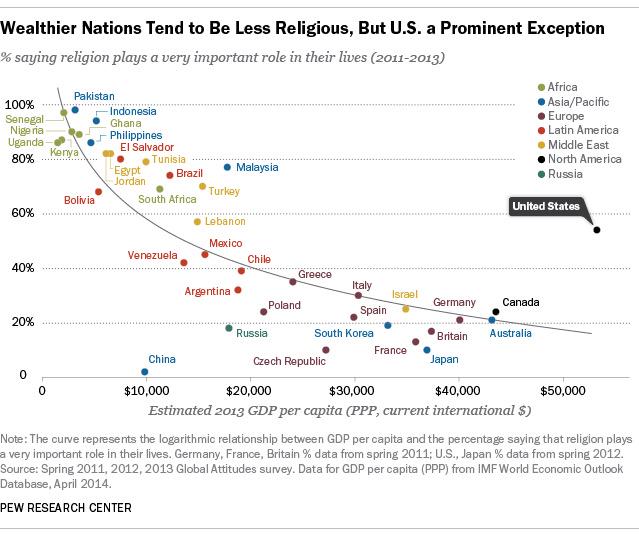
A fundamental assumption of the secularization thesis is that religious and scientific paradigms conflict intrinsically. Religion, comprising superstition and unreason, cannot exist side by side with science, comprising skepticism and reason. This irresoluble conflict requires the advance of science to come at the expense of religion. However, the prediction of the secularization thesis (that as the world modernizes secularism will come to dominate) has not been borne out over the last few decades. This is particularly true in the United States, where religion stubbornly refuses to to go quietly into that good night.
A new paper from the American Sociological Review goes deeper than merely noting the surprising longevity of American religion in the face of science, however, and severely undercuts the premise that religious and scientific paradigms are necessarily locked in a zero-sum contest.
The paper’s authors—Timothy L. O’Brien and Shiri Noy—start with data from the General Social Surveys conducted in 2006, 2008, and 2010. They measured respondents’ relationship to science based on two metrics. The first is the degree of favorability with which a person views science and the second is a person’s scientific literacy. They also measured respondents’ relationship to religion using two approaches, including asking questions like “whether the Bible is (1) the actual word of God, (2) inspired by the word of God, or (3) filled with myths and fables” and respondents’ views of their own religiosity.
Next, they used a statistical technique to determine whether the pattern of answers would be most likely to emerge from a population that had 2 cohorts (e.g. a religious cohort and a scientific one) or more than two. The results indicated that there were three cohorts present in the population.[ref]They tried up to 8 different cohorts. The model with three was the best fit for the data.[/ref]
The first two are well known. Traditionals, as they are called, tend to score lower on scientific literacy, trust science less, embrace religion more, and are also relatively marginalized in terms of social class. Traditionals are the largest group, and make up 43% of the sample. Moderns, by contrast, tend to score higher on scientific literacy, trust science more, are dismissive of religion, and are more socio-economically elite. They make up 35% of the sample. The new third group, making up just 21% of the sample, is the most interesting.
This is the group that O’Brien and Noy designated as post-seculars, and they emphasize that it is not merely “a midpoint between modern and traditional, but a distinct way of using science and religion to interpret the world.” In terms of science, post-seculars are roughly as literate as moderns, and much more literate than traditionals. “For example,” notes the article, “47 percent of the traditional class, compared to 92 and 90 percent of the modern and post-secular groups, respectively, correctly answered that radioactivity occurs naturally.” But post-seculars do not fully share in the optimism and confidence expressed by moderns about science. In addition, there are a couple of specific questions where post-moderns diverge dramatically from moderns: human evolution and the big bang. This table—an abbreviated version of Table 2 in the paper—shows just how wide that divide is.
Conditional Mean of Each Category
Question (0 = disagree, 1 = agree)
Traditional
Modern
Post-Secular
The continents have been moving for millions of years and will move in the future?
.665
.983
.801
The Universe began with huge explosion?
.212
.678
.058
Human beings developed from earlier species of animals?
.330
.877
.032
When it comes to a question about continental drift (which is an important question for reasons we’ll come to later), the post-secular group falls between traditionals and moderns: about 80% of post-seculars accept the theory vs 98% of moderns and 67% of traditionals. But when it comes to the big bang and human evolution, post-seculars reject the scientific consensus much more strongly than the traditionals. Post-seculars accept the big bang and human descent from animals at miniscule rates of 6% and 3%, respectively. That’s a truly astonishing degree of uniformity out of a cohort that represents more than 1/5th of the American public.
The trend is similarly fascinating when it comes to religion, with the post-secular group consistently showing the greatest levels of religiosity. They are also much more consistently conservative on political questions that have strong religious components, such as abortion and embryonic stem-cell research. In both cases, the post-secular cohort is not only more conservative than the moderns, they are more conservative than the traditionals as well. But on issues where there isn’t a direct religious component (like increasing fuel efficiency standards for vehicles or the amount of electricity generated by nuclear power), the post-seculars flip to be at least as pro-science as the moderns.
It is abundantly clear that the standard religion vs. science dichotomy is insufficient to explain what is happening in America, but the real story is harder to ascertain. Further research is required, of course, but here are some preliminary thoughts.
First, I disagree with the authors attempt to keep the secularization thesis on life support. While conceding that post-seculars demonstrate that there is no universal conflict between science and religion, the authors suppose that there are at least a few crucial issues where it really must be either religion or science, but not possibly both. Thus, “rather than the fully compatible worldview we anticipated, the post-secular perspective sees conflict between science and religion as limited to particular issues related to life. In these domains, the post-secular perspective is associated with a tendency to use religion to ground one’s views.” They also raise the possibility that post-seculars simply see questions of human and cosmological origins as unscientific and that therefore “for these individuals… evolution and the big bang are not viewed as legitimate science.”
The fundamental problem at this stage in the analysis is the failure to differentiate between science as philosophy and theory on the one hand, and science as social practice and institution on the other. It may very well be the case that scientific theory and religious belief are fully compatible on a philosophical level, but that scientific and religious authority are incompatible on a practical, social level.
Unfortunately, the issues of human evolution and cosmological evolution have become such controversial symbols in the dispute over authority, that it is impossible to separate philosophical from institutional concerns in simple survey responses. If, for example, a post-secular believes that God created human beings in His image using evolution as a mechanism, how would they respond to a question that asks about evolution without mentioning God? In a purely neutral context, it could go either way. But the contemporary context is very far from neutral. Post-seculars quite reasonably read questions on human evolution that leave out God as loaded questions about the practical, social concerns rather than as neutral ones about the science of genetics and natural selection. This interpretation is suggested by the question about continental drift. 80% of post-seculars agreed that the continents have been drifting for “millions of years,” which means that strict creationist accounts are emphatically ruled out by most post-seculars. The best way to reconcile a rejection of human evolution and a rejection of literalist creation accounts is to understand that the survey is conflating two distinct issues.
If this interpretation is correct, then post-seculars are not a cohort comprised of cafeteria scientists and cafeteria religious followers who pick and choose from the two like a double buffet to create their own idiosyncratic world views. Instead, their positive views of religion and science could very well represent a genuine project of unification and reconciliation on a philosophical level paired with an unflinching loyalty to religious authority on a practical level.
The problem of evil is probably the most vexing philosophical question for monotheism. It has affected people I know personally all the way up to famous scholars like Bart Ehrman. What are we to do with this problem? Even though the question has been explored endlessly, I want to think about it a little today.
First, according to contemporary philosophers, the logical problem of evil is more or lesssolved. The logical problem of evil is a subset of the problem of evil that argues that God’s existence is logically incoherent with the existence of evil. And yet many people remain unsatisfied with the logical resolution of this problem. Why?
Some people argue because the evidential problem of evil remains. The evidential problem of evil involves arguing that the existence of evil makes God’s existence unlikely, rather than illogical. That seems like a decent argument to make, and harder to refute decisively, but I don’t think God’s existence simply being made less likely or unlikely would have the same destructive effect on faith that the problem of evil has.
I want to try a different avenue. I think the problem of evil persists because it so deeply offends our moral sense. To explain, I will turn to a different story.
In Greek philosophy, much thought turns over the Homeric gods. The Homeric gods are the gods we traditionally associate with Greece–Zeus, Athena, Ares, Hermes, Apollo, and the like. The Greek philosophers by and large reject the Homeric gods. But whythey reject the Homeric gods is illustrative. They don’t reject the Homeric gods on an empirical basis, such as the fact that you can physically walk over to Mount Olympus and check if the gods are actually there. Nor do they reject them on a logical or probabilistic basis. Rather, they reject the Homeric gods on a moral basis. Surely the gods do not act in ways unworthy even of human beings. Xenohpanes, a pre-Socratic philosopher, writes:
Homer and Hesiod have attributed to the gods all those things which in men are a matter for reproach and censure: stealing, adultery, and mutual deception.
Plato’s second objection, however, is more fundamental…Homer and the poets teach falsely about the gods and morals. Gods who fight one another, lie and cheat, and who speak and act falsely, are not suitable for the raising and teaching of children.
The Greek philosophers then puzzle out what or who exists if the Homeric gods do not. Some of their thoughts will sound very familiar to modern monotheists (especially Xenophanes’ writings). What I want to note, though, is the direction of their thought. If something about the gods and the world seem contradictory, the Greeks posit the gods (or more generally and non-theistically the moral foundation of the world) must be better than the popular understanding, not non-existent. I think this distinction is very important.
Why? Because, remember, our objection was originally moral in nature. If our objection is moral, and our conclusion then is that the supernatural does not exist, we face the much bigger problem of accounting for the origin of the moral sense that invalidated the supernatural in the first place.
Here’s where my story ties back to the problem of evil. I believe that the problem of evil persists because it fundamentally offends our moral sense. But if the origin of the problem of evil is our moral sense, we make a deadly error in rejecting the supernatural and embracing naturalism as the solution. C.S. Lewis explains this idea in full in Mere Christianity:
My argument against God was that the universe seemed so cruel and unjust. But how had I got this idea of just and unjust? A man does not call a line crooked unless he has some idea of a straight line. What was I comparing this universe with when I called it unjust? If the whole show was bad and senseless from A to Z, so to speak, why did I, who was supposed to be part of the show, find myself in such violent reaction against it? A man feels wet when he falls into water, because man is not a water animal: a fish would not feel wet. Of course I could have given up my idea of justice by saying it was nothing but a private idea of my own. But if I did that, then my argument against God collapsed too—for the argument depended on saying that the world was really unjust, not simply that it did not happen to please my fancies. Thus in the very act of trying to prove that God did not exist—in other words, that the whole of reality was senseless—I found I was forced to assume that one part of reality—namely my idea of justice—was full of sense. Consequently atheism turns out to be too simple. If the whole universe has no meaning, we should never have found out that it has no meaning: just as, if there were no light in the universe and therefore no creatures with eyes, we should never know it was dark. Dark would be a word without meaning.
Naturally I’m biased as a Christian, but I find this resolution fitting. The answer to our problems are implicit in the very objections we raise.





 . Pinker argues very persuasively and with reams of evidence that human nature is real and that it includes meaningful sex differences. What this means is that, if women tend towards actually liking being primary caregivers more than men, working towards equal pay across society (not equal pay for equal work, but equal pay AND equal work) is not actually going to make women happier. It’s going to make them less happy, as a group.

 cent piece from
 Harvard economist