I got very interested in the shame-based vs. guilt-based culture discussion as it plays into reading the Bible based on Misreading the Scripture with Western Eyes: Removing Cultural Blinders to Better Understand the Bible (which I started yesterday). So, for this morning’s post, I wrote about how it might be possible to reconcile those two cultural outlooks and also why it might be important to do so. Give it a read: Reconciling Shame and Guilt.
Catholics and Polls
How often have we heard the statistic cited along the lines of “98% of Catholic women use contraceptives.” It seems come up every time the word ‘Catholic’ and ‘contraceptives’ appear in the same sentence. Here’s the original study.
There are some real oddities in this study, as people have noted since the study came out in 2011. I’ll highlight the two most prominent ones:
1) 11% of women are noted as using no method of contraception, and they mysteriously vanish from the math because only the 2% of women who are identified as using NFP are subtracted from 100% to reach the conclusion that 98% of Catholic women use contraception.
2) The data “[r]efers to sexually active women who are not pregnant, postpartum or trying to get pregnant.” So the study excludes women who are pregnant, postpartum, or trying to get pregnant. Since the Catholic Church teaches NFP as a way to space children, chances are NFP users are going to fall into one of these three categories for decent portions of their reproductive lives.
Normally, I would just put this case down as one more example in the ‘Lies, Damned Lies, and Statistics’ folder. However, the proliferation of this statistic and similar statistics involving the Catholic Church are not simple mistakes. They serve a very clear purpose: To paint the Catholic Church as backward and out of touch with its members and therefore irrelevant. How do I know? Because this has been done before with abortion. Bernard Nathanson, a co-founder of NARAL who later became pro-life and then Catholic, lays out exactly what they did and why:
We systematically vilified the Catholic Church and its “socially backward ideas” and picked on the Catholic hierarchy as the villain in opposing abortion. This theme was played endlessly. We fed the media such lies as “we all know that opposition to abortion comes from the hierarchy and not from most Catholics” and “Polls prove time and again that most Catholics want abortion law reform”.
And the media drum-fired all this into the American people, persuading them that anyone opposing permissive abortion must be under the influence of the Catholic hierarchy and that Catholics in favour of abortion are enlightened and forward-looking.
Sound familiar? This tune is played endlessly on every issue involving in the Catholic Church. People who disagree with the Church are enlightened and forward-thinking. People who hold the Church position are brainwashed and backward. The Guttmacher study above even takes time in its short discussion to paint the Catholic hierarchy as out-of-touch and behind the times:
Even among married Catholic women, only 3% practice natural family planning, while a majority uses contraceptives that the Church hierarchy routinely denounces. This research suggests that the perception that strongly held religious beliefs and contraceptive use are antithetical is wrong—in fact, the two may be highly compatible.
I think it’s worth noting this tactic because it’s moving beyond the Catholic Church. I have been keeping track of the controversy in the Mormon church over women’s ordination, and the same narrative appears: The Mormon hierarchy is backward and authoritarian, bent on enforcing its will on regular Mormons. Those who oppose the hierarchy are free thinkers who want to liberate the church from its oppressive dogmas. This instance is even more obnoxious because, while I’m fairly certain a sizable majority of American Catholics use contraception (just not 98%), we know for a fact that the vast majority of Mormons oppose women’s ordination, and more Mormon women than men oppose it!
Any church that makes a habit of opposing the zeitgeist can expect similar treatment. So if people see some discrepancy between what they see in church and what the internet insists their fellow congregants believe, this is one reason why.
Civilian with Gun Stops Domestic Assault
That’s a still from cell phone video of a Aaron Kreag (with the pistol on the right) stopping Macmichael Nwaiwu (in the red car) from beating a woman who wasn’t named in the story. Kreag told reporters “This large gentleman just pounding on this lady, closed fist you know multiple times and heavy heavy elbows to the face and neck.” So Kreag, who had been out on a date with his wife, pulled out his concealed carry, pointed it at Nwaiwu, and ordered him to stop assaulting the woman in the car with him.
The story is an interesting counterpoint to concerns that civilians with concealed carry permits would turn the United States into the Wild West. As it turns out, the kinds of folks who go through the process of getting a concealed carry permit are not the kind of folks who tend to be trigger-happy, for the most part. It’s just also an interesting case-study in real-life, civilian gun usage. The tensest part of the video, in my mind, is when the cops show up. When you’re the one holding a drawn handgun and the cops roll up, expect to have one pointed at you in return, which is exactly what happened to Kreag. He put down his gun, surrendered, and got cuffed while the cops sorted out what was going on with bystanders.
Within a few minutes, however, he was released and Nwaiwu was in handcuffs. Still, I imagine those initial seconds when the cops drew on Kreag had to be nerve-wracking. It’s what Kreag was expecting, however, and it’s what all concealed carry holders expect to go through if they ever do need to draw their weapon (let alone fire) in the defensive of themselves or others.
Abolish the Corporate Income Tax
A recent online debate involving Nathaniel (and me to a much, much lesser extent) brought up corporate income tax.[ref]I wrote briefly about the corporate income tax at The Slow Hunch (a couple times).[/ref] It reminded me of this recent article in the Wall Street Journal. The author lists ten reasons to abolish it altogether:
- The “engine of tax complexity disappears. And with it disappears an army of lobbyists in Washington working to get favorable tax treatment for corporations.”
- “With no corporate income tax, management would concentrate on what is now pretax profits, an artifact of actual wealth creation.”
- “[T]here would be no reason to tax dividends at lower rates to compensate for the fact that they now are paid out of after-tax profits.”
- Due to increased profits, “corporations would increase both dividends and investment in plant and equipment, with very positive effects for the economy as a whole and increased revenue to the government through the personal income tax.”
- The “stock prices…would rise substantially, inducing a wealth effect as people see their 401(k)s and mutual funds rising in value.”
- “[T]he distinction between for-profit and nonprofit corporations would disappear.”
- “[M]uch of the $2 trillion of foreign earnings, now kept abroad to avoid being taxed when repatriated, would flow into this country.”
- With no corporate income tax, “foreign corporations would flock to invest here…”
- In order to compete, foreign countries “would be forced to lower or eliminate their own corporate income taxes, increasing domestic corporate profits and thus domestic investment and personal income…”
- Finally, “eliminating the corporate income tax would deal a blow to crony capitalism.”
Check out the full article.
Maybe North Korea Didn’t Hack Sony
According to the White House, the FBI, and lots of other folks who really should be pretty sure of these things before making statements or taking action, North Korea was behind the infamous Sony hacks that have been in the news for most of the end of 2014. Apparently, the US was confident enough to retaliate by shutting down Internet to the entire country:
North Korea called U.S. President Barack Obama a “monkey” and blamed Washington on Saturday for Internet outages it has experienced during a confrontation with the United States over the hacking of the film studio Sony Pictures. The National Defense Commission, the North’s ruling body chaired by state leader Kim Jong Un, said Obama was responsible for Sony’s belated decision to release the action comedy “The Interview,” which depicts a plot to assassinate Kim.
And yet, as I’ve been paying attention to the story I am not convinced that we’ve got the write villain. It’s articles like this one that, as far as I can tell, make the strong case that the hack was actually an inside job pulled off primarily by disgruntled ex-employees of Sony itself. One of the first things to point out, for example, is that the hackers showed absolutely zero interest in “The Interview” until after media reports arose alleging a possible North Korean connection. Only at that point did the hackers make an issue out of it, as though taking a convenient opportunity to throw researchers on the wrong track.
Other reasons to think that North Korea might not have been to blame? Logs indicate that files were transferred at a rate that you would only get by physically plugging a device into the server to download files, not by moving them over the Internet. Specific IP addresses and user credentials were known to the hackers ahead of time, not discovered during preliminary hacks. Linguistic examination of online communication by the hackers (Guardians of Peace or GOP) suggests they are native Russian speakers, not native Korean or English speakers.
The leading theory, from where I’m standing, is that an angry, laid-off worker with tech skills (security researchers believe they have identified her individually) teamed up with the kind of hackers who resent Sony for attacking the Pirate Bay and other anti-piracy measures and maybe some friends left inside the company to pull off the hack. Why would the government get it wrong? Well, it’s not like it’s the kind of thing that North Korea wouldn’t or couldn’t do, so I don’t think it was a stupid mistake or a conspiracy theory or anything. But I don’t have a lot of confidence in the federal government’s ability to do this kind of analysis correctly and even less confidence in their ability to correct a mistaken impression once it takes hold at a senior level. Would you want to be the one who told the President he’d gone public with bad intel?
On the other hand, I can’t really think of a worse possible reason to start World War III than mistaken accusations about hacking a movie studio, so I really do hope they figure this one out.
Damon Linker: What I Got Wrong in 2014

The only time I got into a discussion with Damon Linker was a rather heated exchange a month or two back about an article he’d written about ISIS. I still think that was a bad article of his (and, since it didn’t make his list of bad pieces from 2014, I gather he still thinks it was a good article), but I was disappointed that it was our only contact since he’s written several articles that I thought were quite good. In fact, I wrote about one of them earlier this month.
In some ways, though, this is his best one: What I got wrong in 2014
I say “in some ways” because what Damon Linker thinks he got wrong is not the same as what I think Damon Linker got wrong. But that’s not that point. The point is that anyone writing an article about their missteps from the prior year is setting a healthy example of the rest of us. It’s a little late in the year for me to do a review of my own 2014 writings, but, in exactly one year, you can expect to read an article about what Nathaniel Givens got wrong in 2015.
In the meantime? Ironically, perhaps, the fact that I’ve got a plan to review my own mistakes makes me less worried about making them. I mean look: trying not to make mistakes is kind of a dumb goal. You can try to be careful. You can try to work hard. You can try to be honest. Those things are in your control. But, once you’ve done those things, whether or not you’re right or wrong is up to luck and fate. By planning on writing a piece about my own mistakes, I’m reminding myself that it’s just another one of those things that I can write about and analyze, not some deeply personal assessment of my value as a human being.[ref]Again, this is only after taking into account sincere efforts to be accurate and honest, of course.[/ref] So yeah: pressure’s off. Time to go to work for 2015.
Studio Ghibli: “The Kingdom of Dreams and Madness”
I am a huge fan of Hayao Miyazaki, the genius behind Studio Ghibli productions like:
- Nausicaä of the Valley of the Wind[ref]Technically, this film was made before Studio Ghibli existed.[/ref]
- My Neighbor Totoro
- Princess Mononoke
- Spirited Away
- The Cat Returns
- Howl’s Moving Castle
- Ponyo
So I’m really interested in the documentary that, by good fortune, was filmed during the period when Miyazaki deliberated on, decided, and then announced his retirement. Although it doesn’t sound like it will necessarily be fun or happy. According to this article at The Verge, Miyazaki may well qualify as the variety of genius known as tortured:
[T]he man is also marked by moments of cynicism, resentment, and self-doubt that hint at a darkness behind his creations. “I don’t ever feel happy in my daily life,” he says. “How could that be our ultimate goal? Filmmaking only brings suffering.”
That actually makes me want to see the film even more, however. I’ve often wondered at the elusive relationship between desire and happiness and creativity. It often seems like creativity has to come from a kind of intense dissatisfaction with ourselves and the world. Only the discontent, perhaps, are on fire with the urge to change and make something different than what already is. On the other hand, depression is (in my experience) no fit state for accomplishing good work. There is a razor’s edge, it seems, between happiness in the change that is coming and sadness in the state of things as they are, and an artist’s goal is to dance along the sharp blade to make something beautiful.
The real question in my heart, however, is one that this film might not address. Is it possible to live a happy life and make great art? I hope so, but the truth is I’ve already made my choice. I’d rather be happy than be great. Not necessarily for my own sake–I’m not naturally that interested in being happy, and didn’t decide it was important until one day when I was 18–but because when I’m not unhappy I’m no fun to be around. And that’s not fair for my wife and kids. So I’ve made the decision to (try to) be a sane, healthy, functioning, happy father and husband.[ref]Not that I’m executing flawlessly.[/ref]
Does that preclude ever writing something truly great? Maybe. I hope not, but the fact that so many of my heroes seem to have been deeply unhappy people doesn’t exactly fill me with optimism on the subject. I will admit that, when I watch The Kingdom of Dreams and Madness, I’ll be keeping an eye out for clues.
The Masculine Christian
…is probably not what you expect him to look like. Some of the more obnoxious misconceptions look like this:
“Week after week, Mooneyham uses the gospel to punch back against what he perceives to be a rising tide of emasculation,” the article reads. “He’s delivered a series of Sunday talks called ‘Grow a Pair’ and ‘Band of Brothers,’ and the church offers male leadership courses with titles like ‘Spartan’ and ‘Fight Club.’ He’s performed baptisms at Ignite-sponsored tailgate parties and instructed married couples to go home and have sex every day for a week. And there’s rarely a Sunday where Mooneyham doesn’t praise a big truck, a big gun or a pair of big balls in the same breath that praises Christ.”
…a conception so silly I don’t think I need to go into theological depth to point out its issues. However, I don’t go as far as some authors to discredit the warrior as a legitimate Christian archetype. The image of the warrior permeates scripture, and I believe for good reason. That being said, we must properly answer, “Who or what are we fighting?” Scripture gives some guidance:
12 For we are not contending against flesh and blood, but against the principalities, against the powers, against the world rulers of this present darkness, against the spiritual hosts of wickedness in the heavenly places.
Our true enemies are not people. They are, at very worst, servants of a darker power, and never beyond the redeeming power of God. We are fighting the power of Satan himself. And while I believe we are most definitely supposed to bring the fight to the external machinations of Satan and people or nations who would harm innocents, like I have said before I believe the internal battle is also of utmost importance and more often ignored. In that vein, I believe the masculine Christian is not a man who whoops and yells about balls of steel and guns. Rather, he is the man who brings the utmost violence upon Satan, in forgiveness, in hope, in love. He is the man who proclaims the Gospel, trusting his fears of rejection and ridicule to God, turning to peace and patience for counsel. That does not mean he cannot speak forcefully. Jesus had some choice words for the Pharisees and for Herod (“Go tell that fox [Herod]…”) . But we must measure our words carefully, ensuring we speak in righteousness rather than out of human pettiness or our own hurt feelings.
Now, even though I do not reject the warrior archetype, I do believe people are right to point out that the warrior is not the completeness of the Christian man. In particular, I like this thought:
And the simple fact is, when God created Adam he didn’t make a warrior; he made a gardener.
Gardening isn’t easy work. It demands great labor and—since the Fall—requires the sweat of our brow. It’s dirty and it’s tiring. It involves careful, perhaps even painful, pruning. Ultimately, it even demands recognizing that your work on its own is not enough. You need the sun to shine. You need the rain to fall. You need God to make something out of your own weak and feeble efforts.
And then I believe the gardener and the warrior imagery are beautifully tied together by the top comment on the article:
I think it’s worth pointing out that ancient Roman infantry were mostly farmers. The essence of masculinity is probably something like Farmer-who-will-be-a-Warrior-when-he-must.
The Christian man is the gardener and the reluctant warrior. Not reluctant in the sense of ‘I’ll never put my heart into fighting.’ No, if we believe we must fight a battle, then we must fight it with all our strength and conviction. But we must be reluctant in that our prime calling is not the battle. We are not made for unending strife. Rather, we are called to toil patiently for the salvation of all mankind, working to bring God’s kingdom to fruition while trusting in God to make our efforts worthwhile, and if there is any violence to be had, it is upon the powers of darkness, not our fellow human beings.
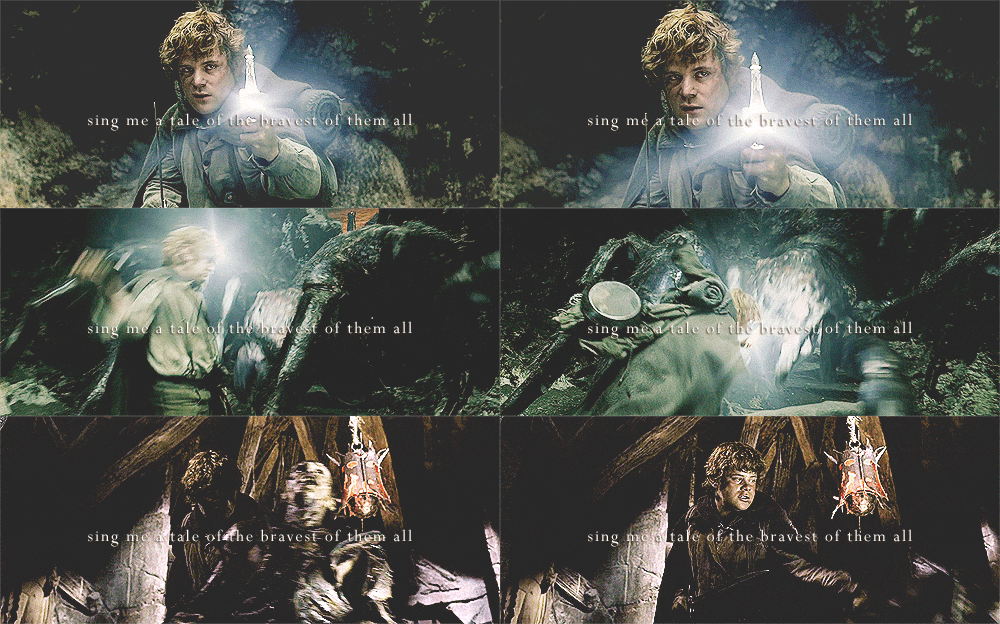
Say, where have I seen this kind of imagery before?


About deGrasse Tyson’s Christmas Tweets
On the one hand, Neil deGrasse Tyson’s Christmas day tweets are the kind of obnoxious trolling that tends to give atheists such a bad name, so I could see if they annoyed people. On the other hand, as obnoxious trolling goes, these are pretty tame. I didn’t think he was being mean-spirited. I just thought he wasn’t being as clever as he thought he was being. Besides, I wrote about his bigger problems back in September, so I was going to just let these go by without comment. But then Ro sent me this article highlighting three unintentional ironies behind Tyson’s quote, and I thought it was definitely worth sharing: Neil deGrasse Tyson’s (Unwittingly) Ironic Trolling.
The main points are:
- Isaac Newton Shows how Religion and Science aren’t Opposed.
- Newton’s Birthday Reminds us of the Church’s Role in Promoting Science.
- Tyson Gets Basic Historical Facts Wrong.
Check out the article for full explanations.
Hearing What They Hear
One of my very favorite parts of the New Year’s season are all the best-of lists that start to come out and especially best albums of 2014. I’m going through the Washington Post’s top 50 albums of 2014 list right now, starting with Montevallo by Sam Hunt (which they put at #2 for the year). I was surprised to find out that I’d already heard one of those songs (“Leave the Night On”), but pop-country is very much not my usual fare so this is definitely a different album from what I usually listen to.
Which is why I like it.
Sure, one of the main reasons I go through these lists is that I’m hoping to find something new that will really speak to me.[ref]Most recent find, if you’re curious, is twenty | one | pilots, which my brother told me to listen to. And now I have to stop myself from just listening to “Migraine” on repeat.[/ref] But the truth is that a lot of the time I like listening to songs that other people like, even if they don’t really speak to me in the same way, because I want to try and hear what they hear.
At one level, it’s just math. The more genres you have acquired a taste for, the more great music there is in your world. But it goes beyond that. You do yourself a favor expanding your capacity to appreciate and your potential to empathize, and in my experience you lose nothing of your own individual perspective along the way. I’m not saying every artist is equally talented or that popularity is quality. Just pointing out that there are a lot of people out there, trying to find or make something beautiful or inspiring or soothing or powerful. If you feel like your world could use a little more of those things, then try stretching out its horizons a little.
Even when you don’t find a new favorite artist, just realizing that other people are trying to bring more light or meaning or fun into the world can bring a sense of hope and optimism. Listening to new genres of music until the sounds and the lyrics start to make some sense is a way of reminding yourself how much we have in common, even when we don’t see eye-to-eye.
And, since I mentioned my current addiction, I’ll give you a sample. I totally didn’t get these guys at first,[ref]I made fun of one of their songs here at Difficult Run before I got into them.[/ref] but now that I’m dialed in to their frequency I can’t listen to their songs without cranking the volume and, more often than not, singing / screaming along.
If the suicide theme seems dark, by the way, be sure you pay attention to the lyrics of the song towards the very end.