Over at The New Republic, there was a small post praising former President Jimmy Carter for saving the beer industry via deregulation:
To make a long story short, prohibition led to the dismantling of many small breweries around the nation. When prohibition was lifted, government tightly regulated the market, and small scale producers were essentially shut out of the beer market altogether. Regulations imposed at the time greatly benefited the large beer makers. In 1979, Carter deregulated the beer industry, opening back up to craft brewers. As the chart below illustrates, this had a really amazing effect on the beer industry:
The increase in breweries over the past few decades is staggering. The industry has reached a milestone with over 2,700 breweries in the U.S. at the end of 2013 with 98% of these being small and independent craft breweries. This is the highest count in close to 140 years. As economist Mark Perry has noted, there has been a 2600% increase in US breweries largely because of craft breweries. Bart Watson, chief economist for the Brewers Association, also finds that “the presence of a strong craft industry has been great for the beer industry.” Between 2009 and 2013, the states with the strongest craft beer industries on average gained volume, while the majority of states lost volume. These craft breweries have also become widely dispersed within the US. While there is still plenty of room for growth, the dispersion is pretty extensive. “Long gone are the days where San Diego and Portland are hogging all the local breweries,” writes Watson. “There are 2,295 [Zip Code Tabulation Areas] that now have a brewery. They range in size from over 100,000 people to 10 (10 ZCTAs with fewer than 100 people have a brewery). Americans, whether they live in urban or rural areas, large towns or small, are increasingly being exposed to beer produced by a local brewer.” Furthermore, this increased competition has led to numerous choices for consumers. As Watson puts it,
Regardless of the optimal number of brands on a shelf, the innovation and entry of so many great new breweries can only be a good thing for the category. Competition breeds innovation, and innovation has bred the incredible diversity of amazing beers available in the US today. The beers that people love will thrive and continue to find shelves and taps and the ones that don’t stand out will fade away. Make a list of your favorite craft beer brands. How many are 10 years old? 5? 1? I know that I’m continuously amazed by the new offerings from America’s 3,000+ breweries, and if it means I have to spend a few extra minutes in the beer aisle sorting out my next selection, it’s worth the wait.[ref]Watson argues against the “choice overload” hypothesis, citing a meta-review that found little evidence to support it.[/ref]
There are a few conclusions I draw from this overview of the beer industry:
1. Regulations often hamper innovation and growth (a major loss for everyone, especially consumers).
2. Perspective is important: information on historical trends is better than snapshot data.
3. There is a difference between pro-business and pro-market.
Obviously I know the band u2. Everyone knows the band U2, and I like the songs of their’s that I’ve heard. And I now all about Bono’s humanitarian efforts. But I’ve never really gotten into u@ in a big way, so I’ve never really paid attention to the lyrics, so I never really knew that Bono’s Christian faith is important to him; important enough to show up in his lyrics on a regular basis. Thankfully, a long article from Deseret News headlined The biggest band in the world is also one of the most spiritual has cleared that up for me.
The article goes through too many examples of religious themes in the music across many of the bands albums for me to list here, and easily enough to convince me that–like songwriting from Brandon Flowers of The Killers–the religious themes are deeply intertwined with their music. Looks like I’ve got a lot of listening to do.
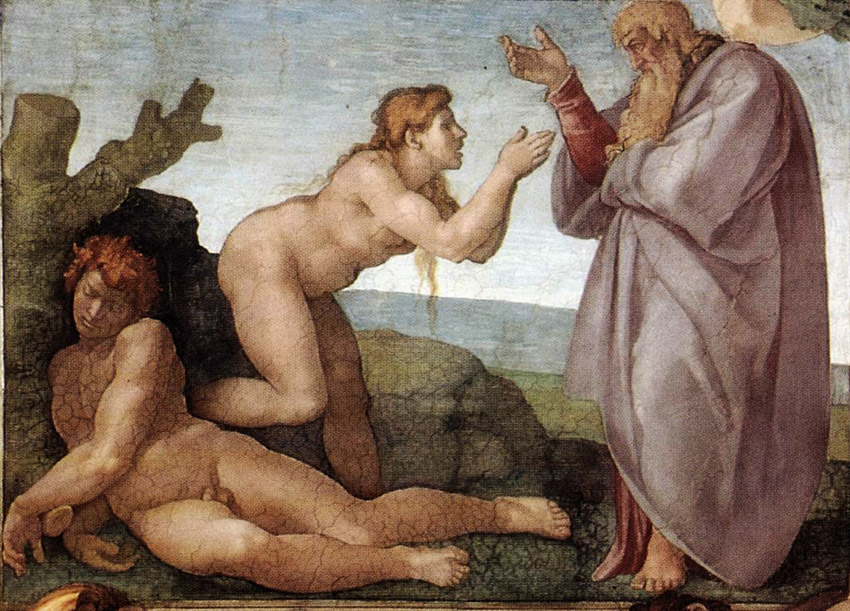
Michelangelo’s Creation of Eve. Detail from the Sistine Chapel.
You can find plenty of attacks on “traditional marriage” these days. These pieces generally take a historical approach, looking at how the institution of marriage has changed throughout history and how widely they differ from 1950s stereotypes. There is a legitimate point to this analysis, marriage has changed quite dramatically from time to time and from place to place, and there are certainly modern embellishments that are anachronistically applied to the tradition backwards throughout time.
Unfortunately, the political assumptions that frequently accompany such critiques distort the analysis. Closer inspection reveals that the same core aspects that defenders of traditional marriage emphasize are much, much older and more deeply embedded into the institution of marriage than critics and maybe even defenders of traditional marriage realize.
The proximate provocation for this post is a piece by Angela C. at By Common Consent: The Myth of Traditional Marriage.[ref]This piece is an extrapolation of the comment I left there.[/ref] The core assumption that leads Angela astray is that marriage is an invention. As she writes:
Depending on whom you ask, marriage was either invented by men to protect or to oppress women. And some men would argue that marriage was invented by women to domesticate men (a pouty version of the protection argument).
Of course, Angela is also employing the highly partisan assumption that the invention of marriage had to have been sexist: either the outright misogyny of exploitation or the insidious sexism of assuming women need protection. As objectionable as this assumption might be, it’s actually far less important than the subtle assumption that marriage is an invention.[ref]Astute readers might also point out that by dismissing any explanation in which women play a proactive role rather than exist as passive subjects she risks enacting a pernicious form of sexism herself.[/ref] Which is to say that it is a social construct.
The explanation of why this idea of social constructivism is associated with socially liberal politics is an interesting one, but it is mostly also outside the scope of this post. I will just point out that it is associated with socially liberal politics. The most obvious example, of course, is the argument that gender is a social construct distinct from biological sex.
Implicit in these theories is the peculiar notion that society is not biological. It is peculiar because it is most often embraced by those who either outright deny the role of a supernatural deity in creating humanity or at least downplay it in favor of scientific explanations. But it’s quite difficult to see how science can provide any metaphysical justification for treating humans and our society and its constructs as one class of beings and the natural world as another. It’s very much like the natural foods advocates who warn against eating anything “chemical” without realizing that everything is chemicals. Social constructivism—at least in its most extreme and naïve form—is a modern superstition.[ref]I anticipate getting some stern replies from those with expertise in this area. I welcome the contribution of experts, but the popular understanding of technical concepts is also a relevant target of analysis and critique.[/ref]
So let us set aside the assumption that marriage is an invention, a deliberate construction willfully created by humans to accomplish a consciously desired end. I don’t mean to say let’s assume that marriage is not an invention. I’m merely saying: if we don’t make that assumption do we find any more likely candidate explanations? And, as it turns out, we do.
To understand the origins of marriage we first have to understand a little bit about the differences between human beings and other animals. The answer is that humans have evolved to make a very high-risk, high-reward tradeoff. The risk is that our offspring are basically helpless for an exceptionally prolonged period of time. This requires enormous resources to feed them and keep them safe. The reward is that, in exchange for that helplessness, our offspring are incredible learners (and then, later in life, incredible teachers). Learning and teaching are what humans do better than any other species. Human babies are useless at running or fighting or hiding, but they are tremendous geniuses at things like language acquisition. We have highly plastic brains that take a long time to learn anything, but that can eventually learn just about anything. That single difference pretty much explains the difference between chimps using sticks to forage for ants and humans launching the Space Shuttle.
The reason why this change has such huge dividends is that it separated human knowledge from human genetics. Other animals are capable of some pretty amazing behaviors (like migration), but these are often instinctual. That means the information is genetic. Advantage: no one has to teach it. Disadvantage: the animals can only learn and change as the speed of genetic evolution, which takes place across hundreds or thousands of generations. If the migration pattern needs to change in an abrupt way, monarch butterflies can’t just tell the next generation to take a different route next time.
Humans, on the other hand, initially used society as a repository for knowledge. Each generation could teach the skills (from language to tool use) to the next generation. This meant that exchange of knowledge (for example when a new tool was discovered) could be exceptionally rapid both across generations and across tribes. That was the basis for creating (eventually) written language, which only further increased the pace since now our knowledge can be transmitted and reproduced even more rapidly and cheaply and widely. In short: other animals learn at the speed of genetics. Humans learn at the speed of memetics which, in the Internet Age, is the speed of light.
This is pretty cutting-edge science because it relies on concepts like group selection that—although initially proposed by Darwin—have been considered more or less impossible until recently. No one could figure out how to make it work: why would one individual sacrifice altruistically in order to benefit his tribe? In short: how do you get trust? Advances in game theory and complexity science have for the first time made it possible to illustrate how these obstacles can be overcome, and therefore how it is possible for groups to compete against each other (and therefore to have group evolution) rather than just individual organisms.
So now we’ve learned two key things. The first is that the chief difference between humans and other organisms is that we have really, really expensive but also really, really high-performing offspring. The second is that this idea carries with it the notion that groups compete and evolve, which is to say that societies can compete and evolve. Most notably, these are intrinsic to what it means to be a human being. They predate any history and go back to the origins of our species.
Which means that marriage predates our history and goes back to the origin of our species, provided we define marriage as (1) monogamous sexual pairing of males and females who (2) cooperate to feed, protect, and teach their offspring. This behavior must be as old as humanity because humanity is impossible without it. Without cooperation, human children cannot be raised by subsistence cultures. They are too expensive. But without sexual monogamy, males and females are not equally vested in the offspring. These behaviors therefore co-evolved with humanity itself.
So we’ve just bypassed all the historical, cross-cultural analysis of formal marriage institutions by a couple hundred thousand years, at least. So much for an “invention.” What does the story look like from there?
Well, all of the individual cultural variations around the kernel of marriage (monogamy and cooperative child-rearing) end up only being possible because of the integral role that the kernel of marriage played in our society. The logic can’t work any other way. Why would someone use marriage as the basis for political alliance, for example, if monogamous, child-rearing relationships weren’t already fundamental to human society? No one would think to invent marriage from scratch for the purposes of political alliance and, if someone did think of it, it would never work because there would be no foundation to build upon.
So it is absolutely true that marriage comes in a wide variety of cultural and legal and historical instantiations, but it is only the variety that is in any sense invented or constructed or arbitrary. They inventions only exist because there was a stable foundation upon which to build them.
Oral language was not invented. It evolved. Written language was not invented. It evolved. Nation-states were not invented. They evolved. Markets were not invented. They evolved. And, like these other bedrock institutions, marriage was not invented. It evolved. Just as oral and written languages vary widely, just as forms of government run the gamut from tribal chiefs to Prime Ministers, and just as the laws for doing business vary from place to place: so do does the institution of marriage alter and change from time to time and from place to place.
But there are individual characteristics that languages, governments, and markets must have in order to exist at all, and similarly there are traits that marriage—despite its many variations—must exhibit in order to exist. Those are sexual monogamy between men and women raising their biological children. Which, not at all coincidentally, are the characteristics that are of utmost importance in the minds of social conservatives defending “traditional marriage.” Whether you believe that marriage was ordained of God by divine fiat in a literal Garden of Eden, was orchestrated by God through the process of natural selection and evolution, or simply evolved spontaneously without any help from a Creator of any kind: marriage remains the fundamental institution that made the human species possible.
The key lesson to learn here is not necessarily that marriage should never change. Marriage—the entire package including the biological kernel and the social embellishments on top of it—changes all the time. Some of those innovations are bad. When society codifies marriage in a way that treats women as property to be bought or sold or gives men a legal right to rape their wives, then society is leveraging the power of the biological kernel of marriage to do great evil. But when marriage is used as a model to care for those in need—like with fostering or with adopting children—then in that case we’re building something beautiful and worthy on top of the foundation that we’ve inherited to work with.
Because this isn’t an argument that marriage should never change, this post cannot function as a direct argument against same-sex marriage, open marriages, or other currently controversial topics. It is possible to believe that the kernel of marriage has filled its evolutionary purpose. Now that we have enormously greater economic prosperity, perhaps the old rationales no longer apply.
This may be so, but at least those who advocate changes to marriage at a fundamental level ought to admit that they are tinkering with the evolutionary foundations of human society. To use a computer analogy: debates about marriage that get to its essential characteristics are not like swapping out one app for another. They are about making changes to the kernel of the operating system. It would be best to know what one is doing before one undertakes such an endeavor. Those propounding the “myth of traditional marriage” manifestly fail to apprehend its true nature and significance. Therefore, they are the last folks I want involved in the process.
Michael T. Osterholm’s piece on Eblola for the NYT pretty much confirms what I’ve been thinking about this unfolding crisis. First: what’s to stop the virus from spreading from West Africa to megacities in the developing nation. He mentions Lagos, Nairobi, Kinshasha, or Mogadishu (in Africa) or even Karachi, Jakarta, Mexico City, or Dhaka. If you’re curious, here are the population figures for those cities:
Lagos, Nigeria: 21,000,000 people at a density of 51,820 per square mile
Nairobi, Kenya: 3,375,000 people at a density of 12,600 per square mile
Jakarta, Indonesia: 9,588,198 people at a density of 37,460 per square mile
Mexico City, Mexico: 8,851,080 people at a density of 15,000 per square mile
Dhaka, Bangladesh: 14,399,000 people at a density of 115,200 per square mile
Just for some context, New York City has a population of 8,405,837 and a density of 27,779 per square mile. So some of these cities are more than twice as big and Dhaka, at least, is more than twice as densely populated. Of course, unlike New York City, they don’t have First World sanitary and medical services. The devastation wreaked by an outbreak in such densely populated regions could be horrific, not to mention the accompanying chaos from fear and quarantine measures.
The other fear, however, is that the virus will mutate to become airborne. Right now it is spread only by direct contact with bodily fluid of someone who is infected, which is why First World nations are probably not as vulnerable to widespread contagion. But, like many viruses, Ebola mutates a lot. What’s particularly worrisome, however, is that the more people that get sick, the more copies of the virus there are to mutate. Every new host is trillions of new chances for an airborne version to emerge. This is why fighting the outbreak now is a global concern, other than for the obvious humanitarian reasons.
I’m not writing this as a scare article. There’s no guarantee that the virus will mutate. This is the worst Ebola outbreak ever, but it’s certainly not the first. I had just wondered, myself, if mutation to an airborne strain wasn’t the primary reason for concern. But I hadn’t heard anyone mention it. Until now. Looks like it is the primary concern. Let’s hope it doesn’t come to that. (Osterholm’s piece has recommendations for hos to fight the virus now, most of which involve the UN.)
I have decided to use Nathaniel’s Top 10 post as a reason to do my own. This was a fairly difficult list to make, but it was likely easier than a list of “favorite” or “best” books. What makes this list different from those is that I don’t have to think the books are any good. They could in principle be awful. What matters is the impact they had on me. However, my life has been influenced by many articles and essays, which technically don’t count. For example, Nobel economist F.A. Hayek’s 1945 article “The Use of Knowledge in Society” was far more influential than, say, his famous book The Road to Serfdom. Hamlet continues to enthrall me and was the main reason I came to love Shakespeare. It ignites my emotions and a need to reflect in a way few works do. I didn’t include it mainly because it is a play, but also because my initial reading of it was intertwined with a viewing of Kenneth Branagh’s film version (which I love). TheFARMS Review (now the Mormon Studies Review) was a highly influential journal for me and my main introduction to biblical and Mormon scholarship. My familiarity with academic journals was largely because of it. But obviously, journals don’t count. David Foster Wallace’s commencement speech/essay “This Is Water” has influenced the way I view the mundane in everyday life. This in turn inspired numerous blogposts, a conference paper, and a new direction of research for me. But it is an essay, not a book. Of course, there are my many kind and intelligent friends that have helped shape my views through discussions, recommendations, blog posts, theses and dissertations, etc. As you can see, plenty of influential pieces and people are being left out, some of which are pretty big.
Now that that has been clarified, let’s proceed with the list (in the order I read them):
1. The LDS Standard Works
Being a devout Latter-day Saint (Mormon), it shouldn’t be any surprise that our scriptural canon shows up on the list. One could say that the Bible, Book of Mormon, Doctrine & Covenants, and Pearl of Great Price are all separate books (and they’d be right), but as you can see in the pic, the four are often published together in a “quad.” These “standard works” are essentially the Mormon canon. Understanding the historical, cultural, textual, and theological meaning of these texts take up a considerable amount of my time and thinking. These are the foundational texts for the paradigm by which I make sense of life. And it was the desire to learn everything I could about these texts and their meaning(s) that eventually spilled over into various fields.
I often say that Calvin and Hobbes was my first introduction to philosophy. And I mean that quite seriously. I used to remove the “funnies” every Sunday morning from the paper in order to read the latest strip from Watterson. I cut out strips centered around Spaceman Spiff and kept them in a folder (I was a big Star Wars fan, therefore, anything with space was cool). Calvin & Hobbes strips are scattered with nostalgia, wisdom, practicality, and imagination. I now own five C&H volumes. The 10th anniversary book was my first and features an introduction by Watterson, which discusses the transition of comics, his influences, the constraints of Sunday strip formats, an explanation of the recurring characters, etc. But the best part is his commentary on the various strips, no matter how brief. For example, the strip where Calvin breaks his dad’s binoculars features this insert from Watterson: “I think we’ve all gone through something like this story. You die a thousand deaths before you even get in trouble.” Nice to know someone else gets the small things in life.
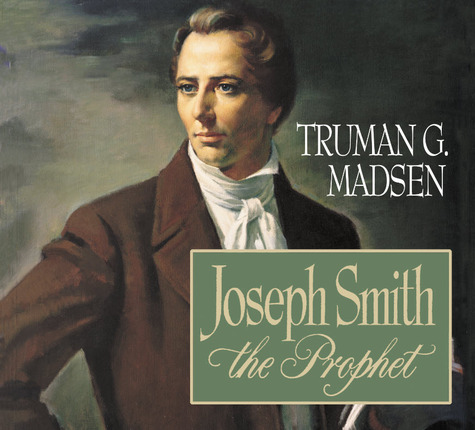
I’m slightly cheating here. At the very beginning of my mission, my trainer (i.e. first missionary companion) owned Madsen’s 1978 audio lectures titled Joseph Smith the Prophet. I didn’t come into contact with the book version until I was well off my mission. But given the fact that the book is basically a word-for-word reprint of the lectures, I included it. I cannot stress enough the impact of these lectures. We listened to them in the car during our travels (when we had a car). I would lay awake late at night listening to them with my headphones. I included them as part of my personal morning studies. This was the first time that Joseph Smith, the founder of my religion, became real to me. While still a positive, faith-promoting rendition, it was the first time he was fleshed out as a living human being. More than that, it was the first time that I can remember any historical figure being fleshed out in my mind. Up to that point, history was an abstraction to me. But these lectures made me want to dive into the details and nuances of history (and eventually everything else). While scholarship over the last few decades has surpassed this, it was still monumental for me. In essence, this was the beginning of my intellectual journey.
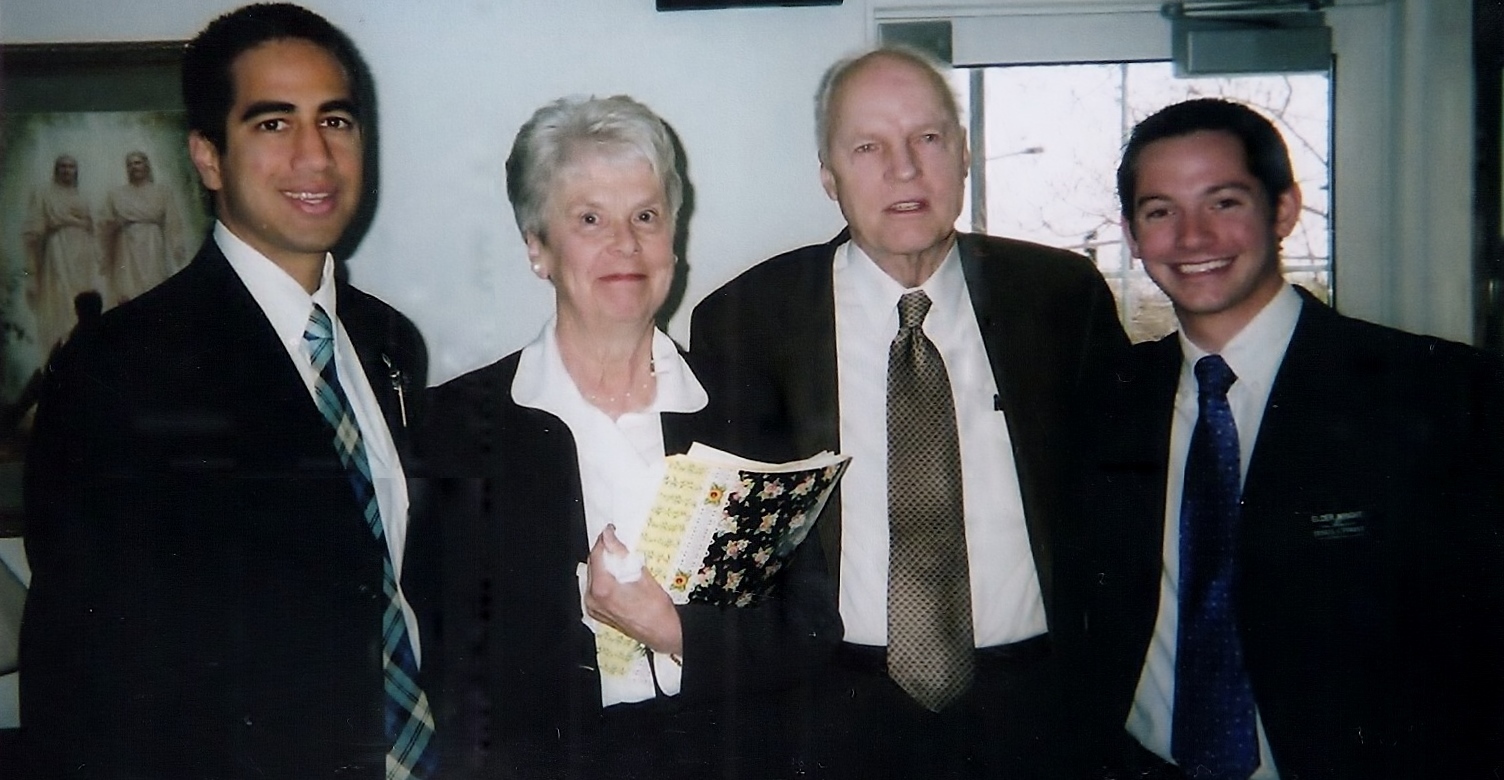
I was lucky enough to meet Truman and Ann Madsen at a women’s conference in Las Vegas on my mission. We four missionaries (me, my companion, and another missionary companionship) were virtually the only males in attendance. I was saddened when Truman passed away a couple years later. It made me all the more grateful that I had been able to thank him personally for the impact his work had on me.
Left to right: Elder Velasco, Ann Madsen, Truman Madsen, Me (2007)
I wouldn’t recommend this book to anyone frankly. It is mildly interesting, but ultimately unsatisfying when it comes to the religion vs. science debate.[ref]It might be worth noting that atheist philosopher Antony Flew was impressed by Schroeder’s arguments, which helped move him to embrace a form of deism late in life.[/ref] However, it was Schroeder that made me actually look at the debate. My interest in science and the history of science can be traced back to this book. Furthermore, it is the reason I became quite comfortable with biological evolution. Prior to my mission, I hadn’t given evolution a thought. I gave it superficial attention on my mission, drawing largely from outdated, anti-evolution quotes (still) found in the Church’s institute manuals.[ref]I remember being called a “hybrid Mormon” one time because I answered the evolution question with, “I don’t personally believe it, but if that’s how God did it, I’m fine with that.” This was my answer for some time.[/ref] But it was Schroeder’s book, which I picked up at a Barnes & Nobles (?) one P-Day,[ref]Mormon missionary lingo for “preparation day,” which was basically our day off. We were supposed to “prepare” for the rest of the week by doing our grocery shopping and the like. Most of us took it to mean “Play Day” and that’s what we did.[/ref] that made me think differently. Despite being critical of the theory (he is one of the contrarian scientists in Ben Stein’s documentary Expelled: No Intelligence Allowed), he provided a new paradigm by drawing on ancient Jewish scholars such as Rashi, Maimonides, and Nahmanides. This helped me think about my own faith’s approach to science and I found myself defending evolution against fellow missionaries by the end of it all.
In elementary school, I was part of a “gifted and talented” program called EXPO (EXceptional POtential). One of its perks was that I was allowed to attend an EXPO course during regular class time. Most the time, EXPO was much more fun than your everyday class. However, when I arrived in middle school, I found that EXPO was during my English class. English had been my favorite subject for years, which is why I quit going to EXPO after one class because I didn’t want to miss it. This love of English stayed with me up to my World Literature course in my early years of college. I had recently returned from my mission, during which I had been trying to understand the history, language, and culture of the scriptures as well as Christian history generally. This anthology was required for the course and it immersed me in multiple voices from a variety of times and cultures. It included works by Yeats, Proust, Lu Xun, Joyce, Woolf, Kafka, and more. It reminded me that there is so much to learn and that my studies should not only be cross-cultural, but interdisciplinary. In short, reading this anthology was my first big taste of one of the grand fundamental principles of Mormonism: “…receive truth, let it come from whence it may.”[ref]Unfortunately, my fiction reading basically died that same year. I was largely non-fiction until recently.[/ref]
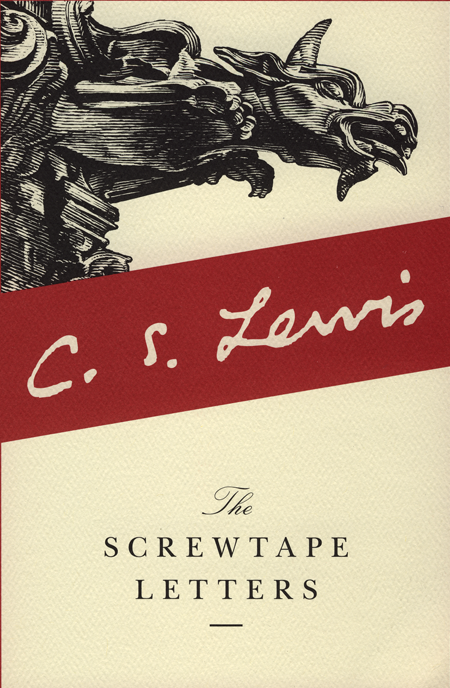
I had never read any C.S. Lewis prior to my mission. A ward member bought Elder Anderson and I copies of The Chronicles of Narnia for Christmas one year, but I never read any of Lewis’ philosophical/apologetic writings until my first year of marriage. I still remember quite clearly lying in bed in our first apartment reading the first chapter (letter) of The Screwtape Letters and being struck by the following (from the demon Screwtape to his nephew Wormwood): “Your business is to fix his attention on the stream [of immediate sense experiences]. Teach him to call it ‘real life’ and don’t let him ask what he means by ‘real’.” I also remember asking myself afterwards what exactly I meant by ‘real’.[ref]This portion comes from a post at The Slow Hunch.[/ref] It could be said that Lewis’ book was my first introduction to the importance of metaphysics. This led to later works on metaphysics, from Blake Ostler to David Paulsen to Edward Feser to David B. Hart to Stephen Webb. My current outlook is similar to Rosalynde Welch’s “disenchanted Mormonism,” but I imagine it will continue to change as metaphysics play an increasingly important role in my theological framework and overall worldview.
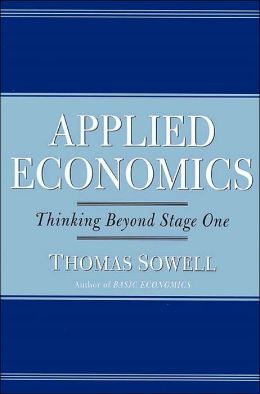
I became a Sowell admirer by reading his weekly columns when I was first becoming interested in politics, but it was this book that made me fall in love economics. I ended up reading his other works soon after, including Black Rednecks and White Liberals, Intellectuals and Society, A Conflict of Visions, Economic Facts and Fallacies, etc. All of these had their own influence, but it was Applied Economics that started it all. What made this different from, say, his Basic Economics was that it looked at economic effects in the real world and explored the unintended consequences of particular choices and policies. It showed what he calls the “constrained” or “tragic vision”[ref]This is explored in his A Conflict of Visions: Ideological Origins of Political Struggles.[/ref] (i.e. there are no solutions, only trade-offs) in action. It aided in my understanding of economics as not merely models and math, but behaviors, emotions, relationships, and everyday choices.
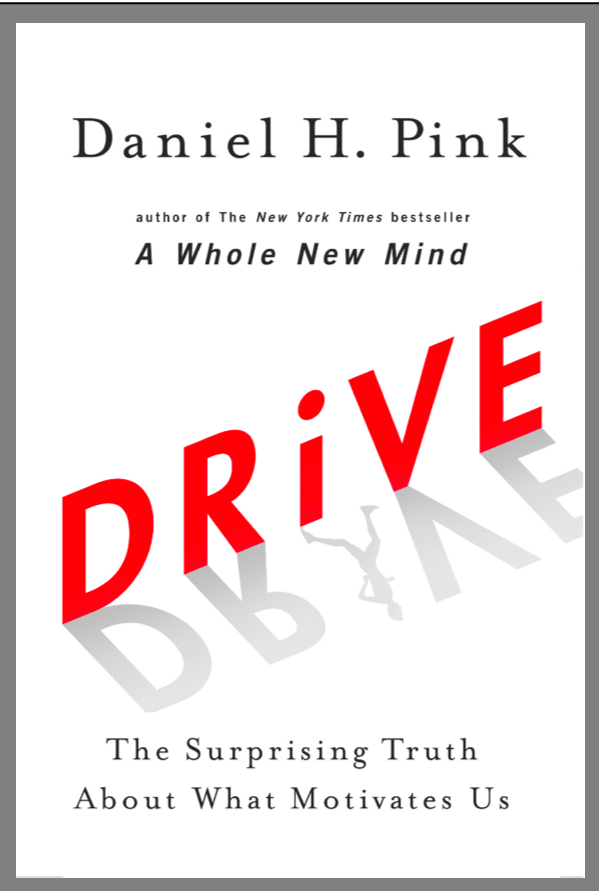
I was originally an accounting major as an undergrad. However, I both hated accounting and sucked at it. Realizing I was too far into my business degree to consider a complete change, I ended up choosing Organizational Behavior and Human Resource Management (mainly because it sounded better than Business – General Studies). I didn’t have much interest in management or business outside of the practicality of a business degree until I had to do a group project on organizational culture in my HR course. In my research, I came across Dan Pink’s TED talk on human motivation. The focus on autonomy, mastery, and purpose in the workplace made me look at businesses in a different light; as organizations or communities of people rather than abstract entities. Organizational theory and management literature became a way of assessing the human condition. Business can be a practice pregnant with meaning, joy, and moral significance. The reason it often isn’t is because, as Pink puts it, there is “a mismatch between what science knows and what business does.” A desire to understand and possibly help repair this chasm was a major factor in my decision to pursue an MBA.
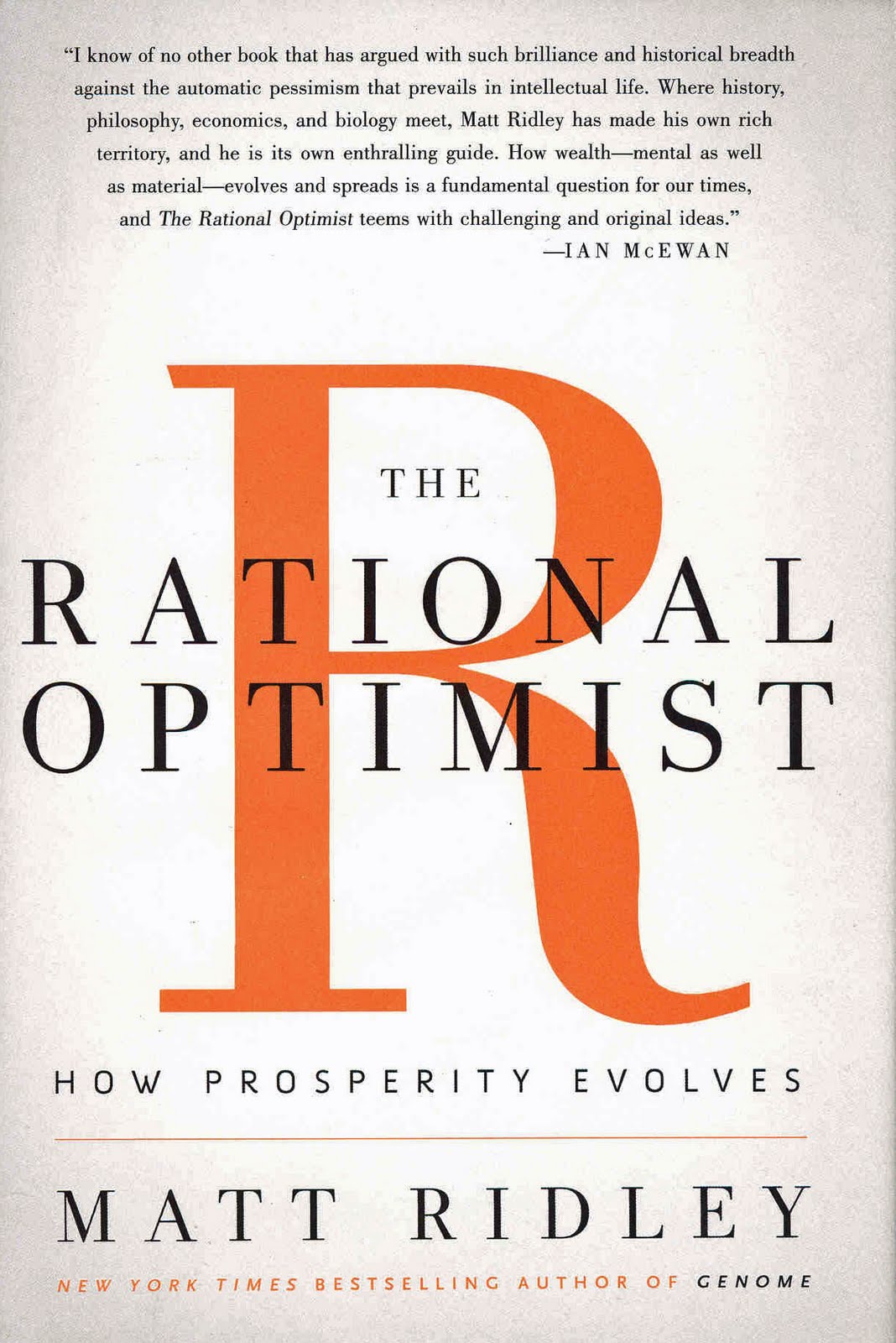
In his many lectures and interviews,[ref]These influenced me far more than, say, Capitalism and Freedom, mainly because I’d watched many of them before I ever read any of his books.[/ref] famed economist Milton Friedman often encouraged his audience to have a sense of proportion. It is easy to look at anecdotal evidence or snapshot data and draw conclusions about the world. Ridley’s book provides the evidence for Friedman’s “sense of proportion.” He documents how prosperity emerged and evolved over hundreds of thousands of years via specialization and exchange. This helped me look at major problems like poverty from both a global and historical perspective. More important, it helped me take typically leftist crusades like “social justice” seriously and thus led to my embrace of a kind of bleeding-heart libertarianism. By tracing the rise of living standards over the centuries, I came to see how important trade and innovation are to the improvement of human well-being. It also left me just a tad more optimistic about the future.
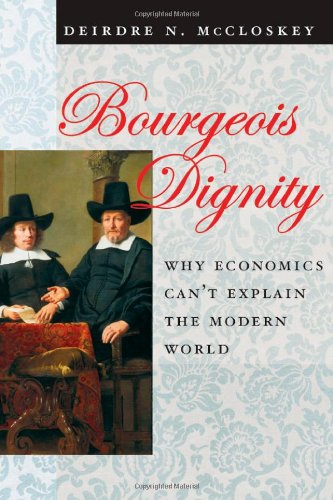
On a panel at Beyond Belief 2006, astrophysicist and popular science educator Neil Degrasse Tyson made an insightful comment while (kindly) rebuking the (in)famous Richard Dawkins for his rhetorical methods: “Being an educator is not only getting the truth right, but there has to be an act of persuasion in there as well. Persuasion isn’t always “here’s the facts, you’re either an idiot or you’re not.” It’s “here are the facts and here is a sensitivity to your state of mind.” And the facts plus sensitivity, when convolved together, creates impact.” Rhetoric today has a rather negative connotation, one associated with cheap emotionalism or a lack of substance. However, McCloskey’s book argues that it was rhetoric–the act of persuasion or, more to the point, the power of words–that caused and sustained the Industrial Revolution. The bourgeoisie (i.e. the professional and educated class) were praised and seen as dignified and free. This shift in opinion changed the social and political spectrums. Far more than an excellent work in economic history, this book demonstrated to me how words and ideas, along with the way they are articulated, ultimately have the ability to transform societies. Rhetoric can inspire brand new thoughts or even recast old ones in a new light. This in turn has inspired me to be careful and selective in my choice of words and phrasing when expressing my ideas.
Here are a few honorable mentions with very brief explanations as to why:
Ingri D’Aulaire, Edgar Parin D’Aulaire, D’Aulaires’ Book of Greek Myths (1962): I read this book over and over in elementary school. Where my love of Greek and Roman mythology came from.
Ian Fleming, Casino Royale (1953): I’m a huge Bond fan and this is still my favorite Bond novel.
Peter Drucker, The Essential Drucker (2001): Hayek is my philosopher economist, Drucker is my philosopher manager.
Jim Butcher, Storm Front (2000): I’m going out on a limb with this one, but this may have major future repercussions. It it is the first in The Dresden Files (I need to begin #13: GhostStories) and it was recommended and given to me as a birthday gift by Nathaniel.I hadn’t read a fiction book in years prior to it. I think it very well may be beginning of my love affair with fiction. We’ll see once I finish the entire series.
I kind of wish my list was a little different, but it is what it is. This will surely change in the future. I probably missed some too. But this is what I can come up with as of now. Hope you enjoy.
There’s an absolutely fascinating article on crowd psychology in aeon that I’ve been meaning to share for several weeks now. The article questions and rejects the conventional wisdom on crowds, which focuses on violent mobs and on the idea that, once they had joined, individuals had “surrendered their self-awareness and rationality to the mentality of the crowd.” In contrast to a kind of brute mob mentality, modern research supports the conception of crowds in which “crowds behave not with mindlessness or madness, but by co-operating with those around them. They do not lose their heads but instead act with full rational intent.”
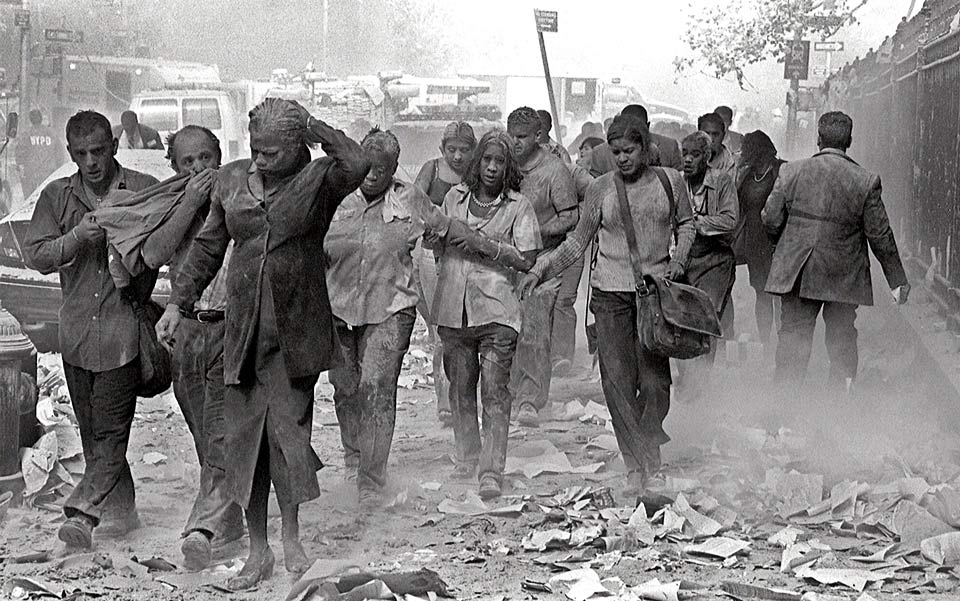
That approach might sound counterintuitive, but that makes sense because in reality crowds don’t actually behave the way they are supposed to in popular imagination. And so, “the model also explains why crowds in emergency situations are disinclined to panic, putting them at higher risk.” The article cites many people who milled around in the Two Towers 13 years ago instead of immediately fleeing, which is something they might have been much more prone to do if they’d been alone, and also cites several other disturbing historical accounts such as “the aircraft fire at Manchester airport in the UK on 22 August 1985, when 55 people died because they stayed in their seats amid the flames.”
This isn’t the first I’ve read of this research. Jonathan Haidt, the social psychologist who invented moral foundations theory, has done a lot of work on crowds and his theories are closely related to the idea of a “superorganism“. A superorganism is “an organism consisting of many organisms,” and the textbook example is a beehive. A beehive is not just a collection of bees. It can be thought of as a creature in its own right that happens to be made up of bees in the same kind of way (although not exactly, obviously) that we human beings are made up of many cells. The human capacity for “groupish behavior,” which is to say behavior that doesn’t make sense from a strictly individualistic standpoint, is a major differentiator and perhaps the essential differentiator between humans and all other primates. This gets into group-level selection, which is something that Darwin believed in but which has only been rigorously outlined and defended very recently. Group-level adaptation is the idea that not just individuals are evolving as they compete for resources, but groups of individuals, too. Like beehives. Human capacity to function as individuals or, when circumstances are right, to lose themselves in part of a larger collective are the reason Haidt describes us as “90% chimp, 10% honeybee.”
Keep that in mind when you read this next sentence about crowd behavior:
Contrary to popular belief that crowds always panic in emergencies, large groups mill around longer than small groups since it takes them more time to come up with a plan.
In a real sense, it’s not that the individuals within the group take longer to come up with a plan. it’s that the group itself takes longer to come up with a plan when it’s a bigger group.
There isn’t just one pithy practical or political implication of this research. It’s the kind of fundamental change in how we look at the world that can end up taking you in any one of thousands of different directions. To me, it’s just another part of the major advances in understanding human nature that are becoming possible now that we’re developing some rudimentary tools for analyzing complex systems.
A lot of the writing that has come out since Ferguson has focused on the disconnect between anger in black communities and apparent indifference in white communities. A lot of these articles have been unhelpful. They start with the premise that Michael Brown’s shooting was obviously illegal and immoral when the reality is that we don’t know. There are reasonable grounds to suspect the shooting was justified. From that erroneous premise, these pieces quickly conclude that the only reason for white people to remain silent on the issue is cowardice, racism, or both. This is unfair, often self-righteous[ref]Especially when the writers are white and don’t demonstrate any deeper awareness of the problem.[/ref], and never helpful.
The problem, I think, is that the shooting of Michael Brown was just a spark that ignited a powder keg. As a symbol, it’s potent, but in terms of understanding the real problem it’s a distraction. Not only because the events are unclear, but also because it puts focus on police-community relations, which are a small part of the real problem: the larger relationship between municipal governments and poor communities. The best article I’ve read on that is the Washington Posts’s How municipalities in St. Louis County, Mo., profit from poverty. The story is relatively simple: fairly innocent violations that would be a speed bump to someone in the middle class are much more disrupting to people who don’t have the same kinds of safety nets and flexibility. These folks are easily trapped in a cycle of violations that are too expensive (literally, in terms of dollars) for them to escape. Meanwhile, the local governments profit from the unending cycle of fines and fees: “Some of the towns in St. Louis County can derive 40 percent or more of their annual revenue from the petty fines and fees collected by their municipal courts.” Read the article, however, to truly understand the scale and perversity of the parasitical relationship between local governments and the populations they are supposed to serve.
It’s a serious problem and a serious injustice that underscores another criticism that I’ve seen liberals make of social conservatives. For all that social conservatives are worried about federal overreach, it’s historically federal or state governments that have stepped in to stop injustice perpetrated by state and local governments. Fear of federal tyranny seems utterly inexplicable in communities that have a history of seeing federal law defend them from local tyranny. Perversely, it doesn’t help that conservatives do see an issue to be angry about in Freguson: the violent initial overreaction of local police to peaceful protests. Militarization of local police is a serious concern, and the fact that conservatives see something legitimate to be upset about can make them all the more mystified when that concern is not acknowledged or shared by liberals.[ref]This isn’t to say that liberals ignore police militarization, but they certainly don’t seem to see it as fundamental to the Ferguson story./[ref]
It’s an old story, really. Both sides have points, but they fail to apprehend each other’s respective points of view. It is deeply unfortunate that sensational, random, tragic stories–like what happened to Michael Brown–seem to be the only thing that gets people talking. It’s not really a conversation when both sides are talking past each other.
I don’t like writing about porn any more than I like writing about sex, but I think it’s important. Earlier this week I posted an article about how one man stopped watching porn because he felt it was warping his ability to express warm, respectful, and compassionate sexuality. This link is to the flip-side of that, a study in England that demonstrates how boys who don’t moderate or (better still) abstain from pornographic content end up coercing their girlfriends into sex. Where does one draw the line between convincing a partner to do something, pressuring a partner to do something, and outright rape? No matter where that line is, it seems clear at least some of these young men have crossed it.
Researchers interviewed 130 men and women aged 16–18 from diverse social backgrounds in three different locations in England. The report, published last month, states that young people “frequently cited pornography as the ‘explanation’ for [engaging in] anal sex,” although masculine competition between boys to see who could engage in the activity the most often also played a role.
They found a “key element” in this risky new behavior is the “normalization of coercion and ‘accidental’ penetration. It seemed that men were expected to persuade or coerce reluctant partners.”
“Some events, particularly the ‘accidental’ penetration reported by some interviewees, were ambiguous in terms of whether or not they would be classed as rape (i.e., non-consensual penetration), but we know from [one] interview that ‘accidents’ may happen on purpose,” wrote Dr. Cicely Marston and Ruth Lewis of the London School of Hygiene and Tropical Medicine in a report published in BMJ Open.
Historically, social conservatives have a reputation for crying wolf about dangers to children. The usual examples are the Dungeons and Dragons scare in the early 1980s and, more recently, the connection between violent video games and real-world violence.[ref]Obviously there is a connection between violent behavior and violent video games since one would expect people who are violent to enjoy violent entertainment. It’s much, much less clear that violent video games cause violent behavior in any serious or lasting way.[/ref] This history of hysteria is going to make it easy for articles and studies like this to be dismissed as “social conservatives say Playboy turns normal kids into rapists.” That’s the exaggerated version. The actual point is that pornography–especially hardcore pornography that is easy to find online–correlate with violence towards women and that we have good reason to suspect some of that relationship is causal. This doesn’t mean a nice, caring man will turn into a serial rapist after watching 30 minutes of porn one day, but it does mean that–aggregated across society–porn is very likely having an impact in fueling a very real culture of rape that treats women as objects to be exploited for pleasure and prestige.
I’ve been very influenced by Jonathan Haidt’s work on moral foundations theory which, in a nutshell, postulates that there are 6 components to intuitive moral reasoning, and that conservatives tend to apply them all but liberals only use a narrow set. The foundations are:
Care/harm for others, protecting them from harm.
Fairness/cheating, Justice, treating others in proportion to their actions (He has also referred to this dimension as Proportionality.)
Liberty/oppression, characterizes judgments in terms of whether subjects are tyrannized.
Loyalty/betrayal to your group, family, nation. (He has also referred to this dimension as Ingroup.)
Authority/subversion for tradition and legitimate authority. (He has also connected this foundation to a notion of Respect.)
Sanctity/degradation, avoiding disgusting things, foods, actions. (He has also referred to this as Purity.)
According to Haidt, liberals consider chiefly care/harm and liberty/oppression, leaving the rest (including authority/subversion) to conservatives. But is that really true? Are liberals so anti-authoritarian? Or do they just have different authorities in mind? Megan McArdle has her doubts:
In the ultra-liberal enclave I grew up in, the liberals were at least as fiercely tribal as any small-town Republican, though to be sure, the targets were different. Many of them knew no more about the nuts and bolts of evolution and other hot-button issues than your average creationist; they believed it on authority. And when it threatened to conflict with some sacred value, such as their beliefs about gender differences, many found evolutionary principles as easy to ignore as those creationists did. It is clearly true that liberals profess a moral code that excludes concerns about loyalty, honor, purity and obedience — but over the millennia, man has professed many ideals that are mostly honored in the breach.
Past psychology studies had found that conservatives have the more favorable attitudes toward statements such as, “If I were a soldier and disagreed with my commanding officer’s orders, I would obey anyway because that is my duty.” Did conservatives have a good feeling about this statement because they think that people ought to obey (in general), or because they support the military and its agenda? I suspected it was the latter.
Subsequent studies bore Frimer’s (and McArdle’s) suspicions out. If you ask about liberal authorities (e.g. “an environmentalist”) then suddenly you get anti-authoritarian conservatives and authoritarian liberals, leading Frimer to conclude: “Rather than thinking of liberals and conservatives as being fundamentally different psychological breeds, I now think of them as competing teams.” Frimer goes on to speculate that the reason we associate conservatives with authoritarianism is that, over time, authorities become conservative. But I think that depends on conflating two separate notions of conservatism: the literal one (e.g. those that maintain traditions) and the more common one (the right-wing of American politics, which is a blend of traditionalism and classical liberal philosophy). Authorities probably become traditionalist over time for obvious reasons. Once you control the institution, you have a vested interest in the institution. But there’s no reason why the institution should correspond to classical liberal philosophy vs any other philosophy other than historical accident.
For me there’s one more big question: where does this leave Haidt’s moral foundations theory? I think it’s plausible that Haidt is right about the 6 dimensions, but wrong about the divide between liberals and conservatives. It might not be that liberals don’t care about authority or sanctity. It might simply be that they don’t recognize their own innate moral drivers because, in American politics, the authority and sanctity considerations of the left are covert. We think of the military and police as authorities. We don’t think of academic as authorities, but they are. We think of purity as a religious concept, but it’s no different in function from the kind of purity that drives orthorexia (aka “Whole Foods syndrome”).
I would further speculate–just speculation at this point–that being cognizant of moral drivers allows them to be better moderated. Conservatives are self-conscious about their respect for authority, which permits critique of that authoritarianism. Liberals, however, are in denial of their authoritarian tendencies and so they are basically unchecked, which is dangerous.
I’m glad that the article tries to present a forgotten side of Jewish-Muslim relations and the positive role of Muslims in Western society, but after reading it I have some concerns.
First, Wolfe somewhat blurs the distinction between rescuing Jews and being involved in the Allied war effort.
Noor Inayat Khan was certainly remarkable, and deserves her own article. Her fiancé had been Jewish, and the Nazi treatment of Jews was one of the factors leading to her involvement in the war effort. She found Nazism “fundamentally repulsive and opposed to all the principles of religious harmony that she had been brought up with by her father.” Her father, Hazrat Inayat Khan, was fond of an old Sufi proverb, “Be the follower of love, and forget all distinctions.” This is a beautiful example of how religious spirituality (in this case, Muslim), however, Noor Inayat Khan was not directly involved in the rescue of Jews, and her motivation was universalist.
It is unlikely that the majority of Senegalese Tirailleurs- conscripts- were motivated by a desire to assist Jews, let alone sacrifice themselves for that cause. There was growing resentment of France for the distinctive uniforms they wore (“slave’s clothing”), and for the insensitive treatment by their officers, so when they helped liberate French towns and discovered that not everyone was fighting in the resistance, they were understandably outraged. This is not to denigrate the Senegalese in any way. They fought bravely, loyally, and often suffered more than other troops. All it means is that they were human, and did not necessarily respond enthusiastically to sacrificing themselves for what they considered a stranger’s cause.
Second, Wolfe presents an entirely rosy view of Muslim efforts to rescue Jews.
The Iranian diplomat Abdol-Hossein Sardari comes across as genuinely good, a dedicated servant of his country. However, the claim that he issued Iranian passports to 500 French Jews is unsubstantiated, appearing only in a statement made by his nephew many years after Sardari’s death. Sardari himself never mentioned it. The actual story involves the Jugutis- a community of crypto-Jews whose ancestors had been forcibly converted to Islam in Meshed in 1839. They lived outwardly as Muslims whilst secretly adhering to Judaism. Several of them resided in France, alongside Jews from Central Asia, Afghanistan, and Iran. One of their leaders, Dr. Atchildi, came up with a plan to save his community by claiming that Jugutis were religiously Jewish, but ethnically Aryan. Sardari helped him achieve legal recognition exempting Jugutis from anti-Jewish laws, and then requested that he place Iranian Jews on the list of Jugutis as well. Sardari’s chief concern was to help his compatriots, which is not a bad thing at all.[ref]Sardari has often been labelled the Iranian Schindler. I don’t concur, but I personally see Sardari more positively than I do the often unsavoury and opportunistic Schindler.[/ref]
The other diplomatic examples in the article pale in comparison. Corry Guttstadt extensively researched Turkey’s role in the Holocaust, and her findings exploded the myth of Turkish rescue. Some consuls, it is true, did save Jews, but the documented cases do not reach thousands of people saved, and the motivations were rarely very noble (though on this score many diplomats of other nations also fare rather poorly). Rescue was often the result only of sexual and monetary exchanges. Lives were saved, which is a good thing, but it hardly does credit to those diplomats who primarily benefited themselves. The Neçdet Kent story of the train seems very moving and inspiring, but is pure fabrication. Kent is the only source of the story, no survivor testimony corroborates it, and it is contradicted by material evidence.
Wolfe’s other Turkish example is even uglier. Not only did Behiç Erkin not issue Turkish passports to thousands of Jews with only distant connections to Turkey, he actually stopped the one individual on his staff- a French national- who did. Beginning in 1942, the Nazis had Jewish nationals of neutral countries deported. The passage to Turkey was neither funded nor organized by Turkey. Individuals either had to pay from their own pocket, or receive funding from a Jewish relief organization. Turkey, in fact, was not only slow to save its Jewish citizens, it even rescinded the citizenship of many Turkish Jews, leaving them stranded and vulnerable.
Ahmed Somia apparently was a dedicated resistance fighter, and the hospital did rescue many parachutists and members of the resistance, although everything that I have read accords Abdelhaffid Haffa- the hospital’s guardian- with a far bigger role than Somia. Haffa led the resistance activity, working secretly with a Jewish doctor. Si Kaddour Benghabrit, a religious leader of Paris’ Algerians and rector of the Grand Mosque, played a far more ambiguous role. Benghabrit saved some Jews, washed his hands of others (even as late as 1944), and generally pursued a range of actions from collaboration to resistance. In Benghabrit’s defense, we tend to approach WWII and the Holocaust with considerable hindsight. Things were usually not as clear to participants. [ref]Avraham “Yair” Stern, leader of a militant Jewish underground in Palestine, even proposed an alliance with Hitler. He thought that although Hitler was persecuting and murdering Jews, the real existential threat came from Britain.[/ref] Benghabrit pursued what he considered the best course for preserving his community. This did not always involve rescuing Jews.
By all means, Muslim assistance to Jews in the Holocaust should be highlighted, but romanticized myth-making does not build better bridges, and might make reconciliation and cooperation even harder.
“Generally, the myths historians interrogate are those that reinforce, rather than contradict, univocal narratives of conflict. In such cases, while the more complex truth may be painful, it can offer recognition to both sides, providing a more blended version of a disputed history and paving the way for possible reconciliation. By contrast, in the case of the Grand Mosque, the more mythical story does not seem to reinforce entrenched hatreds but rather to offer promise for reconciliation. Yet in so doing, it obscures a more complicated historical reality, and… reinforces a wider series of problematic perceptions that mar Jewish-Muslim understanding.”
In other words, we cannot have a meaningful discussion about Jewish-Muslim relations, or Muslims and the Holocaust, or the modern role of Muslims in Western society if we stick to myths. Even if the myth is positive, it obscures the real history and the real problems.
Of course, I also think that history matters, whether or not it leads to meaningful dialogue.
Still, I would like to end with a very positive example from Wolfe’s list. Albanian Muslims (and Catholics, too) were dedicated in saving Jews to an extent rarely found elsewhere. They were moved not only by besa– their code of honour- but also in many cases were influenced by the teachings of the Bektashi Sufi order.