According to the Independent, some prominent clerics based in the UK have jointly issued a fatwa condemning ISIS and specifically condemning British men who run off to join the militant group. On the one hand, this isn’t really big news. Al Qaeda has called ISIS extreme, after all. Still, it’s encouraging to see a prominent example of Islamic religious authority being used to counter Islamic terrorism.
The Brookings Institution has a brand new study on those living on $2 a day in the U.S. One of the most interesting findings is how the estimates depend on the data source. These estimates range from 4% (12 million) to zero:
In response to questions about their study, the authors explain the range of estimates:
First, a significant portion of $2 poverty appears to be temporary, as evidenced by the lower poverty rates recorded when we extend the duration over which individuals’ welfare is assessed. Such spells may be accounted for by life events such as moving between jobs that are not necessarily indications of diminished welfare. Second, social protection programs play a critical role in the welfare of many of America’s poorest households. Programs such as food stamps (SNAP) and the Earned Income Tax Credit mean the difference between living above the $2 threshold or below it for millions of people according to some estimates. Third, a significant share of consumption for the $2 poor likely occurs out of resources that don’t count as income: savings and assets, borrowing, and in-kind government assistance. Poverty estimates based on income (money earned) and consumption (money spent) differ widely. This discrepancy is in keeping with the higher variability of income from month to month.
Furthermore, the authors explain, “If we used the exact same criteria to measure poverty in the U.S. as is used by the World Bank to obtain official poverty estimates for the developing world, we would conclude that no-one in the U.S. falls under the $2 threshold. Part of the reason for this is that even the poorest people surveyed in America appear to find a way to meet their most basic material needs (valued above $2 a day) even if their reported income is zero or close to zero. Furthermore, the poor in America have access to public goods—public education, criminal justice and infrastructure—that would be the envy of the poor in the developing world.”
Finally, the authors point out that “the methodology by which the World Bank compiles official global poverty estimates has recently changed. Whereas in the past the estimate was in practice just a measure of poverty in the developing world, the new method incorporates the populations of rich countries. For now, the entire population of these countries is assumed to not be poor.”
Understanding data sources is important. Consumption is likely a more accurate way to assess the poor’s material well-being, as I think is demonstrated in the range of estimates above. On top of this, one must take into consideration the intangible assets of one’s country. These assets, according to the World Bank, refer to the nation’s human and social capital (i.e. worker skills and trust) and the quality of its formal and informal institutions (e.g. efficient judicial system, property rights). These make up most of a nation’s total wealth.[ref]The magazine Reason has a nice write-up on intangible assets.[/ref] In 2005 (the latest data from the World Bank), the U.S. had $734,195 total wealth per capita, with $627,246 (over 85%) of that wealth being intangible.
One of those studies that should both remind those in developed countries how lucky they are and how much work there is still left to do.
Myth: Rape is caused by lust or uncontrollable sexual urges and the need for sexual gratification.
Fact: Rape is an act of physical violence and domination that is not motivated by sexual gratification. (Counseling Center at Roger Williams University)
The idea that rape is about power, and not about sex, is one of those facts that everyone knows. Sort of like everyone knows that humans only use 10% of their brain capacity. In other words: it’s totally and completely wrong but people keep saying it anyway.
The urban legend about folks using only 10% of their brain may be annoying[ref]And it might lead to Scarlett Johansen starring in a really bad movie.[/ref], but as a general rule it doesn’t get anyone hurt. Misdiagnosing the cause of rape can lead to bad policies, confusion, and more rape, however. It’s not just an annoyance. It’s serious and worth getting right. Unfortunately, as is so often the case, politics gets in the way.
The original source of the idea that sexual assault is about violence and power instead of sex or lust doesn’t come from a scientist or an academic study.[ref]UPDATE: I am arguing against the common argument that rape is only about power. I am not arguing that it is only about sex. Rape is a coercive act, so by definition it is about power. It is not only about power, however, and role of sex/lust is important to understanding rape.[/ref] It comes from a feminist writer named Susan Brownmiller who invented the theory pretty much from scratch for her 1975 book Against Our Will: Men, Women, and Rape.
According to Brownmiller, rape is “a conscious process of intimidation by which all men keep all women in a state of fear.” There is some validity to the idea that the consequence of widespread rape and sexual assault is a ubiquitous power imbalance between men and women in society, and that in that sense even men who never sexually assault women might be said to benefit from rape, but the contention that men consciously engage in rape for the purpose of control (to the exclusion of sexual gratification) never made much sense at all.
In a sane world, Brownmiller’s theory would have been very short lived. This is because an actual scientist stepped in with a direct rebuttal just four years later, in 1979. The book was called The Evolution of Human Sexuality and it was written by the anthropologist Donald Symons. It is no coincidence that Symons wrote from a scientific rather than a political perspective, and his book was widely heralded by some of the greatest social scientists of the 20th century, including Richard Posner, Paul R. Ehrlich, and Steven Pinker.[ref]I do not mean to denigrate theoretical work as a category. Theory matters, but only to the extent that it makes use of available data, which the theory from Against Our Will does not.[/ref]Symons’ thesis was very simple and aligned with common sense: he saw rape as being primarily about the satisfaction of sexual lust.[ref]That contradicts the second half of the opening quote. The first half—that it is uncontrollable—really is bunk.[/ref] In particular, he used evidence to document that:
Victims, as a class, were most likely to be young physically attractive women (as opposed to older, more successful career women). On the other hand, convicted rapists were disproportionately young disadvantaged men whose low social status made them undesirable as dating partners, or husbands. (Summary from Psychology Today)
The nature of sex and sexual violence in society has changed significantly since the 1970s, but continuing research cements Symons’ central claim that rape is a way for men to get access to sex that they can’t get in other ways.
For example, I recently came across another stark confirmation of this in the paper Decriminalizing Indoor Prostitution: Implications for Sexual Violence and Public Health. In it, researchers Scott Cunningham and Manisha Shah found a simple and direct correlation between legalized prostitution and rape in Rhode Island. The state unintentionally legalized prostitution in 2003 an then recriminalized it in 2009.[ref]The fact that the legalization was accidental is actually quite important because it creates a natural experiment.[/ref] After prostitution was legalized, the sex market increased in size and rape (overall, across the entire state) declined by 31%. When prostitution was criminalized again in 2009, the incidence of rape went back up. As Jason Kerwin summarizes:
Cunningham and Shah are very careful to say that they cannot conclude exactly why decriminalizing prostitution reduces cases of rape. They consider a number of potential mechanisms, and conclude that the most likely one is that, for some men, rape and prostitution are substitutes. That is, men commit rape in part due to sexual desire, which can be satisfied in other ways.
Kerwin goes on to point out that:
While Cunningham and Shah’s paper cannot demonstrate this for sure, their finding is consistent with other research by Todd Kendall that finds that the rollout of the internet, and the attendant increase in the accessibility or pornography, appears to have driven a decrease in cases of rape.
I’m well aware of the difference between causation and correlation, but taken together the research of Symons, Cunningham & Shah, and Kendall paint a stark picture in which men—driven by a more powerful sex drive—see rape as one among a series of competing sources of sexual gratification, the others being consensual sex, pornography, and prostitution.
Women have always born more of the risks and costs of sexual activity because it is women who get pregnant. In the 1960s and 1970s, this created incentives for women to wait until marriage to have sex or, more realistically, to at least keep sex within the confines of social courtship rituals. Men with high social capital, because they made good potential mates, therefore had reasonably high access to sex both through marriage and through the courtship that led to marriage. Men with low social capital who had much worse prospects in courtship committed the majority of rapes for that reason: they had less access to sex through courtship and marriage.
Since that time, society has changed dramatically, and the costs of sex—in terms of risks of unwanted children or sexually transmitted infections—have gone down dramatically. However, this has primarily benefitted men rather than women. This is because the prevalence of elective abortion has changed societal attitudes about pregnancy to make it basically a woman’s problem. Since a woman can get an abortion, if she does not society is more likely to see it as her choice alone. This diminishes the social responsibility men feel towards their own offspring and means that women are guaranteed to bear the costs of unplanned pregnancy—whether it’s the aftermath of an abortion or single parenthood—alone. So the costs of sex outside of marriage or courtship rituals have gone down, but the inequality between men and women has actually increased.
For men with low social capital this means that the need to rely on rape may be somewhat diminished because casual sex might be more accessible to them then expensive courtship rituals. The old idea that a man had to have a stable job and be ready to provide for a family before marrying and having sex is dead. It’s possible that men with low social capital are still seen as less desirable mates, but even in that case the ready availability of cheap and abundant porn is a safer outlet (from their perspective) than violent rape.
Men with high social capital have the same considerations, but more so. The kind of man with high social capital is likely to be the kind of man who goes to college. Not only does this create a ready abundance of opportunities for casual sex and porn consumption, but the hookup culture also creates the perfect opportunity for date rape. Date rape is much, much lower risk (for men) than violent rape because there is often no physical evidence and so it becomes a matter of he-said, she-said that our justice system cannot hope to successfully prosecute as a general rule.
Because the political theory that rape is a systematic form of oppression completely misapprehends the actual motivating factors behind rape, it cannot offer reliable policy guidance to address rape. It persists only because the alternative, seeing rape as a about sexual gratification, requires a politically unpalatable recognition of fundamental differences between the sexes.[ref]Primarily the controversial but obvious twin assertions that men are more motivated by sex and that women pay a higher cost for sex.[/ref] Denial of these unpalatable realities blinds us to the reality that sexual liberalization is virtually always beneficial for men at the expense of women and children.
Another big blind spot that comes from the theory of rape-as-power is the tendency to underestimate the connection between rape, pornography (which often includes depictions of violence, and so is basically simulated rape) and prostitution (which often involves sex slavery and coercion of minors[ref]UPDATE: The original link here was wrong. The new link goes to a study from Shared Hope International that identifies demand for pornography as a major factor in domestic (US) trafficking of minors. This is just one example of the connection between prostitution, porn, and sexual violence.[/ref], and so is basically outsourced rape). Consequently, the idea that prostitution and pornography can ease sexual violence in society has merit only to the extent that we recognize we’re regulating sexual violence as opposed to avoiding it. Since it’s difficult to see formalized, lethal dueling being proposed as an answer to murder, it’s hard for me to see pornography and prostitution as solutions to sexual violence against women
Acknowledging the real nature of rape does not lead directly to any silver bullets that will eliminate sexual violence from our world. It is a deep and disastrous dysfunction, much like murder, that will never be entirely eliminated from society. There is hope, however, that correctly recognizing the causes can lead to better policies to make sexual violence less prevalent.
UPDATE: I knew this would be a controversial post, but some of the push back was more than I expected. This is an important issue, both to me personally and also for society at large, and so I want to say thank to the folks who contributed and brought in new perspectives and resources, especially Cynthia L. and Kevin L. I’ll be giving the issue more thought–and more research–and will probably return to it again with a follow-up post.
One of the rallying cries of the New Atheists was that–as 9/11 shows–religion isn’t just harmlessly irrational. It’s dangerous.
The logic seemed clear: the more devoutly you believe in God the more likely you are to go and do something violent, stupid, or both in the name of God’s will. The logic was wrong. As the New Statesman reports:
Can you guess which books the wannabe jihadists Yusuf Sarwar and Mohammed Ahmed ordered online from Amazon before they set out from Birmingham to fight in Syria last May? … Sarwar and Ahmed, both of whom pleaded guilty to terrorism offences last month, purchased Islam for Dummies and The Koran for Dummies. You could not ask for better evidence to bolster the argument that the 1,400-year-old Islamic faith has little to do with the modern jihadist movement. The swivel-eyed young men who take sadistic pleasure in bombings and beheadings may try to justify their violence with recourse to religious rhetoric – think the killers of Lee Rigby screaming “Allahu Akbar” at their trial; think of Islamic State beheading the photojournalist James Foley as part of its “holy war” – but religious fervour isn’t what motivates most of them.
This isn’t just speculation or–worse still–some kind of PC effort to protect the reputation of Islam from its own adherents. As it turns out, this conclusion is the same one that was reached by the behavior scientists at MI5:
In 2008, a classified briefing note on radicalisation, prepared by MI5’s behavioural science unit, was leaked to the Guardian. It revealed that, “far from being religious zealots, a large number of those involved in terrorism do not practise their faith regularly. Many lack religious literacy and could . . . be regarded as religious novices.”
But that’s not even the most interesting finding. This is: The analysts concluded that “a well-established religious identity actually protects against violent radicalisation.”
In other words: if young, budding terrorists were more religious, they’d be less likely to be terrorists. Terrorism is primarily a socio-political response to insecurity, insecurity that a deep and abiding faith would help to alleviate.
Today will forever be remembered as the day I almost agreed with a DailyKos article. Almost. It will also be remembered as the day kos became a right-wing fiscal conservative, almost.
We start off with something everyone should be able to agree on: Eliminate corporate tax, seriously. Kos cites Robert Reich for a universal, non-partisan reason to ditch corporate taxation:
But in many cases, depending on the structure of the market, a significant share of the actual burden of paying the corporate income tax is often borne instead by employees in the form of lower wages, or consumers in the form of higher prices.
This is true. No matter how good “corporate taxation” sounds, the reality is that all tax burdens are ultimately born by people.[ref]Yes, Mitt Romney was right about this too.[/ref] The most obvious problem with corporate taxation is that we don’t know who those people are. We do know that some of them are the employees and customers of big corporations, however. For this reason alone, corporate taxation is unconscionable.
Kos then goes on to make another good observation, but unfortunately this one has ideological implications that run directly counter to his belief. US corporate tax[ref]the highest statutory tax rate in the world[/ref]causes multinational companies to stock more than $2.1 trilllion in off-shore accounts.[ref]The money isn’t just in offshore accounts. It belongs to their foreign based subsidiaries. So the American parent company can’t use the money. It’s just sitting there collecting interest because they’d rather not use it at all than pay 30% to the US government.[/ref] If there were no corporate tax, they would bring most of that $2.1 tillion home. Kos calls this “one hell of a stimulus package for the country.” He’s right, but he’s sounding right-wing, and this triggers an intellectual gag reflex in the next paragraph:
However, this isn’t about free money for the corporatists. Fact is, the big companies are good at avoiding taxes by playing offshore finance games, while small businesses end up paying higher tax rates. Aside from the matter of fairness, it’s poor economics, as those small businesses—the driver of most job creation in our economy—could use that tax money to invest in new employees and equipment.
He’s right that small business drives most job creation, but small businesses are usually not C-corps and so they don’t pay corporate taxation. They are pass through organizations, so f you want to lower their tax rate you have to lower the personal income tax rate. The segue from corporate taxation to small business makes no sense.[ref]Although I find the idea of a mom-and-pop small business with a foreign subsidiary holding foreign profits in a foreign bank kind of hilarious.[/ref] Worse than making no sense, however, Kos is digging the hole deeper. Whether he admits it or not, kos is now arguing to eliminate corporate income tax (to get that $2.1 trillion stimulus) and to lower personal income tax (to reduce the tax burden on the small companies that provide most new jobs in this country). This triggers a second intellectual gag reflex:
But of course, this isn’t an effort to starve government, it’s to move the tax burden on those who can actually afford it—tax capital gains at the same levels (if not higher!) than regular income.
Lest he sound like an anti-tax right-winger, kos has to get around to sticking to the man some how. So he proposes that we make it all up in capital gains. This plan has two enormous defects. First of all, taxing capital gains lowers economic growth, which counteracts the stimulus and job-creation effects of the previous arguments he just made. Secondly, the numbers he borrows for his tax plan make no sense:
For example, a tax of $1 on every $400 of stocks traded (0.25%; one-quarter of one percent) and $1 on every $800 of currency and debt trading including derivatives (0.125%, one-eighth of one percent). This fee (tax) would have raised between $750 billion and $1.2 trillion during each of the past five years (2005 – 2009).
He’s saying: “Let’s pretend we taxed stock trades for 5 years and nobody reacted to the taxation.” Not very realistic, is it? The reality is that if you skim 0.25% of every trade off the top, there are going to be a lot less trades. And so we’re gong to raise dramatically less revenue then he suspects and we’re going to undermine the economy-expanding effects of the first two tax-cuts. All because of ideology.
The really sad thing, of course, is that it takes me (a conservative) to point that he if kos really wants to “move the tax burdn on those who can actually afford it” then he should try a consumption tax. Then we’d actually be able to offset some of the losses from the other forms of taxation and actually hit rich consumers. Oh well.
So there are two really cool sci-fi propulsion technologies that folks at NASA are working on these days. The first, which I’ve written about before, is the Alcubierre drive. That’s a highly theoretical concept for traveling faster than light that made headlines in 2012 and again this year.[ref]I’m not betting I’ll see one in my lifetime, but it’s still exciting.[/ref] Now, I’d say one sci-fi propulsion announcement per year is pretty good, but back in July there was a flurry of articles about a completely separate, exotic propulsion possibility.
Nasa is a major player in space science, so when a team from the agency this week presents evidence that “impossible” microwave thrusters seem to work, something strange is definitely going on. Either the results are completely wrong, or Nasa has confirmed a major breakthrough in space propulsion.
Now, this propulsion technology, called the EmDrive or RF resonant cavity thruster, isn’t faster-than-light but it’s still really exciting. Here’s why: standard propulsion theory says that in order to make your spaceship go one way, you need to make something else go the other way. This is called conservation of momentum, and in practice it means that rocketships have to carry their fuel with them. This is a debilitating limitation on the range and speed of spacecraft because when you load up extra fuel to go faster, you also make the ship heavier. So the more fuel you add the less benefit you get from adding more fuel.
There are two hypothetical ways to get around this limitation. The first is a Bussard ramjet. It is basically gigantic stellaar bulldozer (thousands of kilometers wide) that collects sparse hydrogen atoms from space as the ship moves, then compresses them and shoots them out the back. In other words: it gathers fuel as it goes. It’s a cool idea, but it only works for very large ships traveling very fast. And it doesn’t work at all yet, given the technology we have today.
The EmDrive works, well, no one actually knows why it works although there are theories. The point is, you put electric power in (but no fuel) and you get propulsion out. And it works. People have been claiming it works forever and NASA got tired of saying it probably didn’t so they tested it. And it did. Not a lot, mind you, but working at all is more than anyone expected. So, what can we expect?
If the technology can be figured out and refined, it would make satellites a lot cheaper for starters: they wouldn’t need to carry fuel (extra weight) and would be able to move around almost indefinitely (increasing their useful lifespan). But why stop there? “Say hello to deep-space missions and distant world exploration at a fraction of the cost and at 100 times the speed,” says RT.com. Without any need for fuel, travel around the solar system would be much, much faster (lighter ships accelerate and slow more easily) and even trips to other, nearby worlds might become feasible in relatively short (multi-year) periods.
The above comes from a post by economist Mark Perry in which he explains that the chart shows “the percent changes in total civil employment between December 2007 (when the recession started) and July 2014 for: a) Texas (blue line) and b) the US minus Texas. The chart tells a powerful and important story about the strength of the Texas economy, which has experienced an employment increase of more than 1.3 million workers since late 2007. In contrast, civilian employment in the other 49 states is still almost 1.3 million jobs below the December 2007 level!”
He provides another chart below: “The difference between the two charts is that the one below uses monthly nonfarm payroll employment data and I’m using total civilian employment based on the “household survey” that determines the jobless rate. Total civilian employment is a more comprehensive measure of all US workers that includes agricultural workers, the self-employed, and workers in private households. Using the more comprehensive household survey of jobs shows an even wider divide between the number of jobs added to the Texas economy (+1.3 million) and the net loss of jobs in the other 49 states since December 2007 of -1.23 million!”
From all of us down here in Texas: you’re welcome America.
The War is Boring blog at Medium has a fascinating post about Iranian M-60 tanks being spotted in Iraq on their way to help the Kurds push back ISIS militants from Iraqi territory. This means that we’ll have the following guys fighting all on one side:
Iraqi army
Iraqi militias
Kurdish Peshmerga
Iranian army
United States air power and special forces[ref]That’s not confirmed, but everyone I’ve seen says the US wouldn’t be conducting the kinds of air strikes it has been conducting without our own forces on the ground.[/ref]
If that doesn’t tell you how much of a threat ISIS is to the region, I’m not sure what could. But you really have to be familiar with some history of the region to understand just who truly wackadoodle this coalition is. Consider, for example, the fact that the Iranian M-60 tanks are actually American made because they date back to the time when Iran was an ally. The Kurds, for their part, have alternatively been allied with and betrayed by the Iranian government across multiple Iran-Iraq conflicts. They are currently working with the Iraqi army to fight off ISIS, but they also used the ISIS incursion as an opportunity to further solidify their autonomy and seize additional territory for themselves. Many Kurds still dream of their own homeland: Kurdistan. I don’t even know whether the Iraqi militias that have been involved in fighting alongside the formal army are Sunni or Shia. Maybe both? ISIS is Sunni, as are most Arab states in the region, with Iran being the sole major Shia holdout. Just Saturday, Iraqi Shiite militiamen conducted a massacre at a Sunni mosque in northern Iraq (maybe in retaliation for ISIS?)
A map of Roshar, where the Stormlight Archive takes place.
Last week I published a post contrasting world-building between J. R. R. Tolkien’s Lord of the Rings (hereafter: LotR) and the high fantasy genre that followed using Brandon Sanderson’s Stormlight Archive (which includes Way of Kings and Words of Radiance so far and which I’ll be calling just SA). The post sparked some fun and interesting discussion, but the comments (here and on Facebook) made me realize I could have been a little bit clearer about some aspects of the OP. In this post I’m going to use some simple illustrations and a few more examples (the Harry Potter and Hunger Games series) to try and provide that clarity.
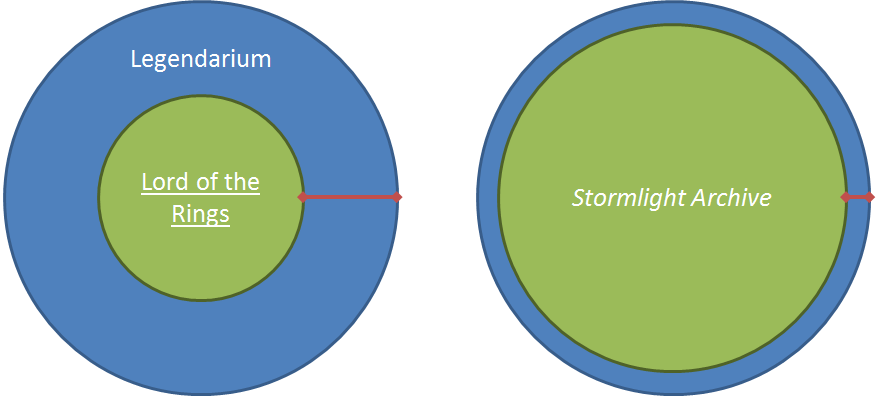
The image below depicts the difference between the setting in which LotR takes place (the blue region) and the aspects of the setting that are actually conveyed directly in the LotR itself (the green region).
To give an example of what I mean, consider the language Quenya. That’s one of the languages he invented[ref]it’s the language of the High Elves, but folks were speaking Sindarin by the time of LotR.[/ref], and he started work on it in 1910, more than 20 years before he started work on The Hobbit. By the time he started work on LotR, Quenya was largely complete. The entire language of Quenya (all the vocabulary, all the grammatical rules, and all the etymology that goes along with it) goes in the blue circle. Just those specific parts of Quenya (a few words, maybe whatever grammar was required for a phrase or sentence) that made it into the LotR go in the green circle. So the blue region is the entire setting (everything the author ever thought of) and the green region is just the parts of the setting that the author actually used directly in the story.
Obviously this isn’t an exact science, but what makes Tolkien’s example so helpful is that he actually made pretty details notes of his entire setting and it even has a name: the Legendarium. The fact that all his world building is collected in notes and papers that are pretty common knowledge (Christoper Tolkien used those notes to complete the manuscript for the The Silmarillion after his father’s death, for example) makes it particularly easy to envision the entire setting as something that is separate from the aspects of the setting that crop up in the LotR themselves.
So that’s what my chart shows: the setting broken down into the parts that show up within the text (the green region) and then the other stuff that might be hinted at in the text, but isn’t actually there directly (the blue region). Here’s what I imagine the charts looking like for LotR and SA side by side:
The blue regions are sized identically because I don’t want to try and talk about who created more, Tolkien or Sanderson. They are both epic high fantasy authors, so they both write a lot. I suspect Tolkien created much more in his lifetime than Sanderson has created so far, but Sanderson may well surpass him. Who cares. The point is that they both do a lot of world-building so let’s just call it equal.
The difference, then, is that the proportion of Sanderson’s world-building for SA that shows up in SA is much, much higher than the amount of the Legendarium that shows up in LotR. That’s what the red lines are showing you: Tolkien’s excess world-building is thick. Sanderson’s excess world-building is thin.
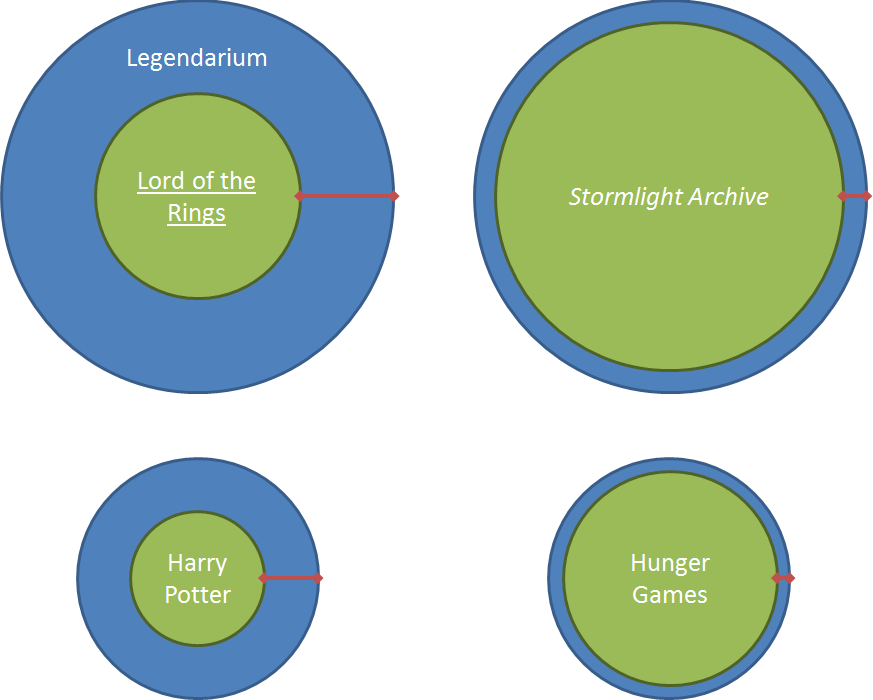
Before we talk too much about what that means, let me just throw up one more image. This one adds the Harry Potter and Hunger Game series to the mix.
I don’t want to get bogged down in the exact details of who did more world-building than whom, but I think it makes sense to say that the epic high fantasy authors (Tolkien and Sanderson) did more world-building than Rowling or Collins. This isn’t to say that they did better world-building. I’m on-record as thinking that J. K. Rowling’s world-building is total genius[ref]Long version. Short version.[/ref], but she didn’t do very much of it compared to Tolkien or Sanderson.
So here’s the main point of this post: more world-building in aggregate (bigger blue circles) isn’t necessarily better, but thicker world building (more gap between the green circle and the blue circle) is better. And now the explanation/defense and some caveats.
I don’t think more world-building in aggregate is better because it’s really just a genre question. High fantasy does lots of world-building. Serious mystery novels and real-world thrillers do very little of it. Historical fiction does lots of it, but it’s research rather than invention, so it’s a very different kind of world-building. The point is, you should create enough of a world for your story to live in. If your story requires a relatively small setting or occurs in the real world, then you don’t need to do a lot of world-building. If your story has a big scope and takes place in a fantasy world, then you do need to do world-building. More, in aggregate, isn’t better. It’s a matter of fitting the world-building to the story.
So why is it bad to have only a small amount of world-building “left over” as it were? The primary answer is that, especially in stories that take place in fictional worlds, you want to preserve a sense of immersion in the world. Excess world-building helps you do that in multiple ways. The most important is that referring to events and locations that have an existence independent of the main narrative is a really powerful signal to readers that “this is a real place where lots of things happened, not just a setting I threw together for this one particular story.” When every single aspect of your story ends up being required for the plot, you strain a reader’s credibility in the same way that having too many coincidences in the plot strains credibility: it doesn’t seem natural. Your story should have places your characters don’t as much or care as much about as other people in the universe do because otherwise you’re implying that everything in the world exists merely in service of the characters. Which feels horribly fake.
The other ways are less direct, but still relevant. The work of doing more world-building is a kind of quality control on what you do show. I think even non-linguists can be struck by the way the language (especially via proper names) in LotR broke down consistently among ethnic and political groups. Most fantasy writers just pick similar-sounding names without worrying about complex etymologies, but the risk of sounding like just a jumble of made up syllables is higher when you’re just throwing out a jumble of made up syllables. Also, leaving a bigger gap between what you create for the world and what you show in the story means you have more freedom with your narrative. If you feel like you have to show off everything you create, you can end up bending the plot so that it becomes more of a guided tour of your brilliant creation rather than an independent story.
So, just to recap the graphic above, Collins does a bad job of world-building because even though her story is limited in scope, she did the absolute bare minimum to create even the relatively small setting she needed. Sure, her world building is pretty terrible in general (that’s pretty well-known), but even if you set aside the stuff that doesn’t make sense the problem remains that she just reskinned the myth of Theseus and the Minotaur with the slimmest trappings of a generic sci-fi dystopia and called it a day. She does do a little bit when it comes to the culture of the Capital, but there’s nothing about the setting scientifically, linguistically, culturally (outside the Capital), historically or in any other sense that would make you believe that this is anything other than a flimsy, disposable backdrop for her plot. In short: Collins didn’t create enough setting to fit her story.
Hogwarts. Geo-spatially, this is about all the setting Rowling needed for her story.
Rowling also had a story with a pretty limited scope. Hogwarts, the Burrow, and the Ministry of Magic pretty much account for all the setting she needs. But Rowling did a good job of making the world fill lived in primarily through the inclusion of tantalizing books. Where Tolkien made the world seemed lived in by giving forgotten histories to all sorts of places (the Barrows, Weathertop, the Argonath just to name a few), Rowling made the world seemed live in by giving context to all the silly textbooks at Hogwarts. If you think about the number of times a book played a crucial role in Harry Potter, you’ll realize how important they were to the landscape. And the fact that their authors frequently showed up as minor characters or historical figures really deepened the sense in which these books were part of the world. Just like J. R. R. Tolkien, J. K. Rowling had plenty of material in her own Legendarium left over to make follow-up books that were based on books mentioned in the original series. There’s The Tales of Beedle the Bard, for example, and the new Harry Potter trilogy is going to be based off of Fantastic Beasts and Where to Find Them (which also exists as a book). J. K. Rowling was as profligate with the books she invented for the Harry Potter universe as Tolkien was with language or as Sanderson is with magical systems.
The SA suffers from the same basic problem as Hunger Games (not enough extra world-building) but for the opposite reason. He created plenty to tell the core story, but then he kept cramming more and more of hiw world-building into the narrative until there was barely anything left over. The end result is the same: there’s no sense of realism that comes from a reader perceiving that the world extends beyond the borders of the pages.
Tolkien, of course, is the gold standard. Although the scope of LotR is great, it is nowhere near the scale of the Legendarium from which it draws. My one wish for Sanderson—because I really do like SA—is that he would be willing to stop feeling the need to show off every idea he has in the narrative. It makes the story feel like a guided tour instead of an adventure.
First major caveat: we’re only looking at world-building. That’s just one aspect of what makes a work tick. There are all kinds of other factors: quality of prose, vibrancy of characterization, mastery of theme and tone, coherence of plot, etc. I’m not attempting to address those. This post together with the previous one are not an attempt to give some kind of comprehensive theory of fiction or high fantasy. They are not even a complete theory of world-building. One of the most important tricks that Tolkien uses, for example, that has nothing to do with green circles or blue circles is to demonstrate that actions in one work change the setting in ways that are felt in subsequent works. The best example of this is the way that Frodo stumbles upon the trolls in LotR that Bilbo had helped turn to stone in The Hobbit. The persistence of changes to the setting across works is a brilliant tool in world-building (and one I understand Sanderson may excel at) that falls totally outside the scope of this post.
Second major caveat: it’s possible that I’ve got the wrong frame of reference for Sanderson’s books. I have only read his SA series, but I am aware that all of the books he’s writing a linked up in a single world. Tolkien has the Legendarium. Sanderson has the Cosmere. That defense is not as strong as it first appears, however, because it increases the size of Sanderson’s setting substantially (the Cosmere is really big) but it also increases the size of his narrative because in addition to the two books in the SA, we’ve also got: Warbreaker, the Mistborn series, Elantris, White Sand, Dragonsteel, and others. In other words: I might be underestimating the scale of Sanderson’s setting, but only if I’m also underestimating the size of his narrative. This is because, unlike the relatively unrelated works of Tolkien, the whole point of the Cosmere is that all the books are actually part of one grand epic. In that case, you might have to draw a much bigger blue circle, but the green circle keeps on growing, too. You’re still let with a thin band. The problem doesn’t actually go away[ref]Of course because Sanderson is only in the early stages of a truly monumental undertaking I can’t be certain in my estimation. But that’s how things look today.[/ref].
The Cosmere crosses the high fantasy genre to include an industrial setting in one of the Mistborn books (Mistborn: The Alloy of Law).
So here’s where this leaves us—and I promise I’m done on this topic for the time being when I wrap this post up—the fundamental rule is that you want your world-building to be comfortably larger than what you’re actually going to use directly in the story you tell. This came naturally to Tolkien. Keep in mind he was working on Quenya twenty years before he started The Hobbit! I’m sure part of that was his personality, but it was also a matter of religious faith to him: world-building was a form of worship. So he did a lot of it. So, even though LotR is a big story, his setting was bigger.
High fantasy is particularly sensitive to the quality of world-building, but high fantasy authors since Tolkien have generally failed to get anywhere close to his mastery of it. Often, this is because they don’t do enough world-building. This makes sense, who wants to invest 20 years in world-building before they start a story they don’t even know if they will be able to publish or not? Sometimes it’s because they’re just not very good at it. But even when you get someone like Sanderson—someone who creates a lot and who does it quite well—they still can run into the trap of wanting to stuff all of that world-building into their story instead of leaving a nice, comfortable margin. If Sanderson included less of the world-building in the story, the narrative would have more focus and the world would feel more extensive and genuine.
Texas Tech economist Benjamin Powell has done extensive research on sweatshops, including a recent book on the subject published by Cambridge University. He has a new article in the Summer 2014 issue of The Independent Review titled “Meet the Old Sweatshops: Same as the New Sweatshops.” The article traces the history of sweatshops in 19th-century Great Britain and U.S. as well as post-WWII East Asia. It documents the incredible increase in living standards, to which sweatshop wages contributed. Perhaps more important, it looks at the impact labor laws had on sweatshop conditions and their eventual elimination:
The short answer is that the laws played very little role in ending sweatshop conditions. For the most part, the laws were adopted once the United States had already reached a level of development that had mostly eliminated the conditions the laws made illegal. Great Britain’s first restrictions on child labor applied only to children under nine years old, and Massachusetts’ child labor law, the first in the United States, limited the workday to ten hours only for children under twelve. The United States didn’t pass meaningful national legislation against child labor until 1938, when its per capita annual income was more than $10,200 (in 2010 dollars)…Similarly, the first federal U.S. minimum wage wasn’t introduced until 1938, and it set the minimum at 25 cents per hour when average productivity was already 62.7 cents (Cowen and Tabarrok 2009, chap. 7). The first state minimum-wage law wasn’t passed until 1912 in Massachusetts, and it applied only to women and children. Other national labor legislation didn’t come until the United States was even more developed…The same pattern is true of workplace safety regulation. Fishback finds that “[m]ost [safety] regulations appear to have codified existing practices in the relevant industry” (2007, 310–11) (pg. 17).
Despite the loud protests, research demonstrates that Third World sweatshops provide an above average standard of living for their workers compared to others within their economies. Also, as economist Alex Tabarrok has noted, “the soft-hearted demand for international labor standards often masks labor union protectionism.” This isn’t to say that we should be content with all examples of sweatshop conditions. But, as Powell concludes, “Poorer countries today would be better served if antisweatshop scholars and activists had a better understanding of how the historical process played out in wealthy countries” (pg. 120).