Growing up as the oldest sibling in a big family means a life of accommodation. I suspect that if you ask any oldest sibling what they’d like even when they are grown, they will probably reply by asking (even if not with these words): What would be easiest for everyone involved in this situation? Then that’s what I’d like.
Ironically, the inability to pick what you want without first knowing how that decision will effect everyone else can be frustrating all by itself. Yesterday, when my wife asked me what cake I wanted for my birthday, she got quite annoyed when she realized that I was actually trying to figure out what cake she had already planned on baking me so that I could state that that was the cake that I wanted. I can see how that would be annoying, but it’s unintentional. At this point it’s pure habit.
Anyway, once my cover was blown I had to try and decide what cake was actually my favorite. And I really had no idea. My family has two theories about my favorite cake.[ref]It probably says something that I can much more easily tell you what other people think is my favorite cake then actually tell you what is, in fact, my favorite cake.[/ref] There are those who think I like the German chocolate cake best and those who think I like the family version of Better Than Sunday cake best.[ref]That’s not the cake’s real name, but the real name was deemed to scandalous for use in front of young children in my home. It has the same initials. You can figure it out.[/ref] Don’t get me wrong, these are both excellent confections. Neither one of these will lead to any disappointment on my part! But were they really my favorite? I had no idea. Even asking the question–without reference to what other people think or expect–was distinctly uncomfortable for me.
Then, out of nowhere, the answer hit me. The cake that I wanted for my birthday was… pie. Specifically: bumbleberry pie. I first had bumbleberry pie[ref]They called it “fruits of the forest pie”.[/ref] at the Navy Federal Credit Union employee cafeteria just last year, so it’s not like I’ve been missing out on my favorite for years. Any other year, it probably would have been a toss up between German chocolate and BTS. (And if you notice that I’m working hard to make sure no one feels hurt by this post, you’re not wrong. But it’s still true!)
In any case, Ro decided she loved me despite being exasperated with my inability to answer simple questions, so she ditched her plans to make me a German chocolate cake and ordered me bumbleberry pie. It’s been in our fridge since yesterday. Every time I open the fridge door to get something I see the box. And I smile. I don’t know which I’ve been enjoying more: the prospect of delicious bumbleberry pie or the ability to actually pick my favorite of something.
P.S. Bumbleberry pie is an inexact term for mixed-berry pie, usually (according to Wikipedia) featuring apple and rhubarb. For me, the best kinds is strawberry, rhubarb, and blackberry. As long as there’s rhubarb in it, however, I’m pretty happy.
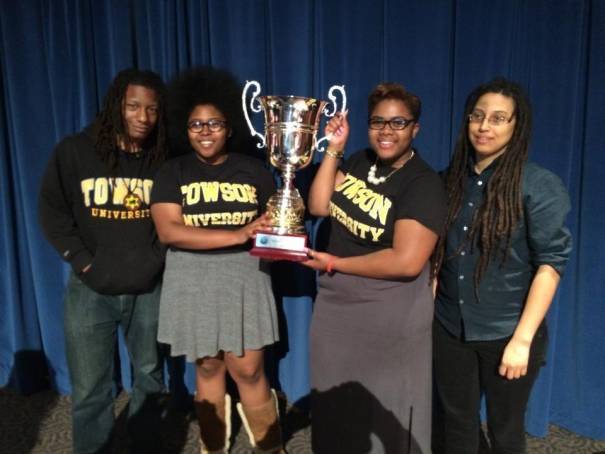
There’s a story percolating through the right wing blogosphere right now about the victory of Townson U in a national debate contest “by repeating N-word and babbling nonsense.” The fact that the winning team consists of two black females is never mentioned explicitly[ref]By the right wing blog posts that I’ve read. It is mentioned by others reporting on the story.[/ref], but race is obviously a part of this story. The (unspoken) gist of it appears to be something like: black students who are not actually competent at debate got an award because of political correctness. To back that up, the blog posts feature transcripts and YouTube videos of the debate, like this one.
That video contrasts the two young ladies in a news story, where they speak articulately and calmly, with clips of their emotional and quite frankly weird speech during the debate. It’s an ugly video because of what it implies instead of having the courage to say. The cuts are obviously designed to undermine what the young ladies say to the reporter with seemingly contradictory excerpts from their debate performance. For example, the reporter asks, “Once you know the topic, what’s next?” One of the women replies, “Well, you do a lot of research.” And then there’s an immediate cut to the debate right at the point where one of the speakers is stuttering heavily. Race is never mentioned, but the point is clear.
Now, I approached this story without any special inside info. I’ve never debated competitively, nor have I ever seen a competitive debate. But I decided to do the one thing that the conservative bloggers apparently decided to skip. Research.
I started with two hypotheses that might explain the apparent contradiction between assumptions about what a national championship debate team might sound like and the jarring YouTube footage. Either this was in some sense an “urban” form of debate or, more likely, the timing rules of competitive debate forced competitors to adopt really strange, unnatural speech patterns. It’s not hard at all for me to imagine, for example, that competitors are judged purely based on the content of their argument and not so much their delivery and/or that the expectations for content delivery are much different in a competitive setting.
I started with the first one because while it seemed less likely, it would be easy to check. Is the Cross Examination Debate Association a minority-focused group? No, it is not.Founded in 1971, it is “the largest intercollegiate policy debate association in the United States.”
So I went to my second hypothesis and decided the simplest thing to do would be to check on the winners from last year. If I got a video of some white competitors using roughly the same kind of speech, I’d kill two birds with one stone. Clearly, if last year’s competitors were white, there wouldn’t be some kind of obvious minority-preference and secondly, if this is how the teams from last year sounded then it would strongly indicate that what we’re hearing has nothing to do with race and is just the way competitive debate works. I searched YouTube and, on the first try, hit the jackpot. Here’s a video called: “More CEDA 2013 Debate Highlights.” A couple of things to note before you watch it:
It features two teams consisting of three white women and one white man.
It represents the “highlights,” so ostensibly this is what competitive debaters find impressive.
It does, indeed, feature the exact same speech: very fast, slurred technical terms, rapid-fire breathing, and weird stuttering.
So let’s recap. In 2013, and probably in many years before that, white kids won a debate contest that, by its competitive nature, seems to require participants to speak in really, really weird ways. No one cared. In 2014, black women won the debate contest using the same tactics, but suddenly conservative writers noticed, [ref]Which isn’t, in and of itself, racist. They tend to keep an eye on political correctness and are often not wrong.[/ref] and they wrote off the bizarre-sounding speech as “unintelligible gibberish” without checking to see if that’s just how debates work.
So: assumptions about folks being less intelligent and/or less capable of speaking standard English because they are black. Yup, that looks like racism to me.
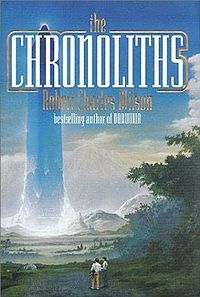
It could just be me, but I don’t hear folks talk about Robert Charles Wilson enough. The first book of his I read was Spin, which won the Hugo in 2006. I thought the sequel (Axis (Spin)) was good, but not great. I’m listening to The Chronoliths now, which was nominated for a Hugo in 2002. Turns out he’s been nominated a few more times, too (1999 and 2010), but–like I said–he’s just not a name that I hear come up often enough in discussions of great sci-fi.
The reason I like Robert Charles Wilson is that he’s one of the best there is at combining truly human-centered, character-driven stories with real, honest, sci-fi concepts. The drama in his books is emphatically character-driven, but it simply couldn’t exist without the sci-fi elements. To me: that’s what all sci-fi should strive to be.
He also has some prose chops. Look, I realize that sci fi (along with all genre fiction) tends to be less about the art and craft of prose than literary fiction, but there were some parts of “Spin” that rose to the level of good art by any standard.
He’s one of those guys who, when I’m reading their story, I think to myself: “I’ll really be doing alright if I ever get this good.”
Ron Haskins of the Brooking Institution has an excellent piece in the Spring 2014 issue of National Affairs. He begins by reviewing the current state of marriage and the rising rate of single parenthood in the United States. Furthermore, he looks at the impact single parenthood has on children, including the increased risk of poverty.
He then looks at the four major policies used to combat this social problem:
Reducing non-marital births
Boosting marriage
Helping young men become more marriageable
Helping single mothers improve their and their children’s lives
Haskins provides a balanced overview of the empirical outcomes of these policies, both successes and failures. He concludes,
If we want to address the challenges of income inequality and immobility, we must address one of their main causes — non-marital births and single parenting. Maybe stable, married-couple families will never again be the dominant norm, but if so the children who are raised by such traditional families will continue to have yet another advantage over their peers who have minimal contact with their fathers, live in chaotic households, and are exposed to instability at home as their mothers change partners.
Our society and culture will no doubt continue to change, but our children will continue to pay the price for adult decisions about family composition. Public policies cannot ultimately solve this problem, but those that prove themselves capable of ameliorating some of the damage are surely worth pursuing.
Hugs are on the rise in China. The physically reserved Chinese culture is apparently changing “due to exposure to the West, especially huggy North America,” reports The New York Times. Sixty schools in the Liuhe District in Nanjing now have emotional intelligence classes. “The third graders’ homework: Hug your parents tonight.” It turns out that “other Asian nations — even formal Japan — may also be involved, according to a recent article in China Daily headlined ‘‘Students Use Hugs to Ease Tensions.” It described ‘‘hugging activities’’ between a group of Japanese studying in Beijing and Chinese passers-by, in which the students hugged about 200 Chinese in an effort to warm feelings between people of the two nations sparring over territory in the East China Sea.”
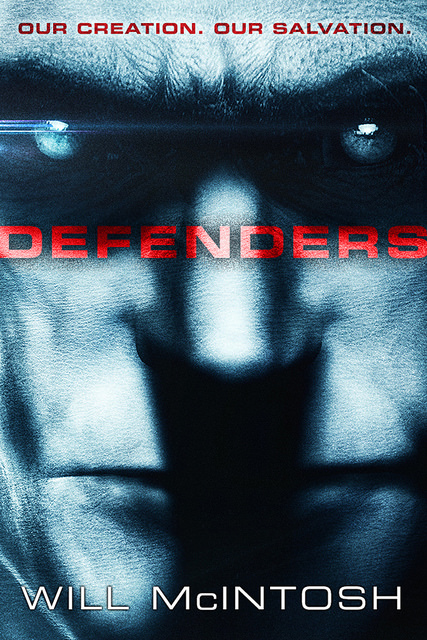
Will McIntosh got a chance to promote his new book Defenders on John Scalzi’s blog a couple of days ago. In it, he makes a frequently heard assertion which is that (in common terms) heroes are boring and unrelatable. McIntosh states that “I don’t particularly like stories with villains. I prefer the good and bad in characters to be more a matter of degree, and, ideally, subject to individual interpretation.” He elaborates:
I prefer Frankenstein to Dracula, for instance. Count Dracula is a bad guy, no doubt about it. Stab him in the heart and no one sheds a tear. But what are we supposed to feel as the Frankenstein monster burns? He kills people, he’s a psychopath, but he was thrust into the role of monster–he didn’t choose it. Maybe Victor Frankenstein is the villain of the piece, but here again, it’s complicated. The good doctor screwed up royally, but that wasn’t his intent, and intentions count when we’re judging good versus evil.
So the thing that’s interesting here is that he’s espousing moral complexity within a morally objective framework. As he puts it, “intentions count when we’re judging good vs. evil” which implies, I think, that there is such a thing as good and evil. So far so good. I think the case against heroes is a little overdone (plenty of books have pretty unambiguous heroes, from The Lord of the Rings to Les Misérables), but the idea that it’s more interesting to have complexity: I can dig it. As Sirius Black told Harry Potter: “The world isn’t split into good people and Death Eaters. We’ve all got both light and dark inside us. What matters is the part we choose to act on. That’s who we really are.” So good and evil exist, unambiguously, but people are complicated.
But then the sets up a plot where each of three factions can plausible be seen as the bad guys, and writes:
While there are unquestionably villains in the world, I think most human conflict takes this form, where the villain of the story depends on your perspective. While I was planning this post, my wife reminded me of the ever-shifting alliances in the novel Nineteen Eigthy-Four, where Oceania is at war with Eurasia and allied with Eastasia on one day, and allied with Eurasia and at war with Eastasia the next. Yes; one day someone is your sworn enemy, the next, they’re your ally. Maybe that’s why I’m uneasy writing about villains.
So I’ve got some issues here. First of all, it’s not a trivial leap to go from moral complexity of individuals to moral complexity of groups. A group is not a person. We often anthropomorphize groups, but once you get past middle school most folks start to realize that the narrative of history as being about good guys and bad guys is somewhere between a useful simplification and an outright fairy tale. Morality applies to individuals. It doesn’t make any more sense to talk seriously about an entire nation being good or evil then it does to talk about a table or a pretzel being good or evil. Secondly, “ one day someone is your sworn enemy, the next, they’re your ally” shows a shift from complex moral objectivism to simplistic moral relativism.
I get that people confuse these ideas all the time. That’s because in both cases the answer to “Was that a good thing to do?” starts with “It depends…” In the place of moral relativsm, “It depends on your subjective assessment of morality.” In the case of complex moral objectivism, “It depends on what the person knew, what he should have known, what he was trying to do, how serious he evaluated the issues, etc.” Complex moral objectivism holds that good and evil can be hard to figure out, but that they are there. They’re real. We just don’t always recognize them. Simplistic moral relativism holds that there isn’t any underlying truth to moral clams. It’s just personal preference.
Now, maybe McIntosh’s actual book handles this topic a whole lot better than his little post at The Big Idea. That’s entirely possible. A lot of good artists are good at making art at least in part because it’s what they focus all their attention on, to the point where talking about the process of art or the products they have made is something they have no talent for at all. So I’m not criticizing the book. I haven’t read it yet, and it actually sounds interesting to me, based just on the setup.
I’m just saying, come on: you don’t need moral relativism to get moral ambiguity and complexity. And, more importantly, there’s still room for heroes and villains even in a world where good and evil aren’t always obvious. Sometimes because you just know (see: Voldemort) but also sometimes because evil isn’t about grand gestures. It’s about apathy, indifference, and following orders (see: The Banality of Evil).
Journalist Michael Totten has a disturbing article in the Spring edition of City Journal on the effects of communism in Cuba’s Havana. Using the recent film Elysium to paint a picture of life in Havana, Totten documents how he lied to get into the country and what he witnesses. “Outside its small tourist sector,” he explains, “the rest of the city looks as though it suffered a catastrophe on the scale of Hurricane Katrina or the Indonesian tsunami.” While the goals of the Marxist leaders “were total equality and the abolition of money; the methods were total surveillance and political prisons. The state slogan, then and now, is “socialism or death.”” Furthermore, “Cuba has a maximum wage—$20 a month for almost every job in the country. (Professionals such as doctors and lawyers can make a whopping $10 extra a month.)” This maximum wage is defended by the government, which argues “that life’s necessities are either free or so deeply subsidized in Cuba that citizens don’t need very much money. (Che Guevara and his sophomoric hangers-on hoped to rid Cuba of money entirely, but couldn’t quite pull it off.) The free and subsidized goods and services, though, are as dismal as everything else on the island.” This includes their supposedly wonderful health care system that Michael Moore was raving about years back. This “free” health care requires patients “to bring their own medicine, their own bedsheets, and even their own iodine to the hospital. Most of these items are available only on the illegal black market, moreover, and must be paid for in hard currency—and sometimes they’re not available at all. Cuba has sent so many doctors abroad—especially to Venezuela, in exchange for oil—that the island is now facing a personnel shortage.”
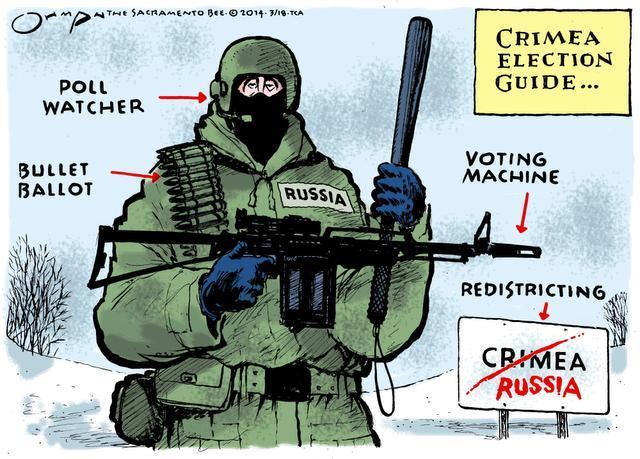
The Democratic People’s Republic of Korea[ref]aka North Korea[/ref] holds elections. It’s democratic, don’t ya know! In the most recent elections, President Kim Jong-un’s party, the Democratic Front for the Reunification of the Fatherland[ref]Tyrants always have the best names and slogans[/ref] got 100% of the vote. Only slightly more credibly, 96.77% of Crimeans voted to secede from Ukraine and join Russia. It’s kind of a silly number on the one hand, and a disturbing one on the other. I mean, at this point Putin is actively making a mockery of any notion of due process.
So what were the actual votes like from the election? Ordinarily we’d just have to guess, but according to Forbes, the Russian Human Rights Council accidentally released the real results briefly on their website. Oops. It says that about half of the voters in Crimea elected to secede and join Russia, but also that only 30% of Crimeans voted (Russia claimed that turnout was 83%). So, that would mean that the vote for Crimea to secede from Ukraine and join Russia has the support of…. 15% of the population.
In his post on the increasing intolerance towards dissenting opinion from both sides of the political divide in the USA, Nathaniel said that I wish someone could tell me it’s gonna get better–or at least that it’s been worse–because it’s kind of lonely and scary to feel that not only have the loonies taken over the asylum, but they broken down the walls, invaded city hall, and took over there, too.
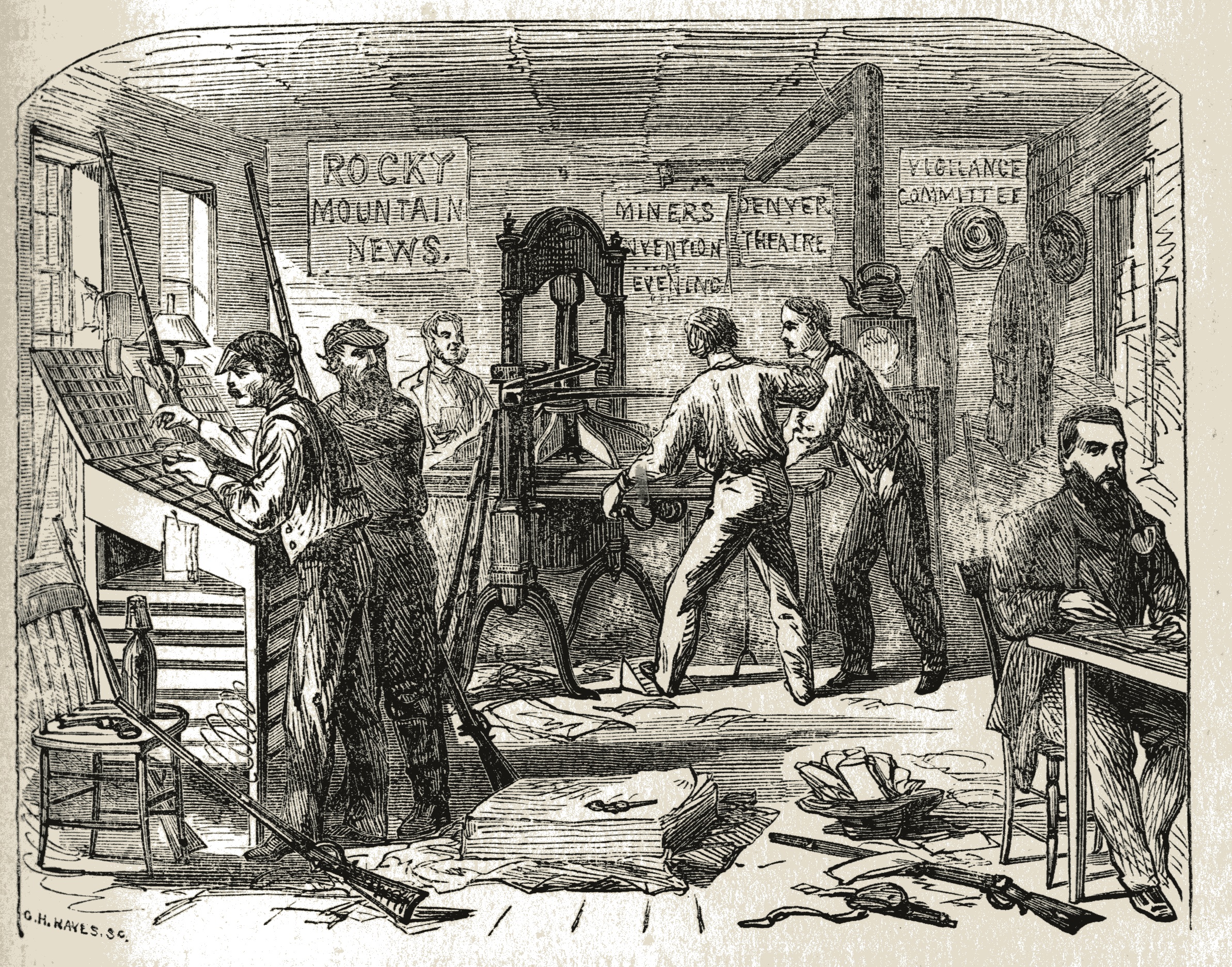
Well, I’m happy to oblige. It has been worse. In the Old West- from St. Louis to San Francisco- free speech often came down to how well you could throw punches or wield a Bowie knife. As David Dary chronicled in his 1998 Red Blood and Black Ink: Journalism in the Old West, newspapers in the West were highly partisan, deeply personal, and frequently inflammatory.[ref]I’ve drawn the material for this post from chapter six, Pistol-Packin’ Editors.[/ref]. While they covered important issues such as the evils of slavery, the reporting often devolved into an editorial feud where each side smeared the character and reputation of the other. Tempers flared, and if the offensive material was not retracted, then it typically resulted in a duel, if not outright murder.
Susan B. Anthony’s lesser-known brother, Col. Dan Anthony, carried two large horse-pistols with him throughout his career as an editor in Kansas. He had good reason, as he was frequently attacked by his opponents for articles he published, and even survived an assassination attempt, as well as other attempts to prevent certain stories from being published.
With characteristically dry wit and black humor, Ambrose Bierce described this occupational hazard of journalists.
The restrictions of the game law do not apply to this class of game. The newspaper man is a bird that is always in season; sportsmen and pot-hunter alike may with assured impunity crack his bones with a bullet, or fill his skin with buckshot. . . Although the American public will not deny itself the pleasing pageant of some blameless citizen accomplishing serpentine contortions under the editorial pen, neither will it inhibit the flight of the blithe bullet through the editorial body.
The trends that Nathaniel outlined are certainly concerning, and ought to be reversed or halted, but things could always be worse. Some sort of comfort, I suppose.
This post will be a little bit more free-form than what I usually write. So buckle up, we’ve got some ground to travel.
What The Elders Know
I read a story as a kid that stuck with me. It was about a team of 1990s archaeologists who decided to excavate a 1950s landfill just to get an objective measurement for what ordinary, everyday life was really like 4 decades before. When they dug up the trash, they found human remains. Skeletons. First it was just a couple, and they thought it might have been mob violence, but then they found more and more. Something horrible had happened in this town, just 40 years ago. But it was forgotten to history. The elderly folks of the community, the only ones who would know the secret of what had happened, came to the digging site and stood staring at the excavation. Saying nothing. Whatever had happened, no one would ever know because they never broke their silence.
At the time, the story mostly just made me reconsider what we know, really know, based on our limited first-hand experience. But it also planted this idea of a group of people who are bound together by some common knowledge that they have that nobody else does.
I realize there’s a sinister spin to that tale, and that’s not what I’m going for. It’s just that idea that there are experiences that no one can tell you about. You can’t understand unless you’ve been there yourself. And, if you have been there, no explanation is necessary. From what I understand, combat is like that. I’ve read books, like On Killing, that describe some of the effects, but it’s really just enough for me to know that I don’t really get it. And, as a non-military guy, never will. Veterans understand something I can’t comprehend.
In my experience, being married is like that, too. Marriage, for me and my beloved wife, has been really, really hard at times. From talking to our close friends we’ve learned that that’s pretty common.[ref]At least, among the sort of people we are likely to be friends with, I guess.[/ref] All the couples that I know well enough to have discussed this with describe going through harrowing bad times that shook their faith in themselves, their spouse, their marriage, and pretty much everything they believed in. And nobody warned us. Nobody told us how bad it could get, and probably would get. I think partially that’s because we just forget–the bad times are already receding into memory for me–but I think it’s also just because you can’t convey what it’s like to someone who hasn’t been there. And you certainly can’t simultaneously convey how much it’s going to hurt and how much it’s still going to be worth it. There’s just nothing to say.
It’s true of raising kids, too. There are a lot of parenting jokes, and even before I was parent I more or less got them, but the most traumatic, mundane experiences of being a parent–like the sheer terror of holding a little baby that is sick and can’t tell you what’s wrong–there’s just absolutely no way to convey that feeling to someone who hasn’t been there. There’s deep connection between parents that crosses pretty much every other social boundary you can think of. I’m reminded of Jerry Holkins’ description of the birth of his son. Holkins writes often excessively vulgar comics about video games for a living. He’s a West Coast atheist with a troubled family history who jokes about porn, who never went to college, and who has a multi-million dollar company that runs giant conventions in Seattle, Boston, Australia, and now San Antonio. So, other than that we’re both geeks, we don’t have a lot in common. But when he described the way he felt after watching his wife deliver their son, I knew that there was one deep, defining experience we had in common:
I am not trying to jostle for primacy over the birth act, the utter valor of which is indelible – I’m fairly certain the credit is going to the right people. There is, however, a parallel experience that I never hear much about, something amazing and profound about the helplessness, the desperation of events which are perhaps a million long miles beyond your control. I just want to find other fathers and, looking at them across the aisles in the grocery store, hold my right fist aloft. I am with you.
There are lots more experiences like this, as well. I think of all the times I got advice from mentors–friends and family with more experience than me–about life decisions. What to study in school, whether to buy a house, what to do with my career, how to follow my passions. Time and time again I’ve found that some of the most important advice was always the advice that, no matter how much I earnestly wanted to learn from these people, I just couldn’t follow. I couldn’t follow it because I couldn’t even understand it. It didn’t compute. I might have thought I understood, but I lacked the perspective and the context to see when and how it applied in my life. I only figured out, years and mistakes later, what it was that they had been trying to tell me.
All of this means that the older I get the more I respect my elders. They’ve been there. They’ve been through a lot of the big experiences but also just the accumulated weight of life under uncertainty. They’ve been on the ride longer. The highs, the lows, what changes, what stays the same. I think they know things, things that maybe I won’t be able to understand until I get there myself. My father’s father passed away too young. As the years go by, I find that I miss him more. Not less. I wish he were here.
Maybe he could help me make sense of this crazy world.
Sound and Fury
Let me be clear about what I mean when I say “this crazy world.” I mean the world is full of people who hold such absolutely wildly divergent opinions and perspectives that if you try to get out there and really understand what’s motivating them all your brain feels like it might break under the strain. Humans handle complexity primarily through abstraction. We find patterns, drop the details, and hold onto the narratives. But when the thing that interests and concerns you is precisely the narratives and paradigms that other people are seeing the world through, abstraction is easier said than done.
Here, enough generalities, lets get to some specifics.
Just a few hours ago, a friend posted an article from Mother Jones about How Gun Extremists Target Women. It starts with the experiences of Jennifer Longdon, a woman who uses a wheelchair because she was permanently paralyzed when a random assailant shot her and her fiancee for no apparent reason.[ref]The shooter was never caught.[/ref] Since becoming a vocal advocate for more gun control laws, she has been spat upon, cursed at, threatened, and even had some guy jump out of the bushes at night and spray her with a realistic-looking water gun. My friend’s comment when he posted the article was just, “Wow. Um, wow.” I guess he believes this is accurate of a small but vocal minority of gun rights activists? My first reaction was that, hey, I’ve been involved in this movement for years (only loosely, but still) and I’ve never seen any behavior like that.
Except that, hours later, I realized that I kind of had. On one particular gun forum I used to hang out at things got way out of hand in a heated debate and next thing you know people are trying to use the real world to intimidate their ideological foes, everything from digging up personal photos to threatening civil and criminal action. I don’t think death threats were involved–and none of the participants were women–but it was ugly enough that I still have screenshots saved on my computer more than 5 years later just in case I ever need to defend myself.
Let’s move on rather than analyze. What else have we got? Oh, how about this gem from the Daily Mail about how a respected climate scientist with over 200 publications joined the board of a skeptical organization (the Global Warming Policy Foundation) because:
I thought joining the organisation would provide a platform for me to bring more common sense into the global climate change debate. ‘I have been very concerned about tensions in the climate change community between activists and people who have questions.
So, he tried to bring some reason and cross-partisan talk to a contentious and serious debate? Big mistake. Next thing you know he’s being harassed online and it got to a point where an American co-author of a paper pulled out because he refused to be associated with someone who was associated with a skeptical organization, even if the person had joined the skeptical organization to try and temper it. Not good enough. Professor Lennart Bengtssen lasted a grand total of three weeks in his new position before the pressure forced him to resign.
Or how about the rash of colleges that have withdrawn invitations to commencement speakers because students protested against allowing anyone who was insufficiently ideologically pure to contaminate their ears. It’s gotten to a point where The Daily Beast[rerf]Not exactly a bastion of conservative sensibilities.[/ref] published an article with the headline proclaiming that The Oh-So-Fragile Class of 2014 Needs to STFU And Listen to Some New Ideas. Olivia Nuzzi writes about how Christine Legarde (head of the IMF) got uninvited from Smith College’s commencement in the same month that Condoleeza Rice pulled out of a speaking gig at Rutgers. (Nuzzi doesn’t mention a third example that we covered at Difficult Run: Brandeis decided that Ayaan Hirsi Ali didn’t deserve an honorary degree after all.)
Wait, wait. There’s more. How about Neil deGrasse Tyson slamming philosophy–yes, the entire discipline of philosophy as ‘useless’. A quick review of his comments is instructive. He frames it as an objective, and pragmatic stance (i.e. non-ideological) but seems to lack the philosophical sophistication to realize that far from brushing philosophy off, what he’s actually doing is engaging in a purge of the wrong kind of philosophy. Materialist reductionism? That’s fine. It’s just all those other kinds of philosophy that are useless. I guess he has so dogmatically accepted his own particular philosophical stance that he’s forgotten it isn’t an unyielding element of the fabric of the objective universe. It’s just the particular brand of philosophy he happens to prefer.
Meanwhile, the UN is trying to get pro-life perspectives classified as “torture.” No, really. The Center for Reproductive Rights submitted a letter stating that:
CRR respects the right of each individual to freedom of religion and acknowledges the importance of religious institutions in the lives of people, including the role they may play in ensuring respect for human dignity. As with any party to an international human rights treaty, however, the Holy See is bound to respect, protect, and fulfill a range of human rights through its policies and its actions. As such, this letter focuses on violations of key provisions of the Convention against Torture associated with the Holy See’s policies on abortion and contraception, as well as actions taken by the Holy See and its subsidiary institutions to prevent access to reproductive health information and services in countries around the world.
So, freedom of religion is a nice idea, but if it entails opposition to abortion then you’re in contravention of the Convention against Torture. Uh… OK?
And, as long as we’re hitting pretty much every hot-button issue of the day, let’s move right along to gay rights and Hollywood’s Sex Abuse Cover Up. Describing the wall of silence about growing allegations of sexual abuse of children by Holywood elites, conservative writer Andrew Klavan observed simply that:
If these [people accused of pedophilia] were conservatives, if these were priests, if they were religious people, this would be a huge story. But as it is, it’s gonna get swept under the rug unless more people come forward.
The article describes sexual abuse detailed by Corey Feldman (of Boy Meets World) in his new memoir, abuse that started when he was 11, along with allegations of abuse against director Bryan Singer and then an absurdly white-washed version of history in the film Kill Your Darlings. The film is supposedly a biopic centering on Lucien Carr, who assembled the original Beat Generation. It portrays Carr’s professor David Kammerer as a kind of mentor and possible romantic interest. The reality? Kammerer was a pedophile stalker who sexually abused Carr to such an extent that, when Carr finally fatally stabbed his tormenter with a Boy Scout knife, the history of abuse convinced the judge to be lenient in sentencing him. That history–the real history, according to Carr’s family–is swept under the rug. Maybe this is about preserving the image of the gay community during the height of the gay rights movement, but hey: Hollywood has been a safe haven for child rapists of the heterosexual persuasion too, so maybe it’s just a generic “Your rules don’t apply here,” kind of thing.
I started with a kind of anti-conservative example, then moved onto a series of anti-liberal examples, so now let’s get back to conservative nuttiness. This YouTube video hails from 2007, so it’s not new, but it was stomach churning for me to watch.
In it, a Hindu guest chaplain tries to offer the opening prayer in the Senate when he is shouted down by Christians saying stuff like “forgive us Father for allowing the prayer of the wicked which is an abomination in your sight.” You’d think folks who tend to think God had a hand in founding this nation might have more reverence for the principles of tolerance and religious freedom that went into it. Well, I’d think that. If I weren’t so cynical.
Here’s what these examples all seem to have in common to me. It’s not about politics. It’s not even about a particular issue. It’s about the idea that we shouldn’t be tolerant of views that contradict our own. It’s about the idea that we should squelch views that we disagree with, rather than engage them. Gun rights proponents issue death threats to paralyzed women who disagree. Climate scientists sabotage the careers and reputations of one of their own when he so much as appears to depart from the orthodox view. College kids block speakers who might disagree with them from being able to speak. The Catholic Church (and, by extension, anyone who is pro-life) gets labeled as a torturer in contravention of international norms and human decency. Hollywood directors silence their critics and rewrite history to protect the reputation of favored groups and individuals. Christians won’t even let a man pray just because he has a different faith.
Look, I’m on all sides of these issues (and maybe off the charts on a couple of them), but that’s just my point. It’s not about the issues. This is not civilized, rational, healthy behavior. Here’s my absolute favorite one, though. It delves deep, deep into crazy town to showcase a meeting of Anarcho-Syndicalists getting shut down because Students of Unity refused to allow one of the anarchist professors to speak. (Warning: video has lots of swearing.)
I actually got curious to figure out what was behind the kerfuffle. Apparently Students of Unity are mad that anarchist Kristian Williams wrote some stuff that included “survivor shaming” and “survivor doubt” and that constitutes “violence.” Williams isn’t feminist enough, and needs to be “accountable for all the people who feel unsafe by the words [she chooses].”[ref]I am not sure these people understand what the word ‘violence’ means.[/ref] I did a little Googling to find the offending piece. It’s called The Politics of Denunciation. It’s absolutely fascinating and spooky to read, because in it Williams writes against exactly what I’ve been describing. She takes a stand against those who try to pre-empt differing views from ever being expressed at all.
The particular target she has in mind is the idea that a survivor of an attack (like sexual assault) must be the only voice allowed to speak at all:
Under this theory, the survivor, and the survivor alone, has the right to make demands, while the rest of us are duty-bound to enact sanctions without question. One obvious implication is that all allegations are treated as fact.
So what she’s saying is that, “Hey, just because someone accuses someone else of sexual assault, it doesn’t automatically mean that whatever that person said is automatically true and that no other perspective is relevant.” Seems pretty tame. But the more general argument she makes is that quashing differing views is a bad thing to do:
While attempting to elevate feminism to a place above politics, the organizers’ statement in fact advances a very specific kind of politics. Speaking authoritatively but anonymously, the “Patriarchy and the Movement” organizers declare certain questions off-limits, not only (retroactively) for their own event, but seemingly altogether. These questions cannot be asked because, it is assumed, there is only one answer, and the answer is already known. The answer is, in practice, whatever the survivor says that it is.
It seems like a very obscure, tiny, fringe discussion, but it’s actually not. It’s the same pattern as every single example I’ve expressed so far. Someone claims to be above politics (like Neil deGrasse Tyson is above philosophy) but in fact they are just trying to elevate a very particular political statement beyond question and thereby silence all dissenting views. Williams argued that we should make room for multiple viewpoints. And for that she and her whole panel were shouted down and silenced.
Nowhere To Turn
It may seem that I’m focusing on some weird, esoteric issues. And I’ll definitely admit that what dragged me down this rabbit hole in the first place was my attempt to delve deeper into the SFWA controversy I wrote about a couple of weeks ago. That, in turn, spawned the article that I wrote about trigger warnings. I took a mostly conservative view in those posts because that’s who I am, but maybe the saddest thing about this whole controversy is that, from where I’m standing, there are no good guys and bad guys. I’d love to just toss my hat in with the conservatives and feel like I have a home, but I can’t. I can’t because–much as I have no beef with folks like Wright, and Torgersen, and even Correia–the more I dug into what Vox Day had said (and he’s the conservative who really got the liberals angry in the first place) the more I decided that a lot of what the liberals said about him is true. The central allegation is that he’s a racist, and it’s based on comments that he made about an African-American writer N. K. Jemisin. So I found the blog post in question, and I read it. Here’s the money paragraph:
Unlike the white males she excoriates, there is no evidence to be found anywhere on the planet that a society of NK Jemisins is capable of building an advanced civilization, or even successfully maintaining one without significant external support from those white males. If one considers that it took my English and German ancestors more than one thousand years to become fully civilized after their first contact with advanced Greco-Roman civilization, it should be patently obvious that it is illogical to imagine, let alone insist, that Africans have somehow managed to do the same in less than half the time at a greater geographic distance. These things take time.
In other blog posts, Vox Day denies being a racist. I can see he might be trying to get off on a technicality, something like “it’s not about race, per se, it’s just that civilization takes time, and Africans have been exposed to (Greco Roman) civilization for a shorter period of time.” Yeah, I’m not buying it because Vox Day is obviously not arguing in good faith. He talks about the “greater geographic distance” it would take for Africa to become civilized (let’s just not even touch that one for a moment) when the person he is calling “half-savage” was born in Iowa.[ref]Wikipedia[/ref]
So there’s your microcosm of what is wrong with the world. We’ve got just enough folks like Vox Day to enable folks like the Students of Unity who shouted down Kristian Williams to feel justified in trying to intimidate anyone into silence who disagrees with them.
And that’s why I want to ask those old folks–those elderly men and women with decades’ worth of life lessons I haven’t experienced yet–is it always like this? I wish someone could tell me it’s gonna get better–or at least that it’s been worse–because it’s kind of lonely and scary to feel that not only have the loonies taken over the asylum, but they broken down the walls, invaded city hall, and taken over there, too.
Because, yeah, I’d love to chalk this up to upstart young idiots not knowing any better and how every generation always thinks the generation after them is going to destroy the world. And that might work for all those stories of college undergraduates protesting against speakers they don’t want to hear or Students of Unity shouting down anyone they don’t like, but Vox Day is not a kid. The gun control opponents who spit on Longdon are not kids. The Center for Reproductive Rights is not, to my knowledge, run by kids. The Christians who shouted down the Hindu chaplain didn’t sound like kids. These are grown ups, in theory at least, and they are occasionally in positions of real power.
And yeah, every generation thinks the world is going to hell in handbasket once the next generation starts to take over, but every now and then they’re right, aren’t they? Sometimes the sky is falling.
Me, I guess I’ll just keep on doing what I’m doing. I’ve got my views, and they are mostly conservative, but I also believe in tolerance and intellectual diversity. Maybe it’s foolish and naive, but I like the idea of having noble ideological adversaries that I oppose, but that engage in a fight that has rules and principles. So, although it’s not as loud or as exciting or as clear-cut as what other sites can offer, that’s what we’ll keep doing here at Difficult Run.
One More Thing: About that Right to Free Speech
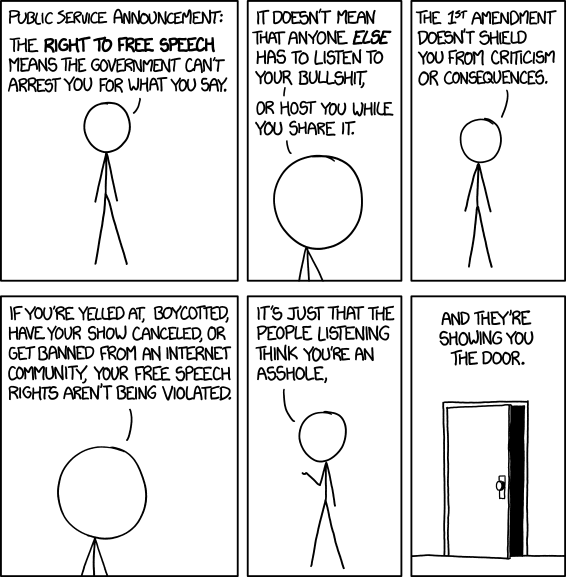
XKCD recently had a comic about the right to free speech.
Mouse over text: “I can’t remember where I heard this, but someone once said that defending a position by citing free speech is sort of the ultimate concession; you’re saying that the most compelling thing you can say for your position is that it’s not literally illegal to express.”
Technically, of course, it’s correct. But it’s a deeply disturbing view. The right to free speech has always been more than a strict legalism in American culture. It’s always been about more than just the freedom from government censorship. It has always involved a culture of tolerance. A view that not only is the government legally prohibited from regulating speech, but also that we as Americans ought to relish our chaotic, free-wheeling, marketplace of ideas. No, there’s no law that says people have to listen to you and there never should be. No, there’s no law that protects people from being free from other people telling them that they think their speech is crap. And again: there never should be. But when a bunch of people get together and use their own freedom of speech to silence someone they don’t like: it’s a violation of who we are as Americans even if it’s not technically a violation of someone’s legal rights.
Randall Munroe (author of XKCD) is right on the letter of the law, but he’s wrong on the spirit. I don’t know exactly where to draw the line, and I’m not saying we should never boycott. We have a comment policy here at Difficult Run, after all. Communities need to regulate what is and is not considered acceptable for that community. But I just wish that tolerance–real tolerance of genuinely conflicting ideas–was something that more communities would actively choose to embrace. Not because the law requires them to do so, but just because it’s the right thing to do.

 , which won the Hugo in 2006. I thought the sequel (
 ) was good, but not great. I’m listening to
  now, which was nominated for a Hugo in 2002. Turns out he’s been nominated a few more times, too (1999 and 2010), but–like I said–he’s just not a name that I hear come up often enough in discussions of great sci-fi.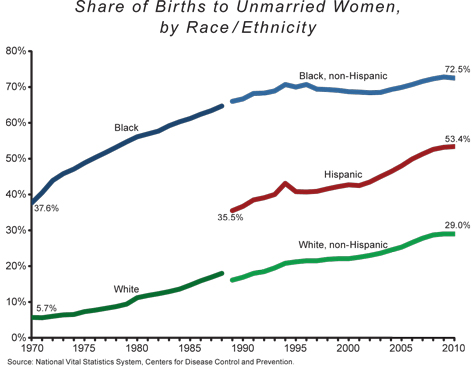


 , that describe some of the effects, but it’s really just enough for me to know that I don’t really get it. And, as a non-military guy, never will. Veterans understand something I can’t comprehend.