The Interracial Marriage Analogy

gay_marriage

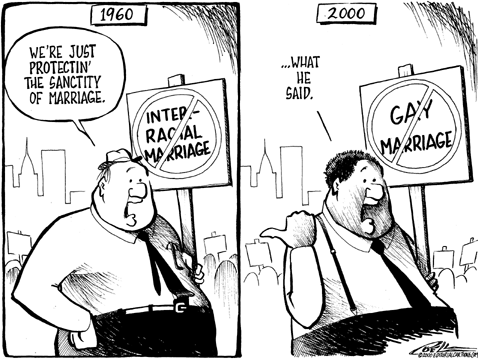
The Atlantic has a recent piece contrasting the claims that to opposition same-sex marriage is just like previous opposition to interracial marriage. This allows those favoring gay marriage to see their cause as similar to that of the Civil Rights Movement, while simultaneously painting their opponents as bigots on par with the Jim Crow South. The author of the piece (who supports equal marriage rights for gays) writes,

Opposition to interracial marriage was all but synonymous with a belief in the superiority of one race and the inferiority of another. (In fact, it was inextricably tied to a singularly insidious ideology of white supremacy and black subjugation that has done more damage to America and its people than anything else, and that ranks among the most obscene crimes in history.) Opposition to gay marriage can be rooted in the insidious belief that gays are inferior, but it’s also commonly rooted in the much-less-problematic belief that marriage is a procreative institution, not one meant to join couples for love and companionship alone. That’s why it’s wrong to stigmatize all opponents of gay marriage as bigots…Opposition to interracial marriage never included a large contingency that was happy to endorse the legality of black men and white women having sex with one another, living together, raising children together, and sharing domestic-partner benefits as long as they didn’t call it a marriage.

The author finds the arguments of same-sex marriage opponents unpersuasive, but not necessarily bigoted (though some certainly are). Of course, the claim that the analogy doesn’t work isn’t new. It just doesn’t show up very often in popular media outlets like The Atlantic. In fact, philosopher Francis Beckwith of Baylor University had an essay a few years ago analyzing the analogy. He found that there was no ban on interracial marriage at common law. This “means that anti-miscegenation laws were not part of the jurisprudence that American law inherited from the English courts. Anti-miscegenation laws were statutory in America (though never in England2), first appearing in Maryland in 1661 after the institution of the enslavement of Africans on American soil. This means that interracial marriage was a common-law liberty that can only be overturned by legislation.” Anti-miscegenation laws were also diverse throughout different regions, ranging from indictments against whites marrying blacks, Mongolians, Malayans, mulatto, and even American Indians. “The overwhelming consensus among scholars,” explains Beckwith, “is that the reason for these laws was to enforce racial purity, an idea that begins its cultural ascendancy with the commencement of race-based slavery of Africans in early 17th-century America and eventually receives the imprimatur of “science” when the eugenics movement comes of age in the late 19th and early 20th centuries.” It is often forgotten that Loving vs. Virginia overturned the eugenics-based Racial Integrity Act of 1924. This is why the interracial marriage analogy is so problematic:
o_brother_pardoned-151For if the purpose of anti-miscegenation laws was racial purity, such a purpose only makes sense if people of different races have the ability by nature to marry each other. And given the fact that such marriages were a common law liberty, the anti-miscegenation laws presuppose this truth. But opponents of same-sex marriage ground their viewpoint in precisely the opposite belief: people of the same gender do not have the ability by nature to marry each other since gender complementarity is a necessary condition for marriage. Supporters of anti-miscegenation laws believed in their cause precisely because they understood that when male and female are joined in matrimony they may beget racially-mixed progeny, and these children, along with their parents, will participate in civil society and influence its cultural trajectory. In other words, the fact that a man and a woman from different races were biologically and metaphysically capable of marrying each other, building families, and living among the general population is precisely why the race purists wanted to forbid such unions by the force of law.

Beckwith concludes by acknowledging that there are “plenty” of “other arguments for same-sex marriage other than the anti-miscegenation analogy…some of which are serious challenges to the common-law understanding of marriage as requiring gender complementarity.”[ref]One of the best arguments I’ve read in favor of same-sex marriage (which has been highly influential on my own thinking) comes from William & Mary law professor Nate Oman: http://docs.google.com/file/d/0Bxii2wEOc220cDV5SGVQdFlidGc/edit?pli=1[/ref] However, “once one understands the purpose of the anti-miscegenation laws and their relation to the common law understanding of marriage, the analogy not only breaks down, but may actually work against the case for same-sex marriage.”

There are better reasons for supporting same-sex marriage than false analogies. Let’s stick with those, shall we?


Are Christians Obsessed with Sex? (First Things)

2014-04-10 Jesus Drawing in the Sand

From time to time a member of the Christian left will admonish the Christian right to stop obsessing about sex. This is a clever move because in addition to undercutting traditional sexual morality it also suggests that those who are concerned with the topic are acting on some secret ulterior motive. Voyeurism? Projection? Repression? Whatever the precise cause, it definitely sounds unhealthy.

Thus begins my post on whether or not traditional Christians are really motivated by sex-obsession in their support of traditional sexual morality. (Spoiler alert: they’re not.)

The folks at First Things thought it was interesting enough for their readers, and so that’s where it’s posted. I’m really humbled to have an outlet that I respect so much publish something I’ve written.

Climate Change Solutions

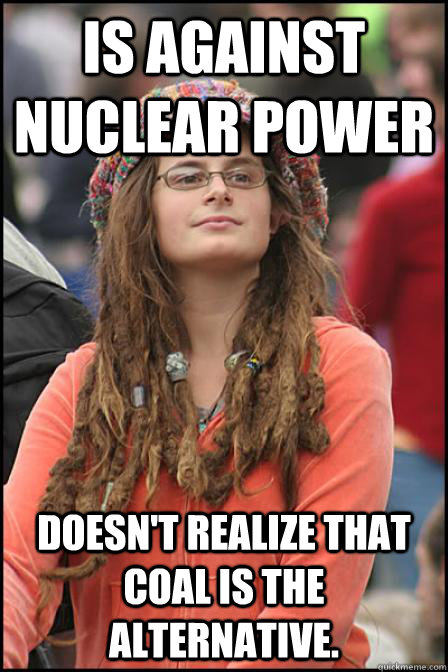
[V]irtually every major national environmental organization continues to reject nuclear energy, even after four leading climate scientists wrote them an open letter last fall, imploring them to embrace the technology as a key climate solution. Together with catastrophic rhetoric, the rejection of technologies like nuclear and natural gas by environmental groups is most likely feeding the perception among many that climate change is being exaggerated. After all, if climate change is a planetary emergency, why take nuclear and natural gas off the table?

While the urgency that motivates exaggerated claims is understandable, turning down the rhetoric and embracing solutions like nuclear energy will better serve efforts to slow global warming.

So concludes an excellent op-ed in The New York Times. I remember reading in The Economist a couple years ago that America’s CO2 emissions had decreased largely due to fracking and the shale gas boom. Yet, many environmentalists continue to object to both natural gas and nuclear power as solutions to climate change.

Just one more reason why I think a serious scientific issue has been hijacked by political agendas.

Does the Internet Erode Religion?

2014-04-10 Beam of Light

New research has found a significant correlation between time spent online and decline in religious affiliation over the past few decades. Correlation is not causation, as the article points out, but the research feels that the relationship is causal based on the fact that most other possible factors have already been controlled for. These statistics are not iron-clad, but let’s assume for the moment that they are true. What should we conclude?

Although the article does not suggest this, the standard assumption is that when people go online they will find out uncomfortable truths about their religion that they were not taught growing up, and that this will have a double-impact that drives them away from their faith. First, the new information is intrinsically troubling. Second, the fact that they didn’t learn about it creates a sense of betrayal. (This theory is widely known among Mormons.)  There’s a corollary to this which states simply that religion is kind of dumb and irrational, and so the more educated people are, the less religious they become. (That correlation is also well-known.) So perhaps the Internet is just educating people to a sufficient point where they outgrow religion.

I feel like I should pause for laughter at this point, as everyone spends a couple of moments thinking about what most actual Internet usage is like. Aside from Wikipedia, it’s basically lolcats, porn, and pointless political debates. Not exactly a crash-course in human intellectual history.

So I don’t take seriously the “Internet makes people too smart for religion” theory, but I do think that the “Internet airs religion’s dirty laundry” theory is worthy of consideration. But it’s still a matter of interpretation. The superficial response, of course, might be that more knowledge is always better and so people learn more and ditch religion and they should. But, thinking again of the Mormon intellectual community as a model again, one thing I’ve noticed is that there tend to be three levels of knowledge about religion.

  1. The Surface
    Folks at the surface really don’t know much about their religion at all, and as a result they are not really troubled by it. Conversely, they are probably not comforted by it either, at least on an intellectual level, although the emotional resilience of tradition can still be important and beneficial.
  2. The Mantle
    Go down beneath the surface, and things start to look weird and uncomfortable. As a simple example: folks who are born and raised in a particular faith almost always undergo a kind of cognitive vertigo when they one day see traditions and assumptions that they had taken for granted through the eyes of an outsider. All religions are kind of weird, just like all families are kind of weird, and this can easily lead to a sense of disenchantment and disassociation.
  3. The Core
    A lot of folks get as far as the mantle and decide that they have had enough, but other folks press deeper. They realize, for example, that their religion is weird to other traditions not because it has some defect, but just because everything that is foreign seems weird. Properly contextualized, that ceases to be an irritant and can even become comforting, the same way that we can treasure our family traditions even after we realize that they may have no real rational basis. These guys dig deeper into their respective traditions, unearth the problems, but then also find gems and insights that (for them) are worth the trouble.

In other words, even if we assume that the Internet is exposing people to a host of uncomfortable truths about their faiths[ref]And let’s be honest, that’s pretty generous given a lot of the conspiracy theory nonsense that is also out there about all religions.[/ref] there’s already a religious concept for that experience: the refiner’s fire. Nietzsche may be an odd source of comfort for the religious, but the old “whatever doesn’t kill you” line is actually probably more true of ideas than it is of people.

There’s a really ugly way this theory can be applied. You could say that the folks who don’t stick around are too weak or ignorant to handle the fire, and so good riddance. That’s taking the metaphor too far, however. I don’t buy into the judgmentalism behind it (we can’t really know the reason people have for leaving or for staying), nor the superiority behind it (notice that I didn’t specify any particular denomination or faith tradition, for example), nor the mean-spiritedness behind it.

All I’m saying is that sometimes the folks who have to struggle to retain or regain their faith are the ones who realize more than anyone else exactly what it is they have.

Book Review: Authoring the Old Testament

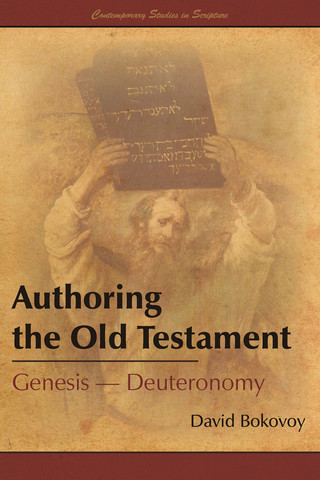
I had the opportunity to read and review David Bokovoy‘s (Ph.D., Hebrew Bible and the Ancient Near East) new book Authoring the Old Testament: Genesis – Deuteronomy for Greg Kofford Books over at Worlds Without End. The book description is as follows:

For the last two centuries, biblical scholars have made discoveries and insights about the Old Testament that have greatly changed the way in which the authorship of these ancient scriptures has been understood. In the first of three volumes spanning the entire Hebrew Bible, David Bokovoy dives into the Pentateuch, showing how and why textual criticism has led biblical scholars today to understand the first five books of the Bible as an amalgamation of multiple texts into a single, though often complicated narrative; and he discusses what implications those have for Latter-day Saint understandings of the Bible and modern scripture.

This is an incredible book for those interested in biblical studies, especially Latter-day Saints. Check out it out.

VR is Sexist

Games Game Developers Conference

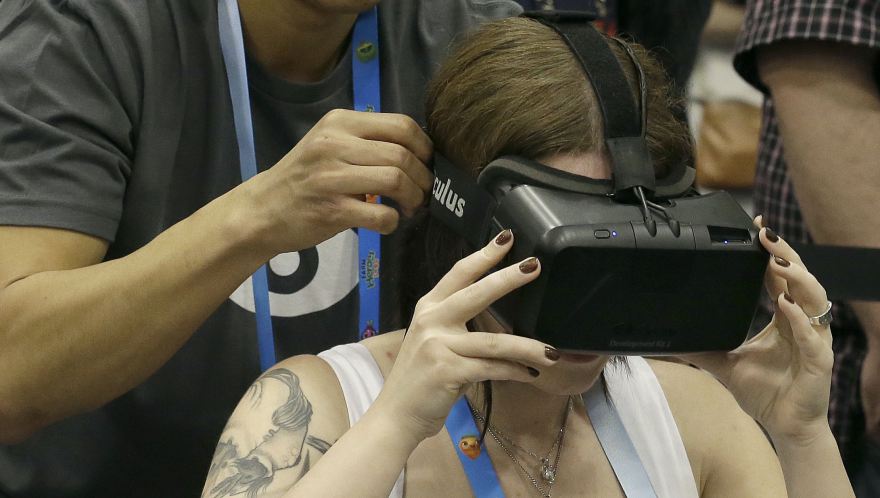
It’s always interesting to check the correspondence between the headline of an article and it’s URL. In this case, the headline reads: “Is the Oculus Rift sexist?” and the URL includes: “is-the-oculus-rift-designed-to-be-sexist/.” That nuance, that it is designed to be sexist, is going to be important as we delve into this story and ask ourselves this simple question: where do we reach the point where silliness outweighs legitimacy in the discrimination olympics?

So here’s the first fact: virtual reality (like the Occulus Rift) tends to make some people hurl. In fact, a major design point for the upcoming Occulus Rift has been to figure out how to alleviate headaches and nausea that can arise with use. And here’s the second: women tend to react much more to VR then men. But does it really make sense to fling around the term “sexist”? Danah Boyd, who wrote the piece for Quartz, clearly thinks so:

That’s when a friend of mine stumbled over a footnote in an esoteric army report about simulator sickness in virtual environments. Sure enough, military researchers had noticed that women seemed to get sick at higher rates in simulators than men. While they seemed to be able to eventually adjust to the simulator, they would then get sick again when switching back into reality. Being an activist and a troublemaker, I walked straight into the office of the head CAVE[ref]Cave Automatic Virtual Environment, a 1997-era VR technology[/ref] researcher and declared the CAVE sexist.

So, to be clear, we’re now declaring inanimate objects to be sexist.

But wait, is this just short-hand for calling the designers sexist? If someone makes a technology that is designed to make women spew chunks, but not men, that would indeed register as “sexist” in my book. But what’s actually going on?

Based on some interesting research, Boyd concludes that men and women process two different cues for depth perception differently. Men rely on motion-parallax, which basically means that closer things move more than things that are far away. Look at the way the clouds in this video (the most distant) move the slowest vs. the tubes (the closest) which move the fastest. That’s parallax.

Women, by contrast, tend to rely more on “shape-from-shading,” which Boyd describes as “a bit trickier.” She goes on to describe it:

If you stare at a point on an object in front of you and then move your head around, you’ll notice that the shading of that point changes ever so slightly depending on the lighting around you. The funny thing is that your eyes actually flicker constantly, recalculating the tiny differences in shading, and your brain uses that information to judge how far away the object is.

It’s not just trickier to describe, however. It’s also much trickier to implement. This is obvious to anyone who knows even a little bit about computer graphics (lighting is hard!) and Boyd agrees:

It’s super easy—if you determine the focal point and do your linear matrix transformations accurately, which for a computer is a piece of cake—to render motion parallax properly. Shape-from-shading is a different beast. Although techniques for shading 3D models have greatly improved over the last two decades—a computer can now render an object as if it were lit by a complex collection of light sources of all shapes and colors—what they they can’t do is simulate how that tiny, constant flickering of your eyes affects the shading you perceive. As a result, 3D graphics does a terrible job of truly emulating shape-from-shading.

So that’s my problem with calling VR “sexist”. The problem isn’t, or at least isn’t primarily, that you’ve got a bunch of dudes who don’t care what women need and/or enjoy excluding women. The problem is that the kind of technology that men react to is computationally easier than the kind that women react to. I’m all for recognizing that fact and working to mitigate it. Now that Facebook owns Occulus I think there’s no doubt that they are going to work hard to get to the bottom of that because you don’t want to alienate half your market. (When Occulus was a hardcore gaming device there may have been a perception that this wasn’t as important. Not anymore.)

I don’t mean to chalk this up to Boyd’s hyperventilating victim-complex. I know that editors choose headlines, and her concluding paragraphs are quite reasonable. But calling the technology itself sexist? Alleging, as the URL does, that it was designed that way? Come on, people. It’s getting silly.

Gender Occupational Fatality Gap

Economist Mark Perry has a rather different take on the gender wage gap:

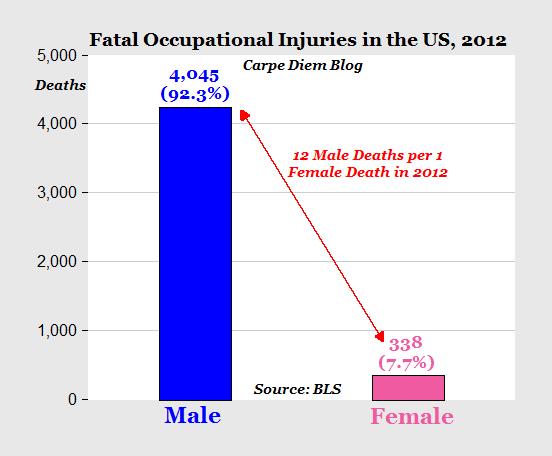
Economic theory tells us that the “gender occupational fatality gap” explains part of the “gender pay gap” because a disproportionate number of men work in higher-risk, but higher-paid occupations like coal mining (almost 100 % male), fire fighters (96.6% male), police officers (84.8% male), correctional officers (72% male), farming, fishing, and forestry (77.3% male), roofers (98.5% male) and construction (97.5% male); BLS data here. On the other hand, a disproportionate number of women work in relatively low-risk industries, often with lower pay to partially compensate for the safer, more comfortable indoor office environments in occupations like office and administrative support (73.3% female), education, training, and library occupations (73.6% female), and healthcare (75% female). The higher concentrations of men in riskier occupations with greater occurrences of workplace injuries and fatalities suggest that more men than women are willing to expose themselves to work-related injury or death in exchange for higher wages. In contrast, women more than men prefer lower risk occupations with greater workplace safety, and are frequently willing to accept lower wages for the reduced probability of work-related injury or death.

In a recent debate, feminist Camille Paglia made a similar point:

Indeed, men are absolutely indispensable right now, invisible as it is to most feminists, who seem blind to the infrastructure that makes their own work lives possible. It is overwhelmingly men who do the dirty, dangerous work of building roads, pouring concrete, laying bricks, tarring roofs, hanging electric wires, excavating natural gas and sewage lines, cutting and clearing trees, and bulldozing the landscape for housing developments.  It is men who heft and weld the giant steel beams that frame our office buildings, and it is men who do the hair-raising work of insetting and sealing the finely tempered plate-glass windows of skyscrapers 50 stories tall.  Every day along the Delaware River in Philadelphia, one can watch the passage of vast oil tankers and towering cargo ships arriving from all over the world.  These stately colossi are loaded, steered, and off-loaded by men. The modern economy, with its vast production and distribution network, is a male epic, in which women have found a productive role–but women were not its author.

I’ve adjusted for hours worked (full-time vs. part-time), education choices, job choices, time off, etc. when analyzing the gender wage gap. Can’t say I’ve ever taken fatalities into consideration.

Minimum Wage Hikes Herald Our Robot Overlords

2014-04-08 Robots

We’ve written critically about the proposal to raise the minimum wage here at Difficult Run before. (Quite a lot, in fact.) In one of the first pieces I wrote back in February I pointed out that there are basically three criticisms of the minimum wage hikes.

  1. By raising the cost of labor, they eliminate jobs.
  2. The benefits tend to go towards families that aren’t poor.
  3. There are much better alternatives (like the EITC).

The minimum wage is not the most evil policy in the history of the world, obviously, but I really loathe it because it’s so obviously a bad idea and therefore the only reason it gets advanced is either because politicians are negligent or are intentionally exploiting public ignorance about how bad of a policy it is. If we can’t stop a policy like minimum wage, what hope do we have of rational policy in general?

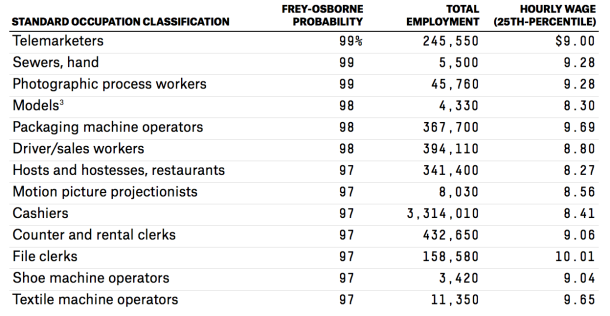
There’s one more aspect to the debate, however, and that is the fact that as the price of human labor raises, the likelihood of replacing their jobs with robots increases as well. That’s the gist of a new post from Nate Silver’s 538 website: The Shift From Low-Wage Worker to Robot Worker. The article covers recent research by economists trying to see which jobs are most vulnerable to being replaced by robots. The short version? Millions of low-wage jobs are incredibly vulnerable to being replaced by robots.

2014-04-08 Minimum Wage Jobs

These probabilities are estimated over a 20-year window, but the trend is clear: millions of American jobs are at risk of automation. In the long run, this is a good thing. In the long run, we don’t want anyone to have to do dull, repetitive, simple work just to put food on the table. In the long run, it would be great if all people worked relatively complex jobs that required minimal physical pain and injury and maximal creativity. The question is how we transition from where we are now. We need a gradual transition accompanied by ample educational opportunities. What we absolutely do not need is an artificial increase in the price of labor. Raising the minimum wage might be good politics, but it’s absolutely terrible policy. In addition to the three problems noted above, it can only serve to make the transition more rather than less gradual.

Cut Off By Technology?

Criticisms of iPhones, Facebook, the Internet, etc. have been around for years. The complaint is often along the lines of “texting is destroying language” or “kids these days are antisocial because all they do is play on their phones.” People have been making strikingly similar claims for centuries and it has never really come to pass. My own skepticism of these claims and those similar emerged when I read science writer Steven Johnson’s Everything Bad Is Good For You: How Today’s Popular Culture Is Actually Making Us Smarter. Plus, even if the criticisms were true, the benefits of these new technologies seem to far outweigh the costs.

An article from the Greater Good Science Center at the University of California, Berkeley explores several recent studies that analyze the connection between technology and social capital. The conclusion?:

Taken together, these three studies hint at a compelling story—that social networking services can be a significant way of developing, maintaining, and strengthening our social connections, both online and in person. Using social networking services builds social capital in a number of ways: greater emotional support, lower levels of loneliness, and more feelings of connectedness. But these studies also contain a note of caution: Too many followers and too much participation can lead to information overload, depression, and feelings of disconnectedness.

The bottom line? I’m going to keep my iPhone and my Facebook account—but I think I’ll also keep setting limits.

Check it out.