 My friend Tyler Andersen recently completed his MA in Rhetorical Studies at Idaho State University. His graduate paper explored the theology of German Lutheran pastor Dietrich Bonhoeffer–who was hanged by the Nazis for his involvement in a conspiracy to assassinate Hitler–through the lens of rhetorical devices ethos, logos, and pathos. The paper is titled “Ein Festre Burg: Dietrich Bonhoeffer’s Use of Theology as Rhetoric.” As an admirer of Bonhoeffer (I have to agree with Tyler that he was “a god among men”), I was thoroughly impressed with the paper. Be sure to check it out. Tyler notes that Bonhoeffer is “little known outside theological seminars and niche academic circles” (pg. 2). We should all become more familiar with this man.
More Cronyism, or: How America Won’t Get Broadband

After making a big, bold promise to wire every corner of America, the telecom giants are running away from their vow to provide nationwide broadband service by 2020. For almost 20 years, AT&T, Verizon and the other big players have collected hundreds of billions of dollars through rate increases and surcharges to finance that ambitious plan, but after wiring the high-density big cities, they now say it’s too expensive to connect the rest of the country. But they’d like to keep all that money they banked for the project.
Of course they would.
I picked this article because it’s another example of the split between the interests of big business (read: cronyism) and the interests of folks on the right. As we all know, one (slightly oversimplified) way of looking at the political spectrum in American is urban vs. rural, with rural folks being on the conservative end of the spectrum. So it’s these guys who stand to lose the most when big telecoms lobby to get laws rewritten so they won’t have to run high-speed broadband out to smaller, less-dense areas of the country.
Oh, and Chris Christie shows up again:
And this isn’t bad news for just Montana and North Dakota. The Eastern Seaboard is getting smacked as well. Verizon has made a tentative deal with New Jersey Governor Chris Christie’s administration to stop expanding its FiOS Internet service in that state. The terms would deny access forever to many small businesses and residences. Verizon declined to make anyone available for an interview.
Thanks, Christie, for once again illustrating the difference between cronyism and capitalism. (We covered the Tesla shut-down earlier.)
500+ Economists Against Raising Labor Costs
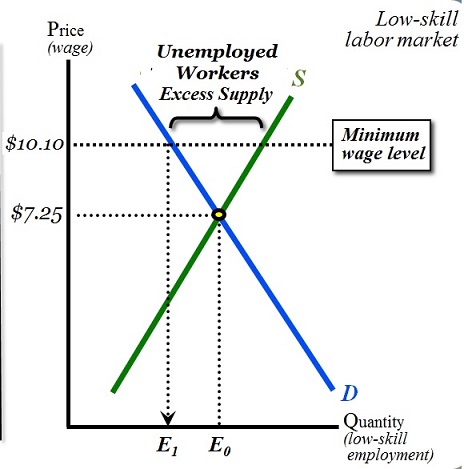 Over 500 economists (including three Nobel laureates) have signed a letter to “Federal Policy Makers” arguing that hiking the minimum wage would be damaging to job creation and the economy:*
As economists, we understand the fragile nature of this recovery and the dire financial realities of the nearly 50 million Americans living in poverty. To alleviate these burdens for families and improve our local, regional, and national economies, we need a mix of solutions that encourage employment, business creation, and boost earnings rather than across-the-board mandates that raise the cost of labor. One of the serious consequences of raising the minimum wage is that business owners saddled with a higher cost of labor will need to cut costs, or pass the increase to their consumers in order to make ends meet. Many of the businesses that pay their workers minimum wage operate on extremely tight profit margins, with any increase in the cost of labor threatening this delicate balance…For these reasons, we encourage federal policymakers to examine creative, comprehensive policy solutions that truly help address poverty, boost incomes from work, and increase upward mobility by fostering growth in our nation’s economy.
Check it out.
How Sensitive is Phone Metadata? Very.
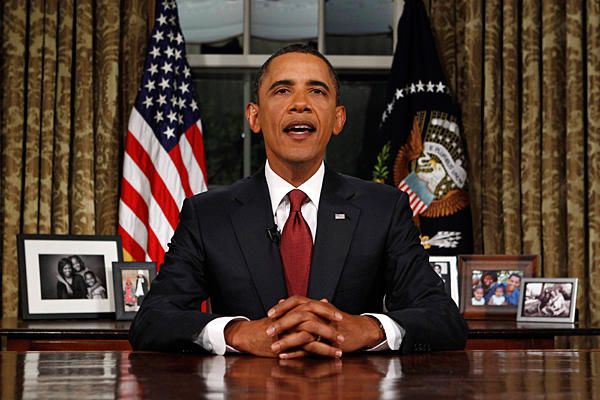
President Obama, assuring people that NSA vacuuming up huge amounts of phone metadata isn’t as creepy as it sounds:
When it comes to telephone calls, nobody is listening to your telephone calls. That’s not what this program is about. As was indicated, what the intelligence community is doing is looking at phone numbers and durations of calls. They are not looking at people’s names, and they’re not looking at content. But by sifting through this so-called metadata, they may identify potential leads with respect to folks who might engage in terrorism. If these folks — if the intelligence community then actually wants to listen to a phone call, they’ve got to go back to a federal judge, just like they would in a criminal investigation.
So I want to be very clear — some of the hype that we’ve been hearing over the last day or so — nobody is listening to the content of people’s phone calls. This program, by the way, is fully overseen not just by Congress, but by the FISA Court — a court specially put together to evaluate classified programs to make sure that the executive branch, or government generally, is not abusing them, and that it’s being carried out consistent with the Constitution and rule of law.
And so, not only does that court authorize the initial gathering of data, but — I want to repeat — if anybody in government wanted to go further than just that top-line data and want to, for example, listen to Jackie Calmes’ phone call, they would have to go back to a federal judge and indicate why, in fact, they were doing further probing.
You got that? They are only getting metadata. No big deal, right? If they really want the juicy goods, then they’ve got to go back to a federal judge. This argument rests on the premise that phone metadata is not, in and of itself, highly sensitive data. Which, when you think about it, is not really a hypothetical or philosophical question. It’s an empirical one. It’s something you could test. So… what kind of info can you glean from a person’s metadata?
The folks at Web Policy set out to answer the question. They used metadata gathered from a small number of volunteers over just a few months to see what they could learn about those volunteers looking only at metadta. Turns out, they could learn quite a lot.
The degree of sensitivity among contacts took us aback. Participants had calls with Alcoholics Anonymous, gun stores, NARAL Pro-Choice, labor unions, divorce lawyers, sexually transmitted disease clinics, a Canadian import pharmacy, strip clubs, and much more. This was not a hypothetical parade of horribles. These were simple inferences, about real phone users, that could trivially be made on a large scale.
This, ladies and gentlemen, is the kind of information your government can collect on you without a warrant or notification or really any restriction of any kind. But that’s not all.
- Participant A communicated with multiple local neurology groups, a specialty pharmacy, a rare condition management service, and a hotline for a pharmaceutical used solely to treat relapsing multiple sclerosis.
- Participant B spoke at length with cardiologists at a major medical center, talked briefly with a medical laboratory, received calls from a pharmacy, and placed short calls to a home reporting hotline for a medical device used to monitor cardiac arrhythmia.
- Participant C made a number of calls to a firearm store that specializes in the AR semiautomatic rifle platform. They also spoke at length with customer service for a firearm manufacturer that produces an AR line.
- In a span of three weeks, Participant D contacted a home improvement store, locksmiths, a hydroponics dealer, and a head shop.
- Participant E had a long, early morning call with her sister. Two days later, she placed a series of calls to the local Planned Parenthood location. She placed brief additional calls two weeks later, and made a final call a month after.
Nothing to worry about, right? It’s just metadata, after all. It’s not like they’re listening to your calls, or something.
Agents of S.H.I.E.L.D. isn’t Firefly 2.0
As any Browncoat knows, you can’t stop the signal. You can, however, try to hijack it. Before the end of the first episode of Agents of S.H.I.E.L.D., I realized that that was exactly what was going on. I’m definitely not the first person to notice the strong parallels between Agents and Firefly. This excellent piece at ScreenRant dives right into the similarities… and why they don’t work. I largely agree with everything Andrew Dyce says in it, but I want to hone in on just the characters themselves, rather than also talking about plot, setting, and theme.
The ensemble cast (9 stars!) was the heart and soul of Firefly, but it was also the show’s Achilles’ heel, because having a lot of characters makes it harder for the audience to invest in the characters. This is partially because each individual character gets less time-per-episode, but there’s more to it than that.
In a show like Firefly, the audience gets to know the characters through their interactions with each other. To really know the group, we have to know how every member of that group relates to every single other member. Which means that it’s not characters that we have to worry about, it’s relationships. And the number of relationships in a group grows much faster than the number of individuals in the group.
This is a basic finding from network theory, but we can skip the theory and go straight to the pictures. In this illustration, taken from Wikipedia, imagine that every dot is a character, and every line connecting two dots is a relationship.
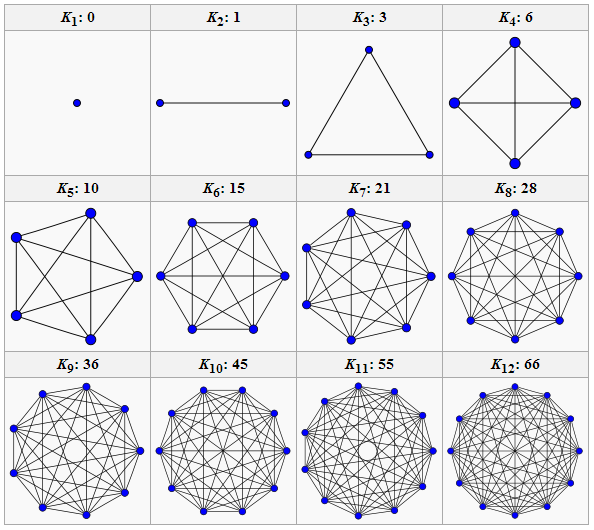
Small groups have very few relationships. You have to get up to three people in a group before you have three relationships to keep track of. But from that point on, the number of relationships grows much faster than the number of people being added to the group. Agents has six characters, so there are 15 relationships to keep track of. Firefly, on the other hand, had nine characters, which means there are 36 relationships to keep track of. This means that the cast of Firefly is more than twice as hard to get to know than the cast of Agents.
This isn’t just some random mathematical excursion, either. Social dynamics are a fundamental part of what makes us human. Some evolutionary biologists believe that one of the defining characteristics of the human brain is the ability to keep track of larger social groups than other primates. This is called the social brain hypothesis, and it was first promoted by Robin Dunbar. He argued that humans can only track a finite number of total, real-life relationships (most modern estimates say about 150), and this number became known as Dunbar’s number. In the real world, Dunbar’s number meant that our ancestors could congregate in much larger groups than chimpanzees, which allowed them to specialize and survive and (according to the hypothesis) could have created a feedback loop of increasing intelligence that led to modern humanity. The point is that we’re social animals, and there’s no reason to think that this doesn’t also apply to art.
This means that narrative with a lot of characters has the potential to be particularly engaging for us, but that it’s also harder to pull off. The story has to be good enough to keep people engaged long enough to have a chance to learn the relationships, and it also has to actually depict all the important relationships.
This isn’t a comprehensive theory of narrative, or anything. There’s a lot more to the story. Harry Potter is an incredibly engrossing narrative, and it only has 3 core relationships (between Harry, Ron, and Hermione) but a lot of the depth there comes from how those relationships change over time. (It’s partially a coming-of-age story, after all.) Game of Thrones has literally dozens and dozens of important characters, and there’s no way the books (let alone show) could hope to describe how every single person relates to every single other person, but that’s fine. The characters in Game of Throne are divided into factions and separated by geography, so it makes sense to have a very incomplete graph: not all the dots are going to have lines between them. But Firefly is a show about 9 people who all live together, and in that context we’re going to want to know how everyone relates to everyone else. Similarly, Agents has 6 people all living together, and so we can do a sort of apples-to-apples comparison between those two shows, even if we can’t generalize the analysis to every other book, movie, or TV show in existence.
So the point is that Firefly had a lot of relationships, and if you watch the shows in order that’s awesome because the story is good enough to keep you hooked, and then the episodes flesh out all the relationships. Which is great, right up until Fox decides to show the episodes out of order and to not even bother airing the premier.
Now, the lesson we Browncoats took from this is simple: air the episodes in the order they were written! TV execs probably saw things differently, however. Rather than fuss with shows that are highly sensitive to viewing-order, you’d want to try and re-engineer the show to be less sensitive. With or without my fancy network diagrams, it’s not really rocket science to realize that the simplest way to do that is to have fewer characters.
Which brings us to Agents as Firefly Lite: they basically took the exact same characters and downsized them from nine to just five[ref]Yes, just five. You’ll see.[/ref] Here’s how they did it:
Mal vs. Agent Coulson
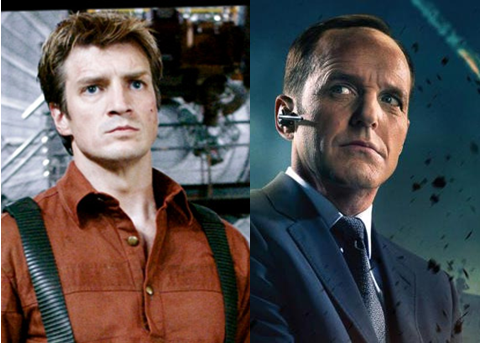
This one is pretty obvious: older, white, father figure who was mysteriously and powerfully changed by some violent, traumatic event in his past. He loves his crew, but maintains a degree of emotional distance and detachment, attributes that serve him well as the unquestioned and unrivaled leader.
Zoe vs. The Cavalry
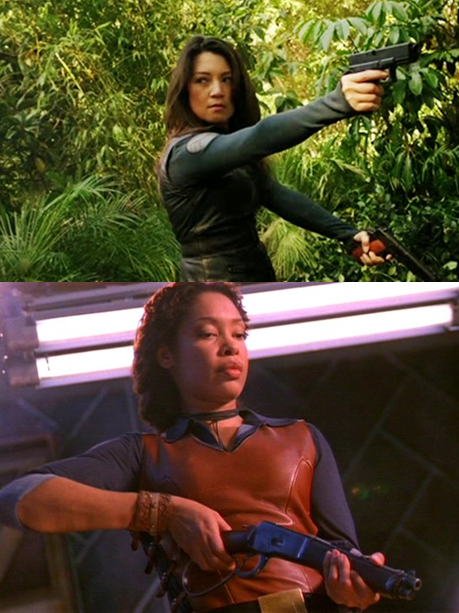
Next up we have the captain’s right-hand woman. She is staunchly loyal to the captain and they have a military history together, but there is absolutely no spark of romance whatsoever. Competent and resolute, she is the consummate professional fighter, but deep down she also bears the scars of loss and injury.
Kaylee vs. Fitz & Simmons

This is the most likeable and relatable character in the crew. We have a scientifically brilliant character who’s skills are without parallel and who has the technical know-how to save the crew on more than one occasion, but also a person who is in no way suited for combat and tends to wilt under threat of violence.
And yes, I am treating Fitz and Simmons as one character. This is because the thing that matters the most for this analysis is the relationship between characters, and the sibling relationship is so well-known that it doesn’t need to be explored or explained.
Jayne vs. Agent Ward
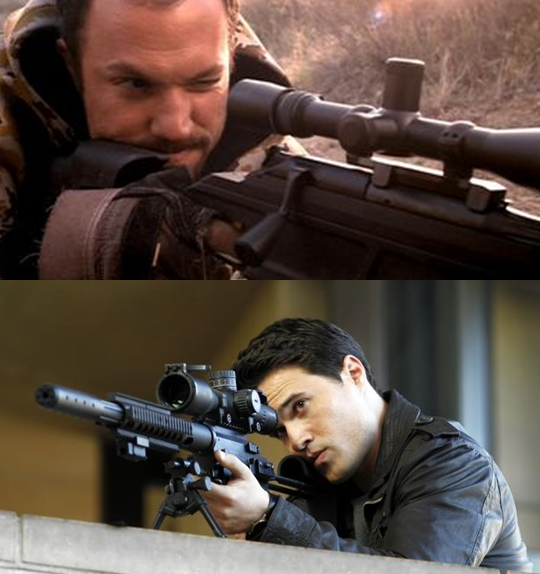
Here we have the muscle of the team. With nothing like the professional technique of the leader’s right-hand woman, the muscle is more an avatar of brute aggression and male assertiveness. Sexually avaricious, self-centered and emotionally stunted, the muscle can be relied on to rescue the team when needed, but usually grudgingly.
River & Simon vs. Skye

Here we have the most recent edition to the crew. This character is viewed with suspicion and a little resentment by everyone else because they arrived late, brought an unknown past, display a troubled personality, and still have murky ties to a mysterious organization that could threaten the whole crew. On the other hand, the character is vulnerable and needs their help and also possess a rare and highly specialized skill. Technical wizardry is great, but it sort of comes with the territory. Your very own top-tier trauma surgeon / hacker? That’s not something that comes standard for a group like this.
You’ll also note that, once again, I’m treating siblings like a single character because from the standpoint of intra-group relationships, the sibling relationship is more of a surplus to be tapped than a vacuum waiting to be filled.
MIA: Book, Inara, and Wash
So let’s talk about the crew of the Firefly that didn’t make the cut: Book, Inara, and Wash. Without doubt, these three characters were the most peripheral. After all, entire episodes took place with literally no input from Book and Inara, and when Serenity opens neither one of them is even onboard the ship anymore. Wash, for his part, ends up gutted on the end of a giant Reaver harpoon-type-thing, so none of them are actually present for the entire show.
They also, at times, fill overlapping roles. Book serves as the conscience of the crew sometimes, but Whedon often preferred to have the religious character ironically rudderless. In those cases, or when the Shepherd was off-camera, either Wash or Inara could also step up to fill that role.
And yet, they also each brought their own, irreplaceable element to the story. Book and Inara served to really flesh out Mal’s character, which is important because otherwise his relationship with the rest of the crew was a little formal and strained. Inara, as the love interest, and Book, as the mentor, showed a vulnerable and relatable side of Mal that made him much, much more compelling and relatable as a character. Wash, filled a similar role for Zoe, adding unexpected depth to her otherwise stoic façade. More than that, however, he served as the source of fun and humor for the crew. Not for the audience, mind you, but for the actual crew. It was Wash, more than anyone else, who could diffuse tension and act as a sort of mediator for some of the other relationships.
In a lot of ways, it was these supporting characters who really made the chemistry happen. They could drop off camera for a scene or even an episode, but they were anything but dispensable. These weren’t the only characters that Agents tried to get away without, however. There’s one more.
Serenity vs. The Bus

Outwardly there’s nothing subtle about this comparison. Serenity is a big, flying ship that is home to the entire crew. The Bus is a big, flying ship that is home to the entire crew. They perform pretty much exactly the same function, they look sort of similar, and they even both feature prominent engines that can rotate for vertical take-off and landing.
Other than function, however, they couldn’t be more different. The name Serenity comes from the Battle of Serenity Valley, which was the pivotal event in the war the defined the entire ‘Verse. It’s a deeply personal name for Mal, but it means something to every single person on the ship. The Bus, on the other hand, is about as impersonal as it gets. The Bus gets you from Point A to Point B. You don’t spend a lot of time worrying about what your relationship is to it. It’s just a means to an end. Agent Coulson named one of his cars with a personal name, but not the plane they all live. It isn’t really a home, and therefore they don’t have that family dynamic.
There’s nothing impersonal about Serenity. Every character on board had his or her own unique relationship to the ship, which is why it makes sense to talk about her as a character. She represents Mal’s stubborn refusal to let go of the past even as he struggles to confront the future, a symbol of the tattered shreds of his idealism and hope. She’s like a giant, beloved children’s toy or safety blanket for Wash, and she’s a confidant and companion to Kaylee. She’s a refuge for Inara, a rare example of a relationship that gives to the Companion without asking for anything in return. She’s like a forest for the Shepherd, providing both the shelter of shade and the confusion of shadow. She’s a bunk for Jayne, but also so much more. On Serenity, Jayne gets his own bunk, and so she represents his fragile self-esteem and acceptance in a that hates him (the feeling is mutual). Even Jayne loves Serenity because everyone loves their mom. Simon might have the most tenuous relationship to Serenity, but his sister River loves the ship so much she becomes incorporeal and merges her identity with it!
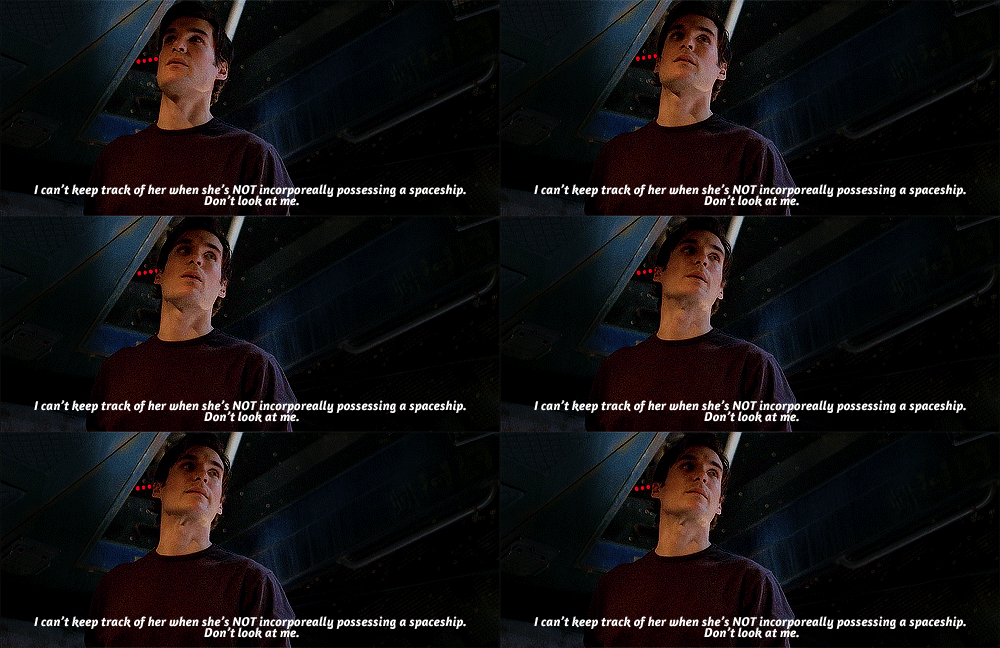
Although she doesn’t often make a big deal of if, however, it might be Zoe who has the most invested in Serenity, even if we don’t see it until after the loss of her husband at her helm.
 Getting Agents off the Ground
Lots of folks have tried to call Agents something like Firefly 2.0, but it clearly doesn’t deserve that title. A 2.0 version is supposed to be a big step forward. It’s supposed to build on the lessons of the prior iteration and offer more and better. But Agents has struggled to find its own voice while living off of borrowed magic from Firefly, and it borrowed that magic poorly. It’s not a version 2.0. It’s much more like a lite version. It took the essential heart of Firefly–a band of misfits forged into a family—and then it tried to get away with a simplified, dumbed-down version. Fewer characters and simpler group dynamics might make the show easier to understand, but it also just means that there’s a lot less to love.
With the announcing of the semi-rebranding of Agents to Agents of S.H.I.E.L.D.: Uprising, the show clearly has aspirations of finally lumbering off the ground on its own right. Some folks are pretty excited about what this means. Others are more skeptical.
I certainly wish the show the best, and I hope it succeeds in finding its own identity. I sort of doubt it will, however. Trying to launch a stripped down version of an earlier success is the definition of playing it safe, and safety is hardly ever the path to greatness.
The Slow Hunch: Aesthetically Pleasing
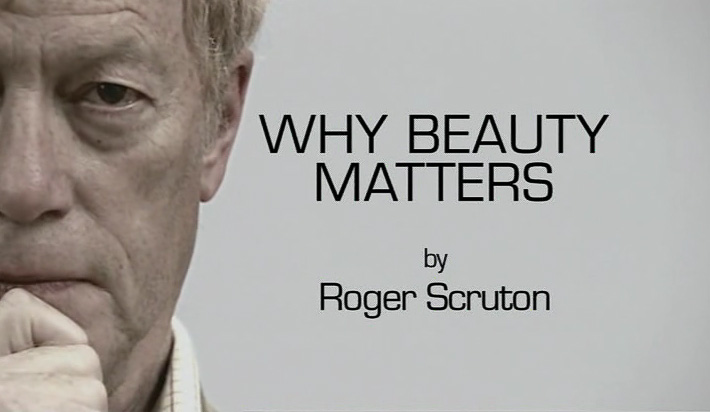
Over at The Slow Hunch, I have a post on the importance of aesthetics within organizations. I draw heavily from philosopher Roger Scruton and ICU physician and cultural historian (not mention fellow Mormon) Samuel Brown. While organizations often get the first two of the ancient triad Truth (science), Goodness (ethics), and Beauty (aesthetics) correct, the third tends to be ignored. Both organizations and the people they serve would be better off if it wasn’t.
Check it out.
New Jersey Bans Tesla: Capitalism vs. Cronyism

Capitalism and free markets are good. Cronyism is bad. Sometimes trying to explain the difference between the two to people can be hard. The one upside to the state of New Jersey effectively banning Tesla from opening any stores in their state is that at least it makes it easier for people to tell which is which. It’s also helpfully in complete and total violation of your usual expectations for a story about economic liberty:
This is a startling inversion of political stereotypes: Northern Californian capitalists quashed by East Coast Republicans defending the use of government regulations to keep competition out of the marketplace.
In a nutshell, politically powerful car dealers are trying to slam the door on Tesla before Tesla has a chance to show people that buying a car need not be a painful ordeal. Meanwhile car makers, who are often at odds with car dealers, are united to do anything they can to prevent Tesla from changing the whole landscape for car manufacturing in the US. So they are both doubling down on old, outdated laws that gave car dealers geographic monopolies back in the day when car makers had all the power.
And that, in a nutshell, is the curse of government intervention in markets. Even in those cases where it might have been valuable and necessary once upon a time, the laws will still be around decades after their original purpose has been forgotten, and there will be plenty of politically powerful elites ready to pay whatever it takes to keep those laws on the books and in force to protect their business interests. That’s not socialism, but it’s not capitalism either. It’s cronyism. Wired has the rest of the story, by the way, and it’s worth a quick read.
How Women Perceive Men With Beards
In the interests of science, researchers asked this question. Then wrote a paper in the Journal of Evolution and Human Behavior. But you don’t need to read the paper because, thanks to the Visual Communication Guy, the results have been distilled into this handy-dandy infographic.
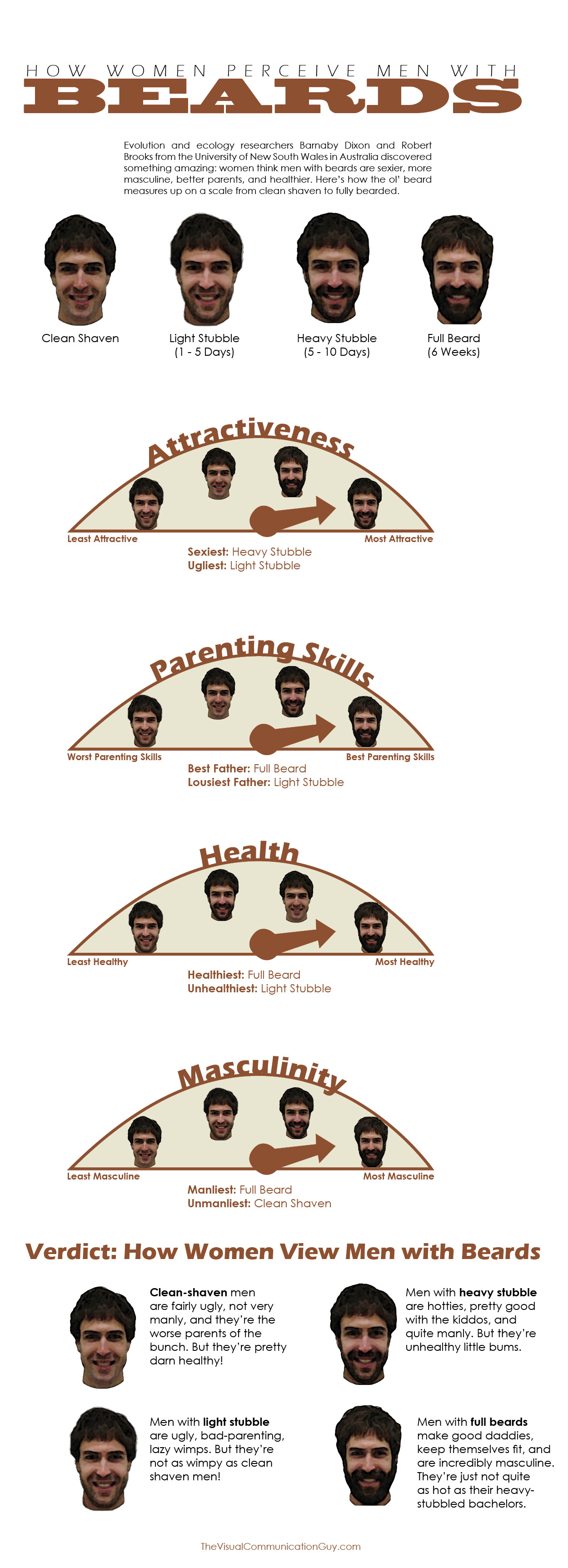
As a man with heavy stubble (based on these classifications), these results do not look too bad. Still, I wish I could grow mine out just a bit fuller…
Cultural Norms and Social Mobility
 Over at the Brookings Institution there is a fantastic post on how cultural norms affects social mobility with numerous links to pertinent research. For example:
- Neighborhood cultures that accept dropping out of high school, out-of-wedlock births, and unemployment hinder social mobility.
- These cultures often lead to obesity, smoking, and other similar habits.
- Religion is connected to greater social capital and mobility.
- Traits like saving are rooted in community cultures.
Definitely worth checking out.
How Men and Women Respond to Grades (And What It Means)
Greg Mankiw linked to a chart from a Washington Post story by Catherine Rampell: Women should embrace the B’s in college to make more later. The chart, all by itself, is arresting.
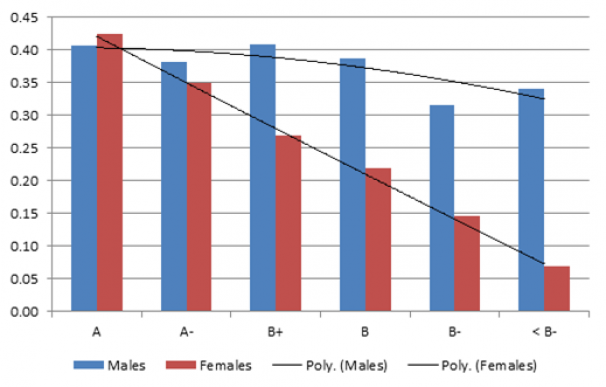
What the chart shows is that if a man gets a lower grade (a B instead of an A) in Econ 101 his chance of majoring in econ is basically unaffected. But for women, there is a very strong and obvious correlation between their grade in Econ 101 and their willingness to major in economics. Just going from an A to an A- (still an A!) drops the likelihood of majoring in econ by about 7 points, from 42% to 35%.
This is a really important finding because it could answer the question of why so few women graduate in STEM courses, despite the fact that more women start them than men. STEM courses are much harsher than humanities, and so if you’re highly responsive to grades, you’re going to abandon STEM to get a degree in something less intimidating. But STEM courses also pay more, so women are sacrificing earnings to avoid lower grades. This could have important relevance for the gender gap, because it is pretty strong evidence that it’s not just preferences that are leading women to lower-paying jobs. As Rampell writes: “If women were changing their majors because they discovered new intellectual appetites, you’d expect to see greater flows into STEM fields, too.”
For me the big question is why women react more to grades than men do. Rampell has ideas (maybe men are overconfident? maybe they just care more about future salary than about grades?) but no solid answers. My initial reaction was to think that women might be more concerned with achievement overall, but my wife pointed out that men may be perfectionists too, but in other areas. Like sports and video games. That really made me think. After all, one major reason I never did sports much in high school was that I knew I didn’t have any amazing athletic ability, so why bother? And to this day I don’t like playing StarCraft 2 online because I know I won’t have the time to get really good at it. On the other hand, I do play a lot of Call of Duty, and I’m only mediocre at that game.
So I’m curious: what do you think makes women more sensitive to grades? And what impact do you think it is having on things like the gender gap and the lack of women in STEM careers?