Economist Bryan Caplan–himself not a utilitarian–argues that a utilitarian case can be made against abortion. His four main arguments are:
“Almost everyone is glad to be alive. The unwanted infant may have a below-average quality of life, but below-average is usually excellent nonetheless.”
“There is a long waiting list – hence excess demand – to adopt healthy infants, so birth mothers need not raise their unwanted children.”
“Due to the endowment effect, unwanted children often become wanted by their birth mother once they’re born – as many would-be adoptive parents discover to their sorrow.”
“Women who just miss the legal cutoff for abortion seem to quickly recover emotionally. Pregnant women who think “A baby will ruin my life” are, on average, factually mistaken.”
Utilitarianism isn’t my favorite approach to ethics, but it can yield some fruitful insights.
Earlier this year, a new study was published in The Review of Financial Studies that “highlights the importance of middle-class and high-FICO borrowers for the mortgage crisis.” In an excellent summary by The Washington Post‘s Robert Samuelson,[ref]This is of the 2015 working paper version.[/ref] he summarizes the three main findings:
First, mortgage lending wasn’t aimed mainly at the poor. Earlier research studied lending by Zip codes and found sharp growth in poorer neighborhoods. Borrowers were assumed to reflect the average characteristics of residents in these neighborhoods. But the new study examined the actual borrowers and found this wasn’t true. They were much richer than average residents. In 2002, home buyers in these poor neighborhoods had average incomes of $63,000, double the neighborhoods’ average of $31,000.
Second, borrowers were not saddled with progressively larger mortgage debt burdens. One way of measuring this is the debt-to-income ratio: Someone with a $100,000 mortgage and $50,000 of income has a debt-to-income ratio of 2. In 2002, the mortgage-debt-to-income ratio of the poorest borrowers was 2; in 2006, it was still 2. Ratios for wealthier borrowers also remained stable during the housing boom. The essence of the boom was not that typical debt burdens shot through the roof; it was that more and more people were borrowing.
Third, the bulk of mortgage lending and losses — measured by dollar volume — occurred among middle-class and high-income borrowers. In 2006, the wealthiest 40 percent of borrowers represented 55 percent of new loans and nearly 60 percent of delinquencies (defined as payments at least 90 days overdue) in the next three years.
Remember this the next time you hear someone blaming the financial crisis on the “irresponsible poor.”
I’m currently reading through the Oxford-published volume The Bible and the Pursuit of Happiness and the second chapter “Is There Happiness in the Torah?” discusses how family life is a major aspect of “the good life” in the pre-Israel, patriarchal narratives of Genesis. This reading combined with a browsing of older saved, but never published blog posts brought out these findings on happiness and marriage from a 2015 New York Times article:
Social scientists have long known that married people tend to be happier, but they debate whether that is because marriage causes happiness or simply because happier people are more likely to get married. The new paper, published by the National Bureau of Economic Research, controlled for pre-marriage happiness levels.
It concluded that being married makes people happier and more satisfied with their lives than those who remain single – particularly during the most stressful periods, like midlife crises.
Even as fewer people are marrying, the disadvantages of remaining single have broad implications. It’s important because marriage is increasingly a force behind inequality. Stable marriages are more common among educated, high-income people, and increasingly out of reach for those who are not. That divide appears to affect not just people’s income and family stability, but also their happiness and stress levels.
…Those whose lives are most difficult could benefit most from marriage, according to the economists who wrote the new paper, John Helliwell of the Vancouver School of Economics and Shawn Grover of the Canadian Department of Finance. “Marriage may be most important when there is that stress in life and when things are going wrong,” Mr. Grover said.
For the most part, this is true worldwide (the exceptions are Latin America, South Asia and sub-Saharan Africa). “Though some social scientists have argued that happiness levels are innate,” the article continues,
so people return to their natural level of well-being after joyful or upsetting events, the researchers found that the benefits of marriage persist.
One reason for that might be the role of friendship within marriage. Those who consider their spouse or partner to be their best friend get about twice as much life satisfaction from marriage as others, the study found.
…The benefits of marital friendship are most vivid during middle age, when people tend to experience a dip in life satisfaction, largely because career and family demands apply the most stress then. Those who are married, the new paper found, have much shallower dips – even in regions where marriage does not have an overall positive effect.
Seems like the patriarchal narratives might be on to something.
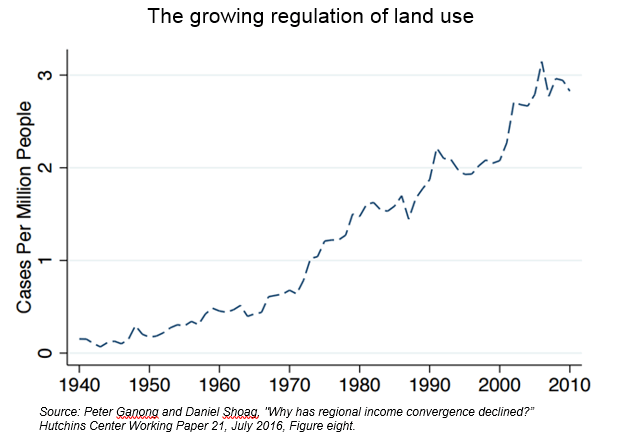
According to Richard Reeves and Dimitrios Halikias at the Brookings Institution, “the movement of less-skilled workers to higher-growth areas has not risen in recent years, a break with the historical pattern[.]” It seems that regulation is the culprit. “The number of court cases mentioning “land use” (an innovative measure of regulation used in a Hutchins Center working paper by Peter Ganong and Daniel Shoag) has risen steadily:”
“The Hutchins paper,” the authors continue, “complements earlier economic analyses, including a study published last year by Chang-Tai Hsieh and Enrico Moretti which estimates that the U.S. economy is 14 percent smaller as a result of constraints on housing development…By using local government powers to zone out lower-income families, upper middle class Americans protect the value of their homes. (Federal policy helps, of course, by regressively supporting richer home owners through mortgage interest deductions.)” Zoning acts as a kind of “opportunity hoarding,” even when it comes to elementary education:
According to Jonathan Rothwell, there is a strong link between zoning and educational disparities. Homes near good elementary schools are more expensive: about two and half times as much as those near the poorer-performing schools. But in metropolitan areas with more restrictive zoning, this gap is even wider. Loosening zoning regulations would reduce the housing cost gap and therefore narrow the school test-score gap by 4 to 7 percentiles, Rothwell finds.
Some of the most effective things are also some of the most mundane.
Among 17 Republican appointees who responded to Journal inquiries, none said they supported Mr. Trump. Six said they did not support Mr. Trump and 11 declined to say either way. An additional six did not respond to repeated messages. Among the 21 Democrats who responded to the Journal, 14 said they supported Mrs. Clinton, none said they opposed her and seven declined to say either way. One Democratic appointee didn’t respond to messages.
Check out the full article to see what the economists are saying.
a growing body of evidence suggests the economic expansion since the 2007-2009 financial crisis has enriched a much larger swath of the upper middle class, and that a deeper income divide is developing between that top quarter or so of the population and everyone else.
The latest piece of evidence comes from economist Stephen Rose of the Urban Institute, who finds in new research that the upper middle class in the U.S. is larger and richer than it’s ever been. He finds the upper middle class has expanded from about 12% of the population in 1979 to a new record of nearly 30% as of 2014.
Rose defines the upper middle class “as any household earning $100,000 to $350,000 for a family of three…Smaller households can earn somewhat less to be classified as upper middle-class; larger households need to earn somewhat more.” These findings fit comfortably with a number of other studies:
Research from Sean Reardon of Stanford University and Kendra Bischoff of Cornell University, for example, found in research published in March that the number of families living in affluent neighborhoods has more than doubled, to 16% of the population in 2012 from 7% in 1980. They define these neighborhoods as those where the median income is at least 50% higher than the rest of the city.
The Pew Research Center last month found that 203 metropolitan areas have seen their middle class shrink, but in 172 of those cities, the shrinkage was in part due to the growth in wealthier families. (In 160 of the cities, the share of lower-income families grew as well.) So Pew found the middle class shrinking from both ends – not just from families falling below the middle class, but also because of families rising out.
While this news can be inspiring, there are nonetheless
way[s] upper-middle class families perpetuate their status across generations…that can sometimes be harmful to middle- or lower middle-class families…Take high housing costs or the soaring costs of higher education. The spread of $3,000-a-month apartments or a national average $32,000-a-year college tuition bill is not driven by heirs or CEOs renting dozens of apartments or sending dozens of children to college. It’s driven by millions of upper middle class families with enough income to foot those bills[.]
As of now, both major presidential candidates oppose the Trans-Pacific Partnership trade deal. Trump’s position isn’t all that surprising, while Clinton’s is a complete flip-flop.[ref]It’s odd to find that Democrats are moresupportive of free trade than their supposedly capitalism-loving Republican opponents.[/ref] With trade openness being challenged in both American politics and abroad, it’s important to review what scholarship says about free trade. For example, a new IMF report demonstrates the benefits of trade liberalization. After speaking favorably of TPP, the authors explain,
Past multilateral trade liberalization rounds have helped boost productivity, so these recent agreements—albeit not global—could do the same, given their broad geographic coverage, both as a percentage of total world GDP and total world trade. Policymakers, however, need to be mindful of the distributional effects of open trade and take steps to mitigate the impact on those displaced to realize the full potential of lower trade barriers on productivity and economic well-being.
As shown below in Chart 1, even in advanced economies, which have already liberalized tariffs in the past, further reductions in nontariff/regulatory barriers to trade and FDI offer scope for additional productivity gains.
The authors then cite the “wide consensus that liberalization of trade and FDI [foreign direct investment] can lead to improved resource allocation across firms and sectors, boosting productivity and output. For instance, existing evidence suggests that more-productive firms tend to gain market share at the expense of less-productive firms. But two specific effects of liberalization additionally enhance productivity:
Increased competition: Lower trade and FDI barriers on final goods can strengthen competition in the liberalized sector(s). This can help firms exploit economies of scale, improve efficiency, absorb foreign technology, and innovate.
Enhanced variety and quality of available inputs: Trade liberalization can also boost productivity by increasing the quality and variety of intermediate inputs used in final goods production.”
There are substantial gains in productivity to be had with the lowering of tariff barriers:[ref]This doesn’t even tell the whole story: “The analysis of productivity gains that would follow from tariff liberalization is only an illustration of how trade liberalization more broadly could bring about even larger gains in productivity. Indeed, our estimated productivity gains from tariff liberalization should be viewed as lower bounds because they do not account for the gains that would arise from reallocation of resources across industries, that is, from more efficiently capitalizing on each country’s comparative advantage or, most importantly, from a reduction of non-tariff barriers” (italics mine).[/ref]
In summary,
Our findings provide a case for further liberalization to raise productivity and output in advanced economies. That the estimates vastly understate potential gains by overlooking the much larger economic benefits of easing non-tariff barriers makes the case all the stronger.
While compensation programs may be in order for those who suffer job loss or wage reduction due to increased trade (something the authors acknowledge and suggest), this should not distract us from the massive gains that trade liberalization brings. Those seeking to be the “Leader of the Free World” take note.
The fear and accusations of voter fraud have almost become a staple of U.S. presidential elections. Granted, other countries require some form of identification to vote, which seems to genuinely be about fraud prevention versus some kind of bigotry as is often claimed here in America. Nonetheless, just as the stories about racist voter ID proponents are likely exaggerated, so are the concerns over voter fraud. As Reason‘s Ronald Bailey explains,
Voter impersonation fraud appears to be almost non-existent. In the wake of 2000’s ballot-counting fiasco, the Help America Vote Act of 2002 created the U.S. Election Assistance Commission to improve voting systems and voter access. In 2007, the commission issued its Election Crimes report, which reviewed what data there was and analyzed numerous anecdotes about voter fraud. The report noted that many experts “asserted that impersonation of voters is probably the least frequent type of fraud because it is the most likely type of fraud to be discovered, there are stiff penalties associated with this type of fraud, and it is an inefficient method of influencing an election.” The penalties include $10,000 in fines and up to five years in prison.
The New York Times reported in 2007 that a five-year Department of Justice crackdown on voter fraud had yielded just 86 convictions. In 2014, Justin Levitt, a professor at Loyola Law School, Los Angeles, reported finding just 31 cases of voter impersonation fraud out of 1 billion ballots cast between 2000 and 2014. Politifact calculated in 2015 that you are 13 times more likely to be struck by lightning than to stumble across an instance of in-person voter fraud in Texas.
Yet, could voter ID laws potentially be used to–ironically–rig elections? The evidence is mixed, but interesting. Some studies found an increase in voter turnout following strict voter ID laws among particular groups, while others found a decrease in voter turnout. Overall, the effects of voter ID laws seem to be insignificant according to most studies. However, the most recent research has
challenged the weak consensus that strict voter ID requirements do not appear to have significant disenfranchising effects. Trying to account for all sorts of demographic, partisan, ideological, and ethnic variables, the researchers examined what happened to voting patterns before and after states adopted strict voter ID requirements. Their analysis focused on individual voter turnout data from 2006 to 2014 derived from the Cooperative Congressional Election Study.
…When they take partisan and ideological differences into account, they estimate that Democratic turnout drops by 8.8 percentage points in general elections and even Republican turnout drops by 3.6 points. Interestingly, strict photo ID requirements result in a drop in turnout for strong liberals of 7.9 percentage points, but among strong conservatives turnout increases by 4.8 percentage points. “Strict voter ID laws appear to diminish the participation of Democrats and those on the left, while doing little to deter the vote of Republicans and those on the right,” they observe.
In short, voting fraud isn’t really a problem, but voter ID laws could potentially be (though the consensus still holds that the effects are nilch). Perhaps we should all calm down.
University of Chicago, Harper Library. Photo by Rick Seidel. (CC BY 2.0)
Let me give you some background: I’m one of those guys who is very skeptical of the impact of contemporary social justice activists[ref]The more common term is “social justice warrior,” but I’m not using it because it’s intentionally pejorative.[/ref] on free speech. One of the most-read posts I’ve ever published to Difficult Run was my manifesto on the topic: When Social Justice Isn’t About Justice. I stand by it.
So when news broke that the University of Chicago had sent out a letter to students warning them that there’d be no “safe space” or “trigger warning” shenanigans, you might think that I’d feel a little sense of triumph, or at least relief. And don’t get me wrong, it is (for the most part), a good letter! For example:
[O]ne of the University of Chicago’s defining characteristics is our commitment to freedom of inquiry and expression… Our commitment to academic freedom means that we do not support so-called “trigger warnings,” we do not cancel invited speakers because their topics might prove controversial, and we do not condone the creation of intellectual “safe spaces” where individuals can retreat from ideas and perspectives at odds with their own.
Second, and this is what I want to focus on, is the broader context. And the broader context is that “thoughtful” and “principled” sadly do not describe the most prominent voices who have been critical social justice activists. Consider Breitbart, which has long been on the vanguard of combating the social justice activists and is becoming the focal point of the alt-right movement. Well, kudos to Breitbart for getting that right, but they also happen to be deeply in the pocket of Donald Trump (Breitbart CEO Steve Bannon just came on board as the new campaign manager) and have a penchant for catering to the least thoughtful and least principled audience on this issue.[ref]I’ve recently written about that as well.[/ref]
To some extent, this is unavoidable. Although it’s a war fought with words and reputations rather than a war fought with bullets and lives, it’s still a very nasty fight. Truth–especially as it relates to nuance, moderation, or context–went out the window a long time ago as far as the mos zealous combatants are concerned. I’ve watched first-hand as people who entered this arena with the noblest of intentions were radicalized by the vicious attacks (often directed not only at thems and their livelihoods, but their spouses and children) to the point where they now engage in the same kind of spiteful attacks that they used to decry. It’s been so sad to watch. There’s a feeling of tragedy to it all. I’m not being judgmental. I don’t know if–had I lived through the stresses that they faced–I could have done any better.
Does it give me second thoughts? Does it make me reconsider whether my own position–very, very suspicious of social justice activism and it’s impact on free speech and also on actual social justice–is warranted? Yes, it does. But then I read a piece like this one from Vox: UChicago’s anti-safe spaces letter isn’t about academic freedom. It’s about power. In it, Kevin Gannon baldly defends the practice of students rising up to protest unpopular speakers:
To move from the hypothetical to the real, the Virginia Tech students who protested their university’s invitation to Charles Murray to deliver a lecture weren’t some sort of intellectual gestapo, they were members of a community calling out other members’ violation of the community’s ethos.
Well no, in fact, calling Murray a “racist charlatan” and characterizing his career as being centered on “social Darwinist assertions that certain ‘races’ are inherently inferior to others” (as Gannon writes in his piece) is exactly what I’d expect from an “intellectual gestapo.” Murray is controversial, of course. Some of my most vivid memories are from my sophomore high school English class where we analyzed an article-length version of his most controversial book, The Bell Curve. Was it comfortable to focus on the theory that there are persistent racial differences in IQ? No. And, I should note, our teacher was an African American woman. But I learned more from her in that classroom than from any other teacher I’ve ever had. She taught me that confronting uncomfortable arguments is what education is all about. If that’s not part of your “community’s ethos”, then your campus needs a new community ethos.
The logic of conflict is brutally simplistic: the enemy of my enemy is my friend. The temptation to go along to get along is highest when there’s some noble ideal (like free speech!) apparently hanging in the balance. But it’s a temptation to avoid.
I really wish I had a side I could join a side without reservation. I’d love it if the conservatives were the good guys and the liberals were the bad guys. At this point, I’d love it almost as much if I could have one of those road to Damascus political conversions and decide that the liberals were the good guys and the conservatives were the bad guys. But it’s just not so, and that’s never been more clear than in these days of fear-mongering, nativist ignorance of the Trump candidacy.
As a writer, I always want to have a clever ending. I want to wrap up a post with a keen and penetrating insight that will impress people. But I don’t have one of those for you today. Sometimes the truth is banal, and the trick lies not in discovering it, but rather in implementing it. So here’s my conclusion: please, be decent. Stop turning political ends into justification for hostility towards people who believe differently than you do. Stop using principles as rationalizations to be uncharitable or to shade the truth. Stop making ideals into excuses.
We’re never going to all get along. We’re never going to all agree. We’re never going to find the ultimate compromise that makes everyone happy. It’s always going to be a struggle, living with each other down here on Earth, but it doesn’t have to be as nasty as it is today. It won’t be perfect. But it could be a little bit better.
I have to start out by saying: I loved this session. Definitely one of my favorite sessions since I started this Odyssey almost a year ago. There were quotable, thought-provoking lines in every single talk, starting with LeGrand Richards’ defense of eternal marriage in Revealed Truths of the Gospel, when he said:
Personally I would just as soon believe that death was a complete annihilation of both body and spirit as to think that I would have to live on forever and forever without a continuation of the love ties that bind my wife and me together, and our family and our loved ones here in this life. Heaven will only be a projection of our life here.
The last sentence—“heave will only be a projection of our life here”—is a pretty common sentiment, I think. If you haven’t heard that exact quote, you’ve heard one like it. But the earlier statement was more personal and much more arresting. It’s one thing to have a theological commitment to eternal families. It’s another to have such a visceral loyalty and love of the ideal that you’d prefer to walk into the abyss than live alone forever.
But Sterling W. Sil had even more eye-brow raising comments in his talk: A Fortune to Share. It was full of funny, irreverent real talk. “Someone has pointed out that if there is anyone who can’t buy happiness with money,” he stated, “it must be that he just doesn’t know where to shop.” And later: “Someone said, ‘Money ain’t everything,’ and his friend said, ‘Just name me three things that it ain’t.’” Funny lines for a General Conference talk, like I said, but in both cases he had a serious point to make. After the “he just doesn’t know where to shop” line, Elder Sil said:
We can build temples with money, we can send out missionaries with money, we can erect educational institutions, operate hospitals, and pay our tithing with money. We can feed and clothe our families with money, and in many ways we can build up the kingdom of God with money.
That’s not a joke. That’s just stone-cold pragmatism. And there are very few things I love more in life than someone who takes a look at realism, takes a look at idealism, and then says, “I’ll take both.” I’ll admit: I’m a little biased here. I have a pretty cynical view of academics and intellectuals and pundits because so often the emphasis is on rhetoric instead of substance, novelty instead of accuracy, provocation instead of truth. But that doesn’t mean I accept being pragmatic instead of being idealistic. I want both. I think a life well lived is, in many ways, a long series of stubborn refusals to abandon either one. To strive for idealism and efficacy is to live a life of integrity, never giving up on the battle to bring the two into correspondence.
And then after the “name three things it ain’t” joke, he went on to say:
Money is preserved labor, it is industry made negotiable, it is stored up accomplishment. It is the medium of exchange that we can trade for things that we can take with us and a great many of them we can actually send on ahead. We can take our families with us. We can take our education with us. We can take our great character qualities with us. And money is the medium that we can use to share the treasures of the earth with others who need our help.
I have to tell you that—as an economist—I swooned.
I haven’t included all the lines from this talk that are funny and yet also profound. There are more. Go read it yourself and you will find them.
Next up was Eldred G. Smith’s talk: Opposition in Order to Strengthen Us. Once again, not a really new theme, but definitely a lot more philosophical than I would have expected in a General Conference talk. Elder Smith goes right into the idea of the Fortunate Fall. In traditional Christian thinking, the Fall is only fortunate in that it provided an opportunity for God’s grace. That would be like saying that a car accident was fortunate because it let a surgeon use their full talents to save your life. It’s not what Mormons have in mind. For us, the Fall wasn’t just a terrible mistake with a grand resolution, but in itself was fortunate:
Adam and Eve had been in a state of stagnation: no progress—no growth—no reproduction. Without a change, they would have remained in that state forever. It was necessary for a change to take place.
The Fall is fortunate, for Mormons, because it was the only way to break the impasse of stagnation and allow us the possibility of growth and development. And—just as with Elder Sil’s comments—there’s a lot more in this talk I wish everyone would read. But I’m going to move on.
William H. Bennett’s talk began with one of those really emotional stories that we often hear in talks. The problem with those stories is that most of them we’ve already heard a million times. But, in “Which Way to Shore?”, Elder Bennett shared one that was new to me. I’m not going to share it. You’ll have to read it. Here is the passage I’ll share instead:
Let me say, my brothers and sisters, that if we want to save individuals, to save the souls of our Father’s children, we must be willing to get involved and to help others get involved in meaningful ways also.
We are addicted to grand, abstract, technical policy solutions. A blog post I’ve been nursing along for several months without finishing talks about this directly. The simple version? Ever since the rise of science and rationality we have grown to view the world as a machine (instead of, for example, a garden) and our role in it as mechanics (instead of gardeners). We have little patience for slow, indirect work, for subtlety and preservation. Instead, we see problems and we want solutions. And sometimes this is possible, but often times it’s not. What’s more, however, is that it tends towards a kind of impersonal charity, and that’s a thing that can never be. There’s truth to the stereotype that we’d rather raise taxes, have the government distribute the goods, and consider poverty “solved” than reach out to people in our neighborhoods or wards who need our help. Not policies and programs and bureaucracies, but personal involvement. And that’s what Elder Bennett’s talk reminded me of.
Next up was A. Theodore Tuttle’s The Role of Fathers, and I think I highlighted about 25% of that talk. One of the passages cut a little close to home for me:
There is yet another intrusion into the home that needs to be mentioned. It is an unwise father who carries to his family his daily business cares. They disturb the peace existing there. He should leave his worries at the office and enter his home with the spirit of peace in his heart and with the love of God burning within him.
This makes sense, but it presupposes that a father has an office where he can leave those business cares. Other than business meetings, I work from home 100% of the time. My office was a standing desk in the dining room in our last house. I have a designated room in this house, which is nice, but it’s still in the home. This is one of those times where I’m going to have to think about how best to apply the principle to my particular situation. And it’s one I need to work on. I often work much more than 8 hours in a day and—when the kids are on summer break especially—it is incredibly hard for me to successfully separate my work time from family time without being stressed and without projecting that stress onto my kids, which they don’t deserve. I’m working on it. Because I’d also like to live up to this injunction:
Fathers, draw close to your children. Learn to communicate. Learn to listen. This means giving a father’s most valuable commodity—time!… To the extent we become friends with our children in unconditional love, to that extent we become like our Heavenly Father.
The last talk in the session was from (then) Elder Ezra Taft Benson: Prepare Ye. The talk didn’t hit me as hard, spiritually, but it was definitely interesting for me to read the calls to food-storage and self-reliance that so heavily influenced my parents and, through them, shaped a lot of my childhood. Like a lot of Mormons out there, we had beds made out of a mattress on top of a sheet of plywood on top of dozens of buckets of wheat. Just as with Elder Tuttle’s talk, there’s also a lot one in this for me to live up to.
 Economist Bryan Caplan–himself not a utilitarian–argues that a utilitarian case can be made against abortion. His four main arguments are: