
T&S Post: The Assurance of Love

776 - Hendrick ter Brugghen - The Incredulity of Saint Thomas
This Monday’s Times and Seasons post went live a little late, but it’s live now. The title is The Assurance of Love, and if you want to see how a Mormon who talks about the dangers of epistemic humility works out a particularly tough pro-certainty talk (in this case, President Hinckley’s October 1981 General Conference address: Faith: The Essence of True Religion), well then here you go.

I didn’t really explain the image I picked in the post. It didn’t fit. But I’ll provide the explanation here. It’s a painting of Thomas doing his doubting thing (The Incredulity of Saint Thomas by Hendrick ter Brugghen), and I went with it because President Hinckley’s talk made me self-conscious about not having enough faith. Of course, I’d like to have enough faith. But maybe I don’t, and maybe that’s my fault. And, if so, then Thomas is my hope. He caught a talking-to, but He was still allowed in the presence of His Savior.

China Ends One-Child Policy

China ended its one-child policy this week, changing instead to a two-child policy. I don’t have much to say about it. A horrific, gendercidal attempt at social engineering that has led to immense human suffering has been softened. Yet, it is not enough. Sadly, as The Economist notes, many of those who wanted a second child have already been sterilized. I’m going to control myself and not lash out in anger over the lack of attention on my Facebook news feed or what seems to be actual support for the one-child policy in one form or another. Instead, I’ll just do what I usually do and post data:

Based on the now debunked threat of overpopulation that was popularized by Stanford University scholar Paul Ehrlich, the communist government subjected the Chinese people to forced sterilizations and abortions. Many newborn babies were either killed or left to die. Today, the Chinese population suffers from a dangerous gender imbalance that favors boys over girls at a ratio of 117:100, and a demographic implosion that threatens future economic growth and prosperity. In fact, as Human Progress advisory board member Matt Ridley shows in his book The Rational Optimist, population growth and economic expansion go hand in hand. The horrific consequences of the Chinese one-child policy are a reminder of what happens when governments are allowed to interfere in the deeply personal decisions of individual citizens and their families.

The claims of overpopulation doomsdayers were wrong. But those claims brought about immense misery. Let’s be grateful that we’re moving in a better direction.

The Secret to Danish Happiness: Vulnerable Family Time

A recent article from the Greater Good Science Center looked at research analyzing one of the main sources behind the high levels of happiness among the Danes: hygge. Hygge, the article explains,

is essentially drama-free togetherness time…Try to imagine going to a drama-free family gathering. There are no divisive discussions about politics, family issues, or Aunt Jenny’s dysfunctional kids. No snide comments, complaining, or heavy negativity. Everyone helps out, so that not one person gets stuck doing all the work. No one brags, attacks anyone, or competes with another. It is a light-hearted, balanced interaction that is focused on enjoying the moment, the food, and the company. In short, a shelter from the outside world.

The article also points out that high levels of inequality lead to unhappiness and that, according to one study, “rich Americans and Danes were equally happy,” but “low-income Danes were much, much happier than their American counterparts.” This could be interpreted as support for Danish models of social democracy. However, it is worth pointing out that family breakdown plays a major role in the lack of economic mobility among lower-income Americans, while wealth overall can have little effect.

Focusing on family and social ties is truly the key to happiness.

Reason, Revelation, and the Perils of One-Way Streets

781 - Faith and ReasonNeal Rappleye writes:

There is a growing tendency among Latter-day Saint academics to talk about “bracketing” faith out of scholarship (although not everyone uses that term). While I grant that this method has certain benefits as a provisional mental or intellectual exercise, and I have gained some valuable insights both from works where such “bracketing” has been done and from engaging such exercises myself, I fear there are also corrosive effects that are not often recognized by its practitioners.

He goes on to outline two of these perils, and the post is definitely interesting and worth your time. But here’s the observation that struck me as the most interesting:

The second byproduct is that it creates what I call a “One Way Street,” between reason and revelation. Because faith is “bracketed,” i.e., blocked off from traveling with our reason into the realm of scholarship, faith and revelation have no influence on the conclusions reached. But these conclusions are still imported back into the practitioner’s faith. That is, they reshape and reform their faith in light of conclusions reached without faith.

I would add just one additional consideration. There is an underlying assumption that bracketing faith leads in some sense to an objective and/or neutral viewpoint. In principle, there is validity to this. If you’re going to have a Muslim, a Mormon, a Jew, a Catholic, and an Atheist all provide mutually accessible analyses, then a great deal of bracketing is necessary. However, in practice the objectivity obtained via bracketing is anything but. Instead of shooting for a minimalist and open-ended neutral territory, bracketing is susceptible to becoming little more than a thin veil for a suite of ideological assumptions that are just as robust as those underlying any faith tradition.

The secularism of Western intellectuals is emphatically not a mere Blank Slate. It is, instead, a collection of metaphysical commitments (e.g. materialist reductionism, scientism) paired with stark political postures (always left-leaning.) This means that bracketing is not only susceptible to the theoretical flaw Rappleye expounds, but in practice is even more susceptible to far more serious pitfalls.

This doesn’t mean there is no place for bracketing. A tolerant, pluralist society must leave room for bracketing not only within academia but in broader social conversation. But this should be genuine bracketing. Even if it is impossible to hit the target perfectly, we should still be aiming at a truly neutral standpoint.

Shkreli, Price Hikes, and Capitalism (Act 2)

780 - Smarm Cat

779 - Perfect CapitalistBack in September the Internet was momentarily preoccupied by news that Turing Pharmaceuticals (run by Martin Shkreli) had purchased a company which made the generic drug Daraprim. Darapim “is used to fight toxoplasmosis, an infection to which unborn babies, AIDS patients, and certain cancer patients are vulnerable,” wrote Martin Tillier at NASDAQ.com. Darapim had been sold for less than $15 / pill, but Shkreli raised the price by more than 5,000% to $750 a pill. This–along with the news that VW had been faking emissions tests–made it “a bad week for capitalism.”

Lots of folks used this as an object lesson in why capitalism is bad, and so the torrent of memes began. I’ve collected a few in this post to give you a sample.

778 - Capitalism and Sociopaths

But then the story got a little bit more interesting. As the Daily Banter so elegantly phrased it: Free Market Capitalist Martin Shkreli Gets Screwed By Free Market Capitalism.

You see, Darapim is not protected by any patents because it is such an old drug. If it was protected by patents, then Shkreli could charge whatever he wanted without fear of immediate competition, but that wouldn’t be the free market at work. That would be government regulation at work, since government regulation is the thing that would be preventing competitors from selling the drug, too. So Darapim was only being manufactured by one company (the one that Shrkeli bought), but there was nothing to prevent other companies from entering the market.

When Darapim was priced at $13.50, no one bothered to compete. This is primarily because setting up a new drug manufacturing line is expensive and–although Darapim is a life-saving drug for the folks who need it–not many folks need it. But when Shrkeli hiked the price to $750, it created plenty of room for competitors to offer their own products.

And now one has. San Diego-based Imprimis Pharmaceuticals Inc. has stepped in to offer Darapim from their website for less than $1/pill. Live by the sword, die by the sword. Or, in the words of finance professor Ramon P. DeGennaro, “Nothing protects consumers better than competition.”

Couple of notes for those interested in the economics, by the way. This isn’t just a textbook econ 101 case of market entry. If nobody wanted to compete at $13.50/pill, then any company who entered after Shkreli raised the price to $750 would have offered their competing product at a price lower then $750, but higher than $13.50. If they could have made a profit at less than $13.50, they would likely have done so already. But Imprimis is selling Darapim for less than $1/pill. Why?

The answer is PR. Imprimis will probably lose money on every pill they sell, but–because Darapim is not a product that is going to get popular–they also already know the maximum amount they stand to lose, and they see that as an expenditure for a brilliant marketing campaign. Think of all the goodwill and publicity that Imprimis gets from standing up as the good guy to oppose Shkreli’s creepiness and greed. So this is about competition, but it’s about competition in a dynamic, interactive system with many, many products and services rather than just a simple case of competition in a single market with a single product.

 

Fatherless Child: “Everybody Deserves a Voice.”

782 - Millie Fontana

Millie Fontana is an atheist raised by lesbian parents who–with the support of her mothers and also her biological father–has been speaking out against same-sex marriage. She stands with Christians (as she puts it) because only Christians are advocating for children in contemporary debates surrounding sexual ethics and law. Here she is, speaking with Ryan T. Anderson, at a conference in Australia. I think the video is well worth watching. (As usual, folks on email will have to visit the site to see the embedded video. Sorry.)


She makes a number of very good points, but here is one that I think was the most interesting. When asked by one of her mothers whether or not she would have felt more stable and secure if her mothers had been allowed to get legally married, Fontana replied with a question of her own: “How would psychologists have treated me for my underlying issues of fatherlessness if to acknowledge fatherlessness was a form of discrimination?”


Now that same-sex marriage is the law of the land in the United States, there’s a sense in which you might say that this is a moot point. Legally you could be right, although I’m not certain. Some once-controversial issues become widely accepted, such as interracial marriage. Others, however, like abortion remain cultural sticking points for decades with no end in sight. It’s too early to tell which of these categories same-sex marriage will fall into, but there is certainly precedent for the possibility that Obergefell was not the last word any more than Roe has been. In any case, however, another point that Fontana made is certainly worth considering:

Until we as a society have a discussion that . . . includes everybody who has been raised fatherless or motherless, until this discussion stops shaming children in my position from coming forward, we should not be pushing marriage through. I am not going to stand here and be silenced by people telling me what was acceptable for me to feel, that I’m a bad person for wanting a father, that maybe I didn’t love my mothers enough because I wanted a father. It’s bull. And I won’t support it.

Everybody deserves a voice.

Balancing the Evidence on Family Structure

Economist Steven Horwitz has a recent post that is well-balanced in its approach to the social science on family structure. Responding specifically to W. Bradford Wilcox’s latest National Review piece, Horwitz brings up some excellent points that should be considered:

  • “[T]here are differences among single-parent households formed through: 1) the choice to have and raise a child by oneself; 2) death of a spouse; and 3) divorce. Each of these presents a different set of circumstances and tradeoffs that we might wish to consider when we think about the role of family structure.”
  • “The empirical evidence under discussion has to be understood with an “all else equal” condition. A healthy marriage will indeed produce better outcomes than, say, single motherhood. But there is equally strong social scientific evidence about the harm done to children who are raised in high-conflict households. Those children may well be better off if their parents get divorced and they are raised in two single-parent households with less conflict.”
  • “[T]o say that married parents create “better” outcomes for kids does not mean that other family forms don’t produce “acceptable” outcomes for kids. It’s not as if every child raised by a single mother, whether through divorce, widowhood, or simply not marrying the father, is condemned to poverty or a life of crime. Averages are averages.”
  • [P]arents matter too…That parents matter too is most obvious with divorce, where leaving a bad marriage may be extremely valuable for mom and/or dad, even if it leads to worse outcomes for the kids. The evidence from Stevenson and Wolfers that no-fault divorce has led to a decline in intimate partner violence as well as suicides of married women makes the importance of this point clear. We can acknowledge that higher divorce rates have not been good for kids, but we can’t do single-entry moral bookkeeping. We have to include the effects of divorce on the married couple, because adults matter too.”

Definitely worth chewing on.

The Capitalist Conscience

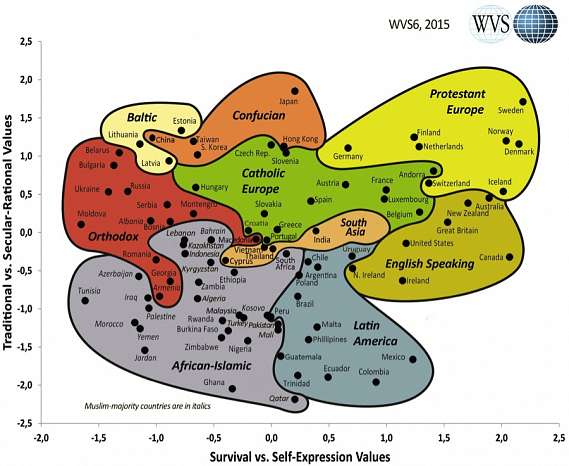
The above graph comes from the World Values Survey Database. As you can see, the vertical line moves from traditional values (religion, ritual, hierarchy, authority) to secular values, while the horizontal line moves from survival values (economic and physical security) to those of self-expression. Social psychologist Jonathan Haidt provides this helpful explanation:

The best way to understand the graph is to consider that nearly all societies used to be agricultural societies. Pre-industrial farming cultures generally have traditional and survival values (they cluster in the bottom left quadrant of the map). Life is hard and unpredictable, so you should do your duty, pray to the gods, and cling to your extended family for protection.

But as countries industrialize and people leave the land and enter factories, wealth rises and values shift.  Interestingly, countries don’t just move diagonally, from the poor quadrant (currently occupied by the Islamic and African nations) to the rich quadrant (anchored by Scandinavia, in the upper right). Rather, there is a two-step process. First, countries move upward, from traditional/survival values to secular/survival values. When money comes from fitting yourself into the routines of factory production, there’s little time or room for religious ritual. People express materialistic values in this quadrant—they want money, not just for security, but for the social prestige it can buy.

…Societies [then] transition to more service-based jobs, which require (and foster) very different skills and values compared to factory jobs. Also, as societies get wealthier, life generally gets safer, not just due to reductions in disease, starvation, and vulnerability to natural disasters, but also due to reductions in political brutalization. People get rights. The net effect of rising security is to transform people’s values in ways that the modern political left should love.

Haidt’s conclusion? “Capitalism changes conscience.”

Strong Families, Prosperous States

A brand new AEI study looks at the connection between marriage and family structure and the performance of state economies. The researchers found:

  • Higher levels of marriage, and especially higher levels of married-parent families, are strongly associated with more economic growth, more economic mobility, less child poverty, and higher median family income at the state level in the United States.
  • The share of parents in a state who are married is one of the top predictors of the economic outcomes studied in this report. In fact, this family factor is generally a stronger predictor of economic mobility, child poverty, and median family income in the American states than are the educational, racial, and age compositions of the states.
  • The state-level link between marriage and economic growth is stronger for younger adults (ages 25–35) than for older adults (36–59), suggesting that marriage plays a particularly important role in fostering a positive labor market orientation among young men.
  • Violent crime is much less common in states with larger shares of families headed by married parents, even after controlling for a range of socio-demographic factors at the state level.

Important stuff. Check it out.