Missing Fathers and Mass Killers

788 - Lonely Son

Damon Linker has a good piece about the violence of mass shootings: Men and mass murder: What gender tells us about America’s epidemic of gun violence. Most perpetrators of violence in all societies (this is one of those social universals) are men, and mass shooters are no exception: “Murder is an overwhelmingly male act, with the offender proving to be a man 90 percent of the time the person’s gender is known. When it comes to mass shootings, the gender disparity is even greater, with something like 98 percent of them perpetrated by men.”

So, first there’s a connection between men and mass shootings. Then Linker goes one step farther and links a particular male response to perceived grievance:

Men and women both experience righteous indignation, of course. But there may be something specific about masculinity — perhaps its deep ties to irrational pride — that leads some men to experience a perceived injustice (and especially a string of them) as an excruciating personal humiliation that cries out not just for redress but for revenge. In this way, wounded pride provokes some men to lash out in a violent fury at their fellow human beings as a way of striking back at the intolerable injustice of the world.

And then he stops. Which is a shame. He should have kept going.

Because there’s another trait that mass shooters have in common: fatherlessness. Peter Hasson covered this for The Federalist: Guess Which Mass Murderers Came From A Fatherless Home. He cites a Brad Wilcox National Review article from 2013 (Sons of Divorce, School Shooters) in which Wilcox says:

From shootings at MIT (i.e., the Tsarnaev brothers) to the University of Central Florida to the Ronald E. McNair Discovery Learning Academy in Decatur, Ga., nearly every shooting over the last year in Wikipedia’s ‘list of U.S. school attacks’ involved a young man whose parents divorced or never married in the first place.

Let me pull in just one more article and then make some final observations. This one is from Sue Shellenbarger in the WSJ: Roughhousing Lessons From Dad. Shellenbarger starts out with an incredibly important observation:

There is no question among researchers that fathers who spend time with their children instill self-control and social skills in their offspring.

If you could name just two traits to lessen the likelihood that a young man ever considers school shootings as the solutions to his life’s problems, these would be the two traits. Social skills to avoid a lot of the alienation and failure that engenders the grievances in the first place, and to help these young men find constructive ways to deal with those grievances that do arise. And self-control to ensure that any grievances which cannot be ameliorated do not become a basis for action.

Everyone wants to find the one solution that’s going to solve school shootings. There isn’t one solution. No complex social problem has a simple, easy solution.[ref]That might not be a law of nature, but it’s a pretty good rule of thumb.[/ref] In particular, gun control debates basically do nothing but make people angry and waste our time. That’s not to say that we should not change our gun laws. There are actually very good arguments–philosophical and practical–for changing gun laws. School shootings, however, are not among those arguments. The basic reason for this is straightforward: most school shootings are premeditated. This means the killer has lots of time to acquire a gun. Most do so legally, passing background checks (which can’t screen for crimes you haven’t committed yet) and following all applicable laws. Those that do not, have the time and the means to acquire them illegally. So the only gun control laws that would do anything are gun control laws that would significantly decrease the availability of guns in the long term. Considering that there are more firearms than human beings in this country, nothing short of a massive, nation-wide confiscation program is going to put a dent in the practical availability of firearms, and therefore nothing that falls short of that is going to have a meaningful impact on the specific type of crime we’re talking about here.Such a sweeping change is not on the table.

Now, I understand a lot of folks will want to push back and insist that there are common sense changes we can make that will help at least a little bit. There really aren’t. Not when it comes to school shootings. When it comes to other gun-related problems–from suicide to gang violence–there is certainly a lot to talk about. I’m not trying to shut down the debate by claiming that laws don’t matter. Obviously, in general, they do. But in the specific case of school shootings–due to the nature of the attacks and the attackers–most incremental changes will have no effect. Add a waiting period? These guys are planning their attacks months or years in advance anyway. Close the gunshow loophole? Most of the shooters acquired their guns by going through the background check process. They didn’t need the loophole. Ban assault weapons? Almost all attacks use handguns anyway, including the deadliest. Reduce the magazine capacity? There is no practical difference in lethality–when attacking unarmed civilians–between a standard 15-round magazine and a low-capacity 10-round magazine. The deadliest school shooter used a mixture of 19 pre-loaded 10- and 15-round magazines. If they’d all been 10-round magazines, he would have maybe carried a few more and maybe reloaded a little more often. (It takes less than a second or two.)

So if you want to debate gun policy: that’s fine. There is lots to talk about. But insisting that incremental policies will have an effect in this particular case is just wishful thinking. I’m sorry, but that’s the reality.

But that doesn’t mean we are helpless to do anything. It just means that laws are not the solution to all social problems. I don’t think that that should really be a revelation, but in some sense it is. We love politics because it’s a spectator sport. It has a score. It has winners and losers. It has teams, and traditions, and tribes, and flags, and symbols, and so naturally it occupies a huge amount of our attention. Too much, I think.

The older I get, the more I think that it’s the quiet, informal, decentralized aspects of our society that are the most important. The traditions, the habits, the expectations, and the attitudes of a people matter a lot more than their laws. And there is room for us to make changes there. The only problem is that, because they happen at the individual level, they are not connected to an exciting sports spectacle. And, in addition, there is really no guarantee that our efforts will have any impact. But I think it’s the only thing that can really help maintain the aspects of our society we cherish and restore or fix the aspects that are broken.

I already posted about the danger of glorifying the mass killers. That’s not a legal change. That’s not a policy change. That’s a social change. It’s enough people–one at a time–deciding to turn off 24-hour cable news coverage, steer clear of clickbait and rumors and conspiracy theories, and opt out of lurid headlines full of details about the killers: their names, their pictures, their backgrounds, their manifestos, all of it.

Even bigger than that is the crisis of fatherlessness in our society. Kids need parents. They need mom. They need dad. We as a society have to figure out how to stem the tide of kids growing up without the irreplaceable guidance and influence of their fathers. We’re paying an incredibly high price for a lax attitudes about sex and parental responsibility that have time and time again placed the interests of adults above the interests of children. As time goes on, that price tag is only going to get higher. School shootings are just one particular symptom.

 

T&S: Reading the Book of Mormon for the First Time Again

789 - Angry Pterodactyl 2

What do giant, angry pterodactyls, vegeta, Harry Potter, and the Book of Mormon all have in common? Read my latest post at Times and Seasons to find out: Reading the Book of Mormon for the First Time Again. (Sort of. In reality, the only thing they have in common is that they’re all in that post.)

Because of Fiorina “Progressivism No Longer Owns Feminism”


Republican presidential candidate Carly Fiorina made one thing crystal clear at the CNN debate. . . : progressivism no longer owns feminism. And it’s about time.

Thus writes Lisa Torcasso Downing in a post at Life Outside the Book of Mormon Belt. She goes on to decry the fact that conservative women have felt–because of the association between feminism and liberal/progressive politics–the need to abandon the movement (or at least the term), although she doesn’t necessarily blame them for doing so:

In general terms, feminism claims its goal is to broaden opportunity for women, but when most Americans hear the word “feminist,” they attach to the word tangential philosophies conservative women reject on intellectual, emotional, and spiritual levels, including socialism as an acceptable political framework for the U.S. and social justice as a means to equality.

Torcasso put’s her finger on exactly my reluctance–and the reluctance of a lot of men and women I know–to go near the term “feminist” with a 10-foot pole. Instead, however, feminism should be simply “The freedom to choose a life, a path, a journey, and an adventure according to the dictates of our own mind, will, conscience, and being.” Obviously Torcasso doesn’t expect for liberal feminists to get behind Fiorina, but she does conclude by saying that:

if you can’t look at Carly Fiorina on that stage, positioned beside ten prominent Republican men, and feel a little thrill that this woman is a viable candidate for the presidency of the United States, then your feminism is dead, strangled by the cords with which you have tied yourself to progressivism.

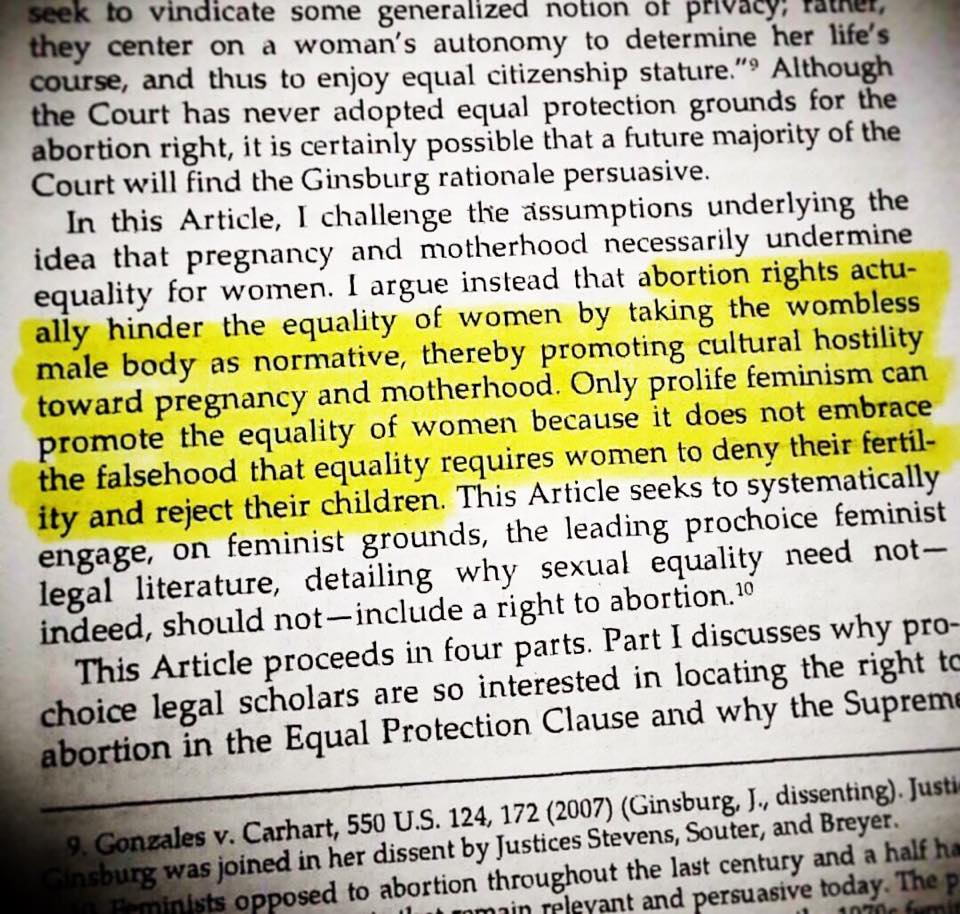
I want to add one more thing. A pro-life friend of mine recently shared this image on Facebook:

801 - Embodied Equality Quote

I think it’s important to point out that conservative feminism is not actually just feminism with the progressive / liberal bits taken back out. Conservative feminism is, therefore, not just the idea of freedom for women. That notion–the kind of apolitical source of feminism–is just that, apolitical. What makes a conservative feminism is precisely that it is political, that it incorporates the idea of feminine dignity and feminine power into an ideology that goes beyond merely being pro-woman.

Liberal feminism is not just pro-woman. It has a whole set of attitudes and philosophical assumptions to go along with it and–even if you disagree with practically all of them (as I do)–they enrich the conversation. So that’s the additional loss that we all suffer due to feminism being more or less wholly subverted by left-wing ideology: there’s a whole continuum of feminist thought that is being silenced. There are attitudes and there are policies and there are insights that are only possible when one combines conservatism with feminism. Views like the one expressed in the quote above, which comes from the paper “Embodied Equality: Debunking Equal Protection Arguments for Abortion Rights” by Erika Bachiochi.

Papers like this one pose a vital question for liberal feminism: which is more important? Liberalism? Or feminism? All too often, the answer has been the former rather than the latter.

Sustainable Development Goals

The UN recently had a meeting to unveil the Sustainable Development Goals. As The Economist reported,
Most of the SDGs’ predecessors, the Millennium Development Goals (MDGs), have been met, largely because of progress in China and India. But there were just eight of them, focused on cutting extreme poverty and improving health care and education, all clearly defined. By contrast there are 17 SDGs and a whopping 169 “associated targets”, covering world peace, the environment, gender equality and much, much more. Many are impossible to measure. They are “higgledy-piggledy”, agrees Lord (Mark) Malloch-Brown, who helped write their predecessors. A tighter focus and more precise definitions might have been wise. Even so, the SDGs are part of an important shift in thinking about development that is making it both more ambitious and more realistic.

What makes these new goals exciting is that they are attempting to sway “governments, private enterprise and civil society” into working “together to create open societies and open economies, end conflict and corruption, and enshrine the rule of law, free speech and property rights.” Furthermore, “the main reason there are so many is that they were set by consensus rather than written by a few specialists, mostly from rich countries. This lessens the feeling that rich men from “the north” are telling “the south” how to do better.” I’m inspired by this because “poor-country governments and rich-world aid lobbies have become less hostile in recent years to the idea that free markets and big business can help cut poverty. Multinationals were wary when the MDGs were unveiled, says Lord Malloch-Brown; now many are on board. And some rich-as-Croesus philanthropists, together with a bevy of market-friendly think-tanks, have started to monitor and measure the results of aid spending, and to search for ways to make it more effective.” In other words, governments and other institutions are worried about actually helping the poor rather than just feeling better about themselves by giving aid. The Economist concluded its report:

As the SDGs proliferate, donors are putting greater emphasis on measuring results and collecting data. They need data to be more disaggregated and to know where the poor are concentrated, as well as their ages, how they live and what sort of work they do. Advances in technology make this easier. Satellites can more precisely determine where forests are thinning, for example, or where crops are thriving or wilting. Among the SDG targets is one that calls for all births to be registered so that all children have legal identities, and their progress can be tracked…The MDGs were meant to create a social safety net; the SDGs to be fit for an age in which the standard of living in a big chunk of the developing world is creeping towards the levels of rich countries. The SDGs’ boosters, though admitting they will be harder to measure than the MDGs, let alone meet, hail them for going “beyond aid”.

Mass Shootings and Heroes

There was another school shooting yesterday, this time at a community college in Oregon. There are all kinds of rumors and arguments flying around Facebook. For the most part, that just makes me want to turn off my computer for the day. But there is one thing I want to share first.

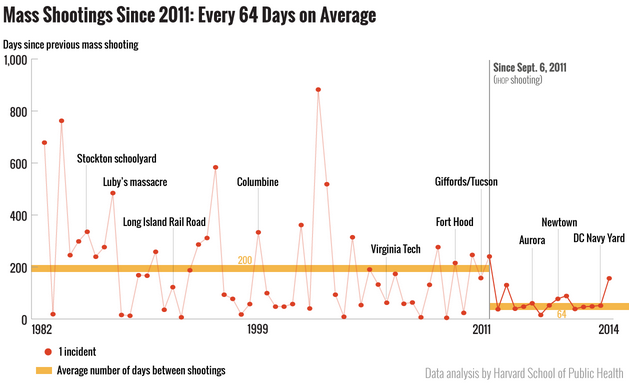
Almost exactly one year ago, Mother Jones published an article summarizing research concluding that “Rate of Mass Shootings Has Tripled Since 2011.” I’ve read the research claiming that the rate has actually not increased and, after reading the article in Mother Jones, I am convinced that this new research is correct. The rate of mass shootings (“attacks that took place in public, in which the shooter and the victims generally were unrelated and unknown to each other, and in which the shooter murdered four or more people”) has increased dramatically.

798 - Rate of Mass Shootings
This chart shows that the time between mass shootings has gone from about 200 days to about 60.

The data strongly indicates that “the underlying process has changed.” Meaning: something is different now than prior to 2011 that is leading to this increased rate of mass shootings.

Gun laws are not a plausible explanation because they have not changed significantly (at the federal or at the state level) during this time frame.[ref]The Federal Assault Weapons Ban did expire in 2004, but not only is that too remote from 2011 to be a plausible cause of the shift, but the reality is that nearly all of these attacks are committed with handguns and other weapons that were not affected one way or the other by the ban.[/ref] That statement is not an argument either for or against changes to existing gun laws. Just because gun laws didn’t cause the rate of attacks to increase does not mean that newer, tighter gun laws couldn’t in theory prevent some of these attacks. This post is not about gun control one way or the other. It is about something else.

I have argued strongly that the way we cover these attacks is a major factor in encouraging future attacks.[ref]Here, here, and here are some examples.[/ref] The media leads with front-page photos of the killers, burns their names into the national consciousness, and implicitly ranks the tallies of their victims like a perverse score board and we the American people eat it up. We tune in, we click links, we debate, and again and again and again we repeat the killers’ names.

There is no hard data linking media coverage to the rate of killings, and due to the nature of these events there probably never will be. But the circumstantial evidence is quite strong. These killers often (not always, but often) talk about their desire for fame, for attention, for a sense of affirmation that their lives matter, and they know how to get that recognition because the media has promised to put their names and likenesses up in neon lights if they are willing to kill enough people to earn it.

This time is no exception. As the Daily Beast notes, the most recent killer paid close attention to media coverage of the last sensationalized murder (when a disgruntled former news anchor killed two of his old colleagues on live television) and wrote just over a month ago:

On an interesting note, I have noticed that so many people like him are all alone and unknown, yet when they spill a little blood, the whole world knows who they are. . . A man who was known by no one, is now known by everyone. His face splashed across every screen, his name across the lips of every person on the planet, all in the course of one day. Seems the more people you kill, the more you’re in the limelight.

Read that. Look at the Mother Jones chart again. Is the sudden increase in the rate of killings really that surprising? This is a textbook example of a positive feedback loop: each successive mass shooting elevates the topic in our national consciousness, leading to more and more coverage, and that coverage in turn motivates more and more killers to take their shot at “the limelight.” The question is: how long are we going to allow this to continue? Have we gotten our fill yet?

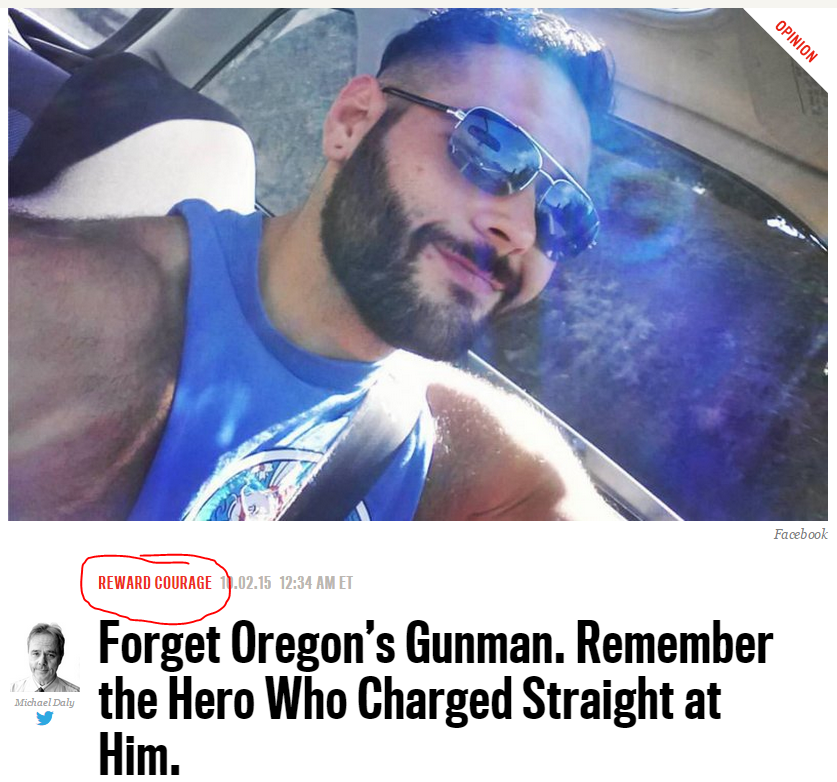
There are signs that we have. The Daily Beast article is a wonderful example whose time has come. This is the headline: Forget Oregon’s Gunman. Remember the Hero Who Charged Straight at Him. The article does not mention the full name of the killer. It does not include a photo of him. It does not make him into a star. Instead, it focuses on Chris Mintz, an army veteran who was shot five times during the attack while charging the killer head on in an attempt to stop the attack.[ref]Update: Another article from NBC says that he was shot seven times.[/ref] It was Mintz’s son’s birthday, and that is what he kept repeating to himself again and again as another student (training to be a nurse) held his hand and prayed with him while they waited for the ambulances to arrive. Mintz is still alive, recovering in the hospital after surgery, although a friend says Mintz may have to learn to walk again.

This is the kind of coverage we need. Michaely Daly and Kate Briquelet, who wrote the article, should be commended. The subtitle of the article is simply “reward courage,” and that’s what he did. While journalists all over the country are going to start the inevitable scramble to unearth every last rumor and irrelevant detail about the killer’s life and fill articles with inane quotes from neighbors and fellow students, Daly instead interviewed the friends and family of a heroic father who risked his life in an attempt to stop a murderer. The Daily Beast should be commended for running this article. Instead of plastering the Internet with photos of an attention-seeking murderer (which is to say: rewarding a murderer), they ran photos of Mintz like this one as their cover image:

797 - Reward Courage

I’m not trying to short-circuit the debate on gun control that will follow. Gun control is an important issue and worth our time to discuss. I’m also not trying to advocate for censorship or burying the truth.

I’m just saying maybe we don’t need so much coverage so quickly so focused on the bad guy. Maybe we write about the good guys, like Daly did. Maybe we just have a little less coverage and spaced out a little more. Right now, 1/2 of what you read about this event is going to turn out to be false anyway. Why are we so desperate to study rumors? Do we really need to watch more completely uninformative aerial footage of hospitals and cars with blinking lights while reporters desperately peddle rumors, guesses, and ignorant analysis? Within a couple of weeks we will likely have a much clearer account of what happened and–to the extent that it is possible–why. If you can’t wait that long to learn the facts, then you may want to examine your own motives. Is it concern for the victims and for possible future victims? Or is it just tragedy voyeurism (using the horrific details of tragedy just to titillate) or outrage porn (turning tragedy into fuel for your pre-existing political self-righteousness)?

Stop rewarding murderers. Start rewarding courage.

Stanford Encyclopedia of Philosophy: What the Internet Could Be

802 - Quartz SEP Article

Quartz has a very interesting article describing the genesis and ongoing success of one of the Internet’s most respected repository of comprehensive, up-to-date, and authoritative information (as long as you’re interested in the topic of philosophy): the Stanford Encyclopedia of Philosophy. I’ve relied on the SEP in the past, and always found it well-written and informative (albeit not as comprehensive as Quartz would have you believe), but I didn’t realize just how rigorously it is maintained.

Best part of the article though? The argument that the SEP doesn’t have to remain a lone unicorn, a solitary bastion of credible, useful information on the Internet. Nope: other disciplines could–and should–seek to emulate it’s success.

Useful, reliable information on the Internet.

Imagine that.

Wisdom and the Wiesn

O'zapft is!
O’zapft is!

Beer, lederhosen, dirndls, beer, and giant pretzels and beer. Oktoberfest is here again!

I’ve been living in Munich teaching English for nearly eight years and every year I know to expect the question from my students: So are you going to the Wiesn this year?

Oktoberfest is held each year at the fairgrounds of Theresienwiese (Theresa's Field), nicknamed by the locals as the "Wiesn"
Oktoberfest is held each year at the fairgrounds of Theresienwiese (Theresa’s Meadow), nicknamed by the locals as the “Wiesn”

I usually tell them that I might go to take some photos (the ones in this post!) but since I don’t drink, it’s not as much fun for me as for others.

You don’t drink!?

This then invites the question about why I don’t drink and pretty soon I’ve outed myself as a Mormon. Which is great! I get to answer questions about my faith, dispel myths, educate, and maybe do a little missionary work. But answering Mormon questions isn’t always easy and some concepts in Mormonism are more nuanced than others, and the principle that keeps me from drinking beer at Oktoberfest is one of them.

Non-Mormons enjoying Oktoberfest.

On its face, the Word of Wisdom would seem like a fairly straightforward practice: we abstain from alcohol, tobacco, coffee, tea, and harmful drugs and should in turn eat and drink foods which are healthy and nourishing. But if you look at the original revelation that later became commandment [ref]The revelation was originally given in 1833 “not by commandment or constraint” and didn’t become a standard practice until well into the 20th Century. [/ref] then it’s not quite so clear. For example, here is the bit that forbids coffee and tea (Doctrine & Covenants 89:9):

And again, hot drinks are not for the body or belly.

Friend: What, no hot drinks at all? Not even hot chocolate?

Me: Well, that has been clarified as meaning specifically coffee and tea. Hot chocolate and even herbal teas are just fine.

Friend: Ok, so it’s the drinks with caffeine that are taboo. I see.

Me: Well, no… Coke and Pepsi are not prohibited.

Friend: So it has to be hot then? So like an ice tea or iced coffee would be ok?

Me: No, it really has nothing to do with the temperature of the drink nor the levels of caffeine. It’s just coffee and black (and green?) tea are no nos.

Friend: But a can of Coke is much worse for you than a cup of earl grey (hot).

Me: Maybe, but one is specifically forbidden by the Lord and the other isn’t.

Friend: Hmm…

I can understand if my friend is rather bewildered by this law of health. He might even be confused as to why it’s called “The Word of Wisdom” rather than a title more specific to health like “Nourish and Strengthen Your Bodies!”

Indeed we usually present the Word of Wisdom as a law of health and rightly so since it talks about these foods in context of being good or bad for the “body or the belly” and couples obedience with promises of receiving “health in their navel, marrow in their bones,” and “they shall run and not be weary, and shall walk and not faint.”

Oktoberfest 2015-5
Useful blessings for an Oktoberfest server.

Healthiness is clearly the core of the commandment. These specific proscriptions against tobacco, alcohol, coffee, and tea are natural starting points from which we can use our own intelligence and agency to decide what is good or bad for our bodies and more fully live the law.

Friend: Wait, sorry, I’m still not satisfied. I mean, no tobacco and alcohol I can understand, even coffee to some extent. But tea? There are many health benefits of tea even black tea. And you won’t even take one sip even though you’ll happily down a mug of Diet Dr. Pepper.

Me: No, not diet. That’s gross.

But my friend has a point. Why does tea make the list? Tannins? Here’s where I believe the Word of Wisdom is not simply about health. It is about obedience, of course, but it is also about setting ourselves apart from the world.

The World

Wine, beer, coffee, tea – is  there a major culture on earth where one of these four drinks does not play a major role? Whether its beer in northern Europe, wine in France and southern Europe, tea throughout the Middle East and Asia, and coffee the world over, these drinks are essential elements in the social rituals and daily habits of pretty much everyone everywhere.

We bond over beers, celebrate with champagne, party with cocktails, meet up for coffee. In Asia it’s all about the tea. Have you tried traveling the Arab world, India, or East Asia without drinking tea? I mean, you can do it but if you’re dealing with locals then it’s a lot of awkward declining hoping that you don’t offend your hosts. Imagine living there as a tea-totaler! [ref] Get thee behind me, Mrs. Potts! Mrspotts[/ref]

Bonding over beers
Bonding over beers

The point is, these beverages and their communal consumption are important in making an individual part of the in-group in a society. Imbibing is integration. There’s nothing wrong with that, in fact it can be rather beautiful if you think about it, but it’s also not entirely essential. This is where the wisdom comes in.

I believe that by strictly avoiding these drinks, Mormons establish themselves as being peculiar in a way that is distinct and sometimes difficult on a personal level when faced with the peer pressure, but it also doesn’t completely alienate them from society either.

Einmal ist keinmal!
Those girls will probably still be friends with me even if I don’t drink, right?

That societal pressure to become fully integrated in the in-group is for some Mormons a very difficult trial of their faith. Yet if they are faithful to this commandment, the consequences are rarely more severe than a loss of status or the failure to fully share in a group experience. In other words, it’s a commandment that directly affects our pride. It’s brilliant.

You know you want to be a part of this in-group.

Since the Beginning, God has given commandments that have set His people apart from the world without physically isolating them from it. The ancient Israelites constantly chaffed at the peculiarities of the Mosaic law with its jealous monotheism, its odd prohibitions, and its rituals. The early Christians were one of the few religions to be systematically persecuted by the generally tolerant Romans for their stubborn refusal to conform to certain political and religious norms. It seems the Lord has always carefully designed his commandments to keep his people separate and strange while still expecting them to remain otherwise integrated in whatever society they are in. He seems to want us to have a constant reminder that in whatever society we find ourselves, our first loyalties go to His society, even the family of Heavenly Father, Mother, Brother, and siblings that we have chosen through covenants. It can pull us upwards to a higher perspective that reveals us as “strangers and pilgrims on the earth.” [ref] See Hebrews 11:13 and the very apt 1 Peter 2:11. [/ref] The laws of peculiarity are divinely-anchored lifelines against moral danger—not just that of getting drunk or getting hooked on a substance, but the danger of forgetting where our better natures have once chosen to belong.

A vivid example of this is when the Israelites were living amongst the Egyptians as their slaves. They too suffered from the plagues brought on by the stubbornness of Pharaoh, but before the final plague they were given a commandment to do something that would distinguish themselves not only from the Egyptians but even the less faithful Israelites. They were told to mark their doorposts with the blood of a slaughtered spring lamb. Very peculiar. Weird even. But those households which made themselves separate from their neighbors through obedience to this commandment were saved from terrible loss.

With this in mind, the final blessing for those who keep the Word of Wisdom is especially apt (D&C 89:21):

And I, the Lord, give unto them a promise, that the destroying angel shall pass by them, as the children of Israel, and not slay them.

Not exactly a passover sacrifice.
Not a passover sacrifice.

Of course, the wisdom doesn’t stop there. A bonus feature of the Word of Wisdom is that its peculiarity gets people to ask questions to its adherents. Those questions lead to opportunities for Mormons to discuss their faith and invite others to come and see why they think it’s so great. In my experience, the question that has most often revealed my Mormon faith and led to further discussion is, “why don’t you drink?” I am sure I am not alone in this.

I'm all over the pretzels, though.
I am all over those pretzels, though.

And so I am happy to forego the revelry of Oktoberfest and in exchange distinguish myself as Mormon, part of a peculiar people, but not without good reason for the hope and whatever wisdom might be in me.

The LDS church building is just one street away from the Wiesn.
Fun Fact: The LDS church building is just one street away from the Wiesn.


Check out more of my photos of Oktoberfest, Munich, and a bunch of other places here.


Shkreli: Product of Capitalism or Red Tape?

Martin Shkreli, hedge fund manager and founder of Turing Pharmaceuticals, has been described as the “most hated man in America” and an example of “everything that is wrong with capitalism” due to his company’s acquisition of the rights to the drug Daraprim and the jacking up of the price from $13.50 to $750 per pill. While incentives (a word typically associated with capitalist rhetoric) obviously played a role, it may not be due to the supposed exploitative underpinnings of capitalism and for-profit business. Blogger Will Wilkinson makes a number of important points over at the Niskanen Center on the perverse incentives created by regulation:
Bringing a copy of Daraprim to market would require filing an Abbreviated New Drug Approval with the FDA…The FDA is notoriously slow and the process is expensive…Shkreli was willing to pay such a huge sum because he could see that no Daraprim copies were in the regulatory pipeline, meaning that, for a time, he would have a monopoly and could reap monopoly profits by callously demanding exorbitant prices from patients who have no alternative to the drug. The scandal of Martin Shkreli’s profiteering tells us very little about capitalism, per se, but it does tell us a lot about the perverse market incentives that overzealous regulation can create.

Drawing on an argument made by economist Alex Tabarrok, Wilkinson points how difficult it is to get a generic drug approved in the U.S., noting that “it’s illegal to sell imported generic versions of the drug that have not been independently approved by the FDA. Some of these generic brands have been blessed by European countries with perfectly sane and safe drug approval processes, but the U.S. won’t recognize foreign vetting, and insists on wasting resources, time, and lives with redundant oversight…If “capitalism” is a system of competitive markets in which prices adjust with supply and demand, then it definitely wasn’t capitalism, in that sense, that led Shkreli to charge $750 for something that costs pocket change on a free market. The culprit is a regulation…that makes it illegal for Americans to buy well-tested, imported generics on the open market.”

Finally, he places growing inequality at the feet of rent-seeking:

In an important new essay in National Affairs, Steven Teles, a political scientist at Johns Hopkins, points out that a fair number of the top 1% of earners owe a sizable part of their incomes to regulatory barriers to entry. Doctors, dentists, and lawyers all profit from licensing schemes that limit competition. Car-dealerships are, more or less, politically-granted concessions protected from competition. Government contractors and consulting firms that specialize in regulatory compliance reap outsized gains from heavily politicized markets. “[R]ents are pervasive in the fields of finance, entertainment, and technology,” Teles observes...[I]f Teles is right, regulation-loving progressives will need to reconcile themselves to the fact that the economic inequality and injustice they deplore may be driven in no small measure by regulations they might otherwise favor. This suggests that fighting inequality requires more than taxing America’s Martin Shkrelis more heavily—though it may require that, too. Pushing for a more equitable economy also means pushing for reforms like ending the ban on the importation of prescription drugs that have been deemed safe by, say, Canada or Germany. Which is to say, well-targeted “deregulation” is the egalitarian’s friend.

Wilkinson concludes by stating that “Martin Shkreli’s brazen legal fleecing would be impossible in an unfettered market. He bought himself a monopoly made entirely of health-and-safety red tape.” And while outrage is warranted, “we ought to be outraged also because Shrkeli’s racket is a straightforward consequence of stupid over-regulation and symptomatic of the way badly fettered markets generate injustice.”

Cell Phone Techno-Panic: Am I Missing Something?

Sherry Truckle has a new book out, and so she’s making the rounds in interviews and articles. I’d like to know if any of our readers have read the books and can recommend them to me as genuinely interesting or just the latest techno-panic. According to an NYT article, her first book, Alone Together was “was a damning report on human relationships in the digital age.” The book focused on robots and made the case that:

When we replace human caregivers with robots, or talking with texting, we begin by arguing that the replacements are “better than nothing” but end up considering them “better than anything” — cleaner, less risky, less demanding. Paralleling this shift is a growing preference for the virtual over the real.

Her new book is Reclaiming Conversation, and it drops the focus on robots to talk about the lost (?) art of face-to-face conversation.

I’m skeptical.

First, as this XKCD comic illustrates, there always seems to be someone around to tell you you’re doing it wrong. No matter what “it” is. And a lot of the criticism of cell phone usage seems to fall into this category.

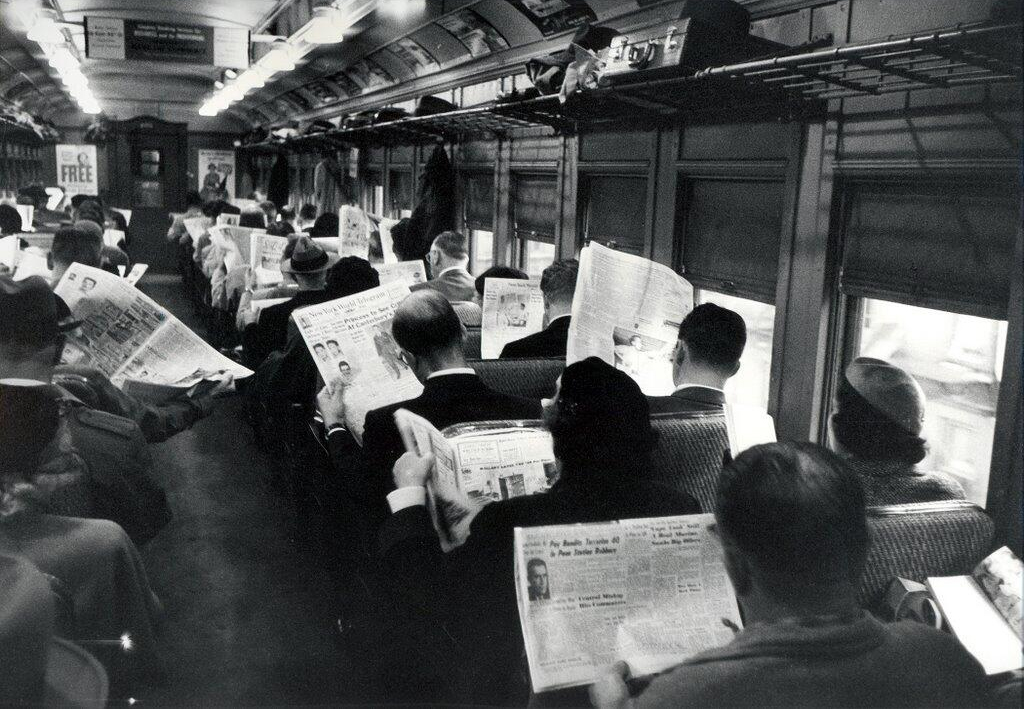
Then there’s the simple fact that we’re always panicking about something. And it’s not even like cell phones are the first technological innovation to threaten the art of conversation. How about, I dunno, the newspaper?

From a Liquid-State article about newspapers surviving (or not) in a digital age.

So that’s why I’m curious: has anyone read Sherry Turkle? Is there more going on? Becaus I have only read articles about her and listened to interviews of her, and in those cases the conversation never seems to go beyond the “gee, golly, phones are scary!” talking point, along with the obligatory jokes about how much the interviewer / author depends on their phone. (Isn’t the irony hilarious? No. It’s tiresome.)

It’s not that I think there are no legitimate concerns. I think there absolutely are. Technology (phones, laptops, tablets) are generally a bad idea in the classroom, and they can easily cause problems in the home. I’m not sure when I’m going to get my kids devices of some sort, but I’m planning on holding out as long as possible. (They do have an old iPad, but it was a very conscious decision to have one device they have to share, because that forces actual interaction when they decide what to watch / play together.) And I am not saying there’s no such thing as too much phone time. Yesterday I zoned out for like an hour playing Civilization Revolution 2 on my phone between 5pm and 6pm, and that was definitely sub-optimal parenting.

On the other hand, all those stories about how couples on dates ignore each other for their phones or how people create this fake version of themselves on social media for public consumption: I dunno. That’s bad, yeah, but I feel like there are some pre-existing conditions in those cases. I don’t imagine that the kind of people who can’t look away from their screen to see the person they are sharing a meal with would be hitting it out of the park without a phone. And when it comes to fake versions of ourselves: I think the underlying problem there is a society that prizes career and advancement over home and community, to the point where people habitually uproot themselves and move cross-country to find work. Doing so severs ties with family and friends and more or less obliterates the idea of a “home,” and the way folks desperately reach out for connection on social media seems like just a symptom of the underlying problem.

Now, there is one thing that does stand out to me as genuinely dangerous, and that’s this (quoting from the NYT’s descripton of Turkle’s first book again, with emphasis added):

When we replace human caregivers with robots, or talking with texting, we begin by arguing that the replacements are “better than nothing” but end up considering them “better than anything” — cleaner, less risky, less demanding. Paralleling this shift is a growing preference for the virtual over the real.

Sci-fi authors have been worried about the idea of people losing themselves in virtual reality pretty much since the idea existed. The starkest and most full-fleshed example comes from Dani and Etyan Kollins’ book The Unincorporated Man. Without spoiling the plot, the setup is that a rich billionaire has himself cryogenically frozen in the late 21st century. Not long after that, virtual reality really takes off, and it turns out that people are super-addicted. The result is that society completely collapses, and there are some pretty horrific vignettes of, for example, families saying goodbye to each other as the world crumbles, plugging themselves into their virtual realities, and then enjoying their last hours or days as they starve to death. By the time society recovers (and unfreezes that rich billionaire, who is the protagonist in the first book), virtual reality is strictly forbidden by legal and social taboos and there are museums to indoctrinate each rising generation about the dangers of VR.
This is just the most vivid account of the danger I’ve read, but there are other folks who–for example–think that the solution to the Fermi paradox[ref]The question of why, if even a tiny fraction of planets support life, the entire galaxy hasn’t been colonized already[/ref] is that every time societies get close to having viable space travel they also have viable virtual reality, and they invariably choose virtual reality because it offers the chance to engineer an environment specifically to scratch every last possible psychological itch a sentient being can have. If all our desires can be catered to with perfect precision, why bother with anything in the real world ever again? So, instead of the stars, every sentient race just collapses into their own solipsistic virtual paradise. (Whether this means they all die off, as in The Unincorporated Man, or just maintain a level of lonely, self-sustaining production to keep the VR lights on is unspecified.)

So don’t get me wrong: tech can be scary. There may be quite legitimate things to fear. But is Turkle one of those, or just another “something new scares me” hand-wringer?

Linker: “Democrats are going to pay a price for defending an unreasonably maximal position on abortion”

805 - Linker Abortion Piece

Damon Linker does not pull any punches in his most recent piece for The Week: Why liberals should support banning late-term abortions. I very much doubt that liberals will pay attention, but they should.

Linker’s central point is pretty simple: United States laws on abortion are so radical that they are out of touch with both American public opinion and “that notorious backwater of oppression for women, Europe.” Citing the recent defeat of the Pain-Capable Unborn Child Protection Act, he compares abortion advocates to the NRA:

That an activist would operate this way — strong-arming senators to champion views that harmonize with a mere 14 percent of the country — isn’t surprising. Planned Parenthood, Emily’s List, and their opinion-journalist allies are acting precisely like the NRA and its champions on the right, warning receptive politicians ominously, “Give an inch and the enemy will take more than a mile next time! No compromise allowed!” And so we get no restrictions on late-term abortion, just as we get no serious federal gun control.

He didn’t stop there, either. Instead, he went on to conclude that:

. . . on the issue of abortion, liberals shouldn’t kid themselves about their ability to keep it up. Their position is untenable, and time isn’t on their side. Those who want to ensure that women keep complete reproductive freedom through the first 20 weeks of pregnancy need to back down on the second 20 weeks. Morality no less than politics demands it.


The entire piece is very, very good and worth reading all the way through. I strongly disagree with Linker about abortion (he is pro-choice; I am pro-life), but I very, very much agree with him on the key factors in this article. American abortion law is truly radical, it is not democratically supported at all, and the pro-choice lobby manages to maintain the status quo only by subterfuge. If Americans understood our laws today, they would not stand for them. An understanding of what the laws really permit–and a deepening understanding of the humanity of the unborn–is inevitable.

Here’s a quick note on why Americans don’t understand abortion law. Roe v. Wade set up a trimester system that allowed states to impose more regulation with each trimester. And so, in theory, the states have wide latitude especially after viability. That is why many people believe that abortion is already illegal or severely regulated later on in pregnancy. The problem is that in every case Roe calls for an exception for a mother’s “health.”

That sounds good and reasonable, but another, lesser-known decision (Doe v. Bolton) that was handed down on the same day as Roe v. Wade defines “health” so broadly that the health-exception basically nullifies any law that includes it.

Whether, in the words of the Georgia statute, “an abortion is necessary” is a professional judgment that the Georgia physician will be called upon to make routinely. We agree with the District Court, 319 F. Supp., at 1058, that the medical judgment may be exercised in the light of all factors – physical, emotional, psychological, familial, and the woman’s age – relevant to the well-being of the patient. All these factors may relate to health.

So “health” can include basically any factor that a physician decides to include. Which means that any law with a “health” exception is useless. It would be like passing a law that says you can’t drink alcohol unless the bartender thinks you need it. As a result, American abortion law is truly radical and late-term abortions are <em>not</em> illegal or harshly regulated[ref]That is not to say that they are common. Two things make late-term abortions very rare. First, there are very, very few abortionists willing to perform them. Second, most women prefer earlier-term abortions. So I’m not saying that they are common. Just that they are legal.[/ref], but in order to fully appreciate this you have to be aware of not only Roe (which everyone has heard of) but also Doe (which is much less well-known). As far as the general public is concerned, the pro-life lobby keeps trying to restrict abortion without exceptions for the mother’s health and that looks very bad and fits the narrative that social conservatives have declared war on women. The understanding that if the health exception goes in the law you might as well just not even bother passing it is little understood.


As long as this charade is maintained intact, the pro-choice lobby continues to operate from a position of strength, even though only 14% of the American public supports their position. But bills like the Pain-Capable Unborn Child Protection Act and the ongoing release of undercover Planned Parenthood videos are eroding that charade.

Time will end the horrific human rights abuse that is the American system of abortion-as-birth control. There will be a day when we look back on this time period with the same mixture of shame and incomprehension as slavery, segregation, and male-only voting. The Democratic Party can get out of the way, or they can take a turn understanding the true meaning of the phrase “the wrong side of history.”