When Profits Are Sinister

Profit is often a dirty word among certain political ideologies. However, for those who defend the importance of profits, it is necessary to realize that sometimes they are signs of something amiss. As economist James Bessen explains,

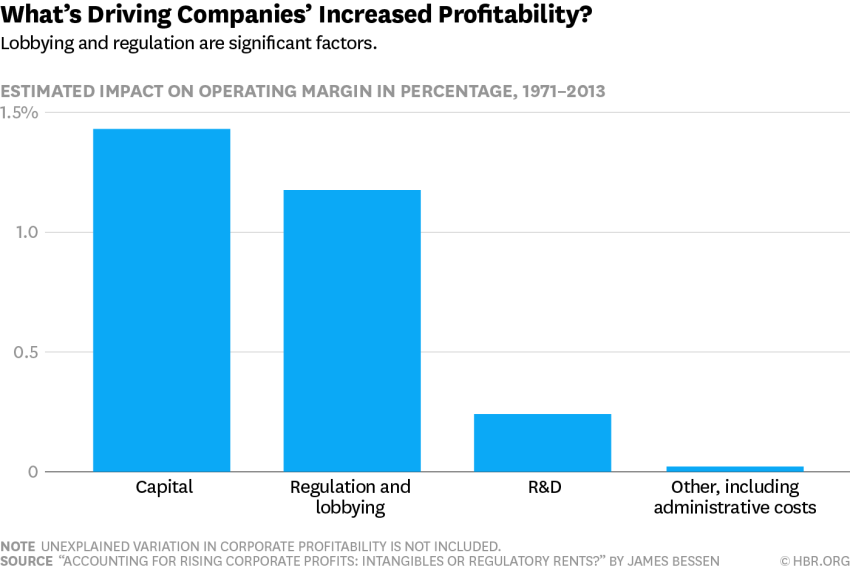
Profits are up. Operating margins for firms publicly listed in the US show a substantial and sustained rise. Corporate valuations are up as well. That is good news for managers and investors. But is it good news for society?

Economists such as Joseph Stiglitz and Luigi Zingales find the rise potentially troubling for two reasons. First, higher profits create greater economic inequality. Rising aggregate profits correspond to a decline in labor’s share of output, contributing to stagnant wages. Also, greater profits for some corporations but not others may create greater wage inequality.

Second, the rise in profits might represent a decline in competition and, with that, a decline in economic dynamism. While a dynamic, competitive economy rewards innovative firms with high profits and punishes poor performers with low profits, sustained aggregate profits suggest, instead, that firms are able to get away with higher prices because competition is limited. Firms engage in political “rent seeking”—lobbying for regulations that provide them sheltered markets—rather than competing on innovation. If so, then high profits portend diminished productivity growth.

However, the increase in profits could be due to firms “increasingly making profitable investments in new technology, in IT, or in their organizational capabilities.” Bessen’s new research paper gets to the bottom of it:

I find that investments in conventional capital assets like machinery and spending on R&D together account for a substantial part of the rise in valuations and profits, especially during the 1990s. However, since 2000, political activity and regulation account for a surprisingly large share of the increase.

This is how rent-seeking, pro-business (vs. pro-market) attitudes, and crony capitalism drag down our economy.

Check out the full article over at Harvard Business Review.

What Are the Effects of Premarital Sex on Marriage?

According to sociologist Nicholas Wolfinger,

By the 2010s, only 5 percent of new brides were virgins. At the other end of the distribution, the number of future wives who had ten or more sex partners increased from 2 percent in the 1970s to 14 percent in the 2000s, and then to 18 percent in the 2010s. Overall, American women are far more likely to have had multiple premarital sex partners in recent years (unfortunately, the NSFG doesn’t have full data on men’s premarital sexual behavior, and in any event they recall their own marital histories less reliably than do women).

As premarital sex became more acceptable, it’s reasonable to anticipate that its negative effects on marital stability waned. In general, Americans became more accepting of nonmarital sex. Certainly fewer men entered marriage with the expectation of a virgin bride. All of the fanfare associated with hooking up is evidence that some young people have become comfortable with the idea of sex outside of serious relationships.

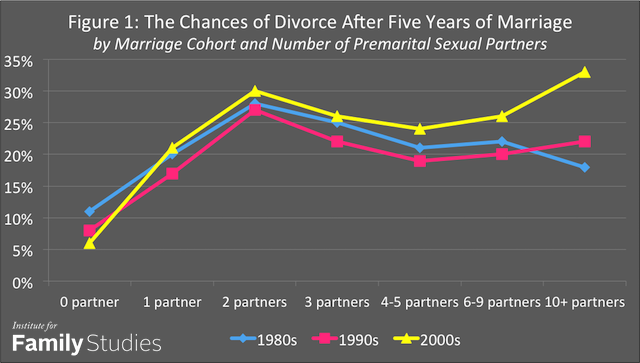
Be that as it may, this prediction is only partially borne out by the data shown in Figure 1. The following chart depicts the percentage of first marriages ending in divorce within five years of wedlock according to the decade the wedding took place and how many sex partners a woman had prior to marriage. Consistent with prior research, those with fewer sex partners were less likely to divorce.

Of course, the percentage drop after 2 partners raises even more questions in the complicated relationship between premarital sexual activity and marriage/divorce.[ref]Compare this with these previous findings.[/ref]

Check out the full article.

Storytelling and the Brain

“Stories are told in the body,” says a recent article at the site for UC Berkeley’s Greater Good Science Center:

It doesn’t seem that way. We tend to think of stories as emerging from consciousness—from dreams or fantasies—and traveling through words or images to other minds. We see them outside of us, on paper or on screen, never under the skin.

But we do feel stories. We know in our gut when we’re hearing a good one—and science is starting to explain why.

Experiencing a story alters our neurochemical processes, and stories are a powerful force in shaping human behavior. In this way, stories are not just instruments of connection and entertainment but also of control.

The article continues to lead us down the path of how “stories unfold in our bodies,” from the release of oxytocin or dopamine to the increase of empathic skills to the triggering of “neurochemical processes that make certain kinds of resource-sharing possible.”

I’ve reported on the psychological benefits of fiction reading here before. This just goes to show how stories can change the brain.

Digital Globalization

A couple months ago, I had a post on research by economist Andreas Bergh which highlighted the importance of information flows in battling poverty. A new McKinsey report on digital globalization supports this view:

To measure the economic impact of digital globalization, we built an econometric model based on the inflows and outflows of goods, services, finance, people, and data for 97 countries around the world. We found that over a decade, such flows have increased current global GDP by roughly 10 percent over what it would have been in a world without them. This added value reached $7.8 trillion in 2014 alone. Data flows directly accounted for $2.2 trillion, or nearly one-third, of this effect—more than foreign direct investment. In their indirect role enabling other types of cross-border exchanges, they added $2.8 trillion to the world economy. These combined effects of data flows on GDP exceeded the impact of global trade in goods. That’s a striking development: cross-border data flows were negligible just 15 years ago. Over the past decade, the used bandwidth that undergirds this swelling economic activity has grown 45-fold, and it is projected to increase by a factor of nine over the next five years[.]

Check out the full article to see how digital globalization is reshaping business.

It’s Not Easy Being [A] Green [Planet]

As reported by NASA:

From a quarter to half of Earth’s vegetated lands has shown significant greening over the last 35 years largely due to rising levels of atmospheric carbon dioxide, according to a new study published in the journal Nature Climate Change on April 25.[ref]The greening effects of global warming were pointed out by Matt Ridley a couple years ago.[/ref]

An international team of 32 authors from 24 institutions in eight countries led the effort, which involved using satellite data from NASA’s Moderate Resolution Imaging Spectrometer and the National Oceanic and Atmospheric Administration’s Advanced Very High Resolution Radiometer instruments to help determine the leaf area index, or amount of leaf cover, over the planet’s vegetated regions. The greening represents an increase in leaves on plants and trees equivalent in area to two times the continental United States.

…However, carbon dioxide fertilization isn’t the only cause of increased plant growth—nitrogen, land cover change and climate change by way of global temperature, precipitation and sunlight changes all contribute to the greening effect. To determine the extent of carbon dioxide’s contribution, researchers ran the data for carbon dioxide and each of the other variables in isolation through several computer models that mimic the plant growth observed in the satellite data.

Results showed that carbon dioxide fertilization explains 70 percent of the greening effect, said co-author Ranga Myneni, a professor in the Department of Earth and Environment at Boston University. “The second most important driver is nitrogen, at 9 percent. So we see what an outsized role CO2 plays in this process.”

The surprising benefits of global warming.[ref]Of course, this doesn’t erase the drawbacks. The good news is that there is some recent evidence that current models may be overestimating warming.[/ref]

Future Mormon: An Interview with Adam Miller

This is part of the DR Book Collection.

Over at Worlds Without End, I’ve written a review of Mormon philosopher Adam Miller’s new book Future Mormon: Essays in Mormon Theology. Those interested in a larger engagement should check it out, but as I describe it there, Miller’s book is an attempt at “a future tense apologetics” that models “a thoughtful and creative engagement with Mormon ideas while sketching, without obligation, possible directions for future thinking” (pg. xii). If future Mormons are anything like what I read here, then they will (compared to my experience with the average present-day Mormon):

  • Place grace at the center of the gospel where it belongs.
  • Take the materialist metaphysics of Mormonism seriously.
  • Be more aware of the implications of their unique and/or innovative doctrines.
  • Find the sacred in the mundane and embodied.
  • Take a more holistic, almost cosmic view of Mormonism.
  • Read the scriptures carefully and recognize the people within them as people, warts and all.

Whether you agree with everything (or anything) in Future Mormon is beside the point. Miller wants you to wrestle with these ideas. The book is meant to start conversations, get the mental wheels turning, and transform the reader into a theologian. In it, he helps lay the foundation for a more thoughtful, earthy, and creative Mormonism; all while extending his hand to readers as an invitation to join him in the process. At least in my case, his hope of inspiring “a thoughtful and creative engagement with Mormon ideas” has not been in vain. And when you pick up Future Mormon and reflect on its pages, I think you’ll find your case to be similar.

You can hear an interview with Adam Miller on Greg Kofford Books’ Authorcast here.

Have Wages Stagnated?

The common claim that wages and living standards have stagnated in the U.S. has been disputed before, but The Washington Post recently reported on a new San Francisco Fed study that suggests the claim is based on a “statistical fluke”:

Workers continuously employed in full-time jobs received wage increases higher than inflation from 2002 to 2015. Last year, the gain was a 3.5 percent increase after inflation, up from 1.2 percent in 2010.

Typically, the median wage — the wage exactly in the middle of all wages — is cited as evidence of stagnation. Indeed, the Fed study confirms this. Median wage increases have fluctuated around 2 percent, unadjusted for inflation. But the median wage is misleading, the report argues, because it’s heavily driven by demographic changes: an influx of young and part-time workers whose relatively low wages drag down the median; and the retirement of baby-boom workers whose relatively higher pay no longer lifts up the median.

This should hopefully calm some of the public hyperventilation that has taken place over the supposed stagnation of wages.

The larger implication is that the study compromises the prevailing economic narrative, which emphasizes the stagnation of wages and living standards. Clearly, millions of households — especially the recently unemployed — have suffered large losses, and the gains of many others are underwhelming. But the impression that most people in the middle class are slipping backward seems overwrought. The anxiety about the future is real, but its causes must be more complicated than commonly thought.

How to Deal With the Top 1%: Competition

“Curbing this inequality requires a clear understanding of its causes,” writes Brooking’s Jonathan Rothwell. “Three of the standard explanations—capital shares, skills, and technology—are myths. The real cause of elite inequality is the lack of open access and market competition in elite investment and labor markets. To bring the elite down to size, we need to make them compete.” He explains that–despite the claims of people like Robert Reich–corporate profits actually represented a lower share of GDP (4.9%) between 1980 and 2014 than between 1950 and 1979 (5.4%).

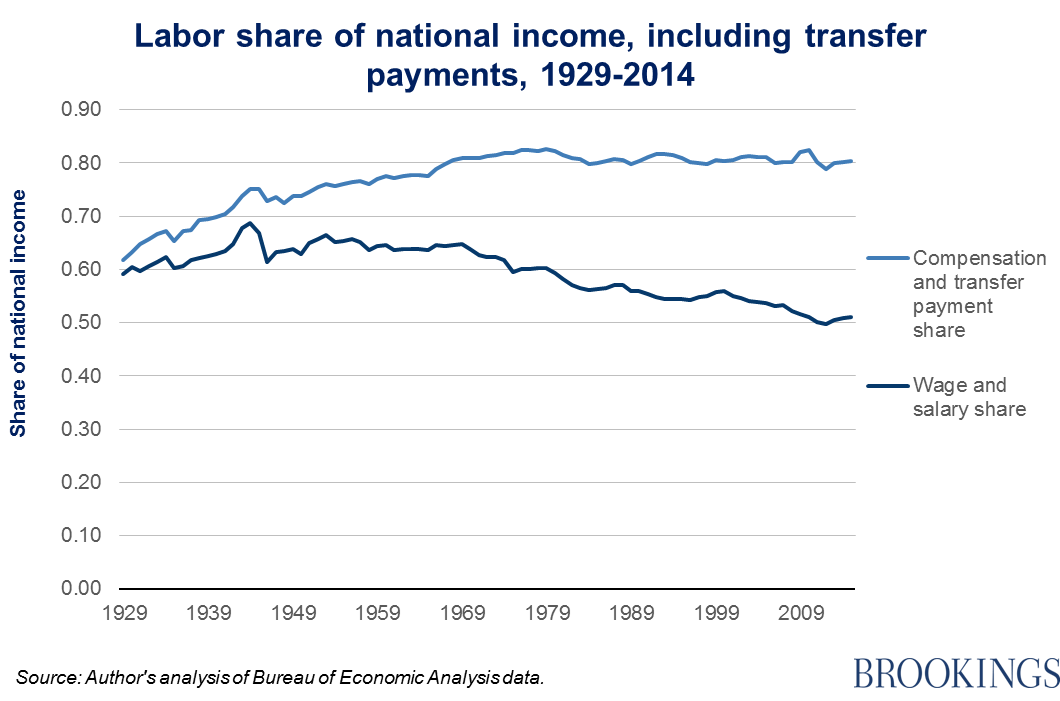
So, what’s going on here? The simple explanation is that wages and salaries are an inadequate measure of the share of economic benefits flowing to labor. Wages and salaries have declined as a share of total income, largely for two reasons. First, total national income includes government transfer payments, which are rising because of an aging population (e.g., Social Security and Medicare). Second, companies have greatly increased non-salary compensation (e.g., healthcare and retirement benefits). Total worker compensation plus transfer payments have actually slightly increased as a share of total national income, from 79 percent between 1951 and 1979, to 81 percent for the years from 1980 to 2015:

Rothwell 32516001

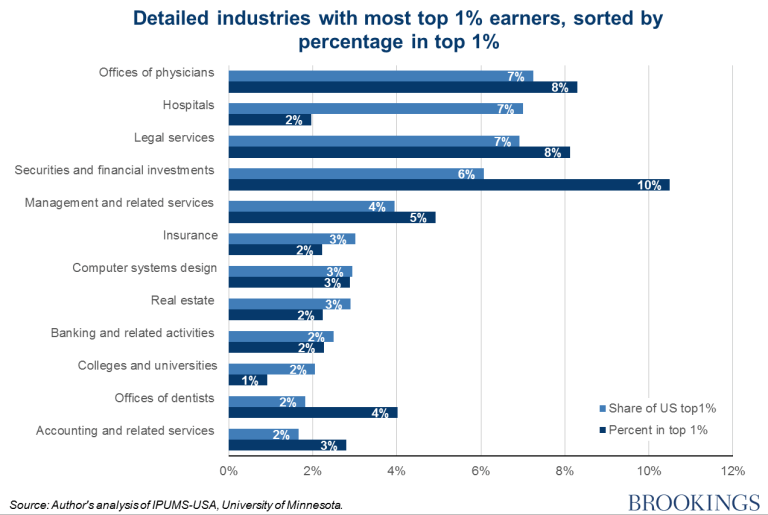
As for the claims that elite earnings are driven by advanced skills and IQ, Rothwell states, “It is certainly true that rising relative returns to education have driven up inequality. But as I have written earlier, this is true among the bottom 99 percent. There is no evidence to support the idea that the top 1 percent consists mostly of people of “exceptional talent.” In fact, there is quite a bit of evidence to the contrary.” Finally, while some entrepreneurs grow rich by founding an innovative technology, the rich are most often found in the doctor’s office. “No industry has more top earners than physicians’ offices, with 7.2 percent. Hospitals are home to 7 percent. Legal services and securities and financial investments industries account for another 7 and 6 percent, respectively. Real estate, dentistry, and banking provide a large number, too.”

So what is leading to inequality according to Rothwell?

One way that the top 1 percent cements their position is by occupying the financial sector, and accessing above-market returns on their investments…The accredited investor rule has mostly been ignored by scholars of inequality. But legal scholars Houman Shadab, Usha Rodrigues, and Cary Martin Shelby are an exception. They have each written persuasively about how the rules contribute to inequality by giving the richest investors privileged access to the best investment strategies. Shadab points out that other countries (with less inequality) allow retail investors to access hedge funds. The law has also inflated the compensation of hedge fund workers—roughly $500,000 on average—by restricting competition. Mutual funds—which charge tiny fees by comparison—are currently barred from using hedge fund strategies because they have non-rich investors. If the law was changed to allow mutual funds to offer hedge fund portfolios, hundreds of billions of dollars would be transferred annually from super-rich hedge fund managers and investment bankers to ordinary investors, and even low-income workers with retirement plans.

But that’s not all.

At the same time, we need more competition at the top end of the labor market. As economist Dean Baker points out, politicians and intellectuals often champion market competition—but what they mean by that is competition among low-paid service workers, production workers, or computer programmers who face competition from trade and immigration, while elite professionals sit behind a protectionist wall. Workers in occupations with no higher educational requirements see their wages held down by millions of other Americans denied a high-quality education and competing for relatively precious vacancies. For lawyers, doctors, and dentists— three of the most over-represented occupations in the top 1 percent—state-level lobbying from professional associations has blocked efforts to expand the supply of qualified workers who could do many of the “professional” job tasks for less pay.

Ultimately, Rothwell suggests that we increase the competition for the top 1 percent.

Before Marx, Adam Smith provided a framework for political economy that is especially useful today. Smith warned against local trade associations which were inevitably conspiring “against the public…to raise prices,” and “restraining the competition in some employments to a smaller number than would otherwise…occasion a very important inequality” between occupations. For earnings to be distributed more fairly, our goal is not to stand in the way of markets, but to make them work better.

Mow the Lawn, Do the Dishes, Save Your Soul

This is part of the General Conference Odyssey.

Last year, journalist Roger Cohen wrote this wonderful little insight in The New York Times:

Life is a succession of tasks rather than a cascade of inspiration, an experience that is more repetitive than revelatory, at least on a day-to-day basis. The thing is to perform the task well and find reward even in the mundane…Want to be happy? Mow the lawn. Collect the dead leaves. Paint the room. Do the dishes. Get a job. Labor until fatigue is in your very bones. Persist day after day. Be stoical. Never whine. Think less about the why of what you do than getting it done. Get the column written. Start pondering the next.

The more I look at it, the more I’m convinced that Joseph Smith’s elevation of the mundane–and consequently the everyday tasks that come along with it–was one of his most inspired doctrines and deepest insights into the human condition. It is within the boring that we discover, as the article puts it, our “personal sliver of the divine.” And it is this affinity for the everyday that tends to be one of the most frequent themes in the General Conference talks we’ve covered so far. President Hinckley’s October 1972 address is no different. In it he celebrates the “small day-to-day decisions will determine the course of your lives.” He determines that the ability to “grow in favor with both God and man…is not beyond your capacity. The course of our lives is not determined by great, awesome decisions. Our direction is set by the little day-to-day choices which chart the track on which we run.” Hinckley admonishes his audience, “Be smart…Be clean. Be obedient. Be prayerful. To do so will require a measure of discipline, the exercise of which will bring strength and capacity for great and demanding tasks that lie ahead of you in building the kingdom of God and in filling places of useful service in the work of the world. Your lives will be satisfying and your joy will be eternal.” Day-to-day choices and the discipline to make good ones are what it’s all about. This even extends into the realm of work:

I have concluded that the work of the world is not done by intellectual geniuses. It is done by men of ordinary capacity who use their abilities in an extraordinary manner. As a member of this church you have the obligation to seek learning and to improve your skills. It matters not whether you choose to be merchant, teacher, carpenter, plumber, mechanic, doctor, or to follow any other honorable vocation. The important thing is that you qualify to be useful workers in society…You cannot afford ever to do cheap or shoddy work. You bear the priesthood of God.

I think part of the reason I (we?) find General Conference so boring is because that’s exactly what they talk about. As Cohen says,

I am less interested in the inspirational hero than I am in the myriad doers of everyday good who would shun the description heroic; less interested in the exhortation to “live your dream” than in the obligation to make a living wage.

When you think of Sisyphus — the Greek mythological figure whose devious attempt to defy the gods was punished with his condemnation to pushing a boulder up a hill and repeating the task through all eternity when it rolled down again — think above all that he has a task and it is his own. Rather than a source of despair, that may be the beginning of happiness.

I’m sure the future Eden will still need its lawn mowed.

Other Noteworthy Quotes & Insights

Marion G. Romney on the helping the poor and needy:

The ultimate test: “In [Matt. 25], the Master declared that the test on which the division would be made on that great day would be the care given to the poor and the needy.”

The necessity of voluntary charity:

In this modern world plagued with counterfeits for the Lord’s plan, we must not be misled into supposing that we can discharge our obligations to the poor and the needy by shifting the responsibility to some governmental or other public agency. Only by voluntarily giving out of an abundant love for our neighbors can we develop that charity characterized by Mormon as “the pure love of Christ.” (Moro. 7:47.) This we must develop if we would obtain eternal life.

The principles of welfare: “Simple as was this program, it was nevertheless founded upon the two basic principles of action operative in all inspired welfare programs, namely: (1) those who have are to give, and (2) those who receive are to work.”

And yet, “As positive, however, as is this commandment against idleness, a disregard of it by the receiver does not justify Church members in failing to impart of their substance “according to the law of [the] gospel, unto the poor and the needy.” (D&C 104:18.)”

Building Zion: “The operation of these two principles, philanthropy by the giver and industry by the receiver, was so perfected in the days of Enoch that “the Lord called his people ZION, because they were of one heart and one mind, and dwelt in righteousness; and there was no poor among them.” (Moses 7:18.)

Interesting tidbits from Harold B. Lee:

Faith-promoting rumors:

I understand that there is a widely circulated story that I was alleged to have had a patriarchal blessing (I don’t know whether any of you have heard about that) that had to do with the coming of the Savior and the ten tribes of Israel. In the first place, a patriarchal blessing is a sacred document to the person who has received it and is never given for publication and, as all patriarchal blessings, should be kept as a private possession to the one who has received it. And second, with reference to that which I was alleged to have had, suffice it to say that such a quotation is incorrect and without foundation in fact. There is one thing that shocks me: I have learned, in some instances, that those who have heard of these rumors are disappointed when I tell them they are not so. They seem to have enjoyed believing a rumor without substance of fact. I would earnestly urge that no such idle gossip be spread abroad without making certain as to whether or not it is true.

Political agendas and violent/illegal activism:

There seem to be those among us who are as wolves among the flock, trying to lead some who are weak and unwary among Church members, according to reports that have reached us, who are taking the law into their own hands by refusing to pay their income tax because they have some political disagreement with constituted authorities. Others have tried to marshal civilians, without police authority, and to arm themselves to battle against possible dangers, little realizing that in so doing they themselves become the ones who, by obstructing the constituted authority, would become subject to arrest and imprisonment. We have even heard of someone claiming Church membership in protest against pornographic pictures being displayed in theaters, having planted bombs, and therefore becoming subject to punishment by the law and subsequently standing judgment before the disciplinary bodies of the Church.

Doomsdayers:

There are among us many loose writings predicting the calamities which are about to overtake us. Some of these have been publicized as though they were necessary to wake up the world to the horrors about to overtake us. Many of these are from sources upon which there cannot be unquestioned reliance. Are you priesthood bearers aware of the fact that we need no such publications to be forewarned, if we were only conversant with what the scriptures have already spoken to us in plainness?

Check out the other posts from the General Conference Odyssey this week and join our Facebook group to follow along!