The first book I ever read by Terry Pratchett was Small Gods. I had never laughed so hard reading any book and–with the exception of a couple of other books also by Terry Pratchett–I never have since. Although he is most famous for Good Omens (written with Neil Gaiman), it was his Discworld novels (including Small Gods) that captivated me. I think that I probably read more books by Terry Pratchett than any other author in high school and–since I’ve read most of the 40+ Discworld novels–I’ve probably read more Terry Pratchett than any other author period.
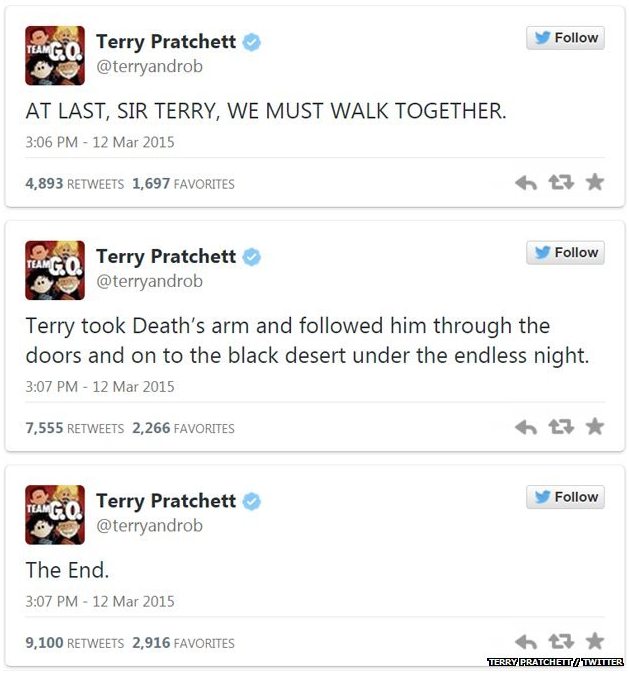
Pratchett was diagnosed with Alzheimer’s in 2007, and he was unusually public about his battle with the disease. He used his last years to not only continue writing, but also to raise awareness about Alzheimer’s. He passed away today, and his death was announced on Twitter. In order to understand the tweets, however, you have to first understand that Death was a recurring character in the Discword novels, and even the star of one of my very favorite books: Reaper Man. In the novels, all of Death’s dialogue was written in capital letters. Keep that in mind when you read the first tweet.
You can read more details from coverage at the BBC.[ref] And, if you were concerned (as I was) about Pratchett’s support of assisted suicide near the end, you may be comforted to know that when he died surrounded by family today, it was not by his own hand.[/ref]
As for me? I think it is time–after nearly 20 years–to re-read some of my childhood favorites.
In 1985, American newspaper readers met an appalling little boy. He taunted his mother (“Prepare for annihilation, pitiful Earth female”), tormented a classmate by telling her he had brought a “thermos full of phlegm” for lunch and kept a sign on his bedroom door that read “Enter and die.” Millions fell in love with him.
Running in hundreds of papers for the following decade, Bill Watterson ’s “Calvin and Hobbes” was not only the strangest American comic strip. It was also the funniest, the most touching and the most profound.
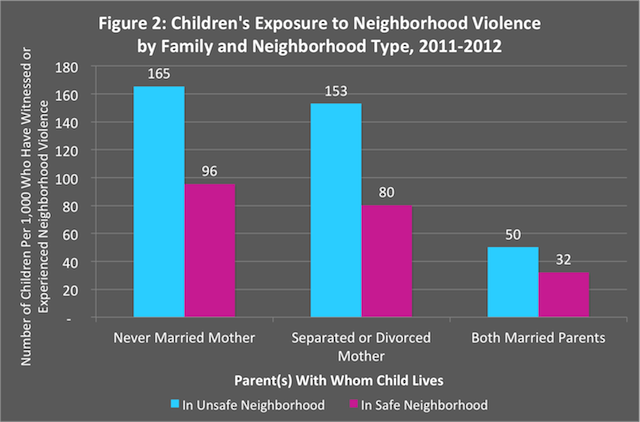
Research has found that children in two-parent families are less likely to be victims of a crime compared to those in single parent households, but it has been ambiguous as to whether this is due to marriage or the neighborhoods in which married families choose to live. A recent analysis on the 2011-2012 National Survey of Children’s Health, however, “shows that even when their families live in unsafe neighborhoods, children in married two-parent families are less likely to be exposed to violent crime than children of never-married and divorced parents.” Family scholar Nicholas Zill explains,
When I looked at combinations of neighborhood safety and family type in which children lived, those living with never-married mothers in unsafe or unsupportive neighborhoods unsurprisingly had the highest rate of encountering neighborhood violence: 165 children per 1,000. This was five times the rate of violence exposure for children living with both married parents in safe and supportive neighborhoods: 32 children per 1,000. Children living with separated or divorced mothers in unsafe neighborhoods were not far behind their peers with never-married mothers: 153 children per 1,000. While children in intact families who resided in unsafe neighborhoods had a higher risk of encountering violence than similar children in safe neighborhoods, their rate of exposure was lower than that of children of never-married or divorced mothers who lived in safe and supportive neighborhoods.[ref]Of course, “these comparisons are adjusted for differences across family types in the average age, sex, and race/ethnicity of the child; family income and poverty status; and the parent’s education level.”[/ref]
Zill offers three possible explanations for his findings:
First is the stress of conflict between parents and the strain of raising children as a lone parent in reduced financial circumstances. These can lead to a lack of vigilance and the overlooking of simple precautions, such as making sure that doors and windows are locked in houses and vehicles. Second, if they have broken up with their child’s other parent, a single parent will usually begin dating and trying to find a new partner. This process often involves being out of the house at night, sometimes leaving children with no or inadequate supervision. Third, as children become adolescents, the peers they become involved with in their less-than-ideal neighborhoods and schools are often troubled ones, who can lead them into hazardous situations and activities.
For me, this is just more evidence as to why those who are concerned about social justice should be the biggest advocates of marriage.
A new study from the Mercatus Center at George Mason University explores the growth of optician licensing in the U.S. Though licensing is often advocated for in the name of “public safety,” this study finds that strict licensing laws reduce competition and enrich opticians with no measurable benefits for consumers (such as vision insurance or optician malpractice insurance premiums). A new NBER study found similar results, concluding that those with occupational licenses in the labor market “earn higher pay, are more likely to be employed, and have a higher probability of retirement and pension plan offers.” Writing in The New York Times, the University of Minnesota’s Morris Kleiner explains,
In the 1970s, about 10 percent of individuals who worked had to have licenses, but by 2008, almost 30 percent of the work force needed them. With this explosion of licensing laws has come a national patchwork of stealth regulation that has, among other things, restricted labor markets, innovation and worker mobility…Occupational licensure has a large and growing impact on labor markets and consumers, but has yet to draw significant public attention or scrutiny. The left and right seem to be in agreement that policy makers need to revisit the process for creating licensure regulations and consider amending or rolling back existing laws in favor of lesser forms of regulations such as certification. Ultimately, we all would benefit from wiser, not more, occupational licensing.
I’m pretty sure that most everyone knows that “live long and prosper” is based on the Jewish priestly blessing. What seems less appreciated is just how fundamental Yiddish culture was to Leonard Nimoy’s identity as a person and as an actor. In 2013, Nimoy was interviewed for the Yiddish Book Center’s Wexler Oral History Project. It is a fascinating interview, even if you only watch the highlights version. Nimoy discusses his family, his life, and his love for a vanishing culture. Oh, and Hamlet’s soliloquy in Yiddish.
The late scholar John Bowyer Bell described terrorists as “real gunmen in imaginary gardens.” By emphasizing the ideological world-view of terrorists- their perceived reality– Bell was going against popular wisdom. It is easy to form the impression that terrorists are driven to desperate measures by harsh, hopeless economic realities. In other words, an environment of poverty and no jobs leaves angry young men with no choice but to lash out violently against the government. This is more or less what Malcolm X meant by a “sociological explosion.”
Is terrorism, though, really about poverty and jobs? A new piece by Peter Bergen argues that it is not. If anything, terrorism is largely a middle-class phenomenon. A terrorist is likelier to be an educated professional such as a surgeon, engineer, or computer programmer than an unemployed laborer. Some, like Osama Bin Laden, are fabulously wealthy. “These are not the dispossessed. They are the empowered.”
If the empowered are the ones resorting to terrorism, it is hard to argue that it is due to economic oppression. These, after all, are people with degrees that epitomize western ideals of applied science and progress, not some sort of unwashed masses. Basically, creating jobs and business opportunities is important, but unlikely to stop radicalized programmers from becoming terrorists. Effectively responding to terrorism requires responding to terrorist ideologies with perceived grievances, and there is no getting round that.
Bergen’s piece draws from top-notch studies providing interesting information on the socioeconomic backgrounds of terrorists, so check it out.
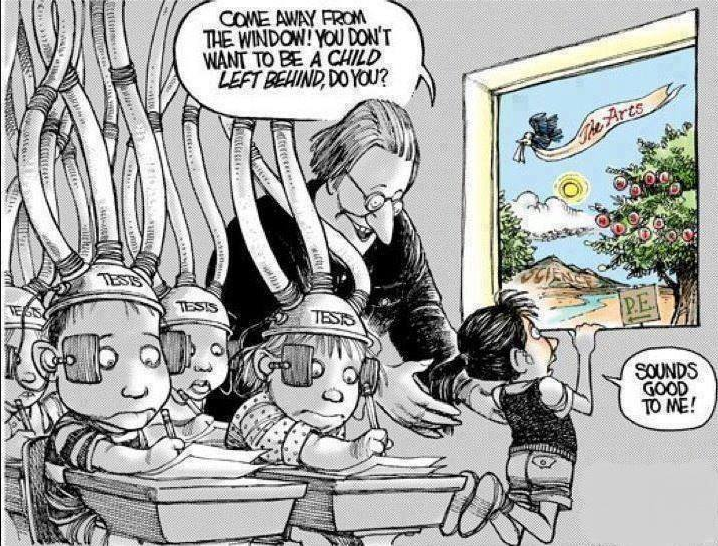
I saw this political cartoon making the rounds on Facebook a week or two ago. I didn’t think much of it until I finished reading The Secret Agent by Joseph Conrad on Saturday. I picked it up on a whim at Audible because the description made it sound like an espionage book, and I’ve been meaning to read some of those. Well, it really wasn’t an espionage book in any conventional sense. But what it was a mind-blowing work of literature in which Conrad floored me again and again with his effortless supply of novel and forcefully evocative metaphors and his profligate characterization. It was stunning.
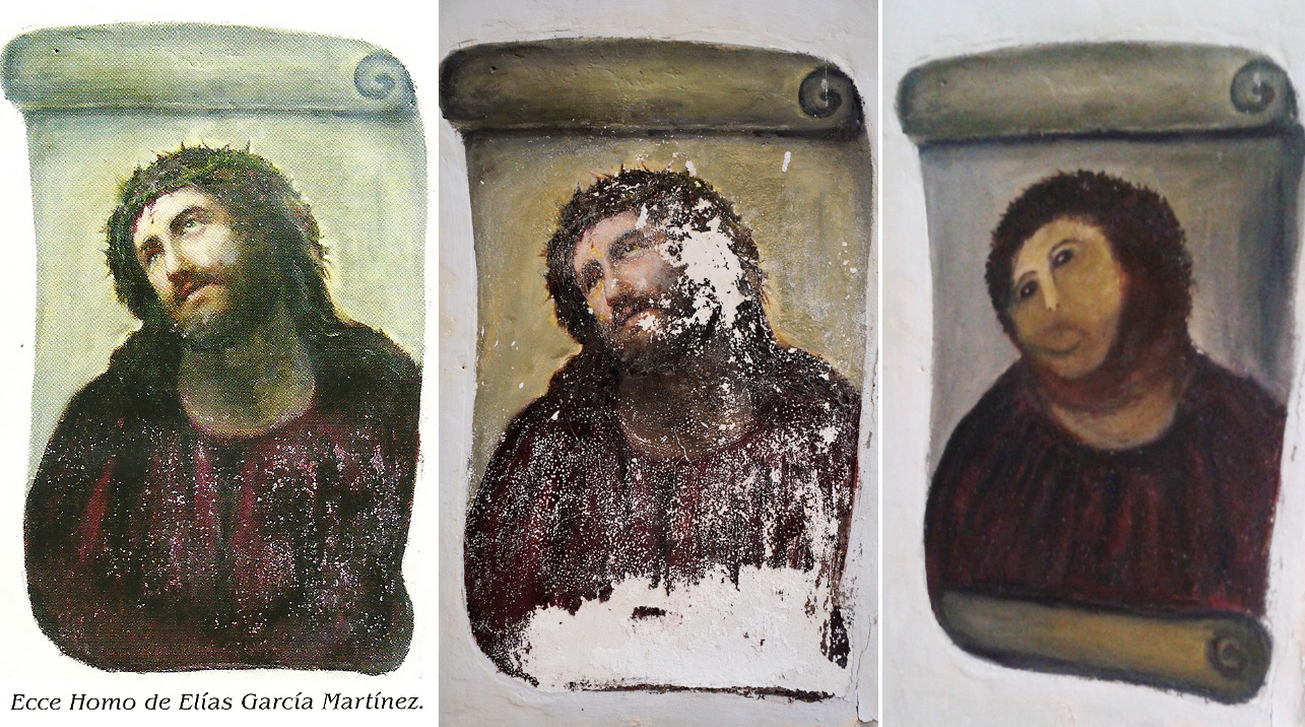
Here’s the thing: I read Joseph Conrad in high school, both Heart of Darkness and “The Secret Sharer.” I remember them as somewhat impressive and a bit dark, but the truth is that nothing much that I was required to read at the time really meant very much to me. How could they have? How much depth, really, does your average 14 year old have? Even the thought of 18 year olds sitting in a college classroom conducting “literary analysis” just reminds of the story of that poor old woman who tried to restore the famous painting of Jesus. The results aren’t pretty.
Call me a cynic, but my view is that your high school English teacher is probably not going to be able to expand your mind to the point where you fully appreciate Joseph Conrad because artistic appreciation is largely something that comes with age and experience. The older I get, the more powerful art is to me. Any attempt to try and cram that sense of wonder and power into a required curriculum strikes me as not only premature, but kind of perverse. Could there be a more apt application of the phrase “pearls before swine?” At 15, Kurt Vonnegut was bizarre, remote, and alien. At 33, I had to stop on several pages just to allow the power of his writing to sort of wash over me before I could keep going.
I’m not arguing against teaching the arts at all, but I do have two thoughts. First, I think we should be more worried about teaching economics, statistics, and basic computer literacy. Those are the skills we need to have an informed electorate and–yes–for people to be able to go out and get a job. They–in addition to basic math and basic literacy–ought to take priority in school because they are needed earlier in life and because, if we’re going to be honest, the ability to appreciate new art at 30 (or 40 or 50) is a lot more likely than the ability to take up calculus or physics. Art stays with you for life. Why rush it?
Second, I’d like to see a whole lot less emphasis on trying to teach kids how to analyze or critique art. In other words: teach the canon. When you invite students to spend their time on analysis you’re turning the whole thing into a farce. If the works are really monuments of intellectual and artistic greatness, than it’s stupid to think that a classroom of random kids will have anything particularly insightful to bring to the table. If the works are really amenable to analysis by a pack of high-schoolers who maybe read 1/2 and skimmed the rest, then obviously there is not really that much to them.
Instead, I’d like to see a whole lot more time on providing the history (and especially the intellectual history) that contextualizes those works. I think lots of folks are worried that the canon might be incorrect, but the reality is that teaching the canon is not primarily an exercise in indoctrination. What is important is not that the kids accept the framework, but that they recognize it and are therefore free to accept, amend, or reject it as informed readers. Ping-ponging around from Socratic dialogues to Herman Hesse to Kurt Vonnegut (just a sample of the high school reading I remember) and treating each one individually and critically is a recipe for disaster.
I’m not confident that this is an approach that would work across-the-board. I don’t think any approach does that. But I do think that the overall emphasis is sound. School should be primarily about learning the stuff that (1) you wouldn’t learn on your own and that (2) must be learned quickly and early on. Focus on skills that are relevant and that can’t be easily picked up alone. An appreciation for art is absolutely essential, but there isn’t as much need to rush the issue in that case.
That’s the question that Brandon Ambrosino asks at Vox. Mostly he’s talking about the movie Old Fashioned, which is a deliberate anti-50 Shades. Now, y’all know I don’t like 50 Shades. I think I made that abundantly clear. But the last possible thing that I think you can do about a movie like that is go try and make an explicit rebuttal.
Overall, I agree with Ambrosino’s assessment. Yeah, most overtly religious art is pretty painful. He is mostly talking about evangelical Christians, but I think it’s equally true of a lot of Mormon art. Second, a lot of that just has to do with lack of skill.
Director, writer, and lead actor Rik Swartzwelder might bear some of the blame here. After all, his resume, like many others in the Christian film industry, seems notably paltry. A good deal of what actors and directors know about their trade comes from on-the-job training, from working on set and in production studios under filmmakers with decades of experience. By isolating themselves from Hollywood, Christian filmmakers are passing up not only on “secular messages,” but on the mentoring that other budding talent are receiving.
There’s also a major signalling problem, which is something that G. covered at Junior Ganymede last week. Art has to push boundaries. Some Hollywood boundary pushing is good. I am not a fan of adding 3d, but I am a fan of constantly trying to refine and challenge the craft. Some Hollywood boundary pushing is bad, as the never-ending race to titillate and outrage more than the last film. In either case, however, there are forcing pushing back. George Lucas innovates on special effects, and gets hammered for short-changing story. The race to the moral bottom is at least substantially slowed by a reluctant public who always want to cross a line, but only by a small amount. But with Christian films, there’s no counteracting force to pressure the amount of Christianity in the film, and so you get the “is it Christian enough” phenomenon that Ambrosino mentions.
But here’s my major point, and it goes back to an earlier part of the article: an artist has to have something to say. And when you’re just critiquing what somebody else already said, that doesn’t cut it.
It isn’t problematic that Christians “borrow ideas” from Hollywood and put their own spin on them. Every film genre does this. But given the Christian doctrine of creation, it is certainly surprising that so many Christian filmmakers — and artists in general — would choose to mimic someone else’s vision, rather than cultivate their own.
This is my problem with negativity and reactionism in defense of religion. There is a time and a place for analyzing or rebutting what has been said in error, but it should never dominate the message. To actual create something, you can’t be looking at an opponent you want to defeat. You have to be looking at a greater vision towards which you aspire. Christians have a temptation to fight back, but it’s a temptation we’ve got to resist in almost all cases, because it will never win out in the long run. You can’t create a viable alternative by imitation. You need a truly independent vision.
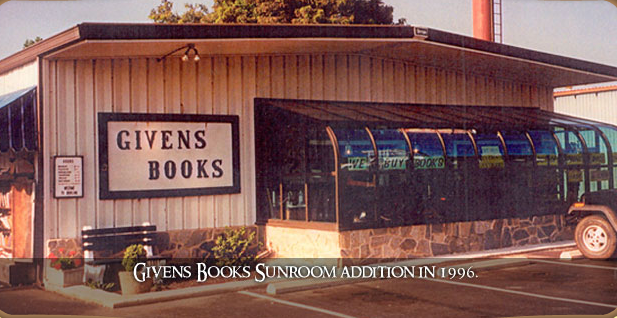
My father’s father’s bookstore, the place I miss most in the world.
My grandfather started a bookstore in Lynchburg, VA long before I was born. Over years of family vacations, it became my favorite place. I spent countless hours of my childhood perusing the covers in the used sci-fi section. I took my favorites back into a break room where I could always find space on an old church pew and occasionally even an off-brand root beer in the mini fridge. My mind took to the stars as I read the old books with their tattered covers, leaving my body behind amid the clutter of American antiques and artifacts. Today, my uncle continues to run Givens Books in a new building down the street from the old one.[ref]The city bought it and demolished it for a road that they ended up never building.[/ref] Another uncle operates another Givens Books in another town. Books, you might say, are in my blood.
And when my family isn’t writing books they are, of course, reading them. Lots and lots and lots of books. But at this point I have to specify that the Givens clan, by and large, reads serious literature. And, on that score, I’ve been a bit of a disappointment to everyone.
Other than the assigned books for school, I have always read pretty much exclusively fantasy and science fiction. From Brian Jacques to J. R. R. Tolkien, and from Alan Dean Foster to Orson Scott Card, I wanted books with magic and spaceships.[ref]Especially spaceships. I fast-forwarded to the space combat scenes in Return of the Jedi on our VCR copy so many times that I broke it and had to patch it with tape. Which totally worked, by the way.[/ref]
This was probably fine when I was just starting to read on my own in elementary school. I went through dozens of Hardy Boys and a lot of Tom Swift, Jr. (which I liked more) and several series of similar kid mystery books from England. Even in middle school it probably wasn’t too alarming. Who can say no to a little Susan Cooper? Others, like Madeleine L’Engle, were probably supposed to be the gateway drugs into more serious literature. But for me, they weren’t, and by the time I was in high school this was clearly something of let-down for all concerned.
The most pristine example of this dynamic was when my cousin (just a couple of years older than me) had his copy of Piers Plowman along with him at a family gathering. Piers Plowman is “a Middle English allegorical narrative poem… written in unrhymed alliterative verse…considered by many critics to be one of the greatest works of English literature of the Middle Ages.” At more or less the exact same time, I was reading Timothy Zahn’s Thrawn trilogy, which is “a series of best-selling science fiction novels…set in the Star Wars galaxy approximately five years after the events depicted in Return of the Jedi.” After all, they had spaceships.[ref]Actually, I might have been re-reading them.[/ref]
My parents were–and are–great. I don’t recall a single lecture about this, let alone any ultimatums or demands. When my dad realized how hooked I was on sci-fi, the best he could do was ask his colleagues in the English department to recommend the best sci-fi had to offer. This is how I got into Isaac Asimov‘s Foundation series[ref]Which, while a classic, is just not really well-written. I liked I, Robot a lot more when I found that on my own a little later.[/ref] and also Philip José Farmer. Unfortunately, no one recommended Ray Bradbury or Philip K. Dick or Ursula K. Le Guin at the time, which really goes to show you that English professors are probably not the best crowd to get sci-fi advice from.
The point, however, is that even though my father did his best not to look at me while my cousin was expressing just how fascinated he was by Pier and his damnable plow, I knew the comparison was too obvious to be missed.
To this day, my uncles and aunts ask me what I’m reading whenever we meet up. This question is both necessary and–in most cases–sufficient for all conversation at a Givens clan gathering. I reply, as often as not, that I’ve just read (e.g.) Jim Butcher’s newest novel and it was fantastic. They never recognize the books, and so they ask for more info with that voracious glint in their eyes that a Givens gets whenever they detect the proximity of satisfying literary prey. But, as soon as they hear “fantasy” or “science fiction,” they remember who they are talking to. Instead of a thick, juicy, literary steak I am talking about bubblegum and breath mints. Interest in literature wanes as they consider me with concern. It’s as though they asked me how work was going, and I told them that it was going pretty well: my boss had given me a promotion now that I knew how to fit the shapes into the correct slots on the first try most of the time.
The problem is, that somewhere along the way I picked up the idea that you were the kind of person who read serious literature or you were the kind of person who did not. You know, it’s the old:
When I was a child, I talked like a child, I thought like a child, I reasoned like a child. When I became a man, I put the ways of childhood behind me.
I felt like I had to choose either-or, and I had some pretty compelling reasons not to go with the serious stuff. First, although I enjoyed some of the literature I got assigned to read in high school and college, the ones that I didn’t like I really didn’t like. Case in point: Siddhartha by Herman Hesse. Oh man, I loathed that book with all the pure and fiery indignation of adolescence. The idea that spirituality requires detachment from ordinary life was (and still is) repulsive to me. If the sacred and the holy cannot survive close proximity to real life then what good are they? Maybe at 33 I’d be less judgmental than I was at 14, but my idea of monolithic categories meant that a couple of bad experiences poisoned the well. If the powers that be put Siddhartha in the same category as The Sheltering Sky, I felt I had to take or leave them together.
I loved The Sheltering Sky, by the way, even though it wasn’t a fun book. I also loved Hemingway, and For Whom the Bell Tolls was probably the one (and only) serious book I read voluntarily as a teenager. Not only had books like Siddhartha sort of peed in the pool, however, but there was also the way that serious literature was read. In college, we had a handbook in one class full of the different literary approaches. You could choose from Marxism, feminism, or deconstructionism. The same authority that said “these are the books to read,” was also telling me “and this is how you read them.” No, thanks.
It’s not that I’m averse to analyzing what I read. Far from it, I can almost never turn off the analytic side of my mind, and most of the time I enjoy it. Probing and critiquing is how I enjoy most of what I enjoy. It’s second nature. The two things that bugged me about the way literary analysis was taught in high school, however, were first that it was so dogmatic and second that it was pathetic to have a bunch of 14-year olds pontificating about books that were way, way outside our capacity to really understand.
As for the dogma: I think that’s kind of self-explanatory. It’s no secret that certain kinds of views are allowed in the humanities, and other views not so much. It’s not that I was so concerned about seeing conservatism recognized, but I just wanted to be able to be freely curious. At the extreme end of the spectrum, I signed up for an elective women in literature class my senior year of high school. I just wanted to understand different viewpoints. I expected to be one of the only guys in the class, but what I didn’t expect was the wall of hostility that greeted me every day. I wasn’t trying to debate anyone. In fact, I wasn’t even trying to ask questions or influence the conversation: I just wanted to sit and listen. But I soon realized that my presence was an unwelcome imposition, so I dropped the class. Even when the examples were not quite as flagrant the message was always universal: only certain kinds of perspectives and certain kinds of people were actually welcome.
As for the analysis: I don’t think that at 33 I’ve arrived at some pinnacle of understanding that I didn’t have when I was still in school at 14 or 18 or 22. But the greater life experiences and the historical and philosophical context make these books mean much, much more to me than they possibly could have then. Going back to The Sheltering Sky for a minute: that book came to life for me all over again when I took a class on existentialism in college. Even though I’d already liked it, my appreciation grew dramatically when I was able to put it in context. The lesson is simple: as a teenager the emphasis should have been more on understanding and less on critiquing the great works. Even most teenagers know that they don’t have anything special or unique to say about books that have been studied by scholars for decades or centuries, so the activity of forcing everyone to pontificate resulted in contrived, hackneyed, embarrassing experiences that undercut the possibility of approaching literature more as student and less as judge or critic.
So, given the political dogma, the pretentious critiques, and the boring books that I thought I’d have to take along with the good ones: I said no, thanks to serious literature. When school was out and I could read whatever I wanted, I glutted myself on fantasy and sci-fi to my heart’s content. But then a funny thing happened. After a few years of this, the books started to lose their taste. I found I’d lost the ability to lose myself in the stories.
My literary Peter Pan syndrome kept me deathly opposed to abandoning my sci-fi for classics, but I started cautiously moving out towards literary sci fi. I read more Vonnegut, more Bradbury, and more Dick. They were all great. Then I turned to more recent literary sci fi with books like Never Let Me Go and The Handmaid’s Tale. I loved them as well, so I kept exploring further. I was still dedicated to staying conspicuously away from outright serious literature, so instead I experimented with some classic American noir: The Big Sleep and Promised Land.[ref]Not really noir, since it was set in the 1970s, but definitely from the same tradition.[/ref] And I loved all of them, too.
Next thing you know, I started asking my family for the books they liked to read, and before you knew it I’d read Marilynne Robinson’s Gilead and Wallace Stegner’s Angle of Repose and both of them blew me away. Most recently, I just finished Joseph Conrad‘s The Secret Agent and finally the dam burst. I mean, Joseph Conrad is as serious as you can get, really. His work is over a century old and I had, of course, read Heart of Darkness in high school. I didn’t get it then, but I got The Secret Agent now. And it wasn’t any of the nonsensical analytic hogwash that I’d rejected in school. It was the sheer power of his writing and, above all, the strength of his amazing metaphors and similes. Here was writing that touched my soul. Here was writing that lived up to Joseph Conrad’s ambition to “by the power of the written word… make you hear, … make you feel… [and] before all, to make you see. That – and no more, and it is everything. If I succeed, you shall find there according to your deserts: encouragement, consolation, fear, charm – all you demand – and, perhaps, also that glimpse of truth for which you have forgotten to ask.”
Not only had I finally fallen in love with some of the literature that I’d eschewed as a kid, but I also couldn’t help but see the obvious parallels between a writer like Conrad (serious literature) and a writer like Ray Bradbury (sci-fi). They are not very similar, all things considered, but they both have a gift for some of the most novel, evocative similes I’ve ever read, doled out with such breathtaking profligacy that I’m left in awe.
It also helped, by the way, that I read a few books I hated. Camus’ The Stranger did absolutely nothing for me, despite the fact that I had loved The Plague. And don’t get me started on Dorris Lessing‘s sci-fi catastrophe.
What really got through to me the most, however, was that at the same time that I was reading serious literature and loving it, I was finding that popular sci-fi and fantasy were starting to resonate with me again for the first time in years. During the same years where I discovered my love of Stegner and Conrad I was also devouring Brandon Sanderon’s epic fantasy tomes and re-affirming Jim Butcher’s place as my very favorite living author.
Now, this may very well be obvious to all of you, but it’s been a revelation to me. Entertainment is part of our identity. Or at least that’s how people usually think of it. In high school and college–when we’re all building our identities–the kind of music that you listen to is automatically connected to the clothes you wear and the friends you have. Turns out, the main reason for that is insecurity and inexperience, and that there’s actually no good reason why you shouldn’t alternate between Renaissance religious chants and screamo. Or, back on the topic of literature, between Fyodor Dostoevsky and John Ringo.
I’m not trying to equate the two. I have pretty strong opinions about who is better at the sheer craft of writing as an art form, and it’s going to be Dostoevsky over Ringo (and on down the line in favor of serious literature in most cases).[ref]I sort of doubt John Ringo would contest that.[/ref] But there are lots of different kinds of beauty in the world. The ceiling of the Sistine Chapel is one and riding on a roller coaster is another. Which is better? Do you want to have to pick just one? Because I don’t. I love going on very long runs (12 miles is my max so far) with all the pain and the sweat and the weakness and the satisfaction that comes with it. I love sleeping in when the temperature is just perfect and the blankets are at optimal coziness and there’s nothing that you absolutely have to do just yet. Is one of these a better way to enjoy the sheer physical sense of being a mortal, living, physical creature than the other? I don’t care to debate, because I choose both.[ref]Although not at the same time, clearly.[/ref]
Life is dark and disappointing enough as it is. I read a quote somewhere that said the secret of life is learning how to let yourself down gently, and it has always stuck with me. The most likely scenario is that none of your dreams are going to come true. Even if they do: they won’t be as beautiful as you imagined. That might sound depressing, but it’s reality. I think that if we could see, at age 14 or 18, all the pain and heartache that lies in store for us we would go literally insane with fear and horror. But there’s also beauty. And the really, really strange thing about being human is that the pain and the joy never seem to cancel out. The positive and negative just keeping adding up. The books are never balanced. If we could see all the beauty and happiness that life has in store for us, we’d be just as quickly reduced to a blubbering mess.
I have a depressing view of human existence, sure, but I have a romantic one, too. Every year I discover new bands, new songs, new books, new movies, new places, new ideas, new images, new people that I quickly come to love so much I can’t believe that I ever got along without them. What else is out there today, crafted by some unknown (to me) artist that will bring a light to those dark tomorrows? I have no idea, but since life has brought me enough of disappointment and never too much joy I am determined not to wall off any beautiful possibilities.
A while back someone asked me why this quote from Kurt Vonnegut means so much to me:
I am honorary president of the American Humanist Association, having succeeded the late, great, spectacularly prolific writer and scientist, Dr. Isaac Asimov in that essentially functionless capacity. At an A.H.A. memorial service for my predecessor I said, “Isaac is up in Heaven now.” That was the funniest thing I could have said to an audience of humanists. It rolled them in the aisles. Mirth! Several minutes had to pass before something resembling solemnity could be restored. I made that joke, of course, before my first near-death experience — the accidental one.
So when my own time comes to join the choir invisible or whatever, God forbid, I hope someone will say, “He’s up in Heaven now.” Who really knows? I could have dreamed all this. My epitaph in any case? “Everything was beautiful. Nothing hurt.” I will have gotten off so light, whatever the heck it is that was going on.
I love this quote–it brings me near to tears whenever I read it–because it is a lie, but it’s a beautiful one. It’s the same lie I tell myself so that I can keep going. It’s the same lie I hope my kids believe. It’s the same lie that–despite calling it a lie–I hope turns out to be true. The lie, and as long as we see only with mortal eyes it will remain an earthly lie, is that one day we will see something that makes it all beautiful. That one day we will feel something that makes all the hurt go away. That one day we will understand something that quiets the confusion we carry with us through our lives every single damn day. That one day we will be together with the people we have missed so much. That even though I can never go back to my grandfather’s bookstore again, one day I’ll be able to see him again.
Until that great day of hope, we’re stuck here in the darkness. But we can still see lights. There are tiny sparks that whisper to us of the promise of dawn. I believe one day the lie will become truth. I believe one day the sun will rise. Until then? I want to gather to myself every one of these flickers of light that I can. While I live, there will never be enough beauty. And I want it all.
A couple of weeks ago, the New York Times ran a really good story called How One Stupid Tweet Blew Up Justine Sacco’s Life. It’s not really just about Justine Sacco, though. It’s about a litany of folks who made a stupid joke on Twitter or posted a stupid photo on Instagram and were then subject to massive social media shaming and had their lives ruined. Now here’s the thing: most of the jokes or images that drew people’s ire were pretty inexcusable as far as things go. But the repercussions seem disproportionate and–most worryingly–the shaming has taken on an kind of barbaric, carnival cruelty aspect. If there’s one thing to take away from this, it’s that social media is shockingly anti-social.



 A
A 

 It’s not just buying and selling, of course. My grandfather was a history teacher before he was a book store proprietor, and his passion for history was life-long. He wrote several books about American and Mormon history like
  and
and  . Another book of his, a memoir of Christmas on the upstate New York farm where he lived as a child, was even picked up by Scribner:
  in 1997. He has been
  and
and  ). I also have at least one aunt who has written her own brilliant, albeit so far unpublished novels.[ref]I say “that I know of,” because I wouldn’t at all be surprised if some of my other aunts were writers, too.[/ref]
 to
to  , and from
  to
to  , I wanted books with magic and spaceships.[ref]Especially spaceships. I fast-forwarded to the space combat scenes in Return of the Jedi on our VCR copy so many times that I broke it and had to patch it with tape. Which totally worked, by the way.[/ref]
 This was probably fine when I was just starting to read on my own in elementary school. I went through dozens of Hardy Boys and a lot of Tom Swift, Jr. (which I liked more) and several series of similar kid mystery books from England. Even in middle school it probably wasn’t too alarming. Who can say no to
  , were probably supposed to be the gateway drugs into more serious literature. But for me, they weren’t, and by the time I was in high school this was clearly something of let-down for all concerned.
 or
or  or
or  at the time, which really goes to show you that English professors are probably not the best crowd to get sci-fi advice from.

 I felt like I had to choose either-or, and I had some pretty compelling reasons not to go with the serious stuff. First, although I enjoyed some of the literature I got assigned to read in high school and college, the ones that I didn’t like I really didn’t like. Case in point:
  was probably the one (and only) serious book I read voluntarily as a teenager. Not only had books like Siddhartha sort of peed in the pool, however, but there was also the way that serious literature was read. In college, we had a handbook in one class full of the different literary approaches. You could choose from Marxism, feminism, or deconstructionism. The same authority that said “these are the books to read,” was also telling me “and this is how you read them.” No, thanks.
 My literary Peter Pan syndrome kept me deathly opposed to abandoning my sci-fi for classics, but I started cautiously moving out towards literary sci fi. I read more Vonnegut, more Bradbury, and more Dick. They were all great. Then I turned to more recent literary sci fi with books like
  . I loved them as well, so I kept exploring further. I was still dedicated to staying conspicuously away from outright serious literature, so instead I experimented with some classic American noir:
  and
and  .[ref]Not really noir, since it was set in the 1970s, but definitely from the same tradition.[/ref] And I loved all of them, too.
 and Wallace Stegner’s
  and both of them blew me away. Most recently, I just finished
  and finally the dam burst. I mean, Joseph Conrad is as serious as you can get, really. His work is over a century old and I had, of course, read Heart of Darkness in high school. I didn’t get it then, but I got The Secret Agent now. And it wasn’t any of the nonsensical analytic hogwash that I’d rejected in school. It was the sheer power of his writing and, above all, the strength of his amazing metaphors and similes. Here was writing that touched my soul. Here was writing that lived up to Joseph Conrad’s ambition to “by the power of the written word… make you hear, … make you feel… [and] before all, to make you see. That – and no more, and it is everything. If I succeed, you shall find there according to your deserts: encouragement, consolation, fear, charm – all you demand – and, perhaps, also that glimpse of truth for which you have forgotten to ask.”
 . And don’t get me started on
 What really got through to me the most, however, was that at the same time that I was reading serious literature and loving it, I was finding that popular sci-fi and fantasy were starting to resonate with me again for the first time in years. During the same years where I discovered my love of Stegner and Conrad I was also devouring
  .
. and
and  .
.