What If I Believe This Just Because It Is Beautiful?

2014-03-25 Bicep2 Telescope

Just over a week ago reports with headlines like Big Bang’s Smoking Gun started to appear all across the Internet. Just yesterday the New York Times weighed in on the significance of the discovery, ranking it alongside the Higgs-Boson:

These gravitational waves are the long-sought markers for a theory called inflation, the force that put the bang in the Big Bang: an antigravitational swelling that began a trillionth of a trillionth of a trillionth of a second after the cosmic clock started ticking. Scientists have long incorporated inflation into their standard model of the cosmos, but as with the existence of the Higgs, proving it had long been just a pipe dream.

There are already skeptics[ref]Cosmologists Say Last Week’s Announcement About Gravitational Waves and Inflation May Be Wrong[/ref], but I want to focus on an odd, impromptu interview with Andrei Dmitriyevich Linde and what it says about the relationship between science and faith. Linde is one of the physicists who first proposed the theory of inflation decades ago, and in the video Professor Chao-Lin Kuo surprises him at his home with initial results confirming that Linde has been right all along. Something Linde said really struck me:

If this is true, this is a moment of understanding of nature of such a magnitude that it just overwhelms and… let’s see. Let’s just hope that it is not a trick. I always live with this feeling “What if I am tricked? What if I believe into this just because it is beautiful? What if…?” Yes, so this is really helpful, to have evidence like that. It’s really, really helpful.[ref]This is my own transcription from the video.[/ref]

Professor Linde’s question really struck me the first time I heard it. “What if I believe it just because it’s beautiful?” What that expresses to me is a much more nuanced and comprehensive understanding of human belief and faith than we are usually allowed to glimpse when the guardians of right and proper rationalism are busy trying to drive their wedges between religious faith and scientific evidence. Just so we’re clear: I’m not equivocating the two, nor am I in any way suggesting that this new discovery itself validates theism.

What I’m doing is just pointing out that belief is about more than just rationality and objective evidence. It’s about intuition and symmetry and beauty and value. I think it would be a terrible misrepresentation of Linde’s faith in his unverified theories to call it “wishful thinking,” or “blind belief,” although there are aspects of both wishing and blindness in it. Similarly, ugly dismissals of religious conviction using the same labels strike me as a fundamentally impoverished view of what it means to be a human being in a world of mystery and contradiction where questions always outnumber answers on any truly meaningful issue.

From where I’m standing, the kind of tentative, pioneering scientific faith that precedes (but dos not obviate) experimental validation is a close cousin of the kinds of thoughtful, humble religious conviction that have animated so many believers in so many traditions for thousands of years. Obviously we should never merely accept this kind of faith where there is the prospect of evidence at hand. But isn’t it just as clear that this kind of faith is intrinsically noble and important? Clearly there are important differences between religious and science inquiry, but this is one commonality: faith is the beginning and not the end of inquiry.

Young Boy Gets Life-Saving Experimental Drug, Now What?

Not long ago the Internet was aflame with the story of how a young, 7-year old boy and his family were desperately asking a pharmaceutical company to give him the drug he needed to survive, and were being denied. The company relented in the end, but to me it seemed that most of the Internet’s attention had already skipped on to new heart-wrenching, outraging, or hilarious stories.

This is not what a heartwarming story looks like.

Fast news stories of the Internet are the intellectual equivalent of fast food. We crave their artificial flavors with Pavlovian desire, but in the end they pass through us undigested. We are let empty and undernourished, our minds fat and heavy instead of lean and strong. Let me give just one gruesome example. Earlier this month, a woman drove her minivan into the ocean with three children inside. Luckily, they were rescued, but even the earliest stories that I read quoted the children as saying “Our mommy’s trying to kill us, please help.” Subsequent reporting included quotes from the woman’s sister that she had been talking about demons and eyewitness testimony that sh had intentionally driven the van into the ocean. That didn’t stop GodVine from publishing a video of the rescue with this description:

Beach patrol and Good Samaritans rushed to rescue a pregnant mom and her three children who were trapped inside. The heroes narrowly avoided being pulled under the water themselves!

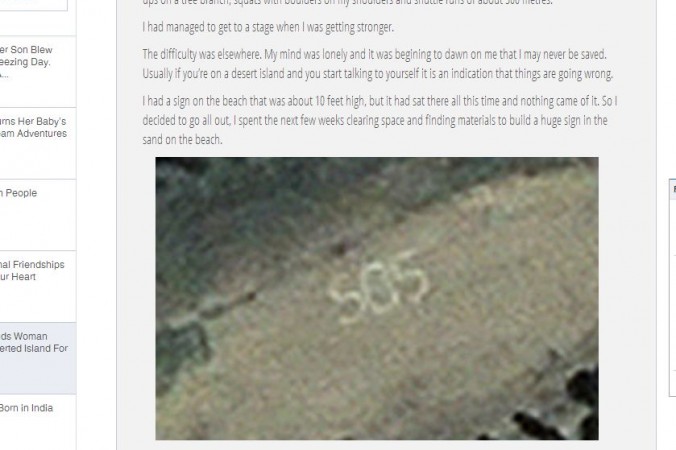
2014-03-24 SOSI know we like to harp on about how bad it is to focus on only negative news, and I get that, but it’s also pretty repugnant to package a macabre story of woman attempting to murder her children as just more feel-good clickbait. Slow down, people, is all I’m saying. Those hoaxes you keep posting (the SOS / Google Earth one has been making the rounds) don’t just  make you look dumb. They are a symptom of vacuous thoughtlessness and emotion-craving that is worse than merely stupid.

So what happened to the young boy who needed the life-saving treatment? If you cared enough to read it the first time, maybe you ought to care enough to actually learn about it. CNN reports that, after getting the drug, he is starting to recover. The headline is cheerful and the first paragraph is upbeat (“After just three doses of an experimental drug, Josh Hardy — whose parents had to launch a media campaign to get him the medicine — is sitting up, doing homework and playing board games with his brothers, his mother said.”) but if you read to the end of the article the package of the feel good story start to unravel.

Now that Josh is taking brincidofovir, he’s no longer taking the other drug that hurt his kidneys, but the damage was done: His kidneys still aren’t working and he has to undergo dialysis three times a week. His mother worries he might be on dialysis the rest of his life… As recently as last month, Josh had a “go get ’em” attitude about fighting his illness, his mother says. But now, even though he’s getting better, she says he seems to be exhausted after months of being sick and lacks motivation.

My heart goes out to Josh Hardy and his family. I’ll be saying prayers for them tonight, and it’s literally the least I can do. But that’s just my point: his family’s struggle to keep their son alive deserves to be treated better than  just the attention-point-of-the-minute for our ADHD culture. First we read the story of the evil pharma company and we’re angry. Then we read that the evil corporation caves to humanity and we expect or even demand that a happy ending follow. And so, if you don’t read between the lines of the CNN coverage, that’s what we get.

Of course, the first half of the story was also a complete invention. Far from being some nefarious big corporation, the company that is making the drug has 50 employees and has never made a profit. They were overwhelmed by requests for compassionate care to the point where they worried that they would be delayed getting the drug to market, a drug that could help 50,000 people in the US and another 55,000 in the EU. Furthermore, compassionate care cases run the risk of skewing the results of the trial, meaning that a potentially life-saving drug could be delayed or even rejected by too many compassionate care cases. Forbes covered the story in more detail (here and here) explaining the very real ethical quandary and the risk of setting a precedent by giving the drug. What’s the solution? Well, no one knows and–frankly–no one cares. Folks were only interested in the story of Josh Hardy’s struggle to stay alive in the same way that they are interested in who wins The Voice or American Idol or whatever.

Look, I think The Bachelor and Real Housewives and most reality TV is stupid and at least a little sick, but at least that stuff is designed as entertainment. You want to get into Survivor? Whatever, that’s your thing. But I just think people ought not to contribute to spreading stories that trigger outrage on social media if they don’t actually take the time to do basic research first. It’s not harmless. It’s delusional and divisive. And we can’t blame this nonsense on Big Media or politicians or anything like that. This is something we do to ourselves. And we need to stop.

So here’s the rule I recommend folks to try to live up to on their own: if you didn’t spend 5 minutes on Google learning about it, don’t share it.

Unless it’s about kittens or other cute animals. I am human, after all.


My Pops in a Web Comic

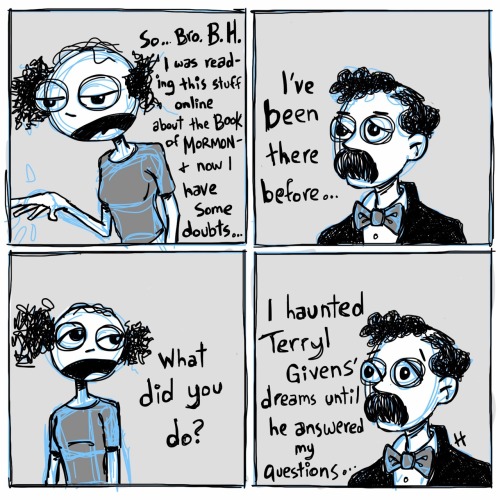
Garden of Enid is a fun, Mormon web-comic that I read regularly. (You should too!) So imagine my surprise and delight when it turns out that Friday’s comic was about my very own dad! Yup, pretty much the finest hour for the Givens Clan, I’d say.

In all seriousness, and at the risk of sounding sappy, I am extremely proud of the work that both my mum and dad do. They are the best. (And I generalize from a comic about my dad to both of my parents because I know how much my mum has been there every step of the way, even if she didn’t come out and coauthor a book until quite recently.)

Real Clear Religion Runs My Article on OW

2014-03-24 RCR Article

Real Clear Religion is running an article I wrote about Ordain Women and the letter they received from the Church Public Affairs Department. They titled it The Mormon War on Feminism. I asked them to change it on the grounds that there are plenty of Mormon feminists who do not support the goals of OW, but they liked the headline they’d picked. I’m not too bothered, because at least I really like the lead in they wrote for it: “Ordain Women risks losing their current position as a standard bearer for reform.” That’s pretty accurate. So it’s not the same as the article I published on DR last week, but there are some similarities. In any case, it’s definitely exciting for me to be reaching new venues. (This is my first article at RCR.)

The Symbol of a Lie

Kevin Williamson at National Review has an article on the “coat hanger” mythology surrounding the abortion debate. Quoting the DC Abortion Fund, Williamson writes,

“The coat hanger is a symbol of the reproductive justice movement because lack of access to abortion causes women to go to desperate lengths to terminate a pregnancy, similar to those undertaken in the pre–Roe vs. Wade era. At that time, consuming Lysol and household poisons was not uncommon to instigate abortion. Nor was inserting knitting needles, Coke bottles, and — yes — wire coat hangers into their cervices.”

As Williamson explains, “That is untrue. It has long been known to be untrue. The wire hanger is indeed a powerful symbol — the symbol of a lie engineered with malice aforethought.”

See why in the full article.

Hebrew Translation of Tolkien

"One does not simply expect Israeli POWs to read Tolkien and do nothing."
“One does not simply expect Israeli POWs to read Tolkien and do nothing.”

This article in The Jerusalem Post is a few years old, but it is a great story:

Of the two Hebrew translations of JRR Tolkien’s classic book The Hobbit, one of them was painstakingly written down in Egyptian exercise books by [Rami] Harpaz and nine other Israeli prisoners-of-war languishing in a Cairo jail. They were eventually released in a prisoner swap brokered after the Yom Kippur War in 1973. To tackle translating Tolkien’s The Hobbit, the forerunner to the Lord of the Rings trilogy, was the brainchild of Harpaz. On the back cover of the prisoners’ Hebrew version of The Hobbit, however, no name appears for the translation – just a mention that it was a group effort by Israeli prisoners-of-war during their years of captivity in the Abaseyar prison.

“We finished The Hobbit after four months. Basically, we became two groups – those who translated and those who read the translation – and for this reason we decided not to translate the trilogy, as it was important to keep the group together as one unit,” said Yitzhak Pe’er, one of the translators. “Two of us would sit out in the sun reading sentence by sentence in English, but out loud giving a word-for-word literal translation into Hebrew while another would be jotting it all down. We had many arguments, even shouting matches, about how this or that should be translated. I think one of our total failures was the translation of the songs, as none of us really had sufficient talent to do them the justice they deserve. It was extremely difficult to translate idioms and other special words, as we wanted not only the words but also the mood of the author.”

Check out the full article.

What Does Ordain Women Really Want?

Disclaimer: If you do not like sarcasm, you may find it difficult to get through this. I understand your point of view. But please note that I sass with love.

I recently stumbled upon the idea, from an OW supporter, that the OW movement simply wants the prophet to pray about Mormon women in the priesthood. They just want some updated revelation. This was of course surrounded by others saying that women “need” the priesthood for eternal progression (I won’t quibble about that today) and women have the “right” to the priesthood (ditto). However, let’s take for a moment the idea that all that OW wants is for the prophet to hear their concerns and pray on their worries. Let’s say that all the people who say women need, want, and have the right to the priesthood are just miscommunicating their desire to get the prophet to pray for revelation. There is a scriptural tradition for such requests in ancient and modern texts.

In this case, I hate to tell you, but OW you are going about it in all the wrong ways. Nate Oman discussed to this in his poorly received (at least by OW) article on why the movement is currently set up for failure. But I can tell you one reason why you are doing it wrong: I had no idea you just wanted more revelation. In fact, I thought you only wanted one particular revelation, if that, otherwise you just wanted ordinations to begin yesterday.

Oo, somethings not right here.

Now, I may just start rehashing some of the things Nate and my husband have already said, but I hope I can bring a little more to the discussion. First of all, I am a woman, so my anatomy does not disqualify me from disagreeing with other women (truth). Secondly, I have children, so I speak for all mothers (sarcasm). Third, I am getting my PhD in a science, so I am liberated, intellectual, academic, and logical, and I speak for all the people who are or prefer those things (again, sarcasm). I also grew up in a household that was technically without the priesthood: yes my mom was a working single mother, I was the product of, whisper it with me now, divorce, and there were no boys to hold up the mantle. (But I could go on and go on about the many incredible, humbling, and teaching ways the priesthood blessed my family, headed by a divorced single mother with cancer, but I will save that for next time.)

Let me explain how the OW movement looks through the eyes of this tired, stressed-out mother and PhD student, who grew up in a completely imperfect Mormon home located in the South. I realize that many people are invested in this movement, and any negative thing I say will sting. I understand. When I received the first draft of my Honors thesis back from my undergraduate advisor, which looked like he had gleefully bled all over every. single. page. I was devastated; like someone had handed me back my baby and said, “Actually, she’s hideous.” So with that in mind, I say, the OW movement appears to be a media-hungry enterprise that cares more about acceptance from the world than working together with the everyday Mormon woman and is solely seeking for everyone, including the prophet, to confirm that its opinions are right. Phew, I know, that came out strong. Commence picking it apart!

Really though, I’m not saying this is what the movement is, or that any particular member feels that way. But, overall, this is how it appears to me. When you have the media discussing what is a very personal and spiritual part of doctrine, when there are more spotlights on Kate Kelly than I can count, when you don’t go through the grass root efforts of talking with sisters who disagree (or at least don’t talk to them kindly or with respect), when you reciprocate the church’s “I’m a Mormon” campaign for a cause, when you have members who very much appear to be making demands (beyond asking for a prayer) from the prophet, it makes me very uncomfortable.

I think part of the problem is that a grass roots effort, something akin to a letter writing campaign, would appear to have much less effect than if we can get the NYT talking about it (although I truly believe the prophet would respond to a heartfelt call from the sisters). As statistics have shown, Mormon women, in general, don’t want the priesthood. Most women see it more as a responsibility and less as an opportunity, and we’ve already got a lot on our plates. There may even be some women who take a don’t-tempt-fate attitude towards asking for the priesthood. I know sometimes I avoid praying for service when I’m really busy, sometimes I do it anyway because I don’t know how I’ll survive without the blessings providing services brings. And I know recently when our family had some financial struggles, we were blessed not with our dollar stretching further, but with the opportunity to stretch our work hours even longer.

So, OW, if you really want to be the messengers for women who just want the prophet to request revelation, I have a few suggestions for you.

First, unify your message. Don’t get caught up in what the world wants to say about the oppression of women in our completely backwards (to them) religion. Don’t demand, plead. The Lord cares about your pains and your desires, but it’s hard for some of us other Mormons to understand what you’re really asking for, if simple revelation is really what you want. In fact, I could maybe get behind a simple desire for a current prophetic response, if I’m in an OK-to-tempt-fate mood. And there is common ground between us for more sensible participation by women throughout the church, regardless of our desire for the priesthood.

Second, ban the hate-filled comments towards those who disagree. It may be true that some of us don’t understand what you are really asking for, but that doesn’t mean we just don’t know what’s best for us. That doesn’t mean we don’t understand our place in the world, the church, and our home. That doesn’t mean we don’t care about you or are distracted by some nebulous patriarchy. We are strong, loyal, and faithful women trying to make it right for our families through this crazy world. We are all in this together, even if we don’t always agree on the same means.

Finally, turn your purpose to service. If women are hurting and they feel having the priesthood will solve that hurt, help us help them. Help us alleviate their pain and suffering. We can’t give them the priesthood, but we can serve them. Please, teach us how to serve these women, and let us serve you. It has to go beyond a catchy “How Not to Speak to Mormon Feminists” and into actual deep caring for one another. The Relief Society has all the potential to allow us to constantly uplift each other, let’s harness that across the divide of OW.

Let me share my light and love with you.

On Ordain Women Being Confined to Free Speech Zones

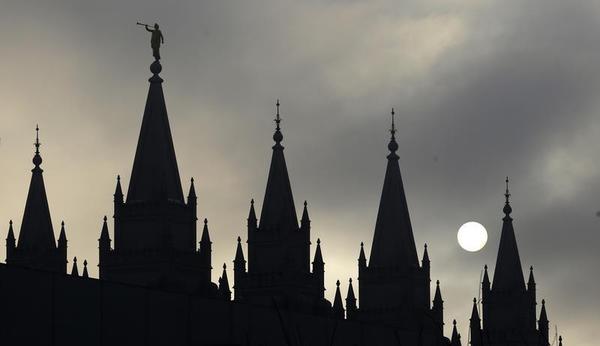
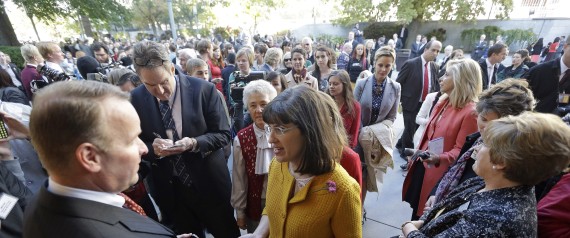
Twice a  year the Church of Jesus Christ of Latter-day Saints holds a General Conference, which consists of 4, 2-hour meetings for the general membership of the Church to attend at the giant conference center in Salt Lake, at church buildings around the world, or even from home via Internet and other sources. In addition to the general membership meetings, there is a Priesthood meeting for men and boys 12 or older and a combined meeting for women and girls as young as 8. Last year, at the Fall General Conference, the feminist Mormon group Ordain Women staged a protest at the male-only meeting. OW seeks to have women ordained to the Mormon priesthoods (there are two orders), but their request was denied and they were barred entrance. The incident made headlines, which seems to have been the purpose.[ref]I base this on both the language used (e.g. “Priesthood Session Action”) and also on the explicit emphasis placed on the publicity the event garnered: ” The images of us watching men and boys walk in instead of us and of each of us asking for permission to enter are powerful.” Alternatively, just look at the cameras and reporters in the pics.[/ref]
Mormon Conference

OW plans to repeat their action again at the upcoming April General Conference, and this has provoked a preemptive response from the Church. An official statement that was released to the public makes two important statements. First, it states that male-only ordination to the Aaronic and Melchizedek priesthoods is “a matter of doctrine.” This draws a deliberate contrast with the racial priesthood ban which the Church rescinded in 1978 and further repudiated in a statement earlier this year. That practice was never based on any canonized revelation, and is now[ref]Original version said “had been viewed” which implied to some folks that it was always seen as just policy. That’s not accurate, and it’s not what I intended to convey.[/ref] viewed as a matter of policy (transient) as opposed to doctrine (permanent). The new statement even went farther and specifically disavowed the folk theology that had grown up around this policy: “None of these explanations is accepted today as the official doctrine of the Church.”

This new statement on race and the priesthood is part of a major, but quiet, new initiative in how the Church talks about its own history and other sensitive issues. It is, in that sense, a sign of progressiveness in the Church. I, and many others, applauded the document when it came out. So it is very telling that the Church chose to refer to this document (however obliquely) in their response to OW. Referring to a new, progressive document conveys the message, “This far, and no farther” more powerfully than a reliance on an older or more traditional source would.

Which brings us to the second, and more controversial, statement:

If you feel you must come and demonstrate, we ask that you do so in free speech zones adjacent to Temple Square, which have long been established for those wishing to voice differing viewpoints.

The formal statement has drawn headlines of its own weeks ahead of the OW demonstration. Kate Kelly, the founder of OW, is quoted in the Salt Lake Tribune as stating flatly:

We have nothing in common with those people [referring to other demonstrators in the free speech zone]. They are seeking to destroy the church. We are not against the church — we ARE the church.

The idea that the Church has chosen to ostracize OW members is widely seen by supporters of OW as victory for their movement. A raft of blog posts from prominent Mormon women, like Jana Riess, have come out stating that the Church is behaving like a bully. Riess writes:

There is something deeply symbolic about yesterday’s statement, for it reveals what the Church apparently thinks of the feminists within its fold. We, as faithful and active members of the Church, are being lumped together with the same anti-Mormon protestors who routinely crash General Conference and shout that the Mormon religion is of the devil. These protestors have started fistfights with conference-goers and even stomped on or burned temple garments.

In line with characterizations like these (although not necessarily as an endorsement of them)[ref]Kristine pointed out in a comment to this piece: “I said nothing about the merits of either side’s case; I was asked to opine on the way the media would respond, and I did.”[/ref], Kristine Haglund, another prominent Mormon feminist, called the decision a “PR disaster for the church.” She went on o say that “Goliath is never going to get better press than David — the optics are terrible.” That’s all I intended folks to glean from her quote, that it was a bad PR move, but I [/ref] On Facebook I’ve seen friends express similar twin feelings of deep hurt at being excluded along with a sense that soon the tide will turn in their favor and the members of the Church will come to see OW as the good guys. I think both of those reactions are mistaken.
2014-03-19 Unjust JudgeFirst, while my heart goes out to those who feel stunned and betrayed by this announcement, I’m afraid they may have set themselves up for tragedy. The movement for female ordination often models their approach on scriptural precedents like the parable of the importunate widow, but this is a very high-risk approach to activism. But this parable is problematic for a couple of reasons. First, it is about a widow and therefore someone who self-evidently has a valid claim.[ref]The parable is more commonly known as the parable of the unjust judge.[/ref] Is it “self-evident” that we ought to ordain women? Obviously most Mormons don’t think that it is. Second, it seems like a serious mistake to apply the parable to conventional PR pressure tactics targeting the leaders of the Church instead of prayer to God. I’m not suggesting that OW should only pray about this and nothing more, but I am suggesting that enlisting this parable as a justification of conventional protests is a mistake. Unfortunately both these elements, the believe that female ordination is self-evident and also the belief in scriptural justification for their tactics mean that OW may have not really prepared themselves for the possibility that the Church simply isn’t going to go their way. I’ve often seen Mormon feminists pronounce total confidence in both the rightness and the inevitability of their cause. In light of such great expectations, there is simply no way that the Church could offer a definitive “no” that would not feel crushing.[ref]By contrast, I have often seen folks who oppose female ordination express a willingness to adapt if God reveals that to be the course for the Church. It seems this has emboldened the OW movement instead of encouraging them to consider their own back-up plans.[/ref]

Meanwhile, however, Mormon feminists often do not seem cognizant of the fact that their requests would cause just as much pain to fellow members as they themselves feel today. If they feel excluded by this statement, imagine how categorically and totally traditional Mormons (who vastly outnumber Mormon feminists) would feel were the Church to repudiate their faith and their convictions by instituting female ordination. There genuinely are two sides to this issue, and those who oppose female ordination frequently do so because of their own equally sincere convictions about what it means to be a Mormon woman. I understand that being asked to stand next to anti-Mormons may feel like symbolic ostracism. Does OW understand the extent to which, if their requests were granted, huge numbers of Mormons would feel just as betrayed? It may be asking too much while the sting is still fresh, but feelings of hurt and betrayal should eventually be examined in this context. This story ends with broken hearts, no matter how it ends.

Second, and for a great many reasons, I do not think that the Church’s statement will result in a significant shift in Mormon perception of OW. It’s important to step back and realize that OW does not even speak for all Mormons who feel dissatisfied with the status quo as it relates to the priesthood and gender issues broadly defined. As I’ve written before, the word “conservative” takes on strange connotations in a religion that is dedicated to ongoing revelation. Mormons believe in a Heavenly Mother, but we know very little about Her. Mormons believe that there are other scriptures beyond the Book of Mormon, but we don’t have them yet. We believe that God “will yet reveal many great and important things pertaining to the Kingdom of God.”[ref]9th Article of Faith[/ref] In a broad vista of possible futures, the movement to ordain women to the Aaronic and Melchizedek priesthood orders is one tiny possibility that does not have broad support even among Mormons who look for forward to further light and knowledge.[ref]I also suspect that the Bloggernaccle is something of an echo chamber for a relatively radical Mormon minority.[/ref] In fact, one of my chief disagreements with OW is precisely that it seems completely deaf to the possibility of a genuinely new and uniquely Mormon resolution to the questions it raises, seeing instead only the conventional secular redress.

What’s more, however, the Church’s statement isn’t in any way a proactive attack on OW itself or its members. This is not some kind of sequel to the September Six. As quick as folks are to draw comparisons with the civil rights struggle and other forms of oppression and persecution, the Church has actually done nothing as it relates to OW generally. It has only specified that if you want to come to Temple Square for the purpose of protesting the Church General Conference you have to do so in the area that has been designated for that purpose. In other words, the statement does intimate that the aim of OW runs counter to the doctrine of the Church, but the only action the Church is taking is a specific, limited, response to a single, contained tactic of OW that causes even generally supportive Mormons consternation. This is not the stuff of which martyrs are made.

Mormonism is an incredibly open-minded faith because of its atheological nature, and I do not believe that the statement from the Church presages an offensive against Mormon feminists in general or even specifically against OW. Lots of Mormons believe lots of things, and lots of Mormons think that other Mormons are crazy for the things they believe.[ref]Welcome to humanity/[/ref] When it comes to behavior, we’re a pretty rigid Church, but when it comes to philosophy it’s pretty much every man or woman for himself. And I like it that way. I like the big tent approach to philsophy coupled with firm stances on ethical actions. But there is a difference between “all people are welcome” and “all ideas are accepted.” No matter how much we as individual members may love our Church, it is ultimately not up to us to define what the Church believes. It isn’t really our Church at all. Every religious tradition must decide for itself which beliefs are essential, which beliefs are somewhat optional, and which beliefs are banned.[ref]As a general observation, I think religious traditions are always more tolerant in this sense than the individual members within that tradition wish they would be.[/ref]

I certainly don’t want to get out ahead of the prophets and declare this answer conclusively resolved based on one sentence from one public relations statement. So I am not going to try and argue that the Church’s position on female ordination is as central as, for example, the divinity of Christ or the Atonement. It isn’t, and it never can be. But I do think that proponents sometimes fail to appreciate the extent to which a commitment to gender essentialism and traditional gender roles is a deep part of our culture, history, and doctrine. Unique teachings that define Mormonism, like the centrality of the family to exaltation, are inextricable from teachings like gender complementarity. These beliefs have been reaffirmed recently with the proclamation on the family. And they seem to be at odds with OW’s particularly severe and uncompromising vision of gender egalitarianism.

There will always be some members of faith traditions who find their treasured convictions on the wrong side of the boundaries of their faith. That is an awful predicament to find oneself in. Historically, some in that position have ultimately been in error, but sometimes it is their particular faith tradition that has made mistakes. (Sometimes both, of course.) That is why, even if the Church gets increasingly explicit about male-only ordination as a matter of essential doctrine, I will sympathize with those who cling to their beliefs and their conscience. I think they are wrong, but (in this possible future) I hope that all those who find themselves in that position realize that they are loved and wanted and welcomed even if one or more of their beliefs have been categorized as out of bounds. I hope they find a way to live with the tension between their competing beliefs (a tension we all feel to some extent at different points in our lives) and remain within our community.


The “Smoking Gun” For Cosmic Inflation


The New York Times has an excellent article on the recently reported discovery of gravitational waves, providing what is being called the “smoking gun” of cosmic inflation. The article provides a simple, but detailed explanation of the theory of inflation:

THE UNIVERSE  is just under 14 billion years old. From our position in the Milky Way galaxy, we can observe a sphere — the visible universe — extending 14 billion light-years in every direction. But there’s a mystery. Wherever we look, the universe has an even temperature.

NOT ENOUGH TIME  The universe is not old enough for light to travel the 28 billion light-years from one side of the universe to the other, and there has not been enough time for scattered patches of hot and cold to mix into an even temperature.

DISTANT COFFEE  At a smaller scale, imagine using a telescope to look a mile in one direction. You see a coffee cup, and from the amount of steam, you can estimate its temperature and how much it has cooled.

COFFEE EVERYWHERE  Now turn around and look a mile in the other direction. You see a similar coffee cup, at exactly the same temperature. Coincidence? Maybe. But if you see a similar cup in every direction, you might want to look for another explanation.

STILL NOT ENOUGH TIME  There has not been enough time to carry coffee cups from place to place before they get cold. But if all the coffee cups were somehow filled from a single coffee pot, all at the same time, that might explain their even temperature.

INFLATION  solves this problem. The theory proposes that, less than a trillionth of a second after the Big Bang, the universe expanded faster than the speed of light. Tiny ripples in the violently expanding energy field eventually grew into the large-scale structures of the universe.

FLUCTUATION  Astronomers have now detected evidence of these ancient fluctuations in swirls of polarized light in the cosmic background radiation, which is energy left over from the early universe. These are gravitational waves predicted by Einstein.

EXPANSION  Returning to our coffee, imagine a single, central pot expanding faster than light and cooling to an even temperature as it expands. That is something like inflation. And the structure of the universe mirrors the froth and foam of the original pot.

Andrei Linde, the physicist who championed the notion of chaotic inflation in 1983, was surprised with the news at his home by Stanford’s Chao-Lin Kuo, a member of the research team behind the new discovery.


This is very exciting.

Level 3 Communications Throws Hat in Net Neutrality Ring

level3

I previously posted about Cogent Communications complaining that Comcast, Verizon, AT&T et al are trying to “unfairly” squeeze more money out of Cogent by holding their own customers hostage from the content those customers ask for and have been told they have access to. Up until recently, Cogent was the only major internet backbone carrier piping up publicly, but now Tier 1 network operator Level 3 is speaking out against major-ISP anti-consumer misbehavior in this blog post by Level 3’s General Counsel of Regulatory Policy Michael Mooney. This is a big deal, because it illustrates just how far-reaching and critical this issue is for the future of the internet and everyone who relies on it. Want to get an idea of how big Level 3 is? You could make a drinking game out of it, but do so at your own peril. Go to your nearest command or terminal window and type tracert (if in Windows) or traceroute (Mac OS X, Linux) and then any random website you go to often, like this:

traceroute www.yahoo.com

Then hit enter, and watch. Whenever you see “l3” or “level3” anywhere in the scrolling results list, take a note. That’s your request being routed through Level 3’s sprawling, expansive network. Enter in some more top-level domains. You’ll see it popping up over and over again.

In the blog post, Michael Mooney takes ISPs to task, criticizing them for utilizing their (oft-ill-gotten and oft-misused) last-mile monopolies to strong-arm content providers into paying for the same service the ISPs’ own customers are already supposed to have paid for. He addresses the ISPs’ counter-claims about the “unbearable” costs of increased bandwidth usage by their customers streaming video and downloading large files by pointing out the inconsistency of such complaints next to the public financial records of these same ISPs showing soaring and growing profits year-by-year. However, instead of using these record revenues to upgrade their infrastructure to provide the level of service their customers are already paying for (oh, yeah, and also being charged increasingly larger fees for, and also being increasingly slapped with data caps over), the ISPs simply let their service degrade and insist the content providers to pick up the tab for upgrades. Mooney claims they have so far refused to negotiate fairly or in good faith. Netflix, for one, has already been forced to cave on the issue with Comcast out of fear of losing droves of customers and for no other reason than Comcast’s customers really, really like using Netflix.

This is not capitalism, or anything like it. It’s rent-seeking, pure and simple, and it’s collusion, not only between ISPs agreeing to not compete with each other but also between ISPs and the governments and politicians that grant them the power and status to play chicken with the welfare of an ever-growing sector of our economy.