Can Time Guess Your Politics?

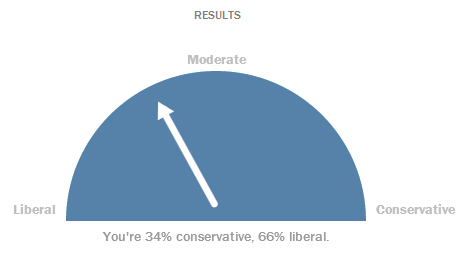
Time gave it their best shot, but it didn’t turn out so well.

2014-01-10 Times Politics
Ummm…. no.

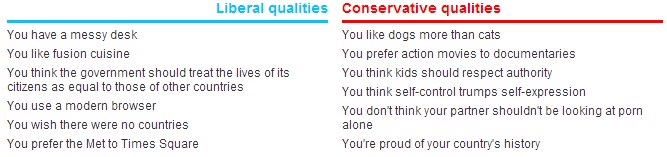
Not really their fault. I’ve often observed that in terms of temperament I’m much more like liberals than conservatives. So I wasn’t surprised that they were wrong. I could even easily tell, question-by-question, which ones would get me nudged in which direction or the other. Here are the specific results, by the way:

2014-01-10Time Politics Detailed

No big surprise, some of them some contradictory. Example “You wish there were no countries,” vs. “You’re proud of your country’s history.” Yeah: I’d love to live in one, giant, happy global community. Apparently humans tend to need an adversary (a “them”) to define a community (an “us”), but I’ve always hoped that a communal endeavor–something like exploring the Solar System–could unite us without the need for an enemy. I’d love to live in that world. We just don’t. Yet.

So… how does Time’s prediction work out for you guys?

New Movie Challenges Pro-Choice Narrative on Pregnancy Centers

There’s a new movie coming out called Gimme Shelter staring Vanessa Hudgens that includes some pretty strong pro-life themes and questions the pro-choice attacks on crisis pregnancy centers while it’s at it. The trailer is pretty intense.

Most of what I know about the movie comes from this Secular Pro-Life piece, but I’m definitely intrigued. I hope I have a chance to check it out and, if I do, I’ll review it here.

Scientific Belief vs. Scientific Literacy

Back in November, Nathaniel had a Times & Seasons post based on a survey from Pew Research. The survey looked at beliefs regarding evolution across various religious denominations. Yet, Nathaniel pointed out that the survey isn’t really about evolution. “It’s basically a roll call to see where  people stand on the perceived cultural war between religion and science”:

Folks who embrace strong, anti-scientific rhetoric are flaunting their disregard for the world’s estimation of their IQ and burnishing their loyalty for all to see. They are signalling to their fellows, yes, but it’s more than that. They are enacting a narrative of persecution and using the scorn that comes their way to validate their sense of importance and role in a larger narrative. The folks on the other side of the fence, those who mock the anti-science crowd, are displaying their sophistication and cosmopolitan nature. Once again, they are signalling to their fellows and strengthening social bonds, but they are also paying the cover charge to see themselves as participants in some grand endeavor. Instead of taking the role of a stalwart band of besieged disciples, however, they are playing the part of foot soldier in the ongoing march of progress. Mocking those who seem ignorant is a cheap price to pay for feeling like you’re part of the rising tide of enlightened reason. (Especially if you bear the burden of a near total lack of relevant scientific expertise.)

This astute observation from Nathaniel has some backing from the Cultural Cognition Project at Yale Law School. Dan Kahan, Elizabeth K. Dollard Professor of Law & Professor of Psychology at Yale Law School, has a couple posts demonstrating that “”believing in evolution” is not the same as “understanding” or even having the most rudimentary knowledge of science knows about the career of life on our planet. Believing and understanding are in fact wholly uncorrelated.”

Turns out the scientific beliefs of the public actually end up being cultural beliefs; markers along political divisions with no basis in scientific literacy. Eye-opening stuff. Give it a read.

Sacrifice is OK for Principle, not People

Noah Smith, a recently minted econ PhD with some fame as a blogger, argues in a piece for The Atlantic that the Seattle Protests of 1999 were right about everything. (Actually, he said “on nearly every count.”) It’s an interesting piece, because it highlights the unexpected callousness of bleeding hearts. Consider:

The clearest example is competition from foreign workers, which really has slammed the American working class. Economists David Autor, David Dorn, and Gordon Hanson did very careful empirical work and found that competition from China lowered wages and increased unemployment for American workers who were in competition with Chinese imports.

I don’t question the science here. I question the values. While American workers in direct competition with Chinese workers are doing worse, Chinese workers in direct competition with American workers are doing better. This is jingoism wrapping itself in the flag of humanitarianism. Later in the post, Smith says that he cares about the health of Chinese workers when it comes to pollution, but apparently his empathy is politically convenient. When it suits him for the welfare of Chinese workers to be irrelevant it gets ignored. When it suits him to be relevant, it goes on prominent display.

It reminds me of the way the American left frequently talks about our need to sacrifice by lowering our standard of living in order to reduce energy consumption and decrease carbon pollution. OK, so we’re willing to lower American standards of living to decrease carbon emissions, but not to raise the standard of living in the developing world?

2014-01-07 Battle in Seattle

Of course, Smith doesn’t address the issue of whether or not the widespread violence and vandalism was one of the “nearly every counts” on which the protests were right. Anarchists are so cute and cuddly when they’re smashing someone else’s windows, right?

3 Factors of Economic Mobility

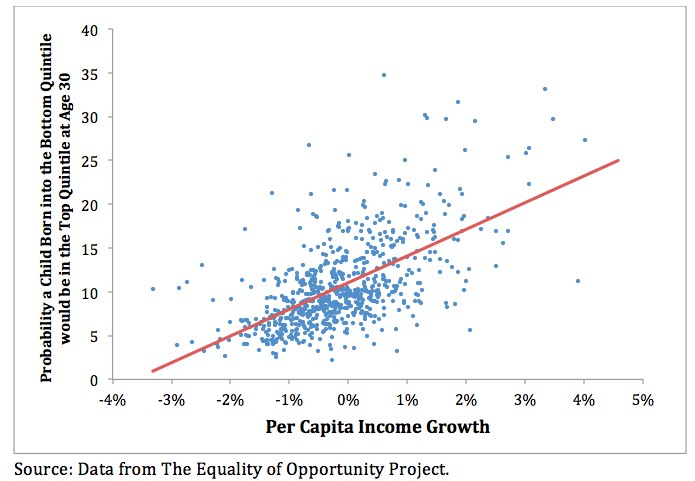
Sociologist W. Bradford Wilcox of the University of Virginia has an excellent piece in The Atlantic, which analyzes data from the Equality of Opportunity Project on what factors contribute to economic mobility. Wilcox finds three main factors: (1) Per-capita income growth, (2) Prevalence of single mothers (negative), (3) Per-capita local government spending (likely a proxy for education spending or public transportation).


Wilcox concludes,

As the nation marks the 50th anniversary of the War on Poverty this week, it’s worth considering that our attention to income inequality, although well-meaning, is distracting us from the most important pieces in the poverty puzzle. Growth, marriages, and local governments are three issues deserving more attention in our efforts to renew the American Dream for the nation’s poorest citizens.

The Problem with Free Stuff (College Tuition Edition)

Jordan Weissmann, writing for The Atlantic, thinks he has calculated the total cost of free tuition in the United States at public universities. The headline? “Here’s Exactly How Much the Government Would Have to Spend to Make Public College Tuition-Free.”[ref]emphasis added[/ref] It’s adorable, really.

First Weissmann gets the total amount spent on all public university tuition ($60b). Then he subtracts the government aid that currently goes to public schools (about $20b). Next, he carefully considers the impact that free education would have on the folks who go to private universities, and estimates how many of them would move to public school (no, I’m kidding, he totally ignores that.) Additionally, he considers all the folks who currently don’t go to college at all because the price and/or financial aid process is intimidating and generates an estimate for new entrants into college (ha, yeah, no: that’s not actually in there.) Then, he considers the indirect costs of overcrowding, the capital outlays that public universities would have to spend on new classrooms, housing, and facilities, and the costs of hiring and training all the new faculty and staff to handle the influx (yeah, that’s not mentioned in the article at all.) Finally, he considers related, complex issues like the future of the profit-machine that is college athletics and how it would interact with this new regime (by now you know very well that he did absolutely no such thing.)

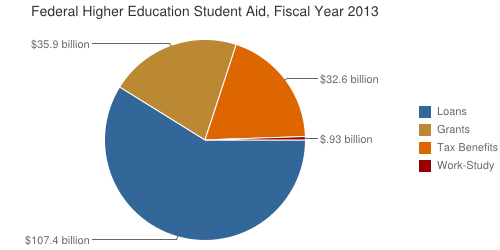
Instead, he compares his make-believe $40b number[ref]it’s in the second update, not the original article[/ref] to this pretty chart.

2014-01-07 Tution

Which tells us… nothing, really.[ref]Not gonna lie, I included the chart for the same reason he did. It’s pretty. Look at that color palette! Gorgeous![/ref]

On the one hand, I can’t blame Weissmann for not doing all that extra work. I spent about 20 minutes trying to get numbers, and it was not fun. But the problem with taking the easy way out is that (in this case at least) you end up with a phony estimate of an irrelevant number. If we think that free public education for K-12 is a good idea, then it’s entirely plausible that free public education for K-16 is a good idea. My point is not that Weissmann’s final conclusion is wrong. Rather, it’s that (1) lazy analysis is counter-productive and (2) pretending that markets don’t exist is silly. If you’re not talking about the way people will respond to major changes in prices, you’re not having a serious conversation of any kind.

The Science of Sleep: Some Links

Given my own tendency toward sleep deprivation, I found the following links illuminating:

Evil Pharmaceutical Companies and Drugs for Profit

"Profits over people! Mwahaha!"
“Profits over people! Mwahaha!”

Many cannot seem to wrap their heads around the high costs of pharmaceuticals. The typical claim is that pharmaceutical companies are evil and greedy, plundering the pockets of those sick and desperate and exploiting the misery of others. While there are numerous reasons for the expensiveness of drugs, very few seem to realize that one of the major contributors is the actual science. Thankfully, Scientific American has published two articles on the subject by chemist Ashutosh Jogalekar: “Why Drugs Are Expensive: It’s the Science, Stupid” and “Why Drug Discovery Is Hard – Part 2: Easter Island, Pit Vipers; Where Do Drugs Come From?” The articles go very well with the following ReasonTV video (from 2009) on medical innovation. Worth thinking about.

The Dark Side of EI

Wheaton professor Adam Grant has an interesting article in The Atlantic on “The Dark Side of Emotional Intelligence.” Psychologist and author Daniel Goleman has popularized the term since the 1990s (along with social intelligence). Goleman’s research helped establish that traits other than IQ can lead to success in organizations and individual lives. But just as impressive cognitive abilities can be used for immoral purposes, so can a strong handle on emotions. Grant points to emerging research that found “when a leader gave an inspiring speech filled with emotion, the audience was less likely to scrutinize the message and remembered less of the content. Ironically, audience members were so moved by the speech that they claimed to recall more of it.” Futhermore, “when people have self-serving motives, emotional intelligence becomes a weapon for manipulating others.” Other experts found “emotional intelligence helps people disguise one set of emotions while expressing another for personal gain.” While these findings may not be surprising, a comprehensive analysis of emotional intelligence literature revealed something that might be:

In jobs that required extensive attention to emotions, higher emotional intelligence translated into better performance…However, in jobs that involved fewer emotional demands, the results reversed. The more emotionally intelligent employees were, the lower their job performance. For mechanics, scientists, and accountants, emotional intelligence was a liability rather than an asset. Although more research is needed to unpack these results, one promising explanation is that these employees were paying attention to emotions when they should have been focusing on their tasks.

Grant concludes, “Thanks to more rigorous research methods, there is growing recognition that emotional intelligence—like any skill—can be used for good or evil. So if we’re going to teach emotional intelligence in schools and develop it at work, we need to consider the values that go along with it and where it’s actually useful.”

Will Gay Marriage Ever Be Settled? Lessons from Duck Dynasty

The American Left has been instrumental in past decades at advancing the cause of equality, but their track record has been mixed. On the one hand, no one questions the morality of the Civil Rights campaign to end segregation and Jim Crow. In the 21st century racial debates tend to be about the nature of equality, but everyone in the mainstream of American life takes for granted that racial equality and integration is a good thing. The very unanimity with which interracial marriage is now accepted (just as one example) demonstrates, to my mind, the rightness of the cause. I would not say that popularity is a perfect metric of morality by any means, but I do think that acceptance of progress over a long time period is relevant to assessing the validity of that progress.
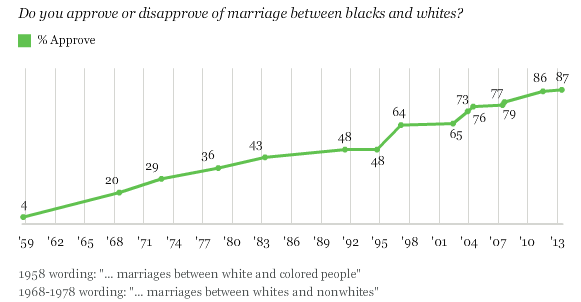
2014-01-07 Interracial Marriage Poll

On the other hand, 40+ years after Roe v. Wade the American Left continues to try and frame the issue of abortion in terms of women’s equality and Americans–women included–continue refuse to buy it.
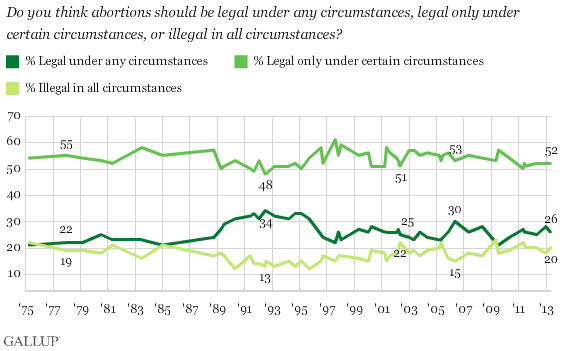
2014-01-07 Abortion Poll

The contrast is, to me, stark and informative. On some social issues there is initial resistance followed by unanimous consent. On others, however, there is no sign of progress whatsoever. In fact, many indications are that the pro-life side is slowly gaining ground.[ref]Secular Pro Life has an entry today about just this topic.[/ref] Since the policy opinion is not shifting substantially, this reflects a growing awareness on the part of American citizens of just how radical and extreme our laws are. Americans are moderate on abortion, Roe v. Wade isn’t.

So the big question is: which category does gay marriage fall into?

The American Left naturally relates gay marriage to issues like interracial marriage and assumes we’ll see a chart like the one above: in 40 years time the idea of opposing same sex marriage will seem as backwards and forgotten as the idea of opposing interracial marriage. That explains the initial reaction to Phil Robertson’s comments about homosexuality: he was roundly denounced as a bigot and A&E immediately booted him from his own show (Duck Dynasty, which is the #1 non-scripted cable show of all time). Writing for the Daily Beast, Keli Goff correctly detected that this was an example of dangerous overreach:

Though nearly half of the country opposes same-sex marriage, the media narrative has become dominated by the storyline that only a small segment of backward bigots who hate gay people oppose same-sex marriage. That simply isn’t true.

Goff also points out that Robertson’s actual comments had been mischaracterized:

Despite the fact that in the next quote Robertson also quotes scripture to denounce those who commit adultery, drink too much, and slander others as sinners, he was roundly denounced as a bigot and hate monger, particularly in progressive and liberal leaning news outlets.

Just to add to that, Robertson did not equate homosexuality with bestiality. He listed homosexuality as a form of sexual deviance along with bestiality and adultery. As a confessed adulterer (before he was born again), Robertson was not calling gays sinners in any sense that didn’t include his own life as well. It’s a rare bigot who operates by painting himself and his targets with the same brush.[ref]There are some polished videos about Phil Robertson, but I like this fairly raw sermon more. Watch ’em, if you want to get a feel for what the man actually believes.[/ref]

Goff even calls out media bias in the language used to cover the controversy:

Reinforcing bias in reporting on this story is the fact that many outlets caved to pressure to use the term “marriage equality” in coverage, when such a term is an activist creation. Interracial marriage is called interracial marriage, not “marriage equality.” If supporters of same-sex marriage view the civil rights fights as comparable, the same language standard should be applied.

It’s obvious that the reaction to Roberton’s comments was overreach, because within days A&E had to repudiate their own position and allow him back on the show. They weren’t the only ones to misjudge public opinion on this one, either. Outlets like restaurant chain Cracker Barrel yanked Duck Dynasty merchandise, and then faced angry customer backlash. They also caved.

Now, maybe the only thing that happened is that A&E, Cracker Barrel, and others misjudged the timing of America’s acceptance of gay marriage. Maybe we’re on that upward slope of acceptance (like for interracial marriage) and in 5 or 10 years comments like Robertson’s wouldn’t generate any widespread support. But I doubt it. I doubt it because what seems to be happening is a growing awareness among many, and not just social conservatives, that there is a real and important difference between bigoted homophobia and opposition to gay marriage. Goff writes:

Among my family members who oppose same-sex marriage, I have been told to congratulate my gay friends whose weddings I have attended. But I have simultaneously been told that such unions don’t fit my relatives’ biblical definition of marriage. I have further been told that in the context of the oft repeated phrase “love the sinner, hate the sin,” they see gay people no differently than they would view a straight person like me who decides to live with someone “in sin” (as the biblical saying goes). It wouldn’t make me a bad person but one who according to biblical text would be “living in sin.” In other words, they wouldn’t throw holy water on me but also wouldn’t throw me a parade. Most of all, they wouldn’t really care how I live my romantic life at all, as long as I was happy.

There’s a big gulf between the relatives I describe and someone who “hates” gay people.

Brandon Ambrosino made pretty much the same point for The Atlantic. Ambrosino, who is gay, criticizes the argument that “if you are against marriage equality you are anti-gay.” He writes:

If it’s “anti-gay” to question the arguments of marriage-equality advocates, and if the word “homophobic” is exhausted on me or on polite dissenters, then what should we call someone who beats up gay people, or prefers not to hire them? Disagreement is not the same thing as discrimination. Our language ought to reflect that distinction.

Ambrosino then concludes: “I would argue that an essential feature of the term “homophobia” must include personal animus or malice toward the gay community.” But, as I’ve already said, Robertson seemed to be placing sexual transgressions like homosexuality in the same category as adultery, of which he is guilty and about which he speaks publicly. I do not share Robertson’s born-again take on Christianity, but I understand it enough to grasp his meaning when he talks about sin and sinners and, most importantly, so does his audience. Millions of Americans were unafraid to stand for Robertson (albeit sometimes with rather strange conceptions of the First Amendment) not because they joined with him in anti-gay bigotry, but because they clearly understood that what he had said wasn’t bigoted.

So here’s the actual graph, so far, of the American public’s opinion on gay marriage.
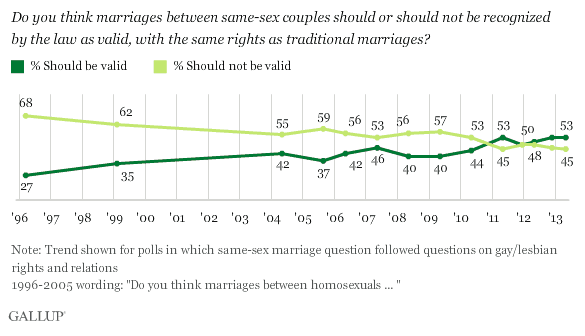
2014-01-07 Gay Marriage

Now, you can’t compare the shape of this graph to the abortion and interracial marriage graphs because the time frames are different. The interracial marriage chart goes back to 1958, the abortion chart goes back to 1975, and the gay marriage chart goes back to 1996. There’s no evidence, just based on the charts, to predict whether the gay marriage issue is going to be locked in a stalemate for decades (like abortion) or whether it will eventually resolve into near unanimity (like interracial marriage).

And, to be perfectly honest, I don’t have a high degree of confidence that I can predict the future on this issue either. Frankly, I suspect that the gay marriage chart will end up looking more like the interracial marriage chart than the abortion chart in decades to come. But it might not.

Goff and Ambrosino, both of whom support gay marriage, have already tacitly accepted that the gay marriage issue is not tied to broader acceptance of homosexuals as equal human beings in the same way that the interracial marriage issue is inextricable from racial inequality. You can’t logically support racial equality without supporting interracial marriage. But you can support equal rights for gays without supporting gay marriage. Race is not the same kind of identity as sexuality. This makes sense, since race is a nebulous biological category at best, but gender is much more clear cut.

The best thing that the gay marriage debate has done is force social conservatives to practice what they preach. In the 1990s and before, much if not most of the opposition to gay rights was really based on bigotry. It was based on “ick.” Conservative defenders of traditional marriage, as they style themselves, were much too slow to distance themselves from hateful rhetoric and genuine bigots. This blunder–both morally and strategically–cost them big. It may have been the deciding factor in the entire issue. Americans do not like haters.

But recently the traditional marriage movement has been sincerely careful in their articulation of a position that is anti gay marriage without being anti gay (to use Amrosino’s distinction). This distinction is obviously accepted by the broad swathe of American social conservatives, and I believe it explains the upwelling of support for Robertson better than the theory that half of Americans are just bigoted, hateful jerks. More importantly, even proponents of gay marriage like Goff and Ambrosino accept this possibility as well. All of this means that support for gay marriage may continue to climb until it reaches near-universal acceptance, or it may stall out well before that level (probably about where it is now) and become an entrenched, ongoing controversy like the abortion debate.

It’s too early to tell.