“That Is How Christ Feels, and So Should We”

This is part of the General Conference Odyssey.

Over at Times & Seasons, Nathaniel responded to the recent tragedy in Orlando by addressing some of the claims that the one’s religious (specifically Mormon) upbringing could cultivate less empathy for the victims because of their sexual orientation:

One of the most important scriptures we have as Mormons is the seventh chapter of Moses in which Enoch beholds God weep. Enoch asks, “how is it thou canst weep?” God’s reply is long, starting in verse 32 and ending in verse 37. It is not short of harsh language, discussing the sins of those who would perish (“they are without affection, and they hate their own blood”) but concluding, “wherefore should not the heavens weep, seeing these shall suffer?”

The Doctrine and Covenants states plainly that “the worth of souls is great in the sight of God,” and that value is independent of righteousness or sin. And that’s a good thing, because we are all sinners. There is no dividing line between technical sinners (good, church-going folks who make inconsequential mistakes now and then) and real sinners. There is just one group, and we’re all in it together, and there’s no justification for trying to figure out a pecking order.

We should mourn for the innocent victims of the horrific shooting in Orlando every bit as much as the innocent victims of any other mass shooting: the prayer group gunned down in Charleston, the children killed at Sandy Hook Elementary or—God forbid—our own Mormon brothers and sisters if a mass shooting ever takes place at one of our ward buildings or temples. When their children suffer, Heavenly Father and Heavenly Mother and the whole heavens weep. They don’t see a difference between one group and another. Who are we to claim sight where God Himself is blind?

This made reading Elder Hanks’ October 1972 Conference address this week all the more moving:

Christ’s commission was clear, and it seems to me that through him our commission becomes clear, that we are so to live that through him and his love we may be lifted up by the Father to enjoy the consequences of our convictions and our decisions.

We are here to love God and to keep his commandments, to live with an integrity that will merit our own self-respect and the respect of our loved ones and make us worthy for the companionship of the Spirit. We are here to love and serve our fellowmen, to reflect in our own lives daily our true convictions as to the priceless value of the individual child of God, to live with joy in a way worthy of the sons of God, to become the manner of men that he is.

He taught us very clearly the worth of souls and that they are very great in the sight of God. The lost sheep should have an anxious shepherd seeking him. The lost coin must be searched for. The prodigal who comes to himself and turns homeward will find his Father running to meet him. Thus taught the Lord.

Recently a stake president told of his visit, with others, to a Junior Sunday School class. When the visitors entered they were made welcome, and the teacher, seeking to impress the significance of the experience for the youngsters, said to a little child on the front row, “How many important people are here today?” The child rose and began counting out loud, reaching a total of seventeen, including every person in the room. There were seventeen very important persons there that day, children and visitors!

That is how Christ feels, and so should we.

May we all remember this on a regular basis.[ref]There were some other noteworthy quotes. Hanks touches on a similar theme to James K.A. Smith’s rejection of humans as “brains on a stick”: “No young person who is truly involved in the warmth of the kingdom need ever feel that he has no place to go and no one who is genuinely concerned about him. No one of them should ever fall for the false proposition that a human being can have his mind unbraided from his heart, sinews, and spirit—the rest of him conveniently stored away while the mind is disciplined and filled like a silo with grains of knowledge—and then the whole braided together again, with the expectation that the individual will now function in the moral, ethical, spiritually strong way we would like in our teacher or doctor or carpenter or lawyer or banker or son-in-law.”

Thomas S. Monson touches on the importance of work: “[Youth] is the training period when busy hands learn to labor—and labor to learn. Honest effort and loving service become identifying features of the abundant life…Such hands are clean hands. Such hearts are pure hearts.” And later: “Whether he be a skilled surgeon, a master craftsman, or a talented teacher, [a father’s] hands support his family. There is a definite dignity in honest labor and tireless toil.”[/ref]

Check out the other posts from the General Conference Odyssey this week and join our Facebook group to follow along!

The Failure of Foreign Aid

The Economist recently reported on the state of foreign aid:

Foreign aid can work wonders. It set South Korea and Taiwan on the path to riches, helped extinguish smallpox in the 1970s and has almost eliminated polio. Unfortunately, as Malawi shows, it is liable to be snaffled by crooks. Aid can also burden weak bureaucracies, distort markets, prop up dictators and help prolong civil wars. Taxpayers in rich countries dislike their cash being spent on Mercedes-Benzes. So donors strive to send the right sort of aid to the places where it will do the most good. How are they doing?

…By almost all of these measures, foreign aid is failing. It is as co-ordinated as a demolition derby. Much goes neither to poor people nor to well-run countries, and on some measures the targeting is getting worse. Donors try to reward decent regimes and punish bad ones, but their efforts are undermined by other countries and by their own impatience. It is extraordinary that so many clever, well-intentioned people have made such a mess.

Some economists (like NYU’s William Easterly) have been incredibly critical of foreign aid. Of course, not all aid is created equal, but there are better ways to help the poor abroad.


When Profits Are Sinister

Profit is often a dirty word among certain political ideologies. However, for those who defend the importance of profits, it is necessary to realize that sometimes they are signs of something amiss. As economist James Bessen explains,

Profits are up. Operating margins for firms publicly listed in the US show a substantial and sustained rise. Corporate valuations are up as well. That is good news for managers and investors. But is it good news for society?

Economists such as Joseph Stiglitz and Luigi Zingales find the rise potentially troubling for two reasons. First, higher profits create greater economic inequality. Rising aggregate profits correspond to a decline in labor’s share of output, contributing to stagnant wages. Also, greater profits for some corporations but not others may create greater wage inequality.

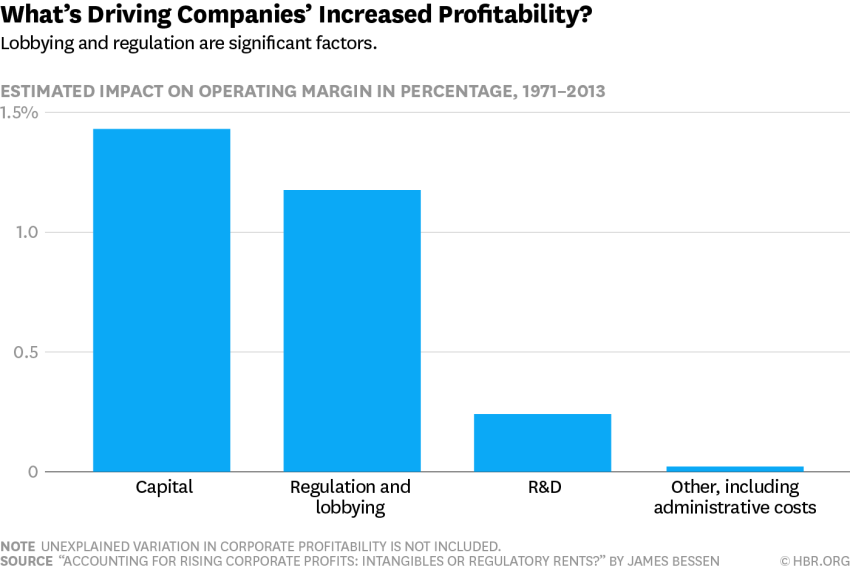
Second, the rise in profits might represent a decline in competition and, with that, a decline in economic dynamism. While a dynamic, competitive economy rewards innovative firms with high profits and punishes poor performers with low profits, sustained aggregate profits suggest, instead, that firms are able to get away with higher prices because competition is limited. Firms engage in political “rent seeking”—lobbying for regulations that provide them sheltered markets—rather than competing on innovation. If so, then high profits portend diminished productivity growth.

However, the increase in profits could be due to firms “increasingly making profitable investments in new technology, in IT, or in their organizational capabilities.” Bessen’s new research paper gets to the bottom of it:

I find that investments in conventional capital assets like machinery and spending on R&D together account for a substantial part of the rise in valuations and profits, especially during the 1990s. However, since 2000, political activity and regulation account for a surprisingly large share of the increase.

This is how rent-seeking, pro-business (vs. pro-market) attitudes, and crony capitalism drag down our economy.

Check out the full article over at Harvard Business Review.

What Are the Effects of Premarital Sex on Marriage?

According to sociologist Nicholas Wolfinger,

By the 2010s, only 5 percent of new brides were virgins. At the other end of the distribution, the number of future wives who had ten or more sex partners increased from 2 percent in the 1970s to 14 percent in the 2000s, and then to 18 percent in the 2010s. Overall, American women are far more likely to have had multiple premarital sex partners in recent years (unfortunately, the NSFG doesn’t have full data on men’s premarital sexual behavior, and in any event they recall their own marital histories less reliably than do women).

As premarital sex became more acceptable, it’s reasonable to anticipate that its negative effects on marital stability waned. In general, Americans became more accepting of nonmarital sex. Certainly fewer men entered marriage with the expectation of a virgin bride. All of the fanfare associated with hooking up is evidence that some young people have become comfortable with the idea of sex outside of serious relationships.

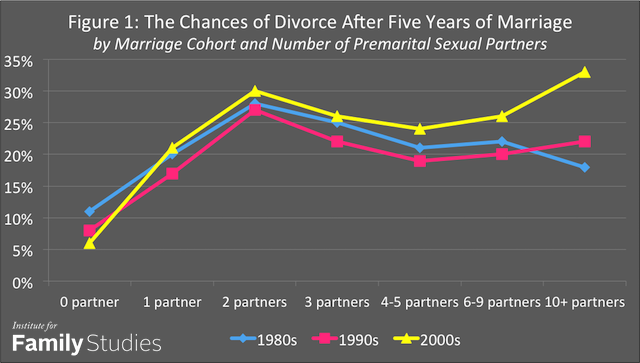
Be that as it may, this prediction is only partially borne out by the data shown in Figure 1. The following chart depicts the percentage of first marriages ending in divorce within five years of wedlock according to the decade the wedding took place and how many sex partners a woman had prior to marriage. Consistent with prior research, those with fewer sex partners were less likely to divorce.

Of course, the percentage drop after 2 partners raises even more questions in the complicated relationship between premarital sexual activity and marriage/divorce.[ref]Compare this with these previous findings.[/ref]

Check out the full article.

Storytelling and the Brain

“Stories are told in the body,” says a recent article at the site for UC Berkeley’s Greater Good Science Center:

It doesn’t seem that way. We tend to think of stories as emerging from consciousness—from dreams or fantasies—and traveling through words or images to other minds. We see them outside of us, on paper or on screen, never under the skin.

But we do feel stories. We know in our gut when we’re hearing a good one—and science is starting to explain why.

Experiencing a story alters our neurochemical processes, and stories are a powerful force in shaping human behavior. In this way, stories are not just instruments of connection and entertainment but also of control.

The article continues to lead us down the path of how “stories unfold in our bodies,” from the release of oxytocin or dopamine to the increase of empathic skills to the triggering of “neurochemical processes that make certain kinds of resource-sharing possible.”

I’ve reported on the psychological benefits of fiction reading here before. This just goes to show how stories can change the brain.

Digital Globalization

A couple months ago, I had a post on research by economist Andreas Bergh which highlighted the importance of information flows in battling poverty. A new McKinsey report on digital globalization supports this view:

To measure the economic impact of digital globalization, we built an econometric model based on the inflows and outflows of goods, services, finance, people, and data for 97 countries around the world. We found that over a decade, such flows have increased current global GDP by roughly 10 percent over what it would have been in a world without them. This added value reached $7.8 trillion in 2014 alone. Data flows directly accounted for $2.2 trillion, or nearly one-third, of this effect—more than foreign direct investment. In their indirect role enabling other types of cross-border exchanges, they added $2.8 trillion to the world economy. These combined effects of data flows on GDP exceeded the impact of global trade in goods. That’s a striking development: cross-border data flows were negligible just 15 years ago. Over the past decade, the used bandwidth that undergirds this swelling economic activity has grown 45-fold, and it is projected to increase by a factor of nine over the next five years[.]

Check out the full article to see how digital globalization is reshaping business.

It’s Not Easy Being [A] Green [Planet]

As reported by NASA:

From a quarter to half of Earth’s vegetated lands has shown significant greening over the last 35 years largely due to rising levels of atmospheric carbon dioxide, according to a new study published in the journal Nature Climate Change on April 25.[ref]The greening effects of global warming were pointed out by Matt Ridley a couple years ago.[/ref]

An international team of 32 authors from 24 institutions in eight countries led the effort, which involved using satellite data from NASA’s Moderate Resolution Imaging Spectrometer and the National Oceanic and Atmospheric Administration’s Advanced Very High Resolution Radiometer instruments to help determine the leaf area index, or amount of leaf cover, over the planet’s vegetated regions. The greening represents an increase in leaves on plants and trees equivalent in area to two times the continental United States.

…However, carbon dioxide fertilization isn’t the only cause of increased plant growth—nitrogen, land cover change and climate change by way of global temperature, precipitation and sunlight changes all contribute to the greening effect. To determine the extent of carbon dioxide’s contribution, researchers ran the data for carbon dioxide and each of the other variables in isolation through several computer models that mimic the plant growth observed in the satellite data.

Results showed that carbon dioxide fertilization explains 70 percent of the greening effect, said co-author Ranga Myneni, a professor in the Department of Earth and Environment at Boston University. “The second most important driver is nitrogen, at 9 percent. So we see what an outsized role CO2 plays in this process.”

The surprising benefits of global warming.[ref]Of course, this doesn’t erase the drawbacks. The good news is that there is some recent evidence that current models may be overestimating warming.[/ref]

Maybe both sides oversimplify transgender issues.

spectrum stick figures

I don’t speak out on transgender issues much, for a bunch of reasons. I’m a cis woman, and I don’t really have any idea what it would be like to be trans. I have only a few friends who are trans (that I know of) to even talk to about it. Also, I’m concerned about multiple factors in the debates around this issue, and I haven’t figured out how heavily I weigh each factor and thus what my position is.

I’m irritated at some of my leftist friends for being unwilling or incapable of considering that anyone could have concerns, questions, or objections about trans issues and policies based on anything other than bigotry. I find that ridiculously simplistic and also really counterproductive if the goal is to get more people to understand and accept people who are trans.

I’m also irritated with some of my right-wing friends for depicting these issues as nothing more than a cavalier preference chosen for trivial reasons, as if people just wake up one day and “feel like” being a different gender. In particular I get annoyed at people for greatly oversimplifying biology. My writing today was inspired by a random comment I saw on a friend’s post:

born xy die xy

Whatever your thoughts on the moral, social, political, and legal implications of trans issues, the statement above (and others similar to it) are overgeneralizations. And, as with most generalizations, they won’t hurt most people because most of the time they’ll be true. But they can cause problems for the exceptions, and I think we should be mindful of that.

So, continuing the biology lesson:

(Typically) our mother’s eggs each contain an X chromosome and our father’s sperm each contain either an X chromosome or a Y chromosome. When egg and sperm meet, the sperm’s chromosome determines the sex of the resulting child. A person with both an X and Y chromosome is male, and a person with two X chromosomes is female. Generally.

However, when we talk about someone being “biologically female” or “biologically male,” there are multiple  factors to consider. The ones we talk about most are:

  1. Chromosomes (female = XX, male = XY)
  2. Gonads (female = ovaries, male = testes)
  3. External genitalia (female = vagina, male = penis)

Most people either possess all three of the female traits or all three of the male traits. However some people instead have some combination of male and female traits. For example, there are multiple ways an XY person could lack specifically male genitalia (or an XX person could lack specifically female genitalia). Mayo Clinic has a good summary here:

  • A lack or deficiency of male hormones in a genetic male fetus can cause ambiguous genitalia, while exposure to male hormones during development results in ambiguous genitalia in a genetic female.
  • Mutations in certain genes can influence fetal sex development and cause ambiguous genitalia.
  • Chromosomal abnormalities, such as a missing sex chromosome or an extra one, also can cause ambiguous genitalia.

For example, Swyer syndrome is a condition in which an XY person develops female reproductive organs. There are several different gene mutations that have been associated with the phenomenon. People with Swyer syndrome often grow up with the female gender identity and keep that identity throughout their lives.

As another example, a condition called 5-alpha reductase deficiency (5aR deficiency) means XY people don’t produce enough of a certain hormone to form male external sex organs. They typically grow up with the female gender identity, however they may adopt a male gender role later in life.

There are other conditions that can have these kinds of “misalignment” effects. As far as I know, none of these conditions are very common. Swyer syndrome is thought to happen in 1 out of 80,000 people, and 5aR deficiency is rare enough it’s unclear how many people have it.

However I don’t think that because these issues are rare, we should act as if they don’t exist. I imagine it can be very difficult for people with these conditions to process both how they view themselves and how society views them. Insisting there is nothing more to sex or gender than either our chromosomes or our genitalia is untrue and, in some cases, I think it’s unkind.

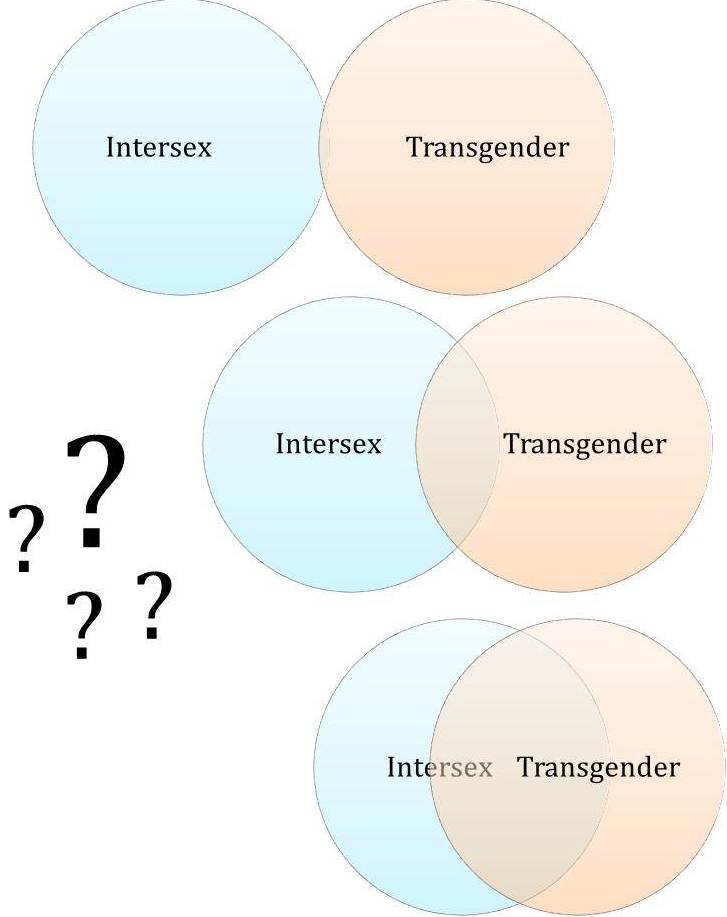
That being said, intersex issues like the ones I mentioned don’t cover the whole scope of trans issues. In fact if there was a Venn Diagram of the two, I’m unclear on how much it would cross over.

intersex vs trans venn diagrams

Intersex issues occur when a person’s biological traits aren’t all either male or female. Trans issues occur when a person identifies as a gender other than the gender normally associated with their biological traits. A trans man could be intersex: he could have external female genitalia but testes and XY chromosomes (intersex) and identify as male (trans). But a trans man isn’t necessarily intersex: he could have external female genitalia, ovaries, and XX chromosomes (not intersex) and identify as male (trans).

And likewise, an intersex person isn’t necessarily trans. Many intersex people don’t have gender identity issues; they spend their entire lives identifying as one gender and having society recognize them as that gender and it isn’t something they struggle with. In fact, some intersex people really object to having intersex issues conflated with trans issues.

So there is some overlap between intersex and trans people, but the extent of the overlap is unclear. And if we assume it’s 1:1 we ignore all the intersex and trans people for whom the overlap doesn’t apply.

Not only that, but if we assume it’s 1:1 we oversimplify the cultural discussion. Just as it’s too black and white to act as if biological sex is always straightforward, it’s too black and white to act as if trans issues are always, much less solely, based on biological “misalignments.” I object to both those oversimplifications. We should be able to make our points and explore our arguments without having to dismiss inconvenient truths.

Saviors in the Home

Home

I really enjoyed Elder H. Burke Peterson’s talk, Harmony in the Home. It’s another one of those talks that makes you realize that there’s nothing recent about the Church’s emphasis on family: “In countless writings the prophets of the Lord have been trying to teach us that throughout time and all eternity the most important organization is the family.” That alone is a talk that makes it interesting to me, but what stood out to me in this particular talk was the relationship between Christ and family.

That’s something that’s not always obviously apparent. To some extent, it seems that the Church’s emphasis on family is separate from and might even detract from a focus on Christ. I happen to be reading a draft of my father’s next book,[ref]Sorry, no spoilers.[/ref] and those three topics (church, Christ, family) are central to his first chapter.[ref]Maybe the whole book, but I’m still in the first chapter.[/ref] And I saw a lot of the same themes in Elder Peterson’s talk.

First, it strikes me that “the Lord” comes before “family” in that snippet I quoted. It seems like such a small thing, but it really matters. Where does the emphasis on family come from? It comes from “prophets of the Lord.” The message is from Him. This kind of connection between the family (or the home) and the Lord ran throughout the talk, for example: “The home should be the great workshop of the Lord. Here is where children must be taught to walk in ways of truth and soberness, of love and service to each other.” Or also: “The gospel of Jesus Christ is more easily taught and longer remembered in a happy home.”

But here–and this is my second point–is the paragraph that struck me the most from this whole talk[ref]I’m patching together two quotes that are kind of far apart in the original[/ref]:

May I suggest that as parents we must require more of ourselves. May I suggest that we give more of ourselves, that we give more good experiences to our children, experiences that are love-producing and family-solidifying…What if you decided to be cheerful tonight at the dinner table, and in spite of what others might do or say, hold to your course. See how long you can uplift your whole family.

On the one hand, this could be read as such a banal little passage. “Be cheerful!” What could be more simplistic or, a cynic might argue, shallower? But I really love this idea at the end, “see how long you can uplift your whole family.” Because here are two great realities of Mormonism within this talk. The first is that little, everyday things matter. We’re used to seeing talks about controversial moral issues, but Elder Peterson’s focus was simpler:

One of Satan’s most effective tools is at work among us today—it is a destroyer of happiness, peace, contentment, family solidarity. Families are stumbling and falling because of its hobbling and crippling effect. This tool of Satan is called contention.

In other words: don’t argue. Be kind. Be nice. How simple! And yet, if you practice it in your everyday life, how profound the impact. Kindness matters. And if kindness really matters, than sacrificing yourself–your time, your energy, your priorities, your pride–to try and bring more happiness to your home is not banal. It’s truly following the example of the Savior. Not in a dramatic way, but in a true way. Giving that last ounce of energy when your day is long, your kids’ questions are irritating, and the to-do list seems never-ending is hard. You want to hold something back. You want to keep something in reserve. You want to give less than everything. But when you summon the courage and the love to go beyond what you thought you could do, even if it’s something as simple as putting aside your expectations or plans to just be with your kids, well… you’re being a savior in your home. You’re following Him.

It’s true that the Church’s emphasis on family goes way back. And it turns out there’s a reason for that. Home really ought to be the workshop of the Lord.

Check out the other posts from the General Conference Odyssey this week and join our Facebook group to follow along!