The Peace of Knowing God

Peaceful Farm

This post is part of the General Conference Odyssey.

With our 21st week of posting, we’ve come to the end of our third General Conference. Which means we have approximately 700 more weeks to go. We didn’t call it the General Conference Odyssey for nothing!

The Sunday afternoon session of the April 1972 General Conference further solidified my impression that the Sunday sessions are where it’s at. This session had some pretty consistent themes as well, with talks like Peace and Whence Cometh Our Peace? along with Knowing God.

In his talk (Peace), Elder Eldred G. Smith asked, “How is it that we have not discovered the secret of peace when we have been looking for it all through the ages?” And then he answered: “I’ll tell you. We are looking for someone to create it for us—to bring it to us.” We can’t just receive peace. We have to make peace. How? Elder Smith makes one practical suggestion: “Peace… comes from service.” In a time of virtual activism—banging at keyboards for justice—this is a more timely reminder than ever.[ref]They don’t call it “slacktivism” for nothing.[/ref]

Then, in Elder John H. Vandenberg’s talk (Whence Cometh Our Peace?), there is this simple but important observation: “Just as running madly after worldly things does not bring peace, neither does sitting idly by.” The peace we seek as Mormons is not a peace of enlightened contemplation, but of active engagement. Of work.[ref]That’s something Walker will like.[/ref]

And then, tying the two together, is Elder Bernard P. Braockbank’s talk: Knowing God, who said, “Many believe that there is a God, many say that they know there is a God, but many do not act like they know God.” He put the emphasis on “know,” saying: “There is a great difference in believing or knowing that there is a God and in knowing God.”  But I am also struck by the transition from the first two statements using the verbs “believe” and know” and the last one, using the verb “act.” There is something about knowing God that ties it inseparably to behavior.

I don’t invest a huge amount of time in trying to formalize my theology, but I do have the belief that all truths are part of one great whole and the hope that one day I will see it. Things we thought were different will turn out to be intimately connected. One such pair consists of love and understanding, which Mormons intuitively believe are intertwined. (No one wrote about this more eloquently than Orson Scott Card.) Another may turn out to be belief and action. It’s possible that true belief in goodness requires us, over time, to be good. The affinity for light and truth in our heart and mind, combined with a sense of integrity, mean that eventually we must seek to bring our own actions into conformity with that light and with that truth.

I’m not sure. As I said: I don’t put a lot of stock in my own theological innovations or speculations. But I catch glimpses now and then of a leviathan just beneath the surface, a vast and intimate construct, that make me happy and optimistic about the destination that lies at the end of the road of discipleship.

Check out the other posts from the General Conference Odyssey this week and join our Facebook group to follow along!

The Smug Style in American Liberalism

The Smug Style in American Liberalism - Small

If you haven’t heard of Emmett Rensin’s article for Vox yet, you will certainly hear about it soon. In a deliberate send up to Richard Hofstadter’s The Paranoid Style in American Politics, Rensin takes liberalism to task for an overbearing smugness that leads the movement to hold in contempt many of the people it allegedly wants to help.

And, just in time, along comes a great example of exactly the kind of smug contempt that Rensin wrote about. Our case study? Jacobin’s article Merle’s America. Erik Loomis has  take-down that explains exactly what is wrong with Jacobin’s discussion of the country music legend: Jacobin: Walking on the Fighting Side of Me.

Were you thinking, I really need to know what Jacobin has to say about Merle Haggard? Probably not. Unfortunately, Jacobin decided to publish a Merle Haggard obituary of sorts, by Jonah Walters. It is, without exaggeration, the worst essay I have ever seen in that publication and one of the worst essays on music I have ever read. It is essentially an exercise in Aesthetic Stalinism, arguing that Merle Haggard was a terrible person and overrated artist because he was supposedly the voice of American reaction for a half-century. This is not only wrong politically, it’s wrong musically.

Loomis spends most of the article going through the factual inaccuracies of the Jacobin piece, but he doesn’t sidestep the central issue either:

[So] often on the left, talking about the white working class as they actually exist, turns into a snobbish dismissal, whether of actual people or of their cultural forms… Walters’ essay shows how quickly many leftists fall into a knee-jerk belief that the actual living breathing white working class is a political failure and thus evaluates their cultural forms from that perspective.

Rensin couldn’t have asked for a better example of this central thesis. Which is, in case you’re curious:

  1. “Beginning in the middle of the 20th century, the working class, once the core of the coalition, began abandoning the Democratic Party… Among white voters making between $30,000 and $75,000 per year, the GOP has taken a 17-point lead.”
  2. The left replied by “[finding] comfort in the notion that their former allies were disdainful, hapless rubes,” and so “smug liberals created a culture animated by that contempt.”
  3. “The internet only made it worse. “

Rensin’s article is long, but it is well worth reading in full.


Gender Wage Gap: Different Choices, Different Pay?

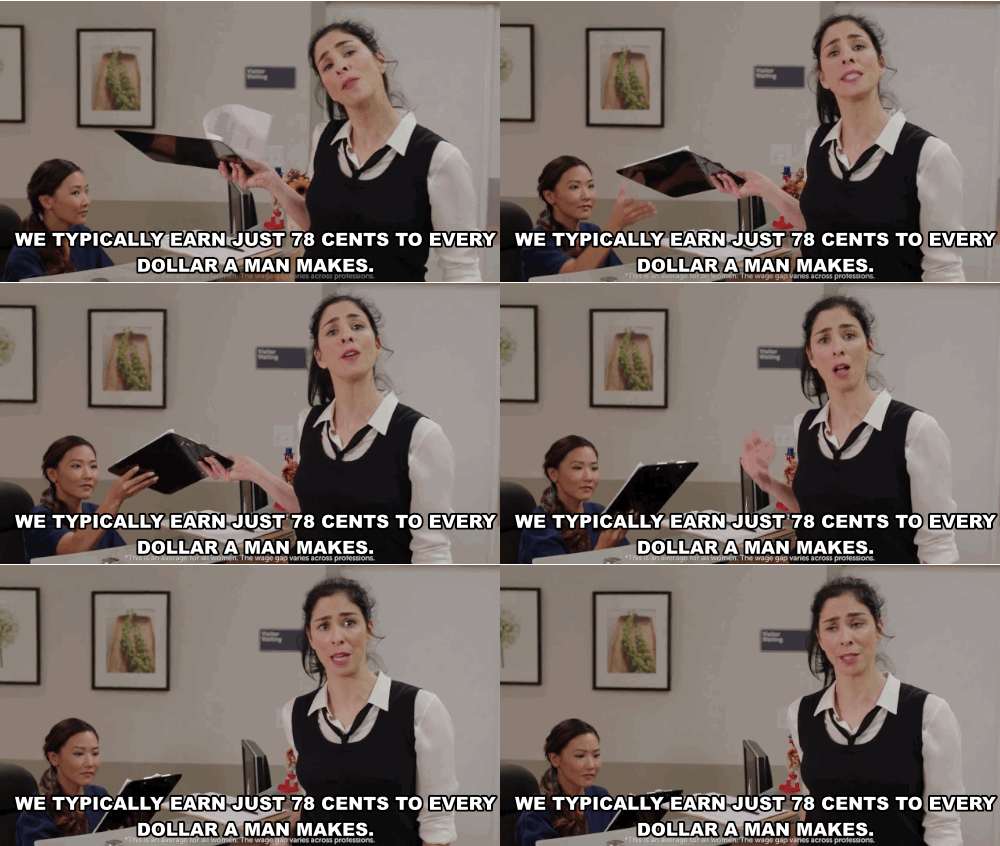
The gender wage gap has been a controversial topic for some time, even though the literature tends show the popular talking points to be exaggerated. For example, the claim that women make 78 cents for every dollar a man makes is misleading because this looks at the average wages of both men and women with no distinction made for careers, education, experience, hours worked, etc.

Nope.

According to the Bureau of Labor Statistics (pg. 80), women work about 5 hours a week less than men. This has been true since 1976. Less hours tend to mean less pay. This has been found to be the case in the medical profession, law, and among MBAs. Men also work more overtime and thus reap its financial rewards. Firms are currently structured to disproportionately favor those who work longer hours (whether this should be changed is worth discussing). Women are also less likely to negotiate for higher salaries, at least when the rules for wage determination are left ambiguous. Noncognitive skills and family preferences also go a long way in explaining the gap. As a 2009 report prepared for the U.S. Department of Labor concluded,

Although additional research in this area is clearly needed, this study leads to the unambiguous conclusion that the differences in the compensation of men and women are the result of a multitude of factors and that the raw wage gap should not be used as the basis to justify corrective action. Indeed, there may be nothing to correct. The differences in raw wages may be almost entirely the result of the individual choices being made by both male and female workers (pg. 2, bold mine).[ref]For a useful rundown of the literature, see economist Diana Furchtgott-Roth’s 2010 testimony before the Joint Economic Committee.[/ref]

A brand new report draws similar conclusions about the choices of men and women when it comes to both careers and college majors (from the abstract):

[W]e find that women, on average, have a higher willingness to pay for jobs with greater work flexibility (lower hours, and part-time option availability) and job stability (lower risk of job loss), while men have a higher willingness to pay for jobs with higher earnings growth. In the second part of the paper, using data on students’ perceptions about the types of jobs that would be offered to them conditional on their college major choices, we relate these job attribute preferences to major choice. We find that students perceive jobs offered to humanities majors to have fewer hours, more worktime flexibility, and higher stability than jobs offered to economics/business majors. These job attributes are found to play a role in major choice, with women exhibiting greater sensitivity to nonpecuniary job attributes in major choice.

Check it out. There is still something like a 6-cents difference in the wages of men and women, which could possibly be due to discrimination.[ref]See pg. 3 of Furchtgott-Roth’s testimony.[/ref] Nonetheless, if we want to get serious about addressing discrimination, we need to be accurate in our assessments. Ninety-four percent and 78% are big differences.

The Bonobo and the Atheist: An Interview with Frans de Waal

This is part of the DR Book Collection.

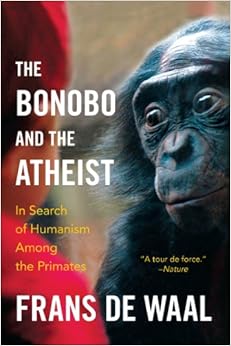
I was at the zoo recently with my wife, my sister-in-law, her husband, and their baby. As we looked at the bonobos and observed their eerily human behavior, I made the comment that I needed to read primatologist Frans de Waal’s book The Bonobo and the Atheist: In Search of Humanism Among the Primates. Morality, de Waal argues, is bottom-up. Behaviors we label as “moral”–such as empathy or fairness–are grounded in our evolutionary development. Morality arises from the emotions and social rules that can be found in other primates. The book made Nathaniel’s best of 2015 list. And I happen to agree with one of his criticisms:
Merely because you can show how a thing arises through evolution doesn’t get you out of this problem. You could explain how humans came to have the ability to reason objectively, but that wouldn’t mean that logic and math were suddenly subjective. It would just prove that somehow evolution managed to get us in touch with non-contingent, objective reason. Same idea here: you can explain how humans came to behave morally or even to understand and think about morality, but it’s a colossal mistake to think that, in so doing, you have proved that morality is “constructed” or in any way subjective any more than reason or logic are. (For fun: let someone try to reason you out of the position that reason is objective. See how that works? It’s a non-starter.)

Even if the philosophy is lacking, the science is fascinating. You can see a Big Think interview with de Waal below.

The Most Decisive Time is Always Now

God Who Weeps Cover - Smaller

This post is part of the General Conference Odyssey.

This was a great session, and right off the bat I was struck by this statement in President Harold B. Lee’s A Time of Decision:

I believe it is an illusion to say that this is the most critical, decisive time. Write it upon the hearts of all of us that every dispensation has been just as decisive, and likewise that every year has been the most decisive year and time for ourselves, for this nation, and for the world. This is our day and time when honorable men must be brought forward to meet the tremendous challenges before us.

I pulled a few more quotes from that talk that almost make a mini-talk of their own:

There has ever been, and ever will be, a conflict between the forces of truth and error; between the forces of righteousness and the forces of evil; between the dominion of Satan and the dominion under the banner of our Lord and Master, Jesus Christ… The greatest weapons that can be forged against any false philosophy are the positive teachings of the gospel of Jesus Christ… The great danger in any society is apathy and a failure to be alert to the issues of the day, when applied to principles or to the election of public officials.

I was especially interested that apathy–as opposed to something like overt sinfulness–was the “greatest danger in any society,” second only to ignorance (and possibly because it leads to ignorance of “the issues of the day.”) I am guessing that, if President Lee were to assess the landscape of our own culture–he would add distraction to go alongside apathy.

There were some parts from Elder Marion D. Hanks’ talk (Joy Through Christ) that also really stuck out to me (both quotations from others):

“God exists in the world. He exists wherever men let him in. Perhaps it is only humble men, men in search of him, men with a great need for him, who really let him in. And God comes to such men not only because of their great need for him, but also because of his great need for them as his allies in the divine task of creating a better world, a better human society, a real kingdom of God.” (P. A. Christensen.)

“You know always in your heart that you need God more than anything else. But do you not know too that God needs you … in the fullness of His eternity He needs you?” (Martin Buber)

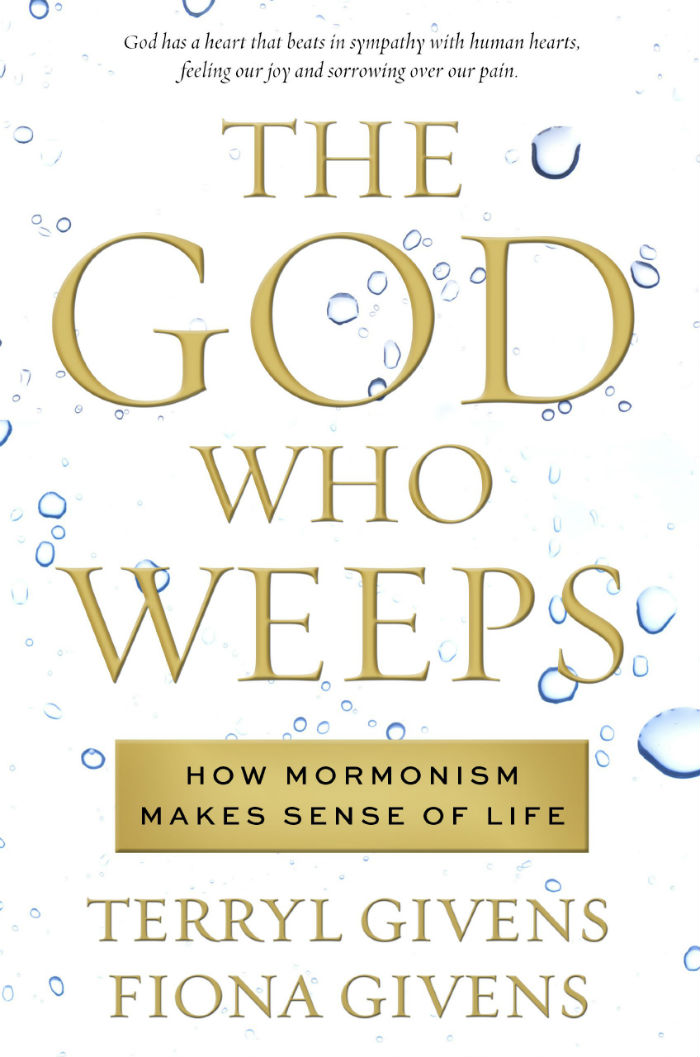
These comments emphasize something worth explaining in a little more detail. Up until the 19th century–when the Restoration took place–one of the core tenets of Christianity was the idea that God is impassable. What that means is that He cannot be affected by humans. Nothing we do can impact Him. Accordingly, He would not care when we suffer, and even mercy would be a question of the action of mercy rather than the feeling of compassion. Today, Christianity has more or less completely rejected this tenet, but it was the default for more than 1,000 years.

This doctrine–the idea of a perfectly remote, unempathic God–was one of the first wrongs to be set right during the Restoration. First, there was the Parable of the Vineyard in the Book of Mormon, in which “the Lord of the vineyard wept, and said unto the servant: What could I have done more for my vineyard?” Later, of course, came the story of Enoch’s witness of God’s tears: “The God of heaven looked upon the residue of the people, and he wept; and Enoch bore record of it, saying: How is it that the heavens weep, and shed forth their tears as the rain upon the mountains?”

Since then, the idea has become so common place that people do not realize how strange and how revolutionary the truths restored through Joseph Smith were. When we consider the implications carefully, however, when we think that there is a Heavenly Father who cares about us and our lives, the implications are still profound.

Check out the other posts from the General Conference Odyssey this week and join our Facebook group to follow along!

You Are Not Special

This is part of the General Conference Odyssey.

You are not special.  You are not exceptional.

That is what high school teacher David McCullough, Jr. (son of the historian of the same name) told the Wellesley High graduating class of 2012. He continued:

Yes, you’ve been pampered, cosseted, doted upon, helmeted, bubble-wrapped.  Yes, capable adults with other things to do have held you, kissed you, fed you, wiped your mouth, wiped your bottom, trained you, taught you, tutored you, coached you, listened to you, counseled you, encouraged you, consoled you and encouraged you again.  You’ve been nudged, cajoled, wheedled and implored.  You’ve been feted and fawned over and called sweetie pie.  Yes, you have.  And, certainly, we’ve been to your games, your plays, your recitals, your science fairs.  Absolutely, smiles ignite when you walk into a room, and hundreds gasp with delight at your every tweet.  Why, maybe you’ve even had your picture in the Townsman!  And now you’ve conquered high school… and, indisputably, here we all have gathered for you, the pride and joy of this fine community, the first to emerge from that magnificent new building…

But do not get the idea you’re anything special.  Because you’re not.

The speech went viral and deservedly so. You can watch the whole speech below.

Now, consider the words of Harold B. Lee in the April 1972 General Conference:

This year is again a most important year of decision for our day. Some have even said that this is the most critical period in the history of this nation and of the world. I believe it is an illusion to say that this is the most critical, decisive time. 

That’s right: an illusion. To top it all off, this was in reference to the election year. Timely, especially since every U.S. election seems to be on the precipice of the Millennium in the American Mormon mind. But I think the illusion is broader than that. This goes to the heart of modern triumphalism and narcissism that gives rise to feelings of entitlement or ridiculous false doctrines like the youth today being generals in the war in heaven. Jesus’ apostles thought he was coming back in their lifetime. So did the early Mormons. And so do many today. This probably has less to do with religious devotion and more to do with–to borrow from McCullough–“our unspoken but not so subtle Darwinian competition with one another–which springs, I think, from our fear of our own insignificance, a subset of our dread of mortality…” We have to be the special generation.

Yet, Lee then makes the most incredible point:

Write it upon the hearts of all of us that every dispensation has been just as decisive, and likewise that every year has been the most decisive year and time for ourselves, for this nation, and for the world. This is our day and time when honorable men must be brought forward to meet the tremendous challenges before us (bold mine).

Why is this?:

Today we are constantly hearing from the unenlightened and misguided, who demand what they call free agency, by which they apparently mean, as evidenced by their conduct, that they have their agency to do as they please or to exercise their own self-will to determine what is law and order, what is right and wrong, or what is honor and virtue. These are frightening expressions when you reflect upon what I have just quoted from the revealed word of God. A moment’s reflection will help you to see that when one sets himself up to make his own rules and presumes to know no law but his own, he is but echoing the plan of Satan, who sought to ascend to God’s throne, as it were, in being the judge of all that rules mankind and the world.[ref]Several early Mormons and Church leaders interpreted the plan of Satan as one that did not force right action, but alleviated the consequences of all actions. See Terryl Givens, Wrestling the Angel: The Foundations of Mormon Thought: Cosmos, God, Humanity (New York: Oxford University Press, 2015), 130-135.[/ref]

Choices always have to be made. Morality always has to be shaped. And this comes through the nitty-gritty, the mundane, the everyday, the common. This comes through nurturing relationships and being present enough (i.e., not looking forward to the Millennium or looking back to compare post-Restoration generations to those of the supposed Dark Ages) to actually do something worthwhile. As McCullough explains,

The fulfilling life, the distinctive life, the relevant life, is an achievement, not something that will fall into your lap because you’re a nice person or mommy ordered it from the caterer…Now, before you dash off and get your YOLO tattoo, let me point out the illogic of that trendy little expression–because you can and should live not merely once, but every day of your life.  Rather than You Only Live Once, it should be You Live Only Once… but because YLOO doesn’t have the same ring, we shrug and decide it doesn’t matter.

None of this day-seizing, though, this YLOOing, should be interpreted as license for self-indulgence.  Like accolades ought to be, the fulfilled life is a consequence, a gratifying byproduct.  It’s what happens when you’re thinking about more important things.  Climb the mountain not to plant your flag, but to embrace the challenge, enjoy the air and behold the view.  Climb it so you can see the world, not so the world can see you.  Go to Paris to be in Paris, not to cross it off your list and congratulate yourself for being worldly.  Exercise free will and creative, independent thought not for the satisfactions they will bring you, but for the good they will do others, the rest of the 6.8 billion–and those who will follow them.  And then you too will discover the great and curious truth of the human experience is that selflessness is the best thing you can do for yourself.  The sweetest joys of life, then, come only with the recognition that you’re not special.

Because everyone is.

How Much Are You Willing to Pay For Free Stuff?

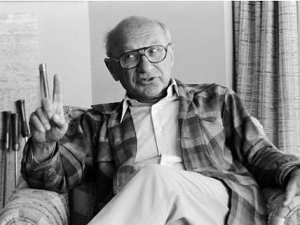
I think that the word "free" is one of the most misused words. - Milton Friedman
I think that the word “free” is one of the most misused words. – Milton Friedman

A couple weeks ago, I wrote about some polling data on millennials and their (un)willingness to redistribute wealth. A recent poll by Vox and Morning Consult found that while most Sanders supporters (80%) are willing to pay more in taxes,[ref]Compare this to Clinton supporters (70%) or Republicans (40%).[/ref] how much more they are willing to pay paints an interesting picture. “When we polled voters, we found most Sanders supporters aren’t willing to pay more than an additional $1,000 in taxes for his biggest proposals [i.e. nationalized health care and free public college tuition]. That’s well short of how much more the average taxpayer would pay under his tax plan.”

Vox explains,

But Sanders’s plan to pay for universal health care coverage would increase taxes on most voters by more than $1,000. He wants to:

  • Add a 2.2 percentage point surcharge on individual incomes. This means marginal tax rates go up for everyone. (After a standard deduction, about a quarter of households won’t have to pay this surcharge.)
  • Add a new 6.2 percent tax on earnings, which employers pay — but will be passed on to workers over time in the form of lower wages, according to the Tax Policy Center’s Roberton Williams.

The kicker for all of this? Some analysts believe Sanders’s plan will cost twice as much as his campaign estimates.[ref]Other economists have been quite critical of his plan as well.[/ref]

Perhaps even more interesting, “[w]hen you break down the poll results by age, rather than by candidate, it appears older people don’t want to pay as much for universal health care. This is especially interesting because older people have higher premiums, use the health care system more often, and spend a larger portion of their money on health care.” Another finding fits with my previous post: “Older people generally make more money and are more likely to be employed, and our poll shows that people who earn more money would pay less for Sanders’s health care plan — both as a percentage of their income and in dollars.” When it comes to free tuition, 14% of Sanders supporters said they don’t want to pay additional taxes for it with nearly half saying they would only pay up to $1,000 a year.

As the article puts it, “most Sanders supporters don’t want to Feel the Bern in their wallets.” The author concludes,

This isn’t a question of whether Sanders’s ideas are valid. This is a question of how voters are thinking about Sanders’s revolution, which is a radical increase in the scope of what government is responsible for, versus the private sector.

To their credit, some Sanders supporters have done the math and figured out that even with big tax increases, they would end up saving more money from Sanders’s new programs. But many other people were surprised when they used our candidate tax calculator and found out how much additional taxes they would pay under Sanders’s plan.

Yet that’s the revolution — one that promises Medicare for all, public college tuition for all, massive investments in infrastructure, expanded Social Security, etc. Those services require higher taxes, but could also save people money in the long run.

It’s a shift in the way we think about how we pay for social services. But right now, it appears that even Sanders supporters haven’t gotten their heads around what that means for their finances.

The Importance of Religious Literacy

In today’s political climate, I often hear some pretty ridiculous things about religion. From liberal atheists to Republican Presidential candidates (here’s looking at you Trump and Cruz), the ignorance abounds. The video below is an excellent reminder as to why religious literacy is important. Check it out.

Guaranteed Basic Income: A 10+ Year Experiment

The organization GiveDirectly is about to embark on a potentially paradigm-shifting social experiment:

to try to permanently end extreme poverty across dozens of villages and thousands of people in Kenya by guaranteeing them an ongoing income high enough to meet their basic needs—a universal basic income, or basic income guarantee. We’ve spent much of the past decade delivering cash transfers to the extremely poor through GiveDirectly, but have never structured the transfers exactly this way: universal, long-term, and sufficient to meetbasic needs. And that’s the point—nobody has and we think now is the time to try.

The reasons for this are evidence-based:

Across many contexts and continents, experimental tests show that the poor don’t stop trying when they are given money,[ref]There is evidence that government programs and benefits can discourage work (at least in an already rich country like the U.S.), including unemployment benefits, Social Security Disability Insurance and VA’s Disability Compensation, Obamacare, Medicaid, the Negative Income Tax, and other forms of welfare. Charles Murray argued decades ago that the welfare state creates perverse incentives. However, not all forms of welfare are created equal, which is the point of the debate.[/ref] and they don’t get drunk. Instead, they make productive use of the funds, feeding their families, sending their children to school, and investing in businesses and their own futures. Even a short-term infusion of capital has been shown to significantly improve long-term living standards, improve psychological well-being, and even add one year of life.

On the other hand, well-intentioned social programs have often fallen short. A recent World Bank study concludes that “skills training and microfinance have shown little impact on poverty or stability, especially relative to program cost.” Moreover, this paternalistic approach is often for naught: Jesse Cunha, for example, finds no differences in health and nutritional outcomes between providing basic foods and providing an equally sized cash program. Most importantly, though, the poor prefer the freedom, dignity, and flexibility of cash transfers—more than 80 percent of the poor in a study in Bihar, India, were willing to sell their food vouchers for cash, many at a 25 to 75 percent discount.

As the authors note, the “idea of a basic income guarantee is being debated around the globe, with pilots being considered by Finland’s center-right government and Canada’s liberal party, and support from across the political landscape, including libertarians from the Cato Institute[ref]Slight quibble: the essay is for Cato Unbound, but Matt Zwolinski isn’t with the Cato Institute. Nonetheless, Zwolinski has praised GiveDirectly.[/ref] and liberals from the Brookings Institution.”

“But fundamentally,” the authors point out,

the question should be an empirical one: What are the impacts of a universal basic income? And how do they compare with other forms of assistance?

We’re planning to find out. To do so, we’re planning to provide at least 6,000 Kenyans with a basic income for 10 to 15 years. These recipients are some of the most vulnerable people in the world, living on the U.S. equivalent of less than a dollar. And we’re going to work with leading academic researchers, including Abhijit Banerjee of MIT, to rigorously test the impacts.

…To get started, we’re putting in $10 million of our own funds to match the first $10 million donated by others. At worst that money will shift the life trajectories of thousands of low-income households. At best, it will change how the world thinks about ending poverty.

This is really exciting stuff. See more on it here.

Brigham Young: A Lecture by John G. Turner

This is part of the DR Book Collection.

In her review of Brigham Young: Pioneer Prophet by GMU historian John G. Turner, Julie Smith writes,

I suspect that John G. Turner’s Brigham Young: Pioneer Prophet will be the definitive biography of Brigham Young for the next few decades.  Overall, this is a good thing.

But it may also be a troubling thing, at least for some people. I wholeheartedly recommended the recent Joseph SmithDavid O. McKay, and Spencer W. Kimball biographies to all members of the Church.  Sure, they are a little less sanitized than we are used to, but the picture in each one of those works is of a prophet of God who had some flaws, with far more emphasis on the “prophet” part than on the “flawed” part.

This book?  Not so much.  I have serious reservations about recommending it to the average church member; if you need your prophet to be larger than life, or even just better than the average bear, this book is not for you.  I think there is a substantial risk that people raised on hagiographic, presentist images of prophets would have their testimonies rocked, if not shattered, by this book.

…So, here’s the Readers’ Digest version of my review:  this book is a real treat, but it might completely destroy your testimony if you can’t handle a fallible, bawdy, often mistaken, sometimes mean, and generally weird prophet.

The book truly is incredible, doing for Brigham Young what Richard Bushman did for Joseph Smith. However, I agree with Julie that “the main weakness of this book” is the fact that “you are not left with any reason as to why people would have made the enormous sacrifices that were part of believing that Brigham Young was a prophet.” To fill in these gaps, here are the reported words of Turner from my friend Carl Cranney on Young’s appeal:

Why did people follow Brigham? He admitted to me and the others in the study group a few weeks ago that he felt he could have handled this question better. He pointed out three things, specifically, that Brigham had done before he became the de facto church president, and later actual church president, that garnered him a lot of good will from the members. First, many of the church members were from the British Isles, and Brigham had led the British mission. So many members of the church had fond memories of him as the leader of the missionaries that brought them into the church. Second, he finished the Nauvoo temple and endowed thousands of Mormons before they abandoned the city. The sheer amount of man-hours this took would have staggered anybody but the firmest believer. Brigham Young was a believer, and it showed to the people that he worked tirelessly for in the temple. Third, he was the “American Moses” who dragged a despondent group of church members from their Nauvoo the Beautiful to the middle of nowheresville, Mexico, to create a civilization literally out nothing in a sparsely-populated desert wilderness. He worked hard to preserve the church and to get its members to safety. So, after doing these three things he had garnered a lot of support and a lot of good will from the members.

Despite this oversight, the book is fantastic and the go-to biography of Brigham Young.

Check out John Turner’s lecture on the bio at Benchmark Books below: