Andrew Sullivan Doubles Down on Tolerance

2014-04-07 hounding-of-a-heretic-sd

When I wrote about Brendan Eich being forced out (he resigned, but under duress) from Mozilla one of the sources I leaned on was Andrew Sullivan. Sullivan is an interesting voice because he is not only in a homosexual marriage, he was the guy who wrote the very first article in a major, mainstream outlet in support of legalizing gay marriage[ref]Here’s a reprint of the 1989 essay.[/ref] He has had some time to think about his initial response to the controversy and he’s decided “the more I have mulled this over, the more convinced I am that my initial response to this is absolutely the right one.”

Sullivan believes his response is “a vital one to defend at this juncture in the gay rights movement.” I, on the other hand, do not support gay marriage. So why is it that I like his post? It’s not just because the enemy of my enemy is my friend. It’s because Sullivan is actually defending “liberalism” in its original, authentic sense. He’s preaching tolerance. We disagree on gay marriage, but I agree with him on the need for real tolerance:

The ability to work alongside or for people with whom we have a deep political disagreement is not a minor issue in a liberal society. It is a core foundation of toleration. We either develop the ability to tolerate those with whom we deeply disagree, or liberal society is basically impossible. Civil conversation becomes culture war; arguments and reason cede to emotion and anger.

He then goes on to say:

A civil rights movement without toleration is not a civil rights movement; it is a cultural campaign to expunge and destroy its opponents. A moral movement without mercy is not moral; it is, when push comes to shove, cruel.

This all makes me want to cheer. Someone gets it. But is Sullivan in the majority on this one? I do not have any scientific polls, but I have a strong suspicion that he is not, and that perhaps his protests represent some of the last gasps of genuine moral principle in a movement that long since sacrificed principle for expedience in its headlong rush to win by intimidating rather than convincing the skeptics. I think you have to read this entire piece to really understand just how far we’ve come in a few short years, and it’s that rapid transition that makes me think there is too much  momentum to stop the train now.

Frozen: The Anti-Disney Disney Movie

2014-04-07 Frozen

There have been a lot of articles written about Frozen. This makes sense, because the movie has earned over a billion dollars in world-wide revenue, making it the highest-grossing animated film of all time. Some of the article I’ve read have been OK, but most have been rather meh. This article, Getting Upset About the Wrong Things in Disney Movies: A Christian Tradition, is the first one I thought was worth passing along.

The article starts with the claim that Christians who have opposed Disney movies over the years have focused on the wrong issues (e.g. modesty of the Little Mermaid) and not the truly nefarious message at the heart of Disney:

Nearly every Disney animated film for decades taught us the same core moral principle. In most contexts, it looked like “love is a feeling that must be acted on at all costs.” At a more fundamental level, though, it was “following your heart is always the right thing to do.” Disney didn’t make most of us a witch, or a pantheist, or a nude sunbather, but boy did it teach us to value nothing above our own desires.

It then argues that Frozen directly contradicted that message: “Instead, the entire plot of the movie is built around the two main characters unlearning these givens of Disney morality.” I’m not sure I 100% agree with the criticism of the criticism of past Disney movies[ref]I think sometimes Christian objections are caricatured as being just about trivial issues because the world can’t grasp their more substantive concerns[/ref], but I think the praise of this aspect of Frozen is  absolutely right. I’m glad it’s the movie my kids insist on watching on repeat.

Portraits of Reconciliation


He killed her father and three brothers during the Rwandan genocide twenty years ago. In their faces there is pain. There is suffering. There is, as the powerful New York Times piece says, “little evident warmth…[A]nd yet there they are, together.” As one survivor said regarding a man who had participated in his brother’s murder,

Sometimes justice does not give someone a satisfactory answer — cases are subject to corruption. But when it comes to forgiveness willingly granted, one is satisfied once and for all. When someone is full of anger, he can lose his mind. But when I granted forgiveness, I felt my mind at rest.

Read it. And stare into faces that have experienced true evil and true forgiveness.

Burn the (Socially Conservative) Witch

2014-04-03 brendan-eich-mozilla

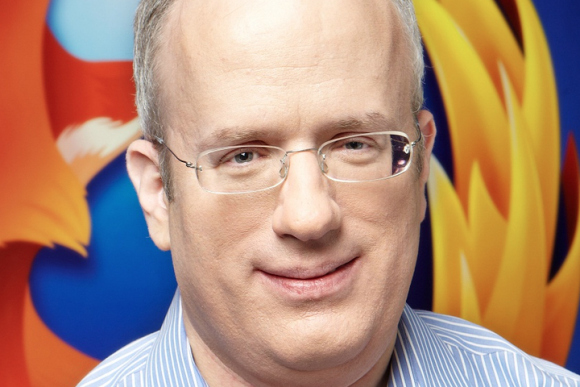
Today Brendan Eich, the CEO of the Mozilla Corporation (the guys who make Firefox) resigned. He had been CEO for less than two weeks. Here’s a rough timeline.

March 24, 2014 – Mozilla announced the appointment of Brendan Eich as the new CEO.

The Mozilla Board of Directors has announced that co-founder and current Chief Technology Officer Brendan Eich will be appointed to the role of CEO of Mozilla, effective immediately.

March 26, 2014 – News stories begin to break about the angry reaction by Mozilla employees and others in the tech world to Brendan Eich’s promotion. The Silicon Valley Business Journal had one search early example:

Wikipedia Mobile creator Hampton Catlin revealed he would no longer develop apps for the Firefox Web browser.

April 1, 2014 – The angry attacks on Mozilla escalate with OKCupid putting up a full banner ad denying access to anyone attempting to use their site with Firefox and explaining their opposition to Eich, as covered by International Business Times.[ref]For the record, I tried loading the site myself, and this was indeed the message I got.[/ref]
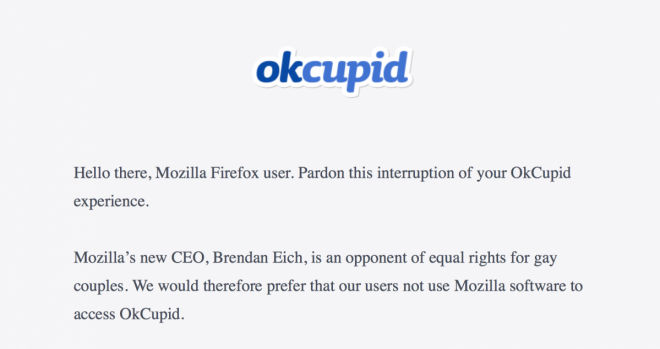
2014-04-03 OK Cupid Message

April 3, 2014 – News about the angry reaction concerns social conservatives. An anonymous article at First Things compares the reaction to “ritual sacrifice.” The excellent article also gave detailed back story on Eich’s history on the issue of gay marriage.

Why, then, the ruckus? Amazingly enough, it is entirely due to the fact that Eich made a $1,000 donation to the campaign urging a ‘yes’ vote on California’s Proposition 8. When this fact first came to light in 2012, after the Internal Revenue Service leaked a copy of the National Organization for Marriage’s 2008 tax return to a gay-advocacy group, Eich, who was then CTO of Mozilla, published a post on his personal blog stating that his donation was not motivated by any sort of animosity towards gays or lesbians, and challenging those who did not believe this to cite any “incident where I displayed hatred, or ever treated someone less than respectfully because of group affinity or individual identity.”

Upon being named CEO last Wednesday, Eich immediately put up another post which among other things pledged in direct terms first that he would ensure Mozilla continued offering health benefits to the same-sex partners of its employees; second that he would allocate additional resources to a project that aims to bring more LGBTQ individuals into the technology world and Mozilla in particular; and third that he would maintain and strengthen Mozilla’s policies against discrimination on the basis of sexual orientation and gender identity. It’s worth emphasizing that Eich made this statement prior to the storm of outrage which has since erupted, and that with these policies and others Mozilla easily ranks among the most gay-friendly work environments in the United States.

The First Things article also quoted from a very widely-read blog post demanding that Eich (1) stop claiming his support of Prop 8 was a private matter (2) recant his support of Prop 8 (3) swear loyalty to the cause of gay rights in general and gay marriage in particular, and (4) pay reparations to the Human Rights Campaign (or similar). The First Things article noted that:

The remedies demanded (public recantation, propitiatory sacrifice) are of the sort necessitated by ritual defilement, rather than the giving of offense.

April 4, 2014 – Brendan Eich announced his resignation. Here’s one story from the New York Daily news, but it’s been widely covered.

This tale serves to highlight two issues I’ve repeatedly raised on this blog. The first is the extent to which ostensibly secular movements and organization frequently assume distinctly religious behavior. One prominent example of this is global warming, of course, and many folks have pointed out that ardent supporters of policies designed to reduce human greenhouse emissions frequently embrace distinctly religious themes and rhetoric. The witch hunt against Brendan Eich is another example. As the anonymous First Things writer put it:

The key realization is that the howling mob which Thomas has ginned up is only partially an instrument of chastisement. It is also intended to educate. Thomas is in this to save souls.

Sound familiar?

Lots of people react with scorn to the idea that secular institution can be called “religious”. Obviously on one level, they cannot. But the deeper reality is that the human behaviors most closely associated with religion are not in fact derived from any of the supernatural beliefs religions hold. Concepts like ritual, purity, obedience, authority, and tradition don’t depend in any way on belief in gods. Religious institutions throughout history took on the traits and characteristics they did not because of religious belief, but because of human nature. Take away the belief in the supernatural, and all the elements of organized religion that critics decry remain just the same. In fact, it is precisely those who believe that belief in god causes the negative characteristics of organized religion that are most prone to repeating the mistakes of the past.

The second issue is the extent to which those who fail to toe the line concerning gay rights are in store for some very, very tough times to come. I understand that the first reaction from many people might be “serves them right.” There is truth to that. I have stated before that the worst mistake social conservatives ever made on this issue was to rely on animosity and fear in the early years of the gay-rights movement. It is only in the last few years that there have been highly visible examples of leading opponents of gay marriage overtly repudiating their prior practices and embracing a more loving and nuanced opposition to gay marriage. (See examples here and here.)

But, as the old saying goes, two wrongs don’t make a right. Andrew Sullivan (“a pioneering crusader for gay marriage” who married his boyfriend in 2007[ref]The Economist[/ref]) said as much on April 3:

The whole episode disgusts me – as it should disgust anyone interested in a tolerant and diverse society. If this is the gay rights movement today – hounding our opponents with a fanaticism more like the religious right than anyone else – then count me out. If we are about intimidating the free speech of others, we are no better than the anti-gay bullies who came before us.

I hope tolerant voices like Sullivan’s win out (and it’s no surprise he went with the headline: The Hounding of a Heretic), but I doubt that they will. To the extent that gay marriage advocates have embraced the rhetoric of civil rights to make their case, there is no way to stop this train. Do opponents of interracial marriage have any kind of legitimate place within our society? No. Would the employees of Mozilla be willing to accept a Grand Wizard of the Ku Klux Klan as their CEO? No. Then why, based on the arguments that the proponents of gay marriage have proposed so far, should they be any more willing to put up with an anti-gay bigot like Eich? (And yes, merely donating $1,000 to Prop 8 is enough to qualify for bigot status.)

What makes me the most sad is that a lot of the folks who stand to suffer most in the future are those who have done nothing wrong in the past. I’m thinking of all the young Christian, Jewish, and Muslim kids growing up now, or yet to be born, who will be forced to choose between devotion to their religious faith and family traditions and acceptance within society. Are they guaranteed to follow the political or religious beliefs of their parents? No, of course not, but my fear is that in the not too distant future adherence to traditional religions will be taken (in the absence of explicit denials) as proof positive of anti-gay bigotry. Sound far-fetched? Maybe, but I think a couple of weeks ago the story of what happened to Brendan Eich would have sounded pretty far-fetched too.

Extra-Biblical ‘Noah’

Darren Aronofsky’s Noah rose above (or likely because of) the controversy surrounding it to have an impressive $44 million opening weekend. I was writing my review, but getting bogged down in some technical details regarding the Watchers. I’d much rather focus on some of the themes from an LDS perspective, so I thought I’d share this blog post from Rabbi Geoffrey Dennis (Adjunct Professor of Rabbinics, University of North Texas) that covers a lot of the interesting extra-biblical bits of Noah with further links. (I’ll likely build on these in my own review, but now I don’t feel obligated to explain it all.)

These include:

  • Watchers: “The fallen angels, based in Gen. 6:4 and grandly elaborated on in the Book of Enoch and the Book of Giants, are a big part of the storyline…Aronofsky elides the more lurid part to the tradition, their coupling with human women and producing giant offspring, focusing instead on their role in Enoch as the bringers of knowledge and technology to humanity.”
  • Tzohar: “The glowy-explosive substance used repeatedly in the movie is based on the tzohar, a miraculous gemstone that tradition tells us illuminated the interior of the ark.”
  • The Garment of Adam: “…I assume this is where the idea for the magical-glowing-serpent skin-arm tefillin worn by the shamanic patriarchs of Seth is derived from. In Jewish tradition, the garment is made from the hide of Leviathan [i.e. the sea serpent]. Here, it’s the sloughed-off, pre-corruption skin of the edenic serpent.”
  • Tubal-Cain: “The terrifying and terrified king is constructed from a single verse of Genesis where he is credited as a worker of bronze and iron, but is then fused with the midrashic King Nimrod, the power-mad tyrant of rabbinic fantasy who attacks God’s messengers.”

Drawing on a parable from the Zohar, Dennis writes,

Hopefully…people are finally coming to understand that the fundamentalist critics of this film are all masters of wheat as alluded to by the Zohar. They think that in cleaving only to the bare bones of the biblical narrative, they are masters of all aspects of the story, but in fact they are, to a great extent, suffering from a kind textual indigestion, or perhaps a spiritual ciliac disorder, in which they fail to absorb the full nutritional value of the biblical narrative because of their restrictive way of reading.  The Noah story as received, a mere one hundred verses, with little dialogue, minimal motivation, no character development or insight, no struggle, is a mere skeleton which the readers must flesh out with themselves, projecting their experiences, emotions, and conflicts, and imagination onto the scaffold of plot to fully realize its many on complex meanings and implications. The movie Noah steps into those many gaps and fills them with clever, and sometimes crazed, midrashic storytelling.

I couldn’t agree more.


Here are a few more Noah-related posts from biblical scholars and biblically literate moviegoers:


All You Need to Know About the Hobby Lobby Case

2014-03-31 Hobby Lobby

The Washington Post has a couple of great sources if you want to know more about the Hobby Lobby case the Supreme Court is considering right now. In a nutshell, Hobby Lobby is a Christian company that doesn’t want to provide access to certain kinds of birth control that can work as  abortifacients instead of as contraceptives.[ref]The difference is that a contraceptive prevents conception from taking place at all, but abortifacients work after conception has already taken place to prevent implantation. IUDs, for example, do both although their primary mechanism is contraceptive.[/ref]

To get even more of a background in the case, I recommend Jaime Fuller’s Here’s what you need to know about the Hobby Lobby case. For legal analysis of the constitutional issues, I recommend Prof. Michael McConnell’s post at Volokh Conspiracy (which now operates within the WaPo). These two articles will give you a solid understanding of this controversial and well-known court case.

Times And Seasons: As Much As I Know Anything

2014-03-31 Before the PulpitToday’s post for Times And Seasons is basically just my testimony. I’ve had lots of people ask me why I believe over the years, and usually I’ve been incapable of giving a simple, concise answer. When I got asked the question again the week before last, however, I finally had an answer. Along with it, I had an understanding of why I’d been unable to express my faith more easily in the past. Read the post at Times And Seasons for the rest. It’s called As Much As I Know Anything.

Incidentally: I neglected to link to my last Times And Seasons post when I posted it two weeks ago. That one was called Human Evolution: Problems and Possibilities.

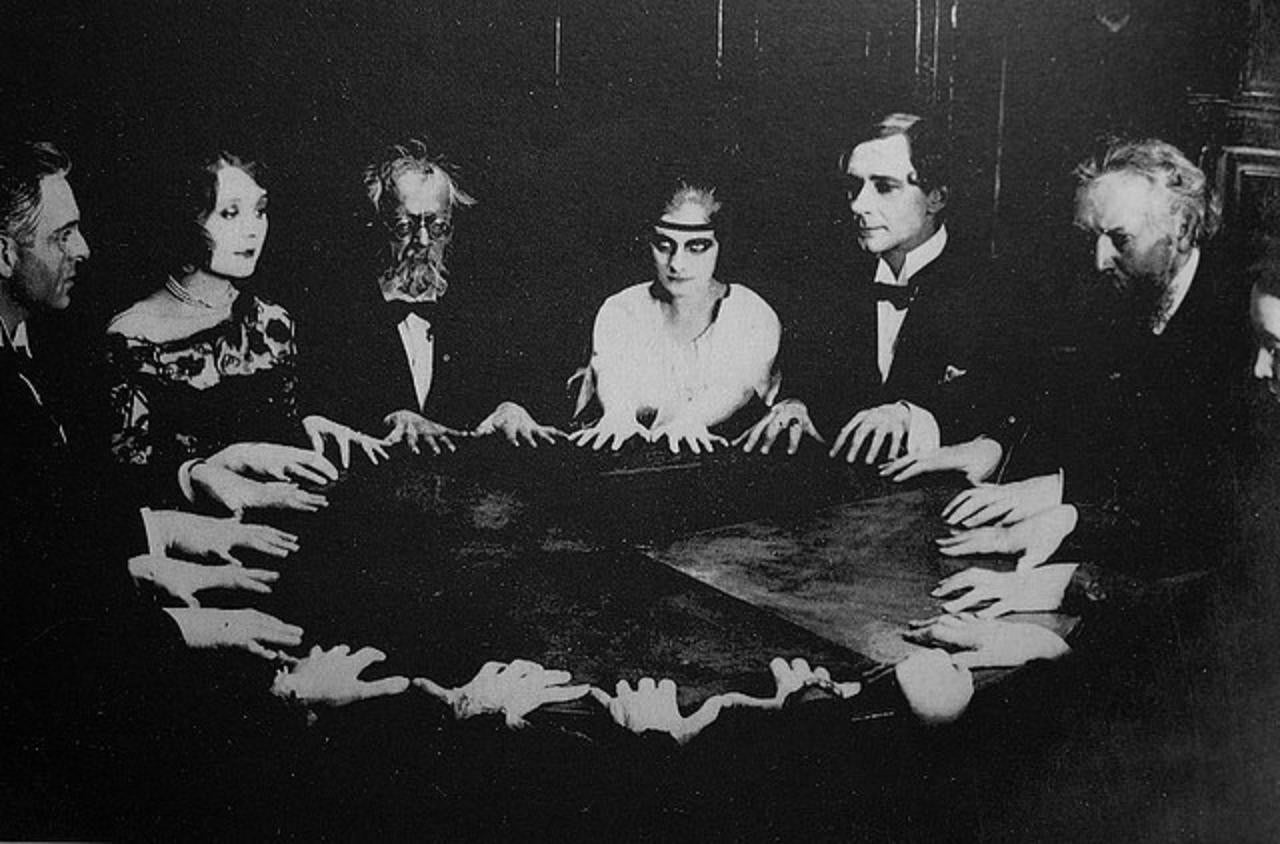
Science and Seances

Image result for seances

Nathaniel posted this past week on the relationship between religious faith and scientific evidence in the wake of new evidence for cosmic inflation. I followed up with a brief post about religious scientists (including Big Bang discoverer Georges Lemaitre). To top it off, this month’s issue of Nautilus has an excellent article entitled “Why Physicists Make Up Stories in the Dark.” The author presents a fascinating history of modern science. Here are a few gems:

  • “Who now will stand up for the British physicist Edmund Fournier d’Albe, who in 1908 put forward the theory that the human soul is composed of invisible particles called “psychomeres” possessing a rudimentary kind of intelligence?”
  • “[W]hen science first began to fixate on invisible entities, many leading scientists saw no clear distinction between such occult concepts and hard science…Victorian physicists were particularly prone. Some conjectured that there exist intelligent, unseeable beings on the subatomic or the cosmic scale. Others speculated that high-frequency waves outside the visible range could transmit thoughts between minds, or that immortal souls were consistent with the laws of thermodynamics. Anything seemed possible, as it often does when we awaken to our ignorance.”
  • “It is no coincidence that these discoveries [e.g. radio waves] happened at the height of the Victorian enthusiasm for spiritualism, in which mediums claimed to be able to contact the souls of the dead. The two trends supported each other. The new physics hinted at explanations for thought transference, whether from other people or from spirits; and a widespread belief in invisible influences and intelligences created a receptive environment for ideas in physics that seemed scarcely less incredible. If radio waves could transmit invisibly between a broadcasting device and a receiver, it did not seem so hard to imagine that human brains—which are after all quickened by electrical nerve signals—could act as receivers.”

And so on. Check it out.

Scientist Priests

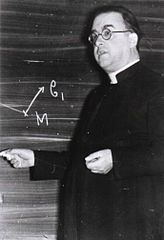
Georges Lemaitre: scientist priest

Nathaniel made an interesting observation the other day about physicist Andrei Linde’s reaction to the new evidence for cosmic inflation. The scientist worried, “What if I believe into this just because it is beautiful?” This led to a discussion about religious faith and scientific evidence. It might be worth remembering in light of the new discovery that Georges Lemaitre, the Father of the Big Bang, was a Catholic priest and a physicist at the Catholic University of Louvain. RealClearScience has a couple brief pieces on the history of scientific and religious thinkers:

Check them out.