Modern Tribalism: Mythical Ideologies for Mythical Ancestors

Bartolomeo_di_Giovanni_-_The_Myth_of_Io_-_Walters_37421
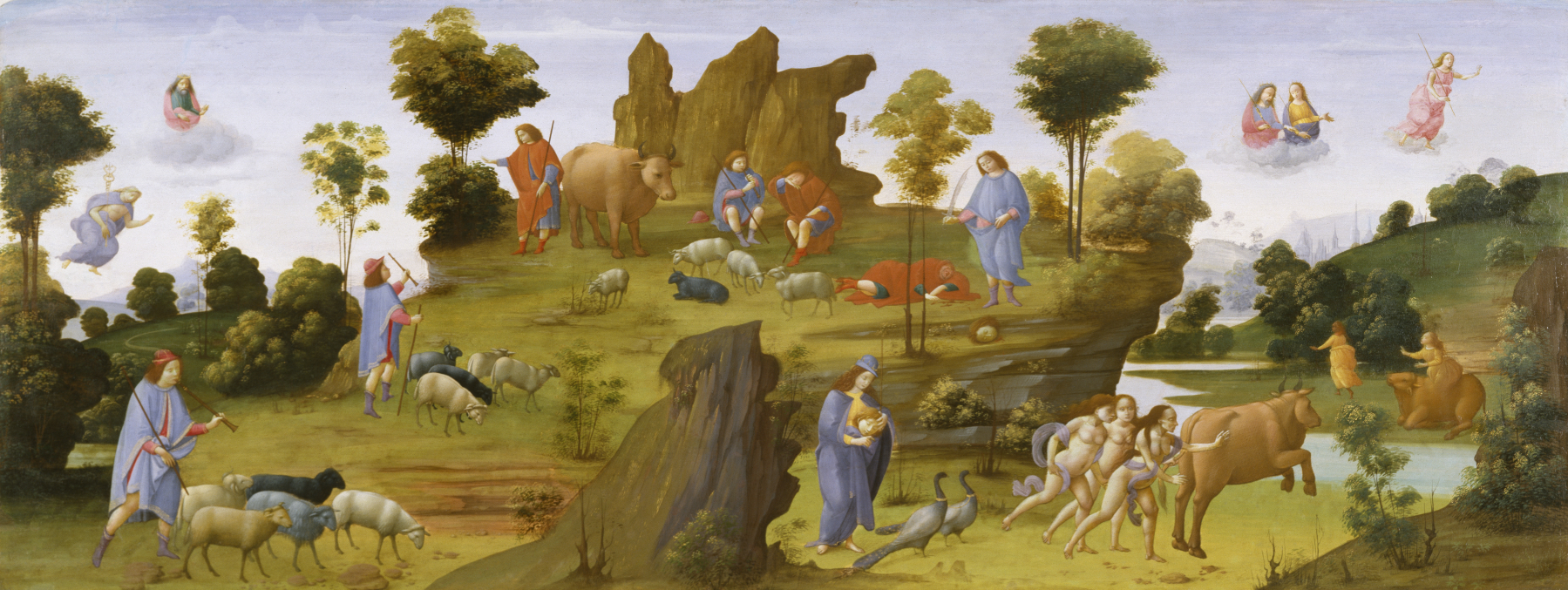
Bartolomeo di Giovanni recounts Jupiter ordering Mercury to rescue Io: an example of a cultural-creating myth.

In the past couple of years, I’ve read several books that deal with the origins of human society: Frans de Waal’s The Bonobo and the Atheist, Matt Ridley’s The Origins of VirtueFrancis Fukuyama’s Origins of Political Order, and Yuval Harari’s Sapiens are just a few examples.

One of the common themes in these books was that the leap from the band-level socities (usually capped at about 150 members) to tribal societies depended on the creation of mythological common ancestors. Tribal societies were successful because they could scale up in times of crisis. The bigger the crises, the more the individual groups would need to group together, so the farther back in time they would look to a common ancestor. A small crisis might entail a couple of tribes who were descended from a common, living grandfather. A medium crisis might require going back a few more generations to a long-dead (but possibly historical) great-great-grandfather. And a really large crisis might require going back even farther to mythical ancestors who may or may not have ever lived. The point was that–because they could always create an ancestor further back in time–tribal societies had truly immense ability to scale up (at least in the short term when faced with an external threat.)

Now, I’m very far from the first person to call modern American political discourse tribal. Basically everyone can see that our society is increasingly fracturing into diverse, ideologically pure and rigid social groups for whom politics is much more about creating and maintaining in-group solidarity than honest political differences.

If you’d like a recap, here’s a long but very awesome article about this: I Can Tolerate Anything Except the Outgroup. In the article, Scott Alexander[ref]a pseudonym[/ref] posits three main tribes in American society: red (conservative), blue (liberal) and gray (techno-libertarian). These are the top-level tribes, but each one is composed of a dense connection of sub-tribes, each smaller and more specific than the level above. For example, the gun-rights crowd is a sub-group in the red-tribe, and the open carry movement is a sub-group of that group.

Now, if you’d asked me last week, I would not have made any serious connection between the development of tribal societies in human prehistory and the rise of tribal politics in the United States. For the most part, the reason people make this analogy is that “tribal” has pretty negative connotations (e.g. insularity, xenophobia, and irrationality) that pretty closely match the behavior we’re seeing in American political society. So, a convenient connection but also a pretty superficial one.

But now I’m starting to think that the connection is actually much deeper than that.

Take a look at this image (one that a Facebook friend posted recently):
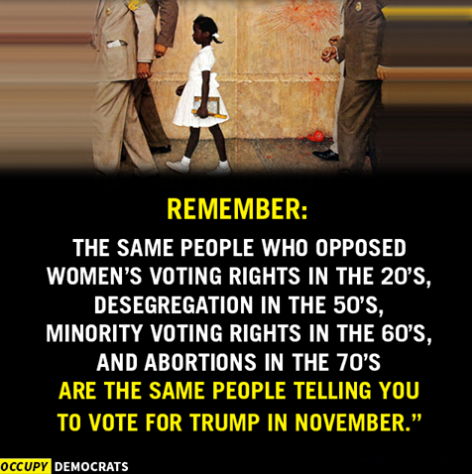
Mythological Ideology

Now, it’s got all the hallmarks of really obnoxious political memes, right down to the sloppy grammar. I’m looking at you, random lonely quotation marks.[ref]Is there a rulebook somewhere that says you have to include grammar mistakes in a successful meme? That was a joke at first. Then I realized that the folks replying to complain about the grammar would actually boost the meme’s stats in Facebook’s algorithms, so now I’m sad because I realize that it’s not a joke after all.[/ref]
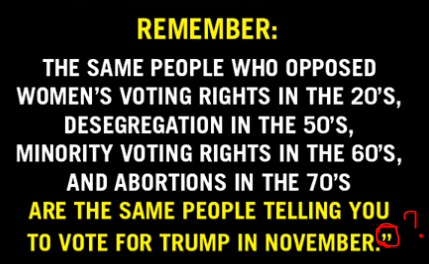
Lonely Quotation Marks

Now, according to this meme “the same people” were fighting against women’s rights in the 1920s, against equal rights for blacks in the 1950s and 1960s, against women’s rights again in the 1970s, and are now supporting Trump in the 2010s. So, who are these mysteriously long-lived people? Who are all those folks showing up in Trump rallies today that were waving anti-enfranchisement posters nearly 100 years ago? Obviously: nobody. Because humans don’t live that long.

Then what does “the same people” refer to? Perhaps there’s an ideology that’s around today that’s been around for 100 years, and so it’s not the individual human beings but the ideology that is the problem. This is also unlikely, however. Not only do ideologies change and mutate over time, but the reality is that (to pick a couple of issues), most of the women’s rights activists of the 1920s were extremely pro-life and would have been campaigning against abortion in the 1970s. Donald Trump, meanwhile, has been pro-choice almost his whole life, only switched to pro-life recently, and didn’t even do a half-way decent job of being convincing about it. So–even if there were such a thing as ideological philosophies that were consistent over time frames of a century or more–there isn’t one that aligns with these issues.

So what’s going on?

In simple terms, Occupy Democrats is creating a mythological ideology in exactly the same way that ancient tribal societies created mythological ancestors. The idea of Romulus created a bond between Romans who might otherwise come from different families, neighborhoods, or tribes. The bond was real, even if the Romulus was not. In the same way, the blue tribe is inventing a narrative of centuries’ of struggle for equal rights that always had a “good side” for them to claim membership in. Of course that’s a comforting belief, but the most important function that it plays is to unify the various sub-groups within the blue tribe who otherwise might fall into internal squabbles.

So, the analogy to tribes goes much deeper than I first thought.

And of course, this isn’t something just the blue tribe gets up to. All tribes do it. They invent common ancestors or (in our ideological time) common ancestral ideologies. The red tribe has actually been at it far, far longer than the blue tribe, but they choose a different narrative. Instead of a battle over equal rights, the red tribe has a battle to preserve the ideals of the American Constitution, and so the Founding Fathers function as the mythological common ancestors and the Constitution as the mythological common ideology of the red tribe.[ref]Obviously the Founding Fathers are not mythological in the sense of being made-up. That’s not the point. They are mythological in the sense of being a holy narrative that contains symbolic truths which bind together a group of people who share reverence for the narrative.[/ref]

Now, if you’ve got any advice on how to get people to stop posting this kind of tribalistic nonsense, I’d love to hear it. I’m begging my friends not to do it anymore–because it makes me hate being on Facebook and is bad for the country–but the worst part is that the kind of people who post this sort of thing (on the left or the right) are precisely the kind of people who can’t conceive of any way in which they could be doing any harm. After all, they’re just telling it like it is, right?
The Kingdom or the World

32479_all_014_01-hunter

This post is part of the General Conference Odyssey.

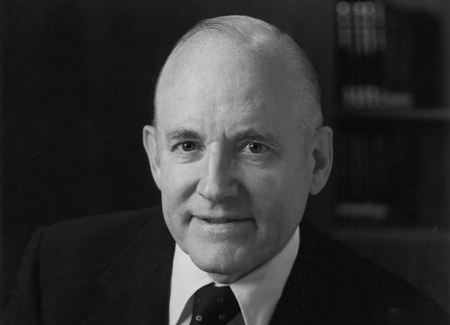
I didn’t really understand the sadness other Mormons felt when Ezra Taft Benson passed away in 1994, but their obvious connection to the then President made me look forward to feeling the same kind of bond with the next man to take up that mantle: Howard W. Hunter. Sadly, his tenure lasted less than a year, and virtually all I remember is that his unofficial them was temples.

So it was particularly interesting to me that the talk that struck me the most from the Saturday morning session of the October 1973 General Conference was (1) by Elder Hunter and (2) not directly about temples at all. Instead, in Of the World or of the Kingdom?, he talked about the conflicts between the unchanging gospel and the transient philosophies and institutions of late 20th century America.

The warnings were familiar. For example:

In this day of increased knowledge, higher thought, and a modernization of the old, the simple has been overlooked and the profound sought after. The basic, simple, fundamental truths of the gospel are being ignored.

Still, Elder Hunter’s specific views on the topic were like a unique improvisation on a familiar theme, with different emphases and nuances than what other leaders have said before. This is important, because we have to see the differences in order to recognize the commonalities, and the commonalities are the most important aspects of the General Conference talks.[ref]This is a fundamental reason for having the General Conference Odyssey in the first place: you can’t spot the commonalities and differences without a large sample size to work with![/ref]

So, here’s one paragraph that struck me as worth paying particular attention to:

I believe we can be modern and enjoy the fruits of a modern world and its high standard of living, and I believe we can have the benefits of modern scholarship and scientific advances without turning to the theories of the modernist. I believe the principles of the gospel announced by the Savior in his personal ministry were true when they were given and are true today. Truth is eternal and never changing, and the gospel of Jesus Christ is ever contemporary in a changing world.

I like the optimism here, and the dogged insistence that being “not of this world” doesn’t entail abdicating either the blessing of a “scientific advances” or “modern scholarship.” The tension between religious believers (of all traditions) and the larger society often leads to monasticism in one form or another, but Mormonism aims to engage with the world, not withdraw from it. It’s just up to us, I think, to articulate why and how “the gospel of Jesus Christ is ever contemporary.”[ref]As an aside, defining modernity is tricky. I’m used to the definition that says the early modern period started in the 1500s and the late modern period ended well before World War II (Wikipedia), which would make the 1970s post-modern instead of modern. But that’s not about right or wrong, just about consistency.[/ref]

And here’s another paragraph, near the end of the talk, that I liked a lot:

The knowledge explosion of which the world is so proud is not of man’s creation. It is his discovery of portions of the unlimited knowledge and information which is part of God’s knowledge. How we use it is determined by whether we are of the eternal kingdom of God or a part of the temporary understanding of the world. The question is simply this: are we seeking to find our place in the world in the realm of worldly thought, or are we seeking to find our place in the unchanging kingdom of God?

I’m definitely looking forward to reading more talks by President Hunter and getting to know better a leader that was not with us for long enough for me to get to know him in life.

Check out the other posts from the General Conference Odyssey this week and join our Facebook group to follow along!

The Social Science of Military Intervention

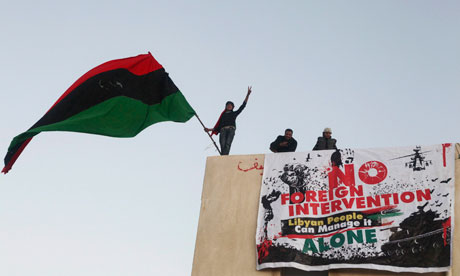
Stephen Walt, the Robert and Renée Belfer professor of international relations at Harvard University, has an older, but still incredibly relevant article in Foreign Policy on the social science of military interventions. “Before France, Britain, and the United States stumbled into its current attempt to dislodge Muammar al-Qaddafi from power in Libya,” asks Walt,

…did anyone bother to ask what recent social science tells us about the likely results of our intervention?

I doubt it, because recent research suggests that we are likely to be disappointed by the outcome. A 2006 study by Jeffrey Pickering and Mark Peceny found that military intervention by liberal states (i.e., states like Britain, France and the United States) “has only very rarely played a role in democratization since 1945.” Similarly, George Downs, and Bruce Bueno de Mesquita of New York University found that U.S. interventions since World War II led to stable democracies within ten years less than 3 percent of the time, and a separate study by their NYU colleague William Easterly and several associates found that both U.S and Soviet interventions during the Cold War generally led to “significant declines in democracy.” Finally, a 2010 article by Goran Piec and Daniel Reiter examines forty-two “foreign imposed regime changes” since 1920 and finds that when interventions “damage state infrastructural power” they also increase the risk of subsequent civil war.

Drawing on then unpublished work by political scientist Alexander Downes, Walt explains “that foreign intervention tends to promote stability when the intervening powers are seeking to restore a previously deposed ruler. But when foreign interveners oust an existing ruler and impose a wholly new government (which is what we are trying to do in Libya), the likelihood of civil war more than triples.” The regime change “disrupts state power and foments grievances and resentments” and increases the probability of civil war. Another paper by Downes found that “states that have their governments removed by a democracy gain no significant democratic benefit compared to similar states that do not experience intervention.”

With Clinton owning Libya–as even leftist outlets have acknowledged–this information becomes all the more timely and important.[ref]Here at Difficult Run, we’ve taken swipes at Trump, Sanders, and even Cruz (one time prematurely and unfairly). But surprisingly little has been said about Clinton. Maybe this is due to her list of scandals and controversies being well-known for so long.[/ref] Something both conservatives and liberals should take into account.

The State of Modern Economics

Herbert Gintis

Economist Herbert Gintis has an excellent piece over at Evonomics on the current state of economics, including developments in behavioral and evolutionary economics and their relationship to traditional economic theory. Gintis has done some fine interdisciplinary work and I’m greatly anticipating his forthcoming book Individuality and Entanglement: The Moral and Material Bases of Social Life. For Gintis, “The most creative behavioral and evolutionary economists remain inspired by the successes of, and consider their work as extensions of traditional economic theory. The most creative supporters of traditional economic theory, in turn, embrace behavioral and evolutionary perspectives and build on its insights.” Gintis walks the reader through a helpful analysis of general equilibrium, comparative statics, economic dynamics, and economic policy. He notes, “Traditional microeconomic economic theory is at its best in analyzing general equilibrium and comparative statics. Behavioral and evolutionary economics have as yet neither altered nor added to our understanding of general equilibrium and comparative statics.” It is in the case of dynamics “that traditional economic theory has the least to offer. Microeconomic theory has virtually nothing to say about market dynamics when there is more than a single good.” He claims that macroeconomics was a framework “economists invented wholecloth…for dealing with economic dynamics that has nothing to do with the microeconomic model of general equilibrium.” While macroeconomics is “widely taught in economics departments and policy makers pay attention to it faute de mieux…it is frankly virtually worthless, except in the very short run, where the near future can be reliably forecast from the recent past.” Gintis recognizes that “the economy is a complex dynamical system and nobody, not even the experts who spend all their time studying the economy, can predict even the direction of the long-term effects of most regulatory changes on the position of individual economic actors.” It is here that he bridges evolutionary economics with traditional, providing much-needed feedback to both the right and left of the political divide:

Evolutionary models of economic dynamics invariably assume adaptive expectations rather than rational expectations. Adaptive expectations assume individuals tend to copy the most successful behavior of others whom they observe in the market, with innovation taking place through random variation.

In the popular press, free market lovers blame financial crises on government intervention, and intervention lovers blame financial crises on insufficient regulation. Neither view is correct. The recent financial crisis was due to improper regulation of the financial sector. The notion that the financial sector of a market economy is robust in the absence of extensive regulation is simply an article of faith unsupported by theory or experience. Evolutionary economists are working on a theory of the financial sector that fits synergistically with our models of generalized market exchange and technological change, but no general model has yet been developed.

He continues by dissecting both market and state failures, which should be an eye-opening discussion for both free-marketers and those favoring more state intervention. In conclusion, he writes,

It is a serious error to reject standard economic theory on the grounds that it supports a free-market ideology. It does nothing of the kind. Correctly deployed, it carefully explains where, how, and when to intervene in the regulation of market exchange. Evolutionary and behavioral game theory are wonderful additions to the economist’s repertoire, but they complement rather than undermine traditional public sector economic theory. The most serious defect in traditional economic theory is its treatment of economic dynamics, and it is here that behavioral and evolutionary theory has the most to contribute.

Some criticize standard economic theory for failing to take into account that reliance on markets promotes selfishness and greed. The evidence from behavioral economics is quite the contrary. Even hunter-gatherers and members of other small-scale societies act more fairly if their society has significant contact with the larger market economy. And we must never forget that virtually every powerful pro-democratic, anti-racist and anti-sexist movement for social change in the world has taken place in market economies with democratic political institutions. Milton Friedman noticed this in his famous Capitalism and Freedom, and it remains valid even more a half-century later.

Check out the full article. It’s one I’ll be continually revisiting.

Why Diversity Programs Fail

Diversity training doesn’t work. At least that’s one takeaway from the write-up in The Washington Post on new research published in Harvard Business Review:

In the cover story of the latest issue of the Harvard Business Review, sociologists from Harvard University and Tel Aviv University explore the counterintuitive idea that some of the most common tools for improving diversity — one of which is mandatory training — are not just ineffective. They could be detrimental to improving the number of women and minorities in the managerial ranks.

Making people attend diversity training may seem to make sense, said one of the study’s co-authors, Alexandra Kalev, in an interview: “But it doesn’t work. For decades, diversity management programs flourished with no evidence whatsoever about their effects and their success.” 

The article is based on a series of research papers by Kalev and Harvard’s Frank Dobbin that studied nearly 830 U.S. companies. It describes how, five years after implementing compulsory diversity training for managers, companies actually saw declines in the numbers of some demographic groups — African American women and Asian American men and women — and no improvement among white women and other minorities.

Some of the findings have implications even outside of the workplace:

The authors point to a range of past social science studies that have shown that efforts to reduce prejudice can backfire — actually increasing bias or leading to more hostility rather than less. In another past study, white subjects who felt forced to agree with a document about bias toward blacks felt more prejudice; those who felt they could choose felt less. The pair also say that when diversity training is just focused on a certain group — like managers or one where there’s been a bias problem — it can also have worse results…The researchers also found that other tactics often aimed at helping with diversity, such as skill tests to help prevent bias in the hiring process or grievance systems where employees can log complaints, also led to declines in the number of women and minorities in the companies’ workforces over time. Managers don’t like being told who they want to hire, so they often distribute tests selectively, Kalev said, while grievance systems can make managers feel threatened and retaliate.

Is there any hope? Yes:

Kalev said their research has shown that training programs that focus on multiculturalism and the business case for diversity — rather than the legalistic reasons behind why it’s being offered — have a less negative impact. Still, she says, “even the most fascinating diversity training will be way more efficient if the crowd is sitting there voluntarily.” 

Indeed, that’s one of the tactics their research found actually lead to more diversity among managers. Voluntary programs that let people choose whether to attend might seem futile — most people don’t think they’re biased, so might not attend — but engagement, rather than coercion, led to growth among several minority groups in Kalev’s research. Diversity managers told she and Dobbin that 80 percent of people typically do attend, even when programs are voluntary. And strong representation from leaders can be one way to help encourage people to show up.

Food-for-thought.


The Economic History of American Inequality

An intriguing article by economists Peter Lindert and Jeffrey Williamson (based on their new book) traces the history of American income inequality. While some suggest that inequality is driven by a “fundamental law of capitalist development,” it turns out that “episodic shifts in five basic forces” to to blame: “demography, education policy, trade competition, financial regulation policy, and labour-saving technological change.” The following took me by surprise:

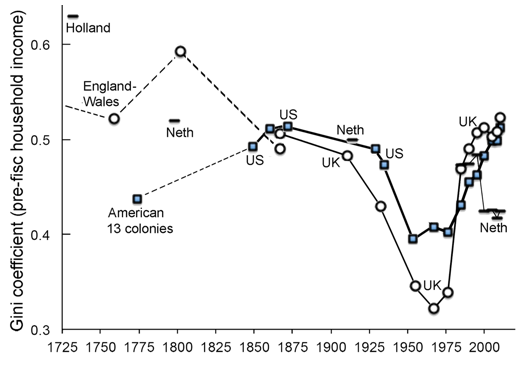
Colonial America was the most income-egalitarian rich place on the planet. Among all Americans – slaves included – the richest 1% got only 8.5% of total income in 1774. Among free Americans, the top 1% got only 7.6%. Today, the top 1% in the US gets more than 20% of total income. Colonial America looks even more egalitarian when the comparison is by region – in New England the income Gini co-efficient was 0.37, the Middle Atlantic was 0.38, and the free South 0.34. Today the US income Gini is more than 0.5, before taxes and transfers. Colonial America was also far less unequal than Western Europe. England and Wales in 1759 had an income Gini of 0.52,and in 1802 it was 0.59. Holland in 1732 had an income Gini of 0.61, and the Netherlands in 1909 had 0.56.  Also, if you agree with neo-institutionalists that economic equality fosters political equality, which fosters pro-growth policies and institutions, then America’s huge middle class is certainly consistent with the young republic’s pro-growth Hamiltonian stance from 1790 onwards. That is, the middle 40% of the distribution got fully 52.5% of total income in New England, the cradle of the revolution!

However, inequality began to rise between 1800 and 1860, “matching the widening income gaps we have witnessed since the 1970s. The earlier rise was not dominated by a surge in the property income share, as argued by Piketty (2014). Rather, this first great rise in inequality was broadly based, with widening income gaps throughout the whole income spectrum – rising urban-rural income gaps, skill premiums, gaps between slaves and the free, North-South income gaps, earnings inequality, and even property income inequality.”

Yet,

the income share captured by the richest 1% fell dramatically between the 1910s and the 1970s, and the share of the bottom half rose, for almost all countries supplying the necessary data. This ‘Great Levelling’ took place for several reasons. Wars and other macro-shocks destroyed private wealth (especially financial wealth) and shifted the political balance toward the left.  The labour force grew more slowly and automation was less rapid, improving the incomes of the less skilled. Rising trade barriers lowered the import of labour-intensive products and the export of skill-intensive products, favouring the less skilled in the lower and middle ranks. And in the US, the financial crash of 1929-1933 was followed by a half century of tight financial regulation, which held down the incomes of those employed in the financial sector and the net returns reaped by rich investors.

The authors note that “policies regarding education, financial regulation, and inheritance taxation…offer ways to check the rise of inequality while also promoting growth.” It is worth pointing out that this is about inequality and not about the absolute economic betterment of the average American. Nonetheless, understanding this economic history is important for those on both the right and the left.

Mass Incarceration is Not a Myth

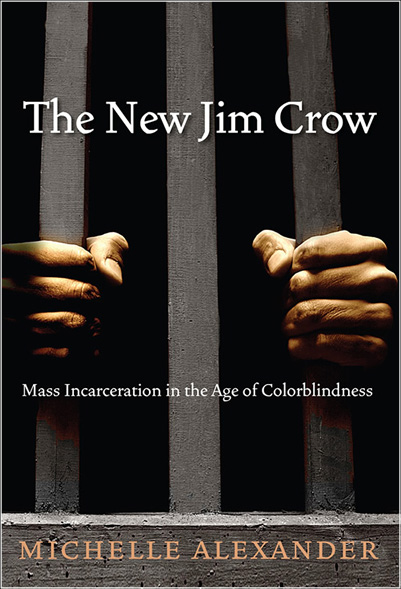
The New Jim Crow CoverIn the past couple of months, Walker and I both read The New Jim Crow and found Michelle Alexander’s arguments that the War on Drugs and the American criminal justice system are racist serious and credible. Then, today, we read and talked about a Wall Street Journal opinion piece making the opposite case: The Myth of Mass Incarceration. I called dibs, so I get to blog about it.

The most striking thing about the WSJ piece (by Barry Latzer) is that although he seems to be alluding to Alexander’s work (and has cited her book in his own work), he ignores the fact that she has already anticipated and rebutted his central arguments. According to Latzer, violent crime is the main driver of mass incarceration, not drug convictions, and to back this up he cites some data. For example:

Relatively few prisoners today are locked up for drug offenses. At the end of 2013 the state prison population was about 1.3 million. Fifty-three percent were serving time for violent crimes such as murder, robbery, rape or aggravated assault, according to the BJS.

The numbers are not in dispute, but they don’t mean what Latzer thinks they mean. Let’s see how this works with a simple (but unrealistic) illustration.

Imagine that in a single year 12 people are given 1-month drug sentences. One serves in January, one serves in February, one serves in March, etc. In the same year, 1 person is given a 1-year sentence for murder. If you take Latzer’s approach and go count the number of inmates in jail and see what they’re in prison for than–no matter what month you pick–you’ll find 1 person in jail for drugs and 1 for murder. You would concludes that 50% of incarcerations are for drugs, and 50% are for violent crime.

But of course that’s not really true. There were twelve drug convictions in our example, not just one. So in reality the proportion of drug offense wasn’t 50%. It was more than 92%. The number is artificially lowered because the drug offenders served shorter sentences, and so taking a poll in the prison year is misleading.

The numbers are invented for this example, but the effect is not. Drug sentences are generally shorter than violent crime sentences, and so taking a headcount of prisoners artificially increases the appearance of violent incarceration simply because those criminals spent more time in jail. Here’s how Alexander wrote about this in her book:

Murder convictions tend to receive a tremendous amount of media attention, which feeds the public sense that violent crime is rampant and forever on the rise, but like violent crime in general, the murder rate cannot explain the growth of the penal apparatus. Homicide convictions account for a tiny fraction of the growth in prison population. In the federal system, for example, homicide offenders account for 0.4% of the past decades’ growth in the federal prison population white drug offenders account for nearly 61% of that expansion. In the state system, less than 3% of new court commitments to state prison typically involve people convicted of homicide. As much as half prisoners are violent offenders, but that statistic can easily be misinterpreted. Violent offenders tend to get longer prison sentences than non-violent offenders, and therefore comprise a much larger share of the prison population than they would if they had earlier release dates.

Latzer also makes another claim that–while technically true–is misleading. And this one was also anticipated and rebutted by Alexander. He says:

Critics of “mass incarceration” often point to the federal prisons, where half of inmates, or about 96,000 people, are drug offenders. But 99.5% of them are traffickers. The notion that prisons are filled with young pot smokers, harmless victims of aggressive prosecution, is patently false.

The problem with this one is that prosecutors have incredibly wide discretion in which charges to bring against people and, on top of that, have virtually zero oversight in how they exercise that discretion. Writing in The New Jim Crow, Alexander points out that:

The risk that prosecutorial discretion will be racially biased is especially acute in the drug enforcement context , where virtually identical behavior is susceptible to a wide variety of interpretations and responses and the media imagery and political discourse has been so thoroughly racialized. Whether a kid is perceived as a dangerous, drug-dealing thug or instead is viewed as a good kid who was merely experimenting with drugs and selling to a few of his friends, has to do with the ways information about illegal drug activity is processed and interpreted in a social climate in which drug dealing is racially defined.

In other words, the exact same behavior (selling drugs) could easily lead to a simple possession charge for some people and a trafficking charge for others. We can’t just blithely assume that whatever charge a person ends up serving time for reflects accurately and fairly on what they did and what someone else did not do.

This is not to say that Latzer doesn’t make any valid point at all. He does. He points out that blacks are more likely than whites to commit violent crime. This is true, and in fact it’s a point that Alexander concedes in her book. So, if you’re focused on violent crime, there is a basis to say that the criminal justice system is fair: there are more blacks behind bars because more blacks commit violent crimes.

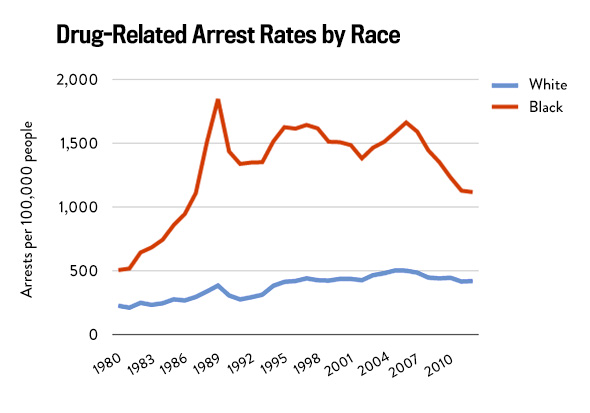
On the other hand, if you’re looking at drug crimes, then there is a basis to say that the criminal just system is not fair. Blacks and whites use illegal drugs at roughly the same rates, but blacks are far, far more likely to face arrest, prosecution, and conviction than whites, as this chart (from Slate) illustrates:

When you look at this chart remember: blacks and whites use illegal drugs at roughly comparable rates. So why aren’t the arrest rates comparable?

But, even in the case of violent crime, there is fairly clear evidence of racism. Many studies have found that the justice system is fairly unbiased when it comes to the race of perpetrators of violent crime, but it is very, very biased when it comes to the race of victims of violent crime. In short, if you kill a black person then (whether you are white or black) your sentence will be relatively low. But if you kill a white person then (whether your are white or black) your sentence will be relatively high. Based purely on the data, one would say that our criminal justice system believes that all lives matter, but some lives matter more.


I’ve been planning a long post / review of The New Jim Crow for some time now, but I haven’t finished organizing my quotes and notes yet. So you can consider this a preview. And, along those lines, I’ll make one more point: the effects of conviction are far, far more general than the question of incarceration. This isn’t really a criticism of Latzer. He focused on incarceration, and so this falls outside the scope of his argument. But it’s something important for us to keep in mind. First, you don’t have to go to jail at all to get a felony conviction on your record. Second, that felony conviction is going to stay on your record long after you have “served your debt to society.” If the criminal justice system is unfair, it’s not just about incarceration. It’s about losing the right to vote. It’s about losing access to government programs like student loans or food stamps. It’s about the government banning your friends and family from supporting you (if they live in public housing) when you get out. And–most egregiously of all–it’s about a scarlet-F that will follow you to every job interview and ensure that long after you are outside the prison walls you are still practically barred from building a new life for yourself.

There’s  lot at stake here, folks, and it’s not just about violent crime.

Natural Gas: The Bridge to Renewable Energy

Most people are in favor of renewable energy such as wind and solar, yet many supporters tend to look at natural gas with disdain.[ref]Arguably due to the means of its extraction (fracking). For example, there’s been some controversy over the EPA’s fracking report. Nonetheless, the shale gas boom has been linked to America’s falling carbon emissions (though it is likely not the only or even biggest contributor).[/ref] However, a new NBER study finds that this position is untenable. As one of the authors writes in The Washington Post,

Because of the particular nature of clean energy sources like solar and wind, you can’t simply add them to the grid in large volumes and think that’s the end of the story. Rather, because these sources of electricity generation are “intermittent” — solar fluctuates with weather and the daily cycle, wind fluctuates with the wind — there has to be some means of continuing to provide electricity even when they go dark. And the more renewables you have, the bigger this problem can be.

Now, a new study suggests that at least so far, solving that problem has ironically involved more fossil fuels — and more particularly, installing a large number of fast-ramping natural gas plants, which can fill in quickly whenever renewable generation slips.

Er…Solar!

…In the study, the researchers took a broad look at the erection of wind, solar, and other renewable energy plants (not including large hydropower or biomass projects) across 26 countries that are members of an international council known as the Organisation for Economic Co-operation and Development over the period between the year 1990 and 2013. And they found a surprisingly tight relationship between renewables on the one hand, and gas on the other.

…“Our paper calls attention to the fact that renewables and fast-reacting fossil technologies appear as highly complementary and that they should be jointly installed to meet the goals of cutting emissions and ensuring a stable supply,” the paper adds.

Image result for earth captain planet gif
…which is where the natural gas is found.

The study seems to indicate that natural gas is “a so-called “bridge fuel” that allows for a transition into a world of more renewables, as it is both flexible and also contributes less carbon dioxide emissions than does coal, per unit of energy generated by burning the fuel.” Or, as Reason‘s science writer Ronald Bailey puts it, “Anti-fracking pro-renewable energy activists are walking contradictions.”


What Do Economists Think About a Basic Income?

In April, I wrote about a new 10-year experiment testing a universal basic income in Kenya. While I find arguments for UBI compelling (especially those made by Matt Zwolinski), it is worth looking what experts are saying about it. Charles Murray has argued that for the UBI to work, it must replace all other transfer systems and bureaucracies. But economists are not so sure.

Granted, this is mainly a response to Murray’s particular brand of UBI. But are there other reasons to be skeptical of UBI? Let’s consider the costs. The Economist reports,

An economy as rich as America’s could afford to pay citizens a basic income worth about $10,000 a year if it began collecting about as much tax as a share of GDP as Germany (35%, as opposed to the current 26%) and replaced all other welfare programmes (including Social Security, or pensions, but not including health care) with the basic-income payment.

Such a big jump in the size of the state should make anyone wary. Even if levied efficiently, on an immovable asset like land, tax rises on this scale would have unpredictable effects on growth and wealth creation. Yet an income of $10,000 is still extremely low: it would leave many poorer people, such as those who rely on the state pension, worse off than they are now—at the same time as billionaires started getting more money from the state.

A universal basic income would also destroy the conditionality on which modern welfare states are built. During an experiment with a basic-income-like programme in Manitoba, Canada, most people continued to work. But over time, the stigma against leaving the workforce would surely erode: large segments of society could drift into an alienated idleness. Tensions between those who continue to work and pay taxes and those opting out weaken the current system; under a basic income, they could rip the welfare state apart.

Lastly, a basic income would make it almost impossible for countries to have open borders. The right to an income would encourage rich-world governments either to shut the doors to immigrants, or to create second-class citizenries without access to state support.

The Brookings Institution’s Isabel Sawhill lists two major objections to a UBI:

  1. Robert Greenstein argues…that a UBI would actually hurt the poor by reallocating support up the income scale. His logic is inescapable: either we have to spend additional trillions providing income grants to all Americans or we have to limit assistance to those who need it most.”
  2. “Liberals have been less willing to openly acknowledge that a little paternalism in social policy may not be such a bad thing. In fact, progressives and libertarians alike are loath to admit that many of the poor and jobless are lacking more than just cash. They may be addicted to drugs or alcohol, suffer from mental health issues, have criminal records, or have difficulty functioning in a complex society. Money may be needed but money by itself does not cure such ills.”

She instead suggests the possibility of “unconditional payments along the lines of a UBI, but to phase it out as income rises.” But more fundamentally, she notes that “the biggest problem with a universal basic income may not be its costs or its distributive implications, but the flawed assumption that money cures all ills.”

As we wrestle over the best policy to assist the poor and needy, we must be willing to look at it from all angles.


Age & Rising Nationalism

World Bank economist Harun Onder has a post over at the Brookings Institution on his brand new study on rising nationalism and older generations:

Much ink has been spilled against such premises of rising nationalism. But a curious observation remains to be explained: Why do nationalist arguments tend to resonate with old people? Take the recent case of Brexit. Only a quarter of youth (ages 18-24) voted for the “leave” camp. In comparison, six out of ten old people (ages 65+) wanted to leave. The youth were quick to announce the stark contrast in social media and clarify their position! So, what is it that the old know about globalization that the young fail to see?

In a recent study, my colleagues Richard Chisik and Dhimitri Qirjo and I tried to explain how demographic aging—an increase in the share of old people in the country—could shift the economic policy preferences in an economy. Because nationalist sentiments often involve objections to free trade and migration, we paid particular attention to those policies. We came up with three interesting results that may help us understand how aging and nationalism are linked.

These results include:

  1. An aging population is more dependent on imports: “To see this, note that the old consume more services like long-term care and the young consume more goods like smartphones. Therefore, the higher the share of old people in the population, the higher the demand for services, which cannot be imported, and the lower the demand for goods that can be imported.”
  2. When aging occurs, more firms move overseas if trade barriers are low: “If…the aging country imposes egregiously high tariffs on imports, smartphone producers might rethink their relocation decisions.”
  3. Nationalists may have a point about free trade at first glance, but more in-depth analysis proves otherwise: “From the nationalist point of view, erecting barriers at the border, be it made of concrete or import tariffs, may appear to make sense economically. However, this logic is terribly shortsighted: It is based on a static view of a world where actions cause no reactions. More specifically, it fails to recognize that when one country erects barriers its partners will do the same in response. In the end, a trade war may be triggered, only to be accompanied by a rising wave of protectionism, which would hurt the aging country more than the partner.”

Check it out.