The Economic Case for Gender Equality

A 2015 McKinsey Global Institute report found that–surprise, surprise–gender equality is good for the economy:

A “best in region” scenario in which all countries match the rate of improvement of the fastest-improving country in their region could add as much as $12 trillion, or 11 percent, in annual 2025 GDP. In a “full potential” scenario in which women play an identical role in labor markets to that of men, as much as $28 trillion, or 26 percent, could be added to global annual GDP by 2025. MGI’s full-potential estimate is about double the average estimate of other recent studies, reflecting the fact that MGI has taken a more comprehensive view of gender inequality in work.
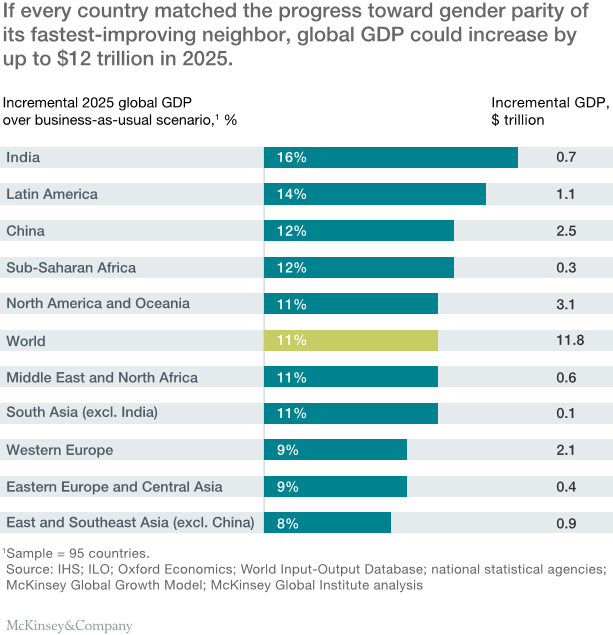
MGI focused on 15 gender-equality indicators, all of which fell under the categories (1) equality in work, (2) essential services and enablers of economic opportunity, (3) legal protection and political voice, and (4) physical security and autonomy. Both developing and advanced countries stand to gain from increased gender parity. “MGI’s new Gender Parity Score (GPS) measures the distance each country has traveled toward gender parity, which is set at 1.00. The regional GPS is lowest in South Asia (excluding India) at 0.44 and highest in North America and Oceania at 0.74. Using the GPS, MGI has established a strong link between gender equality in society, attitudes and beliefs about the role of women, and gender equality in work.” Furthermore, “MGI has identified ten “impact zones” (issue–region combinations) where effective action would move more than 75 percent of women affected by gender inequality globally closer to parity. The global impact zones, which are globally pervasive issues, are blocked economic potential, time spent in unpaid care work, fewer legal rights, political underrepresentation, and violence against women.”[ref]Compare this to the findings in the Columbia-published Sex & World Peace.[/ref]

So, if thinking of women as equals on moral and ontological grounds is just too much of a stretch for you,[ref]Shame on you.[/ref] try indulging in a little economic self-interest and fight for gender equality.
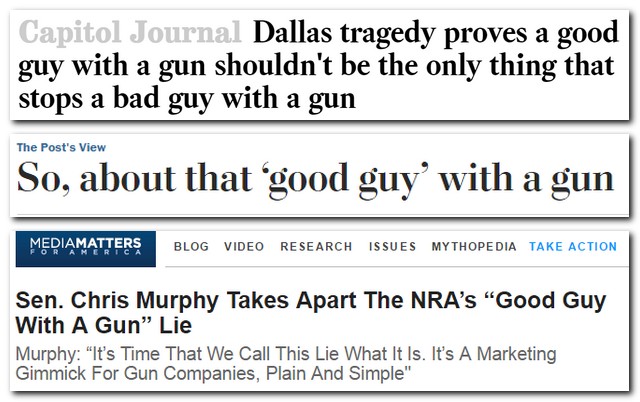
Does Dallas prove “good guys with guns” is a lie?

After the sniper in Dallas killed five police officers, I saw several posts like this:

GGWG pieces

The idea is that there were not only armed police officers present but also citizens with open carry licenses, and yet all these “good guys with guns” didn’t stop the bad guy with a gun from killing people.[ref]It was an unmanned explosive that ultimately took the sniper down.[/ref] That much is true. The people pointing this out then often conclude that good guys with guns won’t protect us. That much is false.

Of course if you mean good guys with guns can’t prevent bad guys with guns from hurting anyone ever again, yes, I agree. But I doubt most gun rights advocates believe or have made such an extreme claim. It’s not that good guys with guns will always be able to keep everyone safe; it’s that good guys with guns will be able to protect people more often than good guys without guns.

I think most people on both sides of the gun control debate recognize this to some extent, because almost everyone agrees the police (“good guys with guns”) should be armed. In fact, using Dallas to claim good guys with guns don’t protect us is especially interesting because both civilians and LEOs with guns weren’t able to stop the sniper. Yet gun control advocates are pointing to Dallas as a reason to disarm civlians only, not the police.

And, I mean, I agree that we definitely shouldn’t disarm the police. It seems clear to me that (1) a military-trained sniper is not representative of the dangerous people police are more typically up against, and (2) everyone would have been worse off if the police hadn’t had guns.[ref]It was police guns that wounded the sniper and caused him to flee.[/ref]

It’s true that civilians and LEOs with guns were unable to stop the sniper before he hurt anyone, but it’s false to suggest the guns were irrelevant or of no benefit, and it’s nonsensical to suggest that if good guys can’t protect people from a military-trained sniper, they can’t protect people in more typical situations. For example, just yesterday (also in Dallas incidentally), a legal gun owner with a pistol stopped a robber with an AK-47.

HuffPo GGWG

There are snippet self-defense stories like that regularly, but they don’t make nearly the media ripples that shootings make. I think that’s understandable to some extent: stories about things going right generally don’t get as much attention as stories about things going wrong, especially when things go really wrong. And there’s a matter of degree here too: in terms of media exposure, a snippet about a civilian stopping a robber might be parallel to a snippet about a robber shooting and wounding a single person. They’re both relatively minor stories. But what would the “good guy” equivalent be to stories about horrific mass shootings? Because a story about preventing a mass shooting doesn’t have nearly the media impact mass shootings have. But I digress.

Gun control advocates point out that if the sniper hadn’t had a gun, he couldn’t have done the damage he did. And I think they’re right. I think it’s obvious. I don’t find compelling the gun rights arguments that imply people can be just as dangerous with knives or baseball bats or whatever as they are with guns.

But while I also wish the sniper hadn’t had a gun, it’s not clear to me what the solution is, for two main reasons. (1) Gun ownership is a Constitutional right, so, absent amending the Constitution, gun control measures can’t undermine that right. (2) The measures would have to effectively stop people from obtaining guns illegally, at least at a level that would make up for stopping “good guys with guns” from being able to protect themselves and others from “bad guys with guns.”

I’m open to the possibility that there are gun control measures that can accomplish both of these feats, it’s just not clear to me right now what those measures would be. I think I’ll save that topic for future posts.

Are Safety Standards Relative?

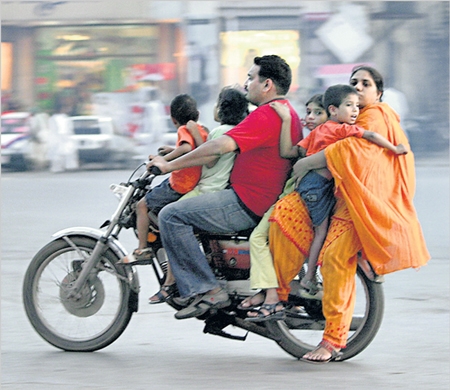
Five cars for the Indian market were recently awarded a zero-star safety rating by the London-based Global New Car Assessment Program. While this low rating is gaining a bit of negative press, economist Alex Tabarrok thinks we should reconsider:

Let’s take a closer look. These cars are very inexpensive. A Renault Kwid, for example, can be had for under $4000. In the Indian market these cars are competing against motorcycles. Only 6 percent of Indian households own a car but 47% own a motorcycle. Overall, there are more than five times as many motorcycles as cars in India.

Motorcycles are also much more dangerous than cars.

…The GNCAP worries that some Indian cars don’t have airbags but forgets that no Indian motorcycles have airbags. Even a zero-star car is much safer than a motorcycle. Air bags cost about $200-$400 (somewhat older estimates here a, b, c) and are not terribly effective. (Levitt and Porter, for example, calculated that air bags saved 550 lives in 1997 compared to 15,000 lives saved by seatbelts.) At $250, airbags would increase the cost of a $5,000 car by 5%. A higher price for automobiles would reduce the number of relatively safe automobiles and increase the number of relatively dangerous motorcycles and thus an air bag requirement could result in more traffic fatalities.

A broader point is that in India today $250 is about 5% of GDP per capita ($5,700 at PPP) and that’s a high price to pay for the limited protection provided by an air bag. Lots of people in the United States wouldn’t pay $2750–5% of US GDP per capita–for an air bag. Why should Indians be any different?

Intending to save lives and actually saving lives are not the same thing.

“Don’t like X? Don’t get one.”

I’m anti-abortion, and this meme really annoys me:

don't like abortion

This meme is addressed to pro-lifers, but it only makes sense if it completely ignores the fundamental pro-life argument: abortion kills non-aggressive, innocent humans. To a pro-lifer this meme is roughly equivalent to “Don’t like murder? Don’t commit one.” Yeah great. Solid point.

Now, an abortion rights advocate might respond that abortion isn’t murder for a variety of reasons, and then we can have that debate. That debate is worth having because it’s actually addressing what the target audience–pro-lifers, in this case–are saying. The above meme completely ignores what pro-lifers are saying. What good is a point that ignores the central premise of the group you’re addressing?

And that’s why, even though I’m a gun rights advocate, this meme annoys me too:

don't like guns

This meme is addressed to gun control advocates, but it only makes sense if it completely ignores the fundamental gun control argument: permissive access to guns results in the deaths of non-aggressive, innocent humans. I imagine to a gun control advocate this meme is roughly equivalent to “Don’t like mass shootings? Don’t commit one.” Insightful, thanks.

I know gun rights advocates, including myself, argue that access to guns can and has saved lives. And I think that’s a debate worth having because it’s addressing what the target audience–gun control advocates, in this case–are saying. But the above meme completely ignores what they’re saying, in the exact same way the abortion meme did.

I understand memes by their very nature can’t be in-depth, nuanced arguments. But they could at least be remotely relevant to the audience they’re supposed to be addressing. That’s not too high of a hurdle, right?

Income Mobility vs. Educational Mobility

Nobel laureate James Heckman has a new paper out with exploring social mobility in the U.S. and Denmark. The abstract reads:

This paper examines the sources of differences in social mobility between the U.S. and Denmark. Measured by income mobility, Denmark is a more mobile society, but not when measured by educational mobility. There are pronounced nonlinearities in income and educational mobility in both countries. Greater Danish income mobility is largely a consequence of redistributional tax, transfer, and wage compression policies. While Danish social policies for children produce more favorable cognitive test scores for disadvantaged children, these do not translate into more favorable educational outcomes, partly because of disincentives to acquire education arising from the redistributional policies that increase income mobility.

In short, the disadvantaged in Denmark are not flourishing and moving up financially because of the labor market, educational attainment, or careers, but simply due to wealth redistribution via high taxes.

The authors conclude,

The failure to promote greater educational mobility in spite of providing generous social services is most likely rooted in the welfare state. Our findings point to wage compression and the higher levels of welfare benefits as being counterproductive in providing incentives to pursue education. The low returns to education observed in Denmark, in particular at the lower levels of education, help explain the disconnect between the egalitarian childhood policies in Denmark and the roughly equal levels of educational mobility in Denmark and the U.S. The sorting of families into neighborhoods and schools by levels of parental advantage is likely another contributing factor. While the Danish welfare state may mitigate some childhood inequalities, substantial skill gaps still remain.

…This paper sends a cautionary note to the many enthusiasts endorsing the Scandinavian welfare state. We make no statements about the optimality and fairness of the U.S. and Danish systems from a philosophical or social choice point of view. The Danish welfare state clearly boosts the cognitive test scores of disadvantaged children compared to their U.S. counterparts. But test scores are not the whole story, or even the main story of child success, despite the emphasis on them in popular discussions. Moreover, substantial gaps in test scores remain across social groups within Denmark.

…The U.S. excels in incentivizing educational attainment. The Danish welfare state promotes cognitive skills for the disadvantaged children. Policies that combine the best features of each system would appear to have the greatest benefit for promoting intergenerational mobility in terms of both income and educational attainment (pgs. 55-56).

Check it out.

The Greatest Tricks the Devil Plays

Detail of The Temptation of Christ by Ary Scheffer. (Public Domain)

This post is part of the General Conference Odyssey.

It is not often that you hear someone share a testimony of the existence of Satan, but that’s exactly what was so striking about Elder David B. Haight’s talk on the Power of Evil. Towards the end he said plainly, “I bear witness this day that the devil is real. I have felt of his influence.”

Which raises the question: why? Why is it important to know this? Mormonism is, generally speaking, a relentlessly optimistic faith. We have very strict rules, but we don’t generally hear a lot about brimstone. The motivation is generally love rather than fear. And so it’s possible to ask—if we already have such strict standards and an emphasis on hope—does it really matter if we talk about the devil?

Well, in one sense, not that much. After all, this is the first talk that has focused on that topic that I’ve ever read. Clearly it’s not our primary emphasis and it won’t ever be.

But on the other hand, the topic was worth bringing up, and Elder Haight’s talk explains why:

Unfortunately, along with much of the world, some of our loved ones are influenced by false prophets, false Christs, and modern movements of spiritualism. Some have become victims of satanic influences because they do not understand or realize the power of the adversary who knows human weaknesses and is ever present.

The reason some are led astray is especially that “the current wave of permissiveness in many areas of our lives is being encouraged by false interpretations of our true, basic, moral principles.” I wasn’t alive in the 1970s, but I’d hazard a guess—based on what I know of the time period and what I’ve read from these talks—that the notion of agency and individual freedom was one thing that led people astray. The same kinds of mistakes are happening today.

But we have to resist the temptation to take a talk like this and morph it into something along the lines of “my political adversaries are devils; my political allies are angels.” If there’s one thing I’ve observed, from following the interplay of politics and morality, it’s the that devil knows how to play both sides of the spectrum. When anti-federalist militia members took over a federal building in eastern Oregon earlier this year, they included flags quoting the Title of Liberty and even one individual who identified himself as Captain Moroni. It’s hard to think of a clearer example of “false interpretations” of Mormonism.[ref]I picked this example because Mormons are famously politically conservative, so I wanted to show that they can be led astray in that direction as well.[/ref]

What it comes down to for me is that we should apply prophetic teachings to ourselves rather than to others. Nephi said that he “did liken all scriptures unto us,”[ref]1 Nephi 19:6, emphasis added[/ref] not that he related scriptures to their enemies. The same principle applies here. Elder Haight’s talk is a warning to examine our own convictions, our own beliefs, and our own actions. A reminder that the devil can lead even the righteous astray is an opportunity for humility and self-reflection. We must be discerning, and tribalism–political or otherwise–is blinding.

There’s a saying that the greatest trick the devil ever pulled was convincing the world he didn’t exist. Perhaps the second-greatest trick is letting the world believe that he does exist, but convincing them that he’s always on the side of their enemies.

Check out the other posts from the General Conference Odyssey this week and join our Facebook group to follow along!

“Black lives matter,” “All lives matter,” and telling people what they mean.

You should be able to describe your opposition’s stance in a way they would agree with. If you can’t do that, do you really understand what they’re saying?

I’m sure I’m not the only one who has seen this argument ad nauseum.

“Black lives matter.”
“All lives matter.”
“Why do you refuse to acknowledge discrimination againt black people?”
“Why don’t you care when others are hurt? Why don’t you care about police officers’ lives?”

Etc.

As best I can tell, this infinite argument stems from two factors:

  1. Allowing the extremists to represent our opposition.
  2. Telling other people what they think and what they mean.

These are both mistakes. We make them often in all kinds of debates, probably more often the more heated the debate is. But guys, I wish we’d stop.

I don’t doubt that there are people who are indifferent to or even celebrate an LEO’s death or a black person’s death. But I don’t think either of those stances represents the majority of either side. And it would be helpful if, when someone says something you think has an ambiguous meaning, instead of assuming they’re using the most extreme, awful meaning, you maybe just asked them to clarify.

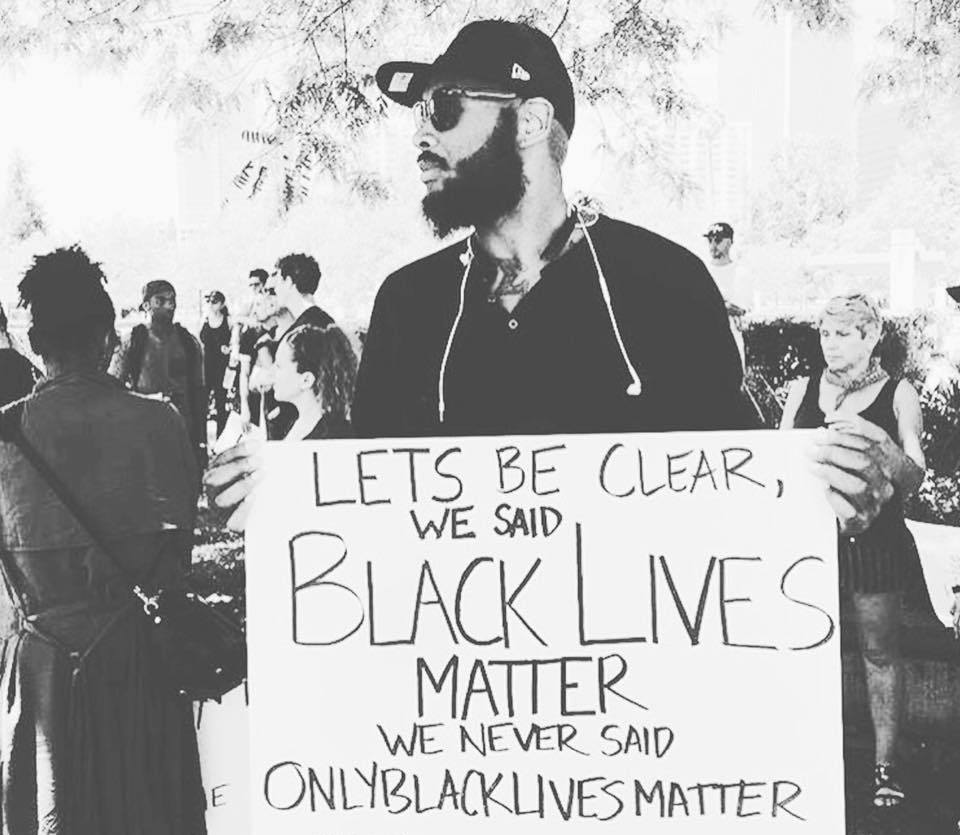
So when someone says “Black lives matter,” instead of assuming they mean “Only Black lives matter,” either give them the benefit of the doubt (they mean “Hey, black lives matter too”), or at least ask them what they mean.

let's be clear BLM

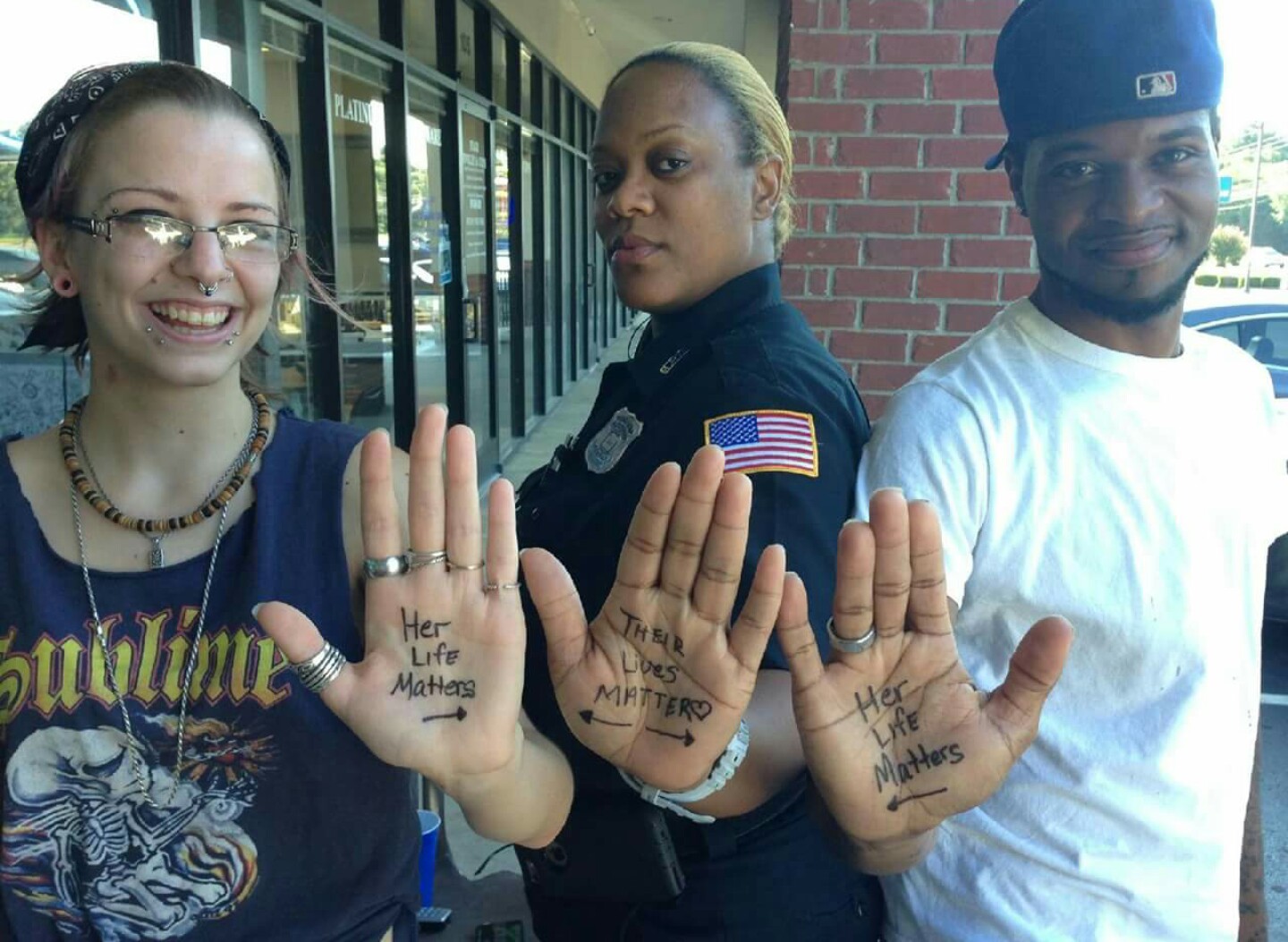
And when someone says “All lives matter,” instead of assuming they’re just trying really hard to ignore the problems people of color face, either give them the benefit of the doubt (they mean “I care about all the lives involved in this issue” and/or “I’ve misunderstood what you mean by ‘black lives matter’”), or at least ask them what they mean.

his her their lives matter

Please stop telling people what they mean when they use a phrase you don’t like. Stop telling them what they think and why they think it. On this topic and most others, assigning meaning usually means you’re getting it wrong and almost always means you’re probably not going to have a useful conversation.

Remember that the people we’re talking to—especially if we’re talking online with strangers or very casual FB friends—likely run in different social circles than us and are exposed to different ideas, news, blogs, talking points, etc. In particular they’re probably exposed more to the extreme voices from our side and less to the rational voices. I think that’s a pretty common phenomenon.

Sometimes it is really hard for me to stop and realize that the premises I find blindingly obvious are ideas the person I’m talking to may not have even heard before. It’s very easy to assume she’s starting from the same baseline assumptions I am and is just being difficult or mean. And hey, sometimes that is what’s happening.

But often–probably most of the time–it’s not. And man I’d love it if we could have more useful conversations about some very serious problems and less yelling at each other about what the other side thinks, feels, and wants. That would be a good start.

Is There a Connection Between Parent-Child Earnings?

Image result for parent childOver at the St. Louis Federal Reserve, economist George Levi-Gayle describes the research on this potentially important topic:

In a recent paper, my co-authors, Limor Golan and Mehmet Soytas, and I wrote that the structure of the family and the division of labor within the household were the main sources of the correlation of earnings across generations…Besides income, other factors need to be considered: how parents accumulate human capital in the labor market, the availability and returns to part-time jobs versus full-time jobs and the return to parental time invested in children.

In another study, we looked at the difference between blacks and whites in the intergenerational transmission of human capital. We focused on the roles of time and income spent in the early childhood years to see how they impacted educational outcomes, if at all. We found that the time that parents spend talking to and otherwise interacting with their children is the major reason for the disparity in educational outcomes between black and white children. For example, for black and white parents who spent the same amount of time interacting with their children, there is no black-white attainment gap.

Check out his research here.

The Anti-Growth Mentality Behind Zoning Laws

I’ve mentioned the economic impact of zoning laws here before. A recent article in The New York Times continues to highlight how detrimental these laws can be:

These days, you can find…people who moved somewhere before it exploded and now worry that growth is killing the place they love. But a growing body of economic literature suggests that anti-growth sentiment, when multiplied across countless unheralded local development battles, is a major factor in creating a stagnant and less equal American economy. It has even to some extent changed how Americans of different incomes view opportunity. Unlike past decades, when people of different socioeconomic backgrounds tended to move to similar areas, today, less-skilled workers often go where jobs are scarcer but housing is cheap, instead of heading to places with the most promising job opportunities, according to research by Daniel Shoag, a professor of public policy at Harvard, and Peter Ganong, also of Harvard.

With the recent shootings in Baton Rouge, Minnesota, and Dallas, arguments over police brutality and black crime have started once again. Though it might sound odd, in many cases zoning laws provide background for the tensions between law enforcement and black communities.[ref]For example, one can see the impact on the black community in St. Louis from the maps here. Journalist Radley Balko provides context in an incredible article for The Washington Post here.[/ref] As the article explains,

Zoning restrictions have been around for decades but really took off during the 1960s, when the combination of inner-city race riots and “white flight” from cities led to heavily zoned suburbs.

They have gotten more restrictive over time, contributing to a jump in home prices that has been a bonanza for anyone who bought early in places like Boulder, San Francisco and New York City. But for latecomers, the cost of renting an apartment or buying a home has become prohibitive.

In short, it’s just another form of tribalism making its way into local laws:

[W]hen zoning laws get out of hand, economists say, the damage to the American economy and society can be profound. Studies have shown that laws aimed at things like “maintaining neighborhood character” or limiting how many unrelated people can live together in the same house contribute to racial segregation and deeper class disparities. They also exacerbate inequality by restricting the housing supply in places where demand is greatest.

The lost opportunities for development may theoretically reduce the output of the United States economy by as much as $1.5 trillion a year, according to estimates in a recent paper by the economists Chang-Tai Hsieh and Enrico Moretti. Regardless of the actual gains in dollars that could be achieved if zoning laws were significantly cut back, the research on land-use restrictions highlights some of the consequences of giving local communities too much control over who is allowed to live there.

“You don’t want rules made entirely for people that have something, at the expense of people who don’t,” said Jason Furman, chairman of the White House Council of Economic Advisers.

How (Not) To Be Secular: A Lecture by James K.A. Smith

Years back, Catholic philosopher Charles Taylor published his 800+-page tome A Secular Age. I actually checked it out from the library once, got about 15 pages into it, and didn’t pick it up again until I had to return it. I realized that it was something I’d have to spend a lot of time not only reading, but chewing on. Given that I was still a newly-married undergrad, I decided to revisit it at another time.

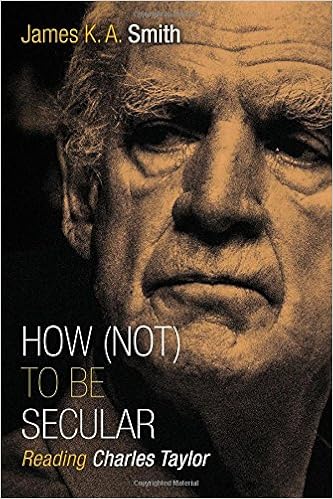
I still haven’t tackled Taylor’s book, but I did recently complete James K.A. Smith’s How (Not) To Be Secular: Reading Charles Taylor. Smith’s book acts as a summarized walkthrough of Taylor’s, illuminating and at times taking issue with the some of ideas presented. By reading Smith’s book first, I feel prepared to take on the entirety of Taylor. In short, Smith and Taylor argue that the Western world has become a disenchanted one in which belief in God is just one option of belief among many:

A society is secular insofar as religious belief or belief in God is understood to be one option among others, and thus contestable (and contested). At issue here is a shift in “the conditions of belief.” As Taylor notes, the shift to secularity “in this sense” indicates “a move from a society where belief in God is unchallenged and indeed, unproblematic, to one in which it is understood to be one option among others, and frequently not the easiest to embrace”…It is in this sense that we live in a “secular age” even if religious participation might be visible and fervent.[ref]Smith, How (Not) to Be Secular, pg. 20.[/ref]

Shifts towards secularization led us to see ourselves as free agents closed off to external meaning, influences, and forces. Social ties and hierarchies were no longer seen as being grounded in higher, sacred orders. Reality was no longer a cosmos full meaning and purpose, but merely a universe full of chaos and chance. The secularity of the modern age is inescapable even for the most ardent believer. But this isn’t a subtraction story (i.e., the loss of superstition) as much as it is a change in sensibilities; a change in the water we swim in so to speak.

I’m certainly not doing the book justice in my brief summary, so I’ll just say this: anyone interested in making sense of our secular age, but hesitant to read 800 pages on the subject, should check out Smith’s book. You can see him lecturing at BYU’s Wheatley Institution below.