Walker joined Difficult Run as an editor in August 2013.
He graduated from the University of North Texas with an MBA in Strategic Management and a BBA in Organizational Behavior and Human Resource Management. He's currently a grad student in Government at Johns Hopkins University. He has been published in SquareTwo, BYU Studies Quarterly, Dialogue, Graziadio Business Review, and Economic Affairs. He also contributed to Julie Smith's (ed.) 'As Iron Sharpens Iron: Listening to the Various Voices of Scripture'. His other online writing can be found at Worlds Without End and Times & Seasons. He lives in Denton, Texas, with his wife.
Economist Bryan Caplan–himself not a utilitarian–argues that a utilitarian case can be made against abortion. His four main arguments are:
“Almost everyone is glad to be alive. The unwanted infant may have a below-average quality of life, but below-average is usually excellent nonetheless.”
“There is a long waiting list – hence excess demand – to adopt healthy infants, so birth mothers need not raise their unwanted children.”
“Due to the endowment effect, unwanted children often become wanted by their birth mother once they’re born – as many would-be adoptive parents discover to their sorrow.”
“Women who just miss the legal cutoff for abortion seem to quickly recover emotionally. Pregnant women who think “A baby will ruin my life” are, on average, factually mistaken.”
Utilitarianism isn’t my favorite approach to ethics, but it can yield some fruitful insights.
Earlier this year, a new study was published in The Review of Financial Studies that “highlights the importance of middle-class and high-FICO borrowers for the mortgage crisis.” In an excellent summary by The Washington Post‘s Robert Samuelson,[ref]This is of the 2015 working paper version.[/ref] he summarizes the three main findings:
First, mortgage lending wasn’t aimed mainly at the poor. Earlier research studied lending by Zip codes and found sharp growth in poorer neighborhoods. Borrowers were assumed to reflect the average characteristics of residents in these neighborhoods. But the new study examined the actual borrowers and found this wasn’t true. They were much richer than average residents. In 2002, home buyers in these poor neighborhoods had average incomes of $63,000, double the neighborhoods’ average of $31,000.
Second, borrowers were not saddled with progressively larger mortgage debt burdens. One way of measuring this is the debt-to-income ratio: Someone with a $100,000 mortgage and $50,000 of income has a debt-to-income ratio of 2. In 2002, the mortgage-debt-to-income ratio of the poorest borrowers was 2; in 2006, it was still 2. Ratios for wealthier borrowers also remained stable during the housing boom. The essence of the boom was not that typical debt burdens shot through the roof; it was that more and more people were borrowing.
Third, the bulk of mortgage lending and losses — measured by dollar volume — occurred among middle-class and high-income borrowers. In 2006, the wealthiest 40 percent of borrowers represented 55 percent of new loans and nearly 60 percent of delinquencies (defined as payments at least 90 days overdue) in the next three years.
Remember this the next time you hear someone blaming the financial crisis on the “irresponsible poor.”
I’m currently reading through the Oxford-published volume The Bible and the Pursuit of Happiness and the second chapter “Is There Happiness in the Torah?” discusses how family life is a major aspect of “the good life” in the pre-Israel, patriarchal narratives of Genesis. This reading combined with a browsing of older saved, but never published blog posts brought out these findings on happiness and marriage from a 2015 New York Times article:
Social scientists have long known that married people tend to be happier, but they debate whether that is because marriage causes happiness or simply because happier people are more likely to get married. The new paper, published by the National Bureau of Economic Research, controlled for pre-marriage happiness levels.
It concluded that being married makes people happier and more satisfied with their lives than those who remain single – particularly during the most stressful periods, like midlife crises.
Even as fewer people are marrying, the disadvantages of remaining single have broad implications. It’s important because marriage is increasingly a force behind inequality. Stable marriages are more common among educated, high-income people, and increasingly out of reach for those who are not. That divide appears to affect not just people’s income and family stability, but also their happiness and stress levels.
…Those whose lives are most difficult could benefit most from marriage, according to the economists who wrote the new paper, John Helliwell of the Vancouver School of Economics and Shawn Grover of the Canadian Department of Finance. “Marriage may be most important when there is that stress in life and when things are going wrong,” Mr. Grover said.
For the most part, this is true worldwide (the exceptions are Latin America, South Asia and sub-Saharan Africa). “Though some social scientists have argued that happiness levels are innate,” the article continues,
so people return to their natural level of well-being after joyful or upsetting events, the researchers found that the benefits of marriage persist.
One reason for that might be the role of friendship within marriage. Those who consider their spouse or partner to be their best friend get about twice as much life satisfaction from marriage as others, the study found.
…The benefits of marital friendship are most vivid during middle age, when people tend to experience a dip in life satisfaction, largely because career and family demands apply the most stress then. Those who are married, the new paper found, have much shallower dips – even in regions where marriage does not have an overall positive effect.
Seems like the patriarchal narratives might be on to something.
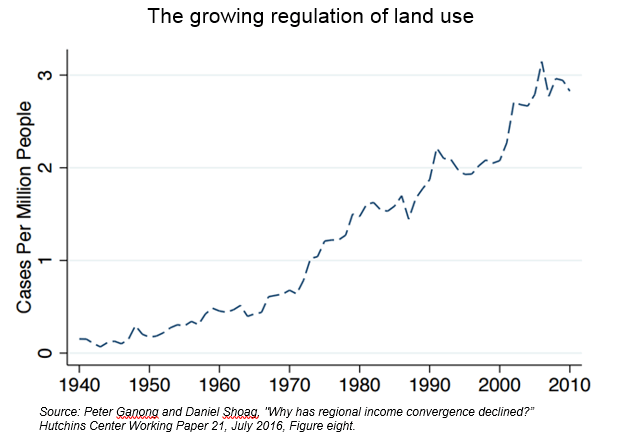
According to Richard Reeves and Dimitrios Halikias at the Brookings Institution, “the movement of less-skilled workers to higher-growth areas has not risen in recent years, a break with the historical pattern[.]” It seems that regulation is the culprit. “The number of court cases mentioning “land use” (an innovative measure of regulation used in a Hutchins Center working paper by Peter Ganong and Daniel Shoag) has risen steadily:”
“The Hutchins paper,” the authors continue, “complements earlier economic analyses, including a study published last year by Chang-Tai Hsieh and Enrico Moretti which estimates that the U.S. economy is 14 percent smaller as a result of constraints on housing development…By using local government powers to zone out lower-income families, upper middle class Americans protect the value of their homes. (Federal policy helps, of course, by regressively supporting richer home owners through mortgage interest deductions.)” Zoning acts as a kind of “opportunity hoarding,” even when it comes to elementary education:
According to Jonathan Rothwell, there is a strong link between zoning and educational disparities. Homes near good elementary schools are more expensive: about two and half times as much as those near the poorer-performing schools. But in metropolitan areas with more restrictive zoning, this gap is even wider. Loosening zoning regulations would reduce the housing cost gap and therefore narrow the school test-score gap by 4 to 7 percentiles, Rothwell finds.
Some of the most effective things are also some of the most mundane.
Among 17 Republican appointees who responded to Journal inquiries, none said they supported Mr. Trump. Six said they did not support Mr. Trump and 11 declined to say either way. An additional six did not respond to repeated messages. Among the 21 Democrats who responded to the Journal, 14 said they supported Mrs. Clinton, none said they opposed her and seven declined to say either way. One Democratic appointee didn’t respond to messages.
Check out the full article to see what the economists are saying.
a growing body of evidence suggests the economic expansion since the 2007-2009 financial crisis has enriched a much larger swath of the upper middle class, and that a deeper income divide is developing between that top quarter or so of the population and everyone else.
The latest piece of evidence comes from economist Stephen Rose of the Urban Institute, who finds in new research that the upper middle class in the U.S. is larger and richer than it’s ever been. He finds the upper middle class has expanded from about 12% of the population in 1979 to a new record of nearly 30% as of 2014.
Rose defines the upper middle class “as any household earning $100,000 to $350,000 for a family of three…Smaller households can earn somewhat less to be classified as upper middle-class; larger households need to earn somewhat more.” These findings fit comfortably with a number of other studies:
Research from Sean Reardon of Stanford University and Kendra Bischoff of Cornell University, for example, found in research published in March that the number of families living in affluent neighborhoods has more than doubled, to 16% of the population in 2012 from 7% in 1980. They define these neighborhoods as those where the median income is at least 50% higher than the rest of the city.
The Pew Research Center last month found that 203 metropolitan areas have seen their middle class shrink, but in 172 of those cities, the shrinkage was in part due to the growth in wealthier families. (In 160 of the cities, the share of lower-income families grew as well.) So Pew found the middle class shrinking from both ends – not just from families falling below the middle class, but also because of families rising out.
While this news can be inspiring, there are nonetheless
way[s] upper-middle class families perpetuate their status across generations…that can sometimes be harmful to middle- or lower middle-class families…Take high housing costs or the soaring costs of higher education. The spread of $3,000-a-month apartments or a national average $32,000-a-year college tuition bill is not driven by heirs or CEOs renting dozens of apartments or sending dozens of children to college. It’s driven by millions of upper middle class families with enough income to foot those bills[.]
As of now, both major presidential candidates oppose the Trans-Pacific Partnership trade deal. Trump’s position isn’t all that surprising, while Clinton’s is a complete flip-flop.[ref]It’s odd to find that Democrats are moresupportive of free trade than their supposedly capitalism-loving Republican opponents.[/ref] With trade openness being challenged in both American politics and abroad, it’s important to review what scholarship says about free trade. For example, a new IMF report demonstrates the benefits of trade liberalization. After speaking favorably of TPP, the authors explain,
Past multilateral trade liberalization rounds have helped boost productivity, so these recent agreements—albeit not global—could do the same, given their broad geographic coverage, both as a percentage of total world GDP and total world trade. Policymakers, however, need to be mindful of the distributional effects of open trade and take steps to mitigate the impact on those displaced to realize the full potential of lower trade barriers on productivity and economic well-being.
As shown below in Chart 1, even in advanced economies, which have already liberalized tariffs in the past, further reductions in nontariff/regulatory barriers to trade and FDI offer scope for additional productivity gains.
The authors then cite the “wide consensus that liberalization of trade and FDI [foreign direct investment] can lead to improved resource allocation across firms and sectors, boosting productivity and output. For instance, existing evidence suggests that more-productive firms tend to gain market share at the expense of less-productive firms. But two specific effects of liberalization additionally enhance productivity:
Increased competition: Lower trade and FDI barriers on final goods can strengthen competition in the liberalized sector(s). This can help firms exploit economies of scale, improve efficiency, absorb foreign technology, and innovate.
Enhanced variety and quality of available inputs: Trade liberalization can also boost productivity by increasing the quality and variety of intermediate inputs used in final goods production.”
There are substantial gains in productivity to be had with the lowering of tariff barriers:[ref]This doesn’t even tell the whole story: “The analysis of productivity gains that would follow from tariff liberalization is only an illustration of how trade liberalization more broadly could bring about even larger gains in productivity. Indeed, our estimated productivity gains from tariff liberalization should be viewed as lower bounds because they do not account for the gains that would arise from reallocation of resources across industries, that is, from more efficiently capitalizing on each country’s comparative advantage or, most importantly, from a reduction of non-tariff barriers” (italics mine).[/ref]
In summary,
Our findings provide a case for further liberalization to raise productivity and output in advanced economies. That the estimates vastly understate potential gains by overlooking the much larger economic benefits of easing non-tariff barriers makes the case all the stronger.
While compensation programs may be in order for those who suffer job loss or wage reduction due to increased trade (something the authors acknowledge and suggest), this should not distract us from the massive gains that trade liberalization brings. Those seeking to be the “Leader of the Free World” take note.
The fear and accusations of voter fraud have almost become a staple of U.S. presidential elections. Granted, other countries require some form of identification to vote, which seems to genuinely be about fraud prevention versus some kind of bigotry as is often claimed here in America. Nonetheless, just as the stories about racist voter ID proponents are likely exaggerated, so are the concerns over voter fraud. As Reason‘s Ronald Bailey explains,
Voter impersonation fraud appears to be almost non-existent. In the wake of 2000’s ballot-counting fiasco, the Help America Vote Act of 2002 created the U.S. Election Assistance Commission to improve voting systems and voter access. In 2007, the commission issued its Election Crimes report, which reviewed what data there was and analyzed numerous anecdotes about voter fraud. The report noted that many experts “asserted that impersonation of voters is probably the least frequent type of fraud because it is the most likely type of fraud to be discovered, there are stiff penalties associated with this type of fraud, and it is an inefficient method of influencing an election.” The penalties include $10,000 in fines and up to five years in prison.
The New York Times reported in 2007 that a five-year Department of Justice crackdown on voter fraud had yielded just 86 convictions. In 2014, Justin Levitt, a professor at Loyola Law School, Los Angeles, reported finding just 31 cases of voter impersonation fraud out of 1 billion ballots cast between 2000 and 2014. Politifact calculated in 2015 that you are 13 times more likely to be struck by lightning than to stumble across an instance of in-person voter fraud in Texas.
Yet, could voter ID laws potentially be used to–ironically–rig elections? The evidence is mixed, but interesting. Some studies found an increase in voter turnout following strict voter ID laws among particular groups, while others found a decrease in voter turnout. Overall, the effects of voter ID laws seem to be insignificant according to most studies. However, the most recent research has
challenged the weak consensus that strict voter ID requirements do not appear to have significant disenfranchising effects. Trying to account for all sorts of demographic, partisan, ideological, and ethnic variables, the researchers examined what happened to voting patterns before and after states adopted strict voter ID requirements. Their analysis focused on individual voter turnout data from 2006 to 2014 derived from the Cooperative Congressional Election Study.
…When they take partisan and ideological differences into account, they estimate that Democratic turnout drops by 8.8 percentage points in general elections and even Republican turnout drops by 3.6 points. Interestingly, strict photo ID requirements result in a drop in turnout for strong liberals of 7.9 percentage points, but among strong conservatives turnout increases by 4.8 percentage points. “Strict voter ID laws appear to diminish the participation of Democrats and those on the left, while doing little to deter the vote of Republicans and those on the right,” they observe.
In short, voting fraud isn’t really a problem, but voter ID laws could potentially be (though the consensus still holds that the effects are nilch). Perhaps we should all calm down.
Stephen Walt, the Robert and Renée Belfer professor of international relations at Harvard University, has an older, but still incredibly relevant article in Foreign Policy on the social science of military interventions. “Before France, Britain, and the United States stumbled into its current attempt to dislodge Muammar al-Qaddafi from power in Libya,” asks Walt,
…did anyone bother to ask what recent social science tells us about the likely results of our intervention?
I doubt it, because recent research suggests that we are likely to be disappointed by the outcome. A 2006 study by Jeffrey Pickering and Mark Peceny found that military intervention by liberal states (i.e., states like Britain, France and the United States) “has only very rarely played a role in democratization since 1945.” Similarly, George Downs, and Bruce Bueno de Mesquita of New York University found that U.S. interventions since World War II led to stable democracies within ten years less than 3 percent of the time, and a separate study by their NYU colleague William Easterly and several associates found that both U.S and Soviet interventions during the Cold War generally led to “significant declines in democracy.” Finally, a 2010 article by Goran Piec and Daniel Reiter examines forty-two “foreign imposed regime changes” since 1920 and finds that when interventions “damage state infrastructural power” they also increase the risk of subsequent civil war.
Drawing on then unpublished work by political scientist Alexander Downes, Walt explains “that foreign intervention tends to promote stability when the intervening powers are seeking to restore a previously deposedruler. But when foreign interveners oust an existing ruler and impose a wholly new government (which is what we are trying to do in Libya), the likelihood of civil war more than triples.” The regime change “disrupts state power and foments grievances and resentments” and increases the probability of civil war. Another paper by Downes found that “states that have their governments removed by a democracy gain no significant democratic benefit compared to similar states that do not experience intervention.”
With Clinton owningLibya–as even leftistoutlets have acknowledged–this information becomes all the more timely and important.[ref]Here at Difficult Run, we’ve taken swipes at Trump, Sanders, and even Cruz (one time prematurely and unfairly). But surprisingly little has been said about Clinton. Maybe this is due to her list of scandals and controversies being well-known for so long.[/ref] Something both conservatives and liberals should take into account.
Economist Herbert Gintis has an excellent piece over at Evonomics on the current state of economics, including developments in behavioral and evolutionary economics and their relationship to traditional economic theory. Gintis has done some fineinterdisciplinarywork and I’m greatly anticipating his forthcoming book Individuality and Entanglement: The Moral and Material Bases of Social Life. For Gintis, “The most creative behavioral and evolutionary economists remain inspired by the successes of, and consider their work as extensions of traditional economic theory. The most creative supporters of traditional economic theory, in turn, embrace behavioral and evolutionary perspectives and build on its insights.” Gintis walks the reader through a helpful analysis of general equilibrium, comparative statics, economic dynamics, and economic policy. He notes, “Traditional microeconomic economic theory is at its best in analyzing general equilibrium and comparative statics. Behavioral and evolutionary economics have as yet neither altered nor added to our understanding of general equilibrium and comparative statics.” It is in the case of dynamics “that traditional economic theory has the least to offer. Microeconomic theory has virtually nothing to say about market dynamics when there is more than a single good.” He claims that macroeconomics was a framework “economists invented wholecloth…for dealing with economic dynamics that has nothing to do with the microeconomic model of general equilibrium.” While macroeconomics is “widely taught in economics departments and policy makers pay attention to it faute de mieux…it is frankly virtually worthless, except in the very short run, where the near future can be reliably forecast from the recent past.” Gintis recognizes that “the economy is a complex dynamical system and nobody, not even the experts who spend all their time studying the economy, can predict even the direction of the long-term effects of most regulatory changes on the position of individual economic actors.” It is here that he bridges evolutionary economics with traditional, providing much-needed feedback to both the right and left of the political divide:
Evolutionary models of economic dynamics invariably assume adaptive expectations rather than rational expectations. Adaptive expectations assume individuals tend to copy the most successful behavior of others whom they observe in the market, with innovation taking place through random variation.
In the popular press, free market lovers blame financial crises on government intervention, and intervention lovers blame financial crises on insufficient regulation. Neither view is correct. The recent financial crisis was due to improper regulation of the financial sector. The notion that the financial sector of a market economy is robust in the absence of extensive regulation is simply an article of faith unsupported by theory or experience. Evolutionary economists are working on a theory of the financial sector that fits synergistically with our models of generalized market exchange and technological change, but no general model has yet been developed.
He continues by dissecting both market and state failures, which should be an eye-opening discussion for both free-marketers and those favoring more state intervention. In conclusion, he writes,
It is a serious error to reject standard economic theory on the grounds that it supports a free-market ideology. It does nothing of the kind. Correctly deployed, it carefully explains where, how, and when to intervene in the regulation of market exchange. Evolutionary and behavioral game theory are wonderful additions to the economist’s repertoire, but they complement rather than undermine traditional public sector economic theory. The most serious defect in traditional economic theory is its treatment of economic dynamics, and it is here that behavioral and evolutionary theory has the most to contribute.
Some criticize standard economic theory for failing to take into account that reliance on markets promotes selfishness and greed. The evidence from behavioral economics is quite the contrary. Even hunter-gatherers and members of other small-scale societies act more fairly if their society has significant contact with the larger market economy. And we must never forget that virtually every powerful pro-democratic, anti-racist and anti-sexist movement for social change in the world has taken place in market economies with democratic political institutions. Milton Friedman noticed this in his famous Capitalism and Freedom, and it remains valid even more a half-century later.
Check out the full article. It’s one I’ll be continually revisiting.

 Economist Bryan Caplan–himself not a utilitarian–argues that a utilitarian case can be made against abortion. His four main arguments are: